Tag: Maine

  • Autumn Leaves

    It always happens this way. The leaves start to turn, and suddenly accelerate into a burst of color. Meanwhile, you’re busy with life, knowing the wave is washing over you but not getting out there enough to see it. The rains come, often with wind gusts, and it ends before you really noticed.

    The alternative is to notice. To walk away from the computer screen and see the foliage, feel the crisp air, smell the freshly fallen leaves mingle with the harvest. To experience the world on more than just the weekends. It seems to me a better way, noticing, and we ought to do more of it.

    Still, I have this stack of responsibilities that keep me at bay. Three big projects due for work, and home projects to finish, and other such to-do commitments. Those seem like compelling reasons to skip a walk amongst the trees today, don’t they? No?

    We remain reckless with our time, we humans, and it flies by regardless of our attention to the urgency of the matter. The autumn leaves come and go whether you linger amongst them or not. But the journey is more pleasant when you linger awhile.

    The image that stays with me most after a weekend in Acadia is not the rocky shore or the stunning sunrise on Cadillac or the lighthouse, but a single brilliant red tree along the Carriage Road. I imagine that the leaves have fallen off that tree in the stormy few days since I was there, but in my mind they remain, fluttering like Cardinals at a social event. And there’s the fleeting magic of fall foliage. The Autumn leaves are here today, gone tomorrow. Go have a look then.

  • For One September

    This is a good year to think about how we use our time. Working is necessary, but so is recreation. And family time. And all the rest of the segmented buckets of time. Use it well or lose it forever. I don’t suppose its a good time for international travel. Or going to concerts. Or standing in line at crowded amusement parks. But there are plenty of good uses of time that don’t involve those things, aren’t there? I think time with those you love is the best time investment you can make. I don’t believe that makes me an outlier.

    “We are actually awash with time and profligate in its abuse.” – Richard Koch, The 80/20 Principle

    Looking up from the frenzy of life and it’s the end of September. Granted, a lot has happened in September. And candidly I’ve personally had better Septembers. But this is the September I was given, and so I’m pressing on with finishing the month as best I can and, if Fortune favors me, moving on to October. If we’re all lucky we’ll make it to October and maybe even 2021 with some measure of hope for the future. But one day at a time. We’ve still got today to contend with.

    I think about the Koch quote: awash with time and profligate in its abuse. And tend to reflect on the abuses more than glow in the best uses. But isn’t that human nature? For all the wasted hours of opportunity, there have been moments of wonder sprinkled in too. And isn’t that the point? Life comes at us one way or the other, make your lemonade out of the lemons and your margaritas out of the limes. But rise to the occasion this day offers. Regrets are living in the past. Make use of now, before you squander this day too.

    “If you enjoyed it, time was well-spent.” – Orange Book Tweet

    When I look back on this month ten years from now, assuming I’ll still be dancing to the music in a decade, I’ll think of September for the loss of one remarkable man, hiking with friends and family, the home nest becoming full again as the fourth bird flew home, and for some remarkable moments in Acadia National Park. The rest – good and bad alike – blurs for me even now, even while we’re still in the month. But maybe that’s enough for one September.

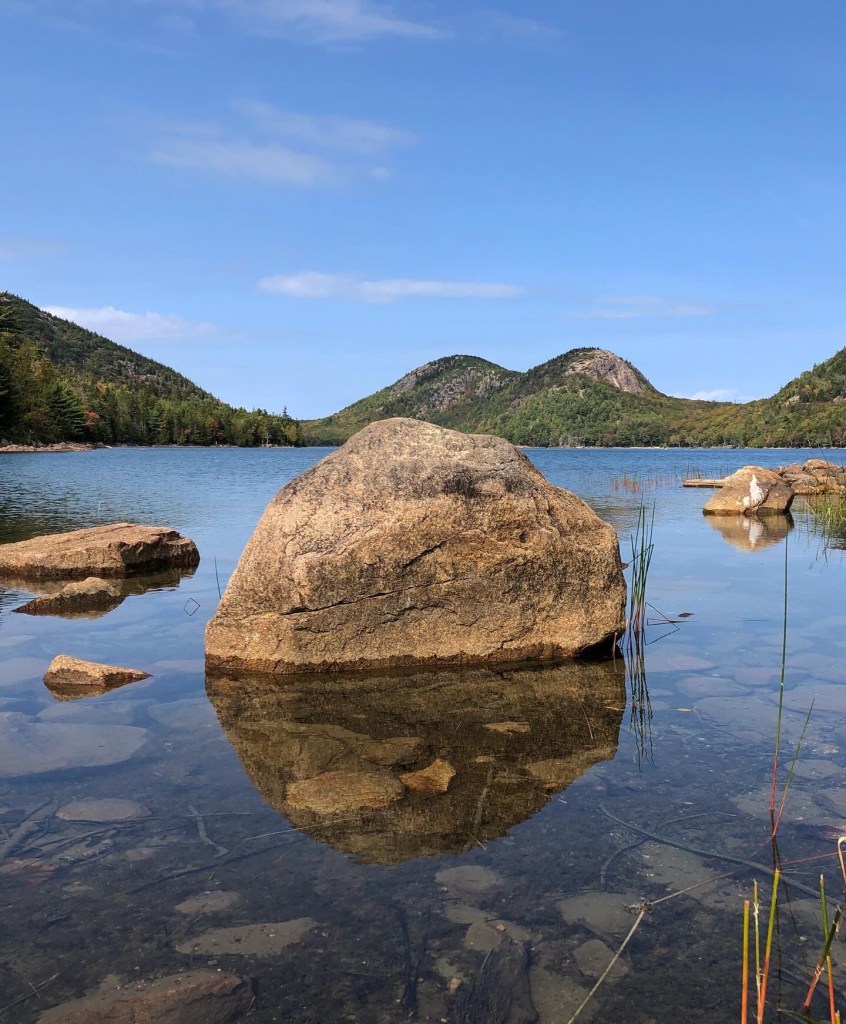
    Jordan Pond
  • Mount Desert Island

    “Le sommet de la plus part d’icelles est desgarny d’arbres parceque ce ne sont que roches. Je l’ay nommee l’isle des Monts-deserts.” – Samuel de Champlain
    (Translated into English: “The top of most of them is bare with trees because they are only rocks. I named it the island of Monts-deserts.”)

    French Explorer Samuel de Champlain sailed up the Gulf of Maine in 1604 and observed the granite mountain summits on the island before him. He named it “Ile de Monts Deserts,” or “island of the bare mountains”. Through all the turf wars between the French and the English the place names haven’t always been consistent, but this one has. The map below was from the British atlas The Atlantic Neptune in 1800 that shows the name clearly, along with other place names commonly accepted. And thus the island became known by a name we’ve called it forever since; Mount Desert Island. The pronunciation of “desert” itself leans towards the French… as it should.

    While exploring this island topped with pink granite peaks, Champlain hit a ledge off of Otter Cliff and had to take the time necessary to repair the hull. With the aid of a couple of Abenaki guides he explored some of the island, most likely around the Otter Creek area, but I wonder how far he explored while he was there. He and his guides would surely recognize large parts of the island today, but would be stunned by the crowds. A large part of the island and surrounding islands and land became part of Acadia National Park (from 1919 to 1929 it was known as Lafayette National Park, but changed to reflect the original French colony) and forever preserved for generations to see what Champlain saw in 1604. It would be the only time he set foot on Mount Desert Island, but his mark on history remains to this day.

  • Hiking The Beehive

    As hikes go, The Beehive is everything you’d want and wouldn’t want rolled into a quick hike. Looking for diverse terrain, stunning views and challenging but non-technical climbing? Beehive. Long lines cued up waiting for people to overcome personal fears of heights? Also Beehive. You either embrace them both and treat it like a Disney ride or you go elsewhere. But it’s a hike worth doing either way.

    Expecting large crowds is part of every Acadia National Park experience. As with Cadillac Mountain, Thunder Hole, Bass Harbor Head Light and Jordan Pond you know what to expect. And sure enough, there they are. But the place is worth the trade-off in breathing space, and there’s always a little corner of the park you can call your own, if only for a few minutes. On Beehive we paused on the pink granite summit for a snack and water in relative solitude. Like a picnic in Central Park on a warm Saturday solitude.

    As for logistics, one thing I never thought I’d say on a hike: bring hand sanitizer to use after summiting Beehive. Those iron rails get used all day and we are in a pandemic. Parking is tight at the trailhead, so get there early. And since you’re sharing the same parking lot with Sand Beach you might as well get out on the beach while you’re there. Beehive, even with the waiting in line, is a short hike. If you want to extend your hiking experience after summiting take the Gorham Mountain Trail, or do as we did and hike the Good Head Trail. Both are less crowded than Beehive, but you’ll still have company. Sand Beach is worth the stop, whether you swim or not is up to you but that ultra-soft sand is worth experiencing.

    Beehive stays with you well after you finish. The iron rungs, the scrambles up granite, the stunning views of foliage, Sand Beach and salt water all through a kaleidoscope of swirling fog. And yes, the shared experience of hiking with hundreds of people, like the millions before you, all winding your way on this Pilgrimage with the ancient mountain.

    Wait your turn
    Just do it
    Dad and daughter mid-climb
  • Community Sunrise

    Most of my sunrises are solo affairs. Occasionally I’ll recruit others to join in, but even then it’s generally a small crowd. So sitting atop Cadillac Mountain in Acadia National Park with hundreds of people is highly unusual for me. But that’s where I found myself.

    The alarm went off at 3 AM, we wrapped ourselves up for the expected wind chill and drove to the summit. That’s right: we drove. Getting up early was earning it on this day. And initially we didn’t have a lot of company save the stars that opened up above us. But gradually the beams of flashlight increased, like the scene in E.T. without the John Williams soundtrack. Instead the chatter of groups and the barks of a few dogs increased from initially jolting to eventually accumulated background noise. And I settled in for the crush of people to follow. And they came.

    The skies brightened until only Venus held out, and the bay below turned from a black canvas to a swirling medley of fog. This sunrise would begin in the swirl, and eventually rise above. In the meantime they still came, hundreds more, but our small corner of pink granite next to a boulder remained relatively sequestered.

    A collective gasp rose through the crowd as the sun broke the surface, seeming to hang there for effect before beginning the slow rise. That swirling mist was highlight in the glow, and the show just kept getting better and better. And when it was over hundreds got in their cars and the slow crawl of cars glowing in brake lights inched down towards more elbow room.

    If you get up for a sunrise on Cadillac Mountain remember to bundle up, bring something to sit on (sleeping pad, pillow, folded blanket) and bring a red light headlamp as a courtesy to those watching the stars. When you walk up from the parking lot you have plenty of options for sitting down. I recommend descending further down for the better views it affords and for a bit more room to breath. But its crowded for a reason: the view is spectacular.

  • Sailing the Gulf of Maine

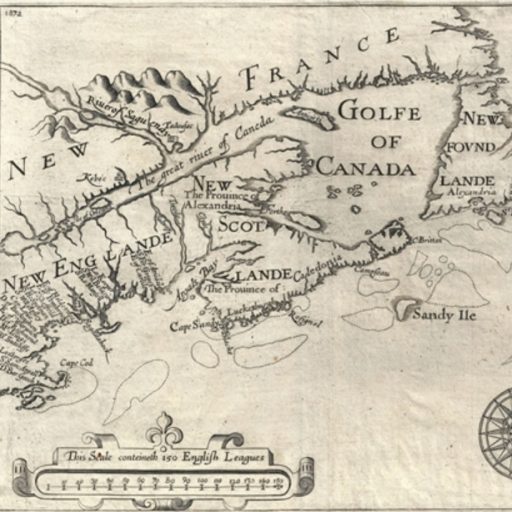
    The Gulf of Maine is a corner of the Atlantic Ocean embraced by Cape Cod to the South and Nova Scotia to the Northeast.  The longest stretch of land in between is part of Maine, which gives the gulf her name.  If you look at Alexander’s map, which this blog is named for, the body of water is just below the land described as “New Englande” and “New Scot Lande”.  A land mass that I’ve grown to love, that I declared I’d explore more, and that I need to return to in earnest once this pandemic is behind us.

    cropped-54b94-alexander2527s2bmap.jpg

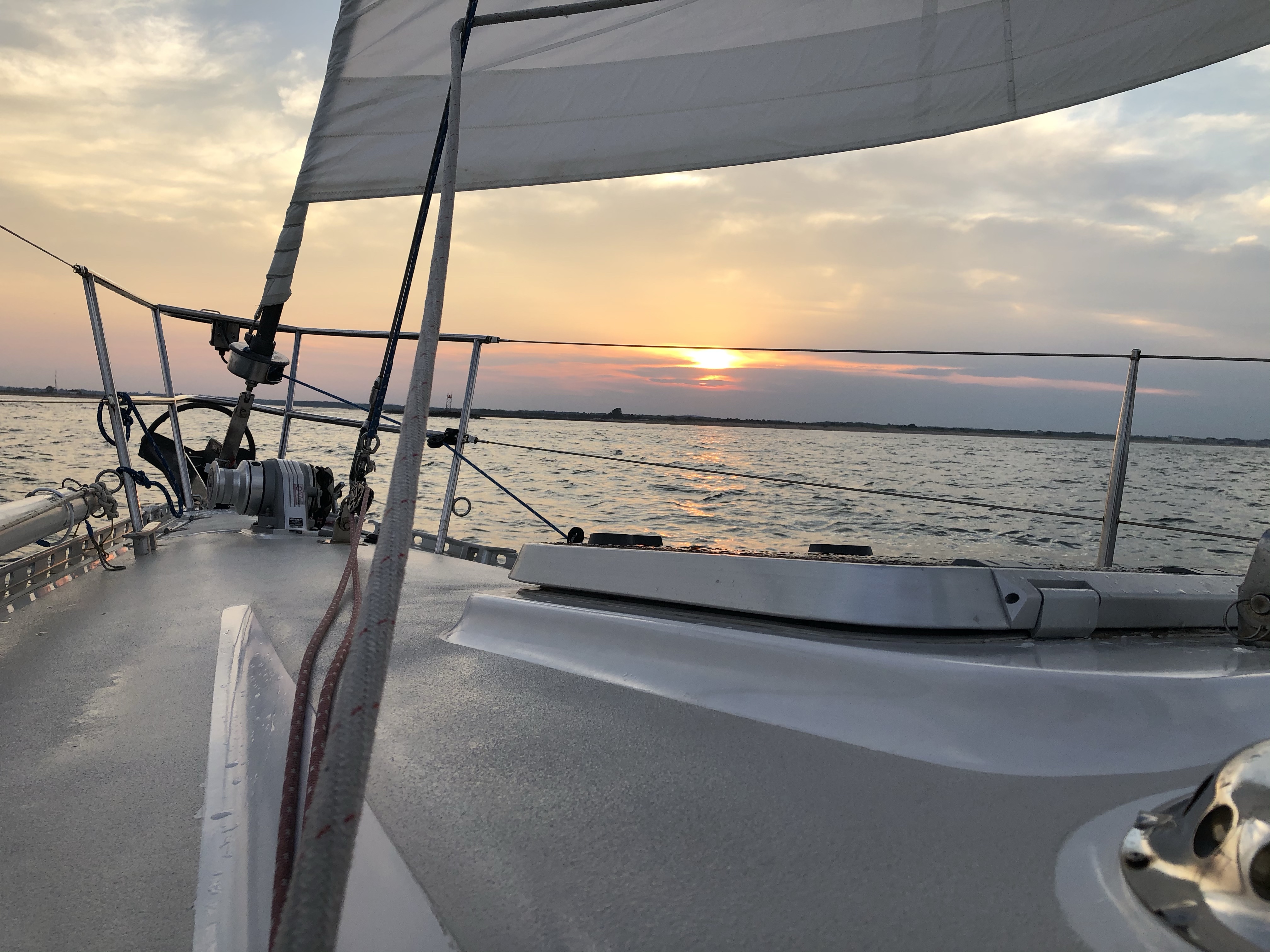
    Yesterday we had the opportunity to sail on Fayaway with friends.  It was an out-and-back sail with one tack.  We left the Merrimack River where they moor Fayaway when they aren’t exploring the world and sailed generally on a compass heading of 90 degrees, which took us roughly along the coast of Maine just out of sight of land.  Sail for 18 miles out one way, tack and return 18 miles the other way.  Not a lot of tactical sailing required, which was perfect for a day of conversation and contemplation on the water.  We had a secondary objective of seeing whales and maybe that evasive Comet Neowise, but each proved elusive on this trip.  A sunfish made an appearance, which was akin to an understudy playing the role when you came to see the star: Wasn’t what you came for, but turned out to be entertaining just the same.

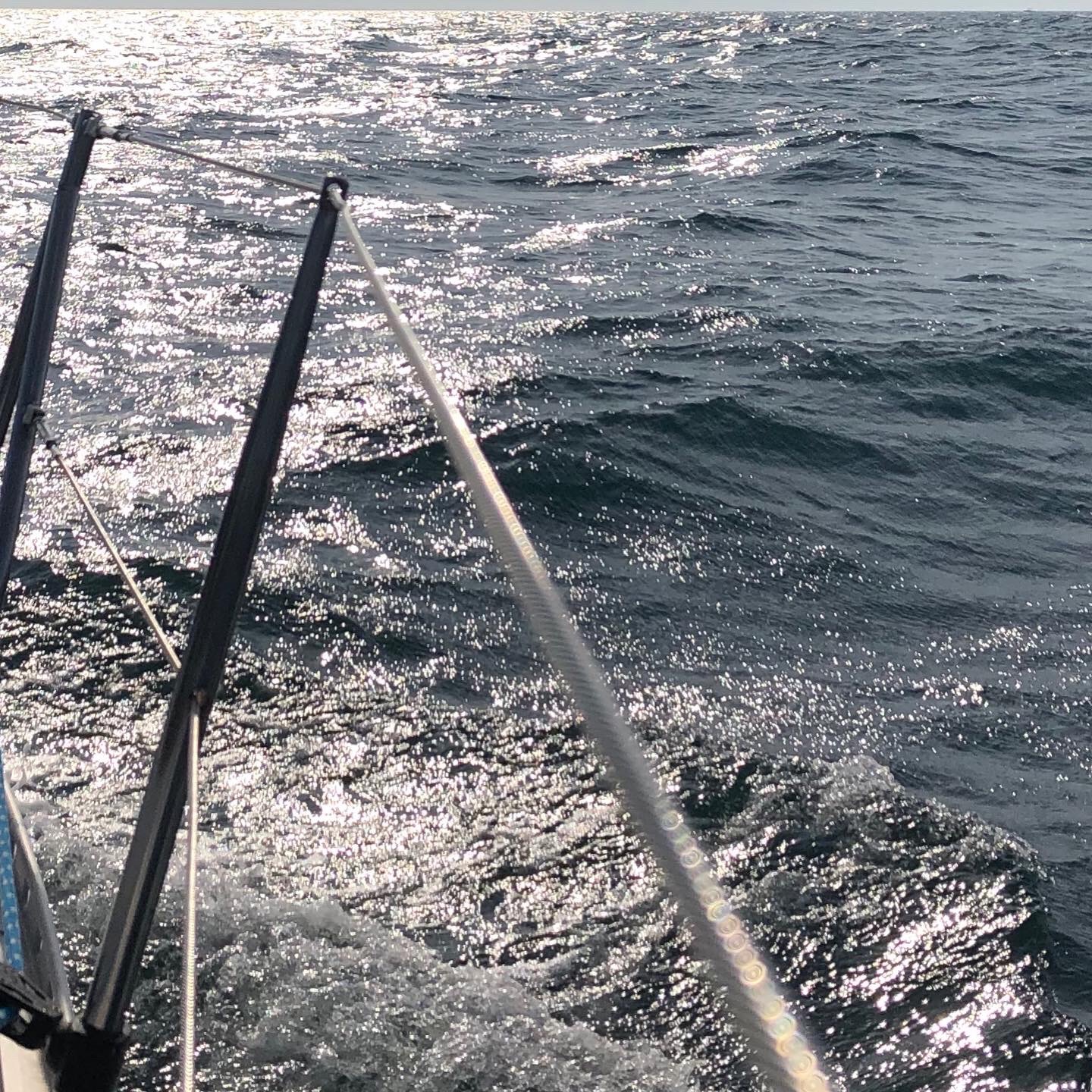
    When we got out of the lee shore of Cape Ann the wave action picked up, with 3 to 6 foot swells that lifted Fayaway and reminded us we were well out at sea.  But Fayaway handles wave action well, and with her sails reefed in the 28 – 30 knots of sustained wind were comfortable for the duration.  Which invited conversation about travel and plans for the future and the kind of catching up you do when it’s just you and others and the wind and splash of waves for hours.

    I’ve learned that I’m a bit rusty with ancillary sailing terminology that goes deeper than the basic rigging, and assisted where appropriate while staying out of the way the rest of the time.  When you see a couple who have sailed together for a year covering thousands of miles you’re witnessing a well-choreographed dance.  I’m not the sharpest knife in the drawer but I know enough not to be the clumsy fop who thumps onto stage mid-act.  Instead be the quiet stagehand who puts away the props when the performers are done.  I was grateful for a patient crew who recognized the rustiness in this sailor.

    There are a few highlights when you sail up the coast from the Merrimack.  You begin with the chaos of the Merrimack River with powerboats and jet-skis racing to win perceived races to get “there”.  It reminded me of aggressive drivers on the highway shifting two lanes and back to get one car ahead.  Its the antithesis of the sailing we were doing, and I greatly prefer being out of that race.  Once you clear the Mouth of the Merrimack, sails are up and you set course for nowhere in particular.  The lines of umbrella stands on Salisbury Beach and elbow-to-elbow fishermen and women on charter boats indicate that social distancing is a guideline many choose to ignore.  I’m sure plenty were doing their best to be socially responsible, while others proved more reckless.  I considered the similarities between drivers on the highway, power-boaters racing each other in a narrow channel to get to the fish first and close-talking beach umbrella bunnies in a pandemic for a moment, and released the thought onto the breeze.  We all live our lives in our own way in America, if not always responsibly.  I was observing from the vantage point of a sailboat in close proximity with another couple, but with the mutual assurance that each couple was taking appropriate measures to avoid COVID-19 exposure.  Maybe those beach throngs were doing the same thing.  I hope so.

    Soon Fayaway moves beyond umbrellas, beyond the sight of land, beyond the hum of motorboats, and we’re in our own world.  For much of the duration of our trip out and back we were completely alone other than a couple of commercial fishing vessels busily working the waters of the gulf.  Time on the water gives you time to ponder and think, and, if you let it, to look through the swirling waves deep into yourself.  And Sunday became another micro adventure for the books.  Leaving terra firma for the sea and exploring a relatively small segment of the Gulf of Maine.  It served as a reminder that I have far to go, but where I am isn’t all that bad either.

  • The Sound of Familiar

    “I hope you’re haunted by the music of my soul
    When I’m gone”
    – Greg Allman, My Only True Friend

    There is what feels like a thousand Black-capped Chickadees living in the holly bush next to my deck. They’re the state bird of both neighboring Massachusetts and Maine. New Hampshire, sitting between these two states, opted for the Purple Finch. Don’t tell that to this cast of characters – they don’t much care for state borders and such human concerns. The party never stops in that holly bush. But now and then a solo singer will fly up on a branch somewhere and sing that familiar “fee-bee” song and it transports me back to earlier days. That song’s been playing my entire life.

    One of the first things I notice when traveling is the ambiance is different. That’s obvious to everyone when you’re seeing the Eiffel Tower or the Grand Canyon, but close your eyes and listen past the sounds of humanity.. There’s a vibration to any place, a soundtrack playing in the background. Wind, water and trees offer their voice, and of course the local bird population sings their own greatest hits like a house band in a local pub. I’m a bit of a migratory bird myself, stuck in a cage at the moment. But I’ve learned to listen in new places and long for the exhilaration of immersion in faraway places.

    With fewer long drives I’m listening to fewer podcasts. I’m reading more, and I’ve grown tired of most of the interviewers I regularly listen to. Instead I favor silence more, or listen to WMVY streaming from Martha’s Vineyard. We all have our greatest hits playing on repeat, but I’ve always sought out new music. WMVY offers music you don’t hear on some corporate iHeart radio station. Respectfully, I prefer to find my own soundtrack. Someday, maybe, I’ll get back to that island. In the meantime I listen to the familiar voices and think about the ferry ride to Vineyard Haven and fried fish and beer at The Newes From America. Island sounds are different from mainland sounds, but for the life of me I’ve lost the sounds beyond the bustle of crowds and the crash of waves. I do need to get re-acquainted, picking up just where we left off like old friends seem to do years between seeing each other.

    The music of a place goes beyond the songs played on the local radio station or in the local pub, it includes the buzz of outboard engines or lawn mowers or street sweepers or chain saws off in the distance, of laughter and chatter coming out of open windows, and the birds occupying the local shrubs catching up on local gossip. The place doesn’t hope you’ll remember it, it just keeps on going as it always has, so long as humanity doesn’t bulldoze it all away anyway. I suppose Greg Allman was thinking about his legacy in the lyrics of this song. We all hope we’ll be remembered in our own way. I write and let it all fall out the way it may. Mostly it’s a familiar record I might return to someday. Like fond memories, revisited.

    I believe I’ve held onto this post long enough. I think it’s time to release this bird from its cage.

  • The Fate of Trees

    Returning to the poem The Ship and Her Makers this morning as I consider the smoke alarm in my hotel room that chirped all night. Such is the glamorous life of travel. Writing instead of sleeping in is a habit I’ve developed, and there’s no sleeping in with a chirpy roommate.

    Consider:

    THE TREES
    We grew on mountains where the glaciers cry,
    Infinite sombre armies of us stood
    Below the snow-peaks which defy the sky;
    A song like the gods moaning filled our wood;
    We knew no men—our life was to stand staunch,
    Singing our song, against the avalanche.

    – John Masefield, The Ship and Her Makers

    Living in New Hampshire I know the power of trees. The white pines that dominated the forests were cut down for masts and wide plank floors and countless other uses the trees weren’t consulted on, but they’ve grown back, and New Hampshire, just behind neighboring Maine, top the nation in percentage of “above ground woody biomass”, or as we call them around here; trees.

    “Every walk in the forest is like taking a shower in oxygen.” – Peter Wohlleben, The Hidden Life of Trees: What They Feel, How They Communicate—Discoveries from A Secret World

    The irony of writing about trees thirteen stories above the largely treeless Chicago landscape isn’t lost on me. Love the city, but couldn’t live here. Give me trees. Walking amongst the tallest of them certainly brings humans back to earth. Forests are the opposite of cities in that respect too. Skyscrapers race to be the tallest, just as trees do, but they’re all in it for themselves. Not so with trees.

    But isn’t that how evolution works? you ask. The survival of the fittest? Trees would just shake their heads—or rather their crowns. Their well-being depends on their community, and when the supposedly feeble trees disappear, the others lose as well.”

    – Peter Wohlleben, The Hidden Life of Trees: What They Feel, How They Communicate—Discoveries from A Secret World

    There’s an underlying sadness in Masefield’s poem emphasized by the first line. We grew on mountains where the glaciers cry. What a portrait of what once was… we were once this grand forest, now we’re the planks under your feet and the mast above. Such are the sacrifices for mankind. Forests regrow of course, but we all lose something by the loss of old growth trees. Wohlleben wrote that in the quote above; when the supposedly feeble trees disappear, the others lose as well. The others aren’t just the other trees: they’re also us.

  • Love the One You’re With

    I woke up extra early today, hearing the call. Looking out the window I see a faint orange tint to an otherwise black sky. Not time yet, but close. I lay back down, but it’s no use. The call prevails. I scroll social media to distract the restless spirit. A quick scan confirms my worst fears of missing out. Aurora Borealis seen in Maine and New Hampshire last night. I switch to the Aurora app and look at the blob of green and orange stretching across the entire northern hemisphere, dipping down enough towards New England that a perch on Mount Washington or Katadin would surely offer a glimpse. Despair. I’ve missed it once again. I close the app and open Facebook to distract me. An old college friend posted pictures in Iceland… bet she saw it, I think to myself. Enough! I get up, get dressed and walk out to the crickets. No Aurora here but something equally spectacular I’m blessed to witness. The last day of August calls, and there’s plenty to see right here.

  • Stone Eggs and Red Dye

    The weekend was frustratingly productive in a Monday morning regret sort of way. Saturday was full of chores – cleaning, pruning, weeding and such. Sunday began the same way, but I felt the stir of restlessness mid-morning and started plotting concentric circles outward for places we’d never been before. When you’ve lived in a place for most of your life that’s challenging, but also surprisingly fruitful. Interesting walk with water views within an hour of home? Not hard when you live near the sea. Place you’ve never been to within that circle? Bit more challenging, but it turns out, not impossible.

    Kittery, Maine is one of those places I drive through on my way to someplace else. Sure, they have all those outlet stores, but shopping makes my brain ache. So does the Sunday traffic trying to bridge the Piscataqua River. Bridges are chokepoints, and being on the wrong side of one on the last weekend before all those kids go back to school is a recipe for gridlock. But the call of new trumped logic and we made our way to Fort Foster for a Sunday afternoon walk.

    Fort Foster sits on the northern point of the Mouth of the Piscataqua River. Historically this river has always marked the boundary between New Hampshire and what was first the Commonwealth of Massachusetts and eventually Maine. The strategic merits of the river and the natural reluctance of the Native American population and the territorial turf war with the French created the need for forts.  That need was served by Fort McClary, just a few miles inland and visible from Fort Foster.  So why another fort?

    In 1885 the United States determined a need to bolster coastal fortifications for modern warfare.  At the time, this included concrete bunkers, disappearing gun artillery designed to combat the new steel-plated modern ships, and most interestingly, anti-submarine measures like mining and guns designed to fire on submarines.  These forts dotted the east and west coasts of the United States.  Fort Foster was completed in 1901, and was active until just after World War II, when the realities of modern warfare had made coastal forts obsolete.

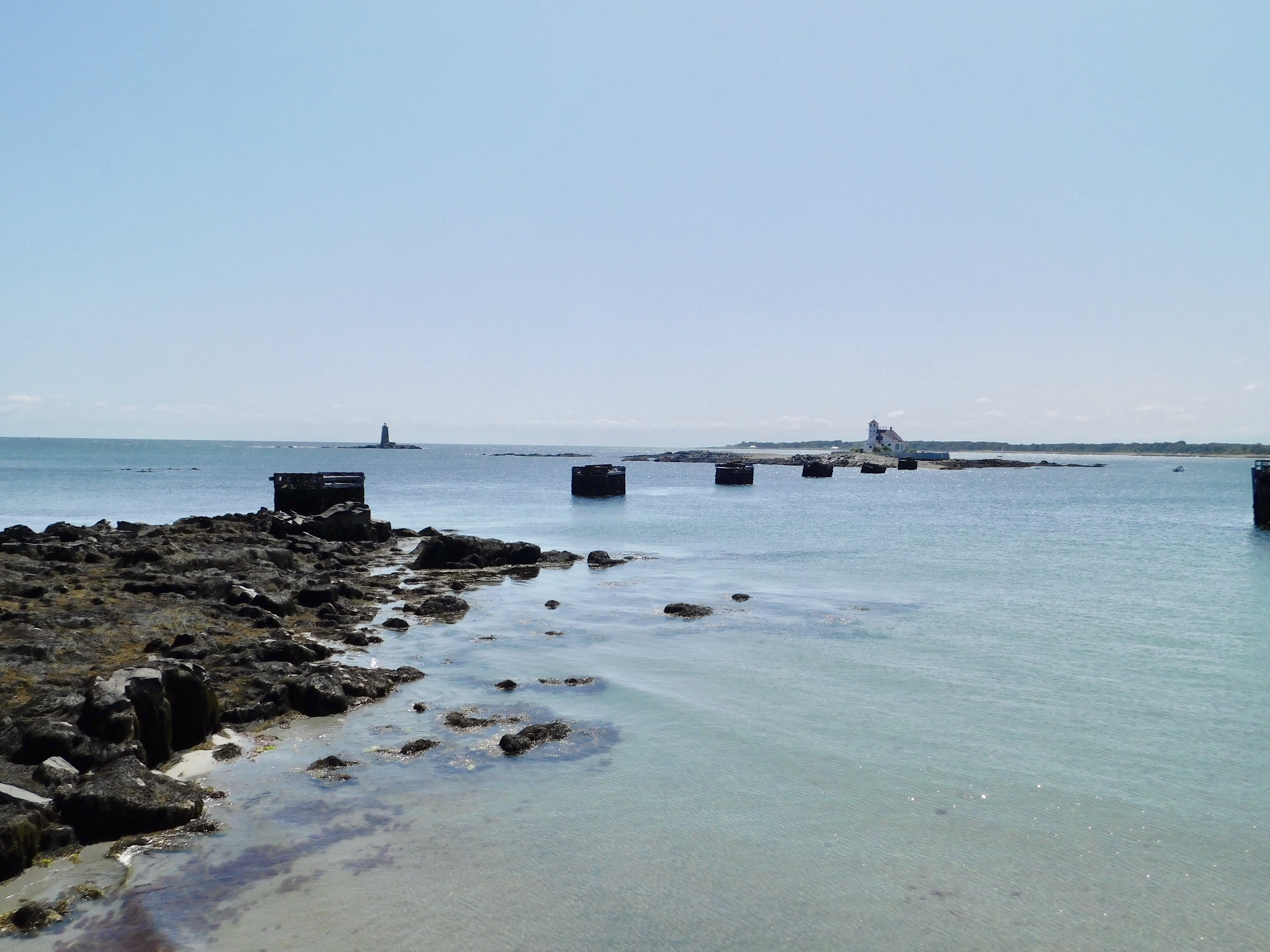
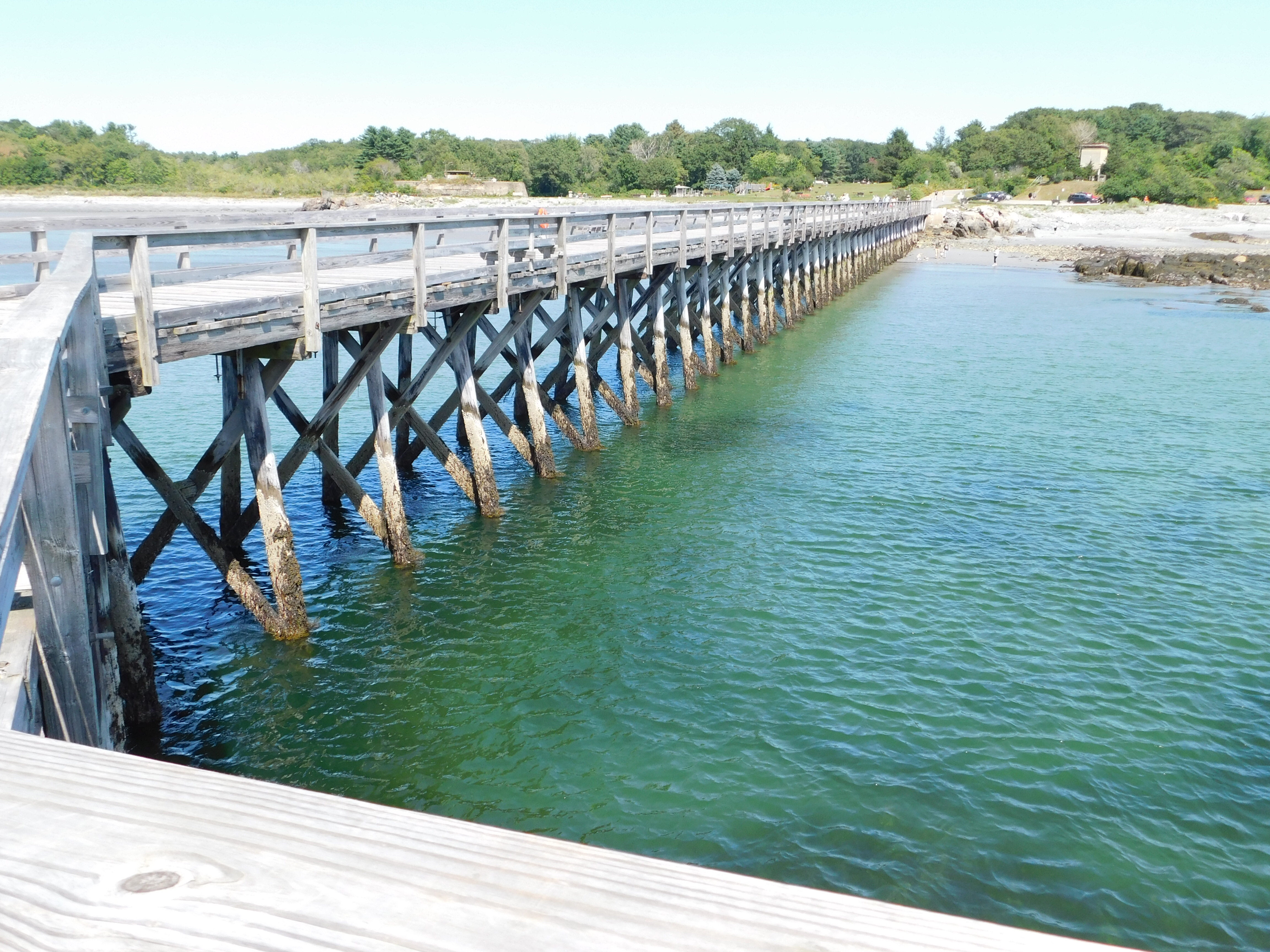
    Fort Foster today offers glimpses of that past.  You can still climb up into the concrete bunker and see the bolts that once secured the disappearing artillery.  But the real reason to visit Fort Foster is to walk on the unique beaches at the Mouth of the Piscataqua River, walk out on the pier to get a closer look at Wood Island with it’s lifesaving station, and Whaleback Light.  There’s been a lighthouse on this spot since 1820, and the one you see now was built in 1872.  The lighthouse keepers surely had a lonely job on that pile of rocks.
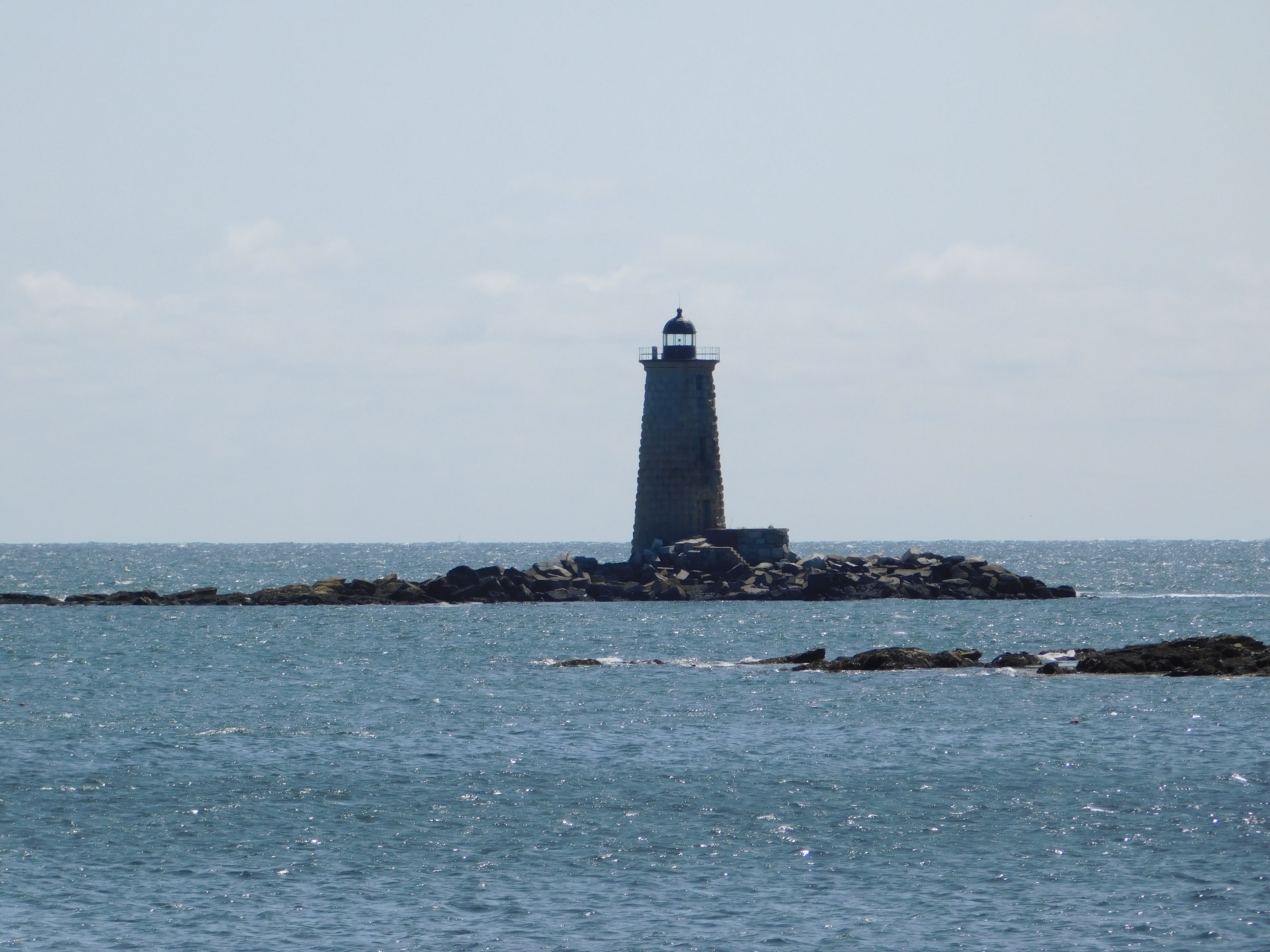
    The beach along the river is hard-pack sand cemented with silt, with granite cropping out wherever it may.  We visited at low tide and the beach extended out 50 to 100 yards in spots.  But there was a funk in the air that betrayed bacteria, and we moved on from the river beaches to those facing the ocean.  The City of Portsmouth, New Hampshire, just on the other side of the Mouth, poured a red dye into the river last month to analyze sewage flow.  There’s a red tint on the seaweed and beaches at low tide, and I wasn’t sure whether it was the red dye or the pervasive Red Tide that has closed shellfish sites in Maine for most of the summer.  Either way, it’s not a beach I would sunbath on, let alone swim in.  Damned shame, because it is a beautiful spot.

    Rounding the corner the funk disappears as the ocean breezes refresh the air.  We walked along the beach at Sewards Cove.  The beach is a fascinating jumble of worn stones, granite outcroppings and stone dust.  Picking up the stone dust, it radiated heat that lingered longer than typical beach sand might.  The beach was dominated by the rounded stones, like river rock you might put in a potted plant, of varying sizes.  One imagines the surf churning these rocks together, round and round, wearing the sharp edges down to smoothness.  The result is lovely, with all manner of shapes and sizes, all eventually becoming that stone dust that makes up the rest of the beach.  I rescued a half dozen egg shaped stones from that fate, instead subjecting them to the fate of eye candy in a beer glass on a shelf at home.  If stones had feelings they might rejoice or resent this fate, but they’ll never tell me.

    We walked as far as we could before we reached a sign that said private property, and turned back towards the river.  We opted for the path instead of the beach on the walk back, and passed groups of families and friends picnicking in nooks and crannies of the park all the way back.  It’s a million dollar view out to the Isle of Shoals and beyond to the east, and over to Portsmouth an Odiorne Point on the opposite shore of the Mouth looking south.  The park charges $20 per car, or $5 per person.  Many people simply park outside the gate and walk in, but anything more than three people and the math stops working for you.  We gave the $20 bucks and called it a donation.  Public space on the ocean is a blessing, and that private property sign reminded me that not every shore is accessible.  Andrew Jackson for a Sunday afternoon walk somewhere new?  A good trade in my opinion.