Tag: Maine

  • The In Between Time

    Once, while hiking the Hundred Mile Wilderness in Maine, I woke up to the sound of splashing in the small pond our tent overlooked. Rising to observe, I watched a moose swim across the pond, climb out the other side, shake himself off and disappear over the hill on the opposite shore. I never saw that moose again, but see it clearly almost three decades later. I’ve chased mornings like that ever since.

    Re-discovering Vagabonding has offered new perspective on many of the quotes Rolf Potts sprinkled throughout the book.  Today I’m borrowing two from his collection.  First, the extraordinary Joseph Campbell, of “Follow your Bliss” and “Hero With a Thousand Faces” fame:

    “People say that what we are all seeking is a meaning for life. I don’t think this is what we’re really seeking. I think what we’re really seeking is an experience of being alive.” – Joseph Campbell, The Power of Myth

    There’s a lot of stoicism in that quote.  The experience of being alive.  I feel most alive on the edges of the day.  The early morning, when I’m often alone with the world, and after sunset, when the light show continues well past the sun disappearing.  The morning offers possibility, reflection on what came before and that rare moose sighting.  I’ve documented plenty of early morning observations on this blog less grand than that moose swimming, but exclamation points on a moment just the same.  The early morning is when you hear the call to follow your bliss.

    I smelled our dog Bodhi last week. He’s passed but still with us; in random wisps of hair found under the sofa, in the dog infrastructure – bowls, food bins and the like – built up to support our canine habit, and especially in the smell of that dog that comes out on a rainy day in the harness and collar hanging in the garage waiting for a final walk that will never come. He stays with us still, Carpet Fresh be damned.

    I also borrowed a bit of Annie Dillard wisdom from Rolf Potts:

    “This is our life, these are our seasons, and then we die. In the meantime, in between time, we can see.” – Annie Dillard

    The time after sunset is when the light show really begins.  If you’re lucky the sky offers you wispy clouds that reflect the fading light in brilliant hues from orange to purple.  When a moment, or a life, has passed, the lingering memory may offer brilliant reflection, staying with us well beyond their time, as the light dances above well after the sunset.  Moments like that moose return to me like the smell of Bodhi on his collar, whispering “I’m still with you”.

    I do think the edges of the day offer focus we may not have during the rest of the day.  Stillness brings awareness that might not be available during the frenzy of activity.  But whether we focus on them or not, each breath is a part of the sum of all of our breaths, and demand consideration. Here again, Annie Dillard reminds us:

    “How we spend our days is, of course, how we spend our lives.” – Annie Dillard

    So our days (and lives) begin with a call to follow our bliss, and end with memories and reflection.  It’s the in between time that is the bulk of our days, and savoring each moment, not just the Instagram moments, is essential. Writing, for me, offers the optics with which to focus on the everyday, and not just that occasional moose moment.
  • The Secret Burial of Colonel Westbrook

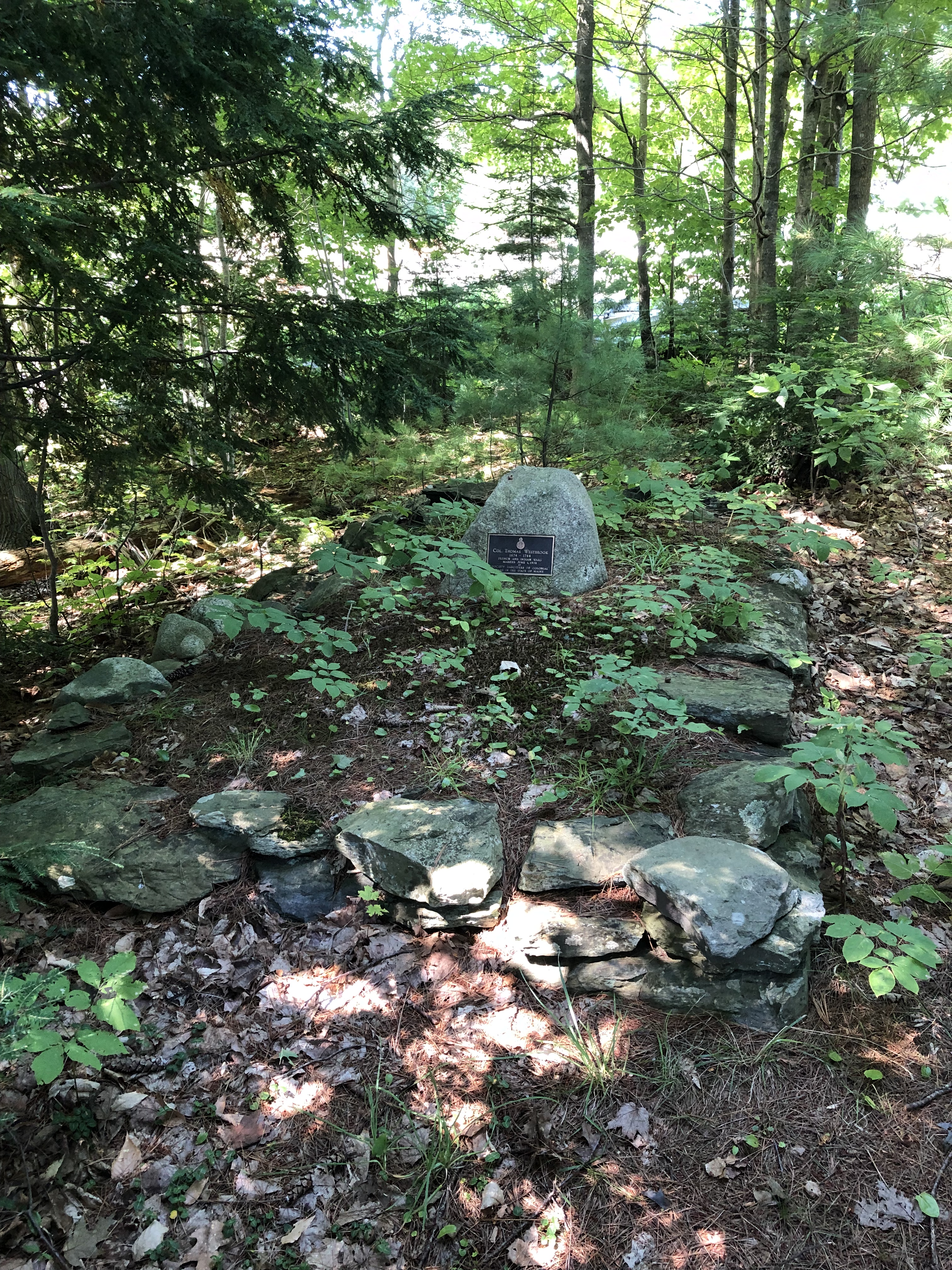
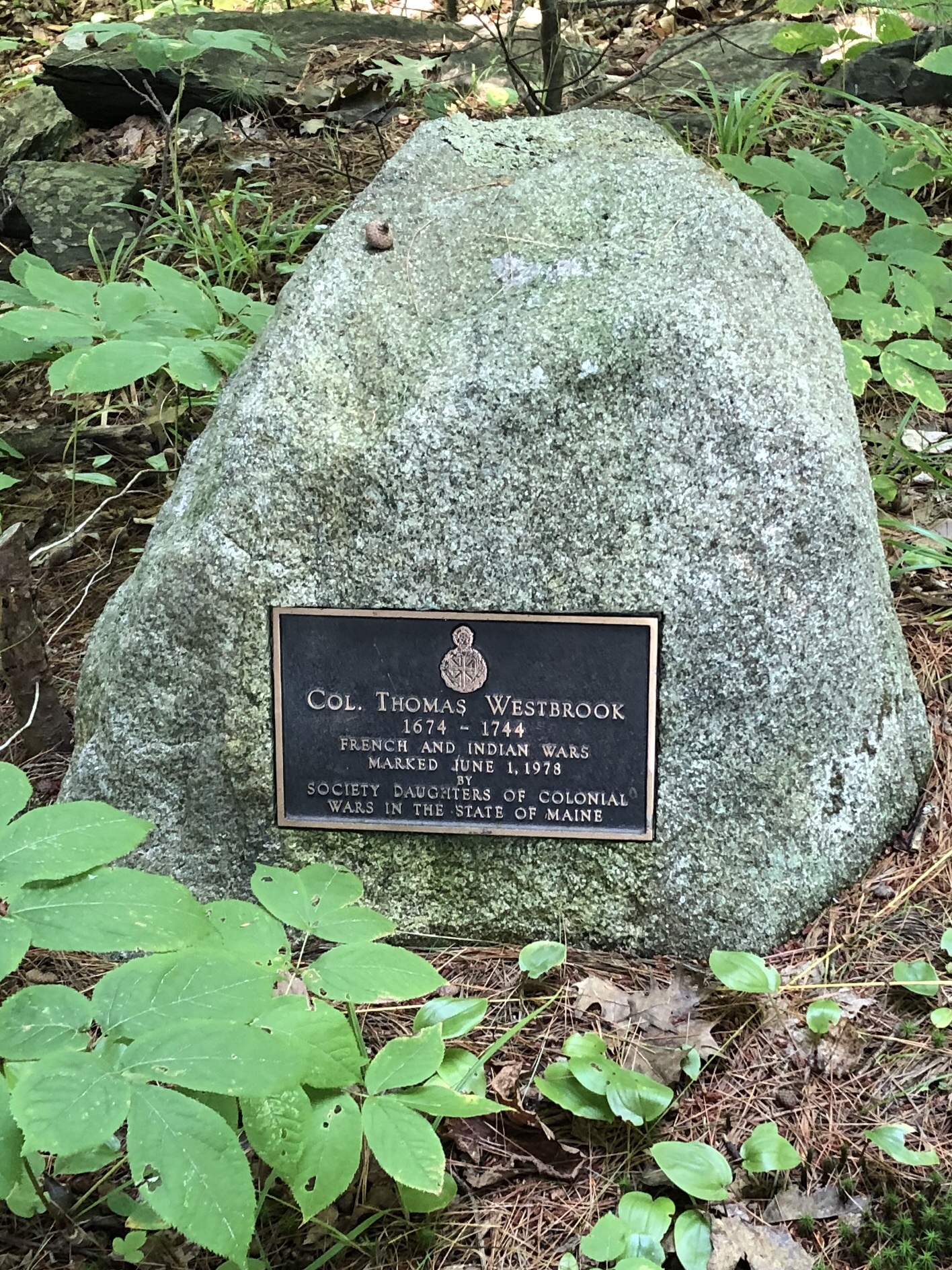
    In the middle of the night 275 years ago a group of family and friends buried the old Colonel in an undisclosed location to keep his body from being dug up and used as a bargaining chip by creditors.  That this war hero was in this position was regrettable, but 1744 Maine was a hardened world not prone to sentiment.  The final years for Colonel Thomas Westbrook were spent in a battle with his old business partner and fellow soldier.  And it was that battle that brought his family and friends out in the middle of the night to bury him, keeping the location of his grave a closely held family secret until the Bicentennial in 1976, an anniversary that settlers in 1744 couldn’t even conceive of.  They were far more concerned with the very real threat of the French and Abenaki than they were about breaking from Great Britain.

    It’s understandable if you have no idea who Colonel Thomas Westbrook is. Frankly I didn’t know who he was until 10:15 this morning, when I passed a sign for the Colonel Westbrook Executive Park on Thomas Drive (well played).  Being in Westbrook, Maine I was curious about a man who accomplished enough in his time to warrant a town being named after him. Which brought me to discover blueberry cheesecake ice cream. But perhaps I’m getting ahead of myself.

    Colonel Thomas Westbrook famously raided the Abenaki village at Norridgewock in search of Father Sebastien Rales (or Rasles, depending on whether you read the English or French description of the man).  Rales led Indian raids on English settlements in Maine (then part of Massachusetts), and by 1722 the English had had enough of it.  Enter Colonel Westbrook who raided Norridgewock but failed to capture Rales.  He did manage to confiscate Rale’s strong box, which had incriminating evidence of coordinating with the Abenaki to raid the English settlements.  This evidence became gas on the fire, igniting more hostilities between the French, English and Abenaki.  In 1724 another raid on Norridgewock resulted in the massacre of 100 Abenaki and Father Rales.  Westbrook wasn’t involved in that event, though his confiscation of the strong box provided plenty of motivation for those who did.  This was indeed a violent time in Maine, with atrocities committed on both sides.  Norridgewock was yet another example.

    Searching for information on Westbrook while I waited for my lunch appointment led me to an article about the discovery of his gravesite, which led me to Smiling Hill Farm, where I asked for directions to the grave site at the ice cream stand along with what their favorite ice cream was, which led me to that blissful blueberry cheesecake ice cream, which – finally – led me to a brief visit with the Colonel. Once again I found myself off-roading in dress shoes. I should really keep some old running shoes in the car for these unplanned detours… but I digress.

    The gravesite sits between a large grass field and a paved lumberyard. Colonel Westbrook was once the Royal Mast Agent supervising the harvest of white pines for the Royal Navy, so I think he’d get a kick out of the ongoing lumbering activity feet from his final resting place. He may be staring up at the planes taking off from the Portland Jetport wondering what the heck is going on in the world though.  Jet engines roar over the white pines that were once the critical material for the cutting edge transportation technology of the 1700’s.  Times have changed, but on the whole the place he’s buried would be familiar for him.  Smiling Hill Farm remains largely as its been for generations, operated by the Knight family since 1720.  They surely know a thing or two about Colonel Westbrook.

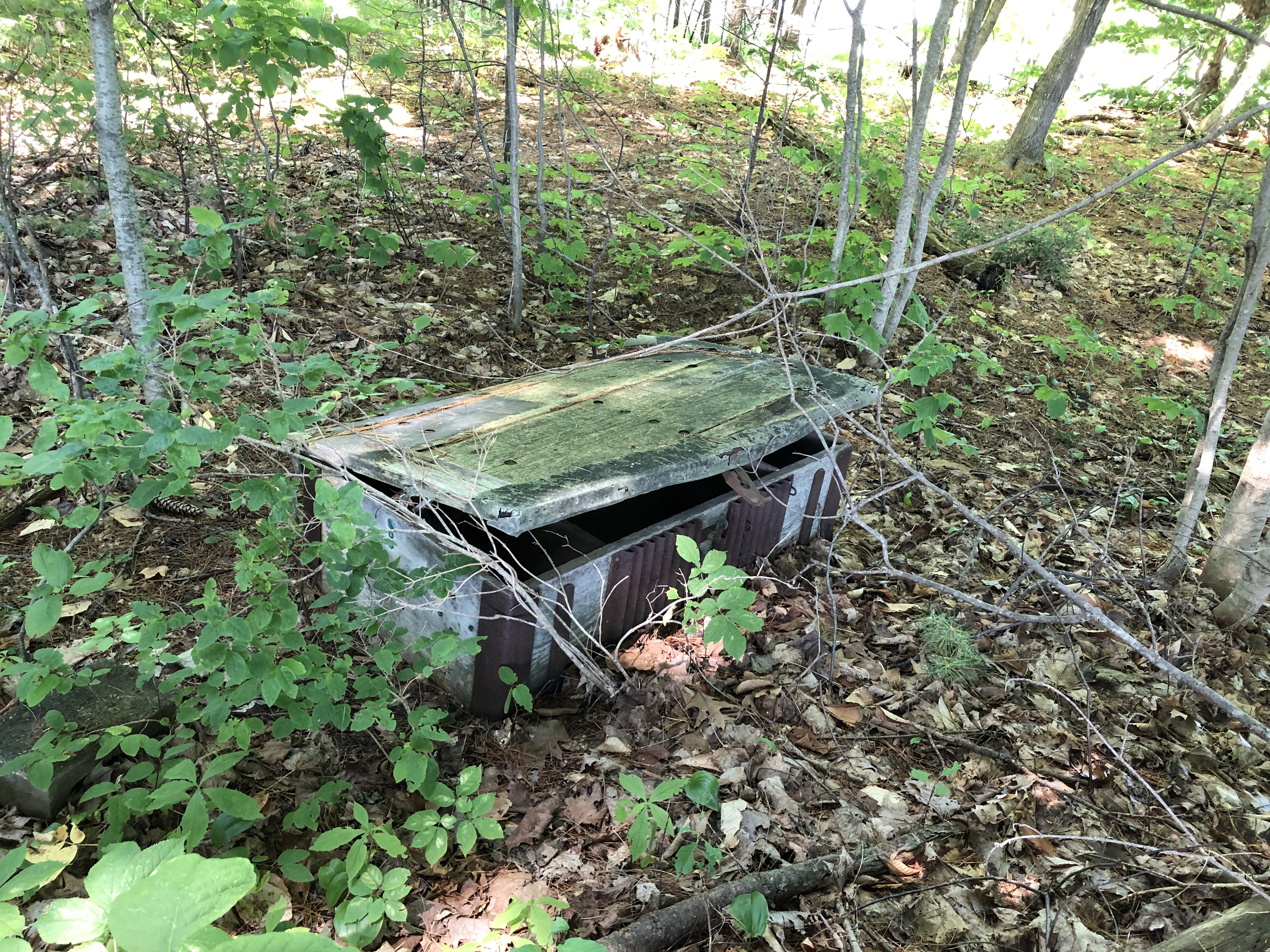
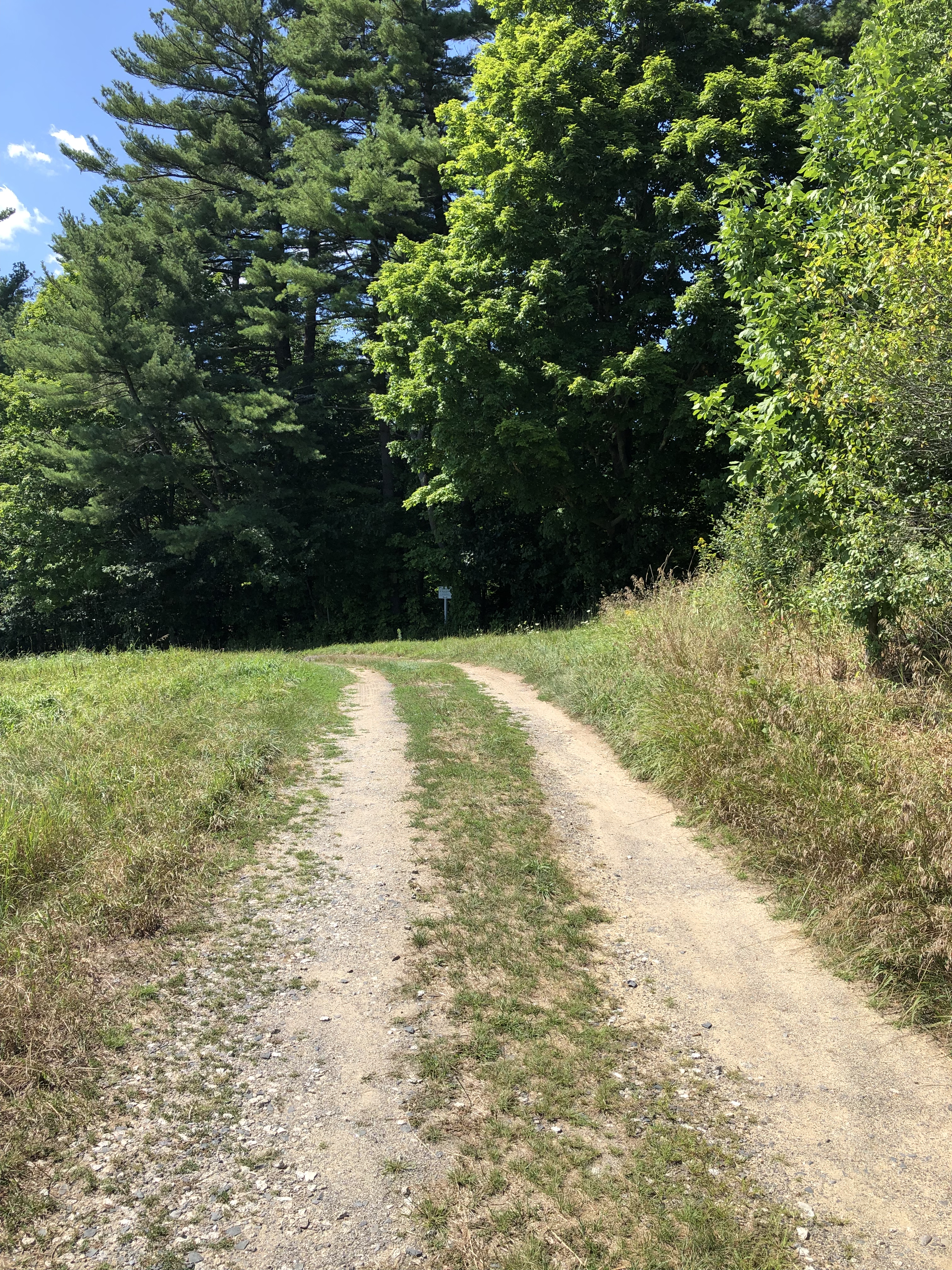
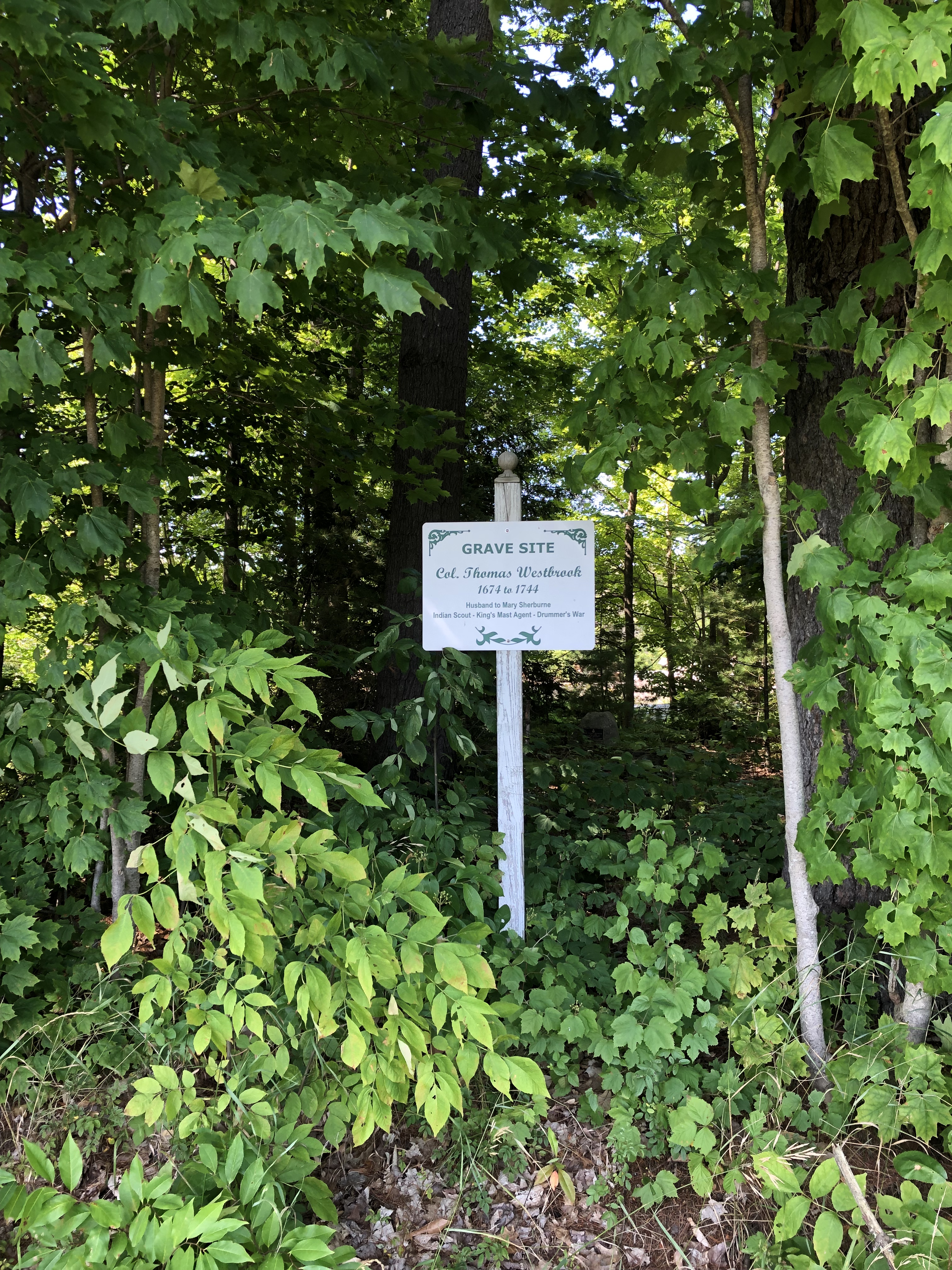
    I walked the dirt and gravel road (mostly a pair of tire tracks) around the front of the lumber yard and there it was, a small white sign in front of a patch of woods marking a quiet, overgrown grave.  This was the site that was revealed to the public in 1976 during the Bicentennial, making Colonel Westbrook famous throughout the area.  There’s a good article that helped me greatly commemorating the 40th anniversary of that Bicentennial celebration posted in the Portland Press-Herald on August 4, 2016.  Two years later it seems the Colonel has been largely forgotten again, at least judging from the overgrown condition of his gravesite.  There’s a replica of Father Rale’s strong box next to the grave site, slowly returning to the earth in this shady nook.

    If you go to Smiling Hill Farm, I recommend trying the blueberry cheesecake ice cream, served with a wooden spoon.  Then walk a bit of it off with a five minute walk to visit the Colonel.  He could use some company.  I may have been the first person to visit in some time based on the path to the grave, but perhaps other history buffs have preceded me.  Those that come after me will see the site in the same condition, as my footprints didn’t make much of a dent in the weeds.  But I paid my respects, dress shoes and all, and got on with my day.  Slightly more informed about events 275 years ago on a quiet hill in the middle of the night.


  • From Pemaquid to Andover: A Tale of Abenaki Revenge

    On February 22, 1698 a group of Abenaki warriors raided Andover, Massachusetts and killed five people and two more (Haynes and Ladd) in Haverhill.  Raids like this were somewhat common in the Merrimack River Valley at that time, as it was the frontier and friction between settlers encroaching on the lands of Native Americans who had lived there for generations was an unpleasant reality for everyone living in this area.  What was particularly interesting about this raid was who they killed, which leads to why they chose this place for a raid in the first place.

    Two years earlier at Fort William Henry in Pemaquid, Maine, Captain Pasco Chubb commanded a garrison of 60 soldiers who were stationed here, tasked with defending this relatively new stone fort from the French and Abenaki who would prefer to have them elsewhere. This site, on a point of land jutting out into Johns Bay at the mouth of the Pemaquid River, wasn’t particularly strategic, but it represented what was meant to be a permanent foothold on the coast of Maine (then part of Massachusetts) and the northernmost settlement by the English. Fort George, A wooden stockade on this spot hadn’t fared well just a few years earlier, so in reconstructing the fort the British stepped in and built it of stone and armed it with 15-20 cannon. It was completed in 1692 and held by a garrison of 60-90 men.

    There were at least three critical weaknesses with Fort William Henry. First, it was isolated and any reasonable hope for reinforcements was small. Second, the small stone and lime walls were not particularly strong, making them vulnerable to the cannon the French would bring. And third, and an unforgivable mistake given the other vulnerabilities, the supply of drinking water was outside the fort walls! So a siege of any length would prove highly effective as water in the fort was depleted.

    Ongoing tensions with the French and Native American population almost guaranteed that a siege would eventually take place.  And Fort William Henry was indeed besieged on August 14, 1696 by 100 French and 400 Abenaki. Prior to the siege, two Abenaki chiefs named Edgeremet and Abinquid went to meet with Captain Chubb under a white flag to inquire about some fellow Abenaki captured by Chubb’s predecessor and shipped to Boston. The goal was a prisoner exchange with the British.  Chubb and his men raised their guns and shot Edgeremet and two of his sons. Depending on the account you read, Chief Abinquid may have escaped. Either way this act of cowardly violence against Abenaki tribal leaders under a white flag enraged the besiegers. They wouldn’t forget Chubb and the British betrayal.

    The Abenaki wrote a letter that demonstrated their rage and feelings of betrayal.  It would set the table for later violence against settlers:

    “Lord who write at to me, listen and understand what I am about to say, аnd write, to you. Thou wilt easily recognize my words, and why wilt them not recognize them. It is thou (so to express myself) that furnishest them to me. Writing with too much haughtiness, thou obligest me to reply to thee in the same style. Now, then, listen to the truths I am about to tell thee of thyself; of thee, who dost not speak the truth when thou sayeth that I kill thee cruelly. I never exercise any cruelty in killing thee, [a*I kill thee] only with hatchet blows and musket shots. Thy heart must have been еvеr addicted to wickedness and deceit. No other proof is necessary than the acts last autumn at Saco and Pemkuit, taking аnd detaining those who were going to obtain news from thee. Never in the universal world has it been seen, never has it been related of a man being taken prisoner who bears a flag [of truce] and goes to parley on public business. This, however, is what thou hast done; in truth, thou bait spoiled the subject of discussion. Thou hast covered it with blood; as for me, I could never resolve to act in that manner, for therein I have even an extreme horror of thy unparalleled treachery. How then dost thou expect that we would talk. What thou sayest I retort on thyself. There, repent and repair the grave fault thou hast committed; seize those who killed me at Saco, and made me prisoner at Pemkuit. I will do the like by thee. I will bring thee those who killed thee when I shall be able to find them. Fail not to do what I require of thee; of this, I say, who killest me without cause; who takest me prisoner when I am off my guard. – Abenaki letter, written by French missionary brothers Vincent and James Bigot, in response to the treachery at Pemaquid

    The French weren’t as surprised, writing in an account of the events that day that “It is to be hoped that the Abenakis will not place any confidence hereafter in English promises.”  

    The English were disgusted with Chubb for quickly surrendering the fort and fleeing back to Boston.  He was thrown in jail for months when he was set free, and only freed when he wrote a petition to the Court.  In it he wrote the following:

    “And whereas ye petition is a very poore man, having a wife and children to look after with by reason of his confines & poverty are reduced to a meane and necesstous condition, having not wherewith all either to defray his prison necessary charges or to relieve his indigent family…”

    Chubb would indeed be released from jail and return to Andover to be with his wife and child.  It was there that a party of 30 Abenaki warriors led by Chief Escumbuit from Big Island Pond would become reacquainted with Pasco Chubb, killing his wife and child, and paying extra attention on Chubb, shooting him several times to ensure he was dead.  Sweet revenge, perhaps, but with the loss of innocents as well.  Chubb has largely been forgotten in the early colonial history of America, and when his name is mentioned it’s appropriately with distain.


  • York Gaol

    Sitting on a small hill in York, Maine is a gambrel-roofed wood and stone building of consequence.  With the original construction beginning 300 years ago this year, it’s been a unique witness to history.  This is a building with stories to tell.

    Gaol means jail, and that’s what this building was for the Province of Maine, a part of the Commonwealth of Massachusetts which of course eventually became the State of Maine.  Situated as it is in York, 27 years after the Candelmas Massacre hit this town hard, the jail was used to hold prisoners from Pisataqua River to the south to the St. John River to the North.  It is thought to be the earliest surviving British colonial structure in North America.  By comparison, Fort Western in Augusta, Maine wasn’t built until 1754.

    This old Gaol has witnessed the French & Indian War, the Revolutionary War, recruitment for the Civil War and countless changes to the landscape around it.  It’s a fascinating little bit of history perched on a hill in York.  I’ve driven by it many times over the years, so it’s witnessed me grow from a know-it-all teenager to a harried soccer parent to an empty-nester history buff.  It was about time I started paying attention as well.

  • Candlemas Massacre: The Raid on York

    Wandering around New England today, it’s difficult to imagine this place as the frontier and a war zone.  But you don’t have to look far to see evidence of ancient atrocities.  In 1692 one of those atrocities took place in York, Maine.  200-300 Penobscot Indians led be sachem Madockawando and Father Louis-Pierre Thury, a French missionary but no man of God.

    There were clearly a lot of horrific things done to the Native Americans over the years, but its simplistic to say that they were always the victims.  Madockawando’s Penobscot warriors, like the Abenaki, were vicious warriors who would kill innocent women and children as quickly as they’d kill an armed soldier.  There are stories of torturing and murdering prisoners that are as bad as any other atrocity I’ve heard about in history.

    Candlemas is the feast of the Presentation of the Lord, which takes place 40 days after the birth of Jesus.  It’s a holy day for Christians, and the faithful of York no doubt looked at it as a day of spiritual celebration.  Unfortunately, York was the edge of the wilderness in 1692, and right in the middle of King William’s War between the English and the French.  Raiding English settlers was considered fair game by the French and their Native American allies.  Scalps were considered proof that they had killed someone, and they were rewarded for every scalp, whether it was a man, woman or child’s.

    On January 24th, 1692, the morning after Candlemas Day celebrations, the Penobscot warriors left their snowshoes on a large, flat rock and raided the settlement of York.  They burned 17-18 houses, killed 75 people and marched between 100-200 more to New France as prisoners.  Several of these prisoners died during the march north, others were eventually set free when the English paid a ransom.

    The rock that the raiding warriors used to lay their snowshoes on was preserved and used as a memorial for the victims of the raid.  You could easily drive past it on Chases Pond Road without realizing what it is, a simple memorial set into the rock, on a small plot of land lined with stones and woodland behind it.  It wouldn’t be hard to envision the Penobscot warriors walking through the woods and setting those snowshoes down.  Walking around and placing a hand on the rock is a handshake with history, and a reminder of the harsh environment our ancestors lived in 327 years ago.  In another nod to history, someone named one of the nearby side roads Snowshoe Spring.  Otherwise this could be any other stretch of country road in New England.


  • Candlemas Massacre: The Raid on York

    Wandering around New England today, it’s difficult to imagine this place as the frontier and a war zone.  But you don’t have to look far to see evidence of ancient atrocities.  In 1692 one of those atrocities took place in York, Maine.  200-300 Penobscot Indians led by sachem Madockawando and Father Louis-Pierre Thury, a French missionary but no man of God.

    There were clearly a lot of horrific things done to the Native Americans over the years, but its simplistic to say that they were always the victims.  Madockawando’s Penobscot warriors, like the Abenaki, were vicious warriors who would kill innocent women and children as quickly as they’d kill an armed soldier.  There are stories of torturing and murdering prisoners that are as bad as any other atrocity I’ve heard about in history.

    Candlemas is the feast of the Presentation of the Lord, which takes place 40 days after the birth of Jesus.  It’s a holy day for Christians, and the faithful of York no doubt looked at it as a day of spiritual celebration.  Unfortunately, York was the edge of the wilderness in 1692, and right in the middle of King William’s War between the English and the French.  Raiding English settlers was considered fair game by the French and their Native American allies.  Scalps were considered proof that they had killed someone, and they were rewarded for every scalp, whether it was a man, woman or child’s.

    On January 24th, 1692, the morning after Candlemas Day celebrations, the Penobscot warriors left their snowshoes on a large, flat rock and raided the settlement of York.  They burned 17-18 houses, killed 75 people and marched between 100-200 more to New France as prisoners.  Several of these prisoners died during the march north, others were eventually set free when the English paid a ransom.

    The rock that the raiding warriors used to lay their snowshoes on was preserved and used as a memorial for the victims of the raid.  You could easily drive past it on Chases Pond Road without realizing what it is, a simple memorial set into the rock, on a small plot of land lined with stones and woodland behind it.  It wouldn’t be hard to envision the Penobscot warriors walking through the woods and setting those snowshoes down.  Walking around and placing a hand on the rock is a handshake with history, and a reminder of the harsh environment our ancestors lived in 327 years ago.  In another nod to history, someone named one of the nearby side roads Snowshoe Spring.  Otherwise this could be any other stretch of country road in New England.


  • Ulster Scots & Potatoes

    Ulster Scots & Potatoes

    The Ulster Scots settled in New England in 1718.  They weren’t coming here to make their fortune, they were coming for survival.  The Ulster Scots were caught between the British and the Irish when forced to out of their homelands in the early 1600’s to the ancestral homelands of the Irish in the County of Ulster.  Civil Wars and massacres in Ulster threatened to wipe out the population.  Many of these people, seeing no hope for the future in Ulster, migrated to America.

    The Governor of Massachusetts in 1718 was Samuel Shute.  Shute was looking at the ongoing threat from the French and Indians on the fringes of civilization and felt that these immigrants would be a great buffer.  So the Ulster Scots settled in what is today Maine and New Hampshire in great numbers.  The Nutfield Grant brought many of these migrants to New Hampshire in 1719, in what is now Derry, Windham and Londonderry.
    One of the leaders of these Ulster Scots was the Reverend James McGregor.  McGregor is credited with being the first person to plant potatoes in America.  And since he did this in Nutfield, this makes New Hampshire the first place on the North American continent to grow potatoes.  
    Potato crops are still big in New England, but not so much in New Hampshire.  The Granite State’s nickname is a stark reality for farmers.  There’s a reason there are stone walls all over the place here.  The rocky soil makes farming tough for anyone.  When your survival is based on what you grew that season, you’d better start with decent soil.

    Most of the potato farms are in Northern Maine, with more than 55,000 acres of farmland dedicated to potato crops in Aroostook County.  It seems that the farmers are mostly Irish and not Ulster Scots.  The original Nutfield Grant doesn’t have any potato farms that I know of, but they’ll be celebrating their 300th anniversary this year.

  • Alexander’s Map

    Alexander’s Map

    A new year, and a new pursuit; this blog.  So why the name?

    Alexander’s Map is a rare map published in 1624 to encourage colonization of the lands granted to William Alexander.  The map gives an early, if inaccurate, glimpse at this region that I’m so fascinated with.  Alexander’s Map stretches from present-day Massachusetts to Newfoundland to the northeast and Quebec (“New France”) to the north.  
    My blog will cover observations from living in this region, and will also include observations from as far west as Buffalo and as far south as New Jersey.  This is where I spend much of my time, and with so much history, food, sports and geological and cultural diversity to explore it will be fun to explore this in writing.  I hope you’ll enjoy the journey with me.