Tag: New Hampshire

  • State Change

    Everything has changed. Well almost everything. New sounds; I’ve never heard that dog bark before. The rumble and back-up beeping of construction equipment is new too. Seems to be road work happening at the top of the hill. A young squirrel is working the oak tree in the neighbors’ yard and there’s a constant drip of acorns plummeting through the leaves and thumping onto the ground.  Seems early for the dropping acorns but the squirrel seems to know more than I do about the matter.

    Some birds remain, like the brown thrasher I spent all summer trying to figure out. But the bluebirds are gone, and with them the feeling of early summer. Some new birds sing but I can’t place them. Migrating from someplace to another destination, with a quick stop in my neighborhood. I don’t know birds like I know some other things. But the more I know about anything the less I seem to know about that very thing.  Such is the way of the world.  I’ve learned to respect the journey of self-education, and hate myself for falling into the trap of thinking I know everything about anything.  Worse still is acting so.  Better to be open to the world around you; a sponge not a bullhorn.  There are far too many bullhorns already.

    Autumn is in the air. I felt it on Buzzards Bay as the winds shifted. This is first day of school bus stop air, and we aren’t yet halfway through August. And here in New Hampshire with the cool, humid air and white noise background buzz of crickets singing their late summer song.  Getting outside away from media opens the senses and the mind alike.  But other changes are in the air. A quarter of the family flying to London soon state change kind of air.  Another quarter entering senior year in college kind of air.  And what are we doing in this big house with all this stuff kind of air.

    Gone for a week and everything is different.  It would have been different if I’d been here too, but the daily gradual change isn’t noticed the way it is when you step away for a bit. Everything changes constantly. And so do I. A little for the better in some ways, a little for the worse in others, but generally more growth than decline. We all know what the ultimate end game is, but that doesn’t mean you have to live like you’re dead already. I know too many people who live in virtual bubble wrap, watching the world pass them by. I want to shake them loose, and whatever cobwebs I’ve grown myself, and shout “Embrace the changes; there’s magic in the air if you’ll only feel it!”

    I have a drive to Connecticut to get to.  That drive brings me from New Hampshire through Massachusetts to Connecticut, then the reverse this evening for the drive back.  Four hour round trip drive time, and more like seven hours with meetings thrown in the mix.  I could probably stay overnight in Connecticut, but there are compelling reasons to get back home this week, and so I’ll do the round trip instead.  My state change is both literal and figurative today.  But I do enjoy the journey.

  • Honing a Curious Mind

    I’ve been trying to figure out who is singing in the neighborhood for the last six weeks. I make a point of being outdoors whenever possible in the early morning (New Hampshire summers are very short after all). Some singers are obvious, others are more evasively unfamiliar to me. I regret that my education never included identifying birdsong. But as with many things I’ve made it a point of my adult learning path. I’m currently in the 101 level birdsong classes.

    I tried an app that analyzes bird song, but the bluebirds always sing at the same time as this character and tend to confuse the analytics. It keeps think its a mockingbird when I can hear the differences clearly. Eventually I came to the conclusion that this was a Brown Thrasher. In the process of figuring that out I’ve come to learn the songs of another half dozen birds I’ve heard in the background music but never took the time to learn about. I’m far from an expert on any of this, but the path is more vibrant.

    In the last 18 months I’ve learned about or reacquainted myself with local and world history, stoicism, transcendentalism, world religions, the power of habits, physiology, native trees, horticulture, birds, bugs, the environment and other diverse (eclectic?) side paths on the route from here to, well, there. Side paths lead to other side paths and before you know it maybe you’ve accumulated something meaningful in the old brain. You can’t write about what you don’t know about, and this cajoles me from tangential interest to deeper learning about topics. As a side benefit I’ve become better at writing too… you’ll see it eventually.

    The discipline of sharing something daily is priceless.” – Seth Godin

  • The Loon Comeback Story

    Early this morning I was reading in the backyard when I heard something I’ve never heard in twenty years of living in this place; the distinct call of a loon as it flew over the house.  In my lifetime loons have always been rare, and usually you’d find them up on the relatively quiet northern lakes.  The first time I heard a loon was on First Connecticut Lake up in Pittsburgh, New Hampshire.  I was 23 at the time; far too old to be hearing a loon for the first time.  Interestingly enough that was the same weekend I first saw a moose in the wild (thanks Pittsburgh).  But it remained a rare experience if you weren’t up in the Lakes Region or north.

    Loons, like hawks and eagles, are the canaries in the coal mine for our ecosystem.  When DDT and other pesticides worked their way up through the food chain it killed more than just bugs.  One research article talked about massive loon die-offs in the mid-1960’s related to pesticides and human interference on Lake Michigan.  This was repeated all around the country as attempts to knock out the mosquito population and pests that eat food crops created unintended consequences.  With the ban of the worst of these pesticides and intelligent management of the rest, wildlife started making a comeback.  As the world struggles with the questions of climate change and plastic in the environment, perhaps looking back on the 40-year rebound of the loon population would be a good example of what positive, long-term change looks like.

    The loons have made a comeback.  The population has tripled in the last 40 years from about 100 in 1974 to over 300 last year.  As the population increases nesting pairs move into new lakes and ponds in Southern New Hampshire, making the once rare sound of a loon song increasingly common again.  That loon flying over my house could have been heading to any of the half dozen large lakes nearby, or perhaps one of the many smaller ponds and that flow into the Spicket River.  But wherever it was heading, it was a signal that things are slowly improving for the loons, and for the rest of us as well.

  • Finding the Essence

    I grew up following my grandfather around the garden. By all accounts he wasn’t a good husband or father to his 16 kids, and I’m told he was once a vicious drunk. But he was a good grandfather to me. Age likely tempered him as it does most of us, but I think it was largely because my memories of him were from that garden. With 16 kids you need to grow some of your own food, and he knew his way around the garden. He’d likely shake his head at my flower garden, wondering why I’d take up so much valuable land on ornamentals. But I’ve raised a more manageable number of kids, and there’s benefit to flowers that go beyond caloric intake.

    I think of myself as primarily a flower gardener, but taking stock I have a respectable number of herbs and edibles mixed in; basil, cilantro, oregano, lemon verbena, chives, monarda, dill, bell peppers, jalapeño peppers and four varieties of tomatoes. I also have two apple trees, blueberry bushes, a lime tree and coffee bush in pots… and those frustratingly unproductive grapes. This year I opted out of some other vegetables I’ve traditionally grown like nasturtium, sunflowers, string beans and squash because they simply overwhelmed the garden.

    The harvest is already coming in, particularly the herbs. The challenge now is to keep up with them. Which means expanding the menu. Growing a new herb or vegetable offers two unique experiences; figuring out how to optimize its growth and then what to do with it when its time to harvest. When I was in Israel the employee kitchen had bunches of freshly picked mint that people would plunk stem and all into their tea.  I’ve been growing mint for years but never thought to do that until they taught by example.  Now that the mint is exploding I’ve taken to drinking more tea with fresh mint and give a nod to my former co-workers for showing me the way.

    So consuming the edibles is one benefit, but the larger gift is in living amongst them day-to-day. Rub the leaves and smell the oil released on the fingertips. Flowering herbs like cilantro, chives and monarda (bee balm) are good for the local bee population, and good for me as I enjoy the show as they work their way around the garden. The garden becomes multidimensional. Good for the senses, good for the palette, good for the soul.

    I think my grandfather was essentially a good man, but he was caught up in the frustrating struggles of his life and alcohol poisoned his mind. The garden drew out his attributes, and I saw the good in him. I haven’t struggled with the demons he struggled with, but I know I’m better for having been in the garden. And so was he.

  • Fences and Forests

    “At present, in this vicinity, the best part of the land is not private property; the landscape is not owned, and the walker enjoys comparative freedom. But possibly the day will come when it will be partitioned off into so-called pleasure-grounds, in which a few will take a narrow and exclusive pleasure only – when fences shall be multiplied, and man-traps and other engines invented to confine men to the PUBLIC road, and walking over the surface of God’s earth shall be construed to mean trespassing on some gentleman’s grounds. To enjoy a thing exclusively is commonly to exclude yourself from the true enjoyment of it. Let us improve our opportunities, then, before the evil days come.” – Henry David Thoreau, Walking

    When I moved into the house I’m living in twenty years ago, when this cul de sac was just being built, I watched a dozen deer run through the woods and diagonally through the backyard out to the front where the driveway is and then off to wherever they roamed from there.  A few years after that I became annoyed with one of my neighbors central vacuum system which didn’t (and still doesn’t) have any form of muffler on it.  I put up a six foot privacy fence on that side of the house to block out the noise a bit.  Fences make good neighbors, they say.

    A few years after that we got a very energetic one year old black lab and put him on a run, which was a cable strung tightly between two trees in the backyard with his chain hanging down, giving him some freedom of movement but not enough.  Eventually we fenced in the backyard entirely, and he had room to roam without running away.  Well, we thought so at the time.  Snow pack and exceptional climbing skills proved the fence wasn’t always as high as it needed to be.

    Then came the pool, and it justified the investment in the fence.  And that fence continues to serve us well, in theory keeping the young neighborhood kids out of the pool while being compliant with the town’s codes which require a fenced-in pool.  With a pool you have liability.  Lawyers love pools. Insurance companies love fences.

    The forest remains timeless.  It’s just on the other side of that fence, and it’s largely as it was twenty years ago, and twenty years before that.  It continues to invite itself back into the yard.  After all the backyard was once part of the forest and perhaps one day it will be again.  I see the deer sometimes just on the other side of the fence.  But they don’t run through the yard anymore.

    Thoreau would find his walking to be very different than it was when he wrote those words.  Aside from conservation land and State Parks like Walden the landscape is completely different than it was for him.  Roads are paved, land is subdivided, fences are put up to screen annoying neighbors or to protect pool owners from wandering toddlers.  Thoreau might say that the evil days have indeed come.  And looking at the building boom going on seemingly everywhere I can’t help but think that myself.  Houses and residential communities popping up everywhere.  Roads getting more and more congested.  Mixed-use development projects all the rage.

    I read a book recently that described the frustration that a family had at the development of Bedford, New Hampshire back in the 1960’s.  I know the stretch of road they described as it is today, but never knew it as the quiet country road portrayed in the book.  They ended up moving further north into Maine.  And maybe moving further away is the answer.  Or maybe it starts with taking care of your own backyard before it’s too late.  Conservation and preservation, zoning restrictions, political will and public demand are the formula for open space.  Developers rule most town halls nowadays.  When people are indifferent to the land around them the void gets filled by people who build 55 plus housing developments.  This isn’t developer bashing – developers do a lot of great things and I’ve directly benefited from development.  It’s more a call to all of us to demand more for the environment we’re creating for ourselves and future generations.  A little preservation goes a long way.

  • Talking Turkey

    This morning I went for a 3 1/2 mile walk and came across a large tom turkey standing on the side of the road. A little later in my walk I saw another turkey, this time a hen, about twenty feet up in a tree. Two turkeys in 3 1/2 miles isn’t exactly extraordinary nowadays in New England, but I was on the Cape and you don’t think of turkeys and Cape Cod. But like everywhere else in New England the turkey population has exploded.

    When I was a kid running around in the woods of various towns in Middlesex County, Massachusetts I never saw a wild turkey. The first wild turkeys I ever saw were in South Kent, Connecticut in 1993. I remember it because it was a unique experience at the time. But Litchfield County is where you might expect to see wild turkey. It’s also where I saw my first coyote in the wild. Now you can see turkey almost anywhere.

    This exponential turkey population growth took place while we (most of us anyway) weren’t paying attention. Back in maybe 2007-2008 I recall seeing a few here and there but it was still a novel experience. Today in Southern New Hampshire it’s novel if I go a day without seeing or hearing one. There are an estimated 40,000+ turkey in New Hampshire today, and an estimated 200,000+ in New England.

    It wasn’t always this way. When Europeans first settled in New England they started clearing the land for farms. This destroyed the habitat of the wild animals that lived there, and those who didn’t die out from lack of habitat were eliminated through hunting. Turkey, deer, pigeons, wolves, bear, and countless other animals suffered the same fate. By 1850 turkey were largely extinct in New England.

    Efforts to re-introduce turkeys began in the 1930’s, first with releasing domesticated turkey into the wild. When that failed wild turkey were caught in Upstate New York and released in New England states. Over time those turkey reproduced and the population growth began to accelerate. One Tom can mate with many hens, which can hatch 6-12 eggs. With few predators it’s easy to see why the population exploded. Today they’re seemingly everywhere, including a little peninsula jutting out into Buzzards Bay.

  • Lilacs in Bloom

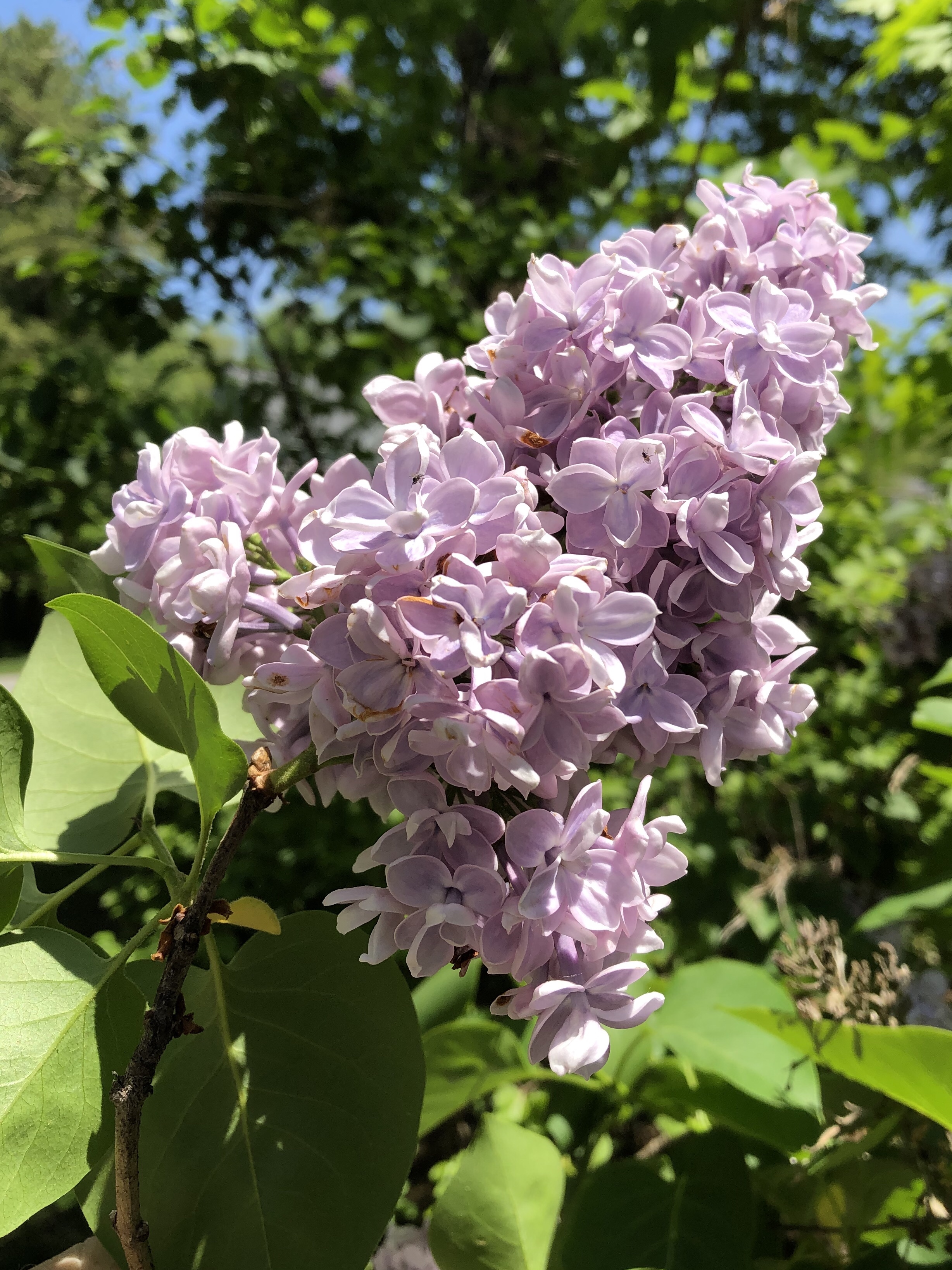
    A garden is a complete sensory experience, and any gardener will tell you that the smells of the garden are as memorable as the sights.  Monarda smells like tea leaves (because they are), tomatoes and marigolds announce the return of summer with a sniff of their leaves and stems.  Basil, mint, rosemary and other herbs have their own delightful fragrance. And of course the flowers offer their own too.  We’re witnessing the long parade of flowers each in turn announcing their time to shine.  For the last couple of weeks that time has belonged to the lilacs.  Their dance isn’t nearly long enough before they recede into the background of the garden like most flowering shrubs.  The magic in lilacs is the fragrance. And they sway in the breeze releasing it to all who come nearby. I make a point of visiting every chance I get, but notice others who love lilacs as much as I do never make the effort to pay them a visit. So I quietly bring them inside to perfume the kitchen. And celebrate spring in New Hampshire.


  • Choice White Pines and Good Land

    I have a fascination with maps, and especially old maps, that dates back to when I was a kid tracing the route that we would take on family vacations.  When I started driving myself around I bought maps to help me navigate first the town I lived in and later New England and points beyond.  As a hiker I’d plot out where I’d be able to refill water bottles and camp for the night.  Maps were essential for navigating the world.

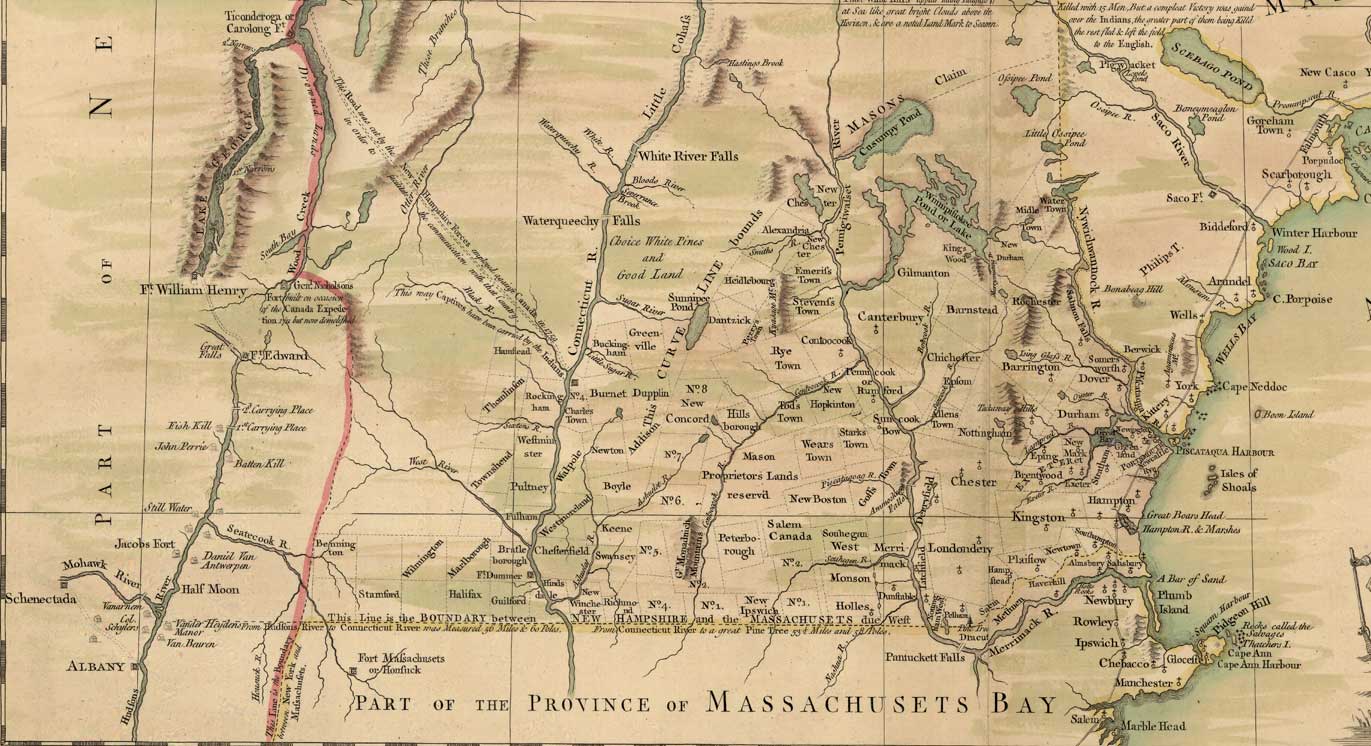
    Today GPS has stolen the magic of maps for everyday use in getting from point A to point B, but they can’t completely replace them.  I still plot out trips on Google Maps to plan the most efficient route.  I still love a good map; evident in the title of this blog.  So it was a delight to find a gem of an old map from 1761 created by Joseph Blanchard and Samuel Langdon.  This map has wonderfully random reference points like “From Connecticut River to a Great Pine Tree” and “This way captives have been carried by the Indians”.  This is a map you can fall in love with.

    Joseph Blanchard was born in the Nashua area and served as a Colonel during the French and Indian War.  He teamed with Samuel Langdon to create this map, which was published after Blanchard’s death.  It’s an amazing time capsule that highlights some contentious early days in our colonial history.  For me, the part of the map I love the most is in the present-day Plainfield/Montcalm area where the map designers noted “choice white pines and good land”.  A name like Montcalm jumps out if you’re talking about the French & Indian War, but apparently it’s not what the selectmen in that town were striving for when they named it.

    If you search online you’ll find there are a couple of versions of the map available for  viewing.  The black and white version I have above, and a color version, a portion of which I show below.  The towns have mostly remained the same, with a few splitting into a multiple towns along the way.  The rivers are fairly accurate, which is notable since these were the superhighways of the day.  The map reaches as far west as Schenectady and as for North as Quebec.  This territory was ground zero in the French and Indian War, and the wars with the French that preceded it.  It would be important again during the early years of the Revolutionary War.  I’ve had the opportunity to travel most of this region over the years, and spend a lot of time writing about it in this blog.  So this map put a spell on me that I haven’t shaken loose from just yet.

    “The paradox of mapmaking… is that as soon as you begin shrinking a geography down to usable size, you necessarily are forced to misrepresent it. By making choices about what to include and what to leave out, you change the map from a document faithfully documenting an area to one furthering a particular point of view.” – Michael Blanding, The Map Thief

    Blanchard and Langdon created a map that clearly furthered a point of view, lending credence to Blanding’s observation. The history buff in me delights in reading it. Would it look the same if a Native American warrior had drawn it? Surely not. But the map no longer serves the purpose of furthering a point of view as much as it creates a snapshot of what the map’s creators were thinking at the time. Either way it’s a fascinating dance across time.

  • General John Stark

    If New Hampshire has a favorite son, it’s John Stark.  The State Motto is a truncated quote from Stark, “Live Free or Die” and of course the people of New Hampshire have a certain Stark independent streak that lives on to this day.  As a transplant from Massachusetts who lives 7 miles from where Stark was born, I’ve come to appreciate the New Hampshire way of thinking more each year.  This is my 25th year in the Granite State and it’s high time I focus on New Hampshire’s Revolutionary War hero.
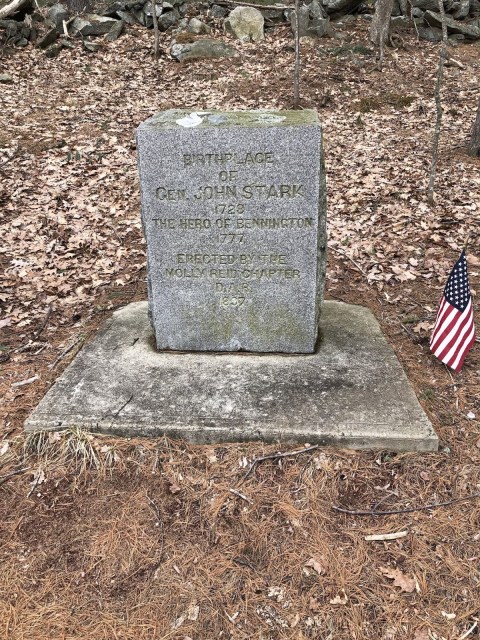
      In each phase of John Starks adult life he had extraordinary moments that would on their own be the highlight of someone else’s story.  As a 24 year-old young man he was captured by the Abenaki while hunting near the Baker River/Mount Moosilauke area.  In captivity he was forced to run the gauntlet but grabbed the stick from the first warrior in the line and attacked him instead!  This endeared him to the Abenaki and they adopted him into the tribe.  He was eventually ransomed back to freedom but this time with the Abenaki would remain a part of him.
    Five years later, with the French and Indian War making New Hampshire a war zone, Stark joined Robert Rogers as a Second Lieutenant and later Captain in Roger’s Rangers.  He participated in many of the legendary battles of the Rangers, including Battle on Snowshoes and other skirmishes around Lake George, New York.  Stark learned a lot from the tactics of Rogers, who in turn had adopted the tactics from the Native American warriors they were fighting against.  This would prove handy in the war to come.
    One event that Stark chose to sit out was the raid on St. Francis, an Abenaki village just over the present-day border of Canada.  Stark opting out was a sign of respect for those who he lived with five years before during his captivity.  It’s a great indicator of his character.
    After the war, Stark returned to his home in Nutfield (Londonderry) to work his farm.  Stark was married to Molly Page Stark, a legend in her own right, and had 11 children.  The Starks were clearly productive on the home front when they weren’t fighting wars.  Molly was a champion for smallpox vaccination, which involved deliberately infecting yourself with a small bit of smallpox, which, if it didn’t kill you, would make you immune to a worse case of it.  Smallpox was a major threat to the Continental Army during the Revolutionary War.
    During the Revolutionary War, John Stark became a legend.  He was one of the first to answer the call to arms, and fought in the Battle of Bunker Hill, where his experience in the Rangers paid dividends.  Stark’s saw immediately what the vulnerabilities were on the northern flank in the defense of Breeds Hill and built a breastwork from old stone walls to defend the Americans from a possible beach landing on the Mystic River.  This proved to be salient as that’s exactly what the British did.
    In a brilliantly orchestrated defense, the first line of New Hampshire militia fired on the attacking British and ducked down to reload.  The British kept advancing with fixed bayonets but were mowed down by a second line.  And then a third line mowed down the advancing British.  By then the first line had reloaded and mowed down the still advancing British and they finally retreated, abandoning the flanking strategy for a full frontal assault elsewhere.
    Stark would later serve George Washington at Princeton and Trenton, but unlike Benedict Arnold, he chose to tell the Continental Congress to take a hike when they passed him over for politically motivated promotions to General.  He returned to New Hampshire but left the door open for further action if needed.  And he was absolutely needed.
    In August 1777, the British Army was moving down from Canada, taking Fort Ticonderoga and working towards Albany.  The goal was to meet with the British forces coming up the Hudson River from the New York and cut off New England from the rest of the colonies.  This would effectively end the war as the British would control the flow of people and supplies.  British General John Burgoyne led an expedition to Bennington to raid supplies stored there.  That’s where he ran into the combined forces of Vermont and New Hampshire, led by 49 year-old John Stark.

    As Stark rallied his troops to attack the British, he shouted the second-most famous sentence he ever produced; “There are your enemies, the Red Coats and the Tories. They are ours, or this night Molly Stark sleeps a widow!”  The first half of that statement is contested.  What seems to have consensus is the “Molly Stark sleeps a widow” part.  Hell of a rallying cry for sure.  During the battle, Stark showed his strategic mind once again by flanking the combined forces of the  British, Loyalists, Indians and Canadians in a double envelopment, creating panic in the ranks of the enemy.  Many of them fled, leaving the British to face a full frontal assault from the majority of Stark’s New Hampshire men, which routed the British and set the stage for victory at Saratoga.

    John Stark, like General Sherman after the Civil War, chose to retire from the spotlight and move back to his farm in New Hampshire.  He lived out his life on his farm in Derryfield (now Manchester).  At the age of 82 he declined an invitation to participate in events commemorating the Battle of Bennington as his health was declining.  Instead, he sent a note with a toast to his old soldiers participating in the events.  It contains his most famous words, familiar to most everyone even if they don’t recall the source; “Live free or die: Death is not the worst of evils.”

  • Live Free or Die

    New Hampshire has a strong bond with Quebec, even if most people who live in the state aren’t always aware of it.  There’s an independent streak in Quebec that strongly mirrors the independent streak in neighboring New Hampshire.  There’s an obviously population blending as many French Canadians moved to the jobs the Industrial Revolution offered in America.  One clue of the bond is the highway signs, which welcome French Canadians in both English and French.  Welcome and Bienvenue are prominently displayed, along with the state motto “Live Free or Die”.  If New Hampshire is famous for anything, it’s Live Free or Die.

    The expression is more meaningful if you reflect on the entire phrase written by General John Stark to commemorate the Revolutionary War’s Battle of Bennington;  “Live free or die: Death is not the worst of evils.”  John Stark is a fascinating, bad-ass kind of guy who I’m going to write about more in a separate post tomorrow, but suffice it to say, he lived the words.

    The expression isn’t entirely an American concept.  Around the time that Stark wrote these words, the French were saying the same thing in the French Revolution; Vivre Libre ou Mourir, which literally means Live Free or Die.  So perhaps changing the highway signs to reflect both the English and French words would be appropriate.  It would be a nice way to bookend the sentiment: Welcome, Live Free or Die/Bienvenue, Vivre Libre ou Mourir.  I think our neighbors in Quebec would appreciate that.