Tag: New Hampshire

  • Awaiting Discovery

    “It is remarkable that men do not sail the sea with more expectation. Nothing remarkable was ever accomplished in a prosaic mood. The heroes and discoverers have found true more than was previously believed, only when they were expecting and dreaming of something more than their contemporaries dreamed of, or even themselves discovered, that is, when they were in a frame of mind fitted to behold the truth. Referred to the world’s standard, they are always insane.” – Henry David Thoreau, Cape Cod

    This is a year of the commonplace and unromantic if you let it be.  Lockdowns and border closings and mandatory quarantines tend to temper the passions of the high agency traveler.  But then again, if you keep your expectations and dreams focused on regional adventuring until things open up again you might just find the world under your nose.

    Yesterday I watched a bobcat, set against the snow, on the hunt.  It was slinking along the edge of the forest where the fence announces wilderness begins.  I expect it was attracted to the bird feeder activity, for there were squirrels and juicy birds for the taking for the ambitious hunter.  Unlike my snowshoe hare encounter I wasn’t prepared for a picture, and I settled for locking her image in my brain.

    Leaving Cape Cod the other day I stopped to fill up the tank and, glancing up, noticed 9-10 osprey hovering in the wind, all clustered together.  I’ve never seen so many osprey flying together, and there they were right above me gliding gracefully about.  By the time I finished fueling the car the osprey had drifted away to awe others elsewhere, but damn if they didn’t capture my imagination first.

    For all his fame as a transcendentalist and beholder of truths, Thoreau didn’t travel very much in his lifetime.  He spent most of his lifetime in Concord, Massachusetts, with notable trips to Cape Cod, up the Concord and Merrimack Rivers to the White Mountains, to the Maine woods, and one solitary trip across an international border when he visited Quebec.  And yet he saw more than most people who travel far beyond the northeast corner of North America.

    There’s light at the end of the pandemic, though we remain in a dark and treacherous tunnel.  This isn’t the time to cross borders, but the world outside our Twitter feed remains vibrant and alive, awaiting discovery.  The bobcat,  osprey and Thoreau have each inspired me to shake off the creeping prosaic mood that shorter, darker days cloak you in and dive back into adventuring.

    Et toi?  Are you ready to re-join the hunt?  Nothing remarkable was ever accomplished in a prosaic mood.
  • White Cap

    “I am in love with Ocean
    lifting her thousands of white hats
    in the chop of the storm,
    or lying smooth and blue, the
    loveliest bed in the world.”

    – Mary Oliver, Ocean

    I anticipate a white cap day on Buzzards Bay as a Nor’easter rolls through. For now the bay is restless but content to let the rain fall in abundance to its surface instead of rising up to meet it. For the march of thousands of white hats the current and wind must be more contentious than this. It will come in time, as it always does on Buzzards Bay.

    Nor’easter days are meant for hunkering down, catching up on reading and sipping hot beverages. On Cape Cod the storm will bring heavy rain and high winds. The salty water will surely rise to greet her fresh visitors. I’m a visitor myself; like a river forever moving between the mountains and the sea. I want to leave the comfort of the warm house to walk on the beach. You don’t come this far to look at it from afar. For I’m mostly water, shouldn’t I rise up to meet it too?

    Up in New Hampshire all this water will mean white hats of a different kind, with heavy snow in the mountains and clever swirls of white donning posts and mailboxes in the lower elevations. I’ll welcome the grace of snow-packed trails covering the ankle-breakers when I return to the mountains. Whenever that might be – I really don’t know. But they’ve heard my silent promise to return. We have unfinished business, those mountains and me.

    I laugh when I read polls asking where you would want to live forever. How do you choose between the mountains and the sea? Its a Sophie’s Choice question; asking one to pick between a mountain waterfall and the crashing surf. Instead I look to the Abenaki who moved for generations between the White Mountains and ocean fishing villages. They didn’t choose one over the other, they chose a life in between. And that’s where you’ll find me too.

    So today as the white caps rise, I’m reminded of the Mary Oliver poem above. I’m on the very edge of that in between for this Nor’easter, and the chop of the storm has begun. Who’s up for a walk?

  • From Asquamchumauke to Baker: What’s in a Name?

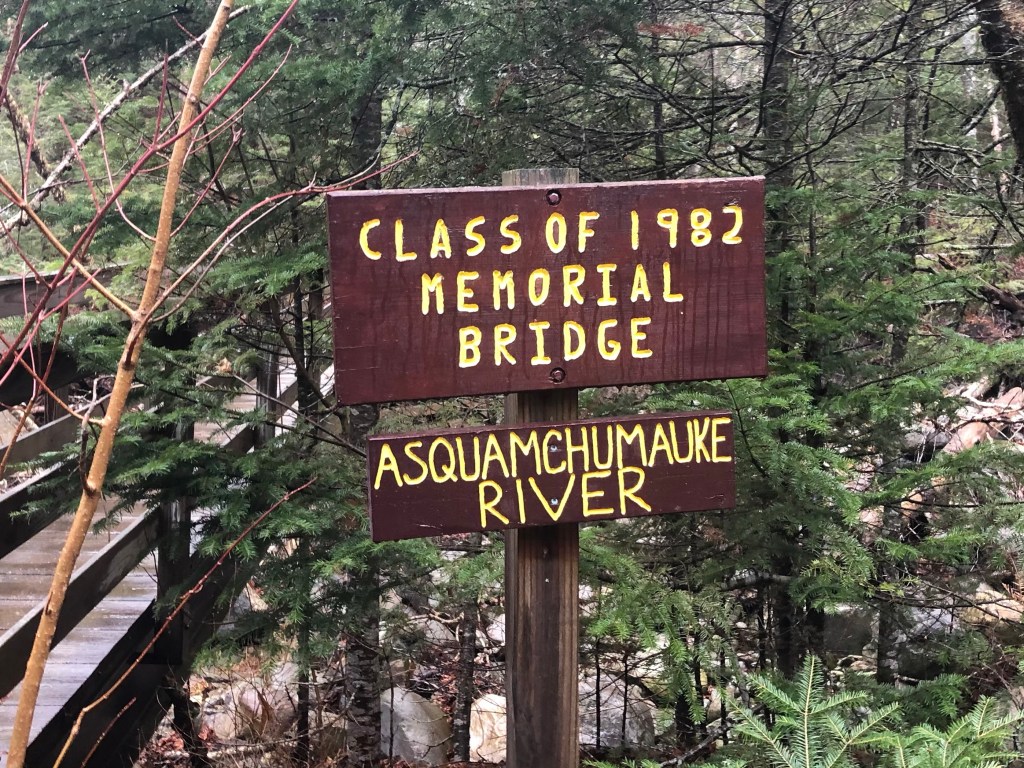
    The Baker River flows from Mount Moosilauke to the Pemigewasset River in present day Plymouth, New Hampshire. On the map the name is cut and dried: Baker. But when you cross the river at the Gorge Brook Trailhead another name emerges from the past: Asquamchumauke. History once again whispering for all who might hear.

    Dartmouth College honoring the original name

    Asquamchumauke means “crooked water from high places” in the language of the Abenaki tribes that once thrived here. It’s a lovely, descriptive name that brings romantic notions of Native Americans living in this place for generations. Yet we’ve called it Baker since well before the American Revolution. The story behind the name change is another fascinating chapter in the violent history of New Hampshire.

    Thomas Baker was a soldier in Deerfield, Massachusetts on February 29, 1704 when the Deerfield Raid occurred. Deerfield was a seminal event in Queen Anne’s War and New England history. French and Native American warriors overran the fortified settlement, 47 settlers were killed and 112 captives, including Baker, were marched up to Montreal. The Native American warriors came from around the northeast, including several tribes of the Wabenaki Confederacy. One of them was a Pennacook sachem named Wattanumman.

    Whether Baker and Wattanumman met during the fighting or forced march to Montreal is unclear, but events would bring them together again eight years later. Thomas Baker led an expedition north with around 30 men and ambushed Wattanumman, a dozen of his men and their families at the site in present-day Plymouth where the Asquamchumauke River meets the Pemigewasset River. Wattanumman and several others were killed and scalped. The men collected furs and anything of value and brought it all down to Massachusetts where Baker was rewarded for his efforts with £40.

    And this is where present-day morality meets the violent frontier morality of New England in the earliest days of our history. Both men participated in violent raids against the other in a time of war. But for fate Baker might have been killed in Deerfield, which may have extended Wattanumman’s life a few more years. Who knows? All of us are subject to the whims of fate.

    There was one other reward for Thomas. To honor what Baker and his men did in this place the name of the river was changed from Asquamchumauke to Baker, a name it still has today. With one event the life of Wattanumman was erased, and the legacy of Baker was sealed. We Americans tend to honor people with place names, while the Native Americans honored the spirit of the place itself. Asquamchumauke: crooked water from high places.

    Has a nice ring to it.

  • Hiking Mount Moosilauke

    I’ve heard about this mountain from several people. Popular because of the great payoff in views and experience for the amount of energy expended compared to other trails. I’d even heard about the Dartmouth Lodge at the head of the trail we were hiking. But you forget what you’ve heard before when you see such places. It served as another reminder that you must get out and see for yourself wonders in this world while you have time.

    There are several trails up to the summit. I’d highlighted the Beaver Brook Trail as one to do based on the cascades there, but with the gimpy ankle my hiking buddies chose an easier trail for this day. The warnings about the Beaver Brook Trail certainly discouraged trying it on an icy day like yesterday. Here’s a typical warning from the AMC: This trail may be extremely dangerous in icy conditions. Okay, got it. Instead we hiked the Gorge Brook Trail out and back. Easier, beautiful, and comparatively free of the ankle-busters you experience on most White Mountain trails.

    Ultimately, this hike made me feel better about the progress of my ankle as it wasn’t a factor. It also made me feel better about the progress of my fitness as the rowing has improved my stamina enough that I didn’t feel winded chasing jackrabbit hikers up the trails. Granted, this was an easy trail and they were likely taking it easy on me.

    Yesterday was several hikes in one. The lower section was wet and a bit muddy in places. The snow started accumulating on ice at higher elevations and prompted us to slip on micro spikes for crunchy hiking. The wind became a factor above tree line. Layers were added and thicker gloves went on. And then on the descent the micro spikes became leaf catchers and clumped up enough that we all opted to stick them back in the packs.

    Moosilauke means “bald place” I’m told, and the summit is fully exposed as advertised. What isn’t guaranteed when you hike is the view. This one would be socked in with fog and snow. No matter, for views are a notable bonus, but hiking the trail to the summit is the goal all along. I’ve got this one on my short list of summits to return to again on a clear day.

    Socked-in summit
    Foundation at summit
    In-between season where there’s snow but still exposed rock
    Snowshoe Hare (see yesterday’s post)
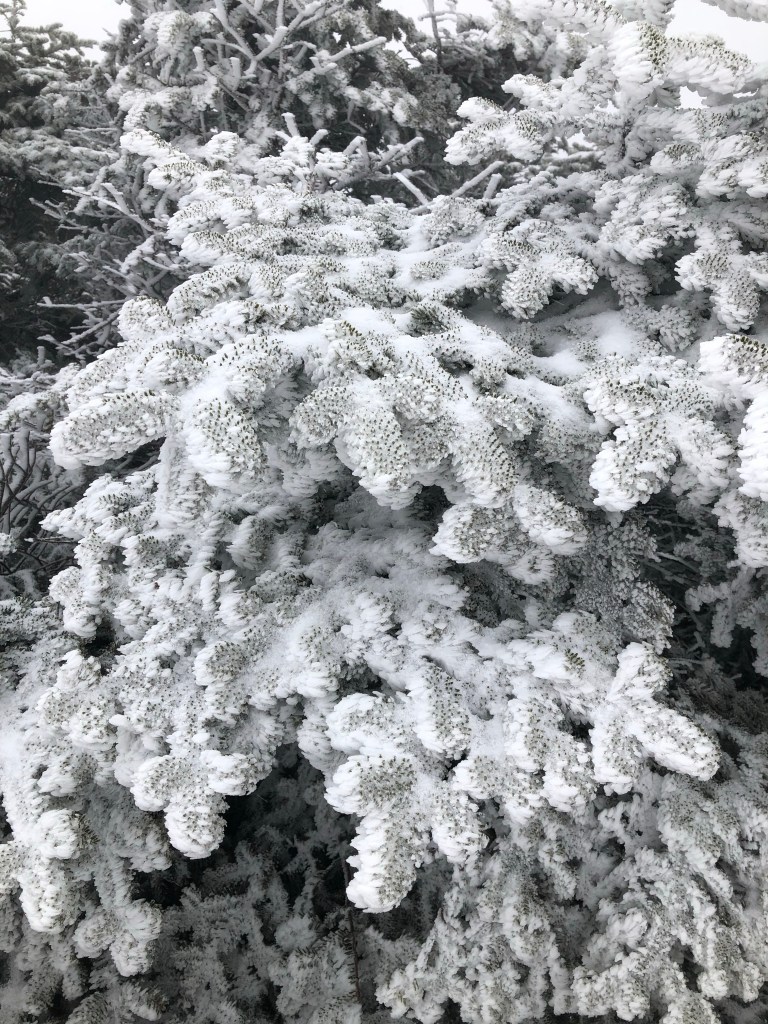
    Rime ice and snow frosting
  • Encounter with a Snowshoe Hare

    The snowy and windy summit of Mount Moosilauke wasn’t a place to linger long. We’d summited and were about to head down below tree line to have lunch when I saw some rime ice building on a cairn and took my iPhone out to snap a couple of pictures of it. Just then I heard a shout from a couple of hikers nearby and a flash of motion. One of my hiking buddies shouted “It’s a Snowshoe Hare!” and a quick glance confirmed it was indeed. With the camera already on I was able to snap a few photos as the hare bounded around me and towards the cover of trees.

    Snowshoe Hare

    The Snowshoe Hare, with the excellent Latin name Lepus Americanus, is native to New Hampshire and loves throughout North America’s colder regions. Its hair turns from brown to white in the fall, triggered by the change in light just as leaves are. The hare I saw looked huge, but it was probably about 5 pounds, which is on the heavier side of their weight range. The distinctively huge rear paws act like snowshoes to launch the hare forward. It was literally born to run in snow.

    As we descended from the summit we wondered what the heck the Snowshoe Hare ate in winter. Looking around there just wasn’t much edible stuff around. According to a State of New Hampshire survey on the animals, they eat up to 2/3 of a pound of “woody browse” per day, and also re-ingest their soft droppings…. yum. May have been better to leave it a mystery.

    Seeing a Snowshoe Hare running through snow in the wild is absolutely thrilling. The only thing more thrilling would have been seeing a lynx or fox chasing after it in a high stakes race. Nothing like that today, just a bunch of appreciative hikers buzzing about the blur of white fur that graced us with a speedy show. And it proved that when you get out there you may just see something amazing.

  • The Grinch Seeks the Seashore

    “The sea-shore is a sort of neutral ground, a most advantageous point from which to contemplate this world.” – Henry David Thoreau, Cape Cod

    I’m a bit of a contrarian in this family. While others are planning to transform the house into a Christmas wonderland, I’m thinking about cold and isolated beaches. Don’t get me wrong, I like warm beaches too, but they’re in short supply this time of year in New England. And when they’re warm they definitely aren’t isolated.

    I saw some of the extended commercial they call the Macy’s Thanksgiving Parade on NBC yesterday while prepping for Thanksgiving dinner. The best way to watch the parade is standing on a street corner in New York. But maybe not in a pandemic. The second best way to watch it is on mute so you don’t have to hear all the breathless commercials for each sponsor as some designated singer lip syncs their cover of a holiday song that will be featured on some rom com special on… NBC. But really, I love the holidays.

    Christmas decorations are lovely, the problem is me. I don’t turn on a dime like that. I don’t rush out to grab whatever is on sale, I don’t flip a switch to start Christmas the moment the Thanksgiving dishes are cleaned, and I don’t have all my gifts purchased yet either. I like to ease into the holidays one at a time, thank you.

    So while the holidays are ramping up in this New Hampshire household, I’m thinking about staring at the ocean. Perhaps too many SV Delos videos? Too much time away from the sea? Really, it could be any number of things, but mostly I think I’m not ready for the crush of Christmas. And yet here we are anyway.

    I’ve plotted an escape. A quick weekend on Cape Cod next weekend to stare at Buzzards Bay, feel the brisk wind on my face, and mentally shift gears from Autumn to winter. Cape Cod in early December is wondrously quiet, which is just what the Grinch needs before he switches to Have Yourself A Merry Little Christmas.

    But that’s next weekend. Today the Grinch strings Christmas lights on dormant trees. After all, it isn’t all about you. Right? Happy Holidays.

  • Scenes from a Wildlife Camera

    The young buck appears on the screen for a total of five sequenced pictures. He’s making his way through the woods. I count the points and it appears that’s he’s legal for hunters. I think about him when I hear the guns fire in the distance in the next few days. November is no time to be straying into open woods with a rack. I hope this guy makes it through to see another season, for I’d like to see what he looks like in a year.

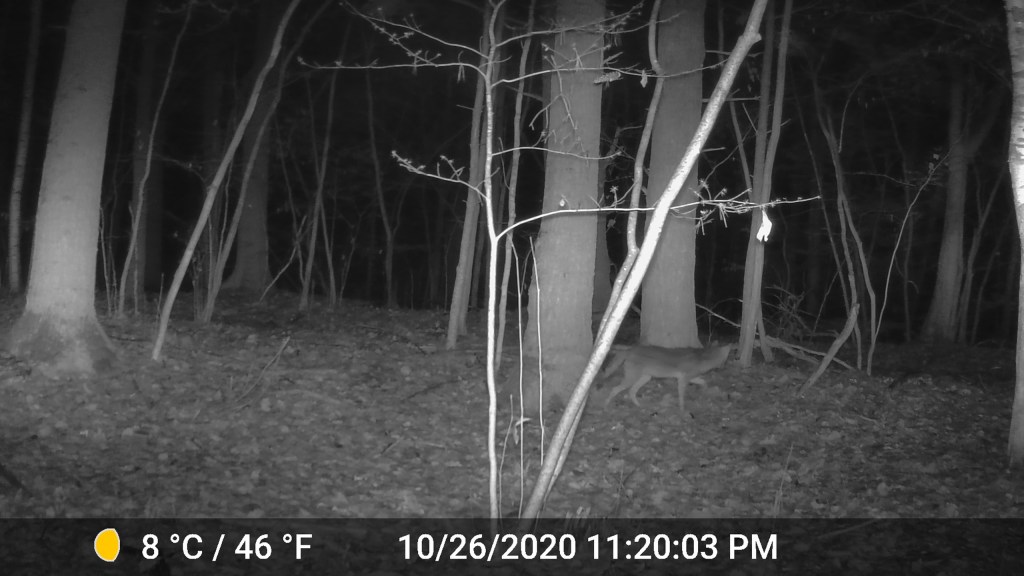
    Nearly in the same spot a coyote nested a week before. I wondered if the buck smells the coyote when he walks by. But this time of year scent changes quickly as leaves stack up and the rain washes everything down. Strangely, there’s only the one coyote on the camera. I thought they were social animals, yet here he was alone in the woods. He took a quick nap under this tree on at least two occasions.

    Of course, not everything happens in the night. The wild turkey roam through the scene in large numbers during the day. This is so commonplace now that it hardly warrants a mention, but even now there’s something interesting about watching these large birds. There’s clearly a pecking order in this rafter, coordinating movement through the woods and spooking would-be predators like that coyote.

    I put up the wildlife camera after years of wondering what walked unseen through the woods behind us. I’ve seen plenty over the years from the yard or from an upstairs window, but hearing that bear crunch through the woods last month finally inspired me to get the camera up and running. To find what defies the eyes peering into the darkness. And it hasn’t disappointed. It’s a bit like Christmas morning walking out to see what it picked up every week or two. Isn’t it always interesting to see what the neighbors are up to?

    We had a fire again on Friday night. I could hear something crunching in the woods. Not as loud as the bear, not as stealthy as the deer. I wondered what it might be? This morning I may take a walk out to the camera to see who our visitor was. I’ve come to enjoy solving a good mystery.

  • Reflecting in the Present

    “When purple colored curtains mark the end of day
    I’ll hear you, my dear, at twilight time”
    – The Platters, Twilight Time

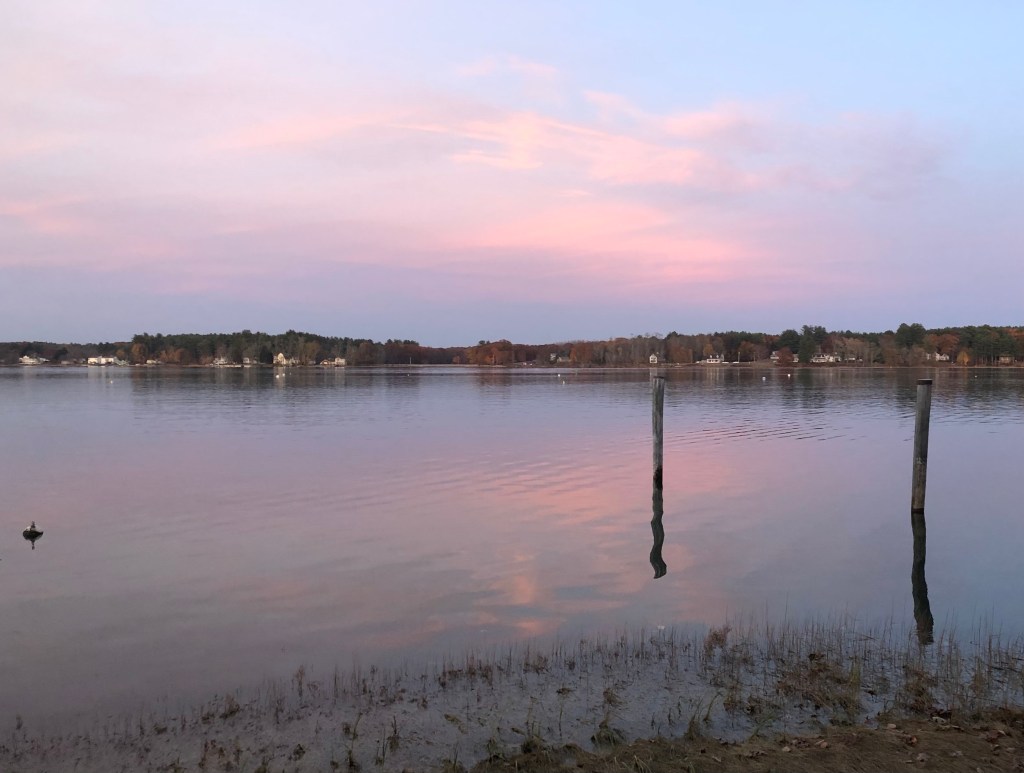
    Piscataqua River

    The sunset gets all the attention, and sure, when you have a western view at the right time of day you enjoy the show. I take great pains to see as many as I possibly can too. But my favorite Navy pilot reminded me long ago to turn around and see what was happening in the rest of the sky, and as we were offered a view of water and a glass of rum to celebrate Democracy in action last night we watched the sun setting on the Piscataqua River in Dover, New Hampshire. The windows on the opposite shore (in Eliot, Maine) suggested the sunset we were missing while we were looking east, but the night was calm, the rum was good and the company was exceptional.

    Looking east at twilight offers something beautiful. It’s a look back on where you’ve been, even as the sun draws you over the western horizon. We can appreciate where we’ve been before, regret moments lost and mourn those we’ve lost. Alternatively, we can look ahead, ignoring where we’ve been before and barely acknowledging where we are now in our scramble to get somewhere else. But really, all we have is now. Here you are lingering in between; reflecting in the present.

    The view in the present can be stunning or off-putting or maybe even monotonous at times, but its our view no matter what we think of it. We can learn from the past, build towards the future and slowly, incrementally change our present – moment-by-moment. Looking east, I reflect that what’s done is done. We did our best with the time we once had. Looking west, I eagerly plot a future I can only hope to arrive at. Reflecting in the present gives us a chance to reset. To pivot towards a better future, built off of who we once were and who we are now. And to celebrate the day we’ve been given even as we hope for a better tomorrow.

  • Election Day, United States

    Polls open at 7 this morning, but I’m awake at 5 AM ready to go. I run through a list of necessary chores like folding laundry and taking the trash bin to the curb for pick-up. Glancing up I see Venus shining through the leftover clouds to remind the waning gibbous moon that it isn’t the only show in town. Rain overnight and my ankle reminds me to get back to working out soon, if only to lose a few pounds acquired since the last hike.

    The shirt selection was easy this morning. The Mount Gay Rum shirt to honor a voter who can’t be here with us today to do the one thing he wanted to do most: help vote the current President out of office. He was a Navy guy and saw through bullshit as quickly as anybody I know. I saw through it too and my vote is his vote today.

    Election Day in the United States is an ebb and flow event. Some years there’s a slight buzz about the upcoming election and banter between the parties. Other years get a lot of attention, with an urgency to vote to keep the country on track. And then there’s 2020, when the worst candidate this country ever elected is up for re-election. 2020 isn’t a roar, it’s a hurricane raging over an earthquake. This year the election is setting records well before election day, with absentee ballots cast, and pre-voting in states that allow it blowing away previous voting records for entire elections.

    Which brings us to today. I’m skipping the coffee this morning until after I vote, anticipating a long line to pick up my ballot. Heck, I’m expecting a long line just to get a parking spot. So no full bladder this morning, thank you. Today we vote for our representatives for Senate and the House of Representatives, for state and local officials, and we vote for President. But we vote as if nothing else matters this morning. Because in many ways, nothing else does.

    The Founding Fathers gave me (as an educated white male) the right to vote in the Constitution. It took the 15th Amendment to give people of color the right to vote. And it took the 19th Amendment to finally give women the right to vote. And so here we are, finally all united, with our collective right to vote. When enough people choose to participate we get the country we want. When too many skip the election thinking it doesn’t matter we get the country we deserve. The last four years have been a lesson for those who weren’t previously paying attention. Today matters. Vote.

  • Hawks and Squirrels, Bears and Goats

    As the leaves fall the big reveal begins. What exactly have the neighbors across the way been doing all summer with all that building and landscaping? We’ll know soon enough. The golden leaves of fall are quickly conceding to fate and weather, dropping in abundance to coat the ground in a blanket of yellows and reds. And suddenly we see what was screened for months.

    I watched a red-tailed hawk flying rapid spirals up and down a white pine tree, wondering for a moment if it was injured, then recognizing the reality of what was happening. The hawk chased a gray squirrel that was scrambling up, down and around the trunk trying to reach the relative safety of the branches above, but found itself stuck in the long exposed trunk. Its only chance was this spiraling scramble. And this is where the hawk proved to be an expert flyer, keeping pace with the squirrel for what seemed like forever. But suddenly it was over, the hawk flying to a nearby branch, exhausted perhaps, but having the food that would keep it alive to fight another day. I picked my jaw up off the ground and left the hawk to its meal.

    The big reveal brought another surprise. I knew the neighbor’s didn’t have a dog, but caught a glimpse of an animal walking back and forth on their patio. A look over the fence confirmed it was a goat pacing back and forth near the patio door. A text to the neighbor to inform them of the visitor and a visit from Animal Control and the goat’s owner revealed the truth of the matter: this goat was a survivor, having run away from a black bear that’s been breaking into animal pens for a week now killing chickens and goats. Dangerous, unusual behavior for the bear. And the State of New Hampshire has taken notice, setting traps to try to move this dangerous character out of the area.

    And so it is that I finally put a wildlife camera out in the woods, beyond the old stone fence that separates land that I pay taxes on from land that is preserved and funded by all taxpayers. After close encounters with deer, coyotes, fox, opossum, skunks, raccoons, groundhogs, bobcats, fisher cats, snapping turtles, assorted rodents, bear and now a domesticated animal I’ve finally taken the hint. That preservation land is an animal highway between the brook on one side and the larger forest on the other. The land that I pay taxes on was once part of that highway, until I put up a fence to keep the dog from meeting this parade of characters marching by. Having shifted the corridor over to the other side of the wall the least I could do is capture images of the travelers. And I wonder what will we find stored on the memory card? There’s still some time left in 2020, what haven’t we seen yet? Unicorn? Centaurs? Griffons? In this year of years nothing surprises me anymore.