Tag: Nova Scotia

  • Halifax Christmas Tree

    If you live in Boston or Halifax you likely know Boston’s Christmas tree is an annual gift from Halifax. Since 1971 Halifax has sent a tree to Boston. Fifty years of tree giving. This isn’t inconsequential. The cost of transporting a tree 700 miles to Boston surely add up. So why make the commitment at all? The story behind that tradition is lesser known.

    In 1917, at the height of World War One, a French ship named the SS Mont Blanc was loaded with munitions and set out from Halifax Harbor for Europe. The ship would never leave Halifax. She collided with another ship in the narrows and caught on fire. When the fire reached the munitions there was a massive explosion that wiped out part of Halifax, killing over 2000 people and injuring another 9000. At the time it was the largest manmade explosion in history. And it occurred in a heavily populated area.

    When Boston’s Mayor Curley heard about the tragedy, he immediately sent a group of doctors and nurses to aid Halifax with medical supplies. Boston’s response was actually significantly faster that Ottawa’s. The team of doctors and nurses spent Christmas 1917 in Halifax, decorating Christmas trees in the hospitals. The bond between Halifax and Boston was forever fused.

    The connection between the two cities goes beyond Christmas trees: Halifax broadcasts Boston’s WCVB and also has a large following of Red Sox and Patriots fans as the games are broadcast there. And then there’s family connections. Since the Port of Halifax was the Ellis Island of Canada, many New Englanders are descendants of immigrants who came through Nova Scotia. The bond is indeed deep.

    In 1971, within the lifetimes of many of the people who lived through that tragedy, Halifax began donating a tree every year. I bet there were several survivors of the explosion who shed a few tears the day that first tree was shipped to Boston. Boston remembered as well, and the tree serves as a reminder of the common bond between the two cities. Today is the lighting of the Christmas tree in Boston, and we turn our eyes north to our friends in Halifax.

    The pandemic has closed borders, blocking access to people and places we took for granted. With the border closed even the Christmas tree took a unique route to Boston in 2020: It was shipped from Halifax to Portland, Maine and then driven down the rest of the way. Many of us look forward to having the borders open again so that we may once again see our friends and kin up north.
  • Sailing the Gulf of Maine

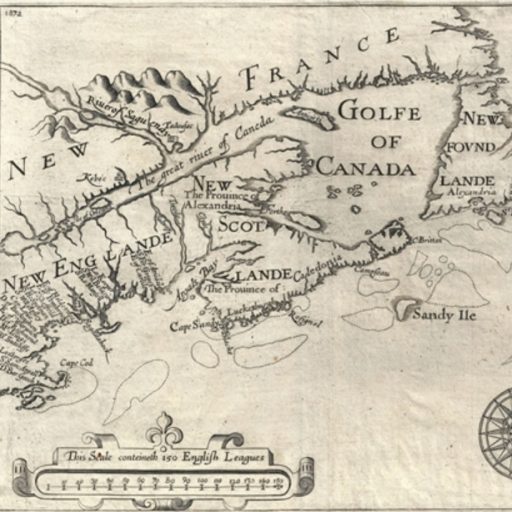
    The Gulf of Maine is a corner of the Atlantic Ocean embraced by Cape Cod to the South and Nova Scotia to the Northeast.  The longest stretch of land in between is part of Maine, which gives the gulf her name.  If you look at Alexander’s map, which this blog is named for, the body of water is just below the land described as “New Englande” and “New Scot Lande”.  A land mass that I’ve grown to love, that I declared I’d explore more, and that I need to return to in earnest once this pandemic is behind us.

    cropped-54b94-alexander2527s2bmap.jpg

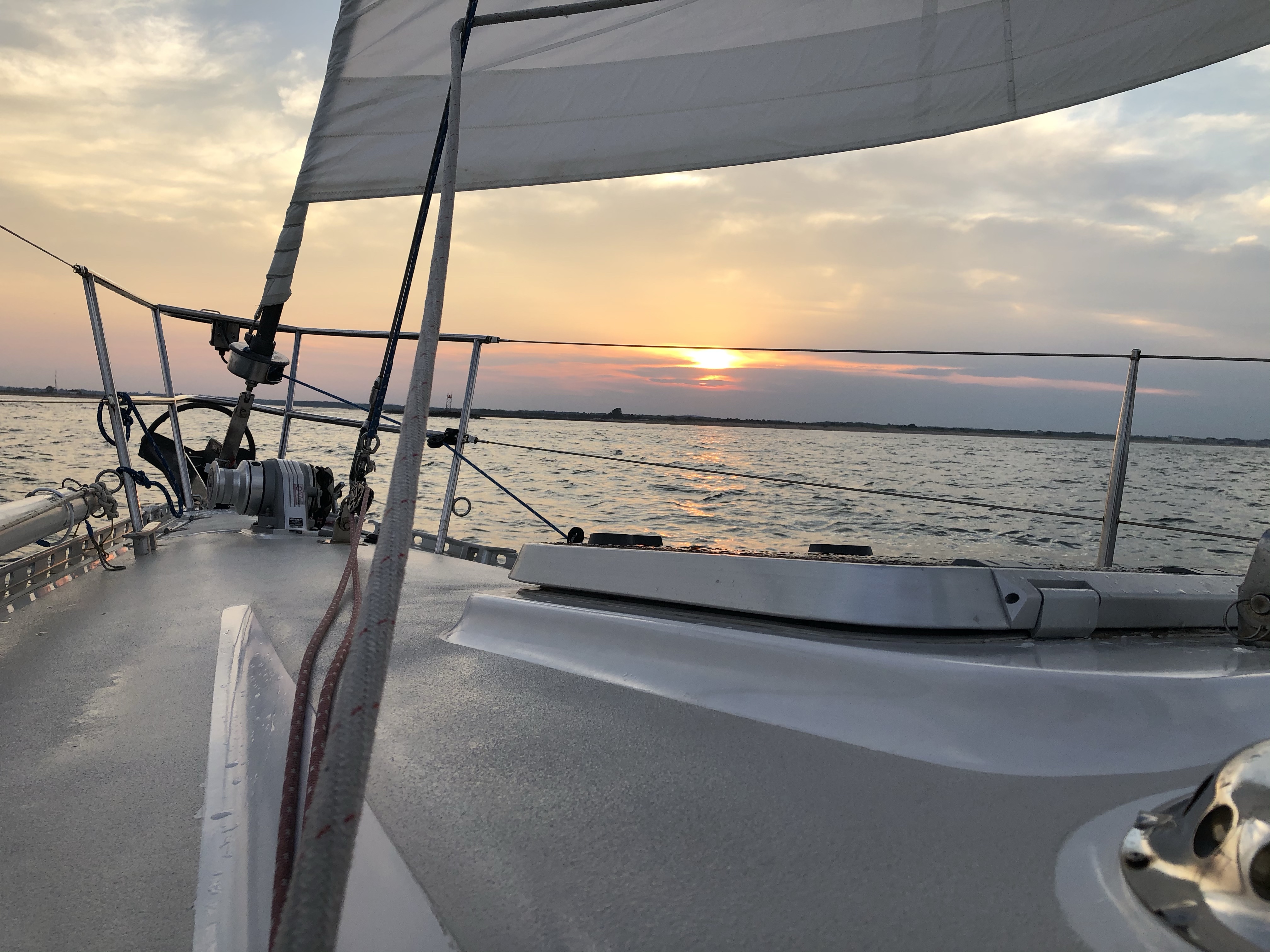
    Yesterday we had the opportunity to sail on Fayaway with friends.  It was an out-and-back sail with one tack.  We left the Merrimack River where they moor Fayaway when they aren’t exploring the world and sailed generally on a compass heading of 90 degrees, which took us roughly along the coast of Maine just out of sight of land.  Sail for 18 miles out one way, tack and return 18 miles the other way.  Not a lot of tactical sailing required, which was perfect for a day of conversation and contemplation on the water.  We had a secondary objective of seeing whales and maybe that evasive Comet Neowise, but each proved elusive on this trip.  A sunfish made an appearance, which was akin to an understudy playing the role when you came to see the star: Wasn’t what you came for, but turned out to be entertaining just the same.

    When we got out of the lee shore of Cape Ann the wave action picked up, with 3 to 6 foot swells that lifted Fayaway and reminded us we were well out at sea.  But Fayaway handles wave action well, and with her sails reefed in the 28 – 30 knots of sustained wind were comfortable for the duration.  Which invited conversation about travel and plans for the future and the kind of catching up you do when it’s just you and others and the wind and splash of waves for hours.

    I’ve learned that I’m a bit rusty with ancillary sailing terminology that goes deeper than the basic rigging, and assisted where appropriate while staying out of the way the rest of the time.  When you see a couple who have sailed together for a year covering thousands of miles you’re witnessing a well-choreographed dance.  I’m not the sharpest knife in the drawer but I know enough not to be the clumsy fop who thumps onto stage mid-act.  Instead be the quiet stagehand who puts away the props when the performers are done.  I was grateful for a patient crew who recognized the rustiness in this sailor.

    There are a few highlights when you sail up the coast from the Merrimack.  You begin with the chaos of the Merrimack River with powerboats and jet-skis racing to win perceived races to get “there”.  It reminded me of aggressive drivers on the highway shifting two lanes and back to get one car ahead.  Its the antithesis of the sailing we were doing, and I greatly prefer being out of that race.  Once you clear the Mouth of the Merrimack, sails are up and you set course for nowhere in particular.  The lines of umbrella stands on Salisbury Beach and elbow-to-elbow fishermen and women on charter boats indicate that social distancing is a guideline many choose to ignore.  I’m sure plenty were doing their best to be socially responsible, while others proved more reckless.  I considered the similarities between drivers on the highway, power-boaters racing each other in a narrow channel to get to the fish first and close-talking beach umbrella bunnies in a pandemic for a moment, and released the thought onto the breeze.  We all live our lives in our own way in America, if not always responsibly.  I was observing from the vantage point of a sailboat in close proximity with another couple, but with the mutual assurance that each couple was taking appropriate measures to avoid COVID-19 exposure.  Maybe those beach throngs were doing the same thing.  I hope so.

    Soon Fayaway moves beyond umbrellas, beyond the sight of land, beyond the hum of motorboats, and we’re in our own world.  For much of the duration of our trip out and back we were completely alone other than a couple of commercial fishing vessels busily working the waters of the gulf.  Time on the water gives you time to ponder and think, and, if you let it, to look through the swirling waves deep into yourself.  And Sunday became another micro adventure for the books.  Leaving terra firma for the sea and exploring a relatively small segment of the Gulf of Maine.  It served as a reminder that I have far to go, but where I am isn’t all that bad either.

  • His Majesty’s Pleasure: The Expulsion of the Acadians

    During the French and Indian War the British looked at Nova Scotia, New Brunswick and Prince Edward Island and saw a threat.  The Acadians, original settlers to this area from France, had been allowed to remain for 40 years after France had conceded this territory after the capture of Port Royal in 1713.  But the Acadians had never pledged an oath to Britain, and the resumption of hostilities in the French and Indian War became the tipping point.  How many in North America suffered because the French and English couldn’t get along?  Too many.

    Beginning on August 10, 1755 the British began rounding up Acadians and expelling them.  Often families were separated, with husbands and wives, mothers and children being sent to different places.  It reminds me of what happened to Japanese Americans in World War II, and what’s happening now on the Mexican border.  The weakness of moral character in people in power causing immense suffering for those who are powerless.  You can have homeland security without being an asshole.

    Henry Wadsworth Longfellow heard about the expulsion of the Acadians from Nathaniel Hawthorne.  There’s a moment when I’d have loved to be a fly on the wall listening in.  Longfellow then wrote a poem called Evangeline that told the plight of a fictional character of the same name trying to reunite with her husband.  The poem brought attention to the expulsion then, and still offers insight into their suffering now.  The Acadians were lured into church to hear at announcement, only to find out that they were prisoners, and their world was being turned upside down.

    “Then came the guard from the ships, and marching proudly among them
    Entered the sacred portal. With load and dissonant clangor
    Echoed the sound of their brazen drums from ceiling and casement, –
    Echoed a moment only, and slowly the ponderous portal
    Closed, and in silence the crowd awaited the will of the soldiers.
    Then uprose their commander, and spake from the steps of the altar,
    Holding aloft in his hands, with its seals, the royal commission.
    “You are convened this day,” he said, “by his majesty’s orders.
    Clement and kind he has been; but how you have answered his kindness,
    Let your own hearts reply! To my natural make and my temper
    Painful the task is I do, which to you I know must be grievous.
    Yet must I bow and obey, and deliver the will of our monarch:
    Namely that all your lands, and dwellings, and cattle of all kinds
    Forfeited be to the crown; and that you yourselves from this province
    Be transported to other lands. God grant you may dwell there
    Ever as faithful subjects, a happy and peaceable people!
    Prisoners now I declare you, for such is his majesty’s pleasure!”
    – Henry Wadsworth Longfellow, Evangeline

    Many of the Acadians would end up in Louisiana, and their descendants are Cajuns.  Others would go to the thirteen colonies.  Some would eventually go back to Nova Scotia, New Brunswick and Prince Edward Island.  Many others died before they reached a destination.  It a dark stain in the history of a beautiful place.  And it offers a lesson we often forget.  The decisions of a few can disrupt the lives of many.


  • Alexander’s Map

    Alexander’s Map

    A new year, and a new pursuit; this blog.  So why the name?

    Alexander’s Map is a rare map published in 1624 to encourage colonization of the lands granted to William Alexander.  The map gives an early, if inaccurate, glimpse at this region that I’m so fascinated with.  Alexander’s Map stretches from present-day Massachusetts to Newfoundland to the northeast and Quebec (“New France”) to the north.  
    My blog will cover observations from living in this region, and will also include observations from as far west as Buffalo and as far south as New Jersey.  This is where I spend much of my time, and with so much history, food, sports and geological and cultural diversity to explore it will be fun to explore this in writing.  I hope you’ll enjoy the journey with me.