Tag: Richard Koch

  • The Vital Few

    “A few things are always much more important than most things” – Richard Koch, The 80/20 Principle

    It’s that time of the year again, when strategic planning takes over, habits are re-evaluated, and revenue clicks back to zero for any business that has their fiscal year aligned with the calendar. I’ve always thrived on building the future on paper. The trick is in the execution to realize it in real life. And proper execution starts with focus. We’ve arrived back at zero and the climb begins once again. It’s a great time to re-assess the vital few.

    The vital few can be customers who prove to be most profitable over time, or your closest of close friends and mentors who bring the most joy into your life, or the key activities that bring the highest return on effort invested. We know most of the time what these are, but we chase more anyway. And this chasing of more is where things break down. Relationships become diluted and less meaningful, less time is spent with key customers, critical metrics are missed chasing after dead ends, and we become too busy to get to “it”.

    The red flag of “trivial many” is answering “How are you doing?” with “Busy”. It signals clearly that something is amiss. Usually that’s doing the 80 percent of things that aren’t going to amount to much in the end. I’m a big fan of simplifying things. Focusing on the vital few, and letting some of the trivial many whither on the vine of neglect. Really, it seems the only way to get anything meaningful done.

    “If we did realize the difference between the vital few and the trivial many in all aspects of our lives and if we did something about it, we could multiply anything that we valued.” – Richard Koch, The 80/20 Principle

    One of the vital few for me is getting enough sleep. I’m an early rise, so for me getting enough sleep means going to sleep earlier than the rest of the family. I probably missed out on some key family moments in doing so, but what happens between 9:30 and midnight that can’t happen before then? I’m more aligned with my sleep patterns and are more effective as a result. Over time this sleep habit has greatly enhanced my cognitive ability and become a force multiplier for other activities, like writing this blog. One vital habit with exponential results.

    So today I’m carefully reviewing lists of people, activities and production that make up the vital few. This is where I’ll focus heavily in 2021. Translating the dreams on paper to reality in life. And acting accordingly.

  • 11 of My Favorite Books Read in 2020

    Looking back on this maddening year, I found I read a lot of poetry that inspired and a lot of page-turner novels that distracted. It would be easy to make half this list collections of Mary Oliver poems, but I subtracted poetry from the list altogether to focus on the craft of the written novel or book. Still, I like to bend the rules, so in making my list of top ten favorite books for the year, I chose eleven. This was a nod to Charlie Mackesy, who spun a bit of magic in a year where it was essential. Illustrating the timeless nature of books (or perhaps how far behind I am in catching up), only four of the eleven were released in 2020. These eleven books are listed in no particular order, largely because there’s a bit of wonder in each of them. Each informed and delighted me.

    Breath: The New Science of a Lost Art by James Nestor
    “The more oxygen life can consume, the more electron excitability it gains, the more animated it becomes. When living matter is bristling and able to absorb and transfer electrons in a controlled way, it remains healthy. When cells lose the ability to offload and absorb electrons, they begin to break down.”

    I find myself thinking often about breathing after reading this book. Waking up with a dry mouth reminds me I need to be better at nasal breathing, when hiking I try to control my breath and focus on how I’m taking in oxygen, and when I chew almonds I crunch with satisfaction, knowing it helps release stem cells and increase bone density. This book is highly informative and strongly recommended for anyone, well, breathing.

    The 80/20 Principle: The Secret to Achieving More With Less by Richard Koch
    “Equality ends in dominance: that is one of the messages of chaos theory. The 80/20 Principle’s message is different yet complementary. It tells us that, at any one point, a majority of any phenomenon will be explained or caused by a minority of the actors participating in the phenomenon. Eighty percent of the results come from 20 percent of the causes. A few things are important; most are not.”

    This was the most highlighted book of the bunch. Honestly, there were chapters I skimmed over because they didn’t sing a tune I wanted to hear, but the theories here are sound. I wish I’d read this book at the beginning of my career, but it’s not too late to implement the core principles in many aspects of my life.

    The Splendid and the Vile: A Saga of Churchill, Family, and Defiance During the Blitz by Erik Larson
    Hitler wanted still more force applied against Britain. America seemed increasingly likely to enter the war but would do so only, he reasoned, if Britain continued to exist. On March 5 he issued another directive, No. 24, this signed by Field Marshal Wilhelm Keitel, chief of the High Command of the Armed Forces (OKW), aimed mainly at how Germany and Japan might coordinate strategy under the Tripartite Pact, which both had signed with Italy the preceding fall. The goal, the directive said, “must be to induce Japan to take action in the Far East as soon as possible. This will tie down strong English forces and will divert the main effort of the United States of America to the Pacific.” Beyond this Germany had no particular interest in the Far East. “The common aim of strategy,” the directive stated, “must be represented as the swift conquest of England in order to keep America out of the war.”

    We all grew up sort of knowing about The Blitz. This book neatly sums up just how tenuous the situation was. I fancy myself well-informed about World War II, but I learned far more from the The Splendid and the Vile than I expected to. For all our complaints about the pandemic, most of us have no idea what real sacrifice is. Larson brings us closer to understanding with this book.

    The Boy, the Mole, the Fox and the Horse by Charlie Mackesy
    “What do you want to be when you grow up?” asked the mole.
    “Kind,” said the boy.


    A beautiful, simple book. I picked this up for my daughter as a gift and read it quickly before wrapping it up. If 2020 kicked you in the ass, read this. Then read it again. The Boy, the Mole, the Fox and the Horse is art, meditation and a warm hug disguised as a book.

    Longitude: The True Story of a Lone Genius Who Solved The Greatest Scientific Problem of His Time by David Sobel
    The zero-degree parallel of latitude is fixed by the laws of nature, while the zero-degree meridian of longitude shifts like the sands of time. This difference makes finding latitude child’s play, and turns the determination of longitude, especially at sea, into an adult dilemma—one that stumped the wisest minds of the world for the better part of human history.

    I’ve danced around this book for years, never getting around to reading it. And then I went to Greenwich and saw the chronometers ticking away in their plexiglass cases and resolved to get right to it when I returned home. This is a story of perseverance solving what was believed to be the impossible. A delightful book.

    Mayflower: A Story of Courage, Community, and War by Nathaniel Philbrick
    No longer mindful of the debt they owed the Pokanokets, without whom their parents would never have endured their first year in America, some of the Pilgrims’ children were less willing to treat Native leaders with the tolerance and respect their parents had once afforded Massasoit.

    Living in New England, you can’t really get away from the story of the Pilgrims. But the part we seem to forget with the Pilgrims is how much they relied on luck and the strategic kindness of Massasoit to survive at all. It seems I’m a descendent of a Pilgrim (or two), so I’m told, and that lineage makes me all the more indebted to the Pokanokets who assured that those first few years here weren’t the last for the passengers on the Mayflower. As the quote above suggests, that indebtedness seemed to skip the next generation, paving the way for the tragedy of King Phillip’s War.

    Draft No. 4: On the Writing Process by John McPhee
    That four-to-one ratio in writing time—first draft versus the other drafts combined—has for me been consistent in projects of any length, even if the first draft takes only a few days or weeks. There are psychological differences from phase to phase, and the first is the phase of the pit and the pendulum. After that, it seems as if a different person is taking over. Dread largely disappears. Problems become less threatening, more interesting. Experience is more helpful, as if an amateur is being replaced by a professional. Days go by quickly and not a few could be called pleasant, I’ll admit.

    Reading McPhee, like reading Hemingway, it’s easy to get just a bit intimidated. The beauty of this book is that he pulls back the curtains to show you the way. Great research, editors and fact checkers smooth out the rough edges and polish the story, but the work you put into it makes the finished product shine.

    Cape Cod by Henry David Thoreau
    The ocean there is commonly but a tantalizing prospect in hot weather, for with all that water before you, there is, as we were afterward told, no bathing on the Atlantic side, on account of the undertow and the rumor of sharks. At the lighthouse both in Eastham and Truro, the only houses quite on the shore, they declared, the next year, that they would not bathe there “for any sum,” for they sometimes saw the sharks tossed up and quiver for a moment on the sand. Others laughed at these stories, but perhaps they could afford to because they never bathed anywhere. One old wrecker told us that he killed a regular man-eating shark fourteen feet long, and hauled him out with his oxen, where we had bathed; and another, that his father caught a smaller one of the same kind that was stranded there, by standing him up on his snout so that the waves could not take him. They will tell you tough stories of sharks all over the Cape, which I do not presume to doubt utterly,—how they will sometimes upset a boat, or tear it in pieces, to get at the man in it. I can easily believe in the undertow, but I have no doubt that one shark in a dozen years is enough to keep up the reputation of a beach a hundred miles long.

    This book, like Philbrick’s Mayflower, informs the native New Englander about the places that once were the places that now are. I have a stack of quotes from this book that I’m saving for other blog posts, but the one above reminds us that the question of sharks has been around a lot longer than we might believe. Like Thoreau I’m much more concerned about undertow when swimming in the surf, but hey, you never know…

    Siddhartha: A Novel by Hermann Hesse
    “Were not all sufferings then time, and were not all self-torments and personal fears time? Weren’t all the difficult and hostile things in the world gone and overcome as soon as one had overcome time, and as soon as time could be thrust out of the mind?

    I’ve heard enough people recommend this book that eventually I had to read it, and I finished it in 2020. Amazingly, it feels like I read this a decade ago, for all that’s happened this year. Like The Alchemist, it’s a story that teaches you a bit about yourself as you wade through it.

    Thinking in Bets: Making Smarter Decisions When You Don’t Have All The Facts by Annie Duke
    What makes a decision great is not that it has a great outcome. A great decision is the result of a good process, and that process must include an attempt to accurately represent our own state of knowledge. That state of knowledge, in turn, is some variation of “I’m not sure.”

    How do you make decisions? How can you make better, more informed decisions when you don’t have all the facts? And what is a game of strategy versus a game of chance? This book uncovers some of these answers. As with anything, there’s book smart and there’s street smart, and reading about it and understanding it in real life are different things. Duke sprinkles in some street smarts hard won on the poker tables.

    Sailing True North: Ten Admirals and the Voyage of Character by James G. Stavridis
    “The contemporary malaise is the unwillingness to take chances. Everyone is playing it safe. We’ve lost our guts. It’s much more fun to stick your neck out and take chances. The whole attitude is to protect yourself against everything, don’t take chances. But we’ve built this country on taking chances” (Quoting Rear Admiral Grace Hopper)

    A quick, enjoyable read that offers lessons learned from some of the great “Admirals” in history. This is examination of character in ten short biographies, but also an unflinching look at racism and sexism in the Navy and how that battle continues to be fought to this day. And there’s no mistaking the Admiral’s feelings about character in certain political leaders we currently suffer through. A timely message for all of us.
  • Quality Time

    “What is the state of things, then? It is this: I do not regard a man as poor, if the little which remains is enough for him. I advise you, however, to keep what is really yours; and you cannot begin too early. For, as our ancestors believed, it is too late to spare when you reach the dregs of the cask. Of that which remains at the bottom, the amount is slight, and the quality is vile.”
    – Lucius Annaeus Seneca, Letters from a Stoic

    Re-read that Seneca quote and measure your use of alive time against what you have left in the cask. If this year offered plenty of cause to question our use of time or the unfairness in the world, it also gave us time to think and to pivot towards better uses of time than we might have before. But the irony is that we can’t waste time dwelling on it, we can only use it as a guiding light for what we do next.

    Our current use of time is not rational. There is therefore no point in seeking marginal improvements in how we spend our time. We need to go back to the drawing board and overturn all our assumptions about time. There is no shortage of time. In fact, we are positively awash with it. We only make good use of 20 percent of our time. And for the most talented individuals, it is often tiny amounts of time that make all the difference.” – Richard Koch, The 80/20 Principle

    I got out and walked yesterday, pondering the narrow shoulders of the roads in my town and the number of cars driving on them in the busy stretches, and appreciating the quiet stretches with no cars where I could think. The takeaway was to remove the busy roads and walk in places where thinking is 80 percent of your walking time instead of simply surviving the experience. The time allocated to walking was always available to me this year, I just put it aside more often than I used it.

    I think back on the crazy year that was 2020, and wonder where the time went. Too much time on useless activities, chasing after opportunities that turned to vapor in the hard reality of the pandemic, and squandering time on social media, political debate, and watching entertainment of questionable quality. I spent more time with an iPhone in my hand than I should have, but tried to use that time reading the Kindle app, learning a bit of French and Portuguese, and taking pictures of the good moments.

    “The 80/20 Principle says that we should act less. Action drives out thought. It is because we have so much time that we squander it…. It is not shortage of time that should worry us, but the tendency for the majority of time to be spent in low-quality ways… If much greater work would benefit the most idle 20 percent of our people, much less work would benefit the hardest-working 20 percent; and such arbitrage would benefit society both ways. The quantity of work is much less important than its quality, and its quality depends on self-direction.– Richard Koch, The 80/20 Principle

    During those moments of thinking time while walking I turned over the key points of Koch’s book in my head, thinking about the the quality of the time spent and how to spend it better. We don’t really know what’s left in the cask, but we know it’s not as full as it once was. The 80/20 Principle is both obvious and widely ignored by most people. But why be most people? When applied to our use of time, the pursuit of quality becomes… imperative.

  • Islands of Time, Cornerstones of Castles

    “Behind the issue of how we allocate time lurks the even more fundamental issue of what we want to get out of our lives.” – Richard Koch, The 80/20 Principle

    In reading Koch’s book it struck me how profoundly influential he was in Tim Ferriss’ The Four Hour Work Week. Not a shock, really, since Ferriss often refers to Koch’s book as one of his cornerstones. I suppose I’d always thought of his use of the Pareto Principle as the essential takeaway, but didn’t realize the extent to which Koch urges lifestyle design himself in his book.

    The 80/20 Principle offers the usual business cases for who you spend your time with and what you spend your time on in business, but I’ll admit I wasn’t expecting the deeper dive into the self that he thrusts upon you. I’ll tap into this book in future posts, but wanted to explore Koch’s top ten highest-value uses of time. Here they are:

    The Top 10 highest-value uses of time:
    1. Things that advance your overall purpose in life
    2. Things you have always wanted to do
    3. Things already in the 20/80 relationship of time to results
    4. Innovative ways of doing things that promise to slash the time required and/or multiply the quality of results
    5. Things other people tell you can’t be done
    6. Things other people have done successfully in a different arena
    7. Things that use your own creativity
    8. Things that you can get other people to do for you with relatively little effort on your part
    9. Anything with high-quality collaborators who have already transcended the 80/20 rule of time, who use time eccentrically and effectively
    10. Things for which it is now or never

    – Richard Koch, The 80/20 Principle

    The list is fascinating on a lot of levels as a look at what a “highly successful person” prioritizes. I’ve put that in quotations because not everyone has the same belief about what success is, but you can’t take away that he’s accomplished quite a bit using his belief system. We all have this lurking issue of time, for we aren’t immortal, are we? So what would you prioritize?

    Well, Koch suggests making four lists to identify your own 20 percent that you should prioritize. He segments them as “islands”, or small segments of time, under which you list the things you’ve done that have contributed disproportionately towards each. The segments are: Happiness Islands, Unhappiness Islands, Achievement Islands and Achievement Desert Islands (periods of greatest sterility or lowest productivity). Your task is straightforward: Identify each, and then act accordingly in how you prioritize your time.

    Ah, yes… Making lists is one thing. Acting accordingly is quite another. And this is where most people fall off. And this is what Thoreau meant in one of his most famous quotes:

    “The mass of men lead lives of quiet desperation.” – Henry David Thoreau, Walden

    Thoreau would have seen common ground in Koch’s list, and he himself pointed the way in Walden:

    “If you have built castles in the air, your work need not be lost; that is where they should be. Now put the foundations under them.” – Henry David Thoreau, Walden

    Ferriss also mentioned Walden as a cornerstone book, and it is for me as well. But cornerstones only mean something if you build your castle on top of them. Otherwise they’re just a few rocks oddly places that someone else might trip over if they were distracted with their own life. Koch’s four islands are a great guide for prioritization and action.

  • Striving for Prévoyance

    “C’est une prévoyance très nécessaire de sentir qu’on ne peut tout prévoir.”
    (“It is a very necessary forethought to feel that you cannot foresee everything.”)
    – Jean-Jacques Rousseau

    Prévoyance. The word tantalizes me, capturing my imagination, tauntingly just out of reach. It’s a French word, essentially translating basically to “foreseeability”. Prévoyance is powerful when applied to the markets, or business, social trends or simply whether to bring an umbrella with you on your walk. It also helps greatly when managing our own lives. I heard a richer and more profound definition from David Hackett Fischer when describing this trait in Samuel Champlain. He defined prévoyance as “the power of a prepared mind to act upon chance events in a world of deep uncertainty.” My French hasn’t reached that level of nuance just yet (and never will without immersion), so I’m grateful when people point out the magic sprinkled in such words.

    The problem with learning is in learning what you don’t know, or levels that you haven’t yet reached in life. But within that inherent underlying frustration lies growth and progression towards a higher self. And that’s where I find myself: decades into life and scrambling over jumbled bits of acquired knowledge in a climb to wisdom and higher truth. The promised land that I’ll never quite reach, but a step closer than I was yesterday or the day before. Sisyphus has nothing on me.

    It was better to be in the right place than to be smart and work hard. It was best to be cunning and focus on results rather than inputs. Acting on a few key insights produced the goods. Being intelligent and hard working did not.”Richard Koch, The 80/20 Principle

    In this life I find myself climbing a succession of mountains, looking around with a sigh, and descending back down to climb yet another (refer to yesterday’s post). Perhaps with a bit more prévoyance I might have climbed fewer mountains, and chosen the right one much earlier in life. But such is life: we don’t know what we don’t know until we gain experience or acquire and leverage knowledge from others who have had the experience.

    What I must do is all that concerns me, not what the people think. This rule, equally arduous in actual and in intellectual life, may serve for the whole distinction between greatness and meanness.” – Ralph Waldo Emerson, Self-Reliance

    That distinction between greatness and meanness lies in which mountains we climb, and how soon we turn back down the path to ascend a different mountain than the one we’re climbing. And that leads back to foreseeability, to prévoyance, and acting upon chance events in a world of deep uncertainty. And so I stuff the brain with as many bits of knowledge from as many perspectives as I can consume, for knowledge, well-used, is the key to prévoyance. This blog, in many ways, is the public-facing library of that accumulated knowledge (such that it is), and the breadcrumbs on the path of where I’ve been recently. And in the 370,000 thousand published words, perhaps it telegraphs where I’m going too.

  • For One September

    This is a good year to think about how we use our time. Working is necessary, but so is recreation. And family time. And all the rest of the segmented buckets of time. Use it well or lose it forever. I don’t suppose its a good time for international travel. Or going to concerts. Or standing in line at crowded amusement parks. But there are plenty of good uses of time that don’t involve those things, aren’t there? I think time with those you love is the best time investment you can make. I don’t believe that makes me an outlier.

    “We are actually awash with time and profligate in its abuse.” – Richard Koch, The 80/20 Principle

    Looking up from the frenzy of life and it’s the end of September. Granted, a lot has happened in September. And candidly I’ve personally had better Septembers. But this is the September I was given, and so I’m pressing on with finishing the month as best I can and, if Fortune favors me, moving on to October. If we’re all lucky we’ll make it to October and maybe even 2021 with some measure of hope for the future. But one day at a time. We’ve still got today to contend with.

    I think about the Koch quote: awash with time and profligate in its abuse. And tend to reflect on the abuses more than glow in the best uses. But isn’t that human nature? For all the wasted hours of opportunity, there have been moments of wonder sprinkled in too. And isn’t that the point? Life comes at us one way or the other, make your lemonade out of the lemons and your margaritas out of the limes. But rise to the occasion this day offers. Regrets are living in the past. Make use of now, before you squander this day too.

    “If you enjoyed it, time was well-spent.” – Orange Book Tweet

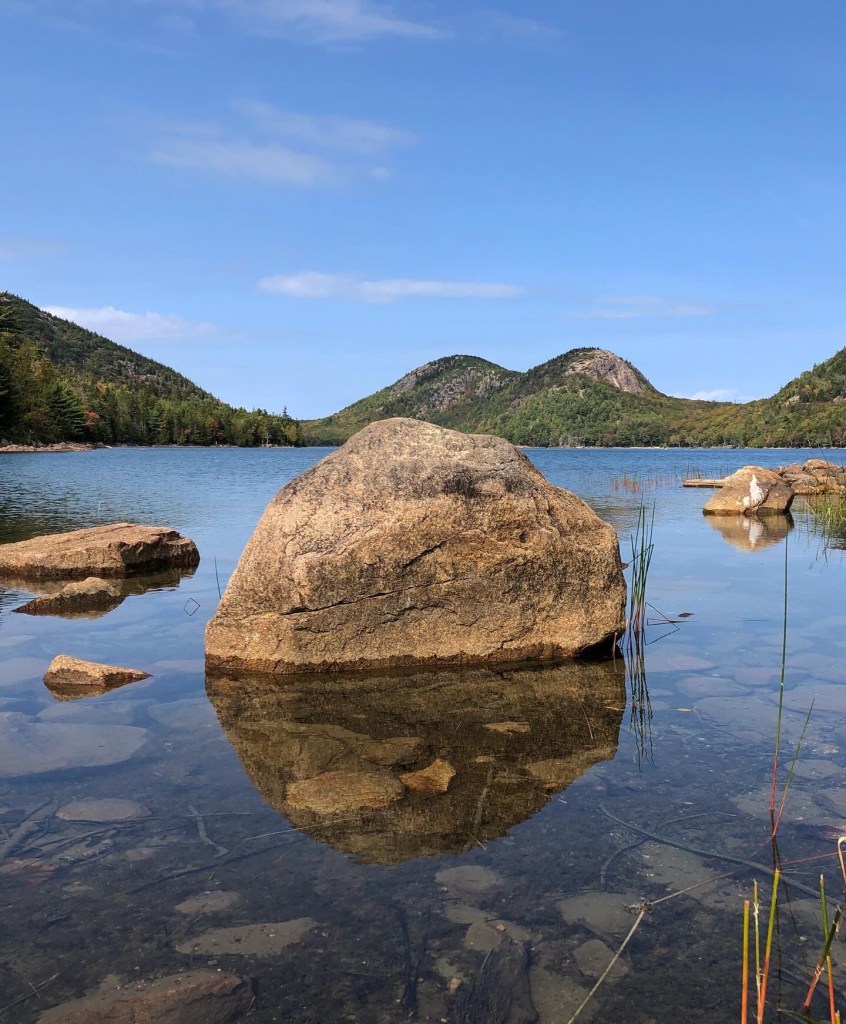
    When I look back on this month ten years from now, assuming I’ll still be dancing to the music in a decade, I’ll think of September for the loss of one remarkable man, hiking with friends and family, the home nest becoming full again as the fourth bird flew home, and for some remarkable moments in Acadia National Park. The rest – good and bad alike – blurs for me even now, even while we’re still in the month. But maybe that’s enough for one September.

    Jordan Pond