Tag: Saratoga

  • Oriskany

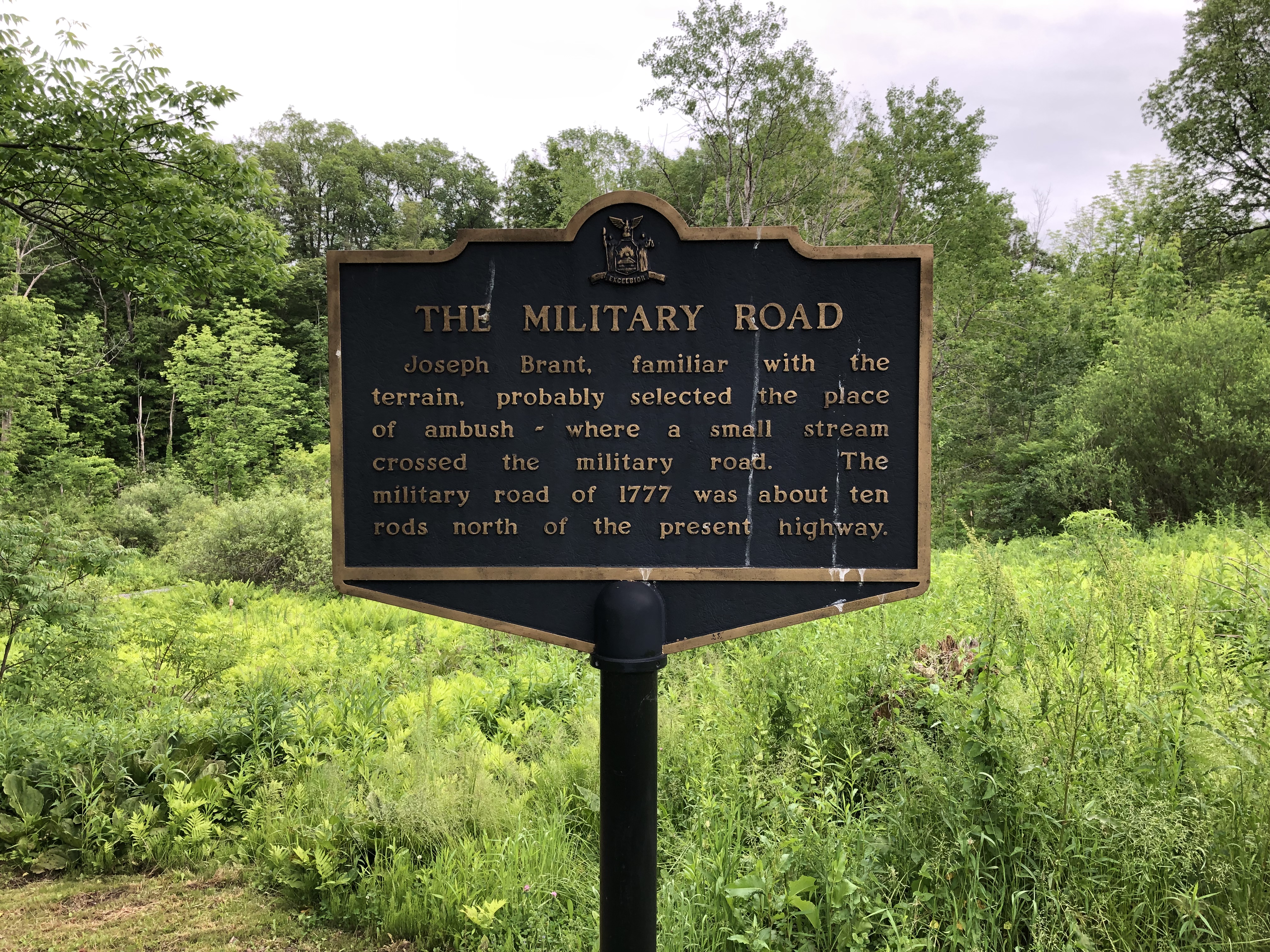
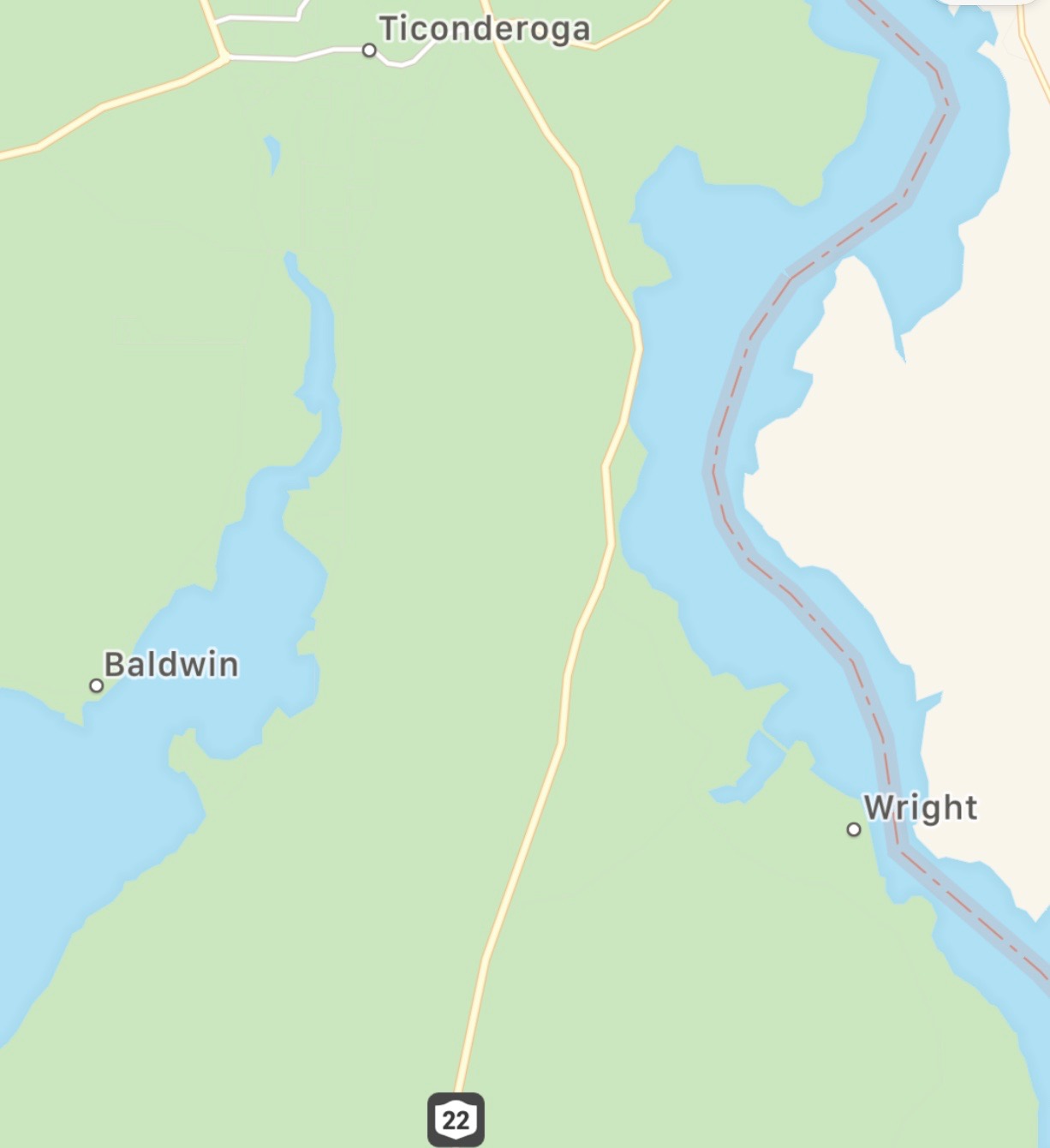
    I wasn’t planning on another detour on this trip, but saw the sign, calculated the total time the detour would take and made the decision to stop by the battlefield.  I was deeply impressed with the quiet dignity of the site, and reflected on the violence that took place in the ravine I walked down into.  The battlefield is nothing but tranquil today, save for the landscaper mowing the fields.  But at 10 AM on August 6, 1777 this valley erupted in thunderous clouds of gunfire and screams the hidden Loyalists and Iroquois aligned with the British ambushed a column of American patriots and Oneida Indians allied with them.  That this battle pitted neighbor against neighbor, Iroquois tribe against Iroquois tribe makes the results all the more devastating.

    We met the enemy at the place near a small creek. They had 3 cannons and we none. We had tomahawks and a few guns, but agreed to fight with tomahawks and scalping knives. During the fight, we waited for them to fire their guns and then we attacked them. It felt like no more than killing a Beast. We killed most of the men in the American’s army. Only a few escaped from us. We fought so close against one another that we could kill or another with a musket bayonet…. It was here that I saw the most dead bodies than I have ever seen. The blood shed made a stream running down on the sloping ground.” – Blacksnake, Seneca War Chief
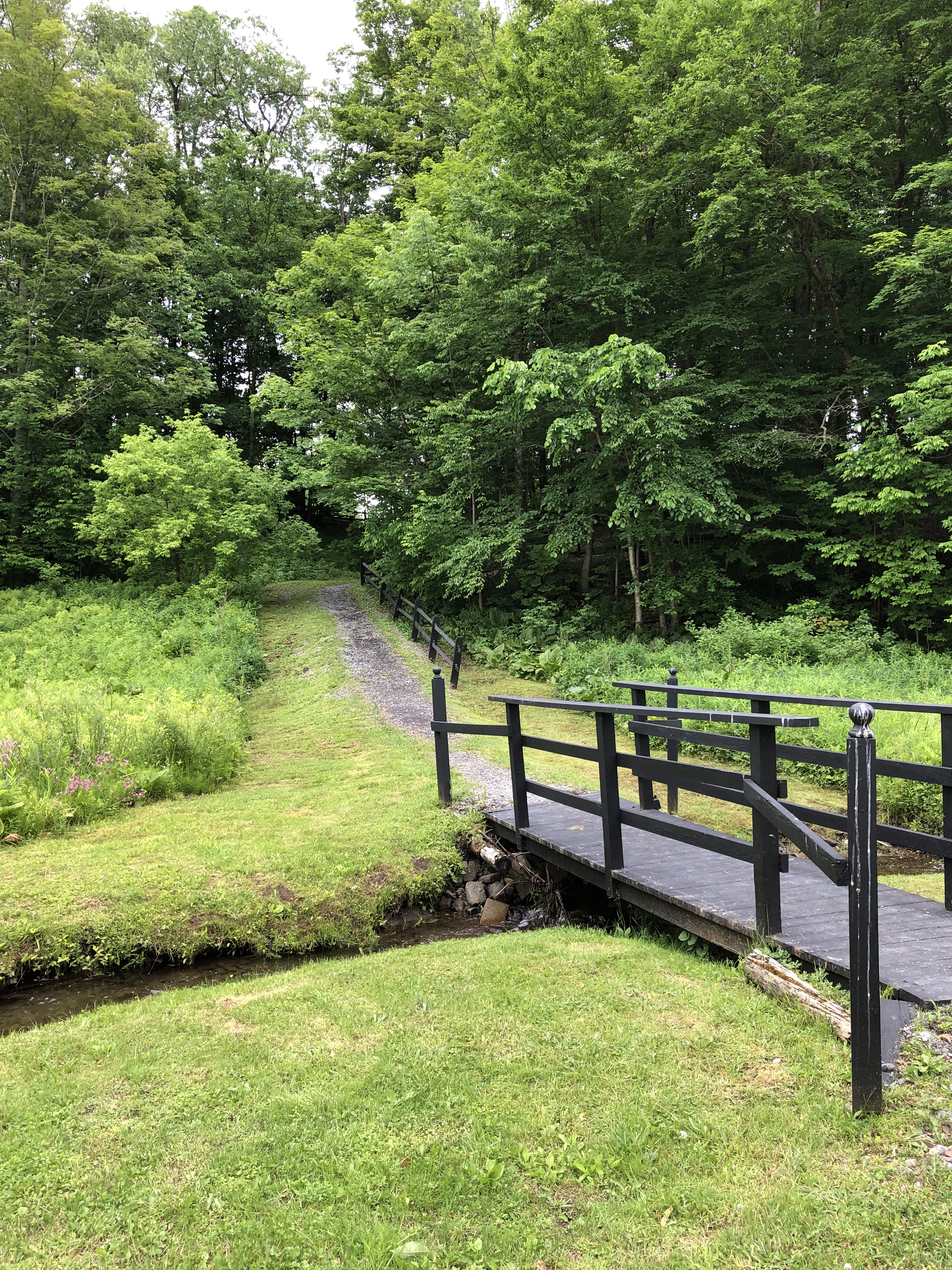
    When I decided to divert from I-90 to check out the battlefield, I had no idea what to expect.  I’d seen pictures of the monument, but there’s an emotional weight in walking in the footsteps of those who perished here down into that ravine, across the creek and up the other side.  The land looks remarkably similar to what it looked like then.  Perhaps more fields have replaced the deep forest of the day, but this area remains largely undeveloped, and will remain so as the Oriskany Battlefield State Historic Site.

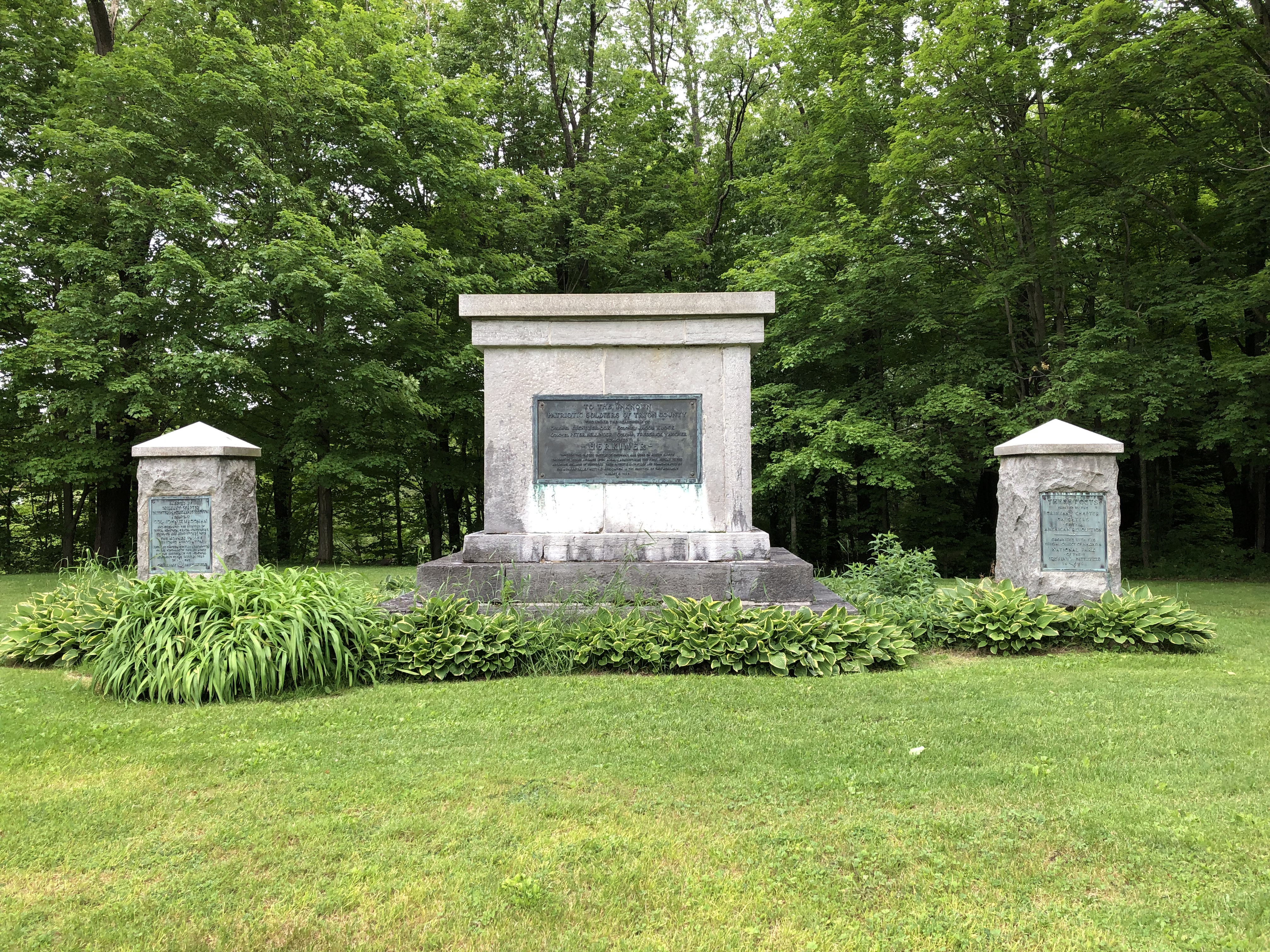
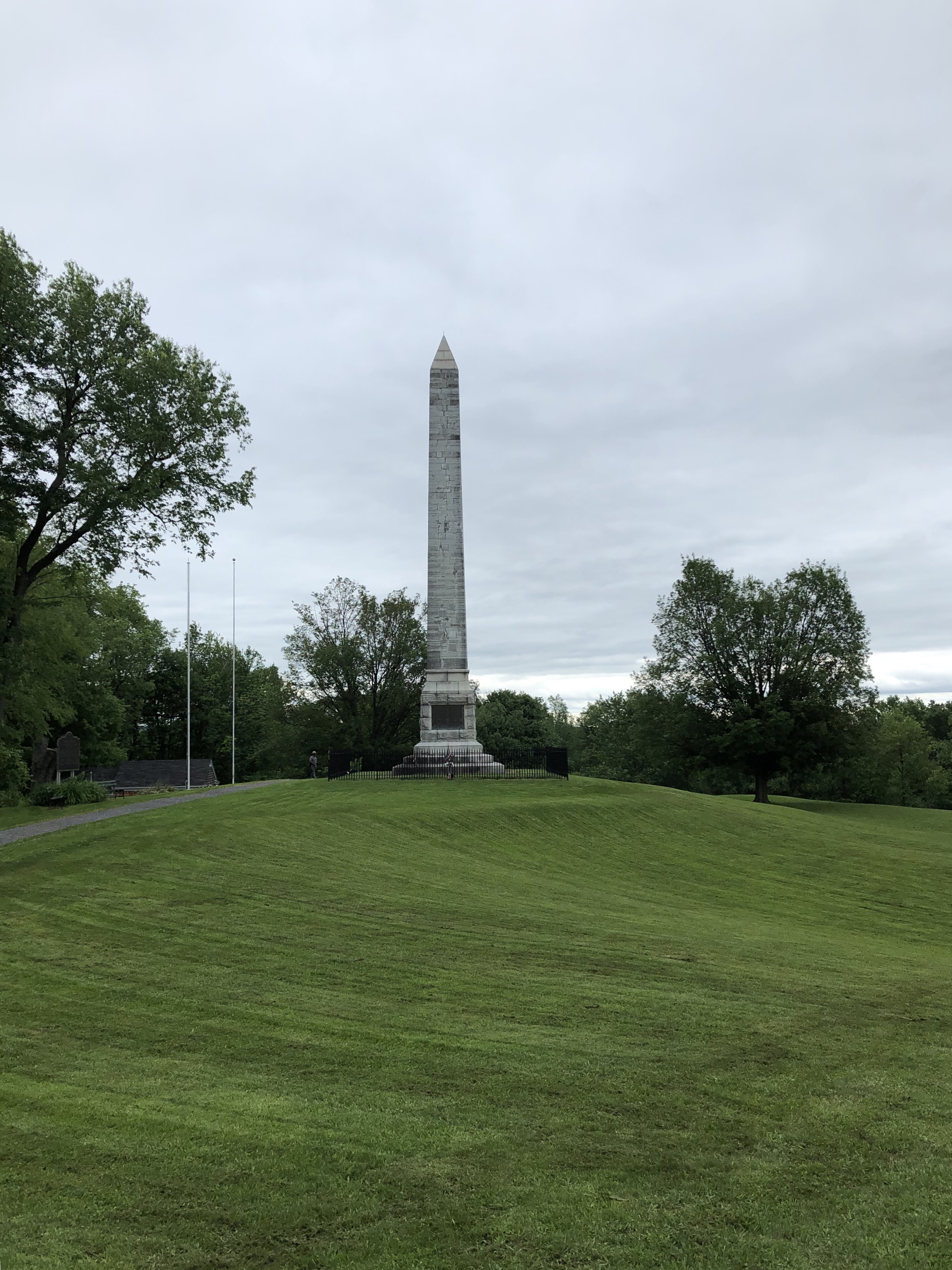
    So I pulled into the driveway leading to the monument and drove down to the parking area.  The 85 foot tall oblisk built in 1883 dominates the landscape in front of you.  But I’d noticed another monument and some signs marking historically relevant locations on the battlefield off to the right as I drove in, and decided to walk over to check those out first.  This is the best approximation of where the ambush took place, and looking around it seemed as appropriate a spot as any.  I walked up to the monument honoring General Nicholas Herkimer, wounded in the initial ambush, who famously directed patriot forces into defensive positions from behind an ash tree at or near this location. The Iroquois warriors would wait for a soldier to fire their one shot then rush at them with tomahawks and knives. This was up close, brutal fighting that decimated the American forces. Herkimer directed his men to pair up, with one firing while the other reloaded, to counter this rush.  Herkimer was shot in the leg, and died when the amputation to save him didn’t go as planned.  I wonder sometimes if Benedict Arnold, shot in the leg later in the same year, refused to have his leg amputated after seeing what happened to Herkimer?

    Of the almost 800 American and Oneida ambushes, almost half were killed, and overall casualties were over 500. For the patriotic farmers who rallied to save their brothers-in-arms under siege at Fort Stanwix, the ambush quickly ended their dreams and destroyed the lives of their families back home.  By all accounts these were tough losses for any army, but for Tryon County, it was a devastating loss of fathers, brothers and sons that brought the county to its knees.
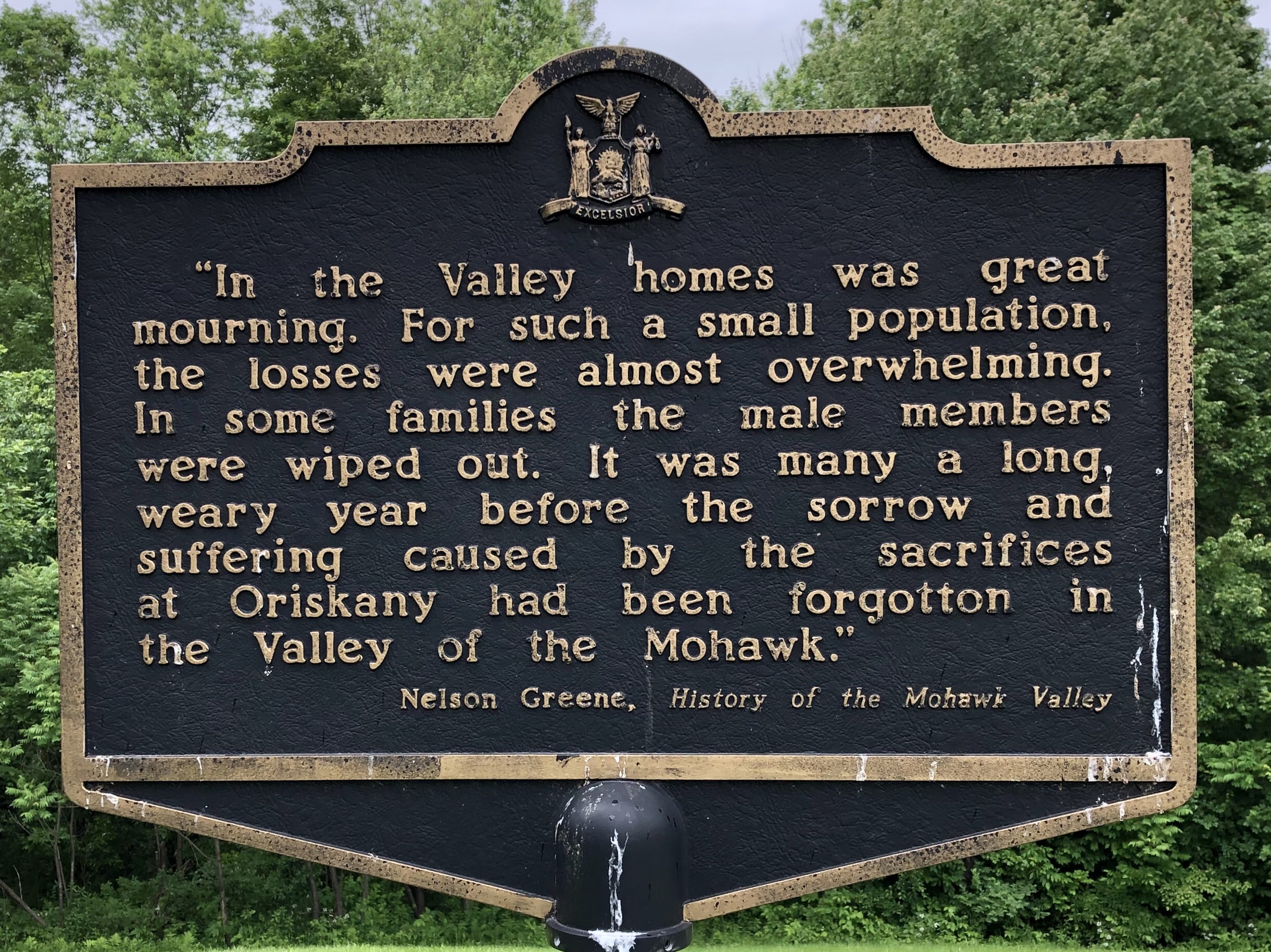
    Ultimately the relief column suffered far more casualties than the defenders at Fort Stanwix, who were saved when Benedict Arnold orchestrated a con to make the British and Iroquois think he was much closer to engaging with them, and with many more troops than he actually had.  But that’s a story for another day.  The Loyalists who survived would eventually flee to Canada or other British territories as reprisals reached their homes as momentum swung away from the British.  While the battle at Oriskany was a huge setback in momentum, it was another domino in the string of events that led to the defeat of General Burgoyne’s army at Saratoga.
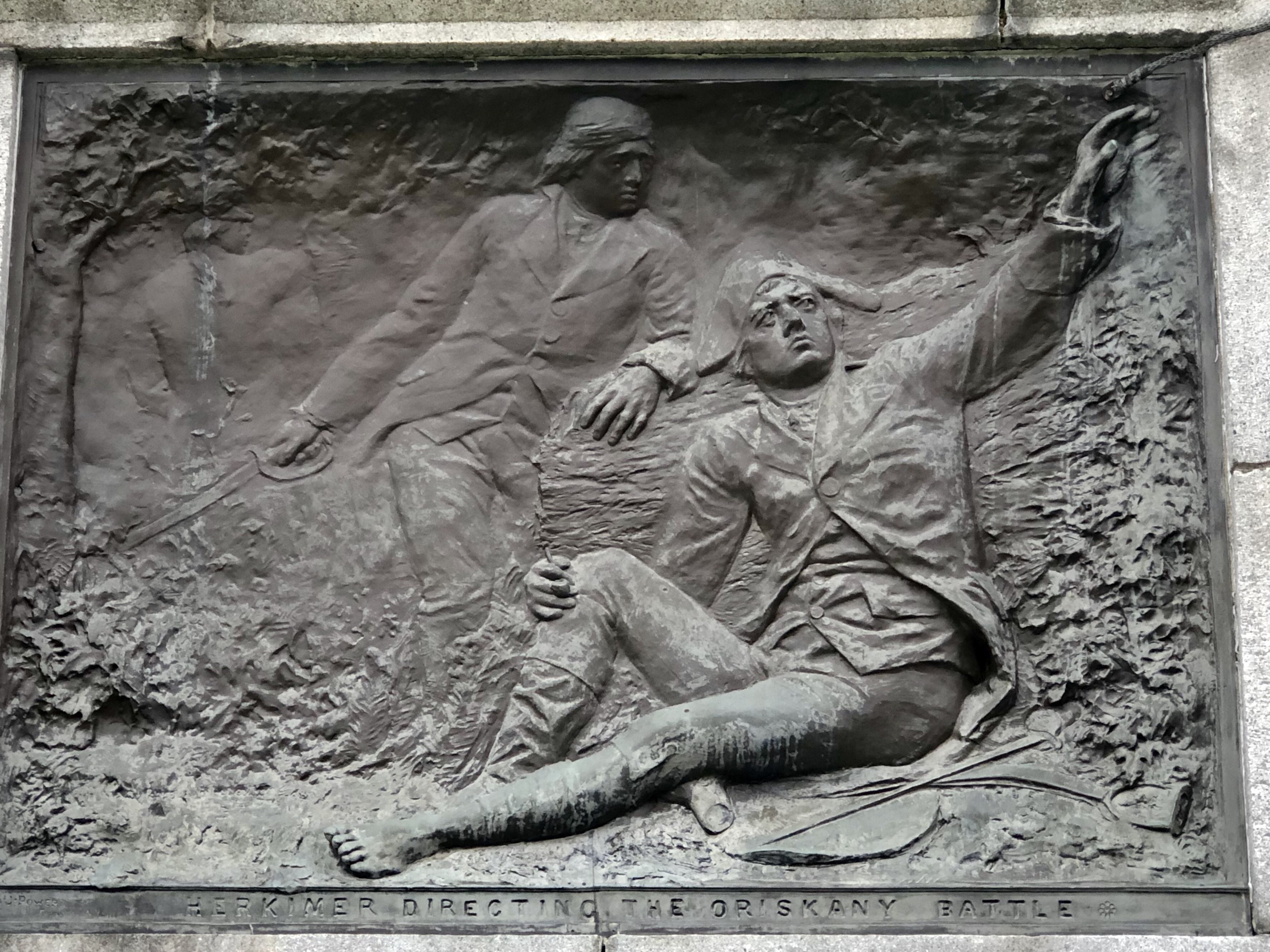
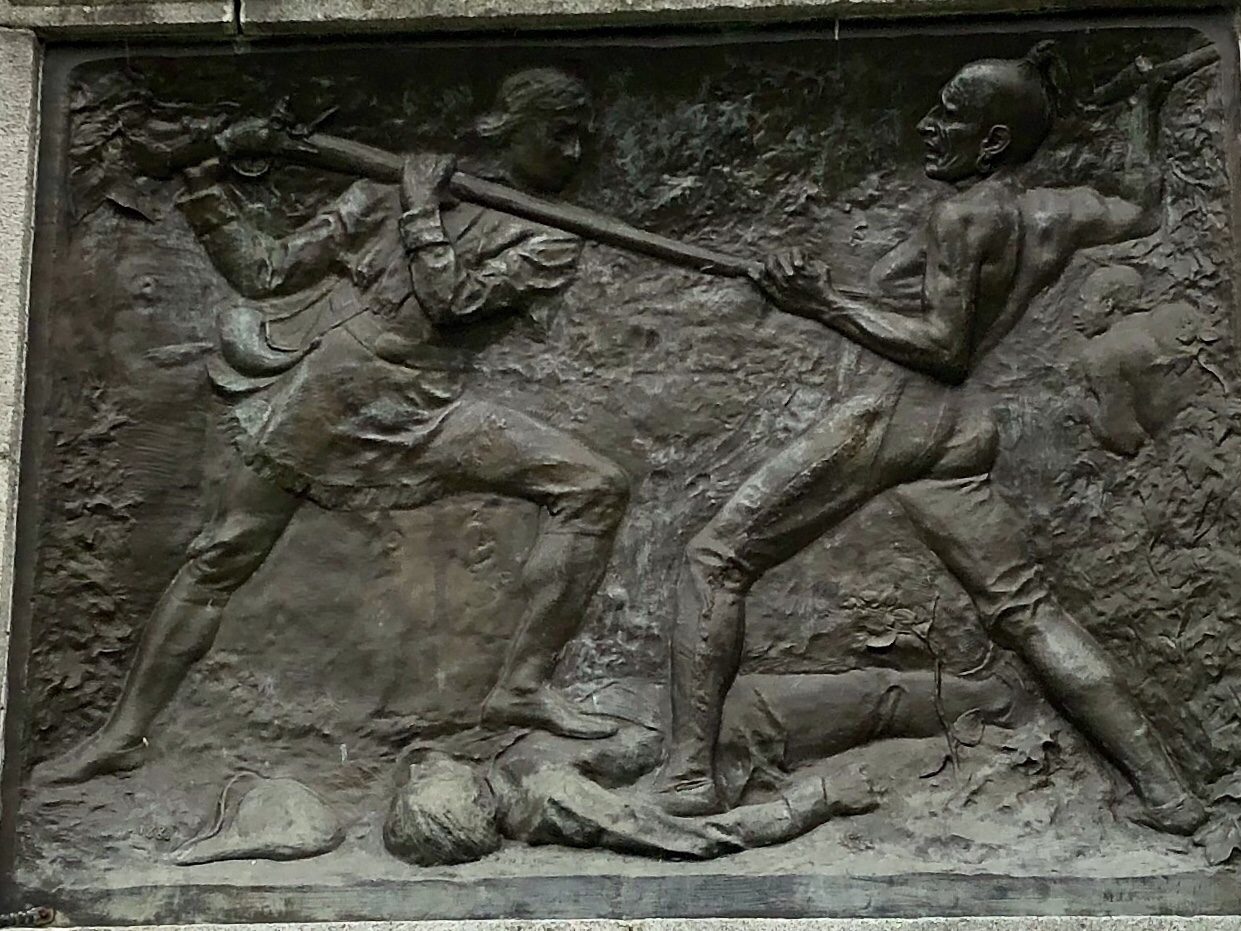
    On this rainy June afternoon, I had the place largely to myself.  There were about a dozen New York State Troopers visiting, a couple huddled under an umbrella, a man walking two Labrador retrievers, and… me.  The experience reminded me of my trip to Hubbardton a couple of months ago, the quiet solitude and signs describing the lay of the land on the day of the battle were similar.  But Oriskany felt different, because what happened here was different. Hubbardton was a retreating rear guard being caught by a faster moving British force. Oriskany was neighbors ambushing neighbors. Iroquois tribe against Iroquois tribe. A mass casualty event that shook a region. The Revolutionary War was far more complicated than Americans overthrowing a tyrannical oppressor. It was a messy divorce that forced each individual to decide which parent they were going to remain with, and which one they would betray in the most violent ways.

    Visiting the Oriskany battle site is easy. Roughly ten minutes off I-90, it offers a quick respite from travel, and perspective on the sacrifices others made to give us the freedom to do so. On the day I visited, as with other battlefields related to the Saratoga campaign, a quiet stillness prevailed. There’s a small building set down behind the monument where you can learn more about the site and events that day, and (please) leave a donation to help support the maintenance of this sacred ground.  The obelisk is showing signs of wear and needs renovation, but remains a striking tribute to those who fell here.
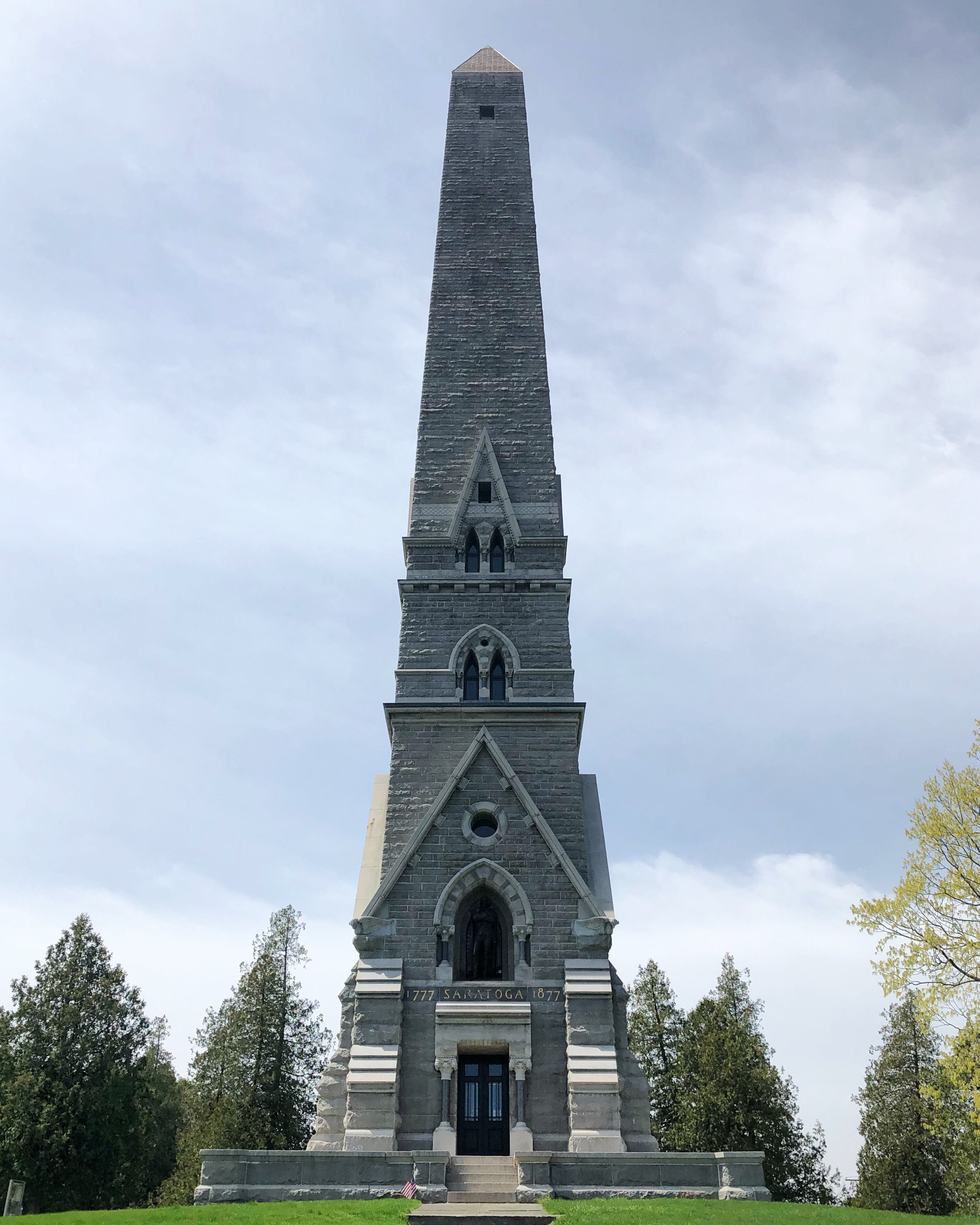
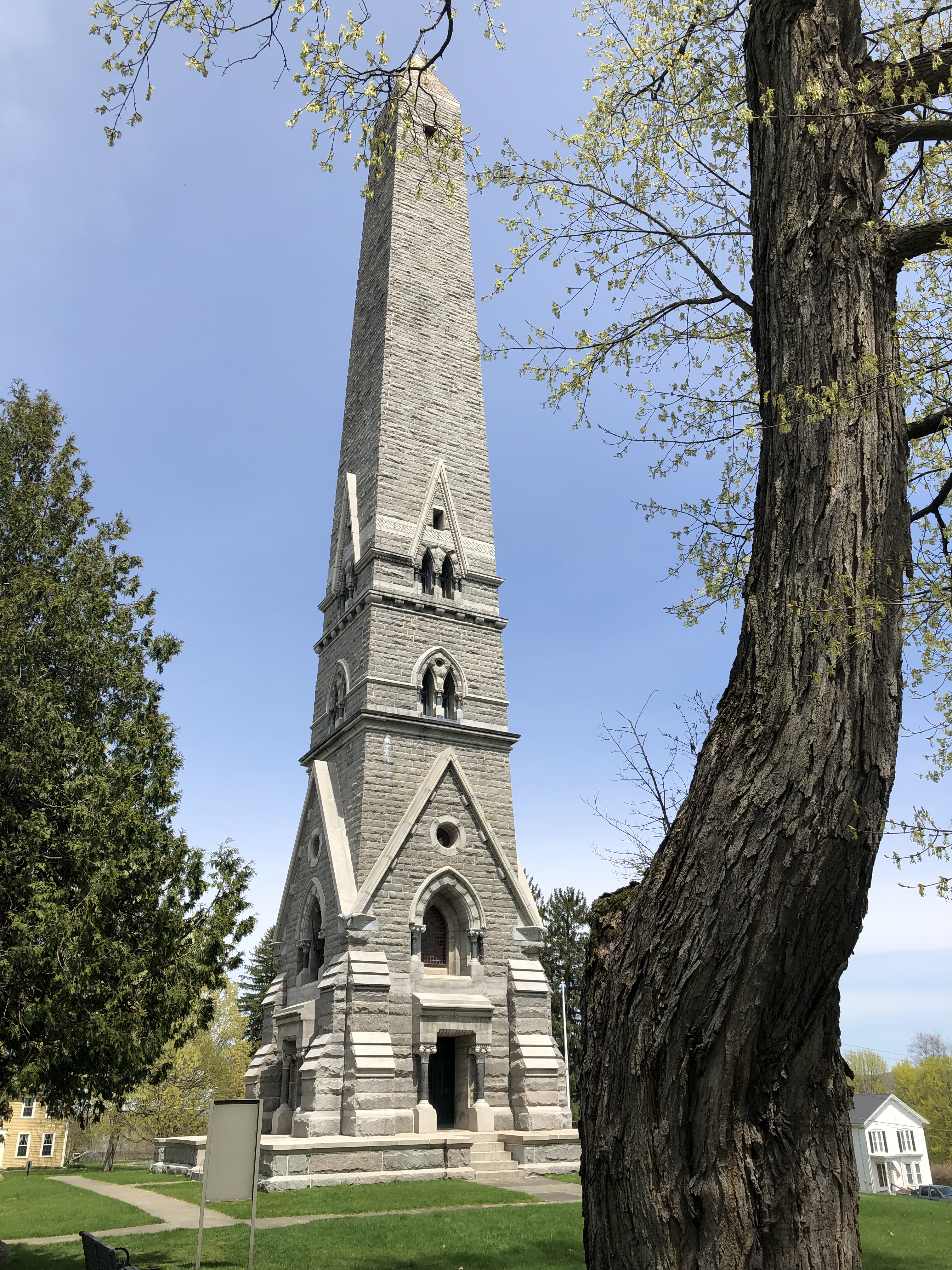
  • Where it all Happened

    When I was a child I thought of Boston, Lexington and Concord as the place where the bulk of the Revolutionary War was fought. Of course, that’s not accurate at all; it’s the place where it started. Or rather, where the underlying tensions felt across the thirteen colonies erupted into open rebellion and eventually violent conflict. Names like Yorktown, Valley Forge, Princeton, Trenton and Saratoga are just place names unless you’ve been there and felt the lay of the land. Having grown up there I’d done that in Boston but it wasn’t until I was an adult that I started visiting these other places.

    Monday I drove from an appointment in Castleton, Vermont to Clifton Park, where I would have meetings the next morning. Before the drive I did my usual survey to see what was on or near the route. I was already very close to Hubbardton, which I’d visited on my last trip up this way. But there was another significant side trip not far from my route…. Saratoga.

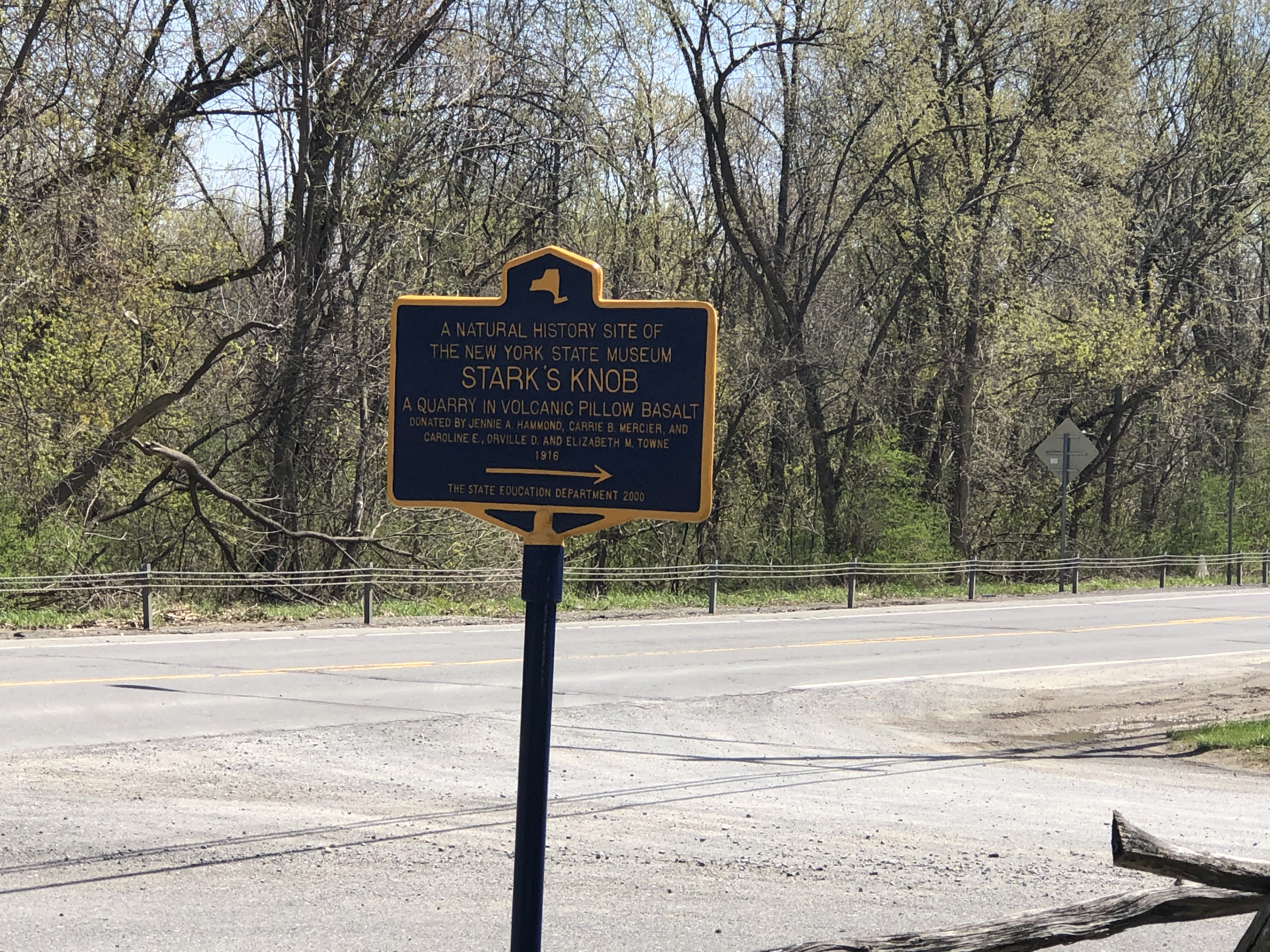
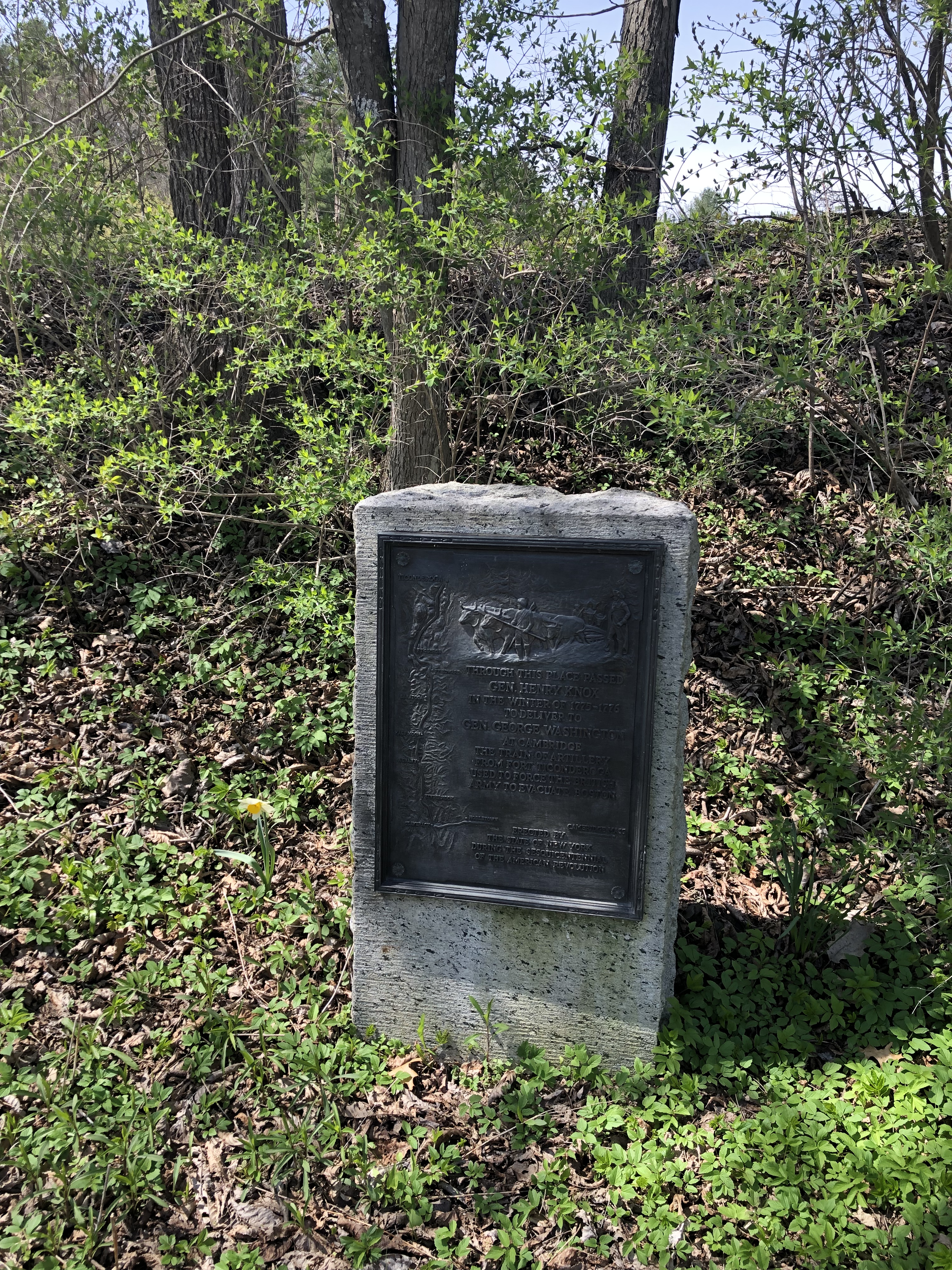
    As with any battlefield the action took place across a wide area over a period of time. The Saratoga Campaign took about a month, with other related skirmishes contributing to the overall result. I didn’t have time and wasn’t dressed for an extended tourist campaign myself, so I chose the visually stunning Saratoga Battle Monument as a priority, and let serendipity take over from there. It didn’t take long as I passed two historical markers of consequence next to each other. First was a sign marking the location of Starks Knob, named after John Stark, who held the high ground on this “basaltic pillow lava formation” which blocked the retreat to the north of General Burgoyne’s British and Hessian troops. Second was a monument to the Knox Trail, marking this ground as significant on a few occasions during the war.

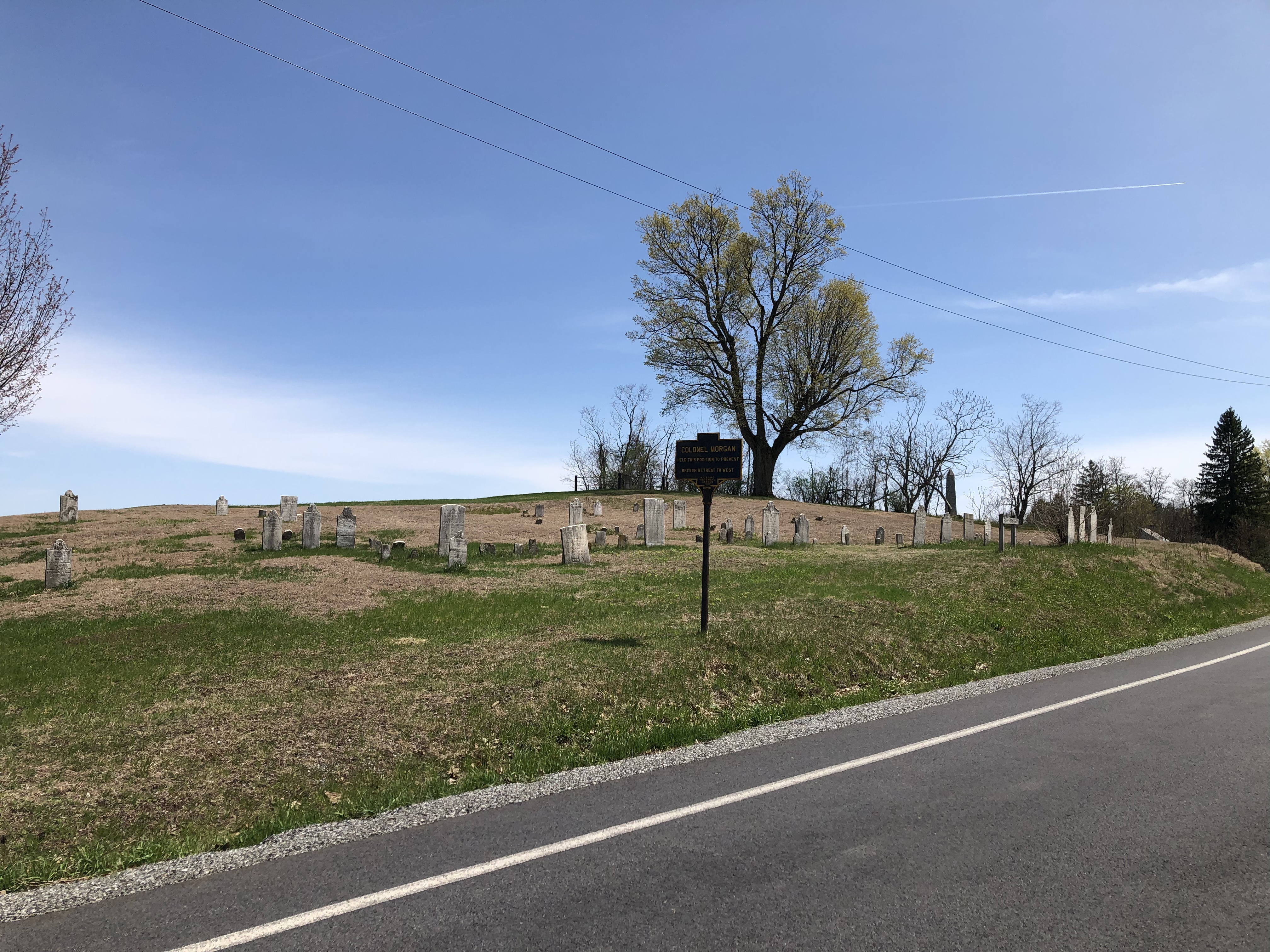
    With Stark blocking retreat to the north, and Colonel Daniel Morgan‘s troops blocking retreat to the west, and the Hudson River blocked retreat to the east, options were running out for Burgoyne. He was cut off with nowhere to go. So on the morning of October 17, 1777 General Burgoyne and his 6000 soldiers surrendered. The Saratoga Battlefield Monument commemorates this event.

    Time or the necessary footwear to visit the battlefield itself weren’t available Monday… Another time perhaps. But seeing this magnificent monument, and seeing Starks Knob to know the lay of the land were worth the detour. History books only tell part of the story. Saratoga was a massively important global event that changed that history. Walking and driving around these places helps me understand what these names on the page were facing.

    I didn’t hear the whispers of ghosts when I visited the monument, but I did have my breath taken away as I drove around the bend from the site Morgan held and saw the monument rise up before me. And I had a shot of adrenaline when I saw the sign for Starks Knob. These places, where these things happened, matter to me, and I continue to seek them out in my travels.

  • Hubbardton

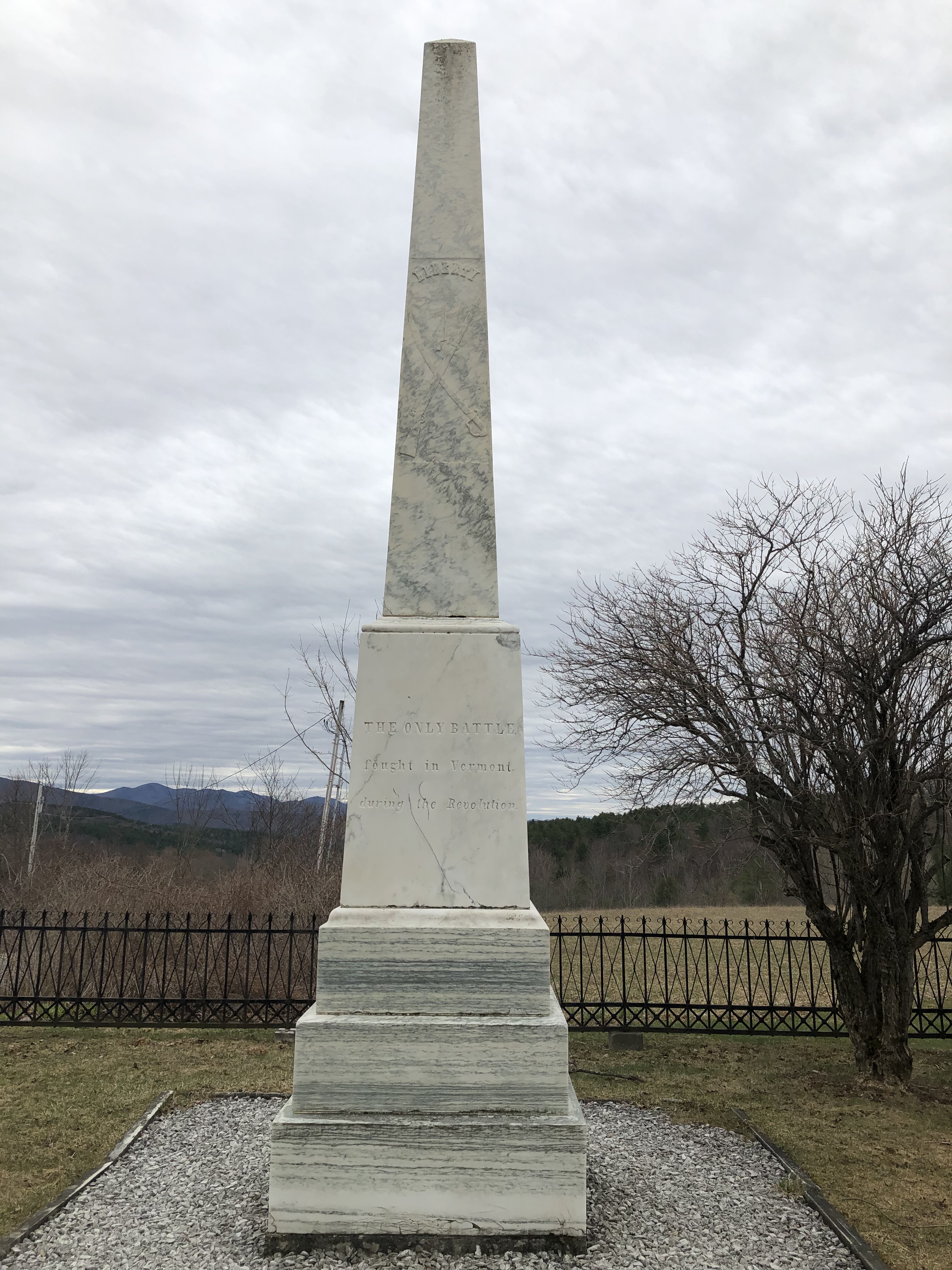
    There was only one battle inside the borders of Vermont during the Revolutionary War.  Many people would point to Bennington as the location, but that battle actually took place in New York.  The Battle of Hubbardton erupted on the morning of July 7, 1777 when the British forces (mostly Hessians) and their Native American allies pursuing Colonial Army forces retreating from Fort Ticonderoga caught up to them on this site.

    The 11th Massachusetts Regiment was the rear guard and were late to join the larger forces commanded by St. Clair, who were marching to Castleton.  Colonel Seth Warner commanded the Green Mountain Boys and Nathan Hale (not the spy) commanded the 2nd New Hampshire Regiment that waited for the 11th to catch up.  Warner decided to spend the night instead of marching on, and the British caught up with them at dawn.  The combined forces of the Massachusetts, New Hampshire Regiments and Green Mountain Boys stood their ground along the top of a ridge and laid fire on the pursuing British forces, retreated further and engaged again.

    Casualties were high on both sides. On the Colonial Army side a combined 370 men were killed, wounded or captured, and New Hampshire’s Nathan Hale was captured in the battle and eventually died in captivity.  On the British side, almost 200 were killed or wounded.  The battle was technically won by the British, but it was a costly battle that, along with battles in Fort Anne and Bennington, were critical delays that helped lead the way to the American victory at Saratoga.  General Burgoyne’s critical mistake was losing focus on the ultimate goal of controlling the British along the water routes from the St. Lawrence to the Hudson River, which would have cut off New England from the rest of the colonies.  Saratoga proved a critical win as it prompted the French to join the Americans against the British.

    I walked around the site of the Battle of Hubbardton on April 18th when I took a quick detour from my business meetings.  Driving out to the battle site is an exercise in faith, as the signage is limited, cellular service ended for both my AT & T and Verizon phones, and you’re driving for what feels like a long time from the highway to the site.  But I’m not easily intimidated by such things.

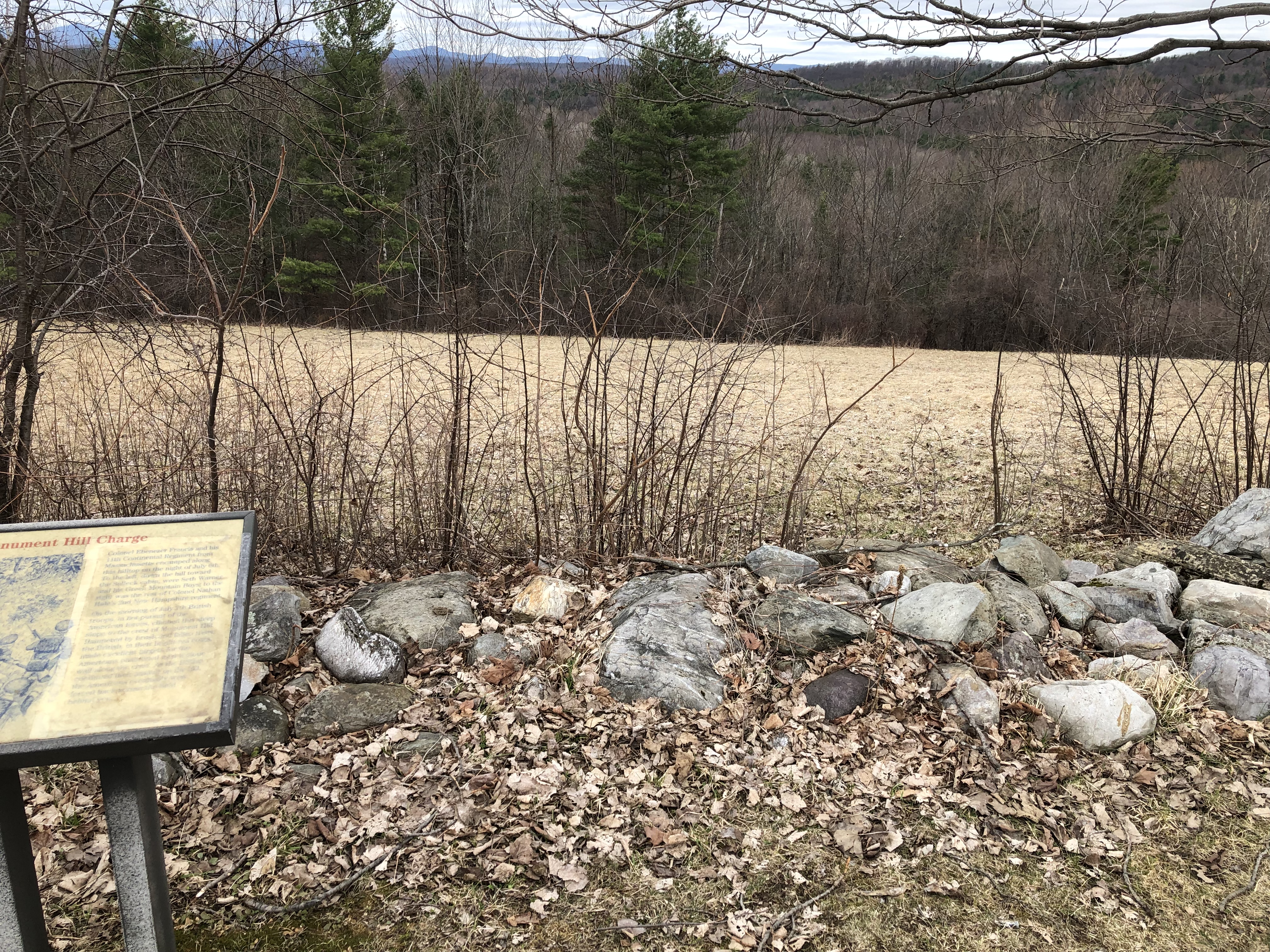
    The actual battle site looks a lot like it did that day.  If anything, it’s even less developed now than it was then, as the fields once planted with corn, beans or hay have been taken back by the forest.  The battle site remains fields, with mown paths that carry you to signs that tell you where you are and what happened at that location.  This was the moment when I recognized that my old dress shoes were no longer waterproof, as the soggy grass transported water to my dress socks with ease.  I normally keep boots in my car but this side trip wasn’t anticipated and, well, it’s only water.

    The Battle of Hubbardton site is an active museum, but it doesn’t open until May and there’s a sign that let me know it’s okay to walk around the grounds.  There’s a small building that likely offers much more information on the battle and the related action at Lake Champlain, Fort Ticonderoga, Fort Independence and Saratoga.  But that will have to wait for another day.  A white marble monument surrounded by an iron fence offers a stoic tribute to the events of that day, and I spent a few minutes walking around it reading the engravings on each side.  I was alone that day, and that solitude made the experience all the more moving as I reflected on the quiet ground that once roared with violent conflict.

  • General John Stark

    If New Hampshire has a favorite son, it’s John Stark.  The State Motto is a truncated quote from Stark, “Live Free or Die” and of course the people of New Hampshire have a certain Stark independent streak that lives on to this day.  As a transplant from Massachusetts who lives 7 miles from where Stark was born, I’ve come to appreciate the New Hampshire way of thinking more each year.  This is my 25th year in the Granite State and it’s high time I focus on New Hampshire’s Revolutionary War hero.

      In each phase of John Starks adult life he had extraordinary moments that would on their own be the highlight of someone else’s story.  As a 24 year-old young man he was captured by the Abenaki while hunting near the Baker River/Mount Moosilauke area.  In captivity he was forced to run the gauntlet but grabbed the stick from the first warrior in the line and attacked him instead!  This endeared him to the Abenaki and they adopted him into the tribe.  He was eventually ransomed back to freedom but this time with the Abenaki would remain a part of him.
    Five years later, with the French and Indian War making New Hampshire a war zone, Stark joined Robert Rogers as a Second Lieutenant and later Captain in Roger’s Rangers.  He participated in many of the legendary battles of the Rangers, including Battle on Snowshoes and other skirmishes around Lake George, New York.  Stark learned a lot from the tactics of Rogers, who in turn had adopted the tactics from the Native American warriors they were fighting against.  This would prove handy in the war to come.
    One event that Stark chose to sit out was the raid on St. Francis, an Abenaki village just over the present-day border of Canada.  Stark opting out was a sign of respect for those who he lived with five years before during his captivity.  It’s a great indicator of his character.
    After the war, Stark returned to his home in Nutfield (Londonderry) to work his farm.  Stark was married to Molly Page Stark, a legend in her own right, and had 11 children.  The Starks were clearly productive on the home front when they weren’t fighting wars.  Molly was a champion for smallpox vaccination, which involved deliberately infecting yourself with a small bit of smallpox, which, if it didn’t kill you, would make you immune to a worse case of it.  Smallpox was a major threat to the Continental Army during the Revolutionary War.
    During the Revolutionary War, John Stark became a legend.  He was one of the first to answer the call to arms, and fought in the Battle of Bunker Hill, where his experience in the Rangers paid dividends.  Stark’s saw immediately what the vulnerabilities were on the northern flank in the defense of Breeds Hill and built a breastwork from old stone walls to defend the Americans from a possible beach landing on the Mystic River.  This proved to be salient as that’s exactly what the British did.
    In a brilliantly orchestrated defense, the first line of New Hampshire militia fired on the attacking British and ducked down to reload.  The British kept advancing with fixed bayonets but were mowed down by a second line.  And then a third line mowed down the advancing British.  By then the first line had reloaded and mowed down the still advancing British and they finally retreated, abandoning the flanking strategy for a full frontal assault elsewhere.
    Stark would later serve George Washington at Princeton and Trenton, but unlike Benedict Arnold, he chose to tell the Continental Congress to take a hike when they passed him over for politically motivated promotions to General.  He returned to New Hampshire but left the door open for further action if needed.  And he was absolutely needed.
    In August 1777, the British Army was moving down from Canada, taking Fort Ticonderoga and working towards Albany.  The goal was to meet with the British forces coming up the Hudson River from the New York and cut off New England from the rest of the colonies.  This would effectively end the war as the British would control the flow of people and supplies.  British General John Burgoyne led an expedition to Bennington to raid supplies stored there.  That’s where he ran into the combined forces of Vermont and New Hampshire, led by 49 year-old John Stark.

    As Stark rallied his troops to attack the British, he shouted the second-most famous sentence he ever produced; “There are your enemies, the Red Coats and the Tories. They are ours, or this night Molly Stark sleeps a widow!”  The first half of that statement is contested.  What seems to have consensus is the “Molly Stark sleeps a widow” part.  Hell of a rallying cry for sure.  During the battle, Stark showed his strategic mind once again by flanking the combined forces of the  British, Loyalists, Indians and Canadians in a double envelopment, creating panic in the ranks of the enemy.  Many of them fled, leaving the British to face a full frontal assault from the majority of Stark’s New Hampshire men, which routed the British and set the stage for victory at Saratoga.

    John Stark, like General Sherman after the Civil War, chose to retire from the spotlight and move back to his farm in New Hampshire.  He lived out his life on his farm in Derryfield (now Manchester).  At the age of 82 he declined an invitation to participate in events commemorating the Battle of Bennington as his health was declining.  Instead, he sent a note with a toast to his old soldiers participating in the events.  It contains his most famous words, familiar to most everyone even if they don’t recall the source; “Live free or die: Death is not the worst of evils.”

  • John Glover

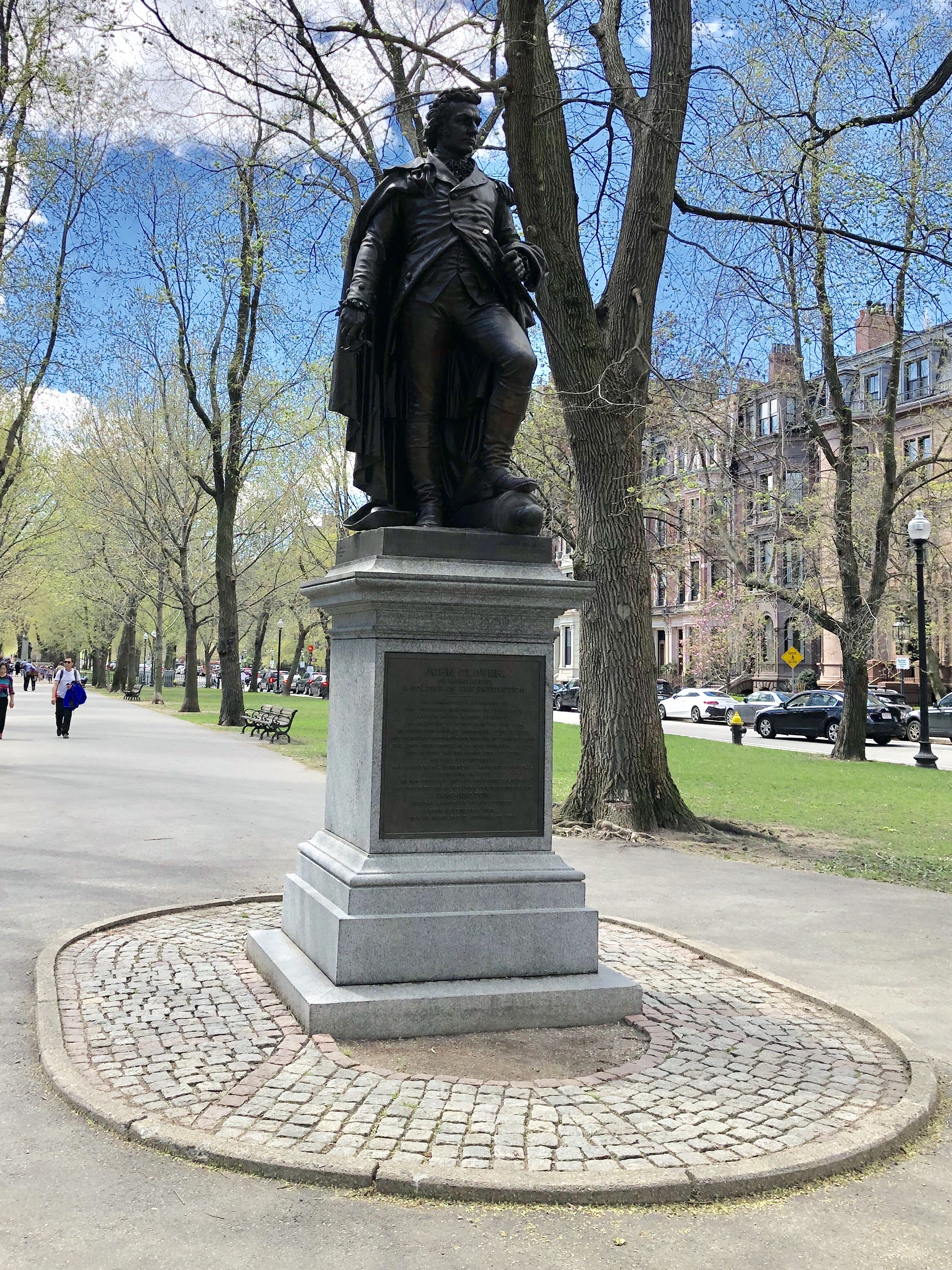
    One of the biggest heroes for the American Colonists in the Revolutionary War in 1776 was a fisherman from Marblehead, Massachusetts.  Actually, he was more than a fisherman, he was also a cordwainer (shoemaker), rum trader, merchant and notably, the first Captain (of the Hannah) in the Continental Navy a later in the war he commanded forces at Saratoga and served with distinction there as well.  But it was and as the Commander of a brigade known as the “Amphibious Regiment” that John Glover became a legend in the history of the American Revolution.

    Glover’s group of fishermen and merchants saved the Continental Army twice in New York with strategic evacuations from Brooklyn and later from Manhattan.  These two evacuations saved the Continental Army from certain defeat against far superior numbers.  These weren’t the battle hardened troops of later in the war, these were undisciplined troops led by Generals, including George Washington, who were being outmaneuvered by the British Generals.  Glover’s fleet of small boats shuttled the entire army across the Hudson River to Manhattan and then to New Jersey in the cover of darkness.

    In December of 1776, Glover’s Marblehead men once again became heroes in shuttling the Continental Army across the frigid Delaware River to Trenton, and then back again with 900 Hessian POW’s.  Glover’s fleet pulled off some of the most impressive amphibious maneuvers of the war, equalling the British invasion of Long Island in seamanship, and perhaps surpassing the British with their sheer audacity.

    At some point I’ll update this post with pictures of John Glover’s statue in Boston and his home in Marblehead, Massachusetts.  For now, I’m taking a moment to appreciate this war hero, rum trader, merchant, fisherman and yes, cordwainer.  Glover is one of the legends of the American Revolution and should be more widely known today.

  • Benedict Arnold

    Growing up in the United States of America, you heard a version of history that made our Founding Fathers and the generals who fought the American Revolution out to be heroes.  And in many ways they were.  The winners write the history, no doubt, but they did create a democracy that was the envy of the world while fighting off the greatest military power of the day.

    I’ve read that if Benedict Arnold had been killed at Saratoga instead of badly wounded he would be remembered as one of our greatest heroes.  There’s no doubt that he was a complicated man; aggressively ambitious to a point where he drove those he commanded, was loathed by many of his peers, but loved as a true leader by anyone who saw him in action.  
    Had Benedict Arnold not turned against the colonies, he would have been celebrated as one of our greatest military leaders for his raid on Quebec, the raid on Ticonderoga, the Battle of Valcour Island on Lake Champlain against overwhelming odds, the Battles of Ridgefield, Connecticut and Saratoga. In all of these, Arnold exhibited courage, persistence, strategic vision and competitive spirit critical in war.  He sacrificed an enormous amount of his personal wealth and political power for the Revolution, and was a key reason the British were ultimately defeated.  And yet he’s best known for his betrayal.
    You can’t take omit that betrayal when considering the man.  There’s no doubt that he deserved the condemnation and infamy he received and receives to this day for not just betraying the colonies, but also betraying George Washington and the troops he served with.  But it’s… complicated.  If Arnold weren’t such a hero in 1775-1778, his betrayal in 1780.  He remains the most famous traitor in history, and the most forgotten hero.
    I’ll try to visit a few of the places that Benedict Arnold made history in.  Not because I admire the man, but because without him I’m not sure that the Continental Army would have won in the end.  And what would our history have been then?  Unlike Washington, there aren’t a lot of “Benedict Arnold slept here” placards on the sides of colonial era homes.  But there are monuments to what he accomplished, and I’d like to explore a few of those in 2019.
  • The Great Carrying Place

    There’s an almost unbroken stretch of navigable water from New York City up the Hudson to Lake George to Lake Champlain to the St. Lawrence Seaway, which in turn leads back to the Atlantic Ocean or deep into the interior of North America to the Great Lakes.  The “almost” part is a couple of stretches of land that must be portaged where the La Chute River is unnavigable.  This two mile stretch of land between Lake George and Lake Champlain is the place the Native Americans called “the great carrying place”.  There are other portages with the same name, notably a stretch of trail in Maine that Benedict Arnold used to invade Quebec, but this stretch in New York is arguably much more strategic.

    In the years before and during the French and Indian War this was one of the most strategically important and thus heavily contested patch of wilderness in North America.  Navigable water was the most efficient and fastest way to travel at the time, and aside from this stretch of land navigable water was close to unbroken.  During the Revolutionary War this place was the site of significant naval and land battles led by Benedict Arnold.

    I’ve been to Glens Falls and Saratoga many times.  I’ve been to Lake George once or twice.  And I’ve been on and most of the way around Lake Champlain.  But I’ve never viewed the region with the educated eyes of a historian.  It’s not that I didn’t know the rough history of the region, it’s that I was apathetic towards it.  I’m not longer apathetic.  The next time I make my way through the region I’m going to spend a little time immersing myself in the history of the region.  Fort Ticonderoga, Mt. Defiance, Saratoga and so much epic history happened right in this area.  I can’t very well ignore it now can I?