Month: March 2019

  • Yes… and especially, No

    I’ve been very deliberately cleansing my news feed.  I Believe that I need to be informed, see both sides of issues and get my news from multiple sources.  But there’s so much insidious outrage porn out there that I’ve become an aggressive editor to what comes at me.  This is not analogous to putting my head in the sand, I’m still aware of what matters.  No, this is self-preservation.

    It started with the obvious.  Don’t watch the local bleed it leads news.  Don’t listen to politic outrage radio.  Don’t listen to sports radio that only seeks less to infor, highlight and discuss as it does to mock, rage and complain.

    But digging deeper, it meant muting friends and family who post clickbate outrage.  Sifting out the people I follow on Twitter based on not just what they post, but what they like.  These likes end up in my feed whether I want them or not.  Thanks a bunch Twitter.

    This falls into the know what to say no to philosophy.  I’m getting better at saying no.  But also yes.  I’m following more long-form bloggers like Farnom Street and Brain Pickings.  I’ve been following Seth Godin for years.  Instead of being a slave to the radio I listen to podcasts.  And after talking to a friend I’ve decided to give Audible another go.  Other yeses are Instagram feeds from places I want to go, or go back to.

    Ultimately we become what we focus on.  In this world where everything demands your focus, saying no more seems to be the only way to move ahead.  No gives you more elbow room for yes.
  • Faraway Birds

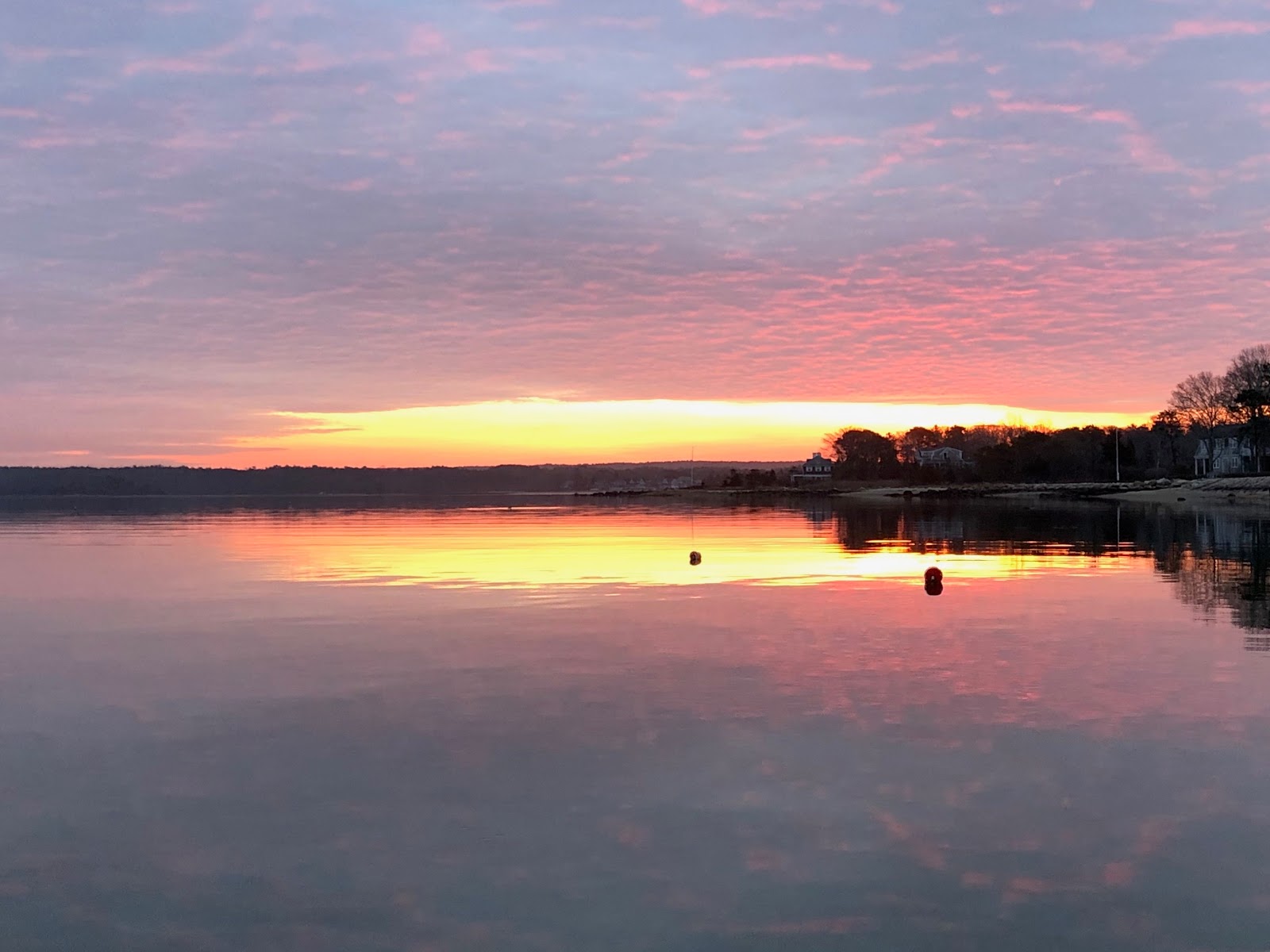
    Up before the dawn, I grabbed my phone and walked down to the water.  These are my favorite moments of the day; to look out at the gray stillness and watch the coming of the light.  Sunsets are grand things that garner the most attention because their more accessible.  And I love a good sunset as much as anyone.   But sunrise is my time.

    This morning brought a pink and salmon sky and a chorus of thousands of unseen migratory birds saying “It’s time!  It’s time!” as they discuss their own plans for the day amongst themselves.  Today is March 30th, and the bay is still.  No boats, no planes dragging insurance company banners behind them, no social media buzz, no landscapers blowing grass clippings, no noise save for those birds.

    I didn’t stay for the sun to pop up over the horizon.  This time of year it’s hidden behind a spit of land jutting out from the Pocasset River.  The best show is well before that anyway.  But the full day is ahead of me, and soon us as the human world wakes up and drowns out the chorus of faraway birds.

  • Short Run to a Long Run

    “The short game is putting off anything that seems hard for doing something that seems easy or fun.  The short game offers visible and immediate benefits.  The short game is seductive.” – Shane Parrish

    “I hope we can all agree that the long run is made up of a bunch of short runs.  That seems obvious.  The surprising thing is that we live our short runs as if that isn’t true.” – Seth Godin

    “Your outcomes are a lagging measure of your habits.” – James Clear

    I was contemplating each of these quotes on their own merit the last few days as each appeared in my inbox or Twitter feed.  It’s no accident that they resonate for me; after all I’ve chosen to follow the authors of each of them.  But they say when the student is ready, the teacher will appear.  I believe that to be true.  And there’s a lesson in each of these quotes that’s hard to ignore.  Daily, consistent action towards an objective.

    James Clear would argue that the goal isn’t the point, the system is more important.  And identifying yourself as someone who would take this daily action is ultimately the most critical part of the entire sequence.  For example, I’m an athlete so of course I get up at 5 AM to work out.  Or, I’m a successful salesperson so of course I make efficient use of my time, have a bias towards action and am highly knowledgeable about my products and each of the opportunities I’m working to close.

    “Only mediocrity is sure of itself.” – Paulo Coelho

    Mediocrity stems from not examining your life, your job, your process, your goals, your system and challenging yourself to improve in each.  Demanding more of yourself is hard to do if you think everything is fine.  We’re all guilty of getting comfortable in our own skin.  After all, it worked yesterday, why not today too?

    Ultimately every day is a small but meaningful part of the whole.  At my age that lesson has become very clear.  Recognizing the value in each day is earned through living.  I remember hearing that throughout my life, but you don’t really know it without the cold intimacy of accumulated time.

    “Life without a design is erratic.” – Seneca

    This is an indictment on winging it.  I’ve seen my own success in anything directly tied to how much I’ve structured action around a specific objective.  We can’t all hit the lottery, but we can all determine our identity, establish long term objectives and break that down into daily tasks that get us there.  As James Clear so eloquently puts it, we cast a vote for our own identity.

    If I live to be 100, and that’s certainly the goal, then I’ve clearly rounded the mark and it’s shrinking into the distance behind me.  Best to have clarity about where you’re going, set the sail and get to it.  There’s a lot to do.


  • York Gaol

    Sitting on a small hill in York, Maine is a gambrel-roofed wood and stone building of consequence.  With the original construction beginning 300 years ago this year, it’s been a unique witness to history.  This is a building with stories to tell.

    Gaol means jail, and that’s what this building was for the Province of Maine, a part of the Commonwealth of Massachusetts which of course eventually became the State of Maine.  Situated as it is in York, 27 years after the Candelmas Massacre hit this town hard, the jail was used to hold prisoners from Pisataqua River to the south to the St. John River to the North.  It is thought to be the earliest surviving British colonial structure in North America.  By comparison, Fort Western in Augusta, Maine wasn’t built until 1754.

    This old Gaol has witnessed the French & Indian War, the Revolutionary War, recruitment for the Civil War and countless changes to the landscape around it.  It’s a fascinating little bit of history perched on a hill in York.  I’ve driven by it many times over the years, so it’s witnessed me grow from a know-it-all teenager to a harried soccer parent to an empty-nester history buff.  It was about time I started paying attention as well.

  • There Once Was a Sink From Nantucket

    The last few days have been a whirlwind.  Running all over creation in search of a viable solution to a vexing problem: an undersized vanity and a hard deadline from the countertop people.

    It started off innocently enough.  We had the sink we needed, we had the countertop ordered and the vanity was installed by yours truly over the weekend.  Everything was in screaming successful installation….  which made me nervous.  Nothing is easy and this couldn’t be THAT easy, right?  Right.  Dry fitting the sink I discovered that it was too deep, and I had a guy coming to measure the template and pick up the sink for installation in two days(!!).

    I returned the sink for a smaller one and drove it down on Tuesday to meet the counter guy.  Dry fit revealed it too was too big.  Cursing myself for not bringing the measurements with me, I quickly drove to Wareham to see what the plumbing supply place had.  No go.  Home Depot? No go.  Lowe’s?  No… go.  So I hustled back with the smallest sink they stocked and realized it too was too big.  Meeting the counter guy, I told him I’d be by their shop tomorrow (today) with a smaller one.

    Quick online searches and some phone calls brought relief – one left in stock in Boston!  Buy it now to hold it and pick it up in the morning!  Whew!

    This morning I got up at 4 AM, drove to Boston to pick up the sink, drove it to Bourne and proudly handed it to the salesperson.  Her response?  We have this same sink in the next room.  See?   Life is either a grand adventure or nothing at all.  But it’s best to check local stock before you drive all over creation trying to find something that was right under your nose the whole time.

  • Candlemas Massacre: The Raid on York

    Wandering around New England today, it’s difficult to imagine this place as the frontier and a war zone.  But you don’t have to look far to see evidence of ancient atrocities.  In 1692 one of those atrocities took place in York, Maine.  200-300 Penobscot Indians led be sachem Madockawando and Father Louis-Pierre Thury, a French missionary but no man of God.

    There were clearly a lot of horrific things done to the Native Americans over the years, but its simplistic to say that they were always the victims.  Madockawando’s Penobscot warriors, like the Abenaki, were vicious warriors who would kill innocent women and children as quickly as they’d kill an armed soldier.  There are stories of torturing and murdering prisoners that are as bad as any other atrocity I’ve heard about in history.

    Candlemas is the feast of the Presentation of the Lord, which takes place 40 days after the birth of Jesus.  It’s a holy day for Christians, and the faithful of York no doubt looked at it as a day of spiritual celebration.  Unfortunately, York was the edge of the wilderness in 1692, and right in the middle of King William’s War between the English and the French.  Raiding English settlers was considered fair game by the French and their Native American allies.  Scalps were considered proof that they had killed someone, and they were rewarded for every scalp, whether it was a man, woman or child’s.

    On January 24th, 1692, the morning after Candlemas Day celebrations, the Penobscot warriors left their snowshoes on a large, flat rock and raided the settlement of York.  They burned 17-18 houses, killed 75 people and marched between 100-200 more to New France as prisoners.  Several of these prisoners died during the march north, others were eventually set free when the English paid a ransom.

    The rock that the raiding warriors used to lay their snowshoes on was preserved and used as a memorial for the victims of the raid.  You could easily drive past it on Chases Pond Road without realizing what it is, a simple memorial set into the rock, on a small plot of land lined with stones and woodland behind it.  It wouldn’t be hard to envision the Penobscot warriors walking through the woods and setting those snowshoes down.  Walking around and placing a hand on the rock is a handshake with history, and a reminder of the harsh environment our ancestors lived in 327 years ago.  In another nod to history, someone named one of the nearby side roads Snowshoe Spring.  Otherwise this could be any other stretch of country road in New England.


  • Candlemas Massacre: The Raid on York

    Wandering around New England today, it’s difficult to imagine this place as the frontier and a war zone.  But you don’t have to look far to see evidence of ancient atrocities.  In 1692 one of those atrocities took place in York, Maine.  200-300 Penobscot Indians led by sachem Madockawando and Father Louis-Pierre Thury, a French missionary but no man of God.

    There were clearly a lot of horrific things done to the Native Americans over the years, but its simplistic to say that they were always the victims.  Madockawando’s Penobscot warriors, like the Abenaki, were vicious warriors who would kill innocent women and children as quickly as they’d kill an armed soldier.  There are stories of torturing and murdering prisoners that are as bad as any other atrocity I’ve heard about in history.

    Candlemas is the feast of the Presentation of the Lord, which takes place 40 days after the birth of Jesus.  It’s a holy day for Christians, and the faithful of York no doubt looked at it as a day of spiritual celebration.  Unfortunately, York was the edge of the wilderness in 1692, and right in the middle of King William’s War between the English and the French.  Raiding English settlers was considered fair game by the French and their Native American allies.  Scalps were considered proof that they had killed someone, and they were rewarded for every scalp, whether it was a man, woman or child’s.

    On January 24th, 1692, the morning after Candlemas Day celebrations, the Penobscot warriors left their snowshoes on a large, flat rock and raided the settlement of York.  They burned 17-18 houses, killed 75 people and marched between 100-200 more to New France as prisoners.  Several of these prisoners died during the march north, others were eventually set free when the English paid a ransom.

    The rock that the raiding warriors used to lay their snowshoes on was preserved and used as a memorial for the victims of the raid.  You could easily drive past it on Chases Pond Road without realizing what it is, a simple memorial set into the rock, on a small plot of land lined with stones and woodland behind it.  It wouldn’t be hard to envision the Penobscot warriors walking through the woods and setting those snowshoes down.  Walking around and placing a hand on the rock is a handshake with history, and a reminder of the harsh environment our ancestors lived in 327 years ago.  In another nod to history, someone named one of the nearby side roads Snowshoe Spring.  Otherwise this could be any other stretch of country road in New England.


  • Nails, Screws and Broken Glass (Oh My!)

    When you pick up a penny that’s heads up it’s supposed to give you good luck.  I tend to leave pennies for others to pick up – my way of passing the luck along to someone who might need it more.  I’m already plenty lucky to have the life I’ve got.

    What I do pick up are nails and screws that I come across on the road or in a parking lot.  I picked a nail up just today as I was returning an item to Home Depot.  It was destined to be stuck in someone’s tire, which would inevitably cause a flat, making someone else’s day a little darker than it might be otherwise.  There’s some cosmic cycle there that I can’t control, but looked at differently, me being in that parking lot at that moment, looking down at that particular spot and seeing a nail poised to be run over is an incredibly random event (even at a Home Depot).  I was clearly meant to pick it up and remove the hazard from the future of someone else’s life.  Or leave it and let the gods of fate determine the outcome.

    I pick up glass when I see it on a beach for the same reason.  Just because I was lucky enough to not step on it doesn’t mean someone else will be as lucky.  Best to eliminate the hazard for future bare footers.

    I choose good karma.  Picking up the nail, leaving the penny for someone else, picking up the broken glass…  and being a positive contributor to this crazy society that we live in.  Perhaps the karma will continue to bless me with a good life, perhaps not, but in any case I’ve done my part.

  • Boulder Hopping

    When I was a kid I’d spend hours climbing on boulders, hopping from one to the next like a goat.  As I got older this tendency didn’t fade.  Instead, the boulders got bigger.  Hiking a boulder cove on a White Mountain trail is still a delight and I hope it always will be.  Perhaps the ultimate boulder hopping adventure is Muhoosuc Notch in Maine.  Once you’ve done this “toughest mile of the Appalachian Trail”, you’ll know what boulder hopping is all about.

    A similar, less strenuous experience is walking along a long jetty that hasn’t been civilized for the general population.  A jetty that’s basically a pile of rocks extended out into the water is much more interesting than, say, the Rockland Breakwater.  Both serve the same utilitarian purpose, but the secondary benefit of each is very different.  The relatively flat Rockland Breakwater allows you to look around a bit instead of constantly checking where you’re going to land your foot next.  Hopping from rock to rock can be compared to working on a jigsaw puzzle in that it requires a high level of concentration, which becomes meditative.  Another analogy might be playing chess, where you’re thinking a few moves ahead to ensure success.

    Stepping stones in a stream are another form of boulder hopping, and offers it’s own reward as well as risk.  Gauging distance between stones, the level of traction you’ll experience when you land on it and the relative stability of the stone are critical components to your overall success in staying dry and getting where you need to go.

    Ultimately the analogy of stepping stones and one’s career is overused, so I’m not going to dwell on that here.  To me the exhilaration of jumping from one boulder to the next is enough.  I’ve never come across a pile of rocks that I haven’t wanted to crawl over or hop from one to the next.  Or a scattering of boulders on a body of water that I haven’t mentally played connect the dots with to determine the best way to land on each without stepping on the same stone twice.  That’s not unlike points on a map, is it?


  • Day One

    One day or day one.  You decide. – Paolo Coelho

    Knocking off a few projects this weekend.  Have some big projects still in front of me.  This quote hits the mark on a few levels.  At the root it’s message of beginning instead of waiting for the right time is dead on.

    Onward.