Month: May 2019

  • Apple Blossoms in the Woods

    Sitting in traffic a couple of weeks ago on Route 110 in Chelmsford, Massachusetts I glanced over at an old apple tree blossoming in the woods. The woods have grown up around it, shading the tree, but it was still throwing out blossoms to be pollinated for fruit. The average apple tree lives about as long as a lucky human – about 100 years.  If your typical farmer in 1920 is 30 years old when they plant the tree it’s likely to outlive them, and maybe their children too.  Like people, an apple tree reaches towards immortality by reproducing, and this tree was working hard to ensure that.

    New England is not an easy place to be a farmer, or to maintain orchards. Short, fickle growing seasons, harsh winters and encroaching development makes farming a challenging livelihood. Farms run out of steam as children choose a different career path, farmers near retirement and the lure of the real estate payday becomes increasingly attractive.  How many farms and apple orchards have been swallowed up by urban sprawl?  More than I’d care to think about.

    The tree I saw was swallowed up by woodland instead.  Farms that aren’t worked return to the woods eventually.  Native trees compete for light and strive to outgrow each other.  An old apple tree doesn’t stand much of a chance over time when the trees come back.  The woods of New England have many such apple trees, which like stone walls and old cellar holes live well past the farmers who introduced them to this place. But unlike stones an apple tree is a living, breathing witness to the history of this plot of land. Eventually the woods will shade the tree so much that it dies and returns to the earth. But not yet. Perhaps the apples will reach the ground, and the seeds will root another tree to replace its parent. The odds are stacked against it though. And yet, this spring the white blossoms signal hope for future generations.

  • The Dip That Matters

    I re-read The Dip, by Seth Godin.  I’m definitely in a Dip at my present job, and I have several opportunities to change being dangled in front of me.  So I figured I’d re-read this quick book to add some clarity to my thinking.  Here are my highlighted notes from my second reading of this book.  The question is, does this Dip matter?  Will slogging through it offer enough reward in the end, or am I wasting time in a Cul-de-Sac/dead end?  The question goes beyond a job of course.  The Dip can be applied to any decision.

    “Winners quit all the time.  They just quit the right stuff at the right time.”

    “Quit the wrong stuff.”

    “Just about everything you learned in school about life is wrong, but the wrongest thing might very well be this: Being well rounded is the secret to success.”

    “In a free market, we reward the exceptional.”

    “Strategic quitting is the secret of successful organizations.  Reactive quitting and serial quitting are the bane of those that strive )and fail) to get what they want.  And most people do just that.  They quit when it’s painful and stick when they can’t be bothered to quit.”

    “The Dip is the long slog between starting and mastery.”

    Scarcity, as we’ve seen, is the secret to value.  If there’s wasn’t a Dip, there’d be no scarcity.”

    “Successful people don’t just ride out the Dip.  They don’t just buckle down and survive it.  No, they lean into the Dip.  They push harder, changing the rules as they go.  Just because you know you’re in the Dip doesn’t mean that you have to live happily with it.  Dips don’t last quite as long when you whittle at them.”

    “The Dip creates scarcity; scarcity creates value.”

    “The people who set out to make it through the Dip – the people who invest the time and the energy and the effort to power through the Dip – those are the ones who become the best in the world.”

    “In a competitive world, adversity is your ally.  The harder it gets, the better the chance you have of insulating yourself from the competition.  If that adversity also causes you to quit, though, it’s all for nothing.”

    “And yet, the real success goes to those who obsess.”

    “Before you enter a new market, consider what would happen if you managed to get through the Dip and win the market you’re already in.”

    “Not only do you need to find a Dip that you can conquer but you also need to quit all the Cul-de-Sacs that you’re currently idling your way through.  You must quit the projects and investments and endeavors that don’t offer you the same opportunity.  It’s difficult, but it’s vitally important.”

    “Most of the time, if you fail to become the best in the world, it’s either because you planned wrong or because you gave up before you reached your goal.”

    “The next time you catch yourself being average when you feel like quitting, realize that you have only two good choices: Quit or be exceptional.  Average is for losers.” 

    “Selling is about a transference of emotion, not a presentation of facts.”

    “If you’re not able to get through the Dip in an exceptional way, you must quit.  And quit right now.”

    “The opposite of quitting is rededication.  The opposite of quitting is an invigorated new strategy designed to break the problem apart.”

    “Short-term pain has more impact on most people than long-term benefits do, which is why it’s so important for you to amplify the long-term benefits of not quitting.  You need to remind youself of life at the other end of the Dip because it’s easier to overcome the pain of yet another unsuccessful cold call if the reality of a successful sales career is more concrete.”

    “Persistent people are able to visualize the idea of light at the end of the tunnel when others can’t see it.  At the same time, the smartest people are realistic about not imagining light where there isn’t any.”

    You and your organization have the power to change everything.  To create remarkable products and services.  To over deliver.  To be the best in the world.  How dare you squander that resource by spreading it too thin.”

    “If it’s not going to put a dent in the world, quit.  Right now.  Quit and use that void to find the energy to assault the Dip that matters.”
     

  • The Pine Tree Riot

    Maine is known as the “Pine Tree State” for good reason; it’s one of the state’s most significant natural resources. New Hampshire has plenty of this particular resource as well, but “Granite State” works just as well. That combination of pine sap and granite makes for a gritty edge. New Hampshire settlers were no pushovers, as seen in people like John Stark and Robert Rogers (born in Methuen, but raised in NH). You can add Ebenezer Mudgett to that list.

    White pine trees made excellent ship masts, and the British Navy needed a lot of them. New Hampshire was a British colony, and in 1722 the New Hampshire General Court passed the Pine Tree Law, reserving the best of these white pines – those with a diameter greater than 12 inches, as the property of the King of England. The trees were marked with a distinctive broad arrow slash. For 50 years New Hampshire lived with this law simmering resentment. These same trees could be sold to merchant ships for a nice profit, or made into floor boards or other profitable products for the lumbermen and sawmills in the state.

    When British surveyors tried to enforce a fine on a sawmill in South Weare, the owner of that sawmill, Ebenezer Mudgett and 40-50 locals rose up in defiance on April 14, 1772. Defiance to them meant hauling the Sheriff and his Deputy out of bed in the middle of the night and beating them with sticks, cutting the ears off of their horses (WTF?) and sending them fleeing off into the night. Not exactly Saratoga but hey we had to start somewhere, right?

    Eventually eight men were charged in the assault, but received light fines. One of the judges in the Pine Tree Riot case was my old friend Theodore Atkinson (I think he’s reminding me that I ought to pay a bit more attention to his accomplishments soon). The case got a lot of attention in the colonies as many others felt the frustration of the Pine Tree Rioters.

    Some say the Pine Tree Riot and the relatively light fines inspired those who participated in the Boston Tea Party in December 1773. What is definitely true is the White Pine became a symbol for New Hampshire in the Revolutionary War, and flew at Bunker Hill when John Stark’s New Hampshire Regiment held off the British flanking maneuvers.

    Today you can have a pint of beer at Able Ebenezer’s Brewing Company in Merrimack, New Hampshire and scan the walls to read some of this history. Maybe have a pint of Broad Arrow as you look at the replica Pine Tree Flag on the wall. Either way, celebrate that New Hampshire independent streak and the role our forefathers played in the creation of these United States.

  • Time Warps and Muscle Memories

    May has thirty-one days in it.  That would mean there are eleven days left in it.  I know – math genius.  But psychologically, next weekend is Memorial Day Weekend.  The unofficial start of summer.  Time zips right along, ready or not.

    This morning getting out of bed was a little tougher.  A weekend of yard work took its toll on me and I’m taking stock of my soreness.  But I got up and worked out nonetheless.  Not much really, just getting the blood flowing.  Coming back upstairs my routine was well-defined.  Drink a glass of water, make a coffee, read some Stoic and a few pages of whatever book I’m reading at the time, and let Bodhi out.  Except there’s no more Bodhi.  But the muscle memory remains.

    It’s not grief; not really.  Its habit developed over thirteen years with him.  When he stopped walking well I went through the same thing at 9:30-10 PM when I would think “time for our walk”.  Time took its toll on Bodhi, as it takes its toll on all of us.  The Stoics would tell you we all must die and life is only now.  And so it is.  Life requires a tack once in awhile.  This is a good time to tack.

    So there are eleven days left in May.  Time has proven once again that it won’t wait for me.  Best to get moving. Determine the set of the sail and get going already. Life is a series of pivot points, isn’t it? The heading is generally the same, allowing for some unfavorable winds along the way. Which brings me to this quote I read in the Farnom Street newsletter:

    We are, finally, all wanderers in search of knowledge. Most of us hold the dream of becoming something better than we are, something larger, richer, in some way more important to the world and ourselves. Too often, the way taken is the wrong way, with too much emphasis on what we want to have, rather than what we wish to become.” — Louis L’Amour

    That about sums it up.

  • Rhumb Lines and the Great Circle

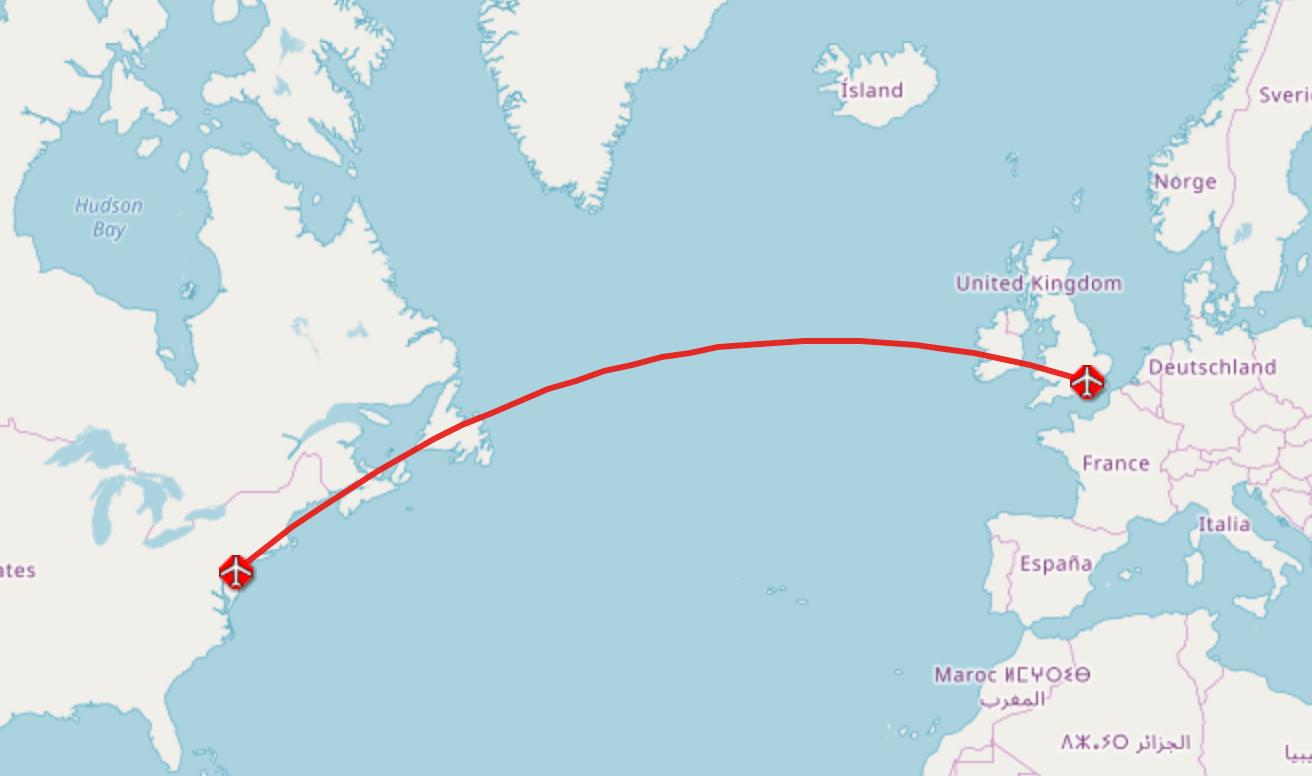
    Whenever I take a flight of any consequence, I inevitably pull out the airline’s magazine to flip through.  I usually end up scanning the flight maps that appear in the last few pages of the magazine to see the arcs of the travel routes from various hubs.  I’m not a navigator, and I’m definitely not a mathemetician, but I have a keen interest in travel and the most efficient way to get from point A to point B.  Rhumb lines illustrates how that happens on a big blue ball, where we can’t very well cut through the middle.  Instead, we calculate the great-circle distance, which is the shortest distance between two points on the surface of a sphere, as measured along the surface of the sphere.  That dotted line that connects the two?  That’s our friend the rhumb line.

    On land rhumb lines don’t help much.  You’ve got to follow the lay of the land, accounting for natural obstacles to progress like mountains, large bodies of water or the George Washington Bridge.  Up in the air, or on the ocean where these types of obstacles are mostly eliminated (reefs and large continents excepted), plotting a course from say, London, latitude 51° :30 m:0 s N, longitude 0° :10 m:0 s W to Philadelphia, latitude 39° :56 m:58 s N, longitude 75° :9 m:21 s W is visually portrayed as a sweeping arc, as you’re flying from the smaller circumference northern latitude to the larger circumference southern latitude.

    Screen Shot 2019-05-19 at 8.04.49 AM

    There’s a nice online resource for visualizing this, as seen in the image above.  It comes from gpsvisualizer.com and allows you to enter either the longitude and latitude for your two points or simply plug in the airport codes for each as I did for London and Philadelphia.  This site didn’t help those Portuquese sailors trying to show other sailors how to sail to the Gulf of St Lawrence for cod fishing, so navigation maps were drawn and copied with the rhumb lines to show sailors which heading would get them there and back.

    I’ve made a few dotted lines across the world over the years, and hope to make many more.  I think basic navigation should be a requirement for all kids in school, as it teaches not just math skills but also illustrates how small we are blipping across the fragile surface of the earth.  Rhumb lines convey hope for the journey ahead, appreciation for how far we’ve come, and focus on the path we’re currently traveling on this great circle.  I’m surely not the only one to pluck that analogy out of this fundamental of navigation, but I’ll celebrate having gotten here eventually.

  • New England Hops

    New England was once the hop growing capital of North America.  Like the population, it migrated to New York and eventually to the west coast.  But it all started here, introduced by the Massachusetts Bay Company in 1629, making it one of the original crops brought to North America.  Potatoes wouldn’t be introduced for almost another century.  So beer played an important role in the life of the earliest settlers.  The Puritans were pretty good at growing hops and eventually began exporting the harvest to other colonies.

    If there is a problem with growing hops in New England, it’s the humidity.  Hops are susceptible to downey mildew, which can devastate an entire crop.  Downy mildew and other factors like Prohibition eventually led to the entire hop growing industry shifting to the west.  In my younger beer drinking years I thought of hops as a west coast crop, and my experience growing a single hop bine proved futile enough to make me believe it wasn’t meant for New Hampshire’s climate.  And yet it was indeed a viable and profitable crop for almost 300 years.

    Today’s explosive growth in micro-brewing has fueled a resurgence in local hop growing.  Driving around Vermont and New York you can easily spot the hops growing in farms and even in urban breweries.  Growers will built tall support structures of wooden poles and string strong cables across the tops.  From these vertical cables run from the ground to the horizontal cables, forming 20 foot long channels for the hop bines to grow.  The hops are usually harvested in August and September and give unique bitter characteristics to the beer.  So we’ve come full circle, and hops are once again a viable local crop.


  • Frogs and All

    Yesterday, after thirteen lucky years together, our black lab Bodhi took his last breath.  Forgive me for this brief eulogy.

    There was the time you dug up every tulip bulb I’d just planted because you smelled the bone meal I used to fertilize them.

    There was the winter when we thought you escaped and were lost and drove around the neighborhood and then the town trying to find you late into the night, only to realize that you were lying under the shed all along.

    There were the countless questionable dining choices you made over the years on underwear, the extra ingredients in the cat litter, various leather goods and your favorite, flattened frog roadkill. The ongoing battle with the cats where they’d eat your food so you’d eat theirs. I respected that.

    I’ll miss those 10 PM power walks we’d do, and admit I don’t walk as much as I did when you were healthy. Back when you were a teenager you’d occasionally charge towards the woods, chasing a rabbit or a black bear or maybe a zombie; I was never really sure. I learned to anticipate those abrupt maneuvers and would spool out retractable leash like I was running out line on a marlin.

    Your best move was late night hide and seek. Pretty clever of you, being a black lab on a moonless night standing perfectly still when we let you out, until we gave up and went in for a flashlight. Even then you were usually found in the very last place I’d look for you.

    The pool filter won’t be the same without a full season of black fur clogging it up. You were one hell of a water dog, and swam so much you’d get ear infections. You always had a look of sheer delight when you would push the screen door to the side and sprint straight to Buzzards Bay, kids in chase behind you. You must have seal somewhere in the family tree.

    We’ll miss you Bodhi. 13 lucky years with you was not quite enough.  We loved you, frogs and all.

  • John Smith and New England

    Captain John Smith is usually associated with Jamestown and Pocahontas.  And he’s most famous for his relationship with the Native American tribes in Virginia.  Smith was proactively aggressive with hostile tribes, but proactively friendly with peaceful tribes.  There are plenty of examples in colonial history where hostile and peaceful tribes weren’t distinguished when it came to aggressive treatment of the Native Americans.  Pocahontas was just 11 when she met Smith, and it’s apparent that the stories of a romance between them are BS.  Whether she actually helped save his life is tougher to determine.

    Smith was an opportunist, but so were a lot of men coming to the virgin coast of North America.  What separated him from many others was his gift for self-promotion and his willingness to take risks to advance his standing.  But he backed up this, let’s call it entrepreneurial spirit with tactical and practical knowledge.  Many point out that the inhabitants of Jamestown didn’t fair so well when Smith went back to England.  Instead of growing and storing food for the harsh winter the settlers of Jamestown held out hope for supplies from England.  When the supplies never showed up as much as 90% of the population of Jamestown starved to death.

    Smith returned to North America in 1614 as ambitious as he was on his original trip.  This time he focused on what is now New England, and his crew worked on whaling and fishing to create a return on investment for those who funded the trip, while Smith and some others focused on mapping the coastline from the Bay of Fundy to the Hudson River.  Smith created a pretty accurate map, and betrayed his ambition by bringing the map to a young Prince Charles to have him choose place names for some of the locations.  A few of these, like the Charles River and Cape Ann, survive to this day.  Smith is credited with coming up with the name “New England” for this region, and named several other places on the map which have stuck.  But if he’d hoped to live on in infamy by naming the islands off Portsmouth, New Hampshire after himself, he’d be sorely disappointed to know they became known as Isle of Shoals.  But then again, Smith did enough to be remembered anyway.

  • Choice White Pines and Good Land

    I have a fascination with maps, and especially old maps, that dates back to when I was a kid tracing the route that we would take on family vacations.  When I started driving myself around I bought maps to help me navigate first the town I lived in and later New England and points beyond.  As a hiker I’d plot out where I’d be able to refill water bottles and camp for the night.  Maps were essential for navigating the world.

    Today GPS has stolen the magic of maps for everyday use in getting from point A to point B, but they can’t completely replace them.  I still plot out trips on Google Maps to plan the most efficient route.  I still love a good map; evident in the title of this blog.  So it was a delight to find a gem of an old map from 1761 created by Joseph Blanchard and Samuel Langdon.  This map has wonderfully random reference points like “From Connecticut River to a Great Pine Tree” and “This way captives have been carried by the Indians”.  This is a map you can fall in love with.

    Joseph Blanchard was born in the Nashua area and served as a Colonel during the French and Indian War.  He teamed with Samuel Langdon to create this map, which was published after Blanchard’s death.  It’s an amazing time capsule that highlights some contentious early days in our colonial history.  For me, the part of the map I love the most is in the present-day Plainfield/Montcalm area where the map designers noted “choice white pines and good land”.  A name like Montcalm jumps out if you’re talking about the French & Indian War, but apparently it’s not what the selectmen in that town were striving for when they named it.
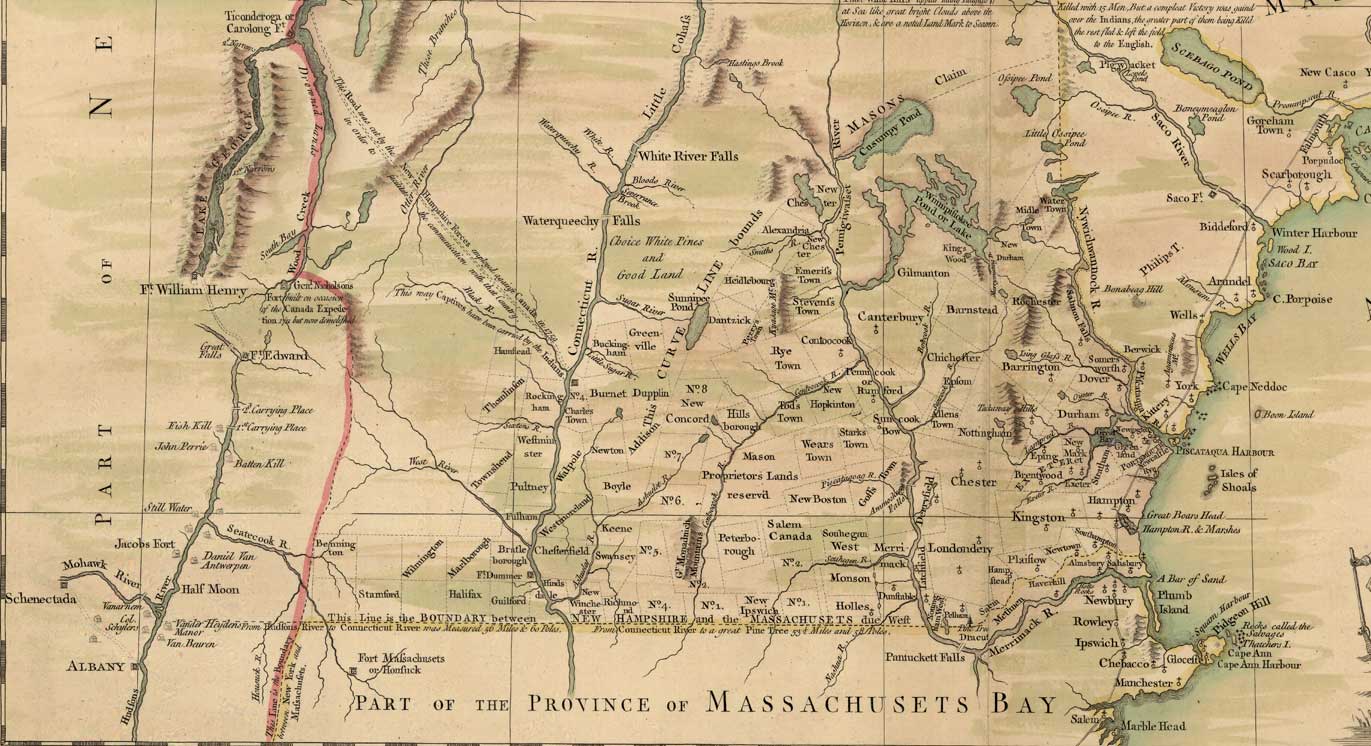
    If you search online you’ll find there are a couple of versions of the map available for  viewing.  The black and white version I have above, and a color version, a portion of which I show below.  The towns have mostly remained the same, with a few splitting into a multiple towns along the way.  The rivers are fairly accurate, which is notable since these were the superhighways of the day.  The map reaches as far west as Schenectady and as for North as Quebec.  This territory was ground zero in the French and Indian War, and the wars with the French that preceded it.  It would be important again during the early years of the Revolutionary War.  I’ve had the opportunity to travel most of this region over the years, and spend a lot of time writing about it in this blog.  So this map put a spell on me that I haven’t shaken loose from just yet.

    “The paradox of mapmaking… is that as soon as you begin shrinking a geography down to usable size, you necessarily are forced to misrepresent it. By making choices about what to include and what to leave out, you change the map from a document faithfully documenting an area to one furthering a particular point of view.” – Michael Blanding, The Map Thief

    Blanchard and Langdon created a map that clearly furthered a point of view, lending credence to Blanding’s observation. The history buff in me delights in reading it. Would it look the same if a Native American warrior had drawn it? Surely not. But the map no longer serves the purpose of furthering a point of view as much as it creates a snapshot of what the map’s creators were thinking at the time. Either way it’s a fascinating dance across time.

  • Leafing Out

    Mid-May; the time of year when the bones of the northern New England forests are once again masked in greens and yellows. Tree trunks, stone walls and other hardscape details disappear into clouds of leaves and shadows. The calendar says it’s been spring for awhile but it doesn’t really feel like it until the trees leaf out.

    Southern New Hampshire is officially Zone 5, and you really notice it this time of year when you travel regionally as much as I do. A trip to New York or Cape Cod can feel like a different world in early May. Zones 6 & 7 are that much further ahead of us. A trip further north reveals our own good fortune.

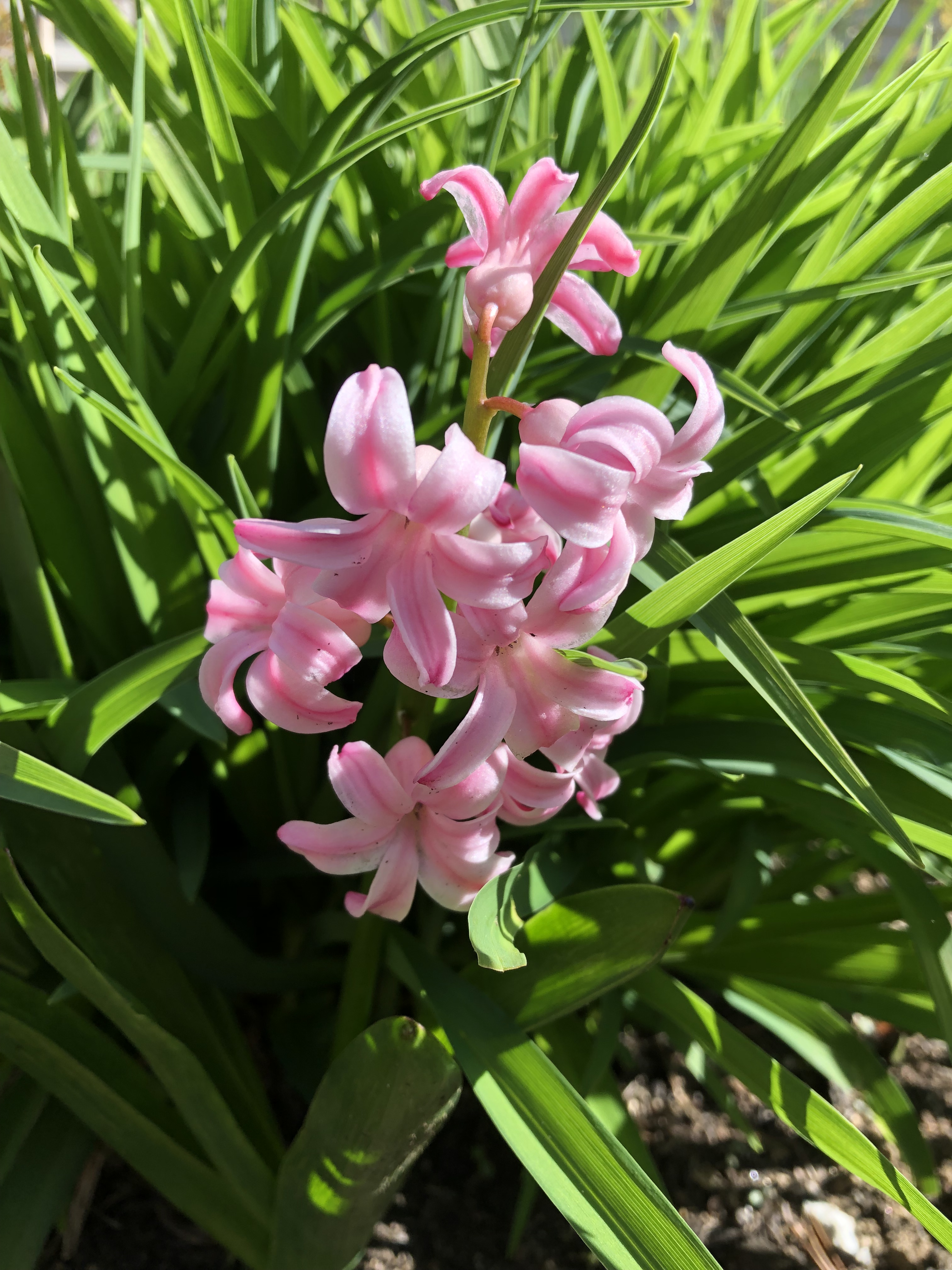
    Flowering trees and shrubs are well underway, while daffodils are just past their peak. Now and then you get a surprise from a bulb that’s way behind popping up to say hello. A single pink Hyacinth poked through a day lily to announce it was time.

    These are the early days of the growing season. Still a danger of frost lingering in the minds of eager gardeners, but safe for some plants. We haven’t seen the heat of summer yet, but we can anticipate it. This is mid-May and mid-spring all at once. Best to enjoy the show because it never lasts long.