Month: July 2023

  • This is Bliss

    “I believe that happiness is, it’s really a default state. It’s what’s there when you remove the sense that something is missing in your life. We are highly judgmental, survival, and replication machines. We are constantly walking around thinking I need this, I need that, trapped in the web of desires. Happiness is that state when nothing is missing. When nothing is missing, your mind shuts down and your mind stops running into the future or running into the past to regret something or to plan something. In that absence for a moment, you have internal silence. When you have internal silence, then you are content and you are happy.” — Naval Ravikant, Naval Ravikant: The Angel Philosopher (2017) [The Knowledge Project Ep. #171]

    I have people in my life who believe that I’m not happy deep down inside because I’m not out there chasing my professed dreams in the world. I contend that I’m just as happy taking a walk around the block as I am visiting some faraway place I’ve had on some bucket list. Happiness is a state we are either in or not in, based entirely on how we view the moment. My default, thankfully, is a state of happiness. That doesn’t mean I don’t stray into the desire for more—we all do that on occasion (and some of us dare to write about it). That desire for more disrupts our current state, upsetting the apple cart of happiness. Sometimes that’s necessary for growth, and sometimes it’s nothing but a distraction from the moment. Either way it’s a state change.

    I’ve been chasing a state change all of my life. Maybe you have as well. But nowadays I’m less into chasing and more into embracing the current state. Writing and creative output bring me to the moment very quickly. I walk and row more, which each lend themselves to being present for the next step or stroke, respectively. I’m equally present in the garden: when I’m dead-heading the geraniums or pulling weeds I’m very much in the moment. This is a state of presence the arrival in the internal silence Naval speaks of. This is bliss.

    The thing is, when we’re declaring our desire to travel or experience something outside of the moment we’re in, we’ve noticed something missing. In doing so, we’re missing the moment. If comparison is the thief of joy, then comparing our current state against some future or past state where we are somewhere else is a happiness remover. Sometimes we might need that kick in the ass: I’m moving more because I was unhappy being lazy and inactive. By being active again I’ve rediscovered a level of happiness that wasn’t there before. But if I start comparing my active body of today against that active body of peak fitness at 22, I may find my happiness knocked down a notch. All that really matters is the next step, the next stroke, and knowing this is the path for us now.

    Direction matters a great deal in reaching bliss, but it doesn’t infer we’ve reached our destination, only that we’re progressing there. We must remember that “there” is just a compass heading. Here is where living happens.
  • The Other Side

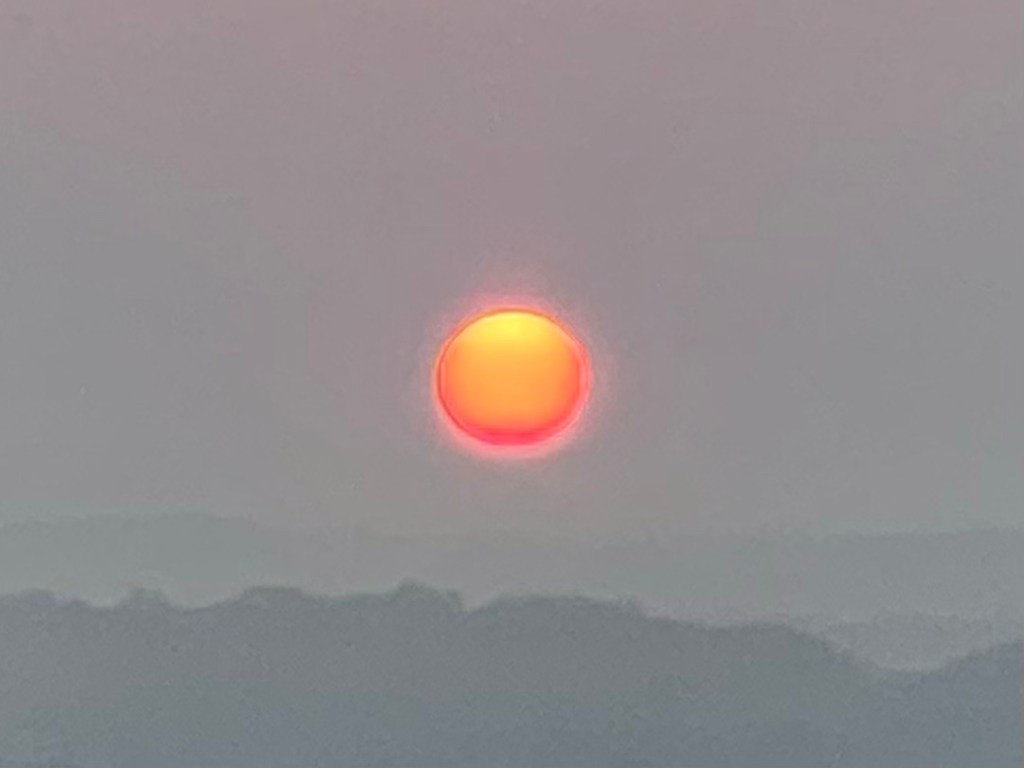
    What happens when you reach the other side of climate change? When is that step too far? Is it the blood orange sunrises from all the smoke in the atmosphere, or the closed trails and roads flooded to ruin? Is it the oppressive heat in the Middle East well above anything a living creature could survive in? I look at the trees for guidance and find they’re equally perplexed. More fallen leaves and branches than ever recollected, some fungus turning tree tops autumn colors in July. Do we wonder what’s happening to us?

    We generally agree we ought to do more, but rely on too many incompetent charlatans to bring transformation just when we need leadership the most. It’s now or never, and we must each rise to meet it. Will we? Have we thus far? When will we reach the other side of apathy?

    A not-so-normal but all-to-common 2023 sunrise. This is a real picture.
  • The Thing About Food Blogs

    “Songwriting is a really intimate experience, it’s kind of like sitting down with a stranger and telling them every secret of your soul…you have to be not afraid to make a fool of yourself.” — Madonna

    I love great food as much as anyone. And I love writing this blog, and have managed to do it every day for a long time now. But generally my days of writing about the best fish and chips in the world are over. I just want to focus on bigger things, thank you.

    I write this just after experiencing back-to-back meals worthy of writing about. Incredible Greek food worthy of several posts, and a perfect New Jersey bagel and cream cheese that stands up with the many amazing bagel places in the region. As a New Englander I can bow to the Metro New York region on certain foods. Just don’t talk to me about their clam chowder.

    The thing about food blogs is that they’re generally uncontroversial. You write about a great meal, take a few pictures and move on with your life. It’s also a great way to gain some followers in the wonderful and passionate world of food. And you don’t tend to have family and friends asking you pointed questions about when you’re going to do the things you say you want to do in your blog (nobody has all the answers: a blog is a forum for sorting things out). There are few things less less enjoyable than explaining a blog post to someone with a stake in the game you’re playing in the real world.

    Perhaps the answer is to have multiple blogs, writing about travel, food, philosophy, poetry and history in distinct blog buckets. Perhaps even anonymously. But really, that’s not what this particular blog is. It’s a bit of everything in a world that is much bigger than the writer trying to take it all in. It will remain as it is, as will I, and the chips will fall where they may. Still, I love a great meal.

  • Facing the Storm

    There’s a metaphor that’s easy to find on the Internet if you Google it about the difference between cows and bison. When a storm is approaching, cows huddle together and run away from the storm. The problem with this is they end up running with the storm, thus prolonging their discomfort. A bison, on the other hand, runs into the storm, facing the discomfort of it head-on, and in doing so, the storm soon passes over them and shortens the duration of their discomfort. The lesson, of course, is to face the storm.

    One of the leaders of the company I work for told this story to a couple of us, and it fit his personality perfectly. When it comes to the tumultuous change needed to grow our company, not only is he facing it head-on and charging, he’s asking everyone around him to be a bison instead of a cow. In our moments of discomfort we must choose whether to face it or try to retreat from it.

    It’s likely most people don’t change because they don’t like the feeling of discomfort associated with beginning—of facing the storm. I’m currently walking around with an abundance of lactic acid and a reawakened creaky ankle, all from the combination of beginning to walk longer distances again and rowing much more than I had been. This state change has created discomfort that will eventually fade as my body adapts. We’ve all felt this, and we know where it leads if we stay on track. Most people retreat from discomfort instead of pushing through. Be the bison instead.

    It’s fair to ask ourselves just what it is that we’re charging into. Is this a storm we want to face? But we know deep down that change is coming either way. Pay me now or pay me later: this is true with everything we do in our lives, whether getting in shape, getting ahead in our career or managing our relationships. You can’t just hide from storms, you’ve got to face them head-on and get through them. To do otherwise is to prolong the discomfort. So get to it already.

  • Time Buckets

    “Draw a timeline of your life from now to the grave, then divide it into intervals of five or ten years. Each of those intervals—say, from age 30 to 40, or from 70 to 75—is a time bucket, which is just a random grouping of years. Then think about what key experiences—activities or events—you definitely want to have during your lifetime. We all have dreams in life, but I have found that it’s extremely helpful to actually write them all down in a list… Your list will be your own unique expression of who you are, because your life experiences are what make you who you are…
    Then, once you have your list of items, start to drop each of your hoped-for pursuits into the specific buckets, based on when you’d ideally have each experience…
    by dividing goals into time buckets, you are taking a much more proactive approach to your life. In effect, you’re looking ahead over several coming decades of your life and trying to plan out all the various activities, events, and experiences you’d like to have. Time buckets are proactive and let you plan your life; a bucket list, on the other hand, is a much more reactive effort in a sudden race against time.” — Bill Perkins, Die With Zero

    When I was helping to raise two very active children, I could barely keep up, let alone plan a sabbatical for three months to explore the fiords of Norway. If you learn anything as a parent, it’s that to be a good parent your own desires should take a back seat to the needs of your family’s. But that phase of life is a different time bucket that you’ll have before and after it. Everything has its season. The trick is to identify when those seasons are and feel the urgency to fill it with experiences that fit it best. I wouldn’t trade the time with my children when they were growing up for anything. Now that they’ve grown up, I might just look towards those fiords again.

    “If not now, when?” ought to be the our mantra, for there’s truth in it when we face it. Time buckets put it all in black and white. We see immediately what is possible and what will be a forever dream. If we don’t book the experiences we want in life, we’re likely to miss them altogether. History is full of people with regrets in those final moments.

    Many people go through life believing that they’ll do those big life experiences when they retire, but forget that our bodies may have other plans. We’re more fragile than we want to believe we are. And there’s no currency more valuable than health and fitness. Some things simply can’t be done when we lose this currency. If you want to hike the Appalachian Trail or follow the Tour de France course on your own bike, it’s unlikely you’ll be able or inclined to do these things when you’re 70 or 80. Even if you are, you’re body is better equipped for the experience when you’re 25 or 35. Time buckets force us to look at such things and determine where in our lives certain experiences best fit in, while reconciling what we’ll never do if we defer any longer.

    Putting life experiences into buckets has merit, but there has to be room for serendipity in our lives too, for life should never be fully lived based on a Day-Timer or spreadsheet. The point isn’t to schedule every aspect of our lives, but to identify the buckets of time when we’re most likely to have the time and resources to do the things we most want to do in this lifetime: Build it and they will come. Life is what what we plan for and make of our time. We’ll have misses along the way, but we ought to put ourselves in the best position to play the hits too.

  • The Optimal Time

    “My number one rule is: Maximize your life experiences. So spend your money while you’re alive—whether it’s on yourself, your loved ones, or charity. And beyond that, find the optimal times to spend money.” — Bill Perkins, Die With Zero

    The dilemma of how much money is enough is the epitome of a first world problem. It’s a fabrication of the society we happen to be in, designed to have us maximize our earning time that we might contribute as much of ourselves as possible before our effectiveness declines. Alternatively, we might choose to make the most of every day rather than making the most possible money in our careers. This is the opposite of nihilism, this is living with purpose and intent at the time in our lives when we are healthiest and most able to be active participants in exploring our potential.

    There are two questions at work here: The where and when of spending time versus money. If a paycheck is the tradeoff for hours of our life, then what is that hour worth to us? We must set ourselves up to have just enough to get by until our very end, whenever that happens to be, without becoming a burden on our families. Perkins’ position is that most people overestimate how much they need in the end, at the expense of living in the middle. Will that time at the office have been worth it when we arrive on our deathbed? Just what are we trading in the process? Put another way, is this the optimal time to optimize time instead of money?

    We each want to contribute something to the world. We must balance this with what the world gives back to us. If we don’t ask for our fair share of time, the time will simply find someone else who wants it more. The optimal time to live is now. Everything else is compromise and sacrifice. Be sure the trade is worthy of your life. We all know, deep down, what matters most. Now is the time to optimize how we’re living.

  • On Sirens and Place

    “Where you are is who you are. The further inside you the place moves, the more your identity is intertwined with it. Never casual, the choice of place is the choice of something you crave.”
    ― Frances Mayes, Under the Tuscan Sun

    I talk of travel but deliberately spend money on plumbing fixtures that cost as much as a plane ticket to faraway places. You can feel the quality in a good plumbing fixture, you can feel the permanence of it if fate allows it a good home. A good faucet will outlive all of us. Surely it will last longer than a trip to Paris or Tuscany. Does a faucet sing a siren song the way that travel does? Surely not, but never forget that Odysseus was simply trying to get home to Ithaca. Sirens pull us away from home, never to return. Still, we hear the call.

    Surely, this place that we call home will outlast our desire to stay in it. Yet the garden remains, with bee balm rising to meet the sun year after year. The hummingbirds return to meet it, and the butterflies and bees. Bee balm (Monarda) is a bit like me, with a wandering soul. Its roots spread out, testing the limits of the garden, and each year the flowers bloom in a different place than the year before. Kindred spirit, I let them roam, content to see where they rise each year. In a walled garden there’s only so much room to run. Still, the hummingbirds always return, knowing they’ll be there somewhere nearby. And so will I.

    Returning seems the thing. When you have a sense of place you’ll move heaven and earth to get back to it again. But to return means to leave now and then. Knowing deep down that place remains.

  • The Net Benefit of Intervals

    I’ve always favored steady state work. Slow and easy may not win the race, but it keeps you in it for the long haul. The drawback is that your body and mind get used to this pace, creating a sense of apathy and inertia. Sometimes you simply don’t feel like you’re getting anywhere very quickly.

    Intervals are a great way to change things up. In rowing, this might mean doing ten 500 meter pieces with a minute off in between, rather than rowing 5000 meters in a steady state set. You end up doing more overall with the same distance as your mind and body commit to working harder for a shorter distance, knowing it will be over soon enough and you’ll have a bit of rest. I can shave two full minutes off the same distance in this way, while getting my heart rate up to places I couldn’t sustain for a longer distance. I’ve begun to mix in more and more interval training to see how my body (and mind) react. I’m far from the peak fitness days of college rowing, but workouts like this bring me a lot closer to those glory days. More importantly, they set me up for greater success with my fitness goals looking forward.

    The principle of intervals works equally well in our work. Rather than slog through a steady state of distracted work, I’ll put on my noise cancelling headphones, play the same Mark Knopfler instrumental song on repeat and power through a specific task until it’s done. This works equally well for writing as it does for finishing an expense report or developing a pivot table for trend analysis. It’s just you and the work, with a defined end point that’s close enough that you know you can get there without checking the phone ten times to see what’s happening in the world. As with the rowing, when you finish a day full of these intervals of focused work, you find that you’ve done far more than the norm.

    Our lives may feel like steady state as we plod along, one day to the next, doing the best we can in a distracting world. Breaking things down to intervals—this day, this hour, these next five minutes, creates the focus and urgency to get things done. Even if we aren’t enjoying this particular interval, we know it will be over soon enough. And just look what we might accomplish when we add it all together.

  • Searching for the Marvelous

    “Ordinary life does not interest me. I seek only the high moments. I am in accord with the surrealists, searching for the marvelous. I want to be a writer who reminds others that these moments exist; I want to prove that there is infinite space, infinite meaning, infinite dimension.
    But I am not always in what I call a state of grace. I have days of illuminations and fevers. I have days when the music in my head stops. Then I mend socks, prune trees, can fruits, polish furniture. But while I am doing this I feel I am not living.” — Anais Nin

    “The secret of a full life is to live and and be open to others as if tomorrow they might not be there as if you might not be there. This eliminates the vice of procrastination, the sin of putting things off, the missed communions.” — Anais Nin

    I’m often accused of talking to everyone—this is often true—for in each of us there’s a story worth discovering. Every now and then you discover magic, sparked by interest. These are the high moments I believe Anais Nin was seeking as well. She seemed a woman I’d have loved to have met. Forget for a moment her fame for writing erotica, she just seemed so damned interesting. We must each find the fascinating things about living and bring it to the world. When you meet someone equally compelled to discover, the space between us erupts in wonder. You don’t have to take your clothes off for that to happen.

    There are moments when I feel the infinite meaning, when I feel the marvelous. You sense these things all around you when you’re attuned to discovery. It might be something as exhilarating as travel or as commonplace as gardening: I’ve found it in waterfalls deep in the forest and in the crashing surf seen from high on a cliffside trail in western Portugal. These are to be expected, and the compelling reason why we seek out such places. But I’ve also found it hiding in plain sight in my backyard garden, in the scent of tomato vines on a hot summer day. It’s all around you when you look for it.

    The trick is to be open to experiences. Find possibility in the circumstance we’ve stumbled into. These occasions are fleeting at best, and gone in an instant. To be fully alive is to tune in to everything around us and savor its sweetness in its season. For this is also our season, and we may never pass this way again. Carpe diem. Let’s not waste another moment.

  • Leading Indicators

    I was bragging about a blister yesterday. This wasn’t just any blister, this was a rowing-induced, thousands-of-meters-sweating-and-working blister. I haven’t had one of those in a long time. Partly, this is breaking in a new rowing ergometer with a handle that doesn’t offer the cushioning of the previous rowing ergometer’s handle. But the handle is also angled slightly, putting a subtle pressure change in a new place on my fingers. And so I celebrated the emergence of a blister. Before you click unfollow, bear with me just a bit longer.

    As you surely have guessed, the point was never the blister, but the accumulation of sweat equity that it indicates. A blister is a leading indicator of change. I’m making progress on some fitness goals, one day and one workout at a time. You may hear more about that sometime in the future. For now, there’s incremental progress and the desire to keep it going. A great habit, replacing a bad habit, does a body good.

    Positive habits means checking boxes and building streaks. You check off a mission accomplished that day, then the next, and soon you want to keep that streak alive for as long as possible. When you achieve some momentum with this and then you do miss a day or two, beginning again is all you think about. The trick is to find the things you want to do to establish that positive momentum. The rest is checking boxes.

    Except that it isn’t that simple. Life gets in the way, we get busy, or other things take priority, like that cold beer your closest friends want to have with you. Finding the time anyway is the trick, and when you do that beer tastes a lot better than it might have otherwise. In moderation anyway, for we’ve got more work to do tomorrow.

    This is what momentum does to us. This is what progression towards a goal feels like. Incremental, positive change one workout at a time. That spot where the blister is will become callused eventually, telegraphing something even more significant: long term commitment towards a healthier life.