Blog

  • Hiking Passaconaway & Whiteface

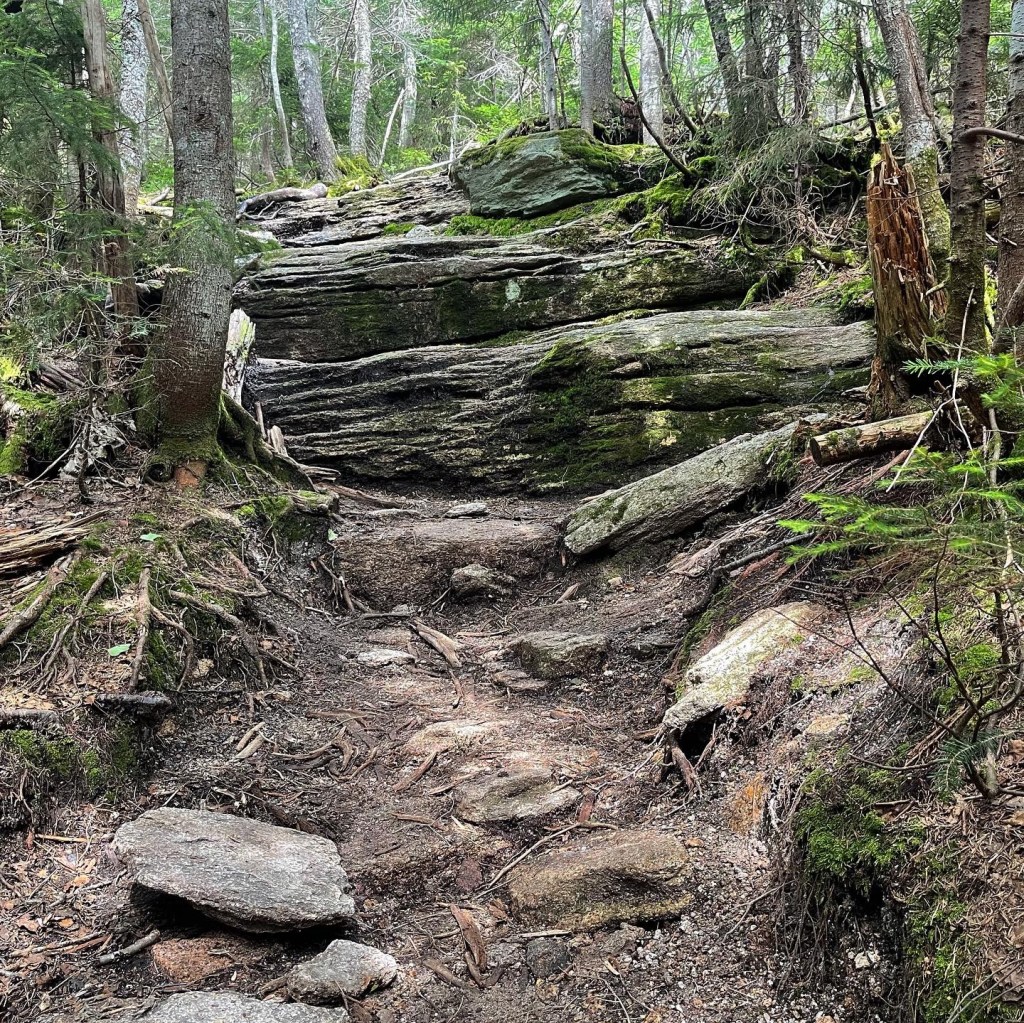
    Hot, muggy August days create hazy, sweaty conditions for hiking, with a dash of risk for thunderstorms. But it’s been six long months since I’d last hiked a 4000 footer, and I was way overdue to notch one or two more. The question then is, who do you hike with? For me, the answer for this day was to hike solo. I needed to work out the rust of hiking on granite again without feeling the obligation of keeping pace. And more importantly, I needed the mental space that hiking offers after another half a year of working during a pandemic.

    My thoughts on hiking alone aside, I didn’t want to drive an extra hour to find the less crowded peaks of the northern White Mountains. So my focus turned to Mounts Passaconaway and Whiteface, each part of the Sandwich range and relatively close with relatively good elbow room. And planned my hike the way most people seem to do it, to hike Mount Whiteface first and then loop around to Mount Passaconaway afterwards. Plans are lovely things, aren’t they?

    When you’re hiking on a trail and come across a spot where you can either haul yourself over a boulder or bypass it entirely by taking the worn path around it, which do you choose? The answer is subjective, isn’t it? It depends on the size of the boulder. It depends on the condition of the worn path around it. And it depends on your mood at the time. My mood at the time I reached the Tom Wiggins trail was such that when I read the sign warning that the trail was not recommended because it was “steep and loose” I paused for a couple of minutes to consult my trail map, contemplate the implications to the overall mileage I’d do that day, and opt for the out and back option instead of the loop. This decision added almost five miles to my hike, and I’d second-guess it the rest of the day, but sometimes you have to trust your gut.
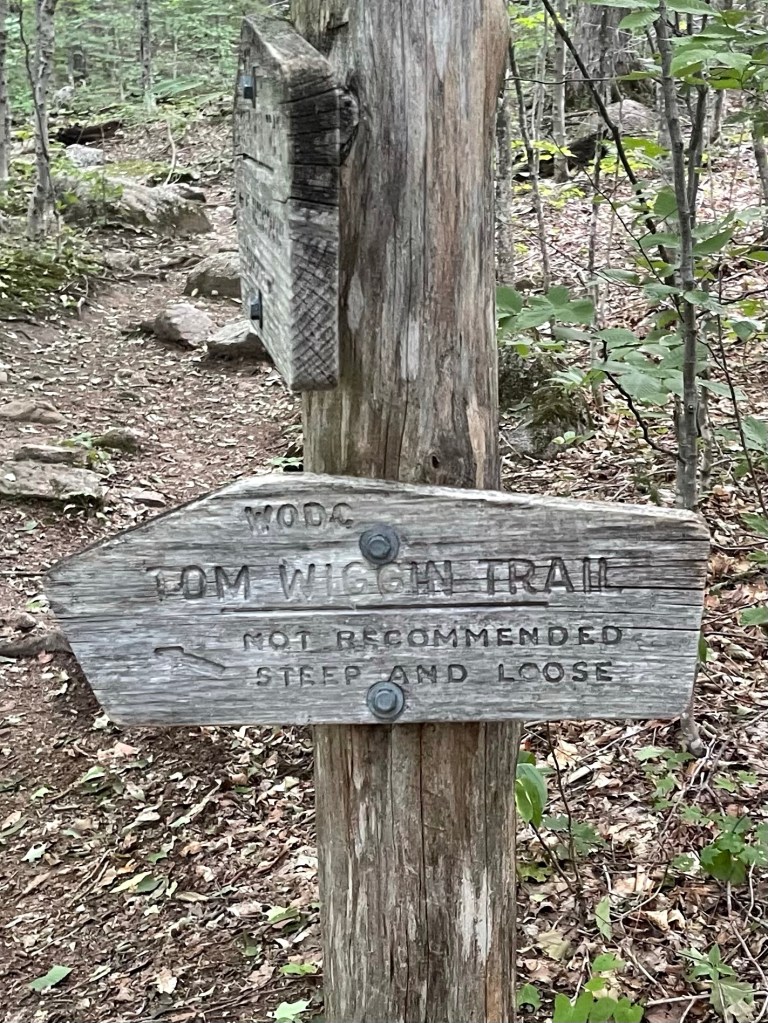
    Decision Time

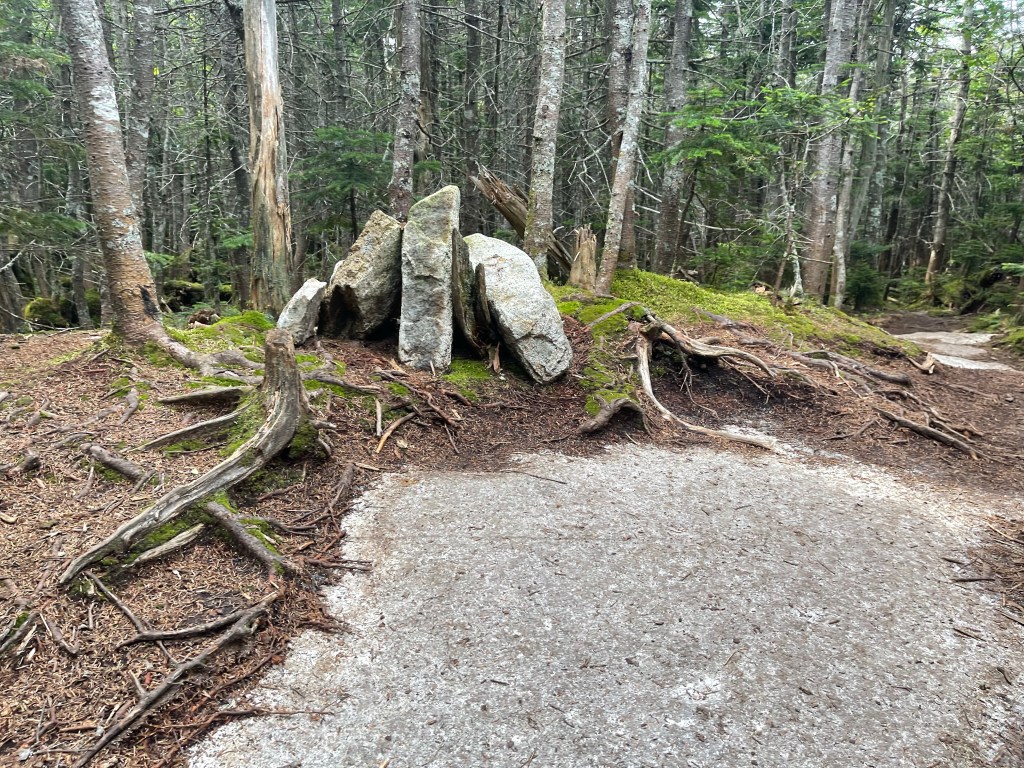
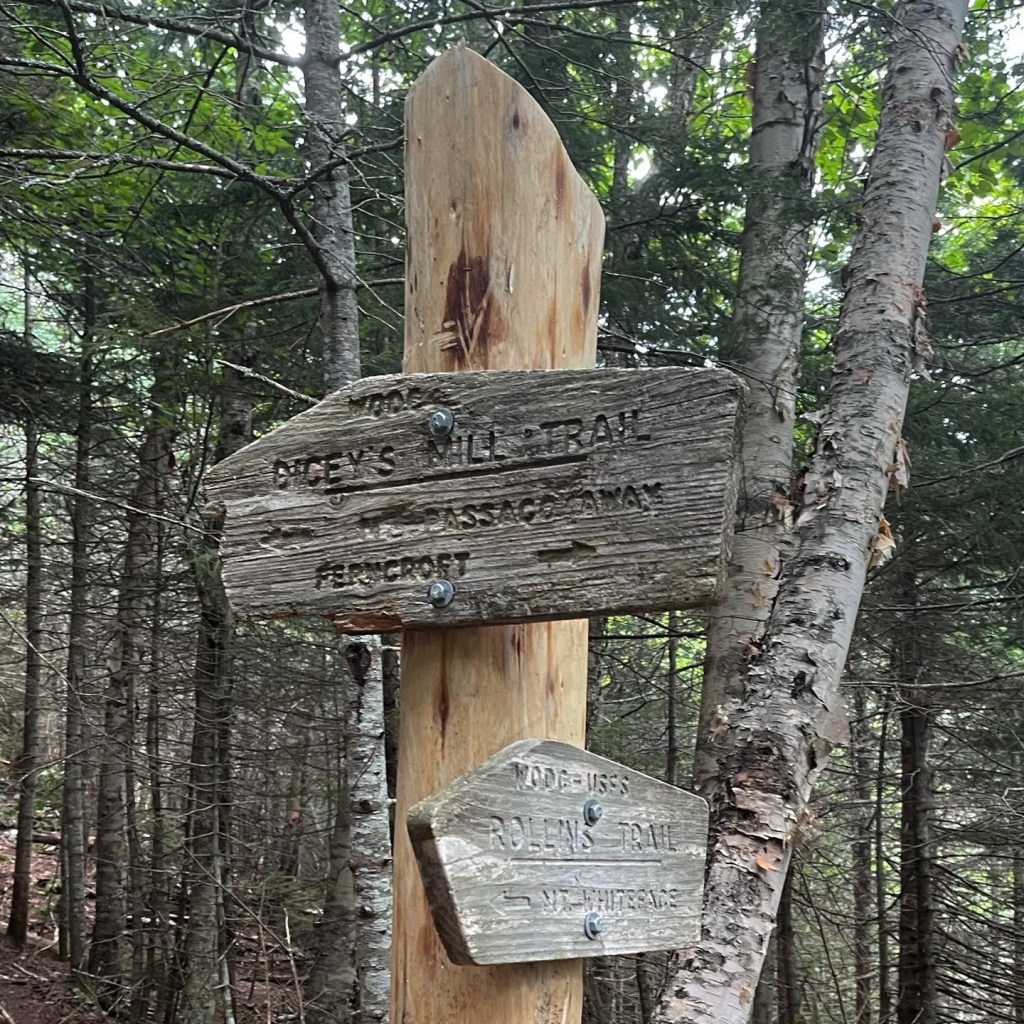
    Decision made, I hiked the Dicey Mill Trail to the junction of the Rollins Trail, where I had another choice to make: knock off summitting Mount Passaconaway first, or hike over to Mount Whiteface via the Rollins Trail and save Passaconaway for last? And here I made another choice that I’d second guess the rest of the day. I chose Whiteface, and hiked the 2.3 miles over to the cairn that marked the summit, went past it to the next trail junction and then turned around and hiked all the way back to where I’d begun. Far simpler to have just knocked off Passaconaway while the legs were fresh. It would have given me the option of descending the Tom Wiggins Trail (which was admittedly advertised as steep and loose). I may still have doubled back, but at least I’d have the option. Anyway, these are the hindsight options you think about as you’re sweating through your hiking shirt and feeling your knees and ankles remind you of your choices in life.

    This out and back hike wasn’t all that challenging, it was just long. And that’s exactly what I’d signed up for back at that sign. Sometimes you have to make peace with your decisions in life, and I’m okay with this one. Seeing comparable hikers who started right in front of me finishing the loop I’d contemplated after me, I recognized that either option was fine. I’ll hike the steep and loose section another day, probably in winter when the only part that matters is steep.

    This was my non-traditional hike of two more 4000 footers. I know if I’d hiked with friends I’d have just done the loop I’d planned all along, but sometimes you’ve got to just go it alone. And live with your choices along the way.
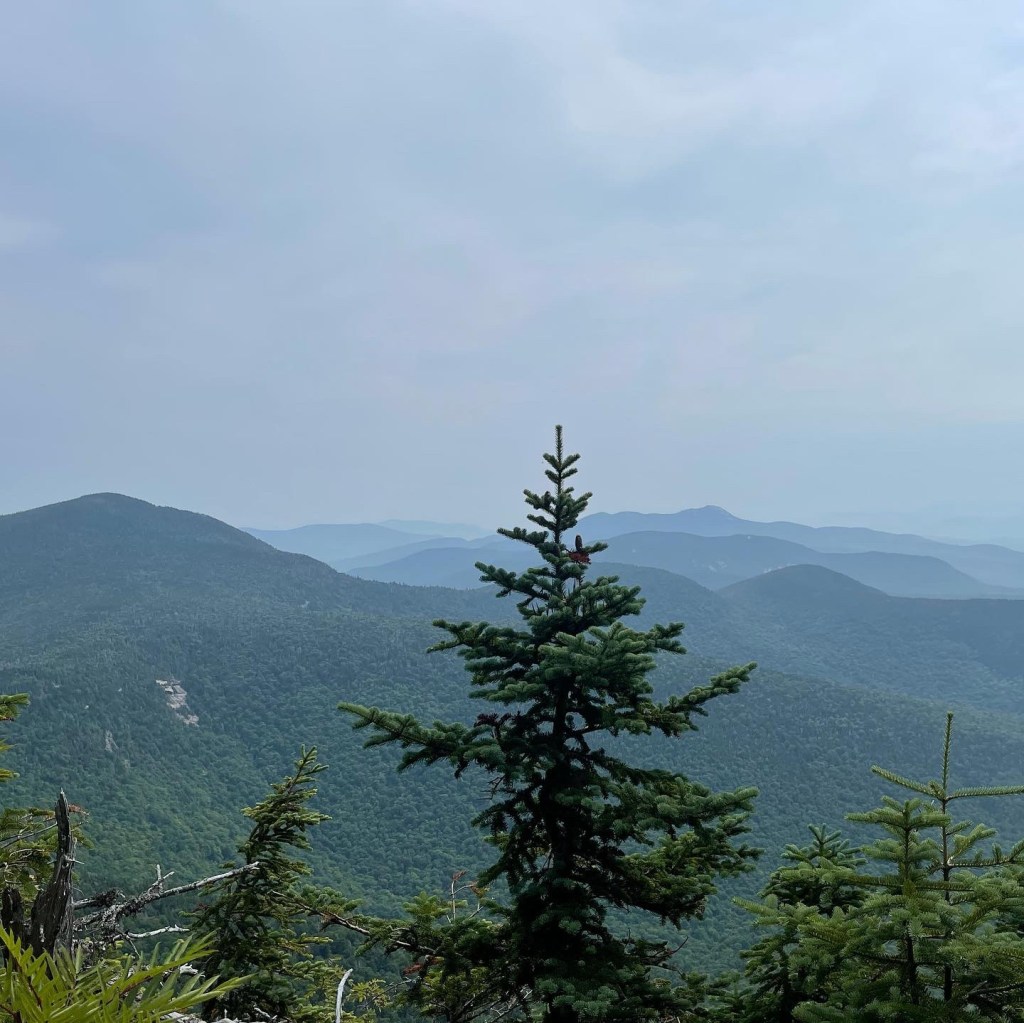
    Second Decision
    Summit of Whiteface
  • Prepping the Night Before

    On the fence about whether to hike a pair of 4000 footers, I decided to just start getting my pack ready, just in case. When the backpack was ready, the boots and hiking clothes laid out, it became a foregone conclusion that I’d actually get up and go at 4:30 AM. But it all started with packing that backpack.

    There’s nothing revolutionary about putting your workout clothes out, or getting your bag packed for an early flight. The work you put in the night before sets the tone for the morning. You don’t forget important things, you aren’t scrambling to find things that you swore were right where you left them the last time you hiked. But mostly, you do what you said you were going to do. Waking up to the alarm with everything laid out eliminates excuses, and pokes you with some positive pressure: I got everything ready, the least I could do is get my ass out of bed and get to it.

    So when you’re on the fence, or when it really matters that you follow through, prep the night before. It’ll make all the difference the next morning. Just remember to set the alarm!

  • The Perfect Day

    When you hear someone say they had a perfect day, what does that mean to you? We have this stack of days, one to the next, before it ends someday. What makes a few of them perfect, while the rest fall slightly short?

    Let’s start with the obvious: Waking up this morning, the day is already off to a great start. If you celebrate that moment the rest of your day may ebb and flow, but starting from a better place you set the tone for what follows. Carpe diem begins with celebrating the gift of life. If you’re bored with life or indifferent to the potential of each moment you’ll never have a perfect day. Each will fall short in some way because your mind isn’t open to the joy of living.

    Perfect requires stacking the moments in a day with just enough beauty and sparkle to reflect back at you, leaving an afterglow in your last moments awake as your cheek feels the cool softness of your favorite pillow. Perfect ought to include certain elements mixed in an elixir: A dash of wonder, moments of connection, the realization of experience, breathless celebration and sensory perception. You drink up this elixir, feel it soak through your pores and course through your veins, and feel high on life.

    We all have moments of perfection in our lives, but to ask for a full day of it seems almost too much. More likely, we forget the down moments in a day. Pushing moments of discomfort or awkwardness or frustration down in our minds for the glow of the rest of the day. And sure, maybe there’s really no such thing as a perfect day at all, but we can surely reach for it.

    As I began my day, I wondered, how can I make this one perfect? I may not reach it, but knowing the recipe you can get pretty close. Does seeking perfection make it artificial, or deliberate? You only find what you look for. There is no perfection, but there is magic in each moment. Often hiding in plain sight.

    And so I seek connection with each of my fellow life passengers that I stumble across, and keep my eye out for new experiences as big as a new summit and as small as watching leaves stir from a hummingbird’s wings, and tickle my senses with a new song on the radio or the scent of garden tomatoes growing on a summer day. These moments of aliveness, stacked together, are where perfection lies. It’s not the day at all, but the moments stacked together. For what is life but that?

  • Editing Our Short [Life] Story

    “Stuart Cornfeld once told me that in a good screenplay, every structural unit needs to do two things: (1) be entertaining in its own right and (2) advance the story in a non-trivial way. We will henceforth refer to this as ‘the Cornfeld Principle.” – George Saunders, A Swim in a Pond in the Rain

    I don’t recall who recommended Saunder’s book to me. It was most certainly a podcast or blog somewhere along the way. On the face of it the book seems a bit academic, but it’s a delightful class in writing well using Russian short stories as the vehicle for instruction. If that sounds boring, I understand, but Saunders makes the stories come alive while informing us on the craft of building a story.

    Which brings me to this observation on writing a screenplay by Stuart Cornfeld. Who can argue each point when it comes to building a story? Yet so many fall flat in one or both element. And what of building a life? Shouldn’t a life be built around joy and purpose? There’s a balance there between fully enjoying this short life and making something of our short time here, isn’t there? What do we keep in our stories and what do we eliminate? This Cornfeld Principle offers a simple template, even if the application isn’t always so simple in practice.

    Stuart Cornfeld passed away last year. He’s best known for collaborations with Ben Stiller, including a joy nugget, The Secret Life of Walter Mitty. I don’t know much about him other than his work, but it’s clear he brought a bit of happiness to the world in his brief go at life.

    Shouldn’t we all aspire to a similar contribution? As we write our oh-so-brief life stories day-to-day, don’t we owe it to ourselves to make it both interesting and non-trivial? Whether our story becomes a page-turner of a life or a satisfying epic is up to us. Edit well.

  • The Force of Bitter Need

    First he chipped fire
    Out of the veins of flint where it was hidden;
    Then rivers felt his skiffs of the light alder;
    Then sailors counted up the stars and named them:
    Pleiades, Hyades, and the Pole Star;
    Then were discovered ways to take wild things.
    In snares, or hunt them with the circling pack;
    And how to whip a stream with casting nets,
    Or draw the deep-sea fisherman’s cordage up;
    And then the use of steel and the shrieking saw;
    Then various crafts. All things were overcome
    By labor and by force of bitter need.
    – Passages from Virgil’s First Georgic, translation by Robert Fitzgerald

    When you read something like this, what does it do to you? Most of us won’t ever experience the life or death struggles that our ancestors faced. Yet the force of bitter need echoes in how we live our lives today. As a student of history, it’s easy to treat the migration of humans across the globe as an academic exercise. To treat wars and conflict and the enslavement and genocide of large swaths of people as horrible footnotes in history. But the stories we tell ourselves that keep the world in order is all so very fragile.

    This translation of Virgil is breathtaking to me, because it reveals our shared history, our overcoming of things, to survive another day and maybe build off that to create a generation after us to keep things going. Our human story is one of deep struggle, pain and labor. Of surviving despite the deck stacked against us. May we never forget how all that we’ve overcome as humans has shaped us. And shapes us still.


  • Is This Enough?

    “Whoever is not in his coffin and the dark grave, let him know he has enough.” – Walt Whitman

    The nagging begins in weak moments of fatigue or boredom or frustration: “More“, the voice says. “I want more” it persists. And the voice bleeds over to the blog now and then, with complaints about not being out there in the world, not finishing that book, not reaching that fitness goal…. whatever.

    The moment you woke up this morning you had enough. More than old Walt has, more than every person you can even think of born before 1900 and most of those born before 1921. A hundred short years and most everyone you can ever think of as being alive vanishes to the other side of life. So who are we, complaining about enough?

    Feel life wash over you, in each breath and heartbeat and blink of an eye. For it is enough. That life is outrageously unfair is well-documented. That we might make a difference if we worked just a bit harder is indeed possible. But never forget in those moments of fatigue and boredom and frustration that this business of being alive today is just audacious enough in itself to celebrate the moment.

  • By These Hands

    The gobs of wet leaves and pine straw pulled with bare hands from the gutter weren’t posted on YouTube for the world to see. Nor were the pulled fence posts as they were chipped free of old concrete footings. The world will never wonder at the labor put into such things by these hands. My labor remains undocumented.

    The same fingers that write these jumbles of words once laid brick on a curving walkway only to pull it up two decades later to reset a stubborn gate heaved by frost and refusing to close. This is the price of time in one place, you find yourself undoing what you’ve done before over and over again. It’s the labor of living, and like generations before mine the work goes largely unnoticed by most. Like an Offensive Lineman, you understand that if your work is noticed it wasn’t done correctly. But you know when it’s done well and when it isn’t.

    Labor is done for profit, and it reveals itself in moments. Each time I open the gate without having to kick the bottom corner, I’ll celebrate the sweat and strain of a Sunday in August when the work was done. Each time it rains I’ll celebrate the sound of water running through the downspout and not up and over the top of the gutter. These observations aren’t celebrated in the same way as seeing the Grand Canyon or St. Basil’s Cathedral or the Tower of London for the first time, because they’re mundane. But when you’ve fixed something that needed fixing and see it work, none of those other places matter a lick in that particular moment.

    I know plenty of people who hire others to do their labor for them. I understand this particular inclination, for paying others buys you time for yourself. Time spent on yard work is time not spent on a mountain summit or a beach on these briefest of days we call summer. But I know deep down that the work done by these hands reveals something in myself that I’d never find if I left the work to others.

    There are lessons in the labor, residing deep inside of me, that others may not see. Lessons that open up for you like a swinging gate free of obstruction. Flow through you like water through a downspout. When you do the work, even when it might all be undone once again someday, you understand that our brief, fleeting lives only have meaning in these mundane contributions we make. Even if it’s never seen on YouTube.

  • What Song Do You Hum to Yourself?

    I want to go all over the world
    And start living free
    I know that there’s somebody who
    Is waiting for me
    I’ll build a boat, steady and true
    As soon as it’s done
    I’m going to sail along in the dreams
    Of my dear someone
    – Gillian Welch & David Rawlings, Dear Someone

    There are bigger, more far-reaching songs on the classic album Time (The Revelator), but this one lingers in my head. It likely began with my interest in all things sailing and boats and travel. Or the lullaby rhythm of the song, which comes in handy when you have young children. I no longer have a boat of my own, having sold it off in relief several years ago. For that matter, I no longer have young children, as they begin their own adventures in places all over the world.

    When you want to start living free, what exactly do you want to be free of? Work? Or the life you’ve built around yourself, sturdy and strong, that locks you into a place and time in your brief go on this planet? Are we shaking off commitments and relationships of proximity in favor of the freedom of travel, or are we running from something in ourselves? Or maybe we’re seeking something that we aren’t finding where we currently find ourselves? Fair questions to ask before you set out in your vessel of choice. But never forget that you have that agency.

    A revelator is someone who reveals the will of God to the rest of us. We all decide what this God character is in our lives. We all have our stories about the world and our place in it. There is no better revelator than time, for it reveals within each of us the truth about who we are and where we want to go. Sometimes it reveals that what you’ve wanted most is what you’ve built around yourself. And that, maybe, what you’re seeking is already here.

    Every day I wake up
    Hummin’ a song
    But I don’t need to run around
    I just stay home
    And sing a little love song
    My love, to myself
    If there’s something that you want to hear
    You can sing it yourself

    Gillian Welch & David Rawlings, Everything Is Free

    The world will open up once again, should we ride out this time and meet it. And then what? What boats are we building? Where do you go from here? Time will surely reveal it all to us, but let’s always remember that we have a bit of a say in the matter too. Over time, if we’re lucky, we learn to listen to the songs we hum to ourselves.

  • Get After It, Again and Again

    Lingering in the good soreness from a couple of days of long beach walks, I can’t help but wonder how fit I’d be if I walked the beach every morning before the sun rose. Then again, I think the same thing after a great hike, after consistently rowing anaerobic pieces, or doing intense weight circuits or swimming laps in salt water. Active is active, and the point of active is to do what you can where you are with what you have. Otherwise you’re inactive.

    So get after it. Carve out the time and do the work. This naturally goes for anything we pursue in life. Plodding along half-assed is a form of wasting space, and we aren’t here to waste space, are we? Sliding into comfortable complacency is just so… easy. But it doesn’t get us where we really want to go.

    “You can usually accomplish more by giving something your full effort for a few years rather than giving it a lukewarm effort for fifty years. Pick a priority for this season of your life and do it to the best of your ability.” – James Clear

    Beginning in early July I challenged myself to 20 days of rigid eating and exercise. It turned out I wasn’t so rigid with either, but still managed to lose 6 pounds and noted significant progress in kettle bell repetitions (my focus during this time period). It was just enough to make me want a little more. Really, a lot more. And so I begin again.

    Normally I’m an Olympics junkie, and love to watch athletes who put everything into their sport come together to compete. If I were broadcasting the Olympics, I’d be following athletes from different sports and different countries for years documenting the blood, sweat and tears as they grind away at it all. Then put together a montage of each, no matter how they finish in their events, through the closing ceremonies and then back home. Where they look around, smile and begin again. But broadcasters (and most people) celebrate the big moment, not the process that gets them there and beyond.

    The more trips around the sun I take, the more I see that life is about becoming, and it’s never fully realized. It’s celebrated in small moments of lingering soreness and beginning again the next day. We’re here to get after it to the best of our ability, to work towards that person we want to become. Beginning again and again.

  • Traveling Between Variants

    Traveling again opens up the world, and exploring new places for a few days in Miami leaves me ready for so much more. Miami has some of the best dining options anywhere, and also some of the worst drivers. I delighted in the best sushi I’ve ever had, while marveling at some of the most ill-advised driving decisions I’ve ever seen. Each destination offers its own unique reveals.

    You forget how much you learned to love the life of a nomad until you’re locked in place for a year. One business trip and it all washes over you again. The anticipation and cadence of a meeting, the shift from one hotel to another as you change cities, overcoming language barriers, and the food versus fuel debate in your head as you scan unfamiliar menus. It’s all part of the life of a traveler, and you count your blessings when you can travel again.

    And yet this business of fighting the virus and its variants isn’t quite over yet. There’s an underlying unease about the virus amongst the thoughtful, and a heightened awareness of crowded spaces. Eating out in a place like Miami involves many crowded spaces. You hear of Australia locking down and patrolling streets and contrast it with the freedom of movement and the casual closeness in packed spaces in Florida. Who is right?

    We may move closer to normal, but the generational impact of the pandemic on the collective psyche of humanity will be felt for our lifetimes. When you travel again you immediately see the world differently than those who are still sheltering, because you have to. The world is moving on even as the virus is doubling down, and you’re either casual with your personal health and responsibility to others or you’re not. I’m surfing the edge and I know it, but the thrill of travel fills me up anyway.

    Travel by its nature requires a leap of faith and calculated risk. If you have the freedom to travel, then do so responsibly. That begins with getting vaccinated and practicing good hygiene. Risk is never eliminated in life, but it can be mitigated. Because getting back out there illuminates this beautiful gift of living, and it would be great for everyone to get back to the brighter days.