“To live is the rarest thing in the world. Most people exist, that is all.” — Oscar Wilde
Do interesting things. Cross borders—real and imagined. Test the validity of advice from timid people. Discover the bridges that fill the gaps between who we are and who we aspire to become. For the clock is ticking and time grows short, even as we foolishly believe it may run on forever.
There’s work to be done (surely there’s always work to be done), but make it work that explores limitations and offers a steep ascent in learning. Always remember that we may never pass this way again, so do what calls for attention while we are here—younger and more vibrant than we would be if we ever were to return.
To live, and not to merely exist. This is our quest. Get to it already!
“Going from zero weekly exercise to just ninety minutes per week can reduce your risk of dying from all causes by 14 percent. It’s very hard to find a drug that can do that.” — Peter Attia, Outlive
I’m sore. The kind of sore that you seek out one step or lift or twist at a time. And since I’m traveling as I write this, that means a whole lot of steps. But I’m on a climb back to a higher level of fitness—the kind that lasts a lifetime.
We are dealt a genetic hand when we are born, and we must learn how to play that hand as best we can to mitigate the bad cards while maximizing the value of our better cards. I’m not much of a card player but I know enough to play for the long term when the cards present themselves a certain way. In poker (and in life) this is called grinding.
There’s always an excuse for stepping off the fitness path. Yesterday’s excuse could have been deep dish pizza and a birthday toast for my daughter. Neither of those things would have changed a great day by having them. I celebrated with a salad and iced water. There’s a time for carbs and booze, and a time to stay on track. Great days happen when we focus on the joyful essential, not the superfluous extras.
Similarly, working out every single day can suck a lot of time away from other things we could be doing. What are those things? Are they so important that we can’t carve out an hour or two out of the day to exercise? Usually not. We made a walking tour of Chicago part of our itinerary, seeing things we might not have seen otherwise while increasing our step count.
They say that life hardens us. But life can also soften us too. We grow comfortable and complacent, and less inclined to do the work needed to be healthy, vibrant and fit. There’s a tax that comes due when we defer our fitness. Pay me now or pay me later…. Choosing to grind each day offers dividends in more energy now and a longer health span down the road. Making that road more vibrant for longer is a great investment in our time now.
Whenever I visit an art museum, I work to appreciate what the artist was saying with their work. As with everything meaningful, we feel art as much as we see it. But there will always be some art that just doesn’t reach us.
When I come across art that I don’t feel, I concede that either the muse wasn’t trying to reach me through that artist or perhaps that artist missed the opportunity to connect. Either way I move on to find art that I may feel immensely. Tempusfugit: time flies, and life is too short to linger with art that doesn’t connect.
I may linger with impressionistic landscapes or cubism or neoclassicism, but I know that the art that will usually stop me in my tracks is simply a portrait. I’m drawn to faces on the wall just as I am with faces in a crowd. Human connection across space and time is my empathic jam. Does that make me less sophisticated than the lover of modern art? Frankly my dear, I don’t give a damn. We must ignore those who would shame us for what we love.
Rembrandt Laughing, self-portrait Portrait of Suzanne Le Peletier de Saint-Fargeau, Jacques-Louis DavidChild Braiding a Crown, William-Adolphe BouguereauIsaac Fuller, self-portraitRaphael breaking the fourth wall, Raphael RoomsThe Dean’s Roll Call, Thomas Eakins
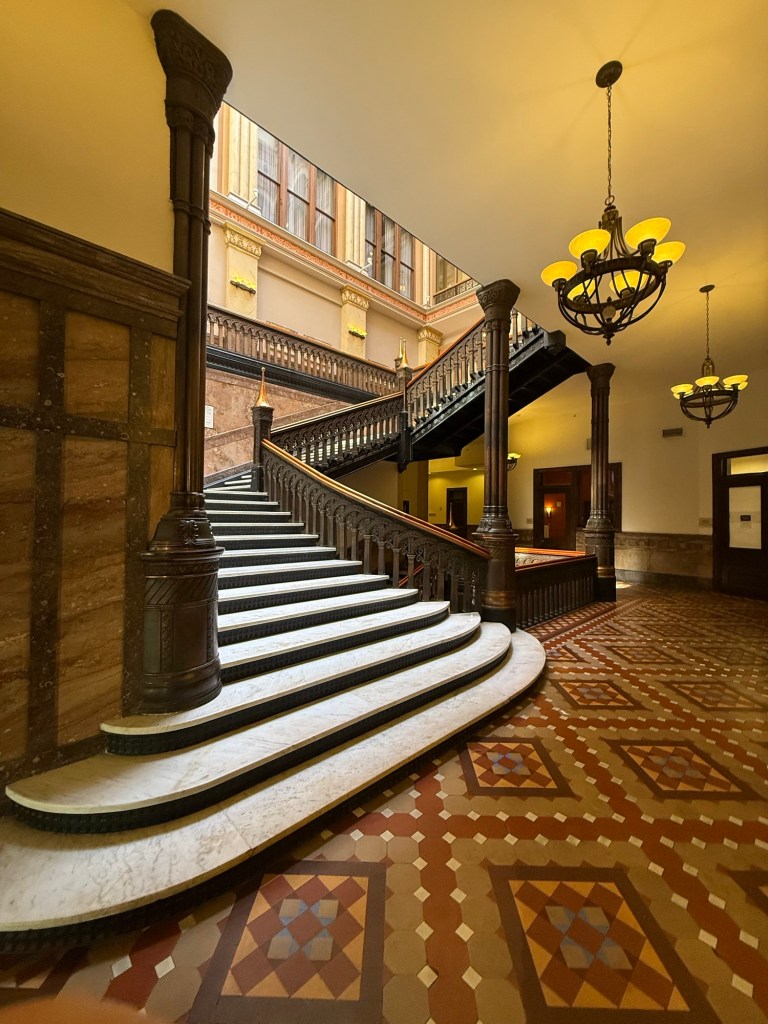
In Milwaukee, Wisconsin there are plenty of fascinating things to see, ranging from the strikingly gorgeous Milwaukee Art Museum to the time machine Bronze Fonz statue to the exceptional German food and beer scene. But beyond all of that, there’s a gem hidden in the most unusual of places that most tourists would never see. Unless, of course, they stayed there.
In the late 19th century, the Northwestern Mutual Life Insurance Co. had commissioned the construction of a Richardsonian Romanesque building designed by S.S. Beman. That building, known as the Loyalty Building was completed in 1886 and is now both a National Historic Landmark and the most beautiful and unique Hilton Garden Inn I’ve ever been in.
The building was built of Maine and Indiana granite, with arches and modern features like dual-lighting (gas and electric!), heating and an innovative cooling system. A massive glass ceiling lets in tons of natural light, and the floors feature terra cotta and terrazzo tiles in intricate patterns. Honestly, you don’t know where to look there’s just so much to see!
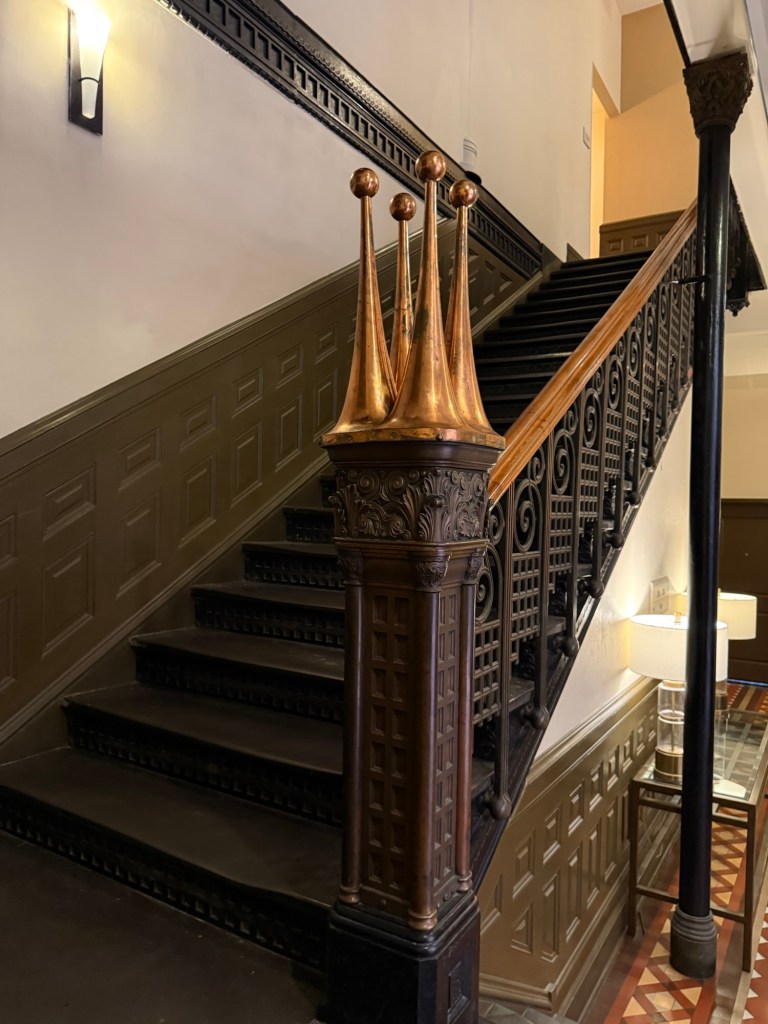
But then you see and know. The star of the show is the staircase, with cast iron balusters and bronze newels topped with tall copper inverted cone-shaped finials. It’s those finials that catch your attention—that’s a lot of copper sitting their marking time. Those cones made it through the Great Depression and two world wars. And it’s the story of their survival that is most interesting of all.
During World War II, copper was in short supply and being scooped up and thrown into the war effort all over the country. The building’s owner at the time, not having the heart to see the copper finials melted down, painted them black to escape notice. They stayed that way, forgotten it seems, until the 1960’s when they were uncovered for the world to see once again. And all you have to do is step into the Hilton Garden Inn in Milwaukee.
“But all the magic I have known I’ve had to make myself.” — Shel Silverstein, Where the Sidewalk Ends
We all find our way in this world. The question is, our way to what? Some live a life of servitude framed in family expectations or social status. Some are brought up believing that nothing matters anyway, so why try? Some are so focused on transcending where they started that they are forever climbing, ignoring anything that doesn’t bring them ever-closer to the top. And some walk through life looking to capture the magic of the moment as they present themselves. We are what we focus on. Give me magic.
Living a life where we are forever collecting moments of magic may seem a frivolous waste of time to the climbers. The non-believers will wonder what the point of it all is when life is nothing but despair and worry to them. We can only work to help them see what was dancing in front of them all along.
Magic is spun out of art and words arranged just so. Hope and love and beauty are spun of magic. Generosity and purpose are woven of magical fibers. Magic is in the interaction between fellow travelers on life’s journey. Magic is manufactured out of parts and pieces and collaboration. Magic is getting out of the way to watch our children grow into exceptional humans. Magic is daring to notice. Magic is daring to do, despite all the naysayers who believe that magic is childish nonsense.
As with anything in this brief moment of consciousness, magic offers a spark of insight and wonder to illuminate the darkness and show others what is hiding in plain sight. To make magic is to help others to see beyond the anger and fear and misery that a singular focus on non-magical things brings to the world. This blog post may be nothing but a jumble of words, heavily sprinkled with the one, or a catalyst for awareness. It’s not for me to say which it might be.
Teachers told us the Romans built this place They built a wall and a temple And an edge of the empire garrison town They lived and they died They prayed to their gods But the stone gods did not make a sound And their empire crumbled till all that was left Were the stones the workmen found All this time The river flowed In the falling light Of a northern sun — Sting, All This Time
Our empires will crumble one day: We learn to accept this even as we continue to gain momentum in the current of life, for this is our time and these are our days to do and be. To exist at all is a blessing worthy of a deliberate life. To move through our time deliberately is to honor the gift, even as we struggle to understand the meaning of it all.
The river flows endlessly to the sea: At the point of their finally meeting is an estuary, with swirling whirlpools of confusion and the brackish mix of fresh and salt water exerting their will upon the other. The sea always wins in the end, but it never forgets that it is the river that gives it life. In return, it will give up it’s waters to begin the cycle again and again. So it is that life is a series of tolls paid for the privilege of being here, now. We ought to pay that toll with gratitude to our final breath.
Progress hides in plain sight: We chip away at our goals—fitness, work, writing, books read, or maybe faraway ports of call, and with each small win we feel that sense of accomplishment for having made another step forward. Even the occasional stumble is okay, so long as we feel we’re moving in the right direction. We don’t really know where it all will take us, but collecting incremental wins feel like the right thing to stack up in a short dance with a vibrant health span. What else are we going to do with our time but grow and learn and find connection with other like-minded beings making their own way through the madness of life? Our purpose is found in the flow, not in the arrival.
“Yesterday I was clever, so I wanted to change the world. Today I am wise, so I am changing myself.” — Rumi
They say that change happens slowly, but it feels more instant than that. Transformation happens slowly—deciding to change happens instantly. The rest is execution. Decide what to be and go be it.
We get too clever for our own good. We come up with great excuses for why we won’t change and say we’ll get to work tomorrow. There is no tomorrow, friend. We must get to work now.
“Allow yourself the opportunity to get uncomfortable.” — Alex Toussaint
When we move into uncomfortable situations, we are making a choice to move away from our old identity into something decidedly new. That in and of itself is daunting. Throw in some well-meaning friends trying to gently pull you back to who you once were and it moves up to challenging. But stay the course and something switches within. It all becomes easier. Our identity has changed from someone who prefers the comfortably familiar to someone who stretches their limitations.
Living in a constant state of getting uncomfortable requires a productive mindset. There is work to be done, we tell ourselves, because we aren’t done yet. One area of life blends with another, and another, and soon we’re finding we aren’t dwelling on excuses anymore, we’re just doing what needs to be done to make progress towards the higher standard we’ve set for ourselves. This applies to work, our health and fitness, our relationships with others, to what we read or the information we otherwise consume, and sure—to what we write. We haven’t reached personal excellence yet, but we’ve lived to fight another day. So fight for it.
If progress is the goal, whatever the pursuit, then comfort is the enemy. We simply cannot progress when we’re holding tight to what was already comfortable for us. To climb away from that scenic vista into the unknown may make us question our sanity at times. What is sanity but behaving in a normal and rational way? Who decides what is normal or rational? The people who want things to stay just the way things have always been. What a sad, boring existence that would be. Identity is a foundation, not our final destination. Keep moving—there’s work to be done.
We should never aspire to be busy, we just become busy as our responsibilities accumulate. At some point something has to give. So what must we hold onto in that moment?
To write daily amidst the big changes occurring in one’s life offers a unique opportunity to capture perspective. That perspective will surely change with the changes, but in that moment we are who we are. A blog is not a novel and it’s not a journal, it’s a daily exercise in capturing perspective before it changes yet again.
Where are we now? What has happened to bring us here? And the question of questions, what comes next? What stands out in this post that marks who we were as we wrote it? Everything is different, everything is the same. We flow through our time grasping for a good anchorage that will hold us long enough to gain some perspective. We must be sure to log it before we’re on the move yet again.
Writing for someone with a lot to say is a release. Writing for someone who isn’t in the mood to share is a chore. We each have moments with each. To write daily is akin to doing our chores. We know we must do our chores, even when we don’t feel like it, and we feel better for having done what we promised ourselves we’d do. The promise is to click publish having said something worthy of the time it takes to read it.
“Our doubts are traitors, and make us lose the good we oft might win, by fearing to attempt.” ― William Shakespeare, Measure for Measure
Something changes in us when we resolve to do something. A switch flips somewhere within our body and soul, and our very identity has changed well before the actual work is done that we’ve decided to do to bridge the gap. The attempt becomes obvious as the logical steps between here and there. Doubt defers to a rigid focus on outcomes. Determination enters the fray.
All of this leads us to make a passage. Like a sailboat crossing an ocean, we are on a journey ourselves, from where we were to where we’re going. This passage is fraught with a potential dangers in the form of well-meaning friends and family, work obligations, and the most insipid of dangers, comfortable habits and beliefs about who we are that must be overcome to complete the transformation. We’ll need all of that rigid focus and determination to make it through.
The thing to remember about a passage is that it’s not one step. It’s a labyrinth, and we aren’t meant to see the other side. We’re only to take this next step. Days will fly by as they always have, but we are moving through them differently than we used to. The passage changes us in ways we don’t see until one day we realize the gap has shrunken before us. We may then honor the changes by simply taking the next step ahead.