Category: Culture

  • A World You Want to Live In

    I know you’re tired
    And you ain’t sleeping well
    Uninspired
    And likely mad as hell
    But wherever you are
    I hope the high road leads you home again
    To a world you want to live in
    — Jason Isbell and the 400 Unit, Hope the High Road

    I had a conversation with a work acquaintance who travels down a different ideological path than me. Maybe because I’m a good listener, or because I look the part, or because he’s inclined to let his opinion be known no matter who was on the other side of the conversation, his path of maybes led down the familiar sound bites for an American conservative man: taxes, guns and the irrational left. I heard him out instead of debating him on each point I disagreed with. I’ve learned long ago to stand my ground but always hear out contrary opinions. The weakest minds among us are those who refuse to listen for want of shouting down instead.

    There’s no doubt the world is experiencing friction. Humans angry with other humans, climate change turning the seasons upside down, rhetoric turned up, and bad behavior seemingly rewarded with fame and fortune. Aggressiveness is celebrated, amplified and repeated. There’s an ugly side to humanity, a side we thought we’d transcended for a brief, shining moment, but which keeps expressing itself despite our best wishes. We used to shame away the crazies, now we make them leaders and lawmakers. History strongly suggests it has always been this way. And yet we progress despite ourselves.

    We all know the expression: be the change you want to see in the world. It may feel insufficient given the weight of all our problems, for we’re far from perfect. As I travel around the world, it’s clear that most everyone is trying to take the high road and be that change we all want to see. Therein lies the secret to happiness in this tragic comedy: choosing what to see. In this brief lifetime together, we must see everything, the ugly and the beautiful, and focus on connection. This is more than symbolism, it’s putting in the sweat equity that brings us closer together instead of further apart. Collectively, we are what we choose to work on.

    May our work carry us higher.

  • The Greatest Ghost

    “In the end, we are haunted by the examples of the past, the denied permission to live a free journey. We are haunted by the partial examples of those in our purview, taking their pusillanimity or oppression as predictive of our own. We are haunted by the social constructs that tell us what a woman is and what she can or cannot do, and what a man is and how he will be shamed by living beyond these calculated constrictions. We are haunted by bad theology, bad psychology, and bad social models into thinking we are defined by our history, by our race, or by cultural heritage. We are haunted by the unexamined lives of our ancestors and caregivers. We are haunted by the widespread impression that history is the future. We are haunted by the limited imagination of our complexes. And even more, we are haunted by the small lives we live in the face of our immense possibilities. Haunting is individual, generic, cultural, and extremely hard to challenge because it so often seems bound by generations of practice, ancestral fears, and archaic defenses of privilege.
    The biggest haunting of all, the biggest shadow that occludes our sense of sovereignty in the outer world, is the specter of our unlived life. Something within each of us suffers, longs, despairs, persists, and even goes underground to reemerge as fantasy, as projections onto surrogate objects of desire, or as anesthetizing self-soothing. When the soul is not honored, when our possibility is denied by an outer oppressor, a social proscription, or worse, our own pusillanimity, our pathology intensifies. We are bombarded with pharmaceutical anodynes, cultural distractions, and rationalizations and evasions that facilitate these deflections from the summons to personhood. In the context of such hauntings, the greatest ghost for us is the apparition of what was possible but that we shunned. Such moments are not very pretty and may have to haunt us even more to get our actionable accountability. If we live in haunted houses, we are called to turn the lights on and clean house.”
    — James Hollis, Living an Examined Life: Wisdom for the Second Half of the Journey

    I suppose Hollis’ words might be broken down to this: We mustn’t live our lives encumbered by the embedded beliefs that have held us back thus far. We must break away from that prison and go live boldly. To do otherwise is to succumb to our limitations. The mass of men lead lives of quiet desperation, as Thoreau put it.

    These are lessons that come to us in time. We see the ghosts for what they are and work to open our minds that they might drift away. Are we the best of what we might have been? Probably not, but we can point to the highlights proudly and remind the ghosts that we’ve lived a good life nonetheless. We each know where we might have done more. That doesn’t make what we’ve done worthless, but it ought to be a foundation more than a prison cell. Who we become next is largely based on what we do with the days left for us.

    The trick to chasing the ghosts away is boldness. Our ghosts don’t want to follow us into scary places. Just as a bully often caves in when confronted, so too do our self-limiting beliefs. We are capable of so much more than we give ourselves credit for. A bit of audacity is good for the soul, and sets it free to go be. Audacity is the antithesis of pusillanimity (I don’t even like writing pusillanimity, let alone being it). Like the character George in Seinfeld, doing the opposite opens up all kinds of possibilities for us.

    We are what we repeatedly do, this we know to be true. So it’s fair to ask ourselves, what voice directs what we’re repeatedly doing? Is it a ghost or the song of freedom from who we used to be? Is it time for a new dance track? Stop shunning possibility. Dance with audacity, it may just turn the ghosts on their heads.

  • History and Identity

    July was originally called Quintilis, which is latin for fifth (The Roman calendar once consisted of ten months: Martius, Aprilis, Maius, Junius, Quintilis, Sextilis, September, October, November, and December). When Julius Caesar was assassinated, his birth month was named in his honor (July: Julius), thus forever changing what we call the month (August was similarly named after a Roman, but let’s not get ahead of ourselves). Such is the reach of the Romans: they’re very much a part of everything around us, we just don’t always see them. The months make a lot more sense when you know they threw on January and February after the fact.

    History isn’t just all around us, it’s a part of our identity. As such, we rarely stop to think about it. Why was a street named this way? How about the town itself? What of the waterways and mountains? Everything originated in history and carries with us today. Whether a Roman Emperor or a slave cast to the lions, each was woven into the fabric of our identity.

    Do you wonder what history we’re making now? Where will all of this take us? They say in songwriting that everything’s been done already, yet people keep coming up with creatively new songs. Likewise, everything has been written already, and AI is taking over everything anyway, so why bother writing anything at all? Because nobody has every experienced what we are experiencing. Nobody could possibly have our unique perspective on the world, because it wasn’t their world then and it surely isn’t anyone else’s. Perspective matters a great deal in art.

    We may not have a month named after us, or even a local street, but we can each leave our dent in the universe with each act. The dominos will fall where they may (or is that Maius?). Everything matters or none of it does: time will determine everything. History will live on without us one day. But it may yet feel our ripple. Perhaps it already has. The only thing certain is this story isn’t over quite yet.

  • Full Moon & Fireworks

    I once was a boat owner. Nowadays I’m a passenger on other people’s boats, and occasionally crew. I’d like to say I like it this way, not having the expense of maintaining a boat and such talk, but once it’s in your blood you never get over not having one, no matter how often you hop on someone else’s. That doesn’t make the experience any less delightful when you’re blessed with the opportunity. It’s more a call from the life that got away.

    Big Island Pond, located in Southern New Hampshire, is bordered by three towns. The namesake big island, called Governor’s Island, is mostly conservation land, making the lake feel like a time warp back to another era. There is a lot of history on this small lake, beginning with the famous Native American warrior Escumbuit, one of the leaders of the Abenaki. For the French, he was considered a hero, and knighted by Louis XIV of France in 1706. For the English settlers, he was a holy terror, responsible for several local raids during King William’s War and Queen Anne’s War. He lived on a small island now named after him; Escumbuit Island. Another famous character, Alan Shepard, the first American in space, also once lived on Escumbuit Island. Surely, there are whispers from history on quiet nights on this lake.

    Today, there’s little doubt who won the long game. The perimeter of the lake is lined with homes, and every one of those homeowners tries to be on the lake for the 4th of July fireworks. The threat of rain postponed the fireworks this night, making the lake quieter than it otherwise would have been. It turned out to be the wrong decision for the fireworks organizers, as the rains drifted away and the skies cleared enough to offer a full moon spectacle for those who ventured onto the lake anyway. That full moon rose over the dark shoreline, illuminating the calm lake with wonder.

    Cruising a populated American lake on the weekend of our national holiday is usually a recipe for boisterous fun and a bouncy ride. Boaters jockey for position to watch the fireworks, various patriotic-themed soundtracks and “homeowner special” fireworks blend together into a chaos of sound. Individual boats are also lit up in various colorful displays. I suspect most of the people on those boats are also lit up. Such is Independence Day in America. Americans don’t take nearly enough time off, but when we try to make up for lost time.

    With the fireworks postponed, it fell to some adventurous souls to make their own display. Three characters, one in nothing but a red, white and blue bathing suit, floated a swimming platform out into the middle of the lake stacked with professional-grade fireworks. They spent the next half an hour lighting off ridiculously large fireworks precariously close to their future well-being. As with boats, other people’s fireworks cost a lot less but offer the same benefit. We had a front row seat for our own fireworks display, making for a magical evening with friends. Sometimes things just seem to come together at just the right time. A timeless lake, full of history and magic, set the stage once again.

  • A Visit with Myles Standish

    Duxbury, Massachusetts doesn’t have the same notoriety as its neighbor Plymouth, but the roots of history run nearly as deep here. To be fair, if people think of Duxbury at all, it’s usually as an upper class suburb of Boston. There’s plenty of wealth on display in this town. But step away from the massive homes with their perfectly manicured gardens and you’ll find a legacy that reaches back to the Mayflower. The most famous character on the Mayflower, Myles Standish, lived and died in Duxbury, and is buried in what is now known as the Myles Standish Burying Ground.

    The burying ground was once adjacent to a meeting house, long gone, but marked with granite stones to indicate where it once stood. It is the oldest continuously maintained graveyard in the United States. The lay of the land is largely the same within the enclosure. The thing about graveyards is you’re walking on ground largely unchanged since the days when the people buried there were laid to rest. The entire area around a graveyard becomes housing developments and strip malls and paved roads, but these small graveyards are a time machine back to another time.

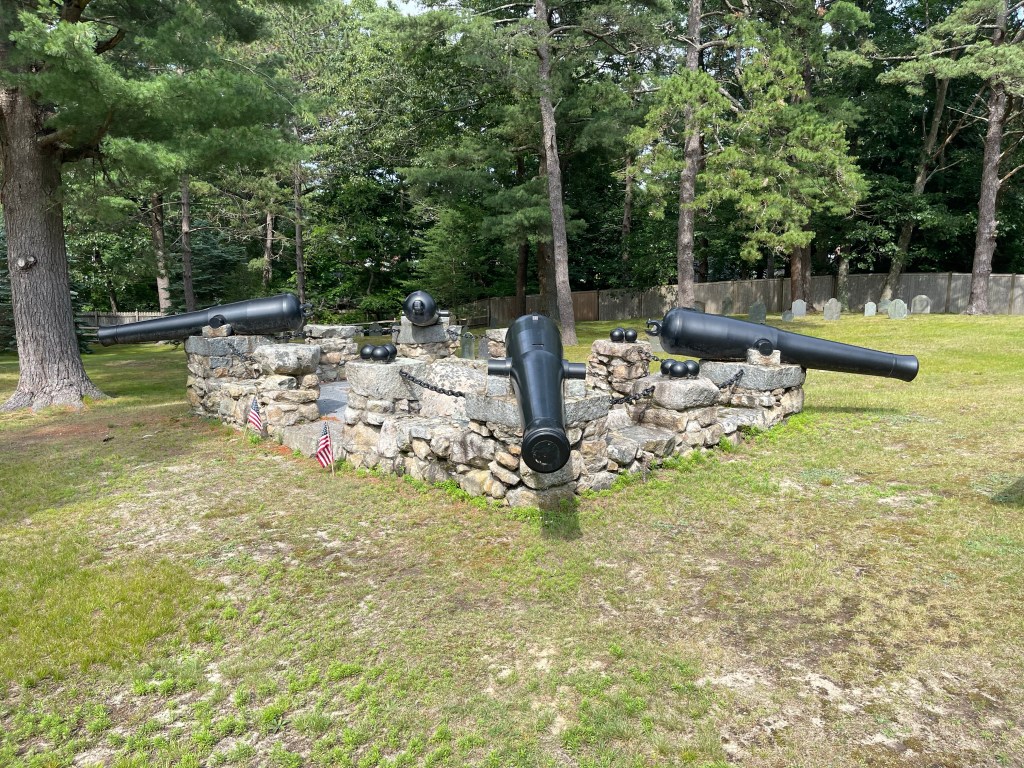
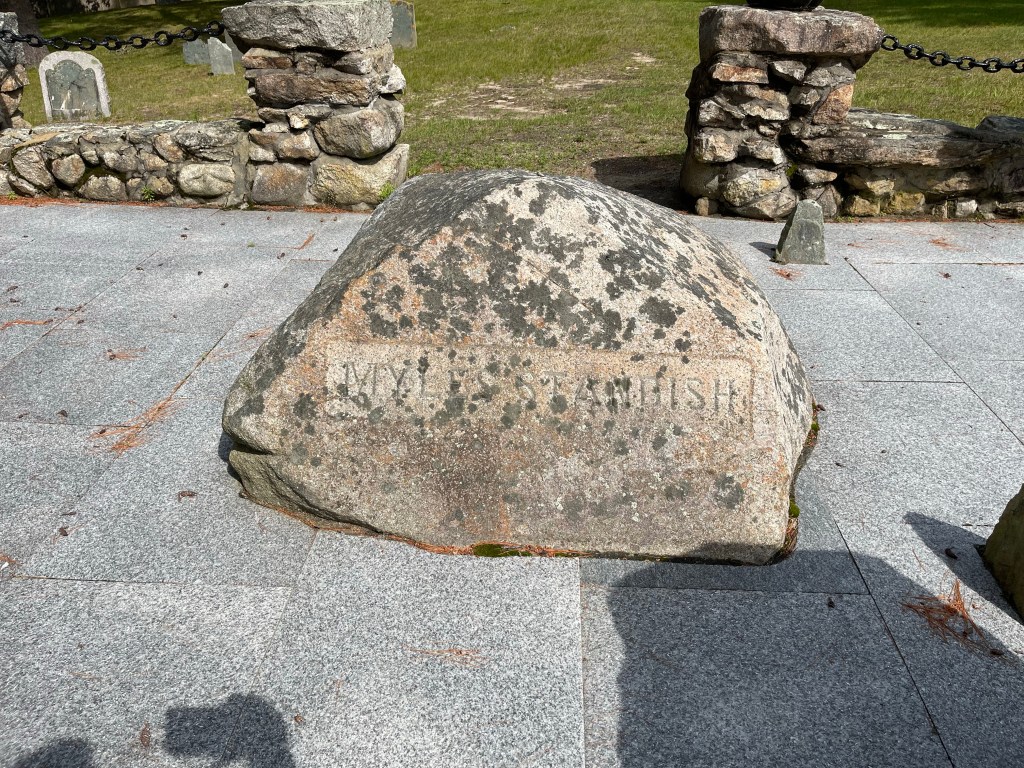
    Captain Jonathan Alden, son of Mayflower passengers John and Priscilla Alden, is also buried in this graveyard, and his is the oldest gravestone in the burying ground. Standish, who died well before Alden, likely had small pyramid-shaped stones marking his interment initially, and the monument built around the spot in 1893 (you can see one of these stones behind the boulder engraved with Myles Standish’s name in the picture below). That engraved boulder, like Plymouth Rock, is something for the tourists. The monument itself, with a fieldstone wall surrounding it and four cannon mounted on each corner, projects the violent boldness of the man interred beneath.

    Myles Standish was a military advisor to the Pilgrims. By all accounts he was brutal and decisive in his actions. He would preemptively attack when he heard trouble was brewing, and famously stuck the head of one rival, Wituwamat, on a pike as a deterrent to others. There seems to be no doubt that Wituwamat was lured into a room and murdered. Was this act of brutality something to be celebrated or scorned? Was there a legitimate threat to the Pilgrims, and could it have been resolved in a more diplomatic way? What’s clear is Standish believed he was fighting for the lives of the colonists, and used any method he could to intimidate those who he believed were threats to their safety. As with all history, we judge it from the comfort of distance.

    At another spot in town, on a point of land jutting out into Kingston Harbor, there are four more granite stones laid out in a park amongst multi-million dollar homes overlooking the harbor. It was here that Myles Standish actually lived. I found this interesting, as a military man like Standish would normally seek the high ground. A review of a Google map later revealed a small pond nearby that would have been his source of fresh water. Perhaps Myles dined regularly on Duxbury oysters, which have become almost as famous as the town’s most notable resident.

  • Becoming Rich With Memories

    “The business of life is the acquisition of memories. In the end that’s all there is.” — Mr. Carson of Downton Abbey

    “You retire on your memories. When you’re too frail to do much of anything else, you can still look back on the life you’ve lived and experience immense pride, joy, and the bittersweet feeling of nostalgia…. Making deliberate choices about how to spend your money and your time is the essence of making the most of your life energy.” — Bill Perkins, Die With Zero

    We all talk of how the time flies by, but perhaps we ought to focus on how many great memories we accumulate in that span. If we’re living well, experiences are acquired and flipped into memories with the turn of the calendar. We may not become financially wealthy, but surely we might accumulate a lifetime of memories worthy of our time. As the quote above points out, in the end, isn’t that all there is?

    What are memories but the realization of deliberate action? As much as I love a good spreadsheet, I know deep down that working in them isn’t creating memories that will last a week, let alone a lifetime. But I may just remember the conversation I have with someone important in my world a lot longer. I may recall the thrill of peering over a cliff at an angry ocean in Portugal and smile someday when I’m too old for such things. I expect I’ll still smile at the recollection of my kids realizing the amusement park ride they insisted on going on was going to be a lot scarier than they’d bargained on when they begged to go on it. This is the accumulated wealth of memories.

    Perkins’ book challenges us to stop accumulating savings and start spending our money while we’re healthy and fit enough to actually do the things we promise ourselves we’ll eventually do, someday, when we retire. As if we can do at 65 what we might do at 25 or 35. Do it now. There is no tomorrow, and if there is, we won’t be able to pull off some of the things we believe our bodies and minds will be capable of someday when.

    I’ve watched too many people in my life hear the news that they won’t make it to retirement. Cancer seems to be the most common thief of dreams, but maybe an accident or a heart attack steals everything you’ve ever planned for “someday when” away from you. Your life is now: accumulate the memories that will make you richer then. It’s the best return on investment we can have with today.

  • The Less Lazy Way

    “Men are inclined to laziness. Some will feel that he might have said with greater justice: they are all timorous. They hide behind customs and opinions. At bottom, every human being knows very well that he is in this world just once, as something unique, and that no accident, however strange, will throw together a second time into a unity such a curious and diffuse plurality: he knows it, but hides it like a bad conscience.” — Friedrich Nietzsche, The Will to Power

    To borrow the Kenny Loggins phrase: This is it. Make no mistake where you are. You’re going no further. We know this intuitively, yet we still wrap ourselves in lazy routines and escapism. We’ve got nothing more than now to work with, yet we treat our days as frivolously as disposable napkins. ’tis now or never friend. Break the lazy—be bolder.

    Easier said than done. We all have our bank of bad habits. I know I ought to work out more and put in more time with the things I’m leaning into becoming. But life gets busy, people we care about need our attention, work demands are never quite satiated. The fact of the matter is, after a long day of filling other people’s buckets our own feels pretty empty. Good enough seems okay in such moments. This is where we must break free of ourselves.

    “How does one become stronger? By deciding slowly; and by holding firmly to the decision once it is made. Everything else follows of itself.” ― Friedrich Nietzsche, The Will to Power

    Decide what to be and go be it. And then establish habits that affirm the identity we wish to have in this brief lifetime. Simple, right? We know better. Creating the person we wish to become is never simple, but it is possible. This is the less lazy way, and everything else follows.

  • The Present

    “And I asked myself about the present: how wide it was, how deep it was, how much was mine to keep.” — Kurt Vonnegut, Slaughterhouse-Five

    “It occurred to him that there must be some state institute, a kind of time bank, where he would be able to change at least some part of his shabby seconds.” — Rainer Maria Rilke, The Notes of Malte Laurids Brigge,

    Time is not ours to keep—more a wave we surf to the beach. We dabble in time, thinking about improving our productivity and efficiency and doing more with less, but really, we’re trying to avoid wasting the time we have. Making the most of the present is the only worthy goal as we surf this wave.

    Lately conversations about time have come up a lot in the circles I run amuck in. Talk of people taking more time off, people who feel they’re time hasn’t been used wisely, people quickly running out of time (I’ve had more conversations about hospice recently than at any time in my life). Everybody is going through something in their lives. The surfing isn’t always great in this complex world.

    This writing habit is one of the best things I’ve invested my time in. Writing isn’t passing the time, and it isn’t a celebration of one’s greatest exploits. It’s putting a spotlight on the hourglass and seeing each grain of sand and savoring the seconds. This is living in the present: good, bad and all that lies in between. The secret is to add depth and breadth to each moment of it. And maybe write the chapter in such a way that it lives on beyond the present.

  • Life is Sweet

    They told you life is long
    Be thankful when it’s done
    Don’t ask for more
    You should be grateful
    But I tell you life is short
    Be thankful because before you know
    It will be over
    ‘Cause life is sweet
    And life is also very short
    Your life is sweet

    — Natalie Merchant, Life Is Sweet

    The very first time I saw the VH1 Storytellers video for this song I was getting dressed in a hotel room in California preparing for a busy day on a business trip. By all accounts it was a day of hopefulness and adventure. With the lyrics running in my head, it became the soundtrack forever associated with a tragic event in American history for me. That was the day that Columbine happened. I’ve been wrestling the song back from that event ever since.

    There are people who will go to great lengths to apply their own brand of miserable to the world. But life can be beautiful if we offer a different perspective. We may not have as many days, or as many good days, as we’d want out of life. But the gift is there for us to celebrate should we take the time to unwrap it.

    Returning from a business trip last night through Washington DC, flight again delayed and overbooked, as they all seem to be nowadays, I glanced at the television monitors showing rolling footage of another tragedy, this one the Titan submarine that imploded on a Titanic dive. We all know that life is short, and the untimely deaths of people making the most of their lives can be shocking. Perhaps that’s why everyone slows down when passing an accident scene, or tunes in when breaking news occurs. Each day offers the opportunity to affirm our beliefs in the darkest nature of humanity or the very best within us. What do we focus on in the moment?

    Memento mori. Carpe diem. We know the soundtrack. Dance with life while the music is playing.

  • The Magic of Applied Attention

    “We’re all going to die, all of us, what a circus! That alone should make us love each other but it doesn’t. We are terrorized and flattened by trivialities, we are eaten up by nothing.” — Charles Bukowski

    There is a Persian lime tree growing in a large pot on the sunny deck behind my house. This spring there were more than a hundred blossoms on this tree, each developing into tiny fruit that promised a bumper crop of limes. But after a particularly angry thunder storm and torrential downpour dozens of those tiny fruits scattered the deck, their tart potential over before they really began. While mourning the loss of so may limes, I took solace in the dozens of fruit still developing on the tree. It seems the tree had culled itself that it might focus on the ripe potential of the fruit that remained.

    We each bear so much in our lifetime, holding on to things we ought to shed to focus on the essential few. It’s okay to let go of the trivial, that we might nurture the truly important things in our lives. Letting go is painful, but not as painful as diminishing our best work by carrying more than we should.

    Little by little,
    as you left their voice behind,
    the stars began to burn
    through the sheets of clouds,
    and there was a new voice
    which you slowly
    recognized as your own,
    that kept you company
    as you strode deeper and deeper
    into the world,
    determined to do
    the only thing you could do —
    determined to save
    the only life that you could save.

    — Mary Oliver, The Journey

    The night after the thunderstorm, I spent an evening with friends, throwing axes at a target drawn on a wooden wall and building fragile wooden castles in the air (Jenga). There is a unique strategy for each, naturally, being so very different from each other in practice. But there are also similarities. Besides each pursuit using wood, it was the act of applied attention that is common to both. To be good at either you must simply get out of your own head and focus on successfully completing the task at hand. One might utilize this in every pursuit, from writing to navigating any of the essential tasks that fill one’s day.

    We ought to cherish our time together, forgetting the trivial affronts that life throws at us. We ought to find our own voice in a world full of people waiting for us to shut up that they may say something clever. We ought to direct our attention inward, to the ripe potential of our own ideas, calling us to truth and clarity. We know, deep down, that we won’t survive this, but if we give ourselves the time to focus, we may just yet produce something substantial anyway.