Category: Garden and Home

  • Simply Essential

    “Never own more than you can carry in both hands at a dead run.” ― Robert Heinlein

    The quest to simplify is often a process of one step forward, two steps back. Eliminating things shouldn’t be so very complicated. Accumulating stuff shouldn’t be so very easy. It’s the eternal wrestling match of what to keep and what to get rid of. Even now I’m considering why I used “very” in the second and third sentence of this very paragraph. Simplicity seems so easy to reach for if we could get past all the complicated in our lives.

    My bride and I talk of downsizing one day. As with everything, it’s more complicated than talk. The questions of where and when and what. And with each question, the place we currently reside looks a bit better than it did before. And so spaces are cleared, things are moved out, other things are moved in. It’s a game really; a sleight of hand performed on the same plot of land with the world spinning around us. The characters come and go but the stuff remains.

    We ought to be better editors. We ought to consider what is most essential in our moment and focus entirely on that. Knowing that the game will change, and what seems most important now may seem trivial when it does, is a good way to measure the essential. When everything eventually goes away, as it inevitably will, what will we hold on to until the last? This is our simply essential. Everything else is just stuff.

  • Home, and Away

    “Now more than ever do I realize that I will never be content with a sedentary life, that I will always be haunted by thoughts of a sun-drenched elsewhere.” – Isabelle Eberhardt

    Well past dark, I completed the relocation process for thousands of fallen red oak leaves that had blanketed the front lawn with the muted satisfaction that comes with not seeing your finished project and knowing it will likely be covered again soon enough. This is fall, but it’s also folly to believe you’re ever done with yard work. The trees giveth in abundance, and on their own timetable.

    The thing is, I like the chores of home ownership even as I contemplate my next move on the bucket list. Restless spirits are always moving, whether at home or in travel. I’ve never sat still very well. Meditation for me requires movement, and there is already an abundance of travel booked or in the works. Schemes and dreams of places near and far haunt me, it isn’t something that can be flushed out of your system like too much drink. Travel perpetuates, as reading does. It’s a positive addiction, trading mundane routine for more worldly experience. Many of us have nomadic tendencies running through our blood.

    And yet we can’t imagine nomads raking the leaves and putting away patio furniture. Having a home base isn’t such a bad thing when it doesn’t dominate the conversation. One can happily manage home chores and segue immediately into the next adventure if one structures a life properly. We can have our cake and eat it too. As with all things, balance is the key.

    Go
    And beat your crazy head against the sky
    Try
    And see beyond the houses and your eyes
    It’s okay to shoot the moon
    — John Sebastian, Darling Be Home Soon

    Like sharks, I suppose, restless spirits must move to live. Being fully alive isn’t passive: energy doesn’t rest. So we too should rest less. But fear not, for we’ll be home soon.

  • Realizing the Benefits of Repetitive Action

    “One thing I’ve found… the road rarely rises up to meet you until you’ve begun walking.” — Michele Jennae

    On my one day off this weekend, on a day of rest no less, I walked twenty thousand steps around my house while pruning trees and shrubs, raking up leaves onto a tarp and hauling them into the woods beyond the fence out back. For good measure, I mowed the front lawn with my push mower to get every last leaf off that lawn. As I write this it’s still dark outside, but I imagine that it’s chock full of leaves again. The oak trees delight in teasing me just so: waiting until the day is done and sprinkling their gifts all over. I’ve come to accept this as the price of keeping the trees when I built this house almost 24 years ago. They were here first and deserve to have their say.

    We either have a bias towards action or we don’t. Is life meant to be spent doing things or lounging around in leisure? I know plenty of folks who embrace the latter. That’s not my way. Spending my one day of rest actively cleaning the yard may seem useless at best, and a frivolous abuse of my brief time on this earth at worst, especially considering that there will be even more leaves sprinkled on the lawn today. Action ought to be married with productivity or it ought not be done, you might point out fairly.

    Yard work should be viewed in the same way that we view doing the dishes or making the bed. Eventually we’ll have to do it all over again, and over and over again still, but that doesn’t make it less worthwhile for having done it today. It’s the price of greatness in a world filled with average performers. We either pay someone to do the work or do it ourselves. There’s an opportunity cost in either choice, and we must ask where we receive the best return on our time investment.

    The thing is, we often know what we’re missing out on when we choose one thing over another, but a bias towards action requires we make a decision and embrace all that comes with it. This applies equally to a career, a marriage, raising children, writing, or a hundred other things. Things like raking leaves instead of hiking or watching a football game. Life is what we make of it: to be meaningful and productive, it requires that we follow through on one decision after another to the best of our ability.

    Showing up for our work every day can feel a lot like raking those leaves. We know that there will be more to do tomorrow and the next day. But repetition pays dividends through discipline. The benefit of repetitive action isn’t just the momentarily completed job at hand, it’s the person we become by following through on our commitment to ourselves day-after-day. As Aristotle said, we are what we repeatedly do.

  • Torn Between Two Places

    God it’s so painful when something that’s so close
    Is still so far out of reach
    — Tom Petty & the Heartbreakers, American Girl

    September conjures up images of red and gold leaves in crisp air. I thought of their possibility while sneaking another swim in water that believes it’s still summer. But what we linger on isn’t always where we are, is it? I reminded myself to savor the water while I was still in it.

    We’re often torn between where we are and where we want to be. Between things we’re comfortable doing and things we’d like to try. It’s a fiendish place; nurtured dissatisfaction with one, with a lingering frustration that the other is just out of reach. We reason with the mind to accept one place, while the other place sings its siren song. No matter, were we to reverse our position, we’d likely yearn for the place we just came from. Such is human nature.

    The space between seems to be the real issue. We can’t have it all, but we dwell on images of places we’d love to be, or parts of our lives we’d love to return to, or maybe run away from. Surely, it’s there in that between where the devil resides. It’s our no man’s land where dreams go to die if we dare wander into it. And don’t we all stumble into discontent at times in our lives?

    All season I’ve been dealing with a garden neglected at the start of the growing season while I bounced around in Europe in June. It never really established itself, then came the drought, and here we are at the end of the season with a sad little garden that’s a shadow of its former self. The garden and I gave it a go, despite it all, and now it will go dormant for the winter before we try again next year. But I wonder, will I be inclined to try again, or leave it for the beauty of another place once again?

    Such are the considerations of an itinerate wanderer with a strong sense of place. Making a go of it here, while thinking about there. With American Girl playing in my head as a soundtrack of this life between two places.

  • What We Will

    “If the world were merely seductive, that would be easy. If it were merely challenging, that would be no problem. But I arise in the morning torn between a desire to improve the world and a desire to enjoy the world. This makes it hard to plan the day.” — E. B. White

    I grow cilantro, not so much to eat it, but to watch bees roll around in the wispy white flowers that wave ever so lightly in the breeze. Surely someone must grow cilantro for all the tasty dishes (or soapy dishes) one might imagine it worthy of, but give me the bees, please. Summer officially ends for me the moment the cilantro peters out—like life itself—entirely too soon.

    The dance between the earnestness of rolling up your sleeves and fixing things versus opening up your heart and savoring all the world offers is a constant struggle. As with everything, we must skate the line between the world of order and the world of chaos, Yin and yang. Nobody said this living business would be easy, but it’s such a short ride we ought to make the most of it.

    Still, there’s work to be done, and no time to waste in solving the world’s problems. As anyone out there trying to get things done knows, there’s just not enough people willing to make a go of it and do the work. Every school, every hospital, every landscaper and construction firm and restaurant is struggling to find a warm body with an eager mind to simply do the work. Who are we to ignore the call? Yet so many do.

    Every day should be filled with a bit of challenge, and a bit of seduction. Every life lived well ends with a measure of satisfaction for the things we did well and a measure of consternation for that which wasn’t accomplished. That’s life, and we must learn to skate that line. In the end, we do with it what we will.

  • A Garden Monk Sips Coffee

    A monk sips morning tea,
    it’s quiet,
    the chrysanthemum’s flowering.

    — Matsuo Bashō

    The mornings are chilly again, and unlike Bashō’s poem, full of the sounds of squirrels gathering food and bickering about who gets what. The water is warmer than the air, for the sun is reluctant to stick around so long nowadays. The seasons are flipping, just as surely as the hickory nuts are falling.

    I think about the fall cleanup and shudder. Is it the chill in the air or the thought of forced labor to come? We dream of autumn for all its beauty, for the crisp air and the scent of fallen leaves. We forget about the work. We pay penance for the pleasure.

    I promised myself I’d drink more tea this summer. I planned to use more of the mint spilling out of its terra cotta pot in an attempt to displace the basil in the neighboring pot. Yet the drink of choice is most often coffee. Does coffee nullify my monk inclinations, or does the ritual matter more? Ask the flowers—for they’ve quietly observed all summer.

    For all the changes, some things remain the same.

  • August Signals

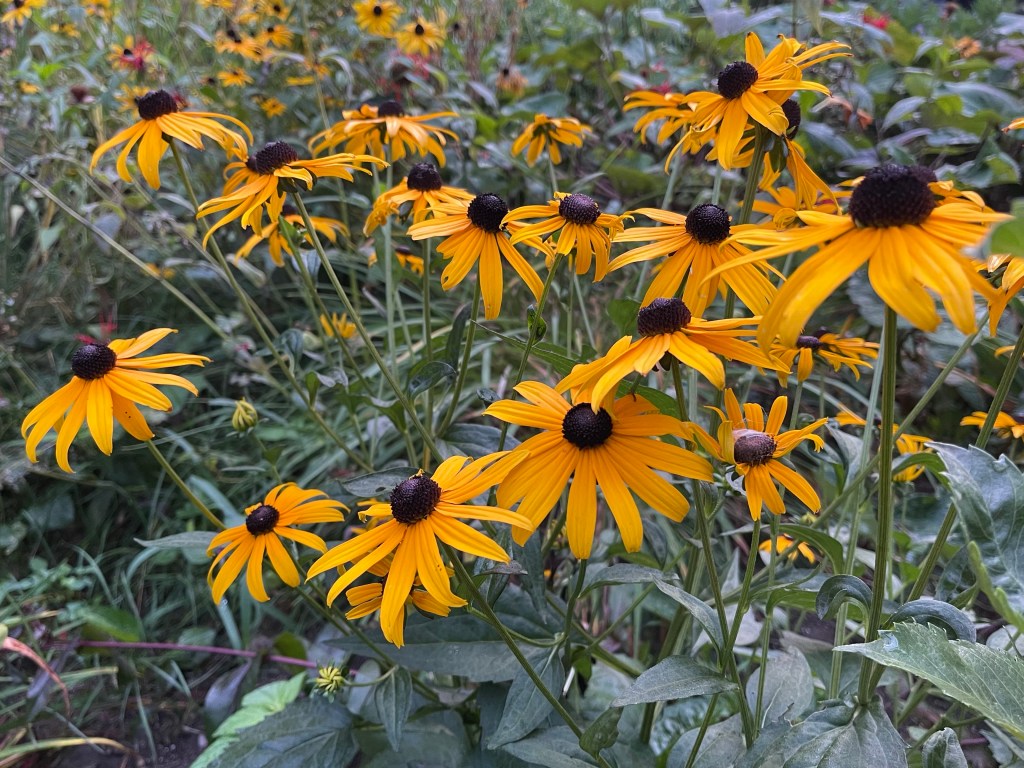
    Black-eyed Susan’s once again dominate, staking a claim on more of the garden every year if you let them. I mostly let them. They remind me of conversations with a favorite gardener who’s moved on, which means they’ll forever receive favorable treatment in my garden.

    Crickets receive no such favorable treatment, but we peacefully coexist nonetheless. They play the soundtrack of August. Most of the year we hardly give crickets a thought, until they begin playing their persistent song from mid-summer to mid-autumn. Thousands of musicians announcing “We’re here, if only so very briefly.” Is there anything more stoic than a cricket?

    The gardener senses the seasons. No calendar is required. The days grow shorter even as the heat continues. For these are the dog days of August, marked by black-eyed Susan’s dancing to the persistent tune of an orchestra of crickets.

  • Garden Blessings

    Ah, yet, ere I descend to the grave
    May I a small house and large garden have;
    And a few friends, and many books, both true,
    Both wise, and both delightful too!
    And since love ne’er will from me flee,
    A Mistress moderately fair,
    And good as guardian angels are,
    Only beloved and loving me.

    — Abraham Cowley, The Wish

    The air is filled with squeaky chirps and the buzzing sound of wings beating the warm morning air, announcing that the bluebirds of June were replaced by the hummingbirds of July. They remind me that the garden, despite early neglect, still dazzles, inspires and informs. The frenetic urgency of the hummingbirds to feed brings life to the midsummer garden, just when it most needs a lift.

    It’s sometimes easy to forget the things we build around us that attract nuance and substance. We build our lives on the four cornerstones of relationships, legacy, learning and action. Each in turn determines who we might become as we build our life atop this foundation. Like the birds flirting briefly with the garden, people come and go from our lives. Jobs and money and fashion come and go. We each note the changes, but how we react is determined by who we’ve grown to be.

    What is a garden but a foundation? We stake our place in this world to cultivate our hopes and dreams as life changes around us like the seasons. Each season brings enchantment, frustration, context and acceptance. We become what we cultivate, influenced by the seasons but not always determined by them. Everything has its time, and the blessings in our lives must be realized in their own season.

  • Delusions of a Hopeful Gardener

    “The thing is you could eat someone’s entire backyard garden and it would be less than 300 calories so what are we doing here?” — @HelloJessicaFox

    A handful of blueberries, picked before they fully ripened, was the extent of the harvest this season. The catbirds and chipmunks got the rest. But at least the tomatoes are showing some progress (until the groundhog determines they’re ripe enough to sample). Sure, gardening is a joyful pursuit, but it’s also folly.

    For most of us gardening isn’t as much about feeding the family as it maintaining a connection to the soil. We grow up watching our grandparents and parents harvesting a bounty of fruits and vegetables and somehow we feel compelled to keep the dream alive. Really, who are we fooling? My garden will produce a few good tomatoes, a summer’s worth of basil and mint and not a whole lot more. If I were a settler 250 years ago I’d have starved to death.

    Yet we press ahead, planting our gardens full of hope, only to have them dashed by Mother Nature and her cast of flying monkeys gobbling up every last blueberry. We dare not complain should she toss in a swarm of locust for good measure. Live with that handful of produce and count your blessings. There’s always the farm stand down the street.

    Still, there’s always hope, and this season I pushed through the challenge of being away most of June and kept almost all of the edibles on track. The season is still early, and there’s still a chance for a bounty of delicious fruits and vegetables… Do you see? The delusions of a hopeful gardener on display.

  • The Garden Blues of June

    There’s been some unusual activity in the garden lately. A squirrel walked up to me as I sat still sipping coffee, looked me squarely in the eye and didn’t run away until I called his bluff. A pair of bluebirds, normally quite shy, are aggressively guarding the birdhouse they made into a home. They let that squirrel know it was time to move along, while given me a sideways glance to remind me there will be no eggs for breakfast for me today.

    Speaking of blue, it’s almost blueberry season in New Hampshire and that means the return of catbirds, the little devils who gobble up ripening blueberries by the pint, usually just before harvest. In previous years I’d rig netting and chicken wire to hold them at bay, but they always seem to find a way to the fruit. This year no netting and only a half-hearted attempt to chase them away. After traveling for much of June I’m conceding the early harvest to nature. Maybe I’ll have better luck with the tomatoes later in the season. We all choose what we fight for in this world. Isn’t it funny how that changes season-to-season in our lives?

    Earlier this morning I walked around the garden, seeing first-hand all the work I’ll need to do to set things straight. Nearing the fence, I spooked a large doe, who betrayed her position in her panic. I told her as her white tail bounced away that I’d never have seen her if she’d just waited a beat longer. Movement betrays, it’s only in stillness that we become one with the natural world. The doe had no use for my unsolicited advice.

    The garden is neglected and mocks me my late return to tend it: “Too little, too late pal.” Such is the way, for stillness need not apply in the garden. But I’ve come to think of the garden differently this season. Or maybe just my position as head gardener. I’ve taken something of a sabbatical this year with more emphasis on the hardscape and less on the seasonal magic. Looking around, it feels foreign to me, this garden I’ve labored over for years. Thinking about the behavior of that squirrel and the doe, I wonder if they simply aren’t used to having someone linger in the garden anymore?

    Gardens, like our lives, ebb and flow. In June 2022, when things are usually flowing, I feel an ebb. So much feels different this season, but the bluebirds remind me that change is inevitable. We either roll up our sleeves and get back to work or we wallow in the blue. Gardens frown upon the wallowing gardener, for the season—our season—isn’t over just yet. And so it must be that we get back to it once again.