Death twitches my ear. “Live’” He says, “I am coming.“ — Virgil
The twitch is there, reminding me to make the most of each day. You may have noticed a lean towards Stoicism early on in this blog. Stoicism celebrates every moment of life, because we remind ourselves that infinity is calling. So decide what to be and go be it. To be or not to be, that is the question that Hamlet forever ponders. And so must we.
My favorite barista retired. I walked in to chat, er, to get a coffee made just so, and she hasn’t been there. Then again, I haven’t been there, traveling and such, but back again and eager for the banter of familiarity. After a couple of tries, I asked a new barista where Sue was, only to find out she’d simply…. retired. Moved on to try new things with her brief dance with light. And I was momentarily floored by the abruptness of it all. It’s not life and death, not yet for either party, but it was one more door closing in a lifetime of closing doors.
I have a cat that meows incessantly if there’s a door closed that she wants to be on the other side of. Pick her up, give her a treat, try to ignore her at your peril: nothing resolves the meowing but an open door. We all have this curiosity, perhaps expressed less annoyingly (perhaps), to know what’s on the other side of the door. We aren’t in a rush to find out, but we’ll find out one day. And knowing that, we must accept that the door is closed for a reason. It’s not our time to dance with infinity, it’s our time to dance with light. So dance, friend.
“Never waste valuable time or mental peace of mind, on the affairs of others — that is too high a price to pay.” — Robert Greene
The world may feel off-kilter, and in fact it surely is, but we must choose a path of productivity and consequence anyway. We can’t produce anything consequential if we’re constantly wringing our hands in anguish at the world around us. We must build towards a better future, despite the crushing combination of very real and completely artificial distractions spinning around us. We must firmly set aside the noise so readily at hand and do the work that beckons us to possibility. For our time is short and the price of procrastination is far too high.
There are a lot of musts in that last paragraph, and it risks sounding far too demanding. But shouldn’t we ask ourselves, in the quiet moments when the world remains at arm’s length from our thoughts, about what really resonates? It’s likely contrary to what the world would ask of us. And isn’t it fair to then ask, when will we complete the work that matters most if not now?
‘Fairy tales are more than true: not because they tell us that dragons exist, but because they tell us that dragons can be beaten.“ — Neil Gaiman, Coraline
We talk about evil in the world, the worst of humanity, beasts of unimaginable strength and viciousness… but most dragons aren’t out there in the world, not really. Most dragons reside within us. The beast isn’t rising up to sink our ship; it’s holding us back from setting sail. The true dragons are bad habits and that voice inside our head that tells us to snooze a bit more, for you’re too inexperienced or established or young or old to dare change things now.
Slay these dragons.
We often think about the gaps between our desired state and our current state as a chasm, when mostly it’s simply a gap. The business of closing gaps is as simple as establishing routines, doing the work one day to the next and moving past what we previously thought possible to discover and close another. We know this intuitively, yet we still listen to dragons. Until their fearsome voices fade into the distance as we build new gaps between who we are now and what we once were.
Life will throw its dragons up at us, but we might prevail anyway. Simply take the next step. Like a toddler learning to walk it’s invigorating and delightful to see where our steps might carry us, one after the other. Make soup of those dragons. It turns out they taste a lot like chicken.
“Habit is a rope. We weave a thread every day, and eventually we can’t break it.” — Thomas Mann
“We are what we repeatedly do. Excellence, then, is not an act, but a habit.” — Aristotle
This business of repeatedly doing is leading somewhere, with our destination highly dependent on what we repeatedly do. Such is the way. Mann’s observation rings true as well, for habits become nearly impossible to break once established. Each small choice is another thread—another resounding, audacious statement about who we want to be.
Our natural inclination is to be a part of something. To build an identity around community or family. This can reinforce positive behavior, or amplify the worst in us. The choice isn’t always ours to decide which pond to swim in, but we may choose whether to keep treading above the surface or drift down into the muck on the bottom.
When our identity is wrapped up in a community that is slowly drifting away, as people get older or recede from view towards other communities, we also choose how to react to that. People come and go. Our health and work and feelings about the world we live in change moment-to-moment. To be highly effective in life we ought to weave a thread of consistent activity that remains independent of the whims of fate. When the world unravels around us, and eventually it will feel that way for all of us, just how resilient are we?
“Between stimulus and response there is a space. In that space is our power to choose our response. In our response lies our growth and our freedom.”— Viktor Frankl
Life is constantly testing our mettle. We control so very little in the big scheme of things. Frankl’s famous observation reminds us that we do get to choose how we react. We have a say in what we might become in our brief dance with the universe in all its harsh indifference. We still might decide what to be and go be it.
“There may be a great fire in our soul, yet no one ever comes to warm himself at it, and the passers-by see only a wisp of smoke.” ― Vincent van Gogh
Wildfires are once again turning our New Hampshire skies a milky white overcast, with a burnt orange sun. This looks extraordinary at sunrise and sunset, but never natural. And yet a wildfire is a natural occurrence, I suppose, if unduly influenced by humanity. A reminder of places changing a great distance away, yet close enough to change our place too.
How often people confuse our wisp of smoke for another fire. Though fire reveals itself in both subtle and apparent ways, we never really know what burns inside the soul of another. We often don’t know it ourselves.
Yet writing reveals. Pages become kindling, words provoke and burst into ideas, and passion plays with the muse to light up our minds and dance across the keyboard. We place ourselves into this cauldron willingly, and forge something transcendent by consequence of the heated ritual.
Drawn in by the slightest ember of idea, the writer coaxes it to a signal fire that others may see, if only they’ll turn their attention ever so slightly this way. Still, the beacon indicates nothing more than where we’ve been. For the artist is already gathering tinder to reveal what’s next.
“Maybe everyone can live beyond what they’re capable of.” – Markus Zusak
I spoke with a gentleman at a cash register while I was purchasing a new shirt. I was the only customer in the store, he was eager to talk to someone and I had the time to give. We spoke of the future, chasing dreams and taking risks. I spoke as a wise old sage, being neither old nor a sage, but being successful enough in his eyes as he looked at me and the shirt I was buying that he decided I must be both. Perhaps success is in the eye of the beholder, but it rarely stares back at us from the mirror. There’s always more to do.
My advice to this man full of dreams was to chase them. To risk slightly beyond his comfort zone and then a little bit further, for regret is more painful than losing money or a safe job in pursuit of something meaningful. Something beyond the life we imagine for ourselves. Something that brings a tear to your eye when you even dare to imagine it.
The thing is, it’s always easier to give advice, much more difficult to take it yourself. But shouldn’t we? Living beyond what we’re capable of is only possible if we step beyond the place we believe to be a bit too far. But, by all means, step there and maybe another step more. For what’s the worst that can happen? Even the most expensive of lessons are lessons nonetheless.
What is ever more painful than the self-talk of someone who didn’t try to leap when the opportunity presented itself? So leap! We might just surprise ourselves at how far we go.
Autumn, delightful as it is in so many ways, is the source of one bit of frustration: the quickly receding number of daylight hours. Traveling west, the morning becomes more and more difficult to work with if you’re trying to be active outdoors. Sure, you can strap on all manner of lighting to make you more visible and to offer a tunnel of light to walk through. But you lose something in all that battery-powered brightness–a feeling of connectedness with the land around you. And isn’t that the point of going outside to walk in the first place?
Just yesterday I was walking on a warm and humid day on Cape Cod. This morning, I found myself next to an old favorite, the Erie Canal at Bushnell’s Basin. The canal trail here is mostly stone dust, with a few paved places along the way. Familiarity is helpful when you’re walking in the dark, and so is choosing to walk in the early morning. Morning offers hope for improving conditions, something an evening walk would be short of. In a safe area like Pittsford there aren’t a lot of concerns about getting mugged, but in a sketchier area most of the thugs eventually go to sleep, leaving the morning generally safer for wannabee fitness models.
Still, there’s something about seeing that offers comfort. Even on a walk I’ve done a dozen times or so, when you run out of ambient light you’ve got to make choices in life. Press ahead into the dark or return to the ambient light? What are the risks? Walking into a branch? A skunk? The Erie Canal? Getting run over by a random cyclist not using a headlamp? None of those sound particularly appealing to start a work day. So I turned back to the light.
Here’s the trick, you don’t walk all the way back to the brightest parts of your walk. You walk just far enough that your eyes can still see in the dim early morning light, then turn around and see how far you can go the next time. Does walking back and forth on a 1000 meter section of cinder path sound fun? You know what? It actually was. Just me and the ducks and some vehicle traffic on the other side of the canal. Back and forth, a bit further each time, until the scales tipped at 6 AM and suddenly you could see everything clear as… well, almost clear as day.
It might seem ridiculous, this walking in the dark business, but I managed four miles before coffee, and sort of saw the Erie Canal from a different perspective than I’m used to. There’s a lot to be said for checking a few boxes before breakfast–exercise, reading, and writing this blog. The only thing that might have made it better would have been an epic sunrise. Perhaps tomorrow, when I plan to be out there again.
Quietly walking downstairs in the dark, water bottle filled, I opened the front door and slipped outside, hoping the dogs wouldn’t bark. They bark all the time… but thankfully not this time. I get in the truck and begin the drive to the Railroad Bridge (capitalized, thank you). 5:30 AM, it ought to be super quiet there, I think, just me and a couple of fishermen.
Pulling into the parking lot, I see just how wrong I was. The entire parking lot is completely filled with pickup trucks and cars. Every contractor in Eastern Massachusetts must be along the canal, rods protruding from shore in hopes of that big catch. I felt like a single woman walking alone into a bar full of dudes, and like her, promptly turned around and got the hell out of there.
Driving to the Bourne Bridge parking lot, I’m relieved to find it relatively empty, as if the fish don’t like the canal water a mile further. No matter, I’m not here to fish, but to walk. The aim was a bridge-to-bridge walk, but instead of the Railroad Bridge it’s the Bourne to Sagamore Bridge out and back. That net’s me roughly 6.8 miles, and that’s enough for this workout.
Early mornings are a lovely time to walk the canal, and the best time to do it without earbuds in. It’s best to hear what’s happening around you when it’s dark out. Situational awareness is important, no matter who you are. Random cyclists and salty fishermen on old bicycles ride past at various speeds. All I can do is hold my line and keep the pace.
Canal fishermen, and they all seem to be men at 5:30 AM, tend to fall into two categories: those who stay near the parking lots, and those who ride bicycles to their own private fishing spot. The bicycles are an odd mix of cheap mountain bikes and yard sale bikes of all shapes and sizes. Each has a basket for fishing gear and two or three PVC rod holders bolted on. I wondered quietly at the aftermarket potential for a bicycle rod holder business and decided it just wasn’t for me. These aren’t the kinds of customers who are going to go with premium pricing, and I don’t have the heart to sell commodity fishing bicycle accessories.
Mind back to the walk, the bladder begins to call. I promise myself I’m not going to stop until I get to the port-o-potty under the Sagamore Bridge, and, feeling the urgency, push my pace a bit to get there sooner. Just as I arrive another character walking from the other direction sees me and makes a beeline for the plastic throne. I silently grumble, walk beyond the bridge to 3.4 and turn around. On the return the facilities are blessedly empty and soon my bladder is too. Relieved, the walk began again in earnest.
Out and back walks always feel shorter on the return trip, and this walk was no exception. I was a known commodity for the fishermen on my return trip, and ambivalent good morning nods became indifferent been there, done that focus on the task at hand. The fish seemed to win the day, as I only saw two catches on the entire walk, and one of those was a heron catching its breakfast. The only winner, besides the fish, seemed to be Dunkin Donuts, judging from the endless parade of Dunks iced cups passed on the walk. Good coffee stock investment tip for those paying attention.
Finishing a long walk brings with it the satisfaction of clicking that key word “end” on the Apple Watch. Lately I’ve been competing against a couple of women who suffer from the delusion that I’m going to let up and allow them to beat me in a seven day competition. Ha! Competitive banter aside, it’s funny how adding some people to the daily fitness routine can really enhance motivation to do the work. This one in the books, I quietly drove back to the house, waiting for the heckling to begin. And knowing I’m one step ahead, at least for this day.
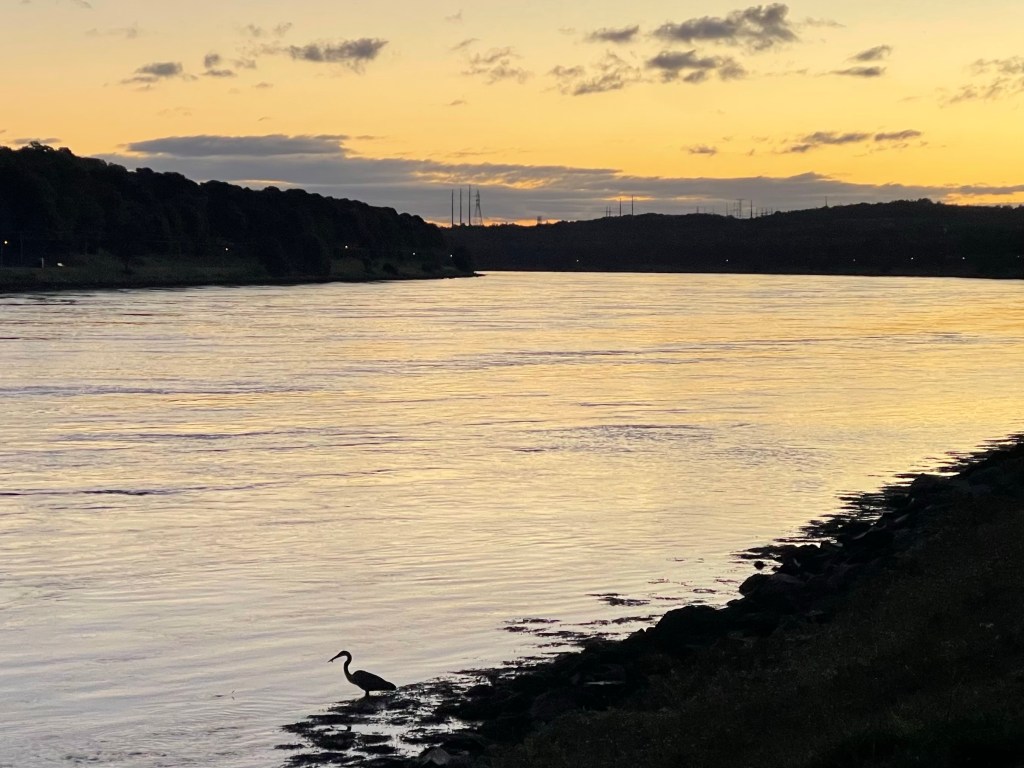
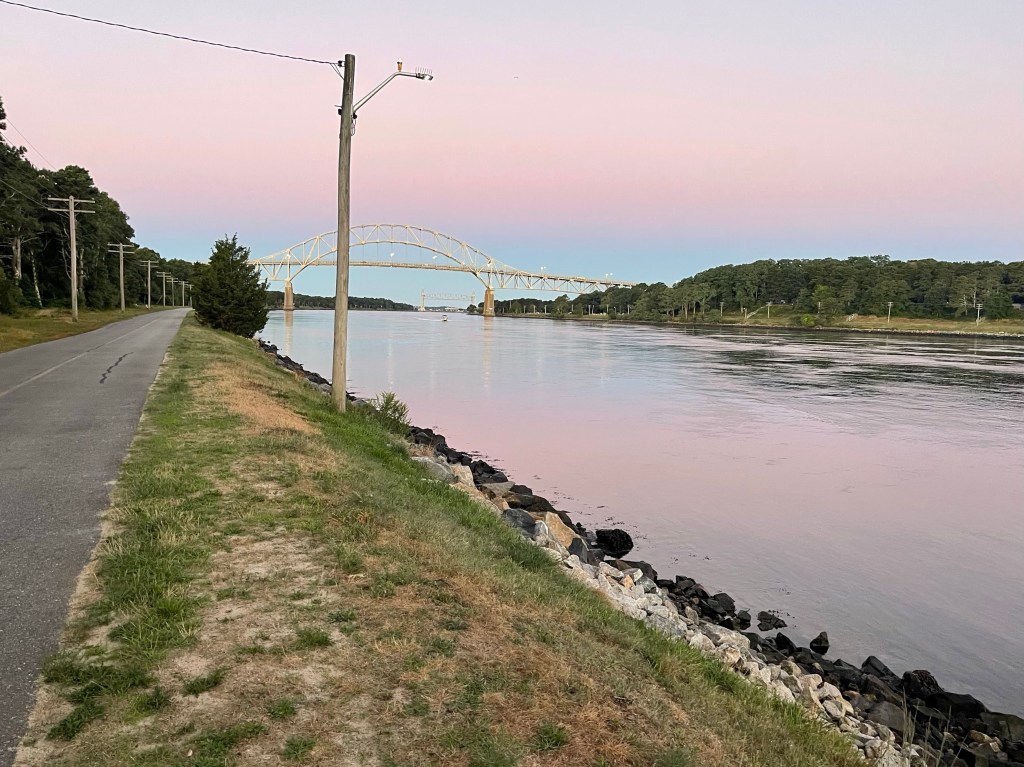
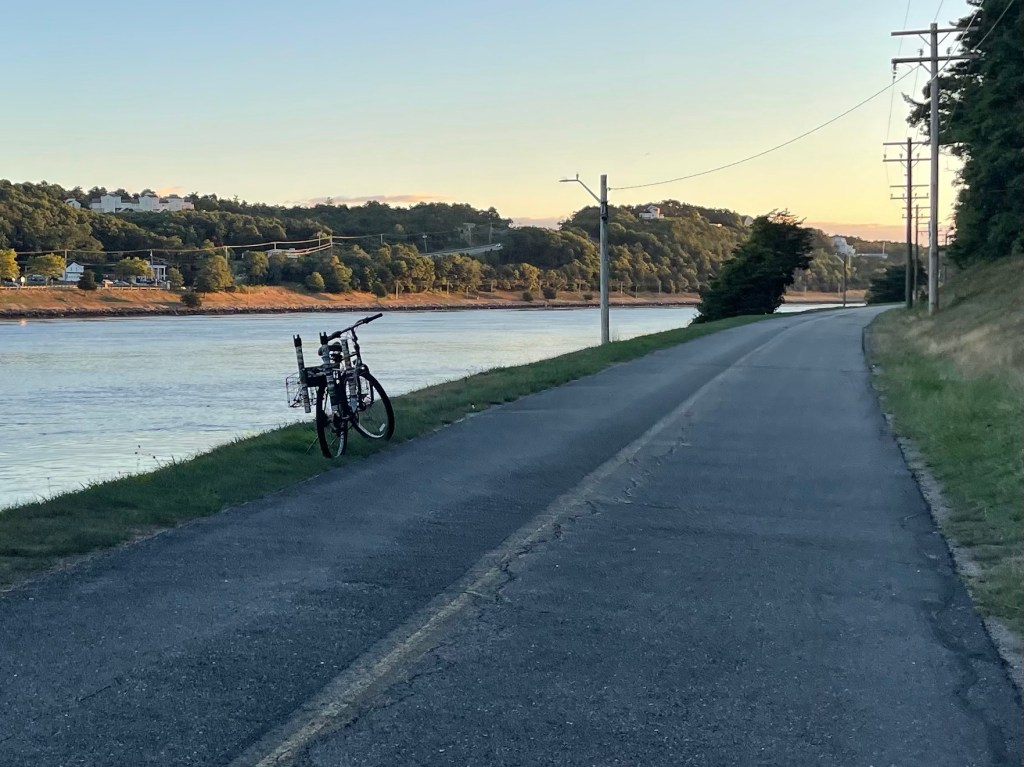
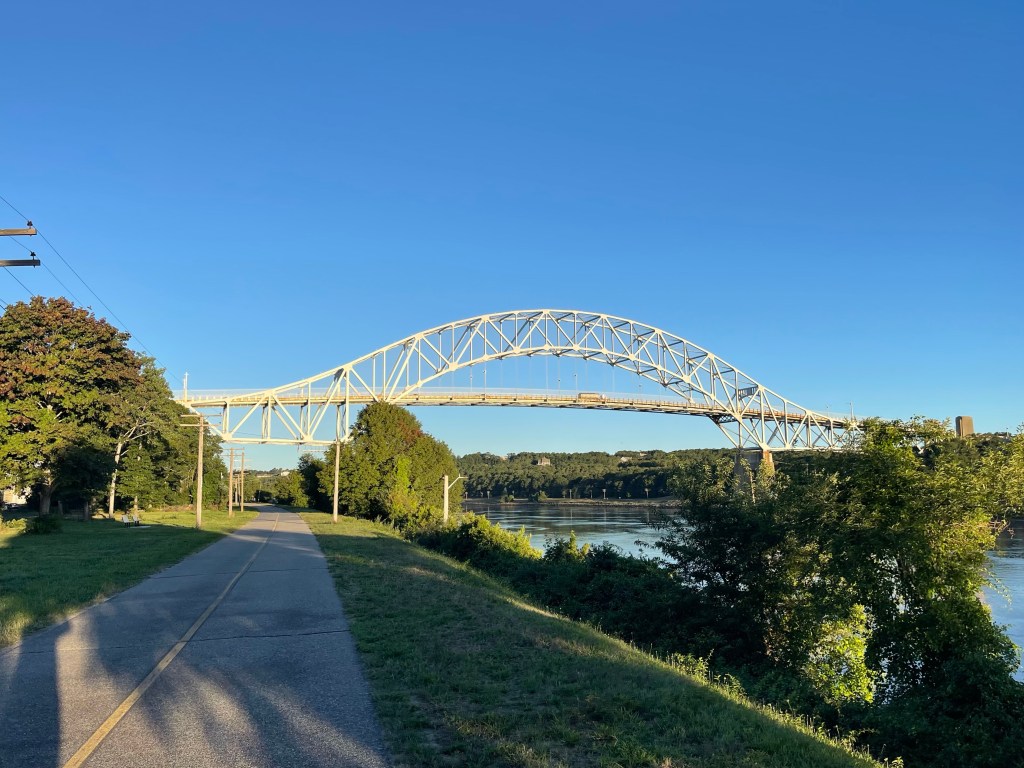
Not all fishing is done with polesBourne BridgeFisherman’s BikeCanal trafficTurning around to return under the Sagamore Bridge
“The most difficult thing is the decision to act. The rest is merely tenacity. The fears are paper tigers. You can do anything you decide to do. You can act to change and control your life; and the procedure, the process, is its own reward.” — Amelia Earhart
I woke up sore all over, with muscles tight and grumpy, protesting the last week of doing what they’re supposed to do but somehow forgot about in lazy compliance with the mind. The soreness is a lag measure of work applied, simply that, and eventually the lag will be replaced by acceptance of the new reality. It was certainly far easier to get out of shape than to climb back to shape. Such is the way.
Decide what to be and go be it… simple on the face of it because it is in fact that simple. The hard part is hidden under the surface of those words: Go be it. Talk is cheap, and decisions without action are nothing but talk until we drag ourselves along for the transformation.
It’s far easier to have a bit of wine and cheese after a long day than it is to change into workout clothes and earn the right to wear them. It’s far easier to start our work a bit later, and end it a bit earlier. And it’s far easier to doom scroll on our phones than to turn off all distraction and dance with the important but not urgent tasks that move the chains in our lives. But there’s a reason easy has a negative connotation. Deep down, we know it in the moment.
So sure, I’m sore today, just as I’ve been sore for well over a week. It’s just the gap between where I am and where I want to be expressing itself. And what is expression but the manifestation of a feeling? Whatever discomfort we feel in the moment is part of the process of becoming, a manifestation of what we want to be. It’s that voice in our head reminding us that this time, if we stay with it, we might actually be it.
“Every instant of our lives is essentially irreplaceable: you must know this in order to concentrate on life.” — André Gide
Here we go again: another week beginning. Much like last week and the week before, yet we’ve changed. We’ve layered on our moments of insight and irreplaceable instants that root us in identity and purpose, or perhaps left us anchor-less and drifting. Let’s hope for the former.
The thing is, this week is different from those weeks gone by. It’s surely more tangible and immediate, but more, this one is in our hands. We can’t get too caught up in our previous successes and failures, we can only double down on what works for us. And maybe, try something bold and new.
I like the idea of micro-bursts: sprints of intensity where you focus on key activities that move you towards your goals. In rowing it was a Power 10, where everyone put aside personal discomfort and focused on making the next ten strokes their very best. It started with a call from the coxswain when they felt the boat needed a boost in momentum. And it nearly always worked.
Focus on living a bold, meaningful life can start in an instant. Often it begins with a feeling that you need a bit of a boost in productivity or purpose. With the right concentration and effort, like a boat gaining a burst of speed and swing, it nearly always works to reset rhythm and concentration.