Category: History

  • Historical Memory

    “History is written by the victors and framed according to the prejudices and bias existing on their side.” — George Graham Vest

    History writes itself as humans progress generation-to-generation, but that’s no guarantee of it being remembered. For, as Vest, a Confederate Senator who managed to retain power after the American Civil War pointed out, our written history is only remembered when subsequent generations choose to remember it. How many billions of souls are nothing more than a footprint? How many heroic figures would have been portrayed as villains had the other side won?

    The point was hammered home for me on a visit to the Colosseum in Rome. The Colosseum affirms history—for who doesn’t know of the Colosseum?—while also emphasizing that remembering or saving anything from one generation is at the mercy of those who follow in the next. Whole sections of the Colosseum were removed and recycled into other things, which themselves may have been removed and recycled again and again. Were it not deemed sacred the Colosseum likely would have disappeared like the statue Colossus, from which it got its name, did.

    Most Emperors, Presidents and Popes fall away into history, let alone you and me. The lesson is to enjoy the ride while we’re here, but also to be so valued by those we leave behind that we’re remembered for all the right reasons. Ultimately, our lives are fragile enough as it is without the burden of being remembered beyond a generation or two after we’re gone, so we ought to simply pursue excellence for its own sake. Our time is not some dusty monument, we write our memories now. The rest is up to those who follow.

    Rome’s Colosseum
  • A Hike to the Hollywood Sign

    If there’s anything iconic in Los Angeles, it’s the Hollywood sign. It’s so deeply engrained in our cultural awareness that when you actually see if for the first time it doesn’t seem real. But there it is, atop Mount Lee, surrounded by chain link fencing, surveillance cameras and warning signs about trespassing. One should heed the warnings, if only to avoid the rattlesnakes and Mountain Lions said to roam the area.

    And that’s the irony of the Hollywood sign: for something so famously welcoming, it’s surrounded by signs telling you to stay the heck away from it. The neighbors don’t want you anywhere near it. The people who protect the sign from vandals take great measures to remind you to stay away from it too. What’s a hiker to do but press on in the face of all the dire warning signs? There are public trails leading to it, after all. The aim isn’t to get within arm’s length of the letters—it’s to be close enough to say you got there.

    We hiked up there early on a raw, wet Sunday morning. There were plenty of other hikers making the same trek, including a busload of tourists with umbrellas and a couple of small groups led by tour guides. The hike is roughly 5 miles round trip from the closest parking area, on terrain (access road) that is forgiving for the sneaker-wearers. Total elevation for our hike was 856 feet. So really, anyone healthy enough to walk it can make it to the summit of Mount Lee, just behind the sign. There are surely longer hikes, but in a land of mudslides those aren’t so fun in the rain.

    So why do it at all? Because it’s there, partly, but also because it’s got amazing views of Los Angeles on a clear day. And really, because it’s kind of cool to say that you’ve done it at least once. Hiking snobs may sniff at the elevation or the bands of tourists swarming around them, but who cares? Sometimes simply hiking for fun is more than enough of a reason to go.

    Los Angeles rising through the mist

    Access road signage designed to jolt the casual tourist to awareness

  • Songs of Freedom

    Old pirates, yes, they rob I
    Sold I to the merchant ships
    Minutes after they took I
    From the bottomless pit
    But my hand was made strong
    By the hand of the Almighty
    We forward in this generation
    Triumphantly
    Won’t you help to sing
    These songs of freedom?
    — Bob Marley, Redemption Song

    We forget, sometimes, the progress we’ve made generation-to-generation through the years. In my own lifetime I’ve seen the pivot towards acceptance and inclusion, and of course the strong, often violent reaction of those who don’t want to change. It’s always been this way. Still, we progress.

    Call me an optimist, but I take the long view on social change. There is a growing awareness of the stakes, even as there’s been growing momentum on the side of autocracy. Populism swings to and fro like a pendulum, fueled by whatever information or disinformation is consumed. The old ways die, but so do memories, and we often repeat the same mistakes over and over again. It can be frustratingly obvious how manipulated we all are at times.

    Once someone is free it’s pretty difficult to ask them to put the chains back on. That requires force. And there are plenty of examples of that in the world too. Places where democracy never took hold, or extremists grabbed power. It can happen here too, should we let the pendulum swing too far.

    Sure, I’m an optimist, but I can’t even convince some of my closest friends that the guy they want to be king is a conman. These are dangerous times for freedom. Never trust someone who tells you they know what’s best for you. They’re almost certainly talking about what’s best for them. But enough have bought in that half the country thinks we’d be just fine slipping backwards. American authoritarianism has legs and some powerful financial backing.

    Really, I can’t even believe I’m writing this blog. It seems so obvious to so many of us what the logical path is that it’s hard to see that we’re just consuming a completely different information diet than the other half of the country. Half. The. Country… Good God. If there’s one thing true about humans, it’s that we don’t always do what’s logical. And so it’s clear that we have to look to the next generation for help. I think that they’re paying attention. Aren’t they? Aren’t we?

    Logic only takes us just so far. Emotion is what always brings voters out on election day. Won’t you help to sing these songs of freedom?

  • The Emperor Has No Clothes

    “Stories appeal at least as strongly to listeners’ emotions as to their calculation. Social psychologists have shown repeatedly that the prestige of a spokesperson, the identities of a speaker’s friends and enemies, and the exploitation of nostalgia or grievances more strongly shape attitudinal change than the sheer merits of a rational argument do. When it comes down to it, the argument that carries the day may well be the one that exerts the strongest affective appeal, rather than the one that triumphs on debating points. For every Abraham Lincoln, whose speeches were more tightly reasoned than those of rival Stephen Douglas, we must countenance the possibility of an Adolf Hitler, who baldly appealed to the lowest common denominator of the German citizenry and found that he could dissolve reason by arousing passions.” — Howard Gardner, Leading Minds: Anatomy of Leadership

    The reasonable mind often has a headache in the climate we’re living in nowadays. The headache is populism fueled by the rise of nostalgia and grievances. Gardner’s argument rings true when considered against the backdrop of the rising popularity of autocrats across the globe. How does reason and rationality hold fast against the din of the chanting hoard? Is it any wonder most people just want to pretend it’s not happening? But we’ve seen this act before, and we know how it ends, and so we must stand up against it as if our lives depended on it.

    The trick is not just to learn how the game is played, but to master the game ourselves, that we may triumph over the best the worst offers. We must become better storytellers than those on the other side of liberalism. We aren’t “woke” for demanding personal freedom and the rights of the individual, and we can’t simply accept that dismissal from those who would bully us into submission.

    The pendulum feels like it’s swinging well to the autocratic side, but the further from the center it swings the more the gravity of the masses want to pull it back to center. The more friction the autocrats feel, the louder and more angry they’ll get. We must continue to tip the scales towards freedom and justice for all.

    The problem with this post is that it’s meant to be a logical argument. If reason dissolves in the face of passion, we must find a way through to common ground. Instead of logic, the better tactic is storytelling. Help others see the light with a modern parable revealed to them in such a way that they might reach the conclusion themselves. We all tend to believe the truth we stumble upon in our own mind more than that which is told to us.

    Our stories must be light and nimble enough that they penetrate the rapt attention of the hardened masses. To shame the reckless autocrat is to shatter their hold over the passionate mind. When the crowd realizes that the emperor has no clothes the illusion may finally be broken.

  • A Great Day Not to be Dead (With the Egopantis and Thee)

    I thought about my car crash and my close call
    I started getting sentimental
    I said, I love this house, I love you guys
    I even love my rusty old car outside
    And I’m so happy to be alive with you
    Let’s do all the things we always said that we would do
    ‘Cause it’s a great day
    It’s a great day
    It’s a great day
    It’s a great day
    And it’s a great day to not be dead
    — Don White, Great Day

    “The Bull Run has been a Tavern for centuries and was the first stop on the Boston-to-Albany Stagecoach route in the 1800s.” — History of the Bull Run Restaurant

    Mounted to the fireplace near the bar of The Bull Run is the head of a creature they call the egopantis. When you see it, you’ll never really forget it, mostly because your first and last reaction when seeing it is, “What the hell is that thing?” Could it be a bear or a buffalo with a distinctive facial birth defect? Or someone’s art project made eternal? The tall tales told by the establishment are enjoyable but only lead to more questions. The only certainty as we navigate fact and fiction in this complicated world is that most answers are a load of bull. So we’d clearly come to the right place.

    That we go through our lives with so few opportunities to see good friends over good food and fun live music is unfortunate. Life really should be a celebration; a forever birthday to mark the miracle of our dance through this time and place together. Life really is what we make of it. So we made our way to the quiet town of Shirley, Massachusetts for a night of live music with the beautiful comedic soul Don White. And we found some magic. Not just a strange bit of taxidermy on the wall magic, but the kind of magic that happens when you gather around a table with some of your favorite people in the world to enjoy some live music. We all remember the worst days of the pandemic when we’d wish for such moments to come back again. Here we are.

    A place as old as The Bull Run has seen a lot of characters come through its doors. A night out with Don White, the edopantis and thee was another layer on the life experience cake. We were simply the latest weary world travelers who stopped in for the night. We may not be able to get a room at the inn like we might have once upon a time, but we can surely have a memorable evening. Memories are what stay with us, after all, so let’s do all the things we always said that we would do. We are history makers one and all.

    Egopantis decked out for St. Patrick’s Day
  • Stepping Out of the Box

    Let me ask you this.
    Do you also think that beauty exists for some
    fabulous reason?
    And, if you have not been enchanted by this adventure—
    your life—
    what would do for you?
    — Mary Oliver, To Begin With, the Sweet Grass

    Plotting our next adventure in a faraway place, we went out for breakfast to dance with the hopefulness of scheduled enchantment. We ran into a woman we know, who once was married and then she wasn’t, but she never accepted that she wasn’t and retreated into herself and the rituals of the church and suddenly twenty years later she’s still the same shell of a person she was then but older and more insulated from the world. She might have gone with us on our adventure, or perhaps one of her own, had she only gotten out of her own way.

    She made me wonder—what rituals of routine are getting in my own way? If the opposite of boredom is engagement and being captivated by the world around us, why do we settle for something less? What lingers just outside the box of our identity? Why is that so frightening? To live in fear of the world is to never be alive.

    As this is published it’s the first Monday in March. March was once the first month of the original Roman calendar. If you think about it, the calendar is arbitrary and nothing but a shared belief that keeps this whole game going. We can’t very well change the calendar and function in a society that works off of it, but we can use it as a reminder to ourselves that we can change things when we find our routine isn’t working for us any more. It’s like adding two months to a year our ancestors thought they had figured out. It turns out the extra two months made it better. Imagine what we can make better if we changed too?

    A few days ago we had a leap day on that 12-month calendar, tacked on to the end of a month that once didn’t exist in the minds of mankind. It was a bonus day and a chance to do something truly different. Most of us went about our lives as we did the day before or the days since. It was sort of like New Year’s Day in this way, where we might think up all sorts of ways we may break out of the box but end up right back in our ritual of routine. Imagining our possibility is easier than actually living it. We forget that we don’t have to leap, we could simply step out of the box and close the door behind us.

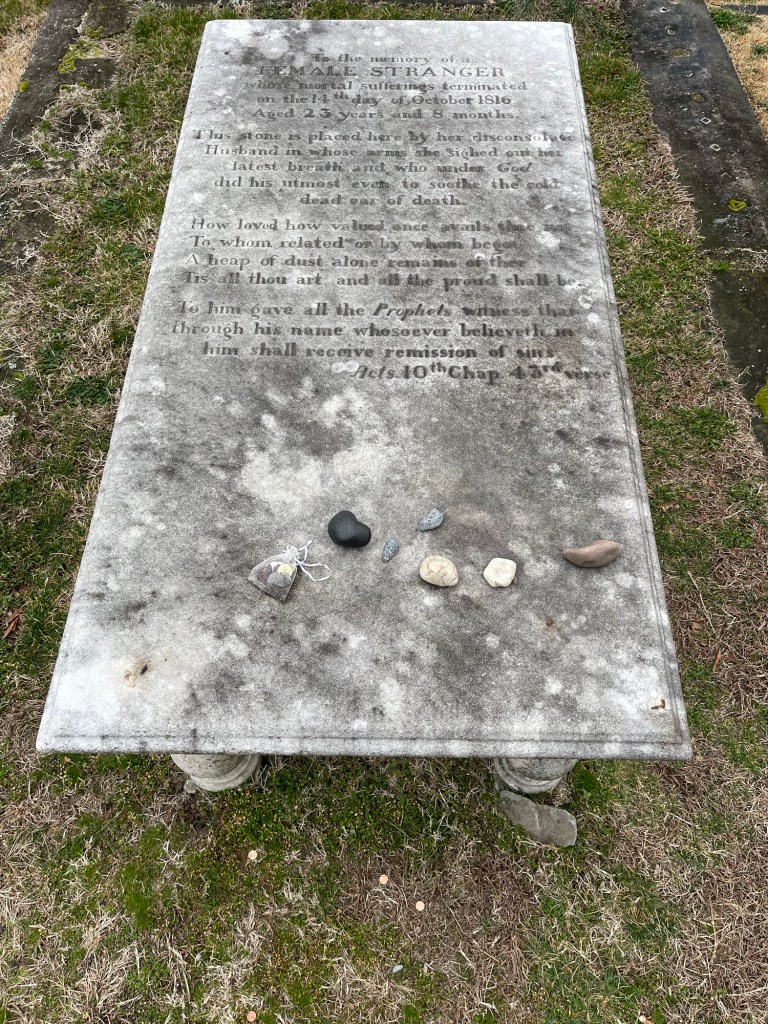
  • The Grave of the Female Stranger

    Alexandria, Virginia is full of history, making it a wonderful place for a history buff to wander about. My early morning walk took me to the Alexandria National Cemetery and the neighboring St. Paul’s Cemetery. Honoring the Union dead was a given, but the lure of my trip was the tragic tale of a young woman visiting the region who died in 1816 shortly after her arrival. The story goes that she and her husband gathered the doctors and nurses before she passed away to have them swear never to reveal her name. They honored her wish and went to their own graves having never told her name. Her husband spent a small fortune on an elaborate tabletop gravestone and then skipped town before the bill was paid. The mystery of the Female Stranger lingers to this day. It’s said that her ghost still haunts the Gadsby’s Tavern, where she apparently died.

    Atop the gravestone is engraved the following:
    To the memory of a
    FEMALE STRANGER
    whose mortal sufferings terminated
    on the 14th day of October 1816
    Aged 23 years and 8 months
    This stone is placed here by her disconsolate
    Husband in whose arms she sighed out her
    latest breath, and who under God
    did his utmost even to soothe the cold
    dead ear of death
    How loved how valued once avails thee not
    To whom related or by whom begot
    A heap of dust alone remains of thee
    Tis all thou art and all the proud shall be
    To him gave all the Prophets witness that
    through his name whosoever believeth in
    him shall receive remission of sins
    Acts. 10th Chap. 43rd verse.

    The unique gravestone is easy to spot, and yet I always seemed to be looking in the other direction as I walked through the St. Paul’s Cemetery. The Female Stranger is not the only soul interred at the cemetery, and I spent some time reviewing the lives of her neighbors on my walk before finally circling back to give my respects to this young lady who’s spirit still haunts the region more than two centuries later. The tokens and coins left behind by other visitors indicate she is more famous in her anonymous death than she ever might have been had her name simply been revealed.

  • Maps

    “A map is not the territory it represents, but, if correct, it has a similar structure to the territory, which accounts for its usefulness.” — Alfred Korzybski, Science and Sanity

    “A map is the greatest of all epic poems. Its lines and colors show the realization of great dreams.” – Gilbert Grosvenor

    I was having a conversation with a friend the other day. I’d asked him when was the last time someone had pulled up asking for directions? It just doesn’t happen now—there’s a phone app for that. That same app takes us to parties and work appointments and the Grand Canyon. Maps are relegated to the wall or the imagination. GPS rules the road now.

    Grosvenor, the founder of National Geographic, had it right when he compared a map to poetry. It stirs the imagination similarly. When you look at a great map of a place, how can you not be stirred to explore that place? Maps whisper to me like Sean O’Connell beckoned to Walter Mitty: Go!

    The name of this blog is Alexander’s map for a reason, it’s based on William Alexander’s pamphlet Encouragement to Colonies and my own wanderings around the northeast corner of North America. I saw a replica of the map Alexander commissioned in a conference room in Newfoundland and it sparked my imagination, which is exactly why he had it commissioned in the first place. I just came into the picture a bit later than he’d planned. That one map completely changed the person who viewed it that day.

    If maps are no longer needed for everyday use, they still have a place in our lives. Maps give us the big picture, while a GPS just tells you where to go. We must always reference the big picture when determining where we want to go in our lives, while remembering always that the map is not the territory. The world is more complicated than that.

    What sparks our imagination? Where do we want to go in our lives, and what tools are we using to get there? The answers to these questions are more important than we might believe.

  • Past and Present

    “It is a mistake to think that the past is dead. Nothing that has ever happened is quite without influence at this moment. The present is merely the past rolled up and concentrated in this second of time. You, too, are your past; often your face is your autobiography; you are what you are because of what you have been; because of your heredity stretching back into forgotten generations; because of every element of environment that has affected you, every man or woman that has met you, every book that you have read, every experience that you have had; all these are accumulated in your memory, your body, your character, your soul. And so it is with a city, a country, a race; it is its past, and cannot be understood without it. It is the present, not the past, that dies; this present moment, to which we give so much attention, is forever flitting from our eyes and fingers into that pedestal and matrix of our lives which we call the past. It is only the past that lives.” — Will Durant, Fallen Leaves

    Super Bowl Sunday was a fun day for many, a crushing day for a few, and a collective memory for all who paid it any attention. Life marches on, no matter which team won or which celebrity did what at the game. It’s all a game in the end. The fact that I woke feeling pretty good overall is far more important to me than who won the game (particularly since “my team” hadn’t even made the playoffs).

    We are each a collection of our past living on within us. We do what we must with the present trying to make it great and to set up a better version of us tomorrow, but our identity is always built on what we’ve done in the past that brought us here. We are all writing our life’s story, our greatest hits, and our obituary. We ought to make it shine.

    A few years ago I started logging what I did every day in a line per day journal. It’s a great way to focus on making something memorable of every day, but it’s also a great way to look back at the breadcrumbs of a life that brought us from there to here. The blank pages to come are full of optimism, but the pages that have been filled are who we really are.

    My recent past has involved looking at several paths forward, weighing each, dismissing some and leaning in to others. Humans must look to the future, even as we live a present built on our past. Our question is always, “What’s next?” and we spend our lives trying to find the answer. Our present, on the other hand, forever answers a different question: “How have you been?” We ought to like the answer. Yesterday is gone, but it lives on within us.

  • The Beauty in Our Memories

    “I can only note that the past is beautiful because one never realises an emotion at the time. It expands later, and thus we don’t have complete emotions about the present, only about the past.” — Virginia Woolf

    I was scanning through some old pictures while looking for a certain image to highlight a conversation I was engaged in and smiled at the memories in the scroll. We forget the blessing of pictures in our march through time. I am that person taking pictures at gatherings because I want to lock in some of those memories. Of course, there’s a fine line between locking in memories and living in the moment. We must first live should the moment slip away.

    In the moment, we know when something is special because we enjoy it so, but we may not realize the impact on our life until well after. We become anchored to these moments with memories—both our own and those of others, through photographs and other media, and through triggers. My mind would go back to the summer between high school and freshman year of college were I to smell the cologne I wore at that time. It floods back to me even writing about that cologne. I haven’t worn cologne since then, making it a uniquely strong trigger for that time in my life.

    I’m attending a reunion tonight that will place me with some of people who may associate me with that cologne. Surely that’s not the whole of my identity, but it might be something that would trigger memories of the character I was then. Reunions are time travel events on their own, and surely stories will bring us back there more than some long lost production of cologne. In all that jovial recollection I hope we remember to savor the moment to lock in those memories to follow. For that’s what makes life beautiful.