Category: History

  • Existing Determinedly

    “The content of our truth depends upon our appropriating the historical foundation. Our own power of generation lies in the rebirth of what has been handed down to us. If we do not wish to slip back, nothing must be forgotten; but if philosophizing is to be genuine our thoughts must arise from our own source. Hence all appropriation of tradition proceeds from the intentness of our own life. The more determinedly I exist, as myself, within the conditions of the time, the more clearly I shall hear the language of the past, the nearer I shall feel the glow of its life.” — Karl Jaspers, Philosophy of Existence (Existenzphilosophie)

    This idea of reading and weaving the philosophical work of past greats into our own lives today is nothing new, yet so many only read new books. If these new books are inspired and drawn from the great thinkers of the past, then doesn’t it make sense to dive deeply into the source material? Put another way, if we are to be a part of the Great Conversation, we must first be conversationally competent. Seek first to understand, then to be understood, as Stephen Covey put it.

    Sitting at the dinner table with some highly intelligent people this evening, the conversation moved from business talk to philosophy, history and religion. Being able to keep pace with these folks doesn’t elevate me to a place of prominence, but it surely makes the evening more interesting than it otherwise might have been. It also makes me more inclined to speak up, and to be listened to by others. Of course, we don’t seek knowledge to be more interesting, but to dive deeper into our own development as human beings. What is the glow of life but feeling fully engaged in the moment? Of rising to meet it?

  • Two Bush Island

    Maine has 4000 islands, which means some names repeat, while other names stand out for their charming descriptiveness. Two Bush Island is one of those latter names. And coming across them inspires even more wanderlust. You simply want to explore a place like this.

    We saved our wandering for Isle au Haut (surely a future blog post), But I was left wondering about the fanciful, perhaps practical name of this tiny island. As we sailed we tossed around all kinds of possibilities, being a lighthouse station and all, but the answer was as Maine Yankee practical as we originally thought. Here is the official version of where it got the name: “The island was named by local fisherman for two large pine trees which inhabited the island and served as navigational daymarkers before the station was built. Two Bush Island Light Station was established in 1897 to mark the southwestern entrance to Two Bush Channel in Penobscot Bay”.

    That link above also offers a wonderful story of the lighthouse keeper’s dog being involved in a rescue. The dog’s name was “Smut”. One night he heard two men trying to row their dory to safety and Smut started barking at them, luring them towards the island and safety. Sure, smut can be the ruin of many a sailor, but this story clearly demonstrates that sometimes Smut can save the day.

    Two Bush Island
  • A Walk Around the Timeless Kenoza Lake

    Kenoza! O’er no sweeter lake
    Shall morning break, or moon-cloud sail,
    No lighter wave than thine shall take
    The sunset’s golden veil.
    — John Greenleaf Whittier, Kenoza

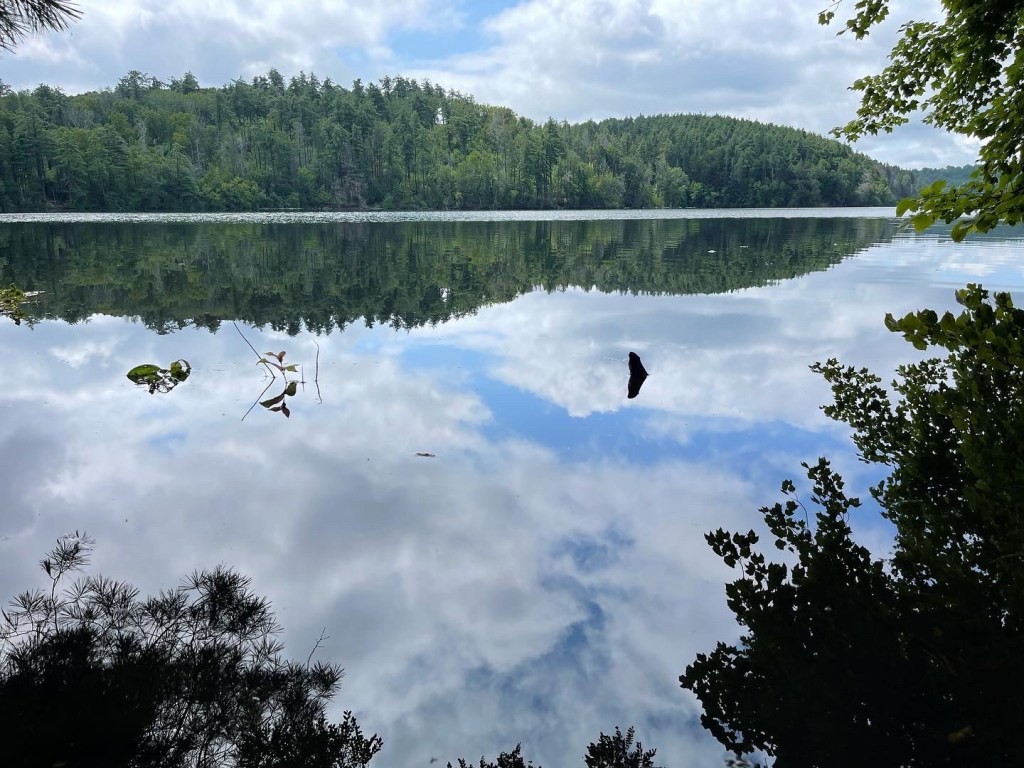
    Whittier wrote this poem for the dedication for a beautiful lake in Haverhill, Massachusetts that was to be named Kenoza Lake. Kenoza means “lake of the pickerel” in the native Algonquian language, and in 1859 the locals formalized the name. There is irony in Native American place names living on when the people who’s language was being used for those names were swept away, but that’s everywhere in the world. The names always betray the past if you dig deeply enough.

    Whittier was an abolitionist, and likely saw the plight of the Native Americans who once lived here with a sympathetic eye. He once lived just a couple of miles away from Kenoza Lake in a quiet farmhouse. His farm looks very much the same today as it did then. Importantly, Kenoza itself also remains pristine, today a protected reservoir that supplies drinking water to the City of Haverhill. That lends a timelessness to the lake and surrounding land that’s impossible not to feel as you walk the grounds.

    The land has transformed over time. It was once deep forest, became farmland (like so much of America in colonial times) and eventually returned to forest again. That the land wasn’t developed required some luck. Dr. James R. Nichols, a wealthy scientist who made his fortune developing chemical fertilizers, acquired the farmland and set about building a castle for himself on top of a hill with views of three states. He called the place “Winnekenni”, which means “very beautiful” in Algonquian. Walking the property, today maintained by the City of Haverhill as parkland and a natural buffer for the reservoir, feels like you’ve been transported back to another time.

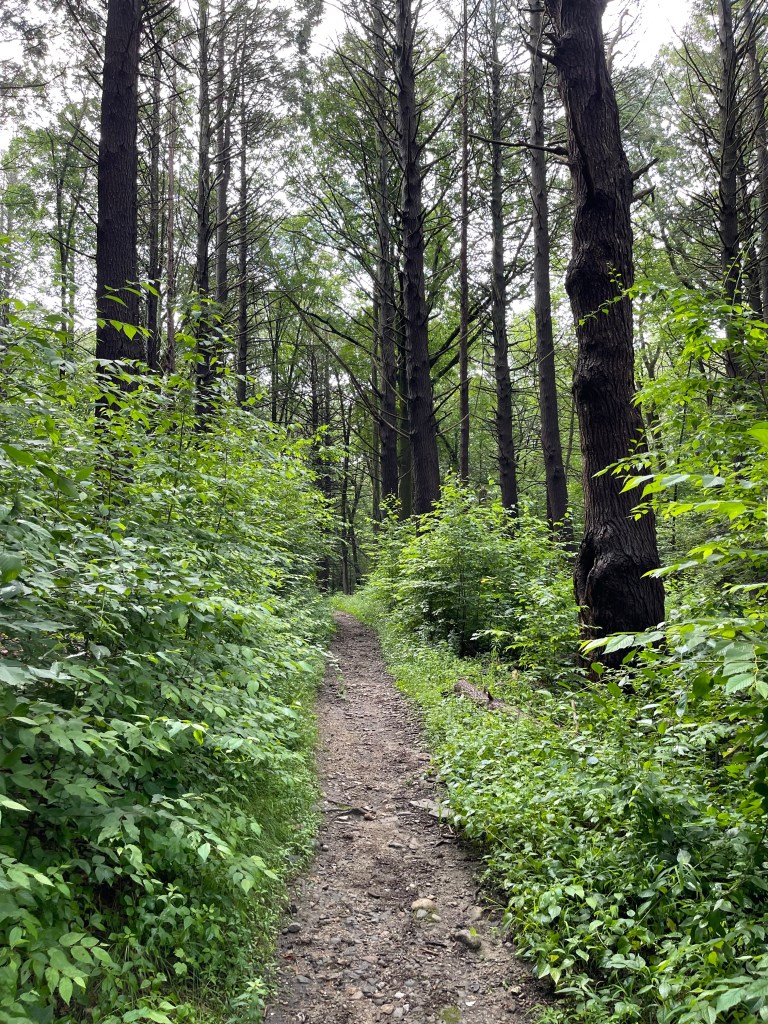
    There is a network of trails throughout the the park, and you can manage a great step count by doing the entire loop around the lake. They range from gravel roads to single track paths squeezed on both sides by abundant undergrowth(including, alas, poison ivy). The trails are well-marked and it’s very difficult to get lost, as you always have the lake to show you your progress. We encountered plenty of walkers, horseback riders and mountain bikers on the trek around the lake, but never felt it was overcrowded. Indeed, on the single track we saw only one other person, a trail runner who quickly distanced himself from us.

    Reservoirs, like graveyards, are time machines back to the days they were established. The lay of the land remains largely as it was then, and offers an opportunity to hear the whispers of history. It’s relatively easy to imagine how this place looked for Dr. Nichols or John Greenleaf Whittier because it’s largely that same place today: timeless, and beautiful.

    Kenoza Lake
    Winnekenni Castle
    The lake is almost always in view
    Local resident
    Very large Bondarzewiaceae fungi enjoying the wet summer
    Single track trail
    One of several memorials in the park
  • A World You Want to Live In

    I know you’re tired
    And you ain’t sleeping well
    Uninspired
    And likely mad as hell
    But wherever you are
    I hope the high road leads you home again
    To a world you want to live in
    — Jason Isbell and the 400 Unit, Hope the High Road

    I had a conversation with a work acquaintance who travels down a different ideological path than me. Maybe because I’m a good listener, or because I look the part, or because he’s inclined to let his opinion be known no matter who was on the other side of the conversation, his path of maybes led down the familiar sound bites for an American conservative man: taxes, guns and the irrational left. I heard him out instead of debating him on each point I disagreed with. I’ve learned long ago to stand my ground but always hear out contrary opinions. The weakest minds among us are those who refuse to listen for want of shouting down instead.

    There’s no doubt the world is experiencing friction. Humans angry with other humans, climate change turning the seasons upside down, rhetoric turned up, and bad behavior seemingly rewarded with fame and fortune. Aggressiveness is celebrated, amplified and repeated. There’s an ugly side to humanity, a side we thought we’d transcended for a brief, shining moment, but which keeps expressing itself despite our best wishes. We used to shame away the crazies, now we make them leaders and lawmakers. History strongly suggests it has always been this way. And yet we progress despite ourselves.

    We all know the expression: be the change you want to see in the world. It may feel insufficient given the weight of all our problems, for we’re far from perfect. As I travel around the world, it’s clear that most everyone is trying to take the high road and be that change we all want to see. Therein lies the secret to happiness in this tragic comedy: choosing what to see. In this brief lifetime together, we must see everything, the ugly and the beautiful, and focus on connection. This is more than symbolism, it’s putting in the sweat equity that brings us closer together instead of further apart. Collectively, we are what we choose to work on.

    May our work carry us higher.

  • History and Identity

    July was originally called Quintilis, which is latin for fifth (The Roman calendar once consisted of ten months: Martius, Aprilis, Maius, Junius, Quintilis, Sextilis, September, October, November, and December). When Julius Caesar was assassinated, his birth month was named in his honor (July: Julius), thus forever changing what we call the month (August was similarly named after a Roman, but let’s not get ahead of ourselves). Such is the reach of the Romans: they’re very much a part of everything around us, we just don’t always see them. The months make a lot more sense when you know they threw on January and February after the fact.

    History isn’t just all around us, it’s a part of our identity. As such, we rarely stop to think about it. Why was a street named this way? How about the town itself? What of the waterways and mountains? Everything originated in history and carries with us today. Whether a Roman Emperor or a slave cast to the lions, each was woven into the fabric of our identity.

    Do you wonder what history we’re making now? Where will all of this take us? They say in songwriting that everything’s been done already, yet people keep coming up with creatively new songs. Likewise, everything has been written already, and AI is taking over everything anyway, so why bother writing anything at all? Because nobody has every experienced what we are experiencing. Nobody could possibly have our unique perspective on the world, because it wasn’t their world then and it surely isn’t anyone else’s. Perspective matters a great deal in art.

    We may not have a month named after us, or even a local street, but we can each leave our dent in the universe with each act. The dominos will fall where they may (or is that Maius?). Everything matters or none of it does: time will determine everything. History will live on without us one day. But it may yet feel our ripple. Perhaps it already has. The only thing certain is this story isn’t over quite yet.

  • Full Moon & Fireworks

    I once was a boat owner. Nowadays I’m a passenger on other people’s boats, and occasionally crew. I’d like to say I like it this way, not having the expense of maintaining a boat and such talk, but once it’s in your blood you never get over not having one, no matter how often you hop on someone else’s. That doesn’t make the experience any less delightful when you’re blessed with the opportunity. It’s more a call from the life that got away.

    Big Island Pond, located in Southern New Hampshire, is bordered by three towns. The namesake big island, called Governor’s Island, is mostly conservation land, making the lake feel like a time warp back to another era. There is a lot of history on this small lake, beginning with the famous Native American warrior Escumbuit, one of the leaders of the Abenaki. For the French, he was considered a hero, and knighted by Louis XIV of France in 1706. For the English settlers, he was a holy terror, responsible for several local raids during King William’s War and Queen Anne’s War. He lived on a small island now named after him; Escumbuit Island. Another famous character, Alan Shepard, the first American in space, also once lived on Escumbuit Island. Surely, there are whispers from history on quiet nights on this lake.

    Today, there’s little doubt who won the long game. The perimeter of the lake is lined with homes, and every one of those homeowners tries to be on the lake for the 4th of July fireworks. The threat of rain postponed the fireworks this night, making the lake quieter than it otherwise would have been. It turned out to be the wrong decision for the fireworks organizers, as the rains drifted away and the skies cleared enough to offer a full moon spectacle for those who ventured onto the lake anyway. That full moon rose over the dark shoreline, illuminating the calm lake with wonder.

    Cruising a populated American lake on the weekend of our national holiday is usually a recipe for boisterous fun and a bouncy ride. Boaters jockey for position to watch the fireworks, various patriotic-themed soundtracks and “homeowner special” fireworks blend together into a chaos of sound. Individual boats are also lit up in various colorful displays. I suspect most of the people on those boats are also lit up. Such is Independence Day in America. Americans don’t take nearly enough time off, but when we try to make up for lost time.

    With the fireworks postponed, it fell to some adventurous souls to make their own display. Three characters, one in nothing but a red, white and blue bathing suit, floated a swimming platform out into the middle of the lake stacked with professional-grade fireworks. They spent the next half an hour lighting off ridiculously large fireworks precariously close to their future well-being. As with boats, other people’s fireworks cost a lot less but offer the same benefit. We had a front row seat for our own fireworks display, making for a magical evening with friends. Sometimes things just seem to come together at just the right time. A timeless lake, full of history and magic, set the stage once again.

  • A Visit with Myles Standish

    Duxbury, Massachusetts doesn’t have the same notoriety as its neighbor Plymouth, but the roots of history run nearly as deep here. To be fair, if people think of Duxbury at all, it’s usually as an upper class suburb of Boston. There’s plenty of wealth on display in this town. But step away from the massive homes with their perfectly manicured gardens and you’ll find a legacy that reaches back to the Mayflower. The most famous character on the Mayflower, Myles Standish, lived and died in Duxbury, and is buried in what is now known as the Myles Standish Burying Ground.

    The burying ground was once adjacent to a meeting house, long gone, but marked with granite stones to indicate where it once stood. It is the oldest continuously maintained graveyard in the United States. The lay of the land is largely the same within the enclosure. The thing about graveyards is you’re walking on ground largely unchanged since the days when the people buried there were laid to rest. The entire area around a graveyard becomes housing developments and strip malls and paved roads, but these small graveyards are a time machine back to another time.

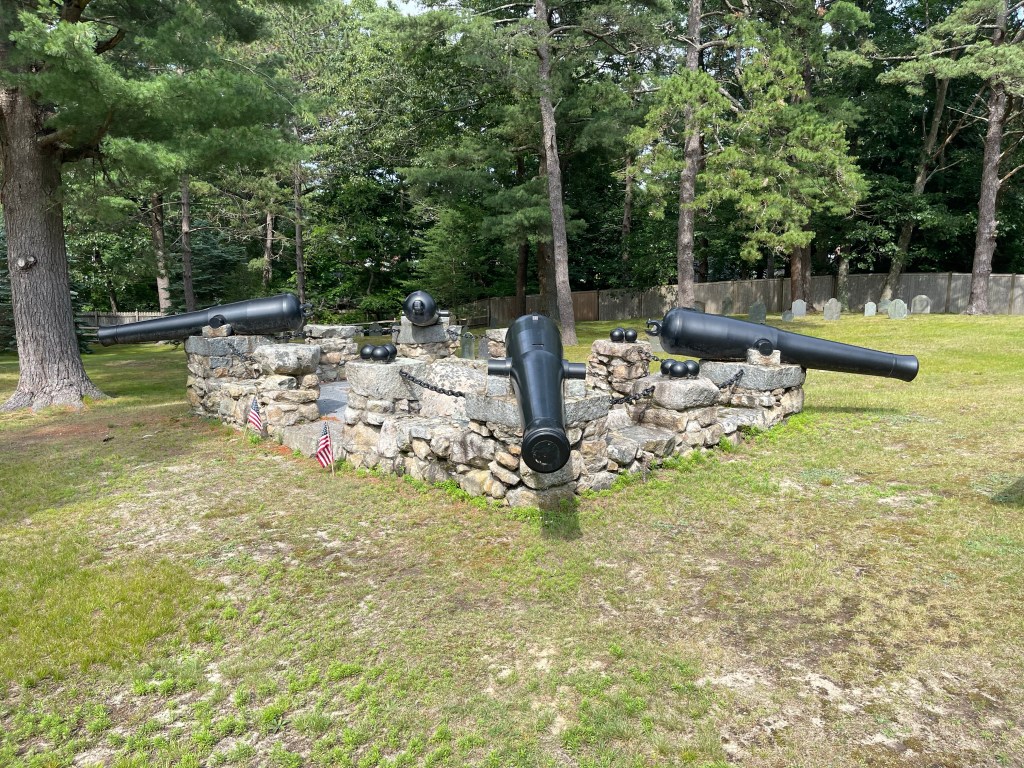
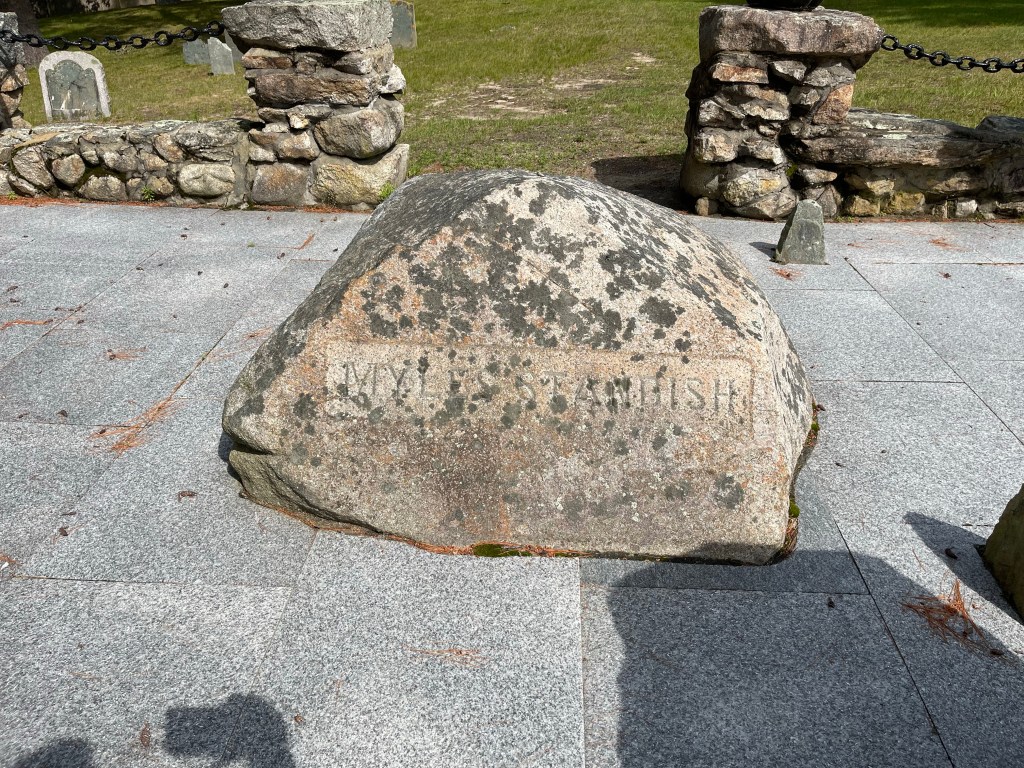
    Captain Jonathan Alden, son of Mayflower passengers John and Priscilla Alden, is also buried in this graveyard, and his is the oldest gravestone in the burying ground. Standish, who died well before Alden, likely had small pyramid-shaped stones marking his interment initially, and the monument built around the spot in 1893 (you can see one of these stones behind the boulder engraved with Myles Standish’s name in the picture below). That engraved boulder, like Plymouth Rock, is something for the tourists. The monument itself, with a fieldstone wall surrounding it and four cannon mounted on each corner, projects the violent boldness of the man interred beneath.

    Myles Standish was a military advisor to the Pilgrims. By all accounts he was brutal and decisive in his actions. He would preemptively attack when he heard trouble was brewing, and famously stuck the head of one rival, Wituwamat, on a pike as a deterrent to others. There seems to be no doubt that Wituwamat was lured into a room and murdered. Was this act of brutality something to be celebrated or scorned? Was there a legitimate threat to the Pilgrims, and could it have been resolved in a more diplomatic way? What’s clear is Standish believed he was fighting for the lives of the colonists, and used any method he could to intimidate those who he believed were threats to their safety. As with all history, we judge it from the comfort of distance.

    At another spot in town, on a point of land jutting out into Kingston Harbor, there are four more granite stones laid out in a park amongst multi-million dollar homes overlooking the harbor. It was here that Myles Standish actually lived. I found this interesting, as a military man like Standish would normally seek the high ground. A review of a Google map later revealed a small pond nearby that would have been his source of fresh water. Perhaps Myles dined regularly on Duxbury oysters, which have become almost as famous as the town’s most notable resident.

  • The One and Only Cribstone Bridge

    On the rocky coast of Maine there’s a bridge like no other in the world. Its formal name is The Bailey Island Bridge, but its more descriptive name is the Cribstone Bridge. What makes it unique is its beautifully complex simplicity. It’s basically stacks of cut granite, piled just so one atop the other to form the foundation for a concrete bridge. The magic is in its strength and open design that permits water to flow freely through it. This stack of granite extends 350 meters across an active tidal waterway in Casco Bay, Maine, and has withstood surf, ice flows, boat wakes and a steady flow of vehicular traffic since it was completed in 1928, with only one major repair between 2009-2010.

    There’s truth in the expression “they don’t build them like that any more”. Time tells, and the bridge has proven itself built to last. Anyone who’s played Jenga can appreciate the complexity of a bridge like this. Stacks of granite slabs bear the load, while shrugging off the ocean tides, nor’easters and the harsh cold of a Maine winter. As a critic of mediocre civil engineering projects, I take a bow to this gem of a bridge, showing generations of Civil Engineers what’s possible with a bit of creative genius. It seems I’m not alone in my appreciation, as the bridge is recognized as a National Historic Civil Engineering Landmark, and also on the National Register of Historic Places.

    I wasn’t seeking out this bridge, but I encountered it on a drive out to Land’s End, quite literally a point of land at the end of the road on Bailey Island. I suppose that makes me an accidental tourist of sorts, but these are the kind of encounters that inspired me to start blogging in the first place. Will the Bailey Island Bridge inspire a return to more deliberate regional exploration in this blog? Time tells.

  • A Visit to Brimstone Hill Fortress, St. Kitts

    On a steep and imposing chunk of rock with the mountains at her back, Brimstone Hill Fortress continues to watch over the Caribbean long after the strategic reasons for having a fort here at all have faded into history. Today St. Kitts and Nevis, and the other island nations nearby, are destinations for fun in the tropics, but three centuries ago these islands were strategically valuable producers of tobacco, cotton and especially sugar and its byproducts, molasses and rum. The conflicts between England and France were played out in the North American colonies and in small islands like St. Kitts. While most soldiers considered being stationed in the tropics a death sentence due to the high mortality rate (from disease, alcoholism, etc), it was nothing compared to that suffered by the original inhabitants and the slaves that built the fortress. Each were decimated as the history of this place evolved. Visiting the castle after playing tourist for a few days, the contrast between the joyful destination of today and its dark history was sobering.

    They say that history is written by the victors. This is largely true, but with enough time and clues, you find enough evidence to piece together a more complete story. The English and French united to massacre thousands of Caribs (kalinagos) in 1626 at a place aptly called bloody point, not far from Brimstone Hill. Once they’d eliminated the native population, the English and French divided St. Kitts between them, with the English taking the middle of the island and the French the rest. This tenuous peace between colonists would last until 1713 (the end of Queen Anne’s War).

    Brimstone Hill Fortress was built by slaves between 1690 and the 1790’s. The slaves were brought from Africa in a continuous loop that began the slave trade of tobacco, cotton and sugar for captured and enslaved people. This highly lucrative trade created generations of wealth and tragedy. The fortress is an early example of the polygonal system, which created fields of fire to ensure that all sides were covered from assault. The sheer height of the fort ensured it would be very difficult to attack from the ground, while offering the prominence of the high ground to fire canon balls up to a mile away. This was state-of-the-art technology for the time. The volcanic stone was mined and cut into a formidable fortress, using lime quarried from lower in the mountain.

    During the American Revolutionary War, the French (allied with the American colonists) invaded St. Kitts and laid siege on the fortress from January and February of 1782. A siege is the kryptonite of a fortress, as the inhabitants face a dwindling supply of water, food and ammunition while the attackers wait them out. Eventually even the strongest fortresses capitulate, and the English surrendered and marched out with full honors. A year later the English were back again when the Treaty of Paris restored the islands to them.

    Today the Brimstone Hill Fortress is a Unesco historic site and remarkably well preserved. Many of the original canon line the fort, awaiting an assault that will never come. Today’s assault is from tourists seeking out the spectacular views from the fortress, stirred with a sobering history lesson. It’s absolutely worth the trip up the narrow, winding road on a clear day. A walk out to the outer walls confirms exactly why they built the fortress here—you can see forever in all directions. Including the past.

  • To Be a Good Ancestor

    It’s understood that our ancestors lived in a time of darkness and brutality mixed with enlightenment and progress. History is a process of confronting and accepting the evidence we stumble across as we explore the path of humanity. We aren’t a perfect species, but we can make incremental progress towards a better world. We cannot judge ourselves today based on the actions of our ancestors, but we can learn and apply that knowledge towards a better future. This of course applies to the individual as much as the collective species. In either case, progress is active work.

    Our ancestors were the best and worst of us. We are the sum of that history: the survivors, antagonists and witnesses rolled into an underlying identity we either celebrate or work to change. We are the latest revision of our species, and the trick, as Kevin Kelly puts it, is to be good ancestors for futures generations. Just as a scale and the mirror inform us of our progress towards fitness, our work and what we invest our time and energy into determine tangible progress for our collective future.

    History suggests steady progress, even as the news suggests a spiral downward. The only thing certain is that we have our verse to be written. What we do with the opportunity is up to us.