Category: Nature

  • From Fenway Park to Barred Owls in the Night

    Yesterday afternoon I changed up the routine and watched the Boston Red Sox play the Detroit Tigers at Fenway Park. Day games are a different vibe than night games, and all games are a different vibe during a pandemic. But we’re slowly coming out of it, and going to a baseball game on a beautiful day felt pretty cool.

    It’s been decades since I’d seen that many empty seats at Fenway Park. Social distancing requirements demand low capacity, and we were among the lucky few to get in to see the game. Honestly the game was a mess of bad pitching and horrific defense for both teams, with 21 total runs scored. But being back inside the park after a couple of years, and especially the last year, made it special.

    The entire experience, like everything else nowadays, occurs with appropriate precautions. They zip tie the seats you’re not supposed to sit in, and have some ushers walking around asking you to put your mask on if you aren’t eating or drinking. I saw plenty of people breaking this rule, but people are spaced so far apart that it didn’t matter much. The group I was part of is fully vaccinated and more comfortable than we might have been otherwise. No food vendors walking up and down the stairs pitching hot dogs and popcorn, and there were limited options below. But we were still at Fenway Park and loving the afternoon vibe.

    Back at home in New Hampshire and ready to call it an early night, I heard the calls of Barred Owls in the woods behind the house. Loud. Close. And what sounded like three or four owls. We don’t generally have Barred Owls in the neighborhood, mostly because we have Great Horned Owls and they stay clear of each other. But here they were, and the night was filled with the apocalyptic sounds of Barred Owls in the night.

    You can’t just slip away to dreamland when there’s a cacophony of owl calls outside. So I walked outside on the deck and stood listening to them in the dark. High up in the tree canopy, making baby Barred Owls or at least deep in negotiation. I thought about the contrast between Fenway Park and the woods of New Hampshire on this beautiful day in May. I’m not sure what this “new normal” will be, but if this was it, I felt lucky to have been a part of it.

  • The Naming of Cape Cod

    “On the 26th of March, 1602, old style. Captain Bartholomew Gosnold set sail from Falmouth, England, for the North part of Virginia, in a small bark called the Concord… The 15th day,’ writes Gabriel Archer, ‘we had again sight of the land, which made ahead, being as we thought an island, by reason of a large sound that appeared westward between it and the main, for coming to the west end thereof, we did perceive a large opening, we called it Shoal Hope. Near this cape we came to anchor in fifteen fathoms, where we took great store of cod-fish, for which we altered the name and called it Cape Cod.’” – Henry David Thoreau, Cape Cod

    A bit of trivia lost in history is where Cape Cod originally got its name. A lot of people, including Thoreau, point to Gabriel Archer. Archer wrote the entry Thoreau quotes above in 1602. He’d then go on to supposedly name Martha’s Vineyard after his daughter when an abundance of grapes were found there.

    Of course, without the Cod, it might have been named something else. Four hundred years of fishing decimated the Cod population, leading to sharp restrictions on fishing. Pressure from commercial fishing lobbies to raise limits on Cod run counter to the goal of full restoration of the biomass. And then you’ve got those seal population increases. The slow restoration of the Cod population is ongoing, but like so many endangered species it hangs by a thread.

    Archer traded with the local Wampanoag Tribe at what is now Cuttyhunk. He returned to England that same year but would return again in 1607. Archer would butt heads with John Smith in Jamestown and would ultimately die there within a few years. His journal was published after his death and the names Cape Cod and Martha’s Vineyard were sticky enough to live on well after him. More than his own name, it seems. Life is funny that way.

  • A Walk on Cahoon Hollow Beach

    “The sea-shore is a sort of neutral ground, a most advantageous point from which to contemplate this world. It is even a trivial place. The waves forever rolling to the land are too far-travelled and untamable to be familiar. Creeping along the endless beach amid the sun-squall and the foam, it occurs to us that we, too, are the product of sea-slime.” – Henry David Thoreau, Cape Cod

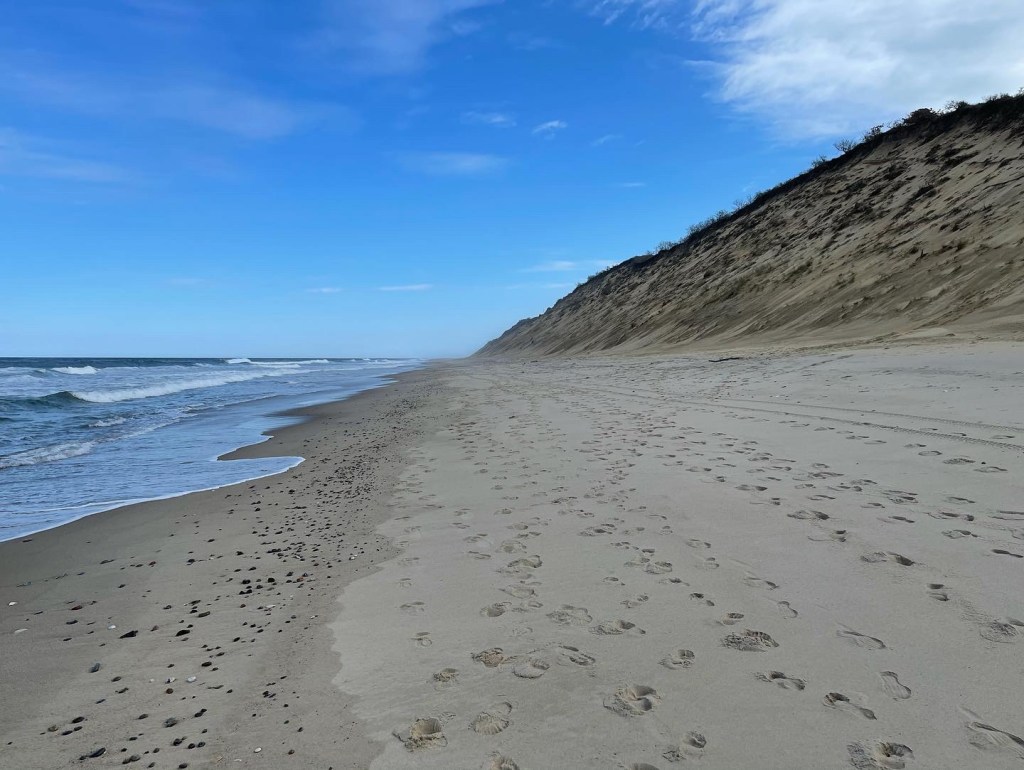
    Between the massive dunes and the crashing Atlantic Ocean in Wellfleet is a strip of sandy beach bearing the brunt of the relentless assault from wind and sea. The surf in warmer months is a feeding ground for Great White Sharks, who have modified their hunting style to chase grey seals right into the churning shallows that swimming humans like to frolic in during the warmer months. Great Whites don’t hunt humans, but sometimes they mistake humans for seals.

    In April you don’t see many seals bobbing in the surf on Cape Cod. So the sharks move on to other hunting grounds and leave this stretch of wild ocean to the occasional surfer and the beach walkers. A walk on the Cape Cod National Seashore can happen just about anywhere with an access path down the 100-foot dunes. Sand is dangerous stuff that can bury a reckless trespasser in no time at all. Sticking to the access paths preserves the dunes and just might preserve you too. The access paths themselves inform in their soft give. This is not a place for the meek. If you can’t handle the access path don’t walk this beach.

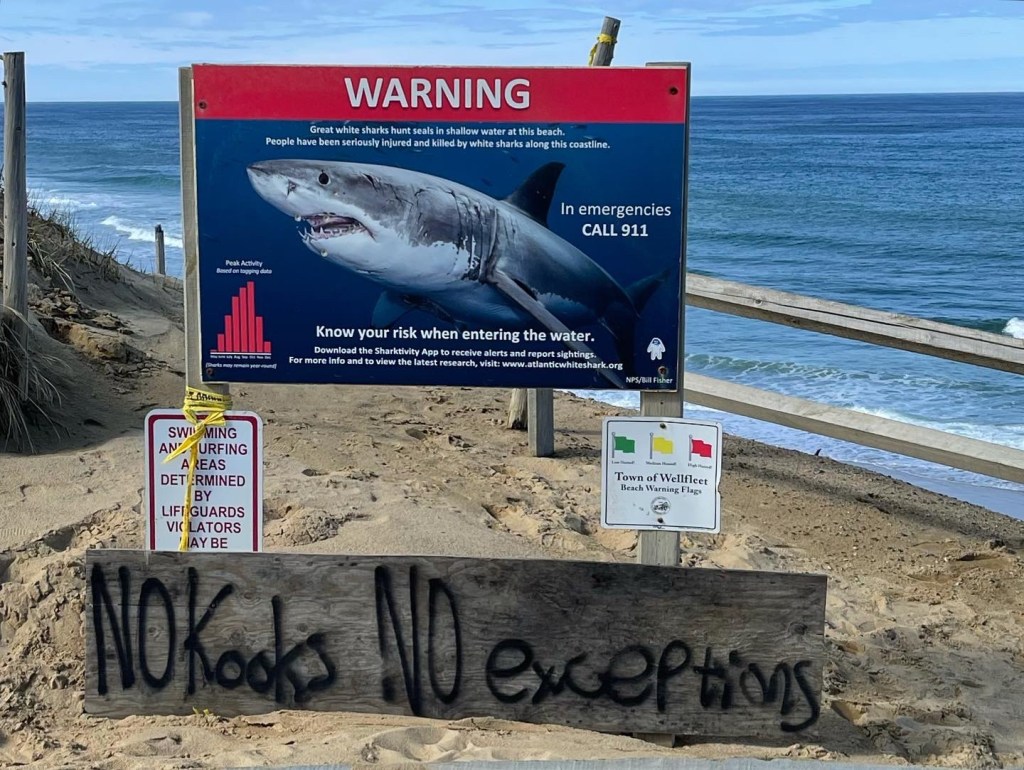
    For an off-season walk, we chose to park at the Beachcomber in Wellfleet and walk a stretch of soft sand known as Cahoon Hollow Beach. The Beachcomber is a trendy cool place at the height of summer. In mid-April it’s a convenient parking spot for easy access to the beach. A sign of the times is a shark warning with a handmade sign added to the bottom sharply suggesting “No kooks, no exceptions”. Wellfleet has had just about enough of the worst representatives of shark tourism.

    The National Seashore has a 40 mile stretch of beach that would test the strongest of walkers. When you say you’ll walk just to the bend you soon realize that bend keeps disappearing ahead of you. We walked about a mile, following the curve of the dunes around the forearm of Cape Cod. Walkers tend to gravitate towards the surf line where shells and smooth rocks offer themselves up for consideration. Soon your pockets are full and you recognize the folly of treasure hunting when every receding wave reveals another treasure.

    Thoreau walked the entire length from Chatham to Provincetown in the mid-1850’s and wrote about it for lectures that would end too soon in his abbreviated life. It would be published after his death in 1865 – the same year the Civil War ended. I think often about Thoreau, dying at 45 with so much left to do and see and write about. And here I was following him again, walking the beach between dune and sea, thinking it might just go on forever. Knowing it won’t.

  • A Walk in Dense Fog

    The dense fog presses up against the glass, tapping on the window lightly, wanting to come inside. Or calling me outside. I listen and layer up for a walk to the bay. I know it’s out there, if only from memory. And walk slowly to the water.

    The fog comes
    on little cat feet.
    It sits looking
    over harbor and city
    on silent haunches
    and then moves on.
    Carl Sandburg, Fog

    The birds carry on their morning song, but not so many today. Early still. What does 98% humidity sound like? It sounds like it looks; muted and disorienting. I close my eyes and let my bearings reset. I’m the only human outside this morning. Or possibly one of thousands – who can tell in the gray billowing dance?

    Down by the water, surprising wave action on a still morning. The bay is restless, like a sleeping child with a fever. Fog blurs hard lines. Instead I focus on what it amplifies. The lapping sounds of the waves slapping on the beach. A loon hidden from view out there somewhere calling its kind. Reaching me.

    Walking up from the shore, the sweet smell of dune grass requests a moment of my time. I gladly linger and thank the grass for the invitation. The air feels different as you walk away from the beach. The waves recede, birdsong grows and the world brightens. Dawn is approaching even as the fog asserts its hold on the world.

    Much later, fog lifting, you see the details fill in. I admit I liked the ambiguity of the fog just a bit more. If only for a momentary change in perspective. And, ironically, the clarity it brought. Swirling in the darkness by the bay.

  • Friends with the Sky

    “One of the many ways we have made ourselves lonely without gaining the deeper nourishment and intimacies of true aloneness, is the way we have lost the greater supporting circle of friendship available to us in the created, natural world: to be friends with the sky, the rain, the changing light of a given day and the horizon always leading us beyond the circle we have drawn too readily for ourselves.” – David Whyte, from the forward of Essentials

    I’ve often wondered at loneliness. I’m rarely lonely, but I’m often alone. I think the root of it lies in Whyte’s observation about the greater supporting circle – a connection to the world around you and with your own inner voice. Nothing awakens your relationship with the world like lingering with it on its terms.

    One of the things I miss about having a dog is that forced connection with the outside, no matter the weather. It’s easy to just stay inside when it’s raining sideways or bitter cold. But having a dog forces your hand – they’ve gotta go, and you must connect them with the place they go. Letting them out is a cop-out. You must walk as a true offering to the pet gods.

    This connection to the outdoors doesn’t require a dog, I’ve had similar connection with hiking, rowing and sailing where you’re forced to deal with nature as it comes to you. When you’re a small part of the natural world you tend to see it differently than you might looking at a screen from the comfort of a favorite chair. Nature demands that we meet it with respect and reverence, and in return we awaken something deeper in us.

    I suppose a circle drawn around us feels like a hug or the blankets you pull over yourself on the coldest nights. The problem with a tight circle is that it’s inherently limiting. Getting out under the open sky and feeling the elements, you recognize that you’re alone, yet a part of something bigger than yourself. When you see the world outside that old circle, you’re never quite the same.

    Loneliness is a state of isolation derived from looking inward. Connection is looking outward, and beyond yourself. Stepping outside the circle is a courageous act if you haven’t spent much time there, but it leads to a world that is alive with wonder. A sensory world of conversations in many dimensions. A world where we can become more than whatever it was you were when contained in that circle. That’s where you’ll find larger possibility. You’ll never be lonely outside your comfort zone.

  • A Visit to Fall of Song

    The Fall of Song is a popular place located on the grounds of Castle in the Clouds in Moultonborough, New Hampshire. The is a waterfall with infrastructure to support the masses, with a large parking lot a short walk from the walls and a boardwalk that runs right up to the waterfalls. These make it far more accessible than most of the waterfalls I visit, and likely ensures a lot of company when you visit at peak times. As is my nature, I visited off-peak and had the place to myself for a short time.

    The Fall of Song was once called Ossipee Falls, so named for the mountain range they’re in. I’m not sure exactly when the name changed to the medieval, lyrical Fall of Song. It may have been in the mid-19th century when the area was known for its mineral springs, or maybe later when BF Shaw came up from Lowell to build Ossipee Park mountain resort here. Or maybe it was when the property was sold to Tom Plant who built his Castle in the Clouds. Any of the characters from that time could have named it Fall of Song. It really doesn’t matter, I suppose. The falls have drawn visitors for generations because they’re simply beautiful.

    Fall of Song

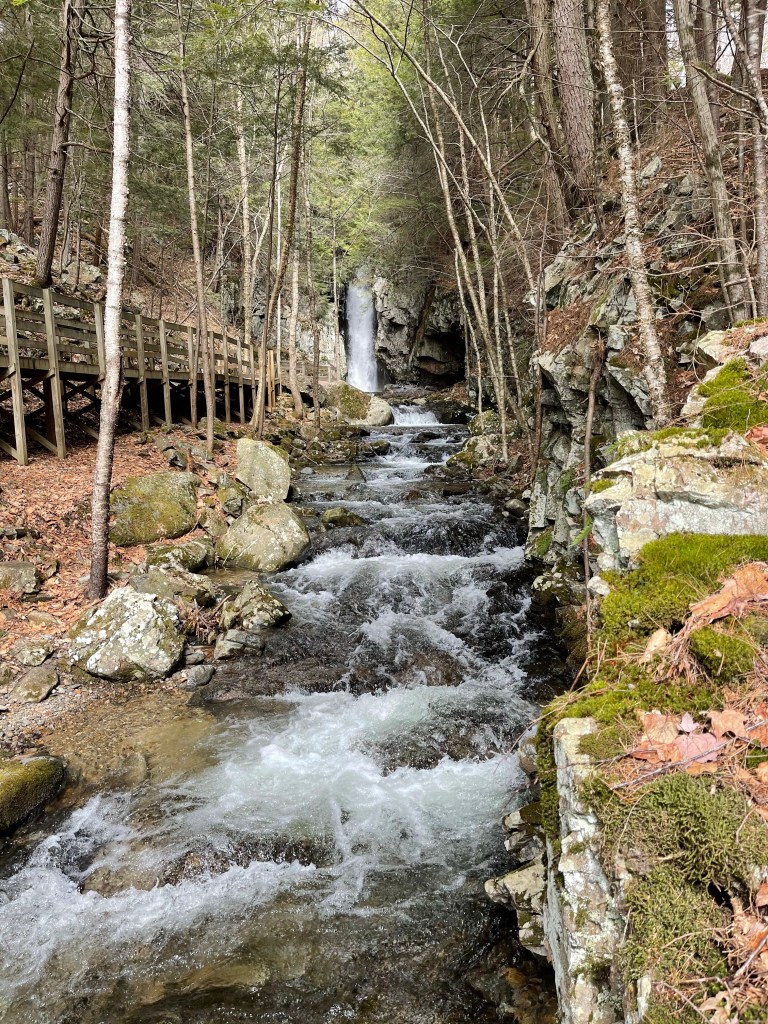
    In the winter and early Spring the gates are closed but pedestrians are welcome. A quick half mile walk up the road offers beautiful views of Shannon Brook tumbling down to greet you. You soon reach The Pebble, a giant glacial erratic that stands watch between the brook and the road. I see a lot of glacial erratics in my walks through the woods, and this one is pretty impressive.

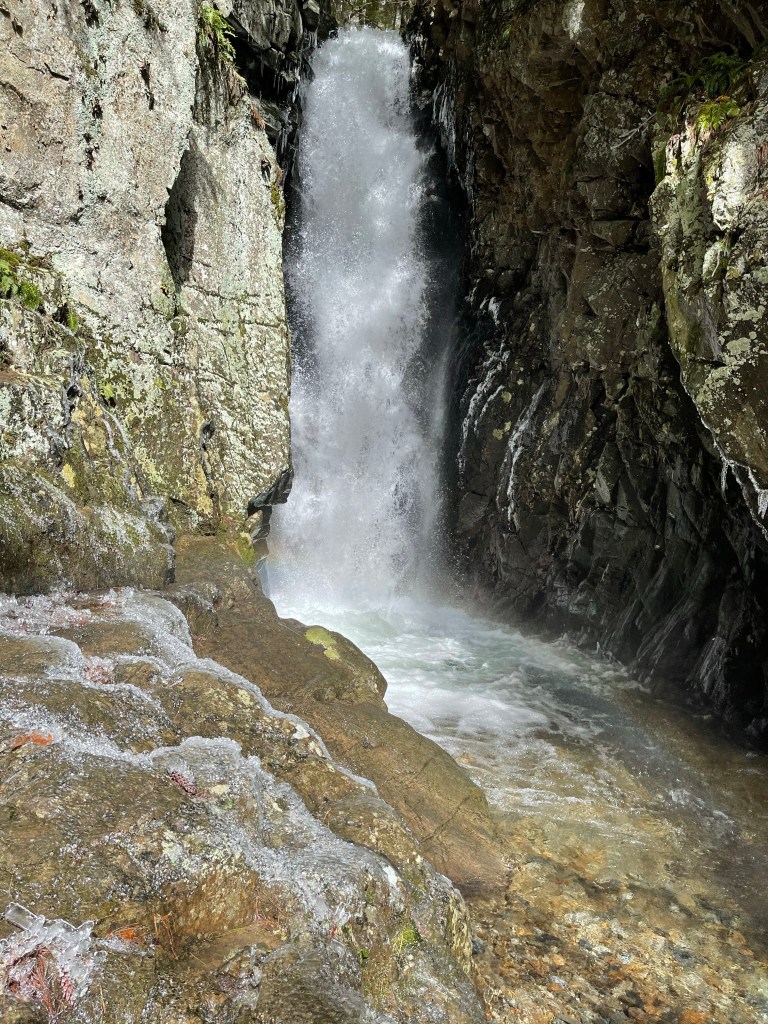
    The Fall of Song is an impressive 40 foot plunge through narrow granite walls. With recent rain they were singing with gusto, with an icy mist swirling into a rainbow in the afternoon sun. I appreciated the boardwalk for what it offers in accessibility for people who might not otherwise see Fall of Song, while thinking about how great the photo might have been without the boardwalk in the picture. So it goes.

    Fall of Song and Shannon Brook

    Not being one to settle for the easily accessible, I hiked up the trail above the falls to see them plunge from above, and then made my way up to Bridal Veil Falls just above Fall of Song. This second fall is one you have to earn, but in doing so you feel you’re in on a little secret that those who only visit Fall of Song never know. I tried several approaches to get to the best vantage point without being completely satisfied with any of them and have promised myself another visit to see them again.

    Shannon Brook, above Fall of Song with a glimpse of Bridal Veil Falls above

    There are several other falls above Fall of Song worth a look, with Bridal Veil being the prettiest. And you can spend a lot more time hiking this area beyond the waterfalls. For all my wandering further north in the White Mountains, the old volcano ring of the Ossipee Mountain range offers stunning vistas. This is a place worth returning to.

  • Freeze and Thaw

    In the dark time of the year.
    Between melting and freezing
    The soul’s sap quivers.
    – T.S. Eliot, Little Gidding

    There are more famous lines from this poem, but this is the time of sap buckets and lines run between maple trees in New England, so forgive me for straying from the popular. For these are the days of freezing and thawing – a confused mix of awakening and nature turning a cold shoulder on us. A reminder that warmer days are coming but we aren’t there just yet.

    And so it is with the vaccine and a pandemic that hasn’t quite finished its business with us, despite casual disregard and letting up of guards. We aren’t quite there, but surely we’re closer. So persevere; for we’ll get through the darkness, together in our isolation.

    Eliot wrote Little Gidding during the darkest days of the Blitz, set it aside in dissatisfaction and returned to it again to publish it during slightly brighter days in 1942. Who would ever think of 1942 as brighter days? Someone who lived through the Blitz of 1940-41 I suppose.

    So who are we to complain about a turn to colder days just as the sun began to warm us once again? Who are we to complain about wearing a mask for just a bit longer? Are we that precious and self-absorbed? Focus on the brighter days ahead, but stay the course in the meantime.

    As the snow and ice retreats for another season, the mud rises to meet our favorite footwear in a cold, gooey grip. The warmest days bring swirls of bugs celebrating their brief dance with life. And we, the comfortable masses, find reasons to complain about the mud and bugs and even the miraculously fast release of vaccines to the world that just seem a bit too slow. For all the joy of thaw, we seem to prefer the angst of freeze.

    Spring is upon us, despite it all. The sap flows with each freeze and thaw, and drips slowly into buckets. Drop by drop, the buckets fill. It’s the only way, really. You can’t very well cut the tree in half to pour out the sap. Not if you hope to have another season anyway. No, progress is slow that way. And offers lessons in patience and perseverance. Of going with the flow and staying the course.

  • The Heart of the Bay

    Nobody owns the sky or the trees.
    Nobody owns the hearts of birds.
    Still, being human and partial therefore to my own
    successes—
    though not resentful of others fashioning theirs—

    I’ll come tomorrow, I believe, quite early.
    – Mary Oliver, Winter and the Nuthatch

    Oliver writes of building trust with a nuthatch that eventually learns to eat out of her hand. One morning she arrives later than other mornings only to find her nuthatch friend eating from another person’s hand. And thus she resolves to arrive earlier the next morning. I’ve felt this myself, not with birds in the hand so much as places of solitude.

    Early Spring is still a time of hard frosts and temperature swings. Maple syrup weather – when the sap flows and gathers in buckets around Maple trees throughout the region. But not here. Cape Cod is more temperate, not subject to the extremes that draw the sap out. And then there’s the trees themselves, which seem to prefer the other side of the bridges. No, here we have a different sap drawn out in the early mornings. And I’m drawn to the light and the chorus.

    Buzzards Bay, well before the dawn, is awash in deep blues and burnt orange and the calls of thousands of Eider Ducks off in the distance. They have a lot to say to each other. It must be breeding season for these migratory birds. They didn’t pay much attention to the stranger on land, and I let them alone in their banter and flirting. The chorus felt altogether different from the bay in warmer months, when outboard engines of fishermen roaring off to favorite holes pierce the silence. Eiders quickly become white noise as I refocus on the task at hand.

    I crunched across a deep frost, leaving footprints in the grass on my walk to the shoreline. Low tide drew me out further into the bay, right to the waters edge quietly lapping in quiet surges like a heart beat. The bay is alive in this way. Alive in its vibrant, nutrient-rich, welcoming way. It pulls at me as it pulls at the Eider ducks, down from northern regions for their version of Spring Break. I suppose I am as well, looking for a change of scenery from New Hampshire to Buzzards Bay. For a return to salt water reflections and big skies.

    The chorus of Eiders ends with the sun breaking the horizon. Mating time gives way to feeding time. I leave the shoreline myself, for I’m not adorned in the down of a duck and the morning chills me in lingering too long. Hot coffee and inadequate words await me, with the glow of the morning alive in my mind.

    Buzzards Bay
  • Determining the Age of a Tree

    I’ve been wondering about the age of a large white oak tree guarding the edge of the forest for years. Not enough to actually do something about it, mind you, but wondering nonetheless. Then a hike with old growth trees last Sunday triggered a burning curiosity in me about the age of the trees we hiked amongst, and by extension, the age of the trees in my own backyard. I found myself having to know.

    There’s an easy way to gauge the age of a tree: you count the rings. The problem with that method is you’re really measuring the age of death of the tree. I prefer to keep them around, especially when they’re my elders. But rest assured, there’s another method for estimating the age of a tree, and that’s doing some basic math and adding a bit of educated guessing. All of this is searchable online, of course, but I found the instructions from Purdue University to be particularly helpful.

    Step one is to measure the DBH of the tree. What’s this? Another acronym in a world of acronyms? Sorry! But this one is easy to remember. DBH stands for Diameter at Breast Height. Take a flexible tape out to your tree of interest, measure 4 1/2 feet up from the base of the tree and there’s your DBH. Now anchor the end of the tape measure (or have someone hold it) and walk around the tree back to your starting point. This is the circumference of the tree. Convert this to total inches. In the case of my stately white oak, it measures 92 inches in circumference.

    The next step is to determine the diameter of the tree, which simply means dividing the circumference by 3.14. For the white oak, this was 29.29. So far, so good. And now we rely on something called the growth factor to figure out the rest. This is where science meets estimation. For a tree on the edge of the forest in optimal growing conditions, the growth factor is pretty straightforward. For a tree on a sidewalk in downtown Boston or near the summit of Mount Jackson in New Hampshire, well, that tree’s growth factor is going to be pretty compromised by the stress of everyday living. You’ll need to factor that in to the equation at some point.

    Back in my backyard, our white oak is happy as a tree can possibly be in this crazy world. The growth factor for a white oak in this happy situation is 5. You multiply the diameter by the growth factor and my favorite white oak tree turns out to be around 146 years old! And those old growth trees I saw hiking? They’re roughly 300 years old, which is about how long a healthy white oak typically lives. I hope they beat the odds with that good clean living.

    So around 1875 when the fields were no longer being farmed or grazed in this patch of Southern New Hampshire land an acorn sprouted and grew in the sun. It witnessed the forest grow around it, protecting it from the worst of the winds and the whims of humans looking for firewood and lumber. And then I became its neighbor and guardian at age 124. And we became fast friends.

  • Finding the Magic Behind the Ice

    There’s something uniquely foreign about the experience, akin to visiting an ice palace in a fantasy movie. Humans aren’t supposed to be in such places. At least that’s what we tell ourselves when we look at a waterfall from the front. And when it’s frozen in winter? Well, there’s something chillingly locked away in… there.

    Now, in case you’re wondering, this isn’t the first time I’ve been behind a waterfall. Like countless thousands, I’ve walked behind Niagara Falls and for the price of admission seen the roaring waters dropping away from the safety of a dim, well-engineered if soulless tunnel. Interesting, to be sure. But not magical.

    It’s clearly the ice. It forms a wall over the falls that announces, “sorry, closed for the season”. There’s beauty in the frozen stillness of a waterfall in winter, of course, but there’s a small part of you that feels betrayed by the ice. You hear the muted sound of water falling deep inside, and want for more.

    Enter Beede Falls in Sandwich, New Hampshire. In warmer months it’s a 35 foot horsetail of falling water with a popular swimming hole. In winter it’s an ice bulge, beautiful but seemingly as inaccessible as other frozen waterfalls. But this one offers a secret for those who dare. You can duck and crawl in behind the falls on the left or right side, and even crawl all the way through if you wanted to. For some less tall than me standing up is even possible.

    I wondered at the characters over the years who have crawled behind the falls in all seasons. I wasn’t the first on this day, and other hikers waited patiently for me to finish to have their own turn in the tight tunnel between granite, water and ice. How many humans have made this crawl over the thousands of years that this cave and waterfall have danced together? A lot, I suppose. But for a few minutes, there was only me and the ice and water.

    That’s where I finally saw the magic locked away behind that frozen blue skin. Deep behind the water is indeed falling, forming icicles and frozen bubbles successively grown upon each other to form otherworldly sculptures. And through it all that shower of water penetrates the center, surrounded by its icy shield and backlit by the daylight beyond. An incredible wonderland so foreign to me, so delightful, that I felt I’d gone to another world. And indeed I had.

    Beede Falls, behind her icy shield