Category: Nature

  • An Offseason Visit to Dale Hollow Lake

    “Dale Hollow Dam and Lake was authorized by the Flood Control Act of 1938 and the River and Harbor Act of 1946. The project was completed for flood control in 1943. Power generating units were added in 1948, 1949 and 1953. The project was designed by the U.S. Army Corps of Engineers and built by private contractors under the supervision of the Corps…. The dam impounds a length of 61 miles of the Obey River creating Dale Hollow Lake with 620 miles of shoreline, 27,700 acres of water, and 24,842 acres of land for recreational opportunities. ” — US Army Corps of Engineers, Nashville District

    Dale Hollow Lake is named after William Dale, a government surveyor who came to the region to survey the border between Tennessee and Kentucky. He settled in the region and later drowned in a boating accident while taking part in the War of 1812. That drowning would prove prescient. The land was originally the region of the Cherokee tribe, and retains its natural beauty, though the Cherokee and William Dale would hardly recognize the place now, hundreds of feet underwater in places they once walked.

    The shoreline is controlled by the Army Corps of Engineers and protected from development, largely preserving the area as a pristine natural environment. Beyond the shoreline, development is grabbing hold of the region, but the lake remains a beautiful statement for preservation, even as it conceals what it stole away. There’s a town named Willow Creek under this lake, built before the Revolutionary War, a ghost lingering below the water hinting at times past. We forget sometimes, living in our moment of now, that there was so much we don’t know about what was here before us. The region whispers its Cherokee and early settler history when you stop and listen.

    Being out on a boat on a raw Late October day, it was easy to listen. The hundreds of houseboats, pontoon boats and fishing boats were largely dormant at marinas. I imagine in summer the area is a bit “Ozark” crazy, but we couldn’t have seen more than a half dozen other boats out on the water with us, all of them fishermen. Off-season has it’s perks.

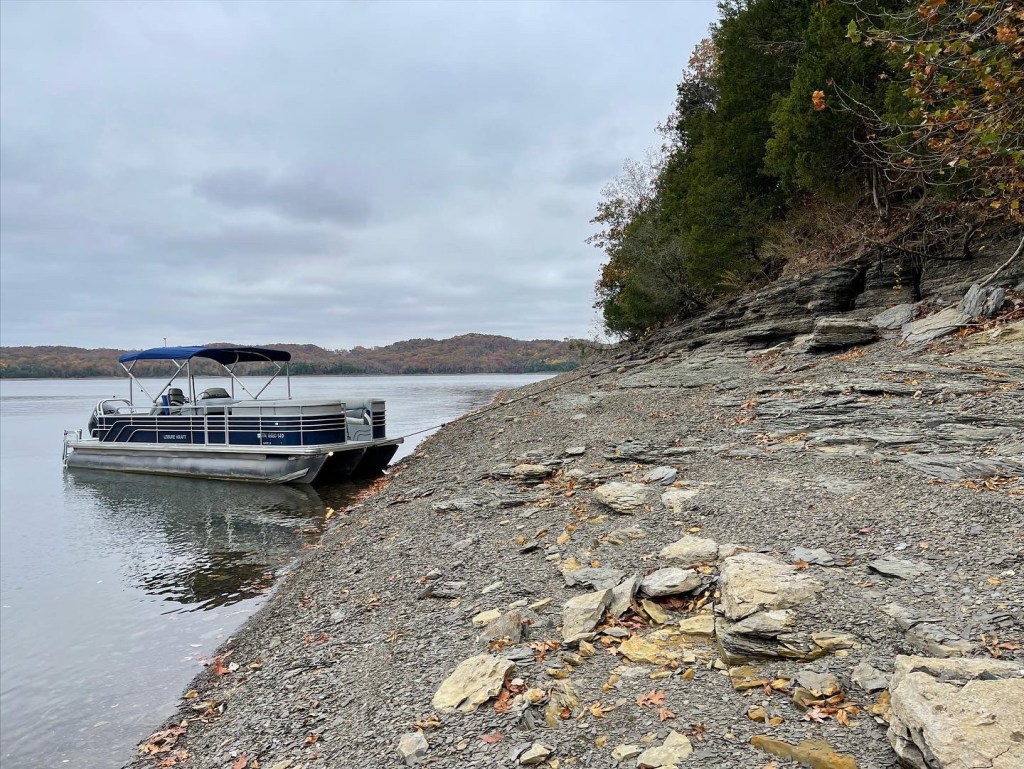
    Turning off the engine, you quickly drift past slate and limestone beaches created when they lower the lake for the winter. The shoreline is composed of countless bits of broken slate, brittle and pliable underfoot. This doesn’t seem a great place for walking barefoot, but as with anywhere, when you dress for the environment it makes all the difference. Walking on those broken sleet beaches was fascinating and wonderful.

    And I do wonder at this place. The region is going through an identity crisis of sorts. On the one hand, you have the people who have always been here: farmers and hunters and people scraping together a living in an area desolately beautiful. On the other hand you have land speculators scooping up property at ridiculously low prices (for a New Englander) and building vacation and retirement communities. Just as the lake swallowed up Willow Creek, there’s an entire community here that is slowly drowning in change, and reacting to it as you might expect. Trump and “Let’s Go Brandon” signs are everywhere, crime is rising as some misfit locals break into vacant houses packed with luxury goods. There’s friction in change, and the changes here are accelerating. Like the lake, some will drown in it, and others will find opportunity to flourish.

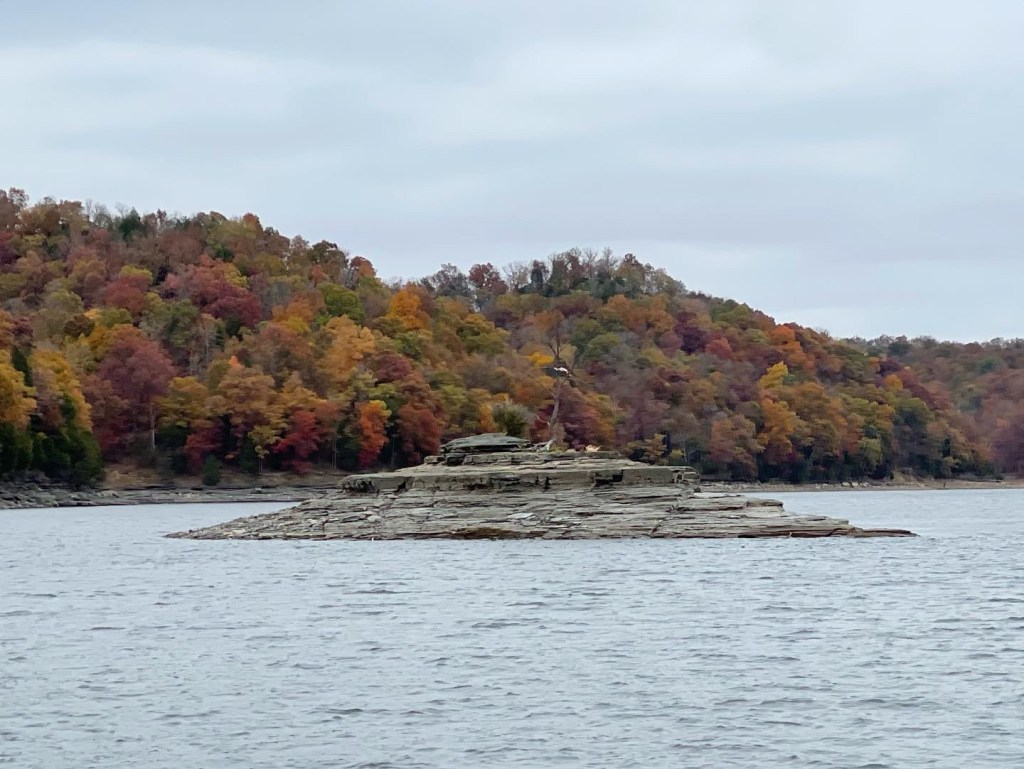
    Hilltop turned island
    Pillars of slate exposed when lake is lowered in winter
    Dale Hollow Lake is split between Kentucky and Tennessee
    When the lake is lowered it exposes a slate and limestone “beach” worth exploring
  • The Enchanted Witness

    I’d contemplated kayaking out into the middle of the bay to capture the sunrise this morning. That plan blew away in the breeze as the chop and chill nixed the very thought of bobbing along waiting out the first glimpse of the new day. Visions of me paddling back to shore with my tail between my legs and my phone resting on the bottom of the bay made me a land creature instead.

    Then a glimpse of the giant October full moon sinking towards the horizon spurred me up and out the door. I cursed myself for not bringing a better camera than an iPhone, and then checked myself and swung over to gratitude for at least having an iPhone to attempt to capture the moment. We forget, sometimes, just how lucky we are to have so much technology at our fingertips. It wasn’t so long ago that sharing an image of the moon setting with the world a few minutes after taking the picture would have been completely out of reach. Modern life is miraculous when we stop to think about it.

    I never forget how lucky I am to be in a place where I can take such pictures at all. To capture the sunrise 38 minutes after witnessing the moon setting over restless water is itself a blessing. I can’t believe people choose to sleep in instead. In the span of 38 minutes the universe revealed so much of itself, and I found myself the enchanted witness.

    Thanks for your company this beautiful morning.

    Moonlight surfing on waves as the moon set over Buzzards Bay
    Moon setting, 9 October 2022 (forgive the blurry iPhone picture)
    Sunrise, 9 October 2022
  • Islands

    There’s something about a coastal island, surrounded by water yet firmly locked to the earth, that is deeply compelling. It offers tangible isolation from the madness of the mainland, yet is close enough to feel its gravitational pull. Some combination of luck and inclination brings me to islands occasionally, where my gut tells me it’s not nearly enough.

    Maine has over 4600 coastal islands, big and small. Some are barren rock knobs, others are quite large, and covered in forest and diverse landscape. Visiting each is nearly impossible, property rights being what they are, but if you visit enough of them you might just realize you aren’t really seeing them at all. The right island soothes a restless soul, and like a soulmate, you’ll know it when you find it. Isn’t it far better to linger with a favorite or two than to endlessly collect names on a list? Islands, as with all such things, ought to be savored.

    Would an island offer enough of the world to satisfy a vagabonding soul? Perhaps. Perhaps not. But I hear their whispers, and wonder if I ought to pay more attention.

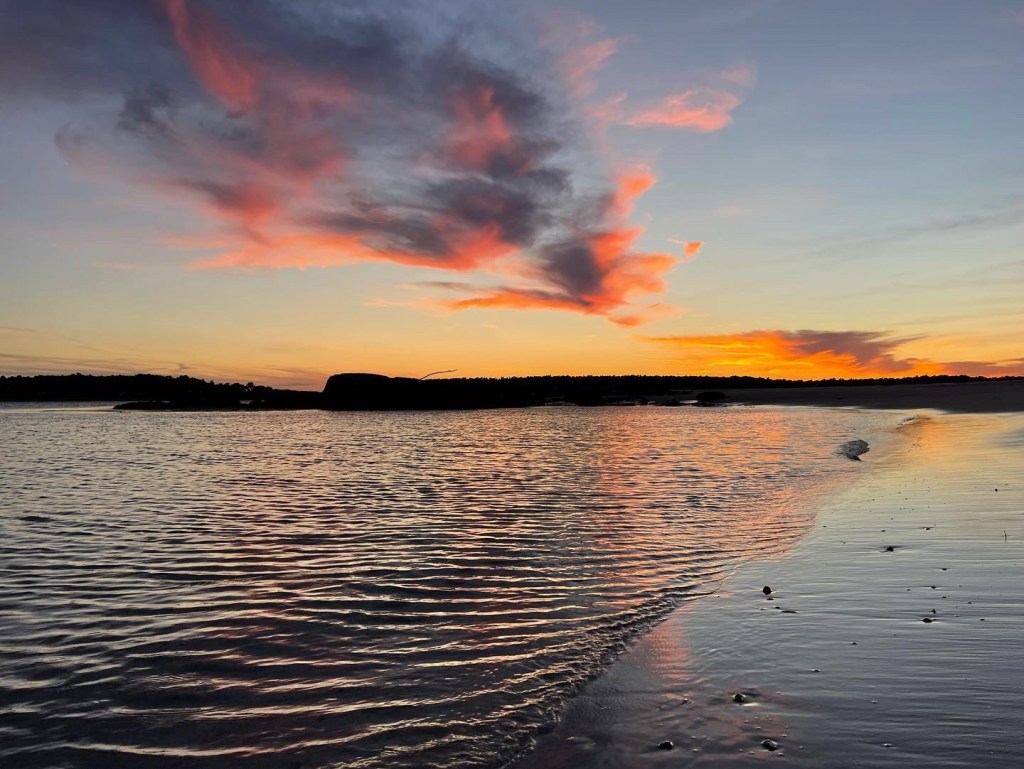
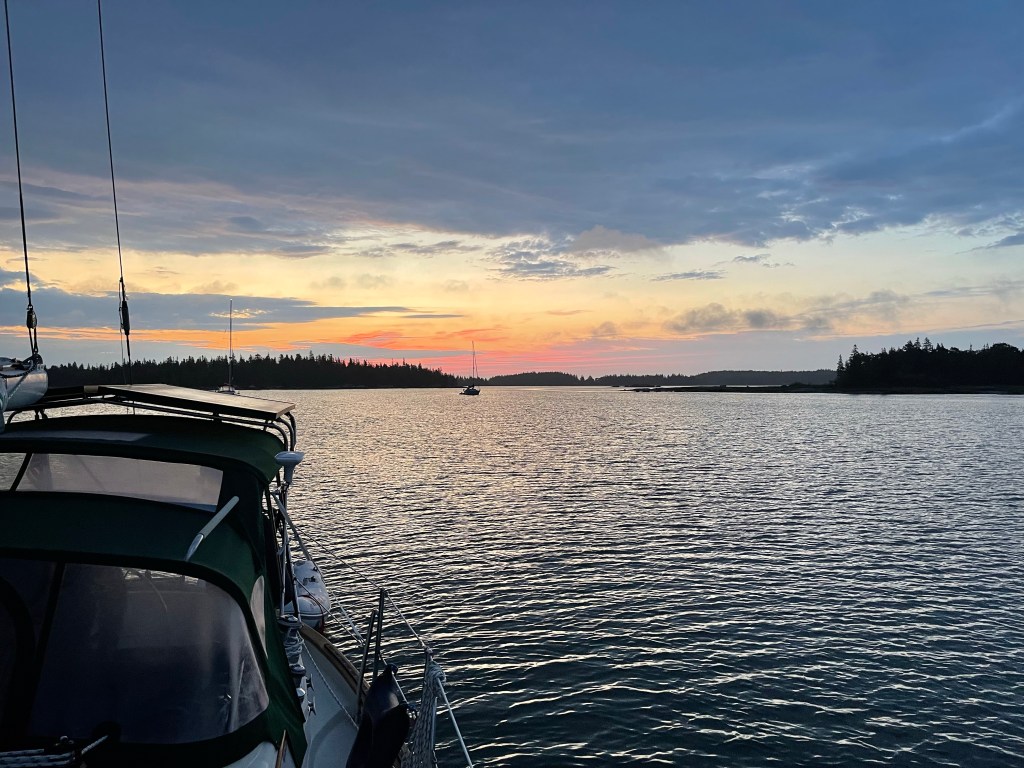
    Sunset on Long Island, Maine
  • A Garden Monk Sips Coffee

    A monk sips morning tea,
    it’s quiet,
    the chrysanthemum’s flowering.

    — Matsuo Bashō

    The mornings are chilly again, and unlike Bashō’s poem, full of the sounds of squirrels gathering food and bickering about who gets what. The water is warmer than the air, for the sun is reluctant to stick around so long nowadays. The seasons are flipping, just as surely as the hickory nuts are falling.

    I think about the fall cleanup and shudder. Is it the chill in the air or the thought of forced labor to come? We dream of autumn for all its beauty, for the crisp air and the scent of fallen leaves. We forget about the work. We pay penance for the pleasure.

    I promised myself I’d drink more tea this summer. I planned to use more of the mint spilling out of its terra cotta pot in an attempt to displace the basil in the neighboring pot. Yet the drink of choice is most often coffee. Does coffee nullify my monk inclinations, or does the ritual matter more? Ask the flowers—for they’ve quietly observed all summer.

    For all the changes, some things remain the same.

  • Stacking the Positives

    “We are the sum total of our experiences. Those experiences – be they positive or negative – make us the person we are, at any given point in our lives. And, like a flowing river, those same experiences, and those yet to come, continue to influence and reshape the person we are, and the person we become. None of us are the same as we were yesterday, nor will be tomorrow.“ — B.J. Neblett

    On a beautifully still morning I watched the fish in the bay react as a seal hunted for its breakfast. Perfect stillness broken by panicked splashes. The seal must eat and the fish must leap to survive. The story evolves around me, yet I have no meaningful role in it but to bear witness.

    There’s no denying the last few years brought plenty of negative experiences, and each shaped us in ways we might eagerly trade for an alternative outcome. But life isn’t gingerly holding our hand for this ride, it grudgingly allows us a seat on this train. The rest is up to us as the hits and highs come at us. What we make of our lives depends on how the sum of our experiences shapes us.

    The stakes aren’t always so dire, but in life we’re either breakfast or having breakfast. Our story will play out one way or the other, and based on how we react, in subsequent choices made in the balance of our days. We must fight for what we believe in yet accept what we can’t control.

  • Sunrise and Mosquitoes

    Seal Bay, Maine. 04:30 and a brightening sky. There’s a strong probability of magic in the air. To get up or to linger awhile in the finally-comfortable position I’d found? The answer is obvious by now—up and at ‘em.

    Moving slowly as not to awaken the crew (who inevitably were awakening anyway), I slid open the hatch with an unwelcome bang that turned my intentions upside down. “Sorry,” I mumbled quietly. There’s just no sneaking around on a sailboat.

    Outside, the sky began to glow, as a light breeze carried wispy clouds of fog across the cove. Sitting a few beats, I heard the familiar song of a mosquito buzzing nearby. Damn. Soon another. We take the good with the bad in this world, and reconcile it as best we can. I celebrated a pristine, quiet cove distracted by a hungry swarm of fast flyers. “Such is the way,” whispered an understated sunrise rising above it all. And so it was.

  • A Swim in the Broth

    “Consider the ordinary barnacle, the rock barnacle. Inside every one of those millions of hard white cones on the rocks—the kind that bruises your heel as you bruise its head—is of course a creature as alive as you or I. Its business in life is this: when a wave washes over it, it sticks out twelve feathery feeding appendages and filters the plankton for food. As it grows, it sheds its skin like a lobster, enlarges its shell, and reproduces itself without end. The larvae “hatch into the sea in milky clouds.” The barnacles encrusting a single half mile of shore can leak into the water a million million larvae. How many is that to a human mouthful? In sea water they grow, molt, change shape wildly, and eventually, after several months, settle on the rocks, turn into adults, and build shells. Inside the shells they have to shed their skins… My point about rock barnacles is those million million larvae “in milky clouds” and those shed flecks of skin. Sea water seems suddenly to be but a broth of barnacle bits.”Annie Dillard, Pilgrim at Tinker Creek

    I confess to briefly recalling this tidbit from Dillard while reacquainting myself with Buzzards Bay, but mostly I considered the front paws of my canine swimming partner enthusiastically paddling in my direction, and equally pressing, the rumble of morning thunder close enough to keep the swim brief. We don’t think about barnacle bits when we swim in salt water any more than we think about the vapor particles we breathe in in a crowded room (at least until the pandemic). These are simply part of the deal. We embrace the universe as it snuggles in close or we curl up in terror under the covers.

    The point is, we’re meant to be out there living in the world. So dip a toe in the broth, or better yet, plunge right in. For we are very much a part of the stew of life and ought to celebrate our brief moment together. But appreciate that outdoor shower afterwards just a little more.

  • Something Different This Way Comes

    Living on a quiet wooded street near a stream for 23 years, you see all kinds of wildlife passing through. The usual animals range from turkey, rabbits, snapping turtles and deer to those a notch up on the food chain, like bobcat, coyote, fox and bear. You get to a point where you feel like you know the place and have seen it all. And then nature surprises you with something different.

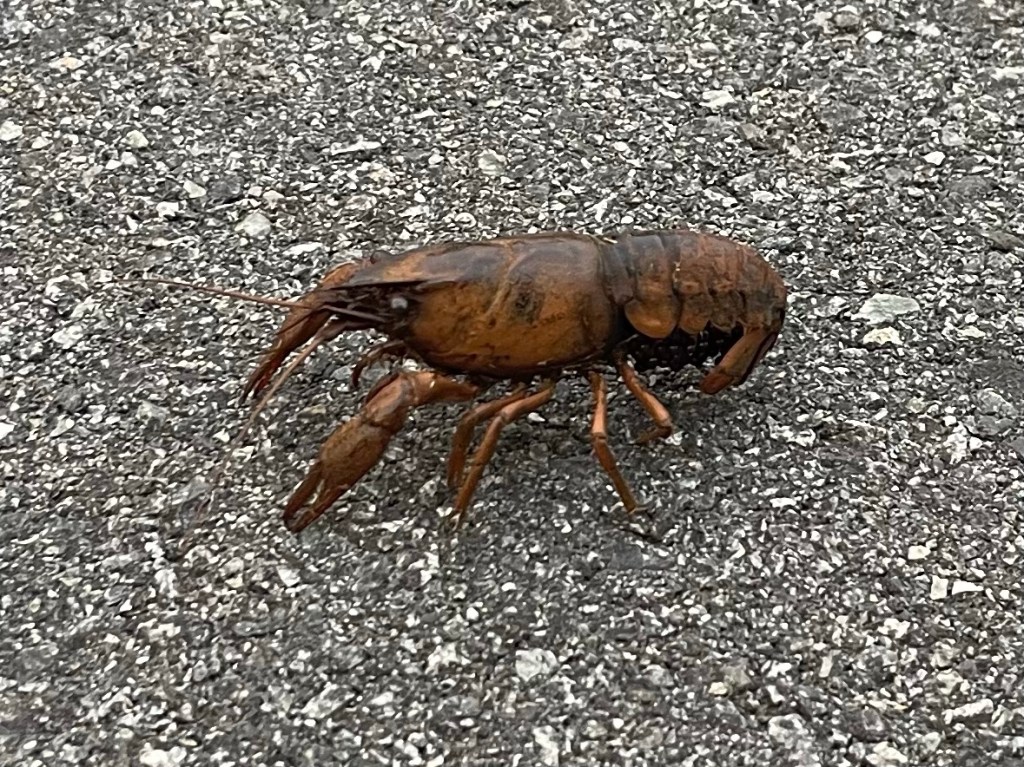
    Taking a walk on the cul-du-sac on a humid night after a day of rain, the sky began a light show of soft orange and yellow moving to deeper orange, pinks and reds. The street had long since dried out and most of the focus was on what was happening in the sky. But then something caught our eye. Some form of critter moving deliberately down the street in our direction. First thought was some kind of bug, but it was almost the length of a chipmunk. On further inspection, it was what I believe to be a rusty crayfish (Orconectes rusticus).

    This thing had black eyes that saw us coming from twenty feet away, and it immediately curled into a defensive position. Debating what to do with it, I decided to remove it from the potential danger (the middle of the street) and move it towards the stream. A bucket and brush did the trick, and this oddity was safely off the street and probably walking through deep grass to the water by the time we finished our walk.

    It was only later when researching this crayfish that I realized it was an invasive species, introduced to waterways as bait or dumped from aquariums. I cursed myself for helping it thrive in an unnatural environment, but you don’t always know what you’re working with until it’s too late. I wasn’t inclined to make jambalaya out of it, and until the moment I found out it was invasive I felt it had earned another day on this planet walking down the middle of a long street between wherever it was to where it was clearly going.

    Humans deliberately and inadvertently help invasive species move into new environments. After years of the expected, this was a first in my particular environment. Maybe shellfish walking down the street is common in your neck of the woods but not so much in Southern New Hampshire. It does make me wonder, what the heck will I see walking down the street next?

    Hey—you’re not from around here?!
  • Become a Holy Fire

    “And I have often noticed that even a few minutes of this self-forgetfulness is tremendously invigorating. I wonder if we do not waste most of our energy just by spending every waking minute saying hello to ourselves. Martin Buber quotes an old Hasid master who said, “When you walk across the fields with your mind pure and holy, then from all the stones, and all growing things, and all animals, the sparks of their soul come out and cling to you, and then they are purified and become a holy fire in you.” — Annie Dillard, Pilgrim at Tinker Creek

    Walking about the garden upon a return from two weeks in Europe, seeing the progress of some plants and the decline of others from neglect, it’s easy to become lost in self-forgetfulness. Minor tasks become meditative when we focus on the work. So it is with hiking in solitude, where every step matters and the mind is forced to quiet itself that you may land properly to take the next one.

    If the aim is to become more open to the spirit of the world around us, surely we must quiet the chatter in our own heads. Be still, learn to listen, observe and receive the energy that might otherwise bounce off our closed mind to find a more willing recipient. What do we lose in our closed-minded self-conversation but our chance to be one with the universe?

    The thing is, most of our self-talk is useless at best and detrimental to our progress at worst. Our Lizard Brain, as Seth Godin calls it, is our worst enemy, making us feel like we aren’t measuring up, that we should have done things differently, that we don’t deserve the moment we’re in now. It’s all crap, and not what we’d expect in a close friend. But who is closer to us than ourselves?

    This Hasidic concept of receptiveness is one way to push aside the self. If we are to become a holy fire today—and in our stack of days, we must tune our receiver and accept the positive fuel that stokes our furnace. We must throw aside the wet blanket of self and accept the world as it offers itself to us.

  • A Visit to the Pristine Königssee

    I’d had this day circled for months, anticipating a spectacular day on the gorgeous Bavarian lake known as Königssee. I’d gotten a peek at the northernmost tip of the lake high atop Eagle’s Nest the day before, and it seemed finally real. And on a warm summer day when seemingly everyone was swimming in the lake and brilliant blue skies contrasted with the mountains, the experience exceeded expectations.

    The logistics of getting there seemed straightforward—it was a short drive from the hotel and the parking lot was plenty big. But that parking lot proved a stumbling block. Most of the pay machines only accept coins, and the change machines weren’t working. There are some credit card readers which also weren’t functional. Signage said to go to the information center for change, but it didn’t open until 09:00. That left several people scrambling for change. Fortunately an acquaintance happened to park nearby and had the app on his phone to pay. Hurdle cleared.

    Königssee, at almost five miles long, and its beautiful little lake sister Obersee, sit within Berchtesgaden National Park. Like Zion National Park in the United States, the towering rock faces seemed a cathedral surrounding you in a hug. You feel inclined to return that affection. There are plenty of options to feel the spirit of the place walking the paths, hiking, sitting in the biergarten or on Königssee itself. Of course, you may feel inclined to do all of those things.

    The famous electric boats leave from Schönau am Königssee, with stops in St. Bartholomä and Salet. To make the most of your visit to Königssee you really should go to Salet. The longer trip brings you past the beautiful Schrainbach Wasserfall as it plunges into the lake. Salet itself offers dining services, but also access to Lake Obersee and the spectacular Röthbachfall as it plunges over 400 meters down a sheer rock cliff. As a bonus there’s another waterfall to the left that likely feels resentful at its bigger sibling getting all the attention. The hike itself is easy and offers some incredible vistas along the way.

    As an American with the tiniest grasp of the German language I was left in the dark when our boat guide rapidly rattled off historical facts and one-liners that had the passengers in stitches, but managed to pick up just enough to follow along. What transcends language barriers is music, and the highlight of the boat ride was our guide playing his trumpet accompanied by its echo on the mountain walls surrounding us. It was magical. So too is Königssee.