Category: Personal Growth

  • Sustained Attention

    I was listening to a Tim Ferriss podcast interview of Ken Burns during a long drive to New York This morning, and pulled out some gems. I strongly recommend this interview if you’re a creative type, history buff or, well, human. Two quotes in particular jumped out at me:

    “All real meaning accrue[s] in duration… that the work we’re proudest of… that the relationships you care the most about have benefited from sustained attention.” – Ken Burns

    Great work takes sustained effort. Being in it for the long haul matters. Creating meaningful long form content in a sound bite world matters. So do the work that matters the most and grow your audience both organically and incrementally. Nothing meaningful is created easily.

    Wake the dead.” – Ken Burns (quoting words his father-in-law said to him)

    This phrase jolted me, as I think I’m doing that on s much (much) smaller scale than Burns. Stories bring the dead back to life, and gives the writer a bit of immortality too (paraphrasing Burns again there). In highlighting the lives of others we’re also highlighting something of ourselves.

  • Time Travel on the Rail Trail

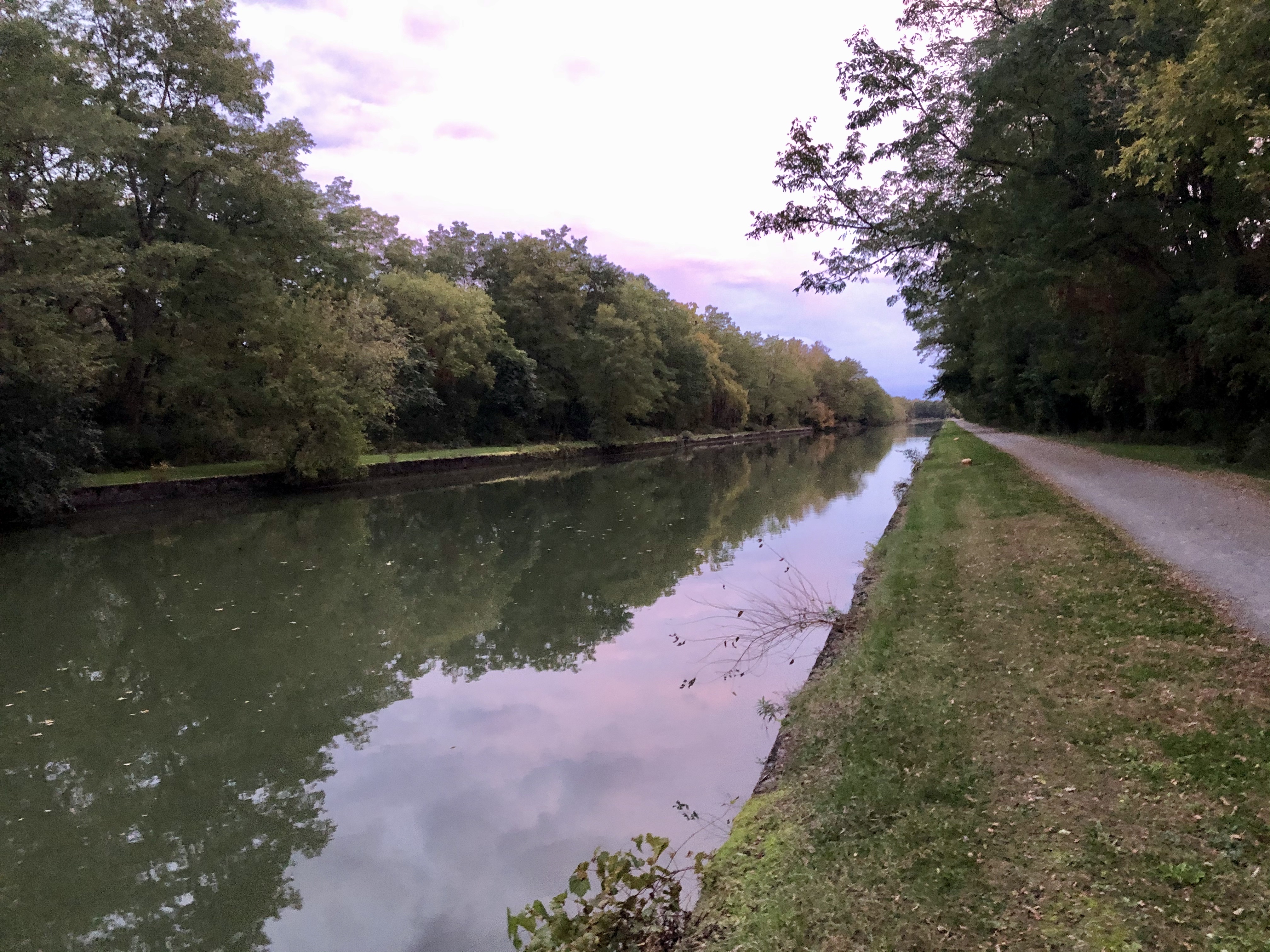
    I took a walk on a local rail trail during a lunch break.  The trail brought solitude occasionally interrupted by fellow walkers, joggers and cyclists. But not really solitude.  There were glimpses of frogs warily looking back at me, chirps of chipmunks announcing “here’s another one.” as I walked by, and a distant hum of traffic in the distance.  But I was alone with my thoughts.  After cutting way back on listening to podcasts and music on most walks and rows, I’ve realized a net benefit in improved creativity.  Everyone has their thing, mine is quiet.

    An acorn stood in the middle of the path, shed of its cap and firmly on its fat end seeking perhaps a bare foot.  But likely hoping for a kick to the grass where it might take root. Asphalt is no place for an acorn with aspirations.  The remains of hundreds of its kin lay massacred on the trail, victims of bicycle tires and shoes alike.  Looking back, I regret not kicking that acorn into the grass.  It might have stood a fighting chance.

    I paused at a wall, built of granite by hand. Dimpled from the stone cutter, lichen and moss-covered from a long watch under a canopy of oak and maple trees.  The wall has stood here for at least 170 years, and aside from a crack or two looks like it could stand for three times that.  If a generation is 30 years, the man that built this wall could well have been my great-great-great-great-great-great grandfather.  I wonder if he thought of that when placing these stones?  Turning back the way I came, I thought the wall could easily stand for another ten generations if left to itself.  Perhaps they’ll stand where I stood today, thinking as I do of those who came before and those who belong to the future.  My moment with the wall was just a glimpse of a time machine passing from then to there, with a brief visit with me along the way.

    That acorn is a time machine as well, waiting to find the right landing place to take root and grow.  It too could outlive all of us.  And a part of me hopes that it does.

  • Viewing Hedonism Through a Stoic Lens

    I was making coffee with the AeroPress this morning. I’ve quickly grown to love this coffee press for its ease of use, quick cleanup and the great cup of coffee it produces. It got me thinking about this concept of hedonic adaptation I’d been reading about, where we quickly become accustomed to new things that once excited us. Every iPhone owner has experienced this the day a new iPhone was introduced. The trick is to not to allow stuff to dictate your mood. Easier said than done, but there’s value in trying. Will I eventually take the AeroPress for granted? Probably, but Stoicism offers a path.

    “Regularly reminding yourself that you might lose any of the things you currently enjoy–indeed, that you will definitely lose them all, in the end, when death catches up with you–would reverse the adaptation effect.” – Oliver Burkeman, The Antidote: Happiness for People Who Can’t Stand Positive Thinking

    There you go: Memento mori. Stoicism taps me on the shoulder once again telling me not to worry about all that stuff, you’ll lose it all in the end anyway. Your happiness can’t be dependent on the newest shiny toy you buy. None of that stuff matters. Does that mean I can’t enjoy that AeroPress? Not at all, just don’t depend on an object for happiness. That’s a fools game, and expensive to boot.

    According to Wikipedia, “The hedonic treadmill, also known as hedonic adaptation, is the observed tendency of humans to quickly return to a relatively stable level of happiness despite major positive or negative events or life changes. According to this theory, as a person makes more money, expectations and desires rise in tandem, which results in no permanent gain in happiness.”

    I’m watching Sunday football as I finish writing this, tolerating the endless stream of commercials promising me happiness if I buy this car or that, order pizza from that delivery place, or buy that latest iPhone with the cool-ass camera(s). All designed to trigger desire for what you don’t currently have. And all nonsense when you view it through a stoic lens.

  • It’s Just a Bird

    Perfectionism is a mean, frozen form of idealism, while messes are the artist’s true friend. What people somehow (inadvertently, I’m sure) forgot to mention when we were children was that we need to make messes in order to find out who we are and why we are here – and, by extension, what we are supposed to be writing.” – Anne Lamott, Bird by Bird

    Yesterday afternoon I re-read my blog post from the morning and noticed an ugly spelling error. Things like that used to horrify me, now I just laughed at my mistake and clicked on the edit button to make it go away forever. If every blog post had to be perfect I’d never get anything done. Which is why Lamott’s quote above resonates with me. I’d read Bird by Bird years ago and it didn’t stick. I didn’t write then, I just thought about writing.

    Lamott’s title is derived from a story about her brother and father, who basically told his son to just chip away at a project one part (birds, of course) at a time instead of being overwhelmed by the whole. It reminds me of something my daughter and I say to each other… “It’s just a bird”, or “no big deal”… at any rate the bird analogy stands. Take things one step at a time, chip away at things and don’t worry about making it perfect on the first draft (there’s no such thing anyway). Just do it as Nike would tell you.

    That chipping away at it concept applies to any project. Just stop thinking about applying it and do it already. Isn’t that the root of every motivational mantra ever written? And every kick-starter campaign? And every sales meeting? But knowing the trick and doing the trick aren’t the same thing, are they? Planning to do something feels like you’re doing something. But we know better.

    I’m reading six books at once right now, and for the life of me I don’t know why I picked up Bird by Bird to read again. But a little bird was calling me and here we are. And in reading it again it resonates as it hadn’t before.

    When the student is ready the teacher will appear

    There’s more to do. My day job calls and I know there’s more to say. There’s always more to say. Every great book I’ve ever read left me satisfied but wanting more. This clunky little blog is bouncing between history, gardening, birds, travel, music and a hundred other passing fancies. But the heart of it is the journey towards better writing. The ritual, practiced daily. Bird by bird.

  • Dancing after the Dragons

    “How could we be capable of forgetting the old myths that stand at the threshold of all mankind, myths of dragons transforming themselves at the last moment into princesses?  Perhaps all dragons in our lives are really princesses just waiting to see us just once being beautiful and courageous.  Perhaps everything fearful is basically helplessness that seeks our help.” – Rainer Maria Rilke, Letters to a Young Poet

    The Ninth Wave is a painting by Ivan Aivazovsky on display at the Hermitage in St. Petersburg, Russia.  I stood in front of it 30 years ago and it stays with me still.  There are two paintings from that visit that keep coming back to mind, the other being Henri Matisse’s The Dance.  Both are stunning when you stand in front of them and immerse yourself in them.  Google both and look at the images that come up, and you’ll see a wide range of colors, from vibrant primary to muted mixed colors.  There’s nothing like seeing each in person, where it literally washes right over you and you swim and dance with the subjects in the paintings.

    I’ve got a bucket list of art and architecture that I hope to see in my lifetime.  I only have to reconcile the images I see in a book or online to know that there’s nothing like seeing the real thing.  Travel gives you that gift.  And more than seeing The Ninth Wave or The Dance in my mind, I see the entire picture of that time.  Babushkas sternly looking at college kids to make sure we weren’t taking flash photography or crossing past the ropes.  Black market traders trying to swap blue jeans for assorted USSR military stuff.  Seeing Cuban soldiers for the first time when we visited the Aurora (As a Cold War kid being in the Soviet Union and seeing Cuban soldiers was heady stuff).  Such is the richness of world travel; Seeing the world as it is and not some portrayal on a screen.

    I may never get back to St. Petersburg, but I would surely go to the Hermitage again and re-visit these two masterpieces.  I’ve changed quite a lot in 30 years, and so has St. Petersburg and Russia.  When I visited I was a college kid visiting a city with a different name in a country with a different name at the height of Glasnost, which would inevitably wipe Leningrad and the USSR names off the maps in favor of what once was and is again.  The enormity of the changes we’ve seen in the last 30 years cannot be understated.  And we’re in the middle of massive change still.  What will the next 30 years bring?  I hope I’m around to report on it.

    The image of that dragon in Rilke’s quote above brought to my mind The Ninth Wave.  This is the moment when the subjects in the painting are either driven to their deaths under the sea or they find salvation. Aivazovsky leaves it for us to interpret how it ends.  The optimist in me sees the brightening sky shining light through the wave.    Have the courage to hold on just a bit longer and things will get better.  Rise to the challenges of the moment and turn that dragon into a princess.  30 years ago it was Glasnost and Tiananmen Square.  Today it’s Climate Change, the rise of political extremism and the Hong Kong protests.  Is this the Ninth Wave?

    The optimist in me sees a positive future, and eventually the scarcity mentality that leads to extremism and greed giving way to a better world.  The report that showed the dramatic decrease in child mortality is a good example of how the world is getting better.  I’m well aware of the dragons in this world, and a little light shining through the storm clouds doesn’t mean the wave isn’t going to crash down on you.  But I see the joyful dancers of Mattise waiting for us if we can only have the courage to find the princess and join in.  What will we do to get us there?

  • Go Above Your Nerve

    If your Nerve, deny you—

    Go above your Nerve”

    – Emily Dickinson

    How the hell did I go all these years without reading that Dickinson poem? Too much time not reading poetry, I’d say. And not casting the net farther. That’s on me, but I’m catching up. Learning is a lifetime sport, and I woke up this morning still very much alive.

    I first felt the whispers of Dickinson when I coached at Amherst College. She lived in Amherst, appropriately there’s a Dickinson museum there, and a thriving community of scholars too. The Amherst air is full of her whispers. But I wasn’t ready to hear them, and left after a year following other voices.

    Perhaps if I’d read this poem before I left I may have listened more. I heard other voices then. The call of other places made it hard to hear. A shame it took so long really, but I’m catching up now. Emily was patiently waiting, and she whispers to me now:

    “If your Nerve, deny you—

    Go above your Nerve

    He can lean against the Grave,

    if he fail to swerve”

    Do you hear her whisper? Get on with it already. What are you afraid of?

  • I Mourn for the Undiscovered

    Up early, reading some Robert Frost poetry I don’t remember reading before.  I’m mesmerized by a line and read on.  I get like this.

    Millions of songs on iTunes, and I’ve barely scratched the surface of what’s out there despite a lifetime focus on music.  I’ve spent huge chunks of my time exploring new music, Shazam’ing songs in loud bars and quiet coffee café and back in the day hanging out in used record stores in Harvard Square trying to find that one gem, that magical song.  And I’ve found many over the years.  Eclectic collection perhaps, but dammit, interesting.

    A bucket list of places to see, and slowly I chip away at it.  My list grows shorter, not because I don’t want to go to all the other places, but because I want to focus on the specific few.  Linger in special places, like listening to a song over and over until you really know it.  Instead of trying to chase everything in a spin of futility.  No, not that.  Give me Thoreau at Walden or Hemingway in Key West.  Or Frost in Derry.  I’ve visited each of these places and understand the power of immersion it had on them.

    I mourn for the undiscovered songs, poems, books and places.  The conversation you never had with a grandparent.  The sunrise you slept through, the lonely beach you didn’t stroll on in winter, the ridge line you didn’t cross, the Northern Lights that danced unseen, the big city that woke up without you, the swims in bracingly cold water and salt on the tongue that you’ll never taste; the places you’ll never be.

    We can’t be everywhere of course.  But I’ll do my best to be present in this moment at least.  Tomorrow will come and I hope to see it.  But don’t mourn for losing today if I should get there.

  • Move to Live

    “To be human is to be on the move, pursuing something, after something. We are like existential sharks: we have to move to live.” James K. A. Smith

    Early start today, and my routine was subsequently turned upside down. Writing and exercise were postponed for commuting and work tasks. And so be it, here I am writing, and the exercise will happen this evening instead. We all need a little agility to effectively navigate life’s twists and turns.  If I look back on this summer, I’ll say I regret not swimming more, not hiking more, not taking more late night star gazing walks….  but also not meeting with more customers, not writing more, not reading more.  I do something, but I could do more.

    It all counts. Do more. Keep moving forward or we atrophy and die. Existential sharks… moving to live.  Write the book, start the business, ask for the date, take on the project, take the chance today on something bolder than you might have done yesterday.  Fortune favors the bold, after all.

    “Make mistakes of ambition and not mistakes of sloth.” – Machiavelli

    James Clear highlighted this Machiavelli quote in his weekly newsletter and it hit me like jumping into a cold lake early in the morning (something I’ve been known to do):  Boom!  You’ve got my attention!  I’ve made many mistakes of sloth over the years – we all have, but use Machiavelli’s advice and choose your mistakes wisely.

    “Some say risk nothing, try only for the sure thing,
    Others say nothing gambled nothing gained,
    Go all out for your dream.
    Life can be lived either way, but for me,
    I’d rather try and fail, than never try at all, you see.

    Some say “Don’t ever fall in love,
    Play the game of life wide open,
    Burn your candle at both ends.”
    But I say “No! It’s better to have loved and lost,
    Than never to have loved at all, my friend.”

    When many moons have gone by,
    And you are alone with your dreams of yesteryear,
    All your memories will bring you cheer.
    You’ll be satisfied, succeed or fail, win or lose,
    Knowing the right path you did choose.”

    – William F. O’Brien, “Better To Try And Fail Than Never To Try At All”

    Well, there it is; Go all out for your dream.  ’tis better to try and fail than never try at all.  Make the mistake of action instead of the mistake of sloth. Keep moving forward. Be an existential shark already.

  • Opting In

    A man is worked upon by what he works on.” – Frederick Douglass

    I’m not a photographer by profession, but I fill Instagram with pictures.

    I’m not an author by profession, but this will be my 416th blog post.

    I’m not a horticulturist. but I’ve spent hundreds of hours painting vibrant portraits with amended soil and pruning shears.

    And so on…

    We aren’t what we want to be, we’re what we do. Theodore Roosevelt’s Man in the Arena comes to mind. There are too many cavalier critics in the world. Too many armchair quarterbacks. Get out there and do something already! Opt in and act. Memento mori; remember we all must die, so do something meaningful while you’re here!

    “People get the mind and quality of brain that they deserve through their actions in life… people who are passive create a mental landscape that is rather barren. Because of their limited experiences and action, all kinds of connections in the brain die off from lack of use. Pushing against the passive trend of these times, you must work to see how far you can extend control of your circumstances and create the kind of mind you desire.” – Robert Greene, Mastery

    The more you do, the more you become. And the more interesting you become. Being interesting is a byproduct of being interested. Being interesting to others of course isn’t the objective, but being interesting with others should be. Engagement offers enlightenment. The curious mind is alive, vibrant and accretive, the disinterested mind is on life support, dull and diminishing.

    Hobbies like gardening and photography aren’t going to get me invited to do a TED talk mind you, but they do make the world a little better, move some electrons around in the brain, and hopefully give me something more to contribute than someone less interested in opting in. If you’re still talking about your conquests in college when you’re over 50 or freeze up when the conversation goes beyond last week’s game you aren’t really growing, are you? Writing for me is no longer a hobby, but not [yet] a profession. Blogging, fueled by travel, reading and curiosity, is my apprenticeship; Teaching consistency, discipline and the art of putting words together from the mind to the screen. I’ll never use this blog to make money, but hope to enrich myself in other ways in the process of daily, consistent writing. I owe that to myself.

  • The Deathbed Question

    “You are 99 years old, you are on your deathbed, and you have a chance to come back right now: what would you do?” – Christopher Carmichael

    No relation to me that I’m aware of, but I love the question. This question is referenced by Jérôme Jarre, a young man with an old soul, in a written interview he’d done in Tribe of Mentors, itself a wealth of information and inspiration.

    The answer should never be “not this” of course, but importantly, what IS that answer? The time travel spin is a variation on the dying wish story: I wish I’d spent more time with my children instead of working, or similar wishes. But it’s easy to separate ourselves from the responsibility of that deathbed moment. There’s still time… Carmichael’s what would you do? question brings the future to NOW. And really, that’s all we have isn’t it?

    So, …what’s the answer to the question? Right now?