Category: Productivity

  • To Go Beyond

    “Firstly you need to aim beyond what you are capable of. You must develop a complete disregard for where your abilities end. Try to do things you’re incapable of.” — Paul Arden

    “The human spirit lives on creativity and dies in conformity and routine.” ― Vilayat Inayat Khan

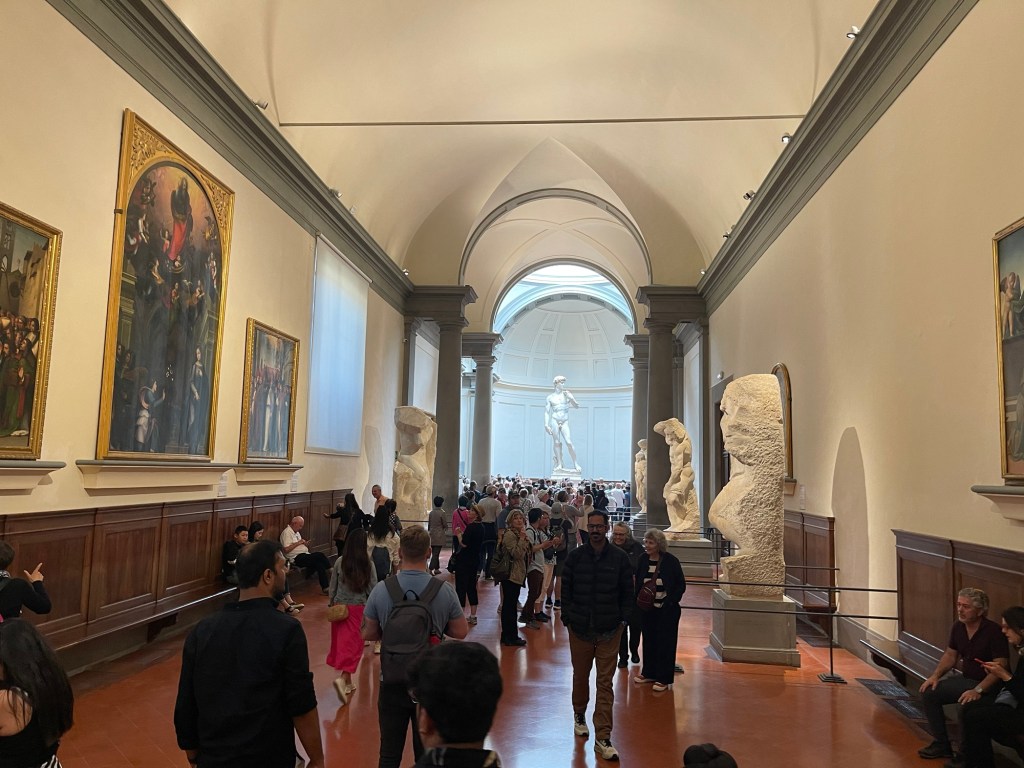
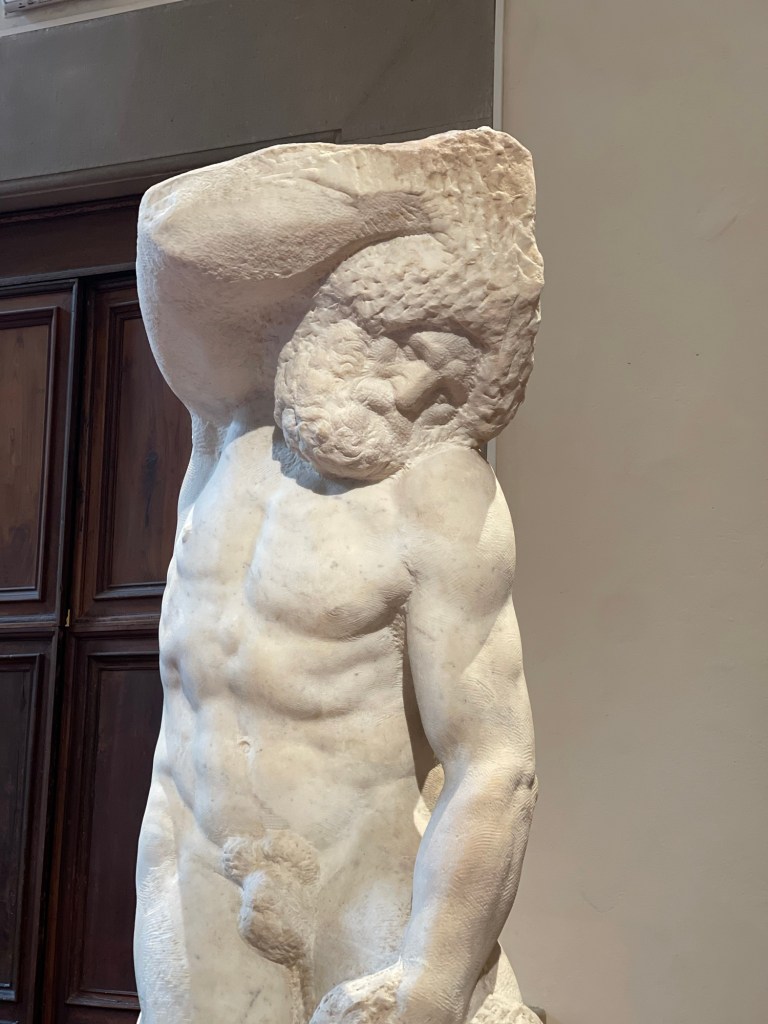
    When you walk up to Michelangelo’s David at the Accademia Gallery in Florence, some of his other sculptures in an unfinished state line the aisle on either side of you. Spending some time with each instead of just rushing past to see David is the best way to see how he released the masterpiece from the marble, as he described it. You can almost see them fighting to break free from the block, just awaiting the help of Michelangelo’s chisel. And so it is when you arrive at David, you understand where he came from—released perfection from a famously imperfect block of marble.

    The interesting thing about that block of marble was that two other artists had begun work on it, gave up on it and it sat partially chiseled and ignored by other artists who couldn’t see the masterpiece within. It wasn’t until Michelangelo saw David within that it became his project. And we are left with the brilliant result, forgetting sometimes the imperfect marble it started as.

    Lately I’ve been wrestling with the imperfect block myself, deciding whether there’s a masterpiece in there or not. To commit and begin chiseling away at something beyond what we are capable of in the moment is the only way to release something exceptional from the average. But why wait? There are no perfect blocks, only something trying to break free from what we have now. So begin with whatever it is we’ve been given and find what calls from within. In those unfinished sculptures is the pain of a masterpiece that never broke free for want of more time.

    The journey to David takes you past unfinished would-be masterpieces
    Michelangelo’s unfinished self-portrait forever trying to break free from the block
  • Breaking Up with Temporality

    “You give yourself to life by leaving temporality behind. Desire for mortal gains and fear of loss hold you back from giving yourself to life.” — Joseph Campbell

    Admittedly, I’ve had a complicated relationship with time. I spent too much of it rushing from one commitment to another, always striving to be early so as not to waste someone else’s time should the universe align itself to create delays. I write this very blog post in a coffee shop having arrived early for a meeting just down the street. Temporality is deeply engrained within me. It’s a hard relationship to break with.

    That doesn’t make it a healthy or enabling relationship. In fact, much of the stress I’ve felt in my lifetime is related to my relationship with time. Productivity calculations in a quarter, splits on a screen as I try to beat some preconceived expectation of how quickly I can complete some workout, or the pressure I put on myself to read or write a certain amount in the time I have available for such things. Time isn’t a great measure of our worth, unless you’re an Olympic athlete or attempting to solve a Rubik’s Cube or some such thing. Tempus fugit, indeed.

    So I’ve promised myself I’d break up with temporality, once and for all. Maybe not today, mind you (for I do have these commitments lined up), surely not tomorrow (I have a flight to catch, after all), but very—very— soon. How soon? Well, maybe time wIll tell? But know this: I’m serious this, uh, time.

  • Conducive to Brilliance

    “Don’t rush your most important work. Allow it instead to unfold along a sustainable timeline, with variations in intensity, in settings conducive to brilliance.” — Cal Newport, Slow Productivity: The Lost Art of Accomplishment Without Burnout

    There’s something brilliant hiding in there somewhere. We believe it because we feel it, even if it takes its sweet time meeting us halfway. Or more likely, brilliant is waiting for us to meet it halfway. The truth is, all things have their time and when the work is done we’ll all be delighted for having completed it. Yet we live in a world, and with a mind, that demands results today.

    Newport’s book isn’t revelatory, but it is an important reminder that our most important work takes time—and a little time off—to reach a higher pinnacle. Sure, we want results now, but we’re talking about the work of our lifetime, not some simple project we could push out in a week. The trick is to know the difference, and settle into the journey that takes us there.

    We reach a place in our lives where accomplishment isn’t the primary goal anymore, but contribution is. We want to do work that matters, not just check boxes on a meaningless career path. In moments of clarity, we might see the forest for the trees, but the grind of important work means there’s a whole lot of trees to navigate. It’s natural to wonder: does it matter in the end? Sometimes it’s only a means to an end. Which leads to other questions. And so it is that life is one riddle after another in this way.

    The answer is to set up a routine that is conducive to brilliance. This blog may be all over the place at times, but it’s about the process of writing and publishing something every day that matters most. There are days I curse myself for having begun the journey, but I’ll get that one random like on a post from six months ago or a text message of support from someone that inspires me to keep going. We can always quit tomorrow, right? Just not today.

    The question is whether we’ll run out of runway before that brilliant work can take off. Plenty of great ideas crash and burn in this way. Still, we can’t worry about the length of the runway, only that we’re gaining momentum and lift. So we set a sustainable timeline (runway) and work daily towards achieving liftoff. That we might one day soar.

  • The Question of Questions

    Over the weekend I had the opportunity to visit both the Getty Center with its impressive collection and the Getty Villa, with its focus on the ancient arts. I could write a year’s worth of blog posts about the combined collected works we viewed there. Alas, we know how these things go. I’ve got hundreds of pictures and notes from similar encounters that have yet to be realized in creative output by this humble blogger. Every day something new may grab hold of us and demand our focus, leaving old ideas and stories to drift away, to be grabbed by someone else someday.

    We dance with the muse when we are blessed with its attention, whatever the topic may be. At the Getty Villa I came face-to-face with the muse, in the form of a Roman fresco from between 1 and 79 A.D. It’s been whispering to me ever since we met. I’m sharing a picture of the fresco here, that you may decide for yourself whether its power transcends plaster and pigment through bits and bytes.

    The thing is, I know only that I still have work to do beyond the blog. If we don’t listen to the muse it finds someone else. We must be deserving of its attention. My encounter with the muse was a reminder that there’s still work to be done. To answer the question of questions: Tempus fugit (time flies). So what have you done with it?

    Fresco with a Muse, displayed at the Getty Villa Museum
  • Practiced Reasoning

    “While we naturally understand that writing is a good way to share ideas with others, we under-appreciate just how much good writing helps us think about an idea ourselves. Writing is not only a means of communication, it enables us to practice reasoning.
    Writing forces you to slow down, focus, and think deeply. In a world where attention is fragmented into seconds, thinking becomes more reactive than reasoned. Only when [we] take time to play with our ideas can we hope to think about them substantially. Writing requires sticking with something a little longer and developing a deeper understanding.
    Writing is the process by which we realize we do not understand and the process by which we come to understand.”
    — Shane Parrish, Unspoken Expectations, Brain Food – No. 569 – March 24, 2024

    Until I read Shane Parrish’s latest newsletter, I still had it in my mind—even after a couple of thousand blog posts—that I was writing for others. I had it partially correct. I’ve been writing for myself, to better understand that which I encounter on this dash through the decades, and then to share that processing with you; the reader. I’ve talked of breadcrumbs and the processing of ideas before myself, so the idea isn’t exactly revolutionary, but he hammered it home well enough that I thought I’d practice a bit more reasoning writing about it here.

    The thing about documenting your own reasoning in a blog is that when you publish, you’ve let the world in on a bit of a secret. Deep down, you know more about who I am and how I process information about the world and my experience in it. Sure, I filter out enough that people aren’t guessing my passwords (those simple passwords are long gone anyway) or otherwise hacking my identity, but the bottom line remains clear: unless you’re writing a blog yourself, you know far more about how I think than I know about how you think. Advantage reader?

    Perhaps. But we aren’t adversaries in this game of life, are we? My reasoning, should you choose to follow along, is simply my half of a conversation. And as a writer we ought to view it as such. Otherwise what is it but a dull college lecture or a dad speaking to a table full of people staring at their phones? There are some blog posts that fail to resonate with the world, and it feels a lot like that latter example in such moments of posting into the vacuum of the Internet, but that is exactly the moment to remind myself that this blog post is one human’s humble attempt to reason with the universe and to see what comes from it.

    In a way, writing this blog is similar to playing chess with the computer. The computer always wins, often in frustratingly devious ways (like a cat and the mouse with me always the mouse), but each game is a lesson in strategic thinking for me, even in the loss. When the game is over, was it a waste of time or an incremental step forward towards becoming a better chess player (ie: strategic thinker)? So it is with this blog post and all those that preceded it. Each is an incremental step towards better reasoning, and better writing. And perhaps that’s enough to make me a better human too.

  • The Start is the Thing

    “A year from now you may wish you had started today.” — Karen Lamb

    This quote has been with me for many years now. It’s spurred me to begin habits that turned into streaks and are now part of my identity. But it’s not a magic spell casting itself over all that I wish to do. In fact, it has no power at all over wishes, for wishes live outside of us. We humans may only take steps and the occasional leap forward.

    The start is the thing. From the start we may keep going and start again tomorrow and the next day. Every great system, every great cause, every great partnership—everything great—begins with the start. From it we may then build momentum.

    So what are we waiting for? Wishes? Wishes are low agency. When we wish we want someone else to fill in the steps for us. Steps are high agency. For steps are ours to take. Put one foot in front of the other and soon you’ll be walking across the floor kind of agency.

    The thing is, we can start so many things in a lifetime. We aren’t one trick ponies. Think about all the great things we once started and just kept doing. Maybe some not-so-great things too. Those things we ought to get rid of, starting today.

    Is there a better day than now to start? Always. That’s why we haven’t started already, isn’t it? But a step isn’t a leap, it’s just a step. Start small and make tomorrow’s step a bit bigger, and so on. It doesn’t really matter so much how big the step is, but we’ll look back on it one day as a leap.

  • To Rest

    “The template of natural exchange is the breath, the autonomic giving and receiving that forms the basis and the measure of life itself. We are rested when we are a living exchange between what lies inside and what lies outside, when we are an intriguing conversation between the potential that lies in our imagination and the possibilities for making that internal image real in the world; we are rested when we let things alone and let ourselves alone, to do what we do best, breathe as the body intended us to breathe, to walk as we were meant to walk, to live with the rhythm of a house and a home, giving and taking through cooking and cleaning. When we give and take in an easy foundational way we are closest to the authentic self, and closest to that self when we are most rested. To rest is not self-indulgent, to rest is to prepare to give the best of ourselves, and to perhaps, most importantly, arrive at a place where we are able to understand what we have already been given.” — David Whyte, Rest

    Some weeks are busier than others. Some are more restful than others too. This past week was more the former than the latter. In the natural ebb and flow of life, I enter the weekend focused on rest and recovery. Perhaps I’ll find it, but then again, I’m back to writing before the dawn.

    Many Americans aren’t particularly good at rest. We charge along, even on our days off, trying to make the most of our time. We forget sometimes the exchange, as Whyte so eloquently reveals: to rest is to prepare to give the best of ourselves. Rest is not self-indulgent, yet we so often believe it to be so.

    To view rest as a natural exchange is to acknowledge that the work will come again, but not just yet. There is a time for everything, including rest. The work will surely be there when we return to it. So if you begin to wonder what I’m up to loafing around so much, remember that I’m not being lazy today: I’m preparing.

  • A Workhorse or Show Pony?

    There’s an old expression, more a question of character, that floats around in the workplace. Simply put, when we talk of employees, are they workhorses or show ponies? Some people shun the spotlight, grind away at the work that must be done and move on to the next project when it’s complete. Some people avoid the tough work but appear busy, and look for the spotlight and the opportunity to shine. The inference, naturally, is to be the workhorse.

    I’ve been the workhorse in my professional life and in my pursuits outside of work. Some days I’d rather be with the ponies prancing around in the green grass, doing nothing much at all. Wouldn’t that be nice? Why must we always be the workhorse? Because who really wants to hang around with show ponies all day? What kind of life is that, friend? A life of posturing and surface-level conversations, lackluster commitment to anything substantive, quick abandonment when fashion changes. Show ponies live a life of bullshit and betrayal. In that world, if you aren’t in the spotlight you’re in the shadow.

    We see examples all around us. I watch a couple of YouTube channels for entertainment. I’ve noticed that some shows start off as one or two workhorses doing what they can to keep afloat. Tough projects are shown, not to celebrate the workhorse nature of the horses, but to show how they did it (with the underlying message being; maybe you can too). The best of these channels retain this spirit, but most spiral into the YouTube formula of chasing subscribers and patreons to fund their adventures. Simply put: most turn into show ponies.

    Did you watch the United States’ State of the Union last week? A room full of show ponies posing as workhorses. Want to make progress in a world full of complicated problems? Elect more workhorses. The problem is that most workhorses don’t want the spotlight, and some turn into show ponies when they find they like the spotlight a little too much. The upcoming election will have a workhorse against a show pony. Deep down we know which is which, and our future is literally at stake based on which horse wins the race.

    The question is, what are we? We can be both at different times in our lives. I was a workhorse for part of the weekend doing projects around the yard. When I’m presenting in front of a room full of people I turn into a show pony, making the most of the spotlight while I’m in it. In between we settle into a routine that reveals who we really are. Anyone can be a workhorse or a show pony, it’s all conditioning and reward. So as we begin another day, isn’t it fair to ask ourselves, “just who do we want to be in this world today?” The world answers, “what do you think we need more of right now?”

  • To Live Creatively

    “Many times, in writing I have looked over my own shoulder from beyond the grave, more alive to the reactions of those to come than to those of my contemporaries. A good part of my life has, in a way, been lived in the future. With regard to all that vitally concerns me I am really a dead man, alive only to a very few who, like myself, could not wait for the world to catch up with them. I do not say this out of pride or vanity, but with the humility not untouched with sadness. Sadness is perhaps hardly the right word either, since I neither regret the course I have followed nor desire things to be any different than they are. I know now what the world is like and knowing I accept it, both the good and the evil. To live creatively, I have discovered, means to live more and more unselfishly, to live more and more into the world, identifying oneself with it and thus influencing it at the core, so to speak. Art, like religion, it now seems to me, is only a preparation, an initiation into the way of life. The goal is liberation, freedom, which means assuming greater responsibility. To continue writing beyond the point of self-realization seems futile and arresting. The mastery of any form of expression should lead inevitably to the final expression—mastery of life. In this realm one is absolutely alone, face to face with the very elements of creation. It is an experiment whose outcome nobody can predict.” — Henry Miller, The Colossus of Maroussi

    Another long quote to start this blog, and surely the SEO needs improvement. So be it. I might have doubled the length for all Henry Miller had to say. In fact, stop reading my blog altogether and go pick up the book. We are the people he had in mind when he wrote these words. Can’t you see him looking over his shoulder at us? If Miller was looking to the future with hopefulness that the world would catch up to his way of thinking, well, he may have been sorely disappointed. We all shake our heads at the madness in the world, and the inclination to dumb it all down for the benefit of the power brokers with all the fancy toys. Some things never change.

    To tag along with Miller as he wanders around Greece on the cusp of World War II is fascinating for the historian in me, for we know how the story ends but not always how the world felt about it as things were playing out. Miller found his soul in Greece just before things got truly crazy. What of us?

    Some of us write to reach self-realization and rarely go beyond it to reach for mastery. I talk a good game myself, but my default is to quiet quit on mastery. It takes a level of discipline I’ve learned I don’t want to grind out of myself to be a master craftsman at anything. I can see it in the pursuits I’ve started and let die out. If the price is to exclude everything else to reach mastery, I’ve come to realize that I won’t pay that price. There are precious few who keep going, which is why there are so very few masters of any craft.

    But there’s hope. If the goal of life is Arete and reaching personal excellence, then the journey never truly ends. Perhaps writing for self-realization is part of the journey that eventually we break through to reach for something more. The only certainty is that the creative journey continues, and so long as the blog posts reach you, you’ll know that I’m still pushing through what Steven Pressfield called the Resistance to find out what’s on the other side.

    There’s a reckoning coming. When we keep pushing ahead it’s inevitable that we’ll face more and more resistance. For us to keep going with the work that calls to us is audacious, and some might say self-serving. This too is recognized as resistance. There comes a point in our lives where we tell our quiet-quitting self that the work means more now. We may still end this trivial pursuit and go on to some other distraction. Just not today.

  • Front Loading Productivity and Purpose

    “Putting first things first means organizing and executing around your most important priorities. It is living and being driven by the principles you value most, not by the agendas and forces surrounding you.” — Stephen Covey

    Early risers are normally starting the day a step ahead, while late risers begin a step behind. That doesn’t translate into what each accomplishes in a day, but it does play a part in how we feel. I hate feeling like I’m late for anything. Some people in my life don’t stress about such things unless it’s a flight or other time-dependent circumstance. Who says one is better than the other? But we know which is better for us.

    Productivity isn’t dependent on starting early, but when we prioritize the right things first it helps ensure that those things get done. For years now that’s been writing, reading and my most essential work tasks. Everything else can fall into place, get piled on or slip to tomorrow, but the day will be deemed a success once I’ve checked those right boxes.

    We know what is essential in our day because it nags at us until we’ve done it. Likewise, we know what isn’t all that important too. To borrow a concept from James Clear, we vote for our identity one checked or ignored habit at a time. He would also suggest making good habits easy to complete, and bad habits more difficult. The best way to do that is to front load the most important things and defer the trivial and bad.

    I know a brisk walk or row would greatly compliment my habit stack in the morning, but I often defer this until late in the day where excuses swirl like leaves in autumn. As a result, the fitness routine is inconsistent. Fortunately I know the fix: do it first. Earn breakfast with sweat equity. Those established habits have enough momentum to sustain a minor deferment.

    The question that greets is each morning is, what drives us? Covey was right that our principles push us forward. When we live a principled life we won’t tolerate excuses from ourselves on why we didn’t at least try harder to follow through on our promises. We become less complacent with where and who we currently are and more proactive in getting after our “it”. For there’s no time to waste.