Category: Exploration

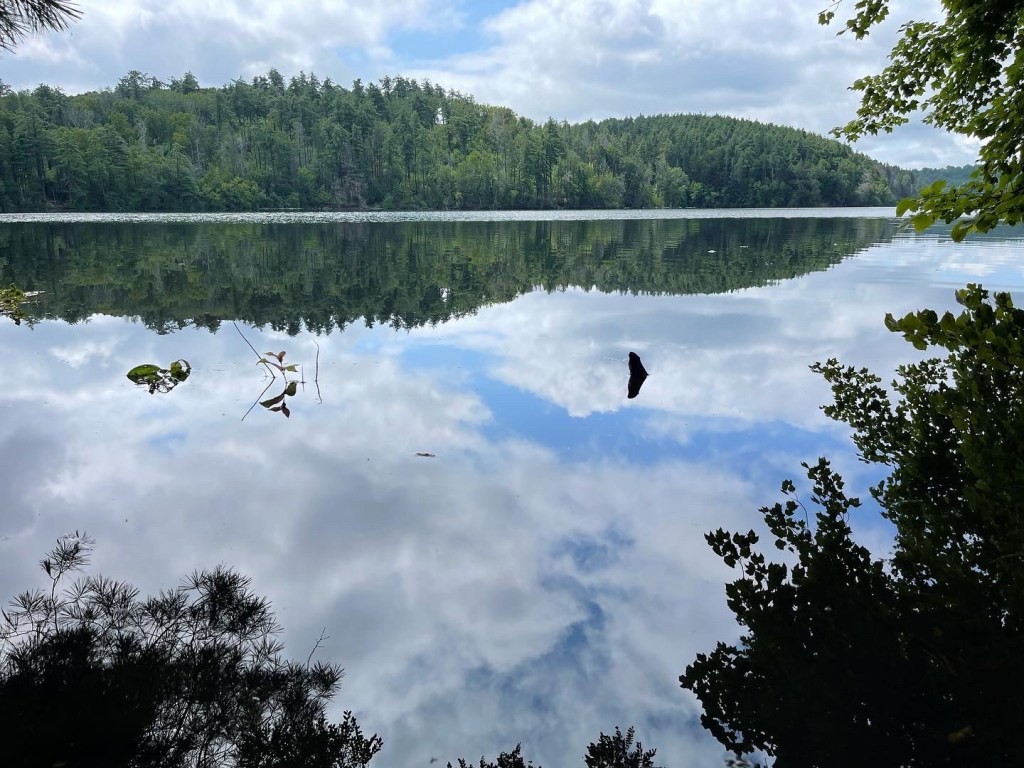
  • A Walk Around the Timeless Kenoza Lake

    Kenoza! O’er no sweeter lake
    Shall morning break, or moon-cloud sail,
    No lighter wave than thine shall take
    The sunset’s golden veil.
    — John Greenleaf Whittier, Kenoza

    Whittier wrote this poem for the dedication for a beautiful lake in Haverhill, Massachusetts that was to be named Kenoza Lake. Kenoza means “lake of the pickerel” in the native Algonquian language, and in 1859 the locals formalized the name. There is irony in Native American place names living on when the people who’s language was being used for those names were swept away, but that’s everywhere in the world. The names always betray the past if you dig deeply enough.

    Whittier was an abolitionist, and likely saw the plight of the Native Americans who once lived here with a sympathetic eye. He once lived just a couple of miles away from Kenoza Lake in a quiet farmhouse. His farm looks very much the same today as it did then. Importantly, Kenoza itself also remains pristine, today a protected reservoir that supplies drinking water to the City of Haverhill. That lends a timelessness to the lake and surrounding land that’s impossible not to feel as you walk the grounds.

    The land has transformed over time. It was once deep forest, became farmland (like so much of America in colonial times) and eventually returned to forest again. That the land wasn’t developed required some luck. Dr. James R. Nichols, a wealthy scientist who made his fortune developing chemical fertilizers, acquired the farmland and set about building a castle for himself on top of a hill with views of three states. He called the place “Winnekenni”, which means “very beautiful” in Algonquian. Walking the property, today maintained by the City of Haverhill as parkland and a natural buffer for the reservoir, feels like you’ve been transported back to another time.

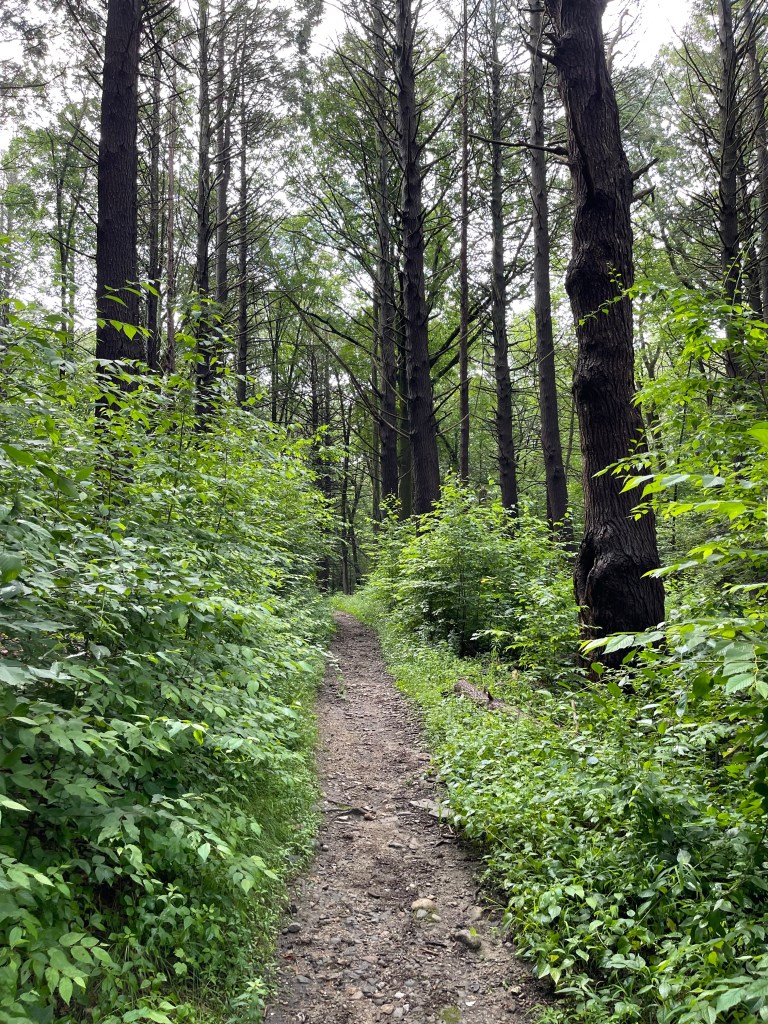
    There is a network of trails throughout the the park, and you can manage a great step count by doing the entire loop around the lake. They range from gravel roads to single track paths squeezed on both sides by abundant undergrowth(including, alas, poison ivy). The trails are well-marked and it’s very difficult to get lost, as you always have the lake to show you your progress. We encountered plenty of walkers, horseback riders and mountain bikers on the trek around the lake, but never felt it was overcrowded. Indeed, on the single track we saw only one other person, a trail runner who quickly distanced himself from us.

    Reservoirs, like graveyards, are time machines back to the days they were established. The lay of the land remains largely as it was then, and offers an opportunity to hear the whispers of history. It’s relatively easy to imagine how this place looked for Dr. Nichols or John Greenleaf Whittier because it’s largely that same place today: timeless, and beautiful.

    Kenoza Lake
    Winnekenni Castle
    The lake is almost always in view
    Local resident
    Very large Bondarzewiaceae fungi enjoying the wet summer
    Single track trail
    One of several memorials in the park
  • Venture, and Be Bold

    “Don’t underestimate the risk of inaction. Staying the course instead of making bold moves feels safe, but consider what you stand to lose: the life you could have lived if you had mustered the courage to be bolder. You’re gaining a certain kind of security, but you are also losing experience points.” — Bill Perkins, Die With Zero

    The question came up just before I began writing this blog—So what are you doing today? It was asked by a friend dashing off to go scuba diving. I mumbled something about the number of miles I needed to walk to maintain my commitment to a charity I’m walking for. There are of course many ways to cover the miles, the trick is to make the way worthy of the things we’re opting out of.

    So what are we doing today? Is it something epic and memorable, or is it satisfying some commitment made? There’s surely value in commitment, for it grounds us in profoundly meaningful ways. We just can’t let it grind us to dust. We must choose our commitments wisely, and default to enriching our life with experiences that lend exponentially profound meaning to a lifetime. If the game of life is score by how well we live it, then we all ought to double down on enriching our days with fulfilling and memorable experiences. Whatever we decide to do with our days, we ought to make it bolder than we might have defaulted to otherwise.

    “Begin, be bold, and venture to be wise.” ― Horace

    It’s essential for us to ask ourselves, what makes a great life? We all keep score in our own way, for we all value some things more than others. Some value security, while some value spontaneity, others simply try to find balance. Life shouldn’t be about regret minimization on our deathbed, but a purposeful quest to reach for a higher plane. Each experience is accumulated and cherished for what it makes of us. Each day may yet be savored. So go on, venture wisely, but with a dash of boldness in this day.

  • This is Bliss

    “I believe that happiness is, it’s really a default state. It’s what’s there when you remove the sense that something is missing in your life. We are highly judgmental, survival, and replication machines. We are constantly walking around thinking I need this, I need that, trapped in the web of desires. Happiness is that state when nothing is missing. When nothing is missing, your mind shuts down and your mind stops running into the future or running into the past to regret something or to plan something. In that absence for a moment, you have internal silence. When you have internal silence, then you are content and you are happy.” — Naval Ravikant, Naval Ravikant: The Angel Philosopher (2017) [The Knowledge Project Ep. #171]

    I have people in my life who believe that I’m not happy deep down inside because I’m not out there chasing my professed dreams in the world. I contend that I’m just as happy taking a walk around the block as I am visiting some faraway place I’ve had on some bucket list. Happiness is a state we are either in or not in, based entirely on how we view the moment. My default, thankfully, is a state of happiness. That doesn’t mean I don’t stray into the desire for more—we all do that on occasion (and some of us dare to write about it). That desire for more disrupts our current state, upsetting the apple cart of happiness. Sometimes that’s necessary for growth, and sometimes it’s nothing but a distraction from the moment. Either way it’s a state change.

    I’ve been chasing a state change all of my life. Maybe you have as well. But nowadays I’m less into chasing and more into embracing the current state. Writing and creative output bring me to the moment very quickly. I walk and row more, which each lend themselves to being present for the next step or stroke, respectively. I’m equally present in the garden: when I’m dead-heading the geraniums or pulling weeds I’m very much in the moment. This is a state of presence the arrival in the internal silence Naval speaks of. This is bliss.

    The thing is, when we’re declaring our desire to travel or experience something outside of the moment we’re in, we’ve noticed something missing. In doing so, we’re missing the moment. If comparison is the thief of joy, then comparing our current state against some future or past state where we are somewhere else is a happiness remover. Sometimes we might need that kick in the ass: I’m moving more because I was unhappy being lazy and inactive. By being active again I’ve rediscovered a level of happiness that wasn’t there before. But if I start comparing my active body of today against that active body of peak fitness at 22, I may find my happiness knocked down a notch. All that really matters is the next step, the next stroke, and knowing this is the path for us now.

    Direction matters a great deal in reaching bliss, but it doesn’t infer we’ve reached our destination, only that we’re progressing there. We must remember that “there” is just a compass heading. Here is where living happens.

  • Time Buckets

    “Draw a timeline of your life from now to the grave, then divide it into intervals of five or ten years. Each of those intervals—say, from age 30 to 40, or from 70 to 75—is a time bucket, which is just a random grouping of years. Then think about what key experiences—activities or events—you definitely want to have during your lifetime. We all have dreams in life, but I have found that it’s extremely helpful to actually write them all down in a list… Your list will be your own unique expression of who you are, because your life experiences are what make you who you are…
    Then, once you have your list of items, start to drop each of your hoped-for pursuits into the specific buckets, based on when you’d ideally have each experience…
    by dividing goals into time buckets, you are taking a much more proactive approach to your life. In effect, you’re looking ahead over several coming decades of your life and trying to plan out all the various activities, events, and experiences you’d like to have. Time buckets are proactive and let you plan your life; a bucket list, on the other hand, is a much more reactive effort in a sudden race against time.” — Bill Perkins, Die With Zero

    When I was helping to raise two very active children, I could barely keep up, let alone plan a sabbatical for three months to explore the fiords of Norway. If you learn anything as a parent, it’s that to be a good parent your own desires should take a back seat to the needs of your family’s. But that phase of life is a different time bucket that you’ll have before and after it. Everything has its season. The trick is to identify when those seasons are and feel the urgency to fill it with experiences that fit it best. I wouldn’t trade the time with my children when they were growing up for anything. Now that they’ve grown up, I might just look towards those fiords again.

    “If not now, when?” ought to be the our mantra, for there’s truth in it when we face it. Time buckets put it all in black and white. We see immediately what is possible and what will be a forever dream. If we don’t book the experiences we want in life, we’re likely to miss them altogether. History is full of people with regrets in those final moments.

    Many people go through life believing that they’ll do those big life experiences when they retire, but forget that our bodies may have other plans. We’re more fragile than we want to believe we are. And there’s no currency more valuable than health and fitness. Some things simply can’t be done when we lose this currency. If you want to hike the Appalachian Trail or follow the Tour de France course on your own bike, it’s unlikely you’ll be able or inclined to do these things when you’re 70 or 80. Even if you are, you’re body is better equipped for the experience when you’re 25 or 35. Time buckets force us to look at such things and determine where in our lives certain experiences best fit in, while reconciling what we’ll never do if we defer any longer.

    Putting life experiences into buckets has merit, but there has to be room for serendipity in our lives too, for life should never be fully lived based on a Day-Timer or spreadsheet. The point isn’t to schedule every aspect of our lives, but to identify the buckets of time when we’re most likely to have the time and resources to do the things we most want to do in this lifetime: Build it and they will come. Life is what what we plan for and make of our time. We’ll have misses along the way, but we ought to put ourselves in the best position to play the hits too.

  • Searching for the Marvelous

    “Ordinary life does not interest me. I seek only the high moments. I am in accord with the surrealists, searching for the marvelous. I want to be a writer who reminds others that these moments exist; I want to prove that there is infinite space, infinite meaning, infinite dimension.
    But I am not always in what I call a state of grace. I have days of illuminations and fevers. I have days when the music in my head stops. Then I mend socks, prune trees, can fruits, polish furniture. But while I am doing this I feel I am not living.” — Anais Nin

    “The secret of a full life is to live and and be open to others as if tomorrow they might not be there as if you might not be there. This eliminates the vice of procrastination, the sin of putting things off, the missed communions.” — Anais Nin

    I’m often accused of talking to everyone—this is often true—for in each of us there’s a story worth discovering. Every now and then you discover magic, sparked by interest. These are the high moments I believe Anais Nin was seeking as well. She seemed a woman I’d have loved to have met. Forget for a moment her fame for writing erotica, she just seemed so damned interesting. We must each find the fascinating things about living and bring it to the world. When you meet someone equally compelled to discover, the space between us erupts in wonder. You don’t have to take your clothes off for that to happen.

    There are moments when I feel the infinite meaning, when I feel the marvelous. You sense these things all around you when you’re attuned to discovery. It might be something as exhilarating as travel or as commonplace as gardening: I’ve found it in waterfalls deep in the forest and in the crashing surf seen from high on a cliffside trail in western Portugal. These are to be expected, and the compelling reason why we seek out such places. But I’ve also found it hiding in plain sight in my backyard garden, in the scent of tomato vines on a hot summer day. It’s all around you when you look for it.

    The trick is to be open to experiences. Find possibility in the circumstance we’ve stumbled into. These occasions are fleeting at best, and gone in an instant. To be fully alive is to tune in to everything around us and savor its sweetness in its season. For this is also our season, and we may never pass this way again. Carpe diem. Let’s not waste another moment.

  • Experiencing More “Ought to Do’s”

    Lately, my personal quest to stack memories seems to be paying off. Scheduled experiences this year have been notable and surely memorable, but so too have the family cookouts, early morning plunges into the pool and evenings throwing axes or on a lake with friends. These are things we ought to do more often, we tell ourselves, and then we never seem to do them very often at all. Best to put it on the calendar. Or forget the calendar altogether and just do it now.

    Our perspective on what ought to be done changes over time. Some people rise up to become far more important investments in our time than others. Likewise, some activities do the same. Lately I’ve had everything from pickle ball to scuba diving dangled in front of me as things we ought to do. It all sounds fun. Find me the time. Take, for example, hiking. I’m still trying to get in more hiking time. I’m not like some other friends that prioritize it every weekend, with a nod to them for making it so. No, I’m an acknowledged casual hiker chipping away at a list of peaks I’d like to hike in the near future. When it isn’t scheduled, it simply gets pushed down the stack.

    And what of that stack? Life is full of trade-offs, and each yes is a no to something else. In the end there will be far more “no’s” than “yes’s”, so we must choose wisely. Living an active and meaningful life is taking those most important “ought to do’s” and prioritizing them immediately. Sometimes urgency matters a great deal more than at other times, when we play the long game. Some experiences simply won’t be around next time; we may never pass this way again. They say that everything has its time. At least until we’re out of it.

    There are two lenses with which to determine what to choose: Our fitness and how meaningful the experience is. Regarding fitness: will we be able to do this in five or ten or twenty years, or is this one of those things we ought to do now? If you want to run a marathon or hike the Appalachian Trail, you’re better off doing it sooner than later. But there also has to be meaning to what we do. We aren’t nihilists, we’ve got a soul that speaks to us in the quiet moments, looking for something more than a good time.

    Contemplation and reflection have a place in our lives, which is why writing is another “ought to do” that I’ve managed to do every day for almost five years now. Clicking publish and sending these blog posts out into the wild, where everyone or nobody will read them, is important for me. The goal has never been to become a wildly successful blogger (thank goodness), but to become a better writer. If there’s an obvious side benefit, I get to communicate regularly with people invested in what I might have to say. Thanks for that. It also prompts me to seek out more experiences, that the writing isn’t just a repository of philosophy notes and collected poetry.

    There are a lifetime of experiences waiting for us, should we find the time to have them. Is it audacious to expect more than we’ve currently got? Clearly—but who else is going to advocate for such experiences? We must each determine who we want to be and set out to go be it. Adding more “ought to do’s” to our days is a lifetime mission. This isn’t bucket list fare, it’s setting out every day to raise the bar on what we experience. Accumulated, this makes for a more exceptional life than we might have otherwise.

  • Mingling with Do You Ever

    There is a pleasure in the pathless woods,
    There is a rapture on the lonely shore,
    There is society, where none intrudes,
    By the deep Sea, and music in its roar:
    I love not Man the less, but Nature more,
    From these our interviews, in which I steal
    From all I may be, or have been before,
    To mingle with the Universe, and feel
    What I can ne’er express, yet cannot all conceal.
    — Lord Byron, Childe Harold’s Pilgrimage

    Do you ever look at the surface of a pond or pool and wonder at the gumption of those who would breach the surface and enter another world? Dolphins and whales leap from the deep and experience our world for a brief moment. Humans dive into water and recall deep within the connection. There’s a calling in water that draws us there. Those who live there apparently seek time in our world as well. This is as it should be, for we are all of the water.

    Do you ever feel the presence of the trees when you walk deep in the woods? The ancients, not the brash young things fighting for a place in this world. Old growth trees know things we’ll never know in our brief lifetime. Rooted deeply into the past, reaching into the future, grounded by a sense of place, trees are the life force of the forest. When we cut down forests we rob ourselves and generations to follow of all of these things.

    Do you ever spend time above treeline, looking at clouds mingling with the lower peaks below you. Are we meant to be in such places where even the wild things steer clear? Walking in such places brings us closer to the universe, and to the heights we may aspire to in our quiet moments of bold reflection.

    We all want a sense of timelessness and a place with the infinite. We forget sometimes that we’re already a part of it. We can’t see the forest for the trees. We must break the surface of self-absorption and see what we’ve been missing deep within ourselves. Doing more of the “do you ever” things is a step in the right direction.

  • Becoming Rich With Memories

    “The business of life is the acquisition of memories. In the end that’s all there is.” — Mr. Carson of Downton Abbey

    “You retire on your memories. When you’re too frail to do much of anything else, you can still look back on the life you’ve lived and experience immense pride, joy, and the bittersweet feeling of nostalgia…. Making deliberate choices about how to spend your money and your time is the essence of making the most of your life energy.” — Bill Perkins, Die With Zero

    We all talk of how the time flies by, but perhaps we ought to focus on how many great memories we accumulate in that span. If we’re living well, experiences are acquired and flipped into memories with the turn of the calendar. We may not become financially wealthy, but surely we might accumulate a lifetime of memories worthy of our time. As the quote above points out, in the end, isn’t that all there is?

    What are memories but the realization of deliberate action? As much as I love a good spreadsheet, I know deep down that working in them isn’t creating memories that will last a week, let alone a lifetime. But I may just remember the conversation I have with someone important in my world a lot longer. I may recall the thrill of peering over a cliff at an angry ocean in Portugal and smile someday when I’m too old for such things. I expect I’ll still smile at the recollection of my kids realizing the amusement park ride they insisted on going on was going to be a lot scarier than they’d bargained on when they begged to go on it. This is the accumulated wealth of memories.

    Perkins’ book challenges us to stop accumulating savings and start spending our money while we’re healthy and fit enough to actually do the things we promise ourselves we’ll eventually do, someday, when we retire. As if we can do at 65 what we might do at 25 or 35. Do it now. There is no tomorrow, and if there is, we won’t be able to pull off some of the things we believe our bodies and minds will be capable of someday when.

    I’ve watched too many people in my life hear the news that they won’t make it to retirement. Cancer seems to be the most common thief of dreams, but maybe an accident or a heart attack steals everything you’ve ever planned for “someday when” away from you. Your life is now: accumulate the memories that will make you richer then. It’s the best return on investment we can have with today.

  • The Traveling Stoic Meets a Flight Delay

    “Develop an interest in life as you see it; the people, things, literature, music – the world is so rich, simply throbbing with rich treasures, beautiful souls and interesting people. Forget yourself.” — Henry Miller

    There’s no better time to practice stoicism than during business travel using the uniquely out-of-your-own-control limbo of domestic flights. Short delays become long delays, longer delays become cancellations, soon you begin to feel that creeping realization that we’re all just pawns on a chessboard. Who dreamed up this hellscape anyway?

    Amor fati. This is the moment when a deep breath and stepping outside ourselves clarifies. After all, enjoying life, even the grind of travel going badly, begins with knowing it’s all a game. If the why isn’t compelling enough to stay in this particular game, change the game. This applies equally well to the long term as the short. Life is altogether too brief to linger longer than absolutely necessary in the inconsequential.

    Walking helps more than visiting the bar. Seeing how many steps you can get in pulling your carry-on throughout the limits the airport sets for you is a more productive game than sampling the drink menu. Seeing how other people react to the same challenges you’re presented with is interesting, but who wants to live constantly comparing yourself to others? It’s better to take a walk, removing yourself entirely from that part of the chessboard to see how the game is going elsewhere. This offers an immediate change of state, both in what you pay attention to and the changes a bit of exercise offers.

    The things you see in an airport terminal when you have the time to wander can be fascinating…. Or at least interesting enough to make you forget where you could have been otherwise. The thing is, we are here, now, in whatever circumstances life throws at us. So buckle up and enjoy the ride.

  • Where Would You Linger?

    A question came up over dinner with close friends and active world travelers: “Where do you want to go?” for which there are naturally a full evening’s worth of answers. I think that we had the question wrong all along. Perhaps “Where would you linger?” might have been more enlightening. The value isn’t in seeing a place, it’s immersing yourself there long enough to get to know it. And, just maybe, for the place to get to know you too.

    Would you choose to stay in a place long enough to learn its ways and figure out the language and tendencies of the locals? How else would you get to know it? An Instagram photo taken at the same spot everyone else takes there’s is nothing more than evidence that we were ever there ourselves. Is that enough? It says nothing of the experience of being there, let alone how we interacted with that place. Seeing hoards of people charge in to take the same selfie before heading off to the next photo op informs. It’s okay to be the tourist, but isn’t it better to stick around to enjoy the quiet with the locals when the last bus or cruise ship departs?

    The frenetic, “sampler pack” travel, favored by many, and realized through a bus tour or a cruise, is a good example. Being part of a group that drops in for a few hours, sees a few things, buys a souvenir and ships off to the next place, allows you to see many things you otherwise might not see on a tight vacation schedule. And this has some merit. That sampler pack is designed to check boxes and quickly give you a very general lay of the land. When you only have a few days, isn’t it (sometimes) better to fill it with as much as possible? The underlying message is that if you love a place you can always go back to it. How many do?

    Is modern travel inherently designed to allow people to keep up with others at a cocktail party? That may be too narrow and cynical a view. Shared experience bonds us in some ways, if only on a surface level. It’s a starting point from which we can go deeper if we wish to. Travel means something different to each of us, but the underlying fear of missing out (FOMO) seems to drive much of the industry. After all, bucket lists are real, and life is short, and available PTO is even shorter. So by all means, we should go see the Eiffel Tower, the Grand Canyon and the Colosseum while we can. Checking boxes in such a way fills bucket lists… but is it fulfilling?

    When I think back on the places I’ve been in this world, I think about the things I missed the first time around and feel a longing to return. With every trip, there’s a lingering feeling of a place not fully realized on the first go-around. It’s natural to want to return again. Do we wonder how we’d feel if we’d simply stuck around longer?

    Great questions prompt great conversation, but also reflection. As with travel, a great question can open us up to all sorts of possibility only partially answered over a few drinks. Great questions linger even after the evening is over. Instead of always wondering “what’s next?”, we might try “what of now?”, and see where it leads us next.

    After dinner and all the talk of places nearly (but never fully) exhausted, the question shifted to, “So, what are you doing this weekend?”, which prompted my response of not very much at all. Isn’t it funny that all the wanderlust revealed in a few hours together ended with such a statement? I think it points to quietly favoring savoring: A designed lifestyle choice, not general apathy towards getting out there in the world. A sense of belonging derived from being present and realizing the full potential of ourselves in that place and time. That’s what filling a bucket really means.