Category: Exploration

  • A Hike Up the Ammonoosuc Ravine Trail to Mount Monroe and Mount Washington

    There haven’t been a lot of hiking blog posts this year as there simply haven’t been a lot of hikes. Similarly, there haven’t been a lot of waterfall visits or posts either. Life sometimes has other plans for us. So imagine my delight when I could combine two 4000 footers with one of the highest rated waterfalls in New England. You might day we hit the trifecta, but we didn’t stop at three amazing experiences. On a spectacular October day after a day of heavy rains, we were set up for quite a day in the White Mountains.

    That heavy rain factored in to where we parked and which trail head we started from. The easy button on this day was to pay the fee for parking at the Cog Railway parking lot and hiking up the Ammonoosuc Ravine Trail. This is a relatively easy trail to warm up on, until you hit the gem pool and begin a steep incline. This was a workout for this author, recently celebrating long streaks of 10,000 steps on flat land and thinking that translated into better fitness, but it was a small price to pay for the spectacular views of falling water and, once above tree line, the vistas from Mount Monroe and Mount Washington. Ironically, my Apple Watch died halfway through the hike and my streak of 10K steps “ended” on a day I did far more. Go figure.

    The Ammonoosuc Ravine Trail offers plenty of opportunity to see falling water. The Gem Pool is a lovely spot with a 35 foot waterfall right on the trail and impossible to miss. Further along, there’s a side spur that features a more stunning view of a 600-700 foot cascade that was roaring on this particular day. Some blown-down trees partially blocked the spur trail but it was a small investment in time for an incredible view. Talking to one hiker as we came back to the main trail, I mentioned that it was totally worth the side trip. He politely ignored me and continued his hike up to Mount Monroe. I wondered, how many incredible moments do we miss out on when we’re so singularly focused on a goal? To use Pico Iyer’s phrase, we abdicate possibility in such moments.

    The trail eventually brings you to the AMC Lakes of the Clouds Hut, closed for the season when we arrived, but offering a warm sunny spot to take a break before continuing to summit Mount Monroe. This is where serendipity stepped in, and we bumped into the two sons of a close friend as they descended from Monroe just after we’d done the same. A few minutes for either party and the encounter would never have happened. Life is full of such chance encounters when we put ourselves in a position to experience them.

    The hike to Mount Washington from Mount Monroe looks relatively simple, but that’s the White Mountains for you. The reality is a hike up a boulder field one deliberate step at a time. Some trail runners make quick work of this, for me it was an opportunity to pace myself. The two sons were soon summiting Mount Washington while I took my sweet time. My hiking buddy Tom was kind enough to wait for me now and then. Getting back in hiking shape after months away from it takes a few hikes. Resuming my quest to complete the 48 4000 footers on the highest peak wasn’t reckless (Washington is relatively easy compared to some lower peaks), but it was bold.

    On this particular day, the Mount Washington Observatory was celebrating its 90th birthday with tours of the weather station. This was a wonderful opportunity to see what happens behind that door, and literally top the experience off with a climb to the weather observatory itself, the highest point you can stand on in New England, and have a look around. Opportunities like that don’t come along often, and it was another moment of serendipity on this day of days.

    If this all sounds like it was too good to be true, well, I still had to pay penance for the audacity of hiking two of the highest peaks in one day. That price was paid in the form of a pair of boots that weren’t up to the task, making the descent rather painful, and with some cramping in the thighs as the finish was just in sight. There were lessons learned on this day: Don’t ever go on a hike unprepared for the things you’ll put yourself through, and always have the best boots available to help finish the job. If there’s a positive lesson, and you’ve no doubt picked up on it already, it’s that putting yourself out there pays dividends in experience both challenging and inspiring. We may live a grander and more full life simply by moving towards it.
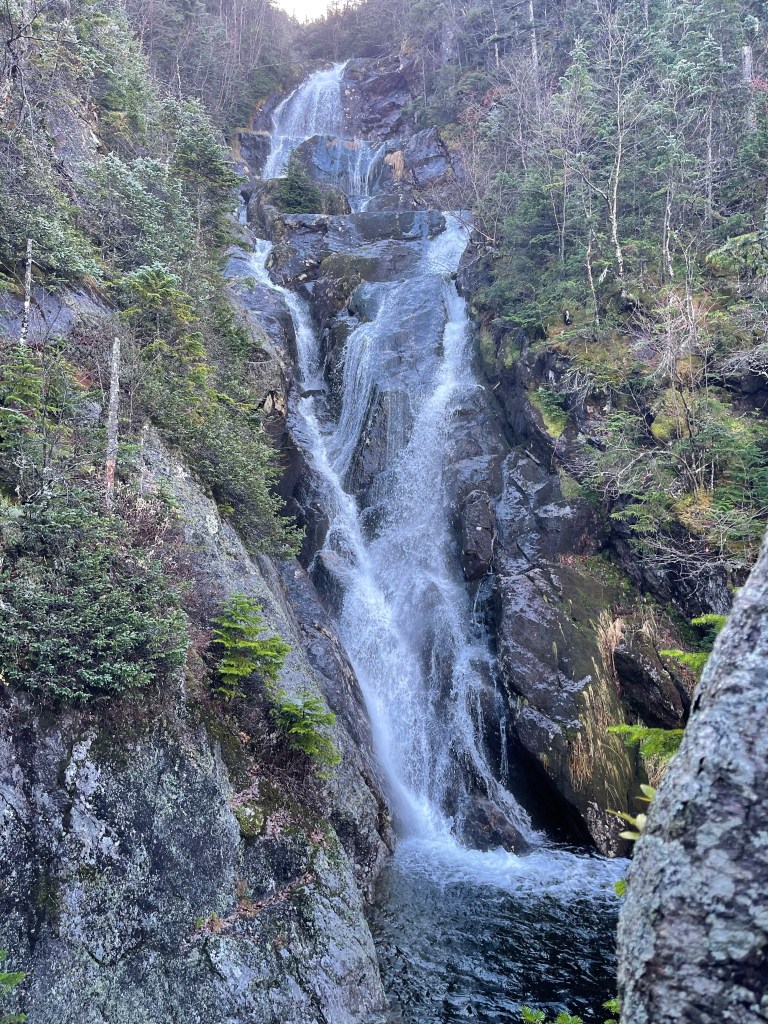
    Upper Ammonoosuc Ravine Falls
    Gem Pool, Ammonoosuc Ravine
    Mount Washington from Mount Monroe. Looks close, doesn’t it?
    Mount Monroe
    Lake of the Clouds with Mount Washington rising above it all
  • A Better Direction

    “Quitting, for me, means not giving up, but moving on; changing direction not because something doesn’t agree with you, but because you don’t agree with something. It’s not a complaint, in other words, but a positive choice, and not a stop in one’s journey, but a step in a better direction. Quitting–whether a job or a habit–means taking a turn so as to be sure you’re still moving in the direction of your highest dreams.”Pico Iyer, “Quit Pro Quotes”, Utne Reader, Sept./Oct. 1996

    We all have moments when we contemplate quitting and doing something else with our brief time. What stops us? Persistence? Faith in the future we’re building? Or is a sense of obligation? We slide into lethargic habits built over time and don’t see that there may be another way. I used to call this an attractive rut that one could easily stay in until the end of time. Maybe having a drink every day at 5 PM is the proper response for a long day of work, or maybe simply walking until you forget what your troubles were does it. Then again, maybe the proper response is to quit altogether the life built around what we believe to be all there is in our world. The answer is different for each of us, but the way we react when someone suggests quitting something deeply ingrained within our identity is telling, isn’t it?

    When you read the word ingrained, did you immediately think of the spelling? I often debate internally whether to use ingrained or engrained when I write it, which says as much about me as anything I suppose. But the point is, we all have traits and defaults within us that seem natural (like obsessing over the right way to use a word that 99% of the world won’t give a thought to). Whether those traits and defaults are productive or detrimental to our progress is a question worth asking ourselves now and then.

    I encourage you to either click the link to read the rest of Iyer’s thoughts on quitting, or Googling the article if you’re rightfully suspicious of clicking links random bloggers throw at you (although you can trust this random blogger—I promise). There’s magic in Iyer’s words, as there usually is, and they may change you profoundly, as they have me even as I write this. The quote above is easily found (Rolf Potts points to it often), but, as with any quote, mining deeper into the place it was drawn from offers so much more. For me, Iyer landed a knockout punch with this nugget:

    “Continuing the job would represent an invisible kind of quitting–an abdication of possibility–and would leave me with live unlived that I would one day, and too late, regret”.

    Don’t read this as a public admission that I’m quitting my job anytime soon, but a spotlight on the key message here: we all abdicate possibility that we will one day regret if we don’t go for it immediately. For now is all we have, and there’s living unlived to get to. See the world. Write the book. Hike that mountain. Sail to that faraway destination. Ask the question. Take the chance…. LIVE.

  • Staying Out of the Traps

    In the absence of clearly-defined goals, we become strangely loyal to performing daily trivia until ultimately we become enslaved by it.” ― Robert A. Heinlein

    “To enjoy the full flavor of life, take big bites. Moderation is for monks.” — Robert Heinlein, Time Enough for Love

    We all walk the line between being active producers and active consumers. As with everything, there’s a balance between the two to have a full life. The world, as it pleases, fills us up with things to do. We actively participate or we step off the production line and dance to our own beat, but we aren’t machines, and even the most productive among us need to consume to refuel and recharge.

    Then again, we see plenty of examples of people over-consuming and not getting anything done in their lives. And surely in this world there’s plenty to consume: food, opinion, trivial pursuits, time. We ought to ask, when consumption is tipping the scales, “just where is this taking me?” But sometimes, as Elvis put it, we get caught in a trap we can’t walk out of. Surely, we must steer clear of the traps.

    I think a lot about the two Heinlein quotes above. I’ve been saving them for some time now, thinking each would stand on their own in a blog post, but they also pair well together. Each highlights this wrestling match called living. We want to have clear purpose and a mission we believe in, for humans are meant to produce something of consequence in our brief time. And we want to be bold and see the world—making the most of this brief time with the sensory experiences that make life worth living in the first place.

    The thing is, we know when things are in balance, just as we know when something is off. The absence of clear purpose makes us “a slave to the man”, as a friend puts it. Put another way, if we aren’t working on our own goals, someone else will gladly give us theirs to work on. We must actively pursue that which has meaning for us, and steadily move away from daily trivia.

    What do we have an appetite for? Decide what to be and go be it. We tend to think small in our days, while forgetting what’s possible over a lifetime. Perhaps too many big bites will give us indigestion, but too few will leave us starving for more. As with everything, balance is the key, but don’t get caught in the trap of thinking small.

    I recognize that this post featured a lot of paraphrased quotes. It was simply me processing each in real time. Thanks for sticking with me on this one. Go be it. I’ll work to do the same.

  • The Enchanted Witness

    I’d contemplated kayaking out into the middle of the bay to capture the sunrise this morning. That plan blew away in the breeze as the chop and chill nixed the very thought of bobbing along waiting out the first glimpse of the new day. Visions of me paddling back to shore with my tail between my legs and my phone resting on the bottom of the bay made me a land creature instead.

    Then a glimpse of the giant October full moon sinking towards the horizon spurred me up and out the door. I cursed myself for not bringing a better camera than an iPhone, and then checked myself and swung over to gratitude for at least having an iPhone to attempt to capture the moment. We forget, sometimes, just how lucky we are to have so much technology at our fingertips. It wasn’t so long ago that sharing an image of the moon setting with the world a few minutes after taking the picture would have been completely out of reach. Modern life is miraculous when we stop to think about it.

    I never forget how lucky I am to be in a place where I can take such pictures at all. To capture the sunrise 38 minutes after witnessing the moon setting over restless water is itself a blessing. I can’t believe people choose to sleep in instead. In the span of 38 minutes the universe revealed so much of itself, and I found myself the enchanted witness.

    Thanks for your company this beautiful morning.

    Moonlight surfing on waves as the moon set over Buzzards Bay
    Moon setting, 9 October 2022 (forgive the blurry iPhone picture)
    Sunrise, 9 October 2022
  • A Simple Salut Will Do

    Some words, like salut and aloha, mean both hello and goodbye. It reminds me of the nonsensical lyrics of the Beatles song, catchy tune that it is, but which blathers on endlessly about goodbyes and hellos. A simple word that means both is rather handy, don’t you think?

    My daughter flew home from across the country, making for a lovely hello, and will join me today in saying goodbye to friends and fellow bloggers Fayaway as they set sail for warmer waters. Goodbyes are rarely as fun as hellos. Isn’t it better all around to say; “until we meet again” Then again, a simple salut would do in all such circumstances.

    Hellos and goodbyes are simply placeholders that bookend moments together. We dance on the floor of life for this moment and go our separate ways for awhile. Perhaps we’ll see you out here on the dance floor again sometime. It’s lovely to believe it so, isn’t it? Life is what we make of it, and relationships are very much in line with that. There are people who have lived on the same street with me whom I haven’t seen for more than ten years. And there are people I’d fly across the globe to visit for a couple of days.

    Seeing Fayaway in faraway places seems likely and offers poetic possibilities. Yes, I like the elegance of the french “Salut” in such moments. And today I think it might do.

  • In Favor of Wonder

    “Sadly it is not only the force of gravity we get used to as we grow up. The world itself becomes a habit in no time at all. It seems as if in the process of growing up we lose the ability to wonder about the world. And in doing so, we lose something central—something philosophers try to restore. For somewhere inside ourselves, something tells us that life is a huge mystery. This is something we once experienced, long before we learned to think the thought.” — Jostein Gaarder, Sophie’s World: A Novel About the History of Philosophy

    Gaarder’s premise is sound: We come into the world full of wonder, but as we grow up being alive becomes a habit. We reach a point where we think we’ve seen it all before and grow comfortable with the general act of our daily existence. Each day remains a miracle, but the vast majority of people take it for granted. What a pity.

    I’ve been working to break this habit in myself for years through deep immersion in philosophy, poetry, history, travel and the deliberate process of savoring the moment. Sometimes I get it right, sometimes I slip into the routine of the day-to-day. But every day I try to begin with reflection on this miracle of being alive. The blog forces me to stay in this lane, if only for a short while, before work and responsibilities draw my attention elsewhere. But I always strive to return to wonder.

    What if instead of returning to wonder we found a way to stay on the dance floor with it? Not in some stupor or drug-induced high, but through deliberate focus on each moment. Turning the habit of living day-to-day on its head and instead embracing heightened awareness and the quiet delight available to us in each encounter along the way. Isn’t that taking the act of living to a higher level?

    We all want more wonder and delight in our lives, for it’s the frosting on our cake—our exclamation point on our moments. The thing is, to break the old habit of merely living, we’ve got to favor wonder and make it a regular part of us. Like any habit, it becomes a part of our identity through consistency. That’s putting the wonder in a full life.

  • Living Life Between Two Melvill(e)s

    “As for me, I am tormented with an everlasting itch for things remote. I love to sail forbidden seas, and land on barbarous coasts.” — Herman Melville, Moby-Dick

    “Ye cannot live for yourselves; a thousand fibres connect you with your fellow-men, and along those fibres, as along sympathetic threads, run your actions as causes, and return to you as effects.” — Henry Melvill, from “Partaking in Other Men’s Sins”

    (As an aside: Henry lived between 1798–1871, Herman between 1819 – 1891, meaning they were tenants on the planets at the same time for 52 years. I doubt they ever met, but they’re forever linked by the latter quote, often associated with Herman Melville because of the similarities in their names and because people simply grab quotes online and use them without doing basic research beforehand.)

    We each live our lives somewhere between responsibility and adventure, don’t we? It’s like our moralist angel is named Henry, while our adventurous devil is named Herman. But life isn’t lived at the extremes? Most of us find ourselves somewhere in between. Our souls want to dance with a calling all its own, and we ought to find the tune that suits us best.

    Yet a thousand fibres connect us. Think about the hundreds of thousands of souls called to war just this year in Ukraine and Russia, simply because of the decision of one man. I imagine most of them would say their best life would be living the normal life they had before the world turned upside down. We choose to be who we are within the social and political fabric we exist in, and ought to celebrate the relative freedom to choose.

    You might think of Henry as a wet blanket, tossing out themes of cause and effect with such authority, but the reason it resonates is because the truth is woven into his sermon. But so too are the words of Herman. We all hear the tormented call to the coasts of our imagination, those places we’d be but for this other thing we must do first. For some it’s a tropical beach, for some it’s filled with icebergs and polar bears, but it calls just the same. Barbarous is in the eye of the beholder.

    Most of us don’t have to live a life mutually exclusive of adventure or responsible productivity. We get to decide what to be and do our best to be it. We’ll each hear calls from the other side, beckoning us to be more adventurous or more responsible. That’s the sound of freedom of choice in a world that doesn’t always offer it in equal shares. We’re privileged to have such options in our brief dance with life. Ultimately, we choose what we lean into to find our balance, and what we let drift away. We ought to be at peace with that.

  • A Visit to the Major John André Monument

    “I had taken my station close on the left of Major Andre’s left hand officer; and continued in that station the whole march. The guard marched a short distance when it wheeled to the left, turning a corner of the road, and marched a short distance, when they again wheeled to the left, in order to pass through a fence. Having entered a field, they marched forward a short distance, wheeled to the right, and halted. The ground here was level; a little distance in front was a moderate ascending hill, on the top of which the gallows was erected. In the position where they halted, Major Andre was, for the first time, in view of the gallows. Major Andre here said, ‘Gentlemen, I am disappointed. I expected my request’ (which was to be shot) ‘would have been granted.’ No answer was given, and he continued with his arms locked with those of the two officers.Dawson, Papers Concerning André

    Early one morning, as commuters made their way to work and parents waited for the school bus on street corners throughout town, I made a quick stop to visit the Major John André Monument. André was swept up in the treason of Benedict Arnold and paid the ultimate price when Arnold wouldn’t turn himself in, hung and buried at this spot on 2 October 1780. George Washington himself would lament the death of André, stating that “he was more unfortunate than criminal”.

    The Hudson River Valley was once the headquarters for George Washington. The river was a critical transportation hub, and if the British were to control it they would have cut off New England from the rest of the colonies. Benedict Arnold was once a highly-respected leader in the Continental army and the fight to protect the Hudson River and Lake Champlain from British control. But he was increasingly frustrated with his status, feeling like he wasn’t properly honored and rewarded for his leadership. His wife was also a Tory and desired a better position in society. This made him a prime candidate for recruitment by the British turn against the American Colonies.

    Major John André, a rising star in the British Army, was chosen to meet with Benedict Arnold to formalize the details of engagement and Arnold’s rewards, both financial and status, for turning against the Americans. Arnold and André met on a warship in the Hudson River and again on shore not very far north from where André’s American journey would end. Unfortunately for André, his warship was chased off by cannon and during his overland journey back to British-controlled territory he was captured in enemy territory while disguised as an American. This made him a spy and subject to execution. That execution would happen on a small hill in what is now Tappan, New York.

    “Every attention and respect was paid to Major Andre that it was possible to pay to a man in his situation … every officer and soldier in the army would have lifted both hands for the exchange of Andre for General Arnold. This exchange was offered by General Washington, but refused by General Clinton, the British Commander-in-chief. So the life of a traitor was saved; and Major Andre fell a sacrifice” Dawson, Papers Concerning André

    Major John André was later exhumed from the site and is now buried as a hero at Westminster Abbey. The site of his execution remained unmarked and, like so many historical places, eventually doomed to obscurity. In 1879, a wealthy American named Cyrus W. Field, who laid the first telegraph cable across the Atlantic Ocean, decided to put a monument up honoring Major John André. It makes sense that a man who made his fortune connecting the Old World with the New would seek to honor a dignified officer seen as more unfortunate than criminal. But it would take time for the community to see it the same way. As you might imagine, erecting a monument honoring an enemy soldier associated with the most notorious traitor in American history was unpopular at the time, and there were three attempts to destroy the monument before someone decided to add a plaque honoring George Washington and his army.

    You’d never know the monument was there, in the middle of a small traffic circle on a quiet residential street, if you didn’t seek it out. Such is the nature of the Hudson River Valley today, rooted in history but built for the future. The former encampment and small hill where Major John André met his fate are today simply suburbia in Metro New York. Yet history still whispers here, and reminds us that nation-defining heroism and treachery once played out right here.

  • The World, Unmasked

    “You do not need to leave your room. Remain sitting at your table and listen. Do not even listen, simply wait. Do not even wait, be quite still and solitary. The world will freely offer itself to you to be unmasked, it has no choice, it will roll in ecstasy at your feet.” — Franz Kafka

    We stumble over the universe most days. Distracted, harried, willfully blinded by the frenzy of staking a claim on our lives. The world unmasks itself when you look up and meet its gaze, and otherwise marches on to infinity without us.

    There’s no way we can possibly see everything, attempting to is a fool’s game. Still, an embarrassment of riches roll to us in waves when we offer our attention. We ought to rise to the occasion and meet the world halfway.

  • Islands

    There’s something about a coastal island, surrounded by water yet firmly locked to the earth, that is deeply compelling. It offers tangible isolation from the madness of the mainland, yet is close enough to feel its gravitational pull. Some combination of luck and inclination brings me to islands occasionally, where my gut tells me it’s not nearly enough.

    Maine has over 4600 coastal islands, big and small. Some are barren rock knobs, others are quite large, and covered in forest and diverse landscape. Visiting each is nearly impossible, property rights being what they are, but if you visit enough of them you might just realize you aren’t really seeing them at all. The right island soothes a restless soul, and like a soulmate, you’ll know it when you find it. Isn’t it far better to linger with a favorite or two than to endlessly collect names on a list? Islands, as with all such things, ought to be savored.

    Would an island offer enough of the world to satisfy a vagabonding soul? Perhaps. Perhaps not. But I hear their whispers, and wonder if I ought to pay more attention.

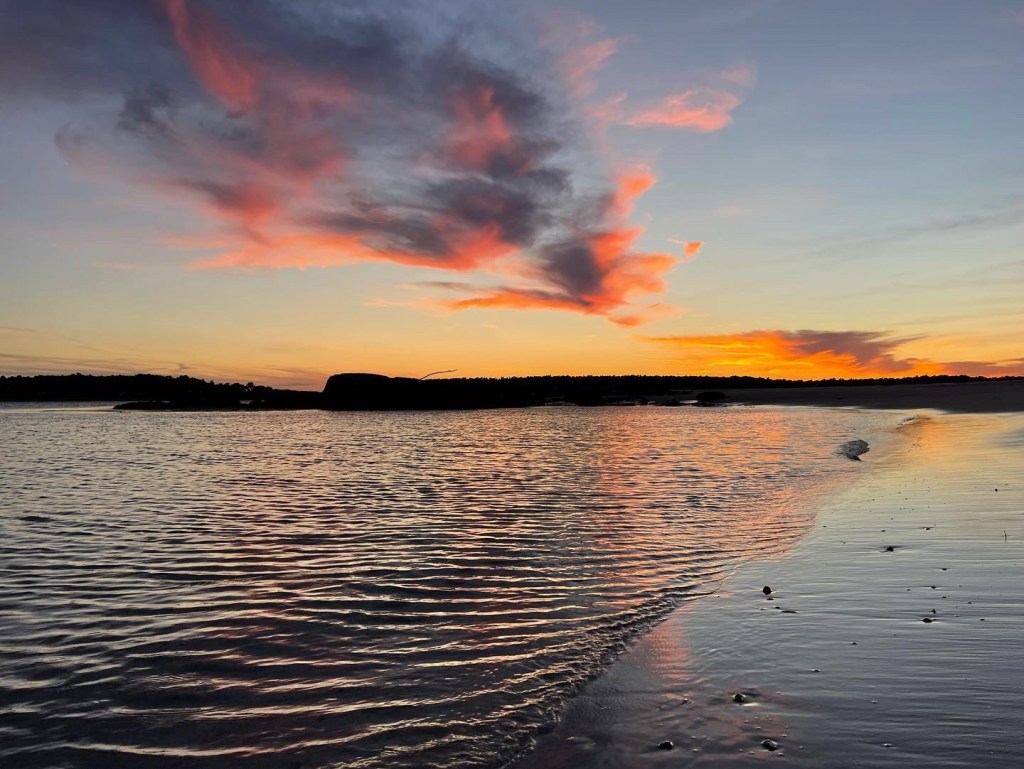
    Sunset on Long Island, Maine