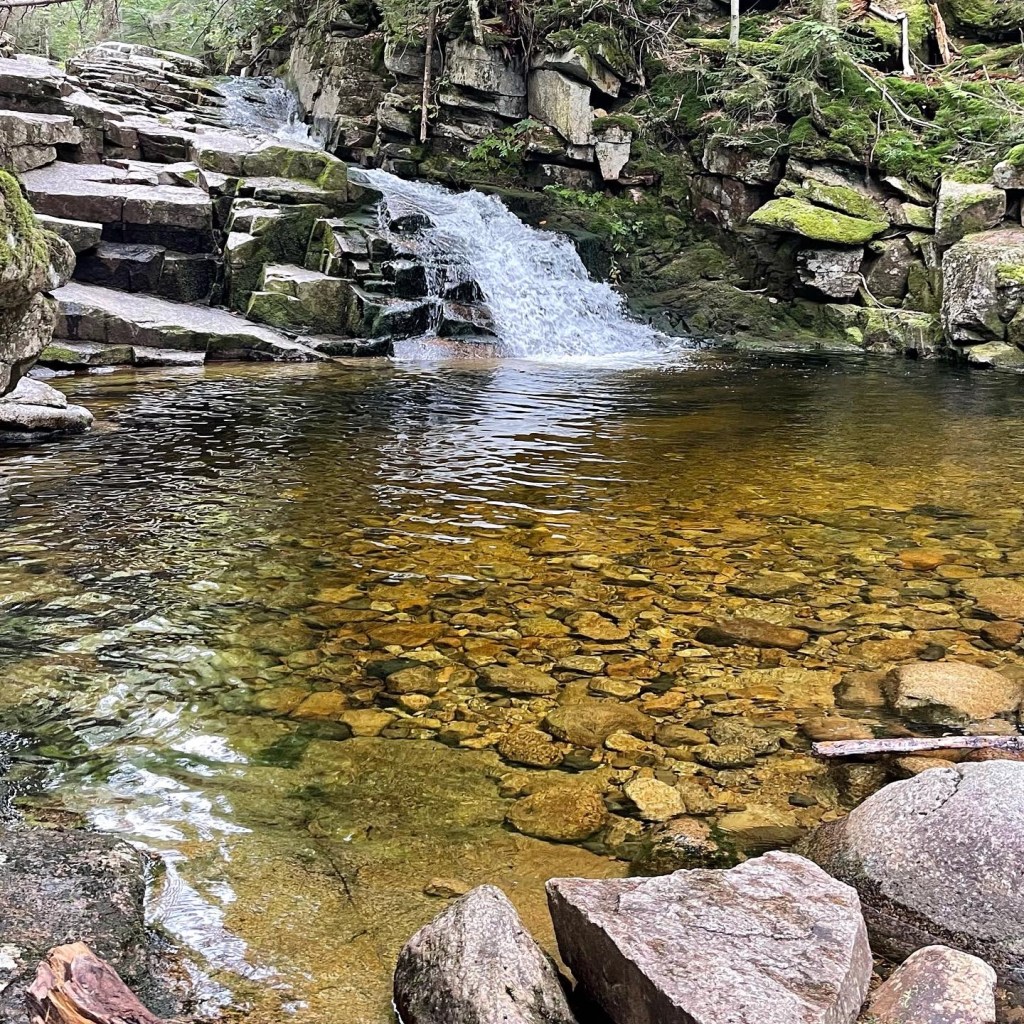
“Flow with whatever is happening and let your mind be free. Stay centered by accepting whatever you are doing. This is the ultimate.” – Zhuang Zhou
Being present in the moment requires a level of surrender that my mind doesn’t easily achieve. So I trick it with the odd mundane task like picking cherry tomatoes or deadheading the geraniums or some such thing. It’s in moments like these that I finally reach the ultimate. It won’t last, but my mind and heart sync for a few beats.
Now is more easily achieved when hiking through a quiet forest or paddling across still water. In these situations the vastness of the universe shrinks down to the immediacy of the next step or the next dip of the paddle as drops of water sprinkle down on you from the opposite, raised blade. Your restless mind has no say in the matter in such moments. It’s just you and whatever you are doing.
I should think that I might never reach some of the things my mind wrestles with. I should think I’ll pass one day having left too much on the table. I may curse the folly of an unfocused mind in that last moment, or celebrate the stillness that awaits me. You aren’t free until you realize that that moment is now.
“When the first light dawned on the earth, and the birds awoke, and the brave river was heard rippling confidently seaward, and the nimble early rising wind rustled the oak leaves about our tent, all men, having reinforced their bodies and their souls with sleep, and cast aside doubt and fear, were invited to unattempted adventures.” – Henry David Thoreau, A Week on the Concord and Merrimack Rivers
There’s finally, blessedly, a plan. Places to be, filled with uncertainty and doubt, in the very near future. With one eye on the variants and another on the weather, reservations and bookings complete. There’s new hope for a return to attempting the previously dreamed of. New adventure awaits.
The moment Thoreau wrote of above took place when he was a young man, before his brother passed away from tetanus, before he wrote Walden or Civil Disobedience. Just a couple of young adventurers waking up along the Merrimack River in Tyngsborough, Massachusetts ready to take on their previously unattempted. It captures that moment of waking up excited and recharged and bursting to get out there and do what you’ve been scheming to do. It’s a more comma-intensive version of my favorite Thoreau quote of all:
“Rise free from care before the dawn and seek adventures.”
It should be no surprise to readers of this blog that I’m scheming again. Ready and willing to burst from this big empty nest of a tent and get out in the world again. Big adventures planned for September and October. Micro adventures to fill the gaps, beginning immediately. Room for a pivot here and there, to be sure, but if you don’t plan it and take the leap you’ll just put it off for another day that may never come.
When you woke up this morning and took stock of the world around you, did it give you a bit of a thrill? If you aren’t buzzing with anticipation, what are you waiting for? Cast aside your doubt and fear and get to it already. Tackle those unattempted adventures.
“When we walk like (we are rushing), we print anxiety and sorrow on the earth. We have to walk in a way that we only print peace and serenity on the earth… Be aware of the contact between your feet and the earth. Walk as if you are kissing the earth with your feet.” – Thich Nhat Hanh
“When we walk, we naturally go to the fields and woods: what would become of us, if we walked only in a garden or a mall?” – Henry David Thoreau, Walking
I’ve been walking on pavement too often recently. The mileage is good but the spirit is muted. Your feet have a hard time connecting you to the earth when there’s three inches of asphalt separating you from it. Still, walking on asphalt is better than being indoors all day, and to be honest, I’ve experienced too much of that lately.
One recent walk took me along the Cape Cod Canal for six miles. Visually it was striking with a parade of yachts and commercial vessels streaming past on a particularly busy day. And the company was certainly good. But that connection to the earth was missing on those paved bike paths.
Maybe walks on pavement are better than nothing, but like Henry I wonder what becomes of us when we aren’t off in the fields and woods. The more we connect our feet to the earth and cover ground the more we hear our own voice. Walking flushes the toxins out of your body and soul. Sitting all the time, as we do these days with our desk jobs and a return to commuting robs us of that flushing and the ick pools up inside of us until we once again get up and out.
“We humans live in two worlds. First, there is the outer world of appearances—all of the forms of things that captivate our eye. But hidden from our view is another world—how these things actually function, their anatomy or composition, the parts working together and forming the whole. This second world is not so immediately captivating. It is harder to understand. It is not something visible to the eye, but only to the mind that glimpses the reality. But this “how” of things is just as poetic once we understand it—it contains the secret of life, of how things move and change.” – Robert Greene, Mastery
You might read a paragraph like the one above with the eye of a scientist, seeing the truth through the lens of composition of matter and chemical reaction and such. You might read it through the eyes of a politician or businessperson, immediately grasping the backroom deals and favors that occur well before the headlines catch the attention of the public. Or you might read it with the eye of an artist, seeing the structure of the words themselves and how they spin magic in their unique assembly on the page. There is indeed poetry in the how.
There’s a light that dawns when you see this other side of things, this secret sauce of how and why things are the way they are. Lessons learned through experience and intelligent observation and time invested in the questions of how. Some people receive the gift of a curious mind early in life and immerse themselves in the wonder of how, but most of us are too dazzled by the sleight of hand to focus on how the magician does the trick.
There’s magic in the how. Watch Paul McCartney at a mixing board isolating bits of a Beatles song and you learn the intricate composition and experimentation that went into crafting it. The magic seems to sparkle on the surface, but it’s much deeper than you might hear in a first listen. The final product is an illusion built on layers of sonic novelty and gumption. The joy lies in discovering things you missed the first dozen times you heard a song.
The magic lies in the mix. What we see on the surface is only the tip of the iceberg. Dive deeper into the how.
“What prevents people from learning... is not the subject itself—the human mind has limitless capabilities—but rather certain learning disabilities that tendto fester and grow in our minds as we get older. These include a sense of smugness and superiority whenever we encounter something alien to our ways, as well as rigid ideas about what is real or true, often indoctrinated in us by schooling or family. If we feel like we know something, our minds close off to other possibilities. We see reflections of the truth we have already assumed. Such feelings of superiority are often unconscious and stem from a fear of what is different or unknown. We are rarely aware of this, and often imagine ourselves to be paragons of impartiality” – Robert Greene, Mastery
My quest for an open, more aware mind bumps into smugness. I’ve run into this demon before. We so easily spot smugness in others but rarely detect it in ourselves. It appears as artificial confidence and a sense of superiority and are the tools of a closed mind. As such they ought to be snuffed out at all costs. But the mind buries them defensively, knowing your game, and you perceive yourself as open in your comfortable world until that world is challenged once again.
I see it in myself by the things I’m offended by. A cache of grudges based on perceived slights, which usually betrays something about your relationship with that person, culture or perspective. This cache, like the one on your PC, occupies space that might otherwise be used for stretching the mind in new directions. And isn’t that the real goal? Opening the mind, becoming aware, delighting in the world around us – if these are truly the objective then we have no room for walls built of resentment, fear and superiority.
“Around us, life bursts with miracles–a glass of water, a ray of sunshine, a leaf, a caterpillar, a flower, laughter, raindrops. If you live in awareness, it is easy to see miracles everywhere. Each human being is a multiplicity of miracles. Eyes that see thousands of colors, shapes, and forms; ears that hear a bee flying or a thunderclap; a brain that ponders a speck of dust as easily as the entire cosmos; a heart that beats in rhythm with the heartbeat of all beings. When we are tired and feel discouraged by life’s daily struggles, we may not notice these miracles, but they are always there.”– Thich Nhat Hanh
What are we missing while we wrap our minds are distracted by our own narrative? What miracles are happening around us even as we dwell on the past? These are the stakes. We must hunt and kill our smugness to open the mind for awareness, empathy and a deeper understanding of the world around us. To see at last what we’ve been missing all along. And in pursuing it to finally understand ourselves.
“That’s the whole secret: to do things that excite you.” – Ray Bradbury
Truth be told, there are many things we do every day that aren’t exciting, yet we keep on doing them anyway. This is the attractive rut of doing the same thing: familiar and predictable and comfortable. But does it stir the soul?
If we agree that life is short, shouldn’t we pursue that which excites us? I know, we’ve all gotta make a living, but that doesn’t mean we shouldn’t find the fun in both work and living. And if life is short, why waste years of it doing things that bore you to tears? Shake yourself out of the rut and dive into the deep work. The meaningful and enlightening. The exciting stuff.
For most of us, exciting is reserved for vacations and weekends. I should think a healthy dose of exciting ought to be injected into each day. Too bold an ask? What are we here for if not to feel the thrill of stepping beyond your comfort zone? Too old? When are you going to get younger than now? If not now, when? If we’re going to slowly fade, why not use our brightest days moving towards exciting things?
“Imagine if you will being on your death bed – And standing around your bed – the ghosts of the ideas, the dreams, the abilities, the talents given to you by life.
And that you for whatever reason, you never acted on those ideas, you never pursued that dream, you never used those talents, we never saw your leadership, you never used your voice, you never wrote that book.
And there they are standing around your bed looking at you with large angry eyes saying we came to you, and only you could have given us life! Now we must die with you forever.
The question is – if you die today what ideas, what dreams, what abilities, what talents, what gifts, would die with you? ” – Les Brown
You may have heard a version of this in a Denzel Washington commencement speech with something like 40 million views, but the framework for this story is older than that, and as far as I can tell, Les Brown was the first to tell it. And honestly, his version flows better than Denzel’s, and thus quotes better.
I’ve been thinking about this lately myself. Whether to keep blogging or focus on the bigger writing I want to do. Whether to travel and explore to the level I want to or defer until some undefined, unlikely time in the future. Asking myself, what do you finish when you don’t have an infinite lifetime?
Questions demand answers. Most of us distract ourselves from thinking about these things. Our lives are filled with white noise and busywork, but eventually we need to reckon with our ghosts.
What dreams, abilities, talents and gifts will die with you? We can’t do everything in life, but surely we can do more. So what will you bring to life before you go?
You ask me: Why do I live On this green mountain? I smile No answer My heart serene On flowing water Peachblow Quietly going Far away Another earth This is Another sky No likeness To that human world below ~Li Po, On The Mountain: Question And Answer (translated by C.H. Kwôck & Vincent McHugh)
Three days later and I’m still on a mountaintop. The aches and pains fade but the glow of walking the ridge line between peaks stays with me. And I wonder at this world I’ve created for myself, pressed in close to a desk, laptop at the ready, always asking for more. The mountains don’t ask for anything of you, but it’s understood that they demand respect.
Solo hiking, for all the social abuse I receive for it, offers meditation and a connection to the mountains that you don’t get with even the quietest, most reverent hiking buddy. So occasionally I like to indulge in time alone on trails, walking until my own voice finally stops talking to me and I begin at last to listen to the song of the infinite.
Yet you’re never quite alone in the mountains. There’s always a fellow hiker on a pilgrimage of their own, with a knowing look and a brief exchange before turning their attention back to the trail. The mountains aren’t entirely about solitude, for there are more people than ever on the trails. And every one of us with a reason for being up there.
There’s an energy that you draw on when hiking with others. A momentum of common purpose, shared struggle, and shared beliefs. I do like hiking with others, quite a lot, and look forward to sharing the mountains with them again soon. Just give me a moment alone with this sky before I reluctantly descend to that human world below. Where I’ll plot my return.
Hot, muggy August days create hazy, sweaty conditions for hiking, with a dash of risk for thunderstorms. But it’s been six long months since I’d last hiked a 4000 footer, and I was way overdue to notch one or two more. The question then is, who do you hike with? For me, the answer for this day was to hike solo. I needed to work out the rust of hiking on granite again without feeling the obligation of keeping pace. And more importantly, I needed the mental space that hiking offers after another half a year of working during a pandemic.
My thoughts on hiking alone aside, I didn’t want to drive an extra hour to find the less crowded peaks of the northern White Mountains. So my focus turned to Mounts Passaconaway and Whiteface, each part of the Sandwich range and relatively close with relatively good elbow room. And planned my hike the way most people seem to do it, to hike Mount Whiteface first and then loop around to Mount Passaconaway afterwards. Plans are lovely things, aren’t they?
When you’re hiking on a trail and come across a spot where you can either haul yourself over a boulder or bypass it entirely by taking the worn path around it, which do you choose? The answer is subjective, isn’t it? It depends on the size of the boulder. It depends on the condition of the worn path around it. And it depends on your mood at the time. My mood at the time I reached the Tom Wiggins trail was such that when I read the sign warning that the trail was not recommended because it was “steep and loose” I paused for a couple of minutes to consult my trail map, contemplate the implications to the overall mileage I’d do that day, and opt for the out and back option instead of the loop. This decision added almost five miles to my hike, and I’d second-guess it the rest of the day, but sometimes you have to trust your gut.
Decision Time
Decision made, I hiked the Dicey Mill Trail to the junction of the Rollins Trail, where I had another choice to make: knock off summitting Mount Passaconaway first, or hike over to Mount Whiteface via the Rollins Trail and save Passaconaway for last? And here I made another choice that I’d second guess the rest of the day. I chose Whiteface, and hiked the 2.3 miles over to the cairn that marked the summit, went past it to the next trail junction and then turned around and hiked all the way back to where I’d begun. Far simpler to have just knocked off Passaconaway while the legs were fresh. It would have given me the option of descending the Tom Wiggins Trail (which was admittedly advertised as steep and loose). I may still have doubled back, but at least I’d have the option. Anyway, these are the hindsight options you think about as you’re sweating through your hiking shirt and feeling your knees and ankles remind you of your choices in life.
This out and back hike wasn’t all that challenging, it was just long. And that’s exactly what I’d signed up for back at that sign. Sometimes you have to make peace with your decisions in life, and I’m okay with this one. Seeing comparable hikers who started right in front of me finishing the loop I’d contemplated after me, I recognized that either option was fine. I’ll hike the steep and loose section another day, probably in winter when the only part that matters is steep.
This was my non-traditional hike of two more 4000 footers. I know if I’d hiked with friends I’d have just done the loop I’d planned all along, but sometimes you’ve got to just go it alone. And live with your choices along the way.
When you hear someone say they had a perfect day, what does that mean to you? We have this stack of days, one to the next, before it ends someday. What makes a few of them perfect, while the rest fall slightly short?
Let’s start with the obvious: Waking up this morning, the day is already off to a great start. If you celebrate that moment the rest of your day may ebb and flow, but starting from a better place you set the tone for what follows. Carpe diem begins with celebrating the gift of life. If you’re bored with life or indifferent to the potential of each moment you’ll never have a perfect day. Each will fall short in some way because your mind isn’t open to the joy of living.
Perfect requires stacking the moments in a day with just enough beauty and sparkle to reflect back at you, leaving an afterglow in your last moments awake as your cheek feels the cool softness of your favorite pillow. Perfect ought to include certain elements mixed in an elixir: A dash of wonder, moments of connection, the realization of experience, breathless celebration and sensory perception. You drink up this elixir, feel it soak through your pores and course through your veins, and feel high on life.
We all have moments of perfection in our lives, but to ask for a full day of it seems almost too much. More likely, we forget the down moments in a day. Pushing moments of discomfort or awkwardness or frustration down in our minds for the glow of the rest of the day. And sure, maybe there’s really no such thing as a perfect day at all, but we can surely reach for it.
As I began my day, I wondered, how can I make this one perfect? I may not reach it, but knowing the recipe you can get pretty close. Does seeking perfection make it artificial, or deliberate? You only find what you look for. There is no perfection, but there is magic in each moment. Often hiding in plain sight.
And so I seek connection with each of my fellow life passengers that I stumble across, and keep my eye out for new experiences as big as a new summit and as small as watching leaves stir from a hummingbird’s wings, and tickle my senses with a new song on the radio or the scent of garden tomatoes growing on a summer day. These moments of aliveness, stacked together, are where perfection lies. It’s not the day at all, but the moments stacked together. For what is life but that?