Category: Exploration

  • To Leap in the Froth

    May I never not be frisky,
    May I never not be risqué.

    May my ashes, when you have them, friend,
    and give them to the ocean,

    leap in the froth of the waves,
    still loving movement,

    still ready, beyond all else,
    to dance for the world.
    – Mary Oliver, Prayer

    It’s been almost a year now, and I think of you when I come across a poem like this. You were a dancer, covering a dance floor with the same elegance and ease that you’d use in a tricky conversation. And sure, you were equally at ease leaping in the froth of the waves not all that long ago. Measuring up to that standard hasn’t been easy, friend, especially in this pandemic and the lingering bitterness of political strife. You’d navigate that more easily too.

    There were times over the last year when I could have used your perspective on things, but then again, I can hear exactly what you’d tell me in those imagined conversations. So we press on, doing what must be done, leaving that stuff to sort out another day. And honor your memory with action, humor and a healthy dose of friskiness.

    When I pass, sprinkle my ashes in the ocean on an outgoing tide. Life is movement and a dance through our days. I don’t want to rest in peace when it all ends, but to skip across the waves to the ends of the earth. And there, maybe, we’ll meet again.

  • Reaching Beyond the Immediacy of Our Experience

    “Men honor what lies within the sphere of their knowledge, but do not realize how dependent they are on what lies beyond it.” – Zhuang Zhou

    “The whole problem with the world is that fools and fanatics are so certain of themselves and wiser people are so full of doubts.” – Bertrand Russell

    Robert Greene, in his great book Mastery, describes the challenge a missionary had with understanding the language of a remote tribe in the Amazon. The key for the missionary to unlock the code of their language was when he realized that everything they did was based on immediacy of experience, for what was not before the tribe’s eyes did not exist.

    You don’t have to dive too deeply into social media to recognize that this trait is deeply embedded in the larger world today. So many believe at face value what they’re familiar with, and ignore the prospect that what they’ve learned might not be true. Worse, they parrot what they believe to be true, reinforcing their immediacy of experience instead of transcending it.

    Part of the problem is that people become comfortable being comfortable. Sticking with the same social circle that believes a certain thing, not challenging family or a leadership figure in your life that spouts a certain viewpoint to the exclusion of all others, and most of all, not challenging ourselves. For questioning our very beliefs can becomes very uncomfortable indeed.

    “People who do not practice and learn new skills never gain a proper sense of proportion or self-criticism.” – Robert Greene, Mastery

    To reach wisdom is to grow beyond the immediacy of our experience. This seems self-evident, doesn’t it? Growth infers expansion. To go beyond our present limitations. It’s not comfortable, but growth is never comfortable. And we must persist through discomfort to transcend it.

    “The reasonable man adapts himself to the world: the unreasonable one persists in trying to adapt the world to himself. Therefore all progress depends on the unreasonable man.” – George Bernard Shaw, Man and Superman

    The path to progress, mastery, wisdom, excellence… whatever you choose, necessitates placing yourself into the uncomfortable. This may feel at times like being overwhelmed, or being called out by others, or dealing with imposter syndrome, or a combination of all of these things. We’ve got to wade through all of this to reach beyond our limits. Where, deep down, we know that we ought to be.

  • A Hike to Waterville Cascades

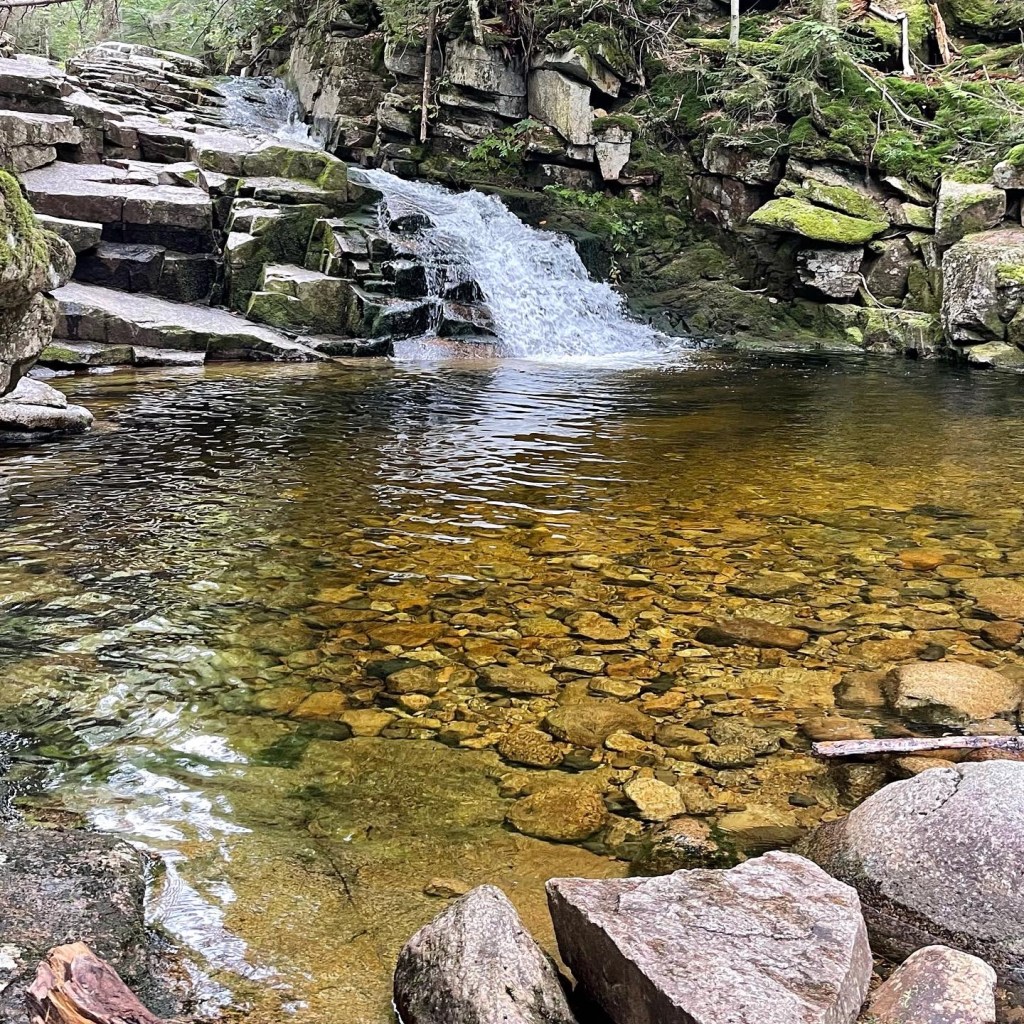
    This hike was meant to be a compromise to myself. No salt water weekend, no longer hikes to knock off another 4000 footer or three. But still spectacular, still a light workout on a beautiful trail, and the real payoff; seven waterfalls in a relatively short span.

    I had my doubts. You walk to the trailhead at Waterville Valley Resort and see right away that this hike is going to start between the road and some of the village condos. But you cross a road and leave most of that behind you. From then on you are hiking a pleasant trail to the first waterfall and not really seeing many people (for me, a Saturday afternoon).

    The Cascade Trail is a 3 mile round trip to the Waterville Cascades. The silence of the forest is notable and welcome. You quickly forget that you’re in close proximity to a ski resort, and instead immerse yourself in hiking relatively pristine second growth forest that wraps itself around you and shuts out the outside world. Before you know it the hike brings you to the first cascade on Cascade Brook, a series of seven plunges that feel bigger and more remote than they really are.

    But there are reminders of the alternative paths to the falls. We met a group we’d seen in the parking lot that opted to ride the chairlift up instead of hiking. We spoke to another couple of guys on mountain bikes who had ridden up to the falls to soak in the swimming holes. Both conversations reminded us that there were other faster ways to reach the cascades than hiking. We saw sad proof of this when we passed a pyramid of empty Bud Lite cans that some fools had stacked alongside the brook. Without a backpack for this short hike I had to leave this mess for someone else to deal with. Not everyone who ventures into the woods leaves them as they found them. This is the price of proximity.

    But the falls themselves were each wonders, and we celebrated the unique beauty of each as we climbed higher and higher up the trail. When you reach the last big cascade there’s a bridge for a mountain bike trail that you can cross to descend the other side and return you to the Cascade Trail and your hike back down.

    I’m interested in how people meet the falls. Some are reverent and respectful, some more nonchalant about the experience. I think it’s relative to how much work you put in towards reaching them, and the path you chose for yourself. But that may seem dismissive and smug when a hiker says it. More specifically, it’s not the work you put into reaching it, it’s how your attitude when you reach it that matters most.

    The work-to-reward ratio of the Waterville Cascades makes it an easy choice. The proximity of that resort comes in handy for lunch or dinner and a restroom afterwards. The entire experience reminds you that finding beautiful in this world isn’t all that hard if you just put yourself out there to meet it.

  • Accepting Whatever

    “Flow with whatever is happening and let your mind be free. Stay centered by accepting whatever you are doing. This is the ultimate.” – Zhuang Zhou

    Being present in the moment requires a level of surrender that my mind doesn’t easily achieve. So I trick it with the odd mundane task like picking cherry tomatoes or deadheading the geraniums or some such thing. It’s in moments like these that I finally reach the ultimate. It won’t last, but my mind and heart sync for a few beats.

    Now is more easily achieved when hiking through a quiet forest or paddling across still water. In these situations the vastness of the universe shrinks down to the immediacy of the next step or the next dip of the paddle as drops of water sprinkle down on you from the opposite, raised blade. Your restless mind has no say in the matter in such moments. It’s just you and whatever you are doing.

    I should think that I might never reach some of the things my mind wrestles with. I should think I’ll pass one day having left too much on the table. I may curse the folly of an unfocused mind in that last moment, or celebrate the stillness that awaits me. You aren’t free until you realize that that moment is now.

  • Unattempted Adventures

    “When the first light dawned on the earth, and the birds awoke, and the brave river was heard rippling confidently seaward, and the nimble early rising wind rustled the oak leaves about our tent, all men, having reinforced their bodies and their souls with sleep, and cast aside doubt and fear, were invited to unattempted adventures.” – Henry David Thoreau, A Week on the Concord and Merrimack Rivers

    There’s finally, blessedly, a plan. Places to be, filled with uncertainty and doubt, in the very near future. With one eye on the variants and another on the weather, reservations and bookings complete. There’s new hope for a return to attempting the previously dreamed of. New adventure awaits.

    The moment Thoreau wrote of above took place when he was a young man, before his brother passed away from tetanus, before he wrote Walden or Civil Disobedience. Just a couple of young adventurers waking up along the Merrimack River in Tyngsborough, Massachusetts ready to take on their previously unattempted. It captures that moment of waking up excited and recharged and bursting to get out there and do what you’ve been scheming to do. It’s a more comma-intensive version of my favorite Thoreau quote of all:

    “Rise free from care before the dawn and seek adventures.”

    It should be no surprise to readers of this blog that I’m scheming again. Ready and willing to burst from this big empty nest of a tent and get out in the world again. Big adventures planned for September and October. Micro adventures to fill the gaps, beginning immediately. Room for a pivot here and there, to be sure, but if you don’t plan it and take the leap you’ll just put it off for another day that may never come.

    When you woke up this morning and took stock of the world around you, did it give you a bit of a thrill? If you aren’t buzzing with anticipation, what are you waiting for? Cast aside your doubt and fear and get to it already. Tackle those unattempted adventures.

  • When We Walk

    “When we walk like (we are rushing), we print anxiety and sorrow on the earth. We have to walk in a way that we only print peace and serenity on the earth… Be aware of the contact between your feet and the earth. Walk as if you are kissing the earth with your feet.” – Thich Nhat Hanh

    “When we walk, we naturally go to the fields and woods: what would become of us, if we walked only in a garden or a mall?” – Henry David Thoreau, Walking

    I’ve been walking on pavement too often recently. The mileage is good but the spirit is muted. Your feet have a hard time connecting you to the earth when there’s three inches of asphalt separating you from it. Still, walking on asphalt is better than being indoors all day, and to be honest, I’ve experienced too much of that lately.

    One recent walk took me along the Cape Cod Canal for six miles. Visually it was striking with a parade of yachts and commercial vessels streaming past on a particularly busy day. And the company was certainly good. But that connection to the earth was missing on those paved bike paths.

    Maybe walks on pavement are better than nothing, but like Henry I wonder what becomes of us when we aren’t off in the fields and woods. The more we connect our feet to the earth and cover ground the more we hear our own voice. Walking flushes the toxins out of your body and soul. Sitting all the time, as we do these days with our desk jobs and a return to commuting robs us of that flushing and the ick pools up inside of us until we once again get up and out.

    Today is a good day for a walk.

  • The How of Things

    “We humans live in two worlds. First, there is the outer world of appearances—all of the forms of things that captivate our eye. But hidden from our view is another world—how these things actually function, their anatomy or composition, the parts working together and forming the whole. This second world is not so immediately captivating. It is harder to understand. It is not something visible to the eye, but only to the mind that glimpses the reality. But this “how” of things is just as poetic once we understand it—it contains the secret of life, of how things move and change.”
    – Robert Greene, Mastery

    You might read a paragraph like the one above with the eye of a scientist, seeing the truth through the lens of composition of matter and chemical reaction and such. You might read it through the eyes of a politician or businessperson, immediately grasping the backroom deals and favors that occur well before the headlines catch the attention of the public. Or you might read it with the eye of an artist, seeing the structure of the words themselves and how they spin magic in their unique assembly on the page. There is indeed poetry in the how.

    There’s a light that dawns when you see this other side of things, this secret sauce of how and why things are the way they are. Lessons learned through experience and intelligent observation and time invested in the questions of how. Some people receive the gift of a curious mind early in life and immerse themselves in the wonder of how, but most of us are too dazzled by the sleight of hand to focus on how the magician does the trick.

    There’s magic in the how. Watch Paul McCartney at a mixing board isolating bits of a Beatles song and you learn the intricate composition and experimentation that went into crafting it. The magic seems to sparkle on the surface, but it’s much deeper than you might hear in a first listen. The final product is an illusion built on layers of sonic novelty and gumption. The joy lies in discovering things you missed the first dozen times you heard a song.

    The magic lies in the mix. What we see on the surface is only the tip of the iceberg. Dive deeper into the how.

  • The Fight for an Open Mind

    “What prevents people from learning... is not the subject itself—the human mind has limitless capabilities—but rather certain learning disabilities that tend to fester and grow in our minds as we get older. These include a sense of smugness and superiority whenever we encounter something alien to our ways, as well as rigid ideas about what is real or true, often indoctrinated in us by schooling or family. If we feel like we know something, our minds close off to other possibilities. We see reflections of the truth we have already assumed. Such feelings of superiority are often unconscious and stem from a fear of what is different or unknown. We are rarely aware of this, and often imagine ourselves to be paragons of impartiality” – Robert Greene, Mastery

    My quest for an open, more aware mind bumps into smugness. I’ve run into this demon before. We so easily spot smugness in others but rarely detect it in ourselves. It appears as artificial confidence and a sense of superiority and are the tools of a closed mind. As such they ought to be snuffed out at all costs. But the mind buries them defensively, knowing your game, and you perceive yourself as open in your comfortable world until that world is challenged once again.

    I see it in myself by the things I’m offended by. A cache of grudges based on perceived slights, which usually betrays something about your relationship with that person, culture or perspective. This cache, like the one on your PC, occupies space that might otherwise be used for stretching the mind in new directions. And isn’t that the real goal? Opening the mind, becoming aware, delighting in the world around us – if these are truly the objective then we have no room for walls built of resentment, fear and superiority.

    “Around us, life bursts with miracles–a glass of water, a ray of sunshine, a leaf, a caterpillar, a flower, laughter, raindrops. If you live in awareness, it is easy to see miracles everywhere. Each human being is a multiplicity of miracles. Eyes that see thousands of colors, shapes, and forms; ears that hear a bee flying or a thunderclap; a brain that ponders a speck of dust as easily as the entire cosmos; a heart that beats in rhythm with the heartbeat of all beings. When we are tired and feel discouraged by life’s daily struggles, we may not notice these miracles, but they are always there.” – Thich Nhat Hanh

    What are we missing while we wrap our minds are distracted by our own narrative? What miracles are happening around us even as we dwell on the past? These are the stakes. We must hunt and kill our smugness to open the mind for awareness, empathy and a deeper understanding of the world around us. To see at last what we’ve been missing all along. And in pursuing it to finally understand ourselves.

  • Towards Exciting Things

    “That’s the whole secret: to do things that excite you.” – Ray Bradbury

    Truth be told, there are many things we do every day that aren’t exciting, yet we keep on doing them anyway. This is the attractive rut of doing the same thing: familiar and predictable and comfortable. But does it stir the soul?

    If we agree that life is short, shouldn’t we pursue that which excites us? I know, we’ve all gotta make a living, but that doesn’t mean we shouldn’t find the fun in both work and living. And if life is short, why waste years of it doing things that bore you to tears? Shake yourself out of the rut and dive into the deep work. The meaningful and enlightening. The exciting stuff.

    For most of us, exciting is reserved for vacations and weekends. I should think a healthy dose of exciting ought to be injected into each day. Too bold an ask? What are we here for if not to feel the thrill of stepping beyond your comfort zone? Too old? When are you going to get younger than now? If not now, when? If we’re going to slowly fade, why not use our brightest days moving towards exciting things?

    Really, this shouldn’t be that much of a secret.

  • What Dies With You?

    “Imagine if you will being on your death bed – And standing around your bed – the ghosts of the ideas, the dreams, the abilities, the talents given to you by life.

    And that you for whatever reason, you never acted on those ideas, you never pursued that dream, you never used those talents, we never saw your leadership, you never used your voice, you never wrote that book.

    And there they are standing around your bed looking at you with large angry eyes saying we came to you, and only you could have given us life! Now we must die with you forever.

    The question is – if you die today what ideas, what dreams, what abilities, what talents, what gifts, would die with you? ” – Les Brown

    You may have heard a version of this in a Denzel Washington commencement speech with something like 40 million views, but the framework for this story is older than that, and as far as I can tell, Les Brown was the first to tell it. And honestly, his version flows better than Denzel’s, and thus quotes better.

    I’ve been thinking about this lately myself. Whether to keep blogging or focus on the bigger writing I want to do. Whether to travel and explore to the level I want to or defer until some undefined, unlikely time in the future. Asking myself, what do you finish when you don’t have an infinite lifetime?

    Questions demand answers. Most of us distract ourselves from thinking about these things. Our lives are filled with white noise and busywork, but eventually we need to reckon with our ghosts.

    What dreams, abilities, talents and gifts will die with you? We can’t do everything in life, but surely we can do more. So what will you bring to life before you go?