Category: Travel

  • Remembering New Hampshire’s Soldiers Lost at Bunker Hill

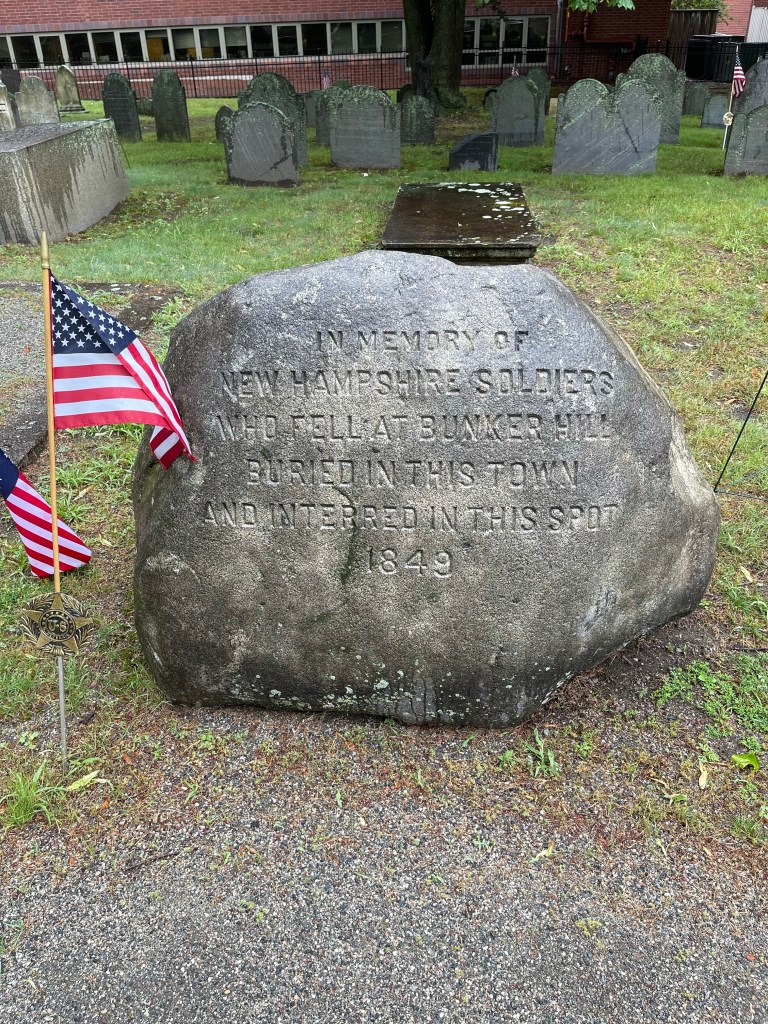
    The boulder quietly marks time amidst the everyday buzz of Medford Square, with cars circling the Burying Ground like planes preparing for a landing at nearby Logan Airport. It’s a nice touch, really, a nod to tough New Hampshire granite, honoring the men who left New Hampshire to fight in the Battle of Bunker Hill who never returned. They’re buried in Medford, and the engraved boulder placed here in 1849 honors their sacrifice.

    The Salem Street Burying Ground is a time capsule back to the earliest days of American history, surrounded on all sides by a perimeter of brick walls, roads and buildings. Medford is not what it was in 1775, but then, everything changed after Bunker Hill. Everything but the quietly stoic gravestones standing in rows around the boulder, like the soldiers themselves once lined up to battle men not much different from themselves. Enemies by fate and events bigger than themselves.

    New Hampshire sent its share of men to fight at Bunker Hill, most famously John Stark. If you look at the roster of soldiers from New Hampshire you see an extensive list from all parts of the state. By my count, 32 were killed on June 17, 1775 and two died from their wounds within a few days. No New Hampshire town paid a bigger price than Hollis, with 25% of the killed in action originating from this small community.

    Many of the British soldiers killed that day are entombed in the crypt at Old North Church in Boston. For the Americans killed that day, many are buried in small burial grounds throughout the area. This one in the heart of Medford, a little more than 4 miles from Breed’s and Bunker Hill, offers a small tribute to New Hampshire’s lost soldiers.

    I wonder about that final journey for these men. Did all of them make it to marked graves like the ones here, or were some buried in places now covered over by the relentless march of progress? For many, their final resting place, like many of their names, is lost to history.

    Honoring New Hampshire’s soldiers killed at the Battle of Bunker Hill
  • A Beautiful Reluctance

    We were born saying goodbye
    to what we love,
    we were born
    in a beautiful reluctance
    to be here,
    not quite ready
    to breathe in this new world

    – David Whyte, Cleave

    I understand this reluctance. I wrestle with it myself. And tackle the moments as they wash over me and undermine my footing like a relentless surf. We’re never quite ready for what the world throws at us, but with a subtle shift and a will to persevere we find a way to keep our footing.

    For all the harshness in the world we learn that, more often than not, the waves come from within. The demons aren’t out there marching towards you in waves, they whisper in your ear. The distractions and busywork and perceived obligations squander our moments and precious minutes. The reluctance pulls at our sleeve, back towards what we are comfortable with, back towards the safe and predictable and indistinct.

    Each step is uncertain, but slowly we move forward. The farther we venture, the harder it is to hear the call to come back. And in the growing quiet we might hear something just out of reach. Just ahead. And we continue towards those who call us, towards the Muse, towards our boldest dreams. One moment, and one breath at a time.

    But it begins, as it must, with goodbye.

  • More Like a Cardinal

    Contemplating the turf war between a pair of stressed House Wrens and a nonchalant female Cardinal perched a little too close to the nest. I was struck by the similarity between the birds and my relationship with my neighbors. The neighbors are fine people, mind you, but they each do something that I find annoying in some small way. And I realized that I was like the House Wrens reacting to encroachment from the Cardinal. And of course, the neighbors were like the Cardinal.

    The Cardinal was simply existing, but doing so in a way that annoyed the Wrens. And I recognized I don’t want to be like a House Wren at all. I want to be more like a Cardinal. Not necessarily annoying the neighbors with my presence, but in the nonchalant way that it goes through life.

    I realized in that moment that I’m probably going to live in this spot, with a nod to fate, for at least thirty years of my lifetime. By far the longest I’ve spent any time in any place. And I’m a nomad at heart. What brought me to this realization? Comfort? Complacency? Commitment? I’m sure there are C’s I’m missing, but you already know the answer anyway. It’s a bit of each. And this is how communities are formed. People sticking together despite annoying tendencies and a competing urge to try a new place now and then.

    Cardinals don’t migrate. They stick with the place they live in and make it work. House Wrens, on the other hand, migrate to warmer climates for the winter and return when the weather warms up again. Snowbirds versus redbirds, if you will. Both return, but where they’ve been in the meantime is so very different.

    Ultimately, I long to fly like each bird. To fly off but return to the home nest seems appealing. I’m coming to terms with the idea that my travel will be shorter in duration, but perhaps more meaningful knowing I have a place to land in when I return. Maybe that’s enough. And thirty years in one nest is surprisingly closer than I ever imagined.

  • Wake, Into This Life

    The sound
    of a bell
    still reverberating.

    or a blackbird
    calling
    from a corner
    of the
    field.

    Asking you
    to wake
    into this life
    or inviting you
    deeper
    to one that waits.

    Either way
    takes courage,
    either way wants you
    to be nothing
    but that self that
    is no self at all,
    wants you to walk
    to the place
    where you find

    you already know
    how to give
    every last thing
    away.
    – David Whyte, The Bell and the Blackbird

    A poem like this grabs you just like that bell or blackbird, reverberating inside and declaring it sees what you’re doing. What you’re not doing. And reminds you that time is quickly slipping away. And yet here you are, giving it all away.

    Or are you?

    When we finally wake up into this life, we see the uneven ground we walk on, the big asks and the small favors that add up. How do we deal with that, when we finally see life as it is? Do we run away from it or embrace it?

    What is asked of us is not the point of life. What matters is what we give. Willingly or grudgingly, what we give back to life is all that ever matters.

    Have the courage to be selfless.

    Have the courage to give it all away and go to what awaits you.

    But wake up.

  • To Be Touched by Everything I’ve Found

    One obvious problem with long drives is that it eats into reading time. You can solve this with audio books, of course, but then what of podcasts? As a heavy consumer of both, what do you choose? And this is where time becomes our enemy.

    Long drives require epic podcast episodes, and there’s nothing more epic than Hardcore History with Dan Carlin. For the last year I’ve been saving long stretches of travel to complete Supernova of the East, which is like all of Carlin’s podcasts: devastating edge of your seat listening. You want a little perspective as you crawl along in traffic over the Tappan Zee Bridge? Listen to the details of the Battle of Okinawa as Carlin spins his magic.

    What do you do when you’ve finished a series like Supernova of the East and you need to step back into the better side of humanity? Music helps. Lately I’ve been mixing classic rock and what today is known as “Americana” music (personally, I just call it music). Specifically, diving into old Crosby, Stills, Nash & Young tunes and new Jason Isbell and the 400 Unit compilations. Looking for poetry set to music? You can’t go wrong with either. As a lover of words piled together just so, Isbell does to your brain cells what a complex Cabernet does to your taste buds.

    The best I can do
    Is to let myself trust that you know
    Who’ll be strong enough to carry your heart

    – Jason Isbell and the 400 Unit, Letting You Go

    When you get to a hotel room in some remote place and you’ve caught up on all those emails and administrative work, what next? Drink? Watch television? Or dive back into the books that have tapping you on the shoulder for attention? There’s a place for every form of entertainment, but in most of my travels the hotel television never gets turned on. But the Kindle app does.

    After some consistent prodding by a friend of mine, I’m finally finishing Sapiens by Yusef Noah Harari. I know, what took me so long? Honestly it just kept slipping down the pile as other books jumped ahead. Regrettable, but life is about tradeoffs. What we choose to dance with in our brief time makes all the difference in how we see the world. Now that I’ve almost wrapped it up, I see what all the fuss is about.

    “Even today, with all our advanced technologies, more than 90 per cent of the calories that feed humanity come from the handful of plants that our ancestors domesticated between 9500 and 3500 BC – wheat, rice, maize (called ‘corn’ in the US), potatoes, millet and barley. No noteworthy plant or animal has been domesticated in the last 2,000 years. If our minds are those of hunter-gatherers, our cuisine is that of ancient farmers.” – Yusef Noah Harari, Sapiens

    Speaking of that stack of books, I put aside a couple of other books to focus on completing Sapiens. One in particular, The Blind Watchmaker, is a heavier lift than Sapiens, but compliments it well. I’ve referenced it before in the blog, and look forward to moving it to the virtual “done” pile. Combined, these two books have shaken my perspective of the world and how we got here.

    “If you have a mental picture of X and you find it implausible that the human eye could have arisen directly from it, this simply means that you have chosen the wrong X.” – Richard Dawkins, The Blind Watchmaker

    Inevitably I need to sprinkle in page-turner fiction, poetry and sharp left turn material to shake off reality until I can catch my breath again. Journey to Ixtlan by Carlos Castaneda was a definite left turn for me, an interesting read that got me thinking about mysticism and craving more time in the desert Southwest.

    “You can do better. There is one simple thing wrong with you—you think you have plenty of time.” – Carlos Castaneda, Journey to Ixtlan

    The Sea in You: Twenty Poems of Requited and Unrequited Love by David Whyte is a lovely collection of poems by one of our living masters. Whyte stirs words together with the best of them and catches my imagination with his alchemy. I’ll surely spend more time with Whyte in this blog in the near future.

    “be weathered by what comes to you, like the way you
    too
    have travelled from so far away to be here, once
    reluctant
    and now as solid and as here and as willing
    to be touched as everything you have found.”
    – David Whyte, The Sea in You: Twenty Poems of Requited and Unrequited Love

    We collect bits of wisdom and memorable nuggets in our consumption. Does this make us better conversationalists or a faster draw on Jeopardy? Most likely, but there’s something more to it than that. To revisit the old cliche, we are the average of the five people we spend the most time with. What we consume either amplifies our biases or challenges them. I choose to be challenged, and find myself slowly stretching and building a better mind, with greater perspective, through what I listen to, watch and read.

    In short, to be touched by everything I’ve found.

  • The New Clumsiness of Travel

    What happens when, having spend your adult life mastering the art of traveling, you pause said travel for months at a time? Other than one memorable trip to Ohio last fall I haven’t traveled since March 2020. So I eagerly packed my bag for a brief regional trip Monday morning, wondering what the road might offer me this time.

    This one was supposed to be simple. Drive four hours south to New Jersey, spend a night and meet with some folks on Tuesday, then drive up to Connecticut for some other meetings. But I noticed the rustiness right away. It started with leaving my laptop at home. I realized it at a gas station just down the road – no harm, no foul. Just time counted against me. Time that would stack up as traffic built in front of me, adding proposed route changes and a distinct feeling that the drive would be much longer than anticipated.

    Welcome back! Connecticut said, throwing orange greeting cones up for me in celebration at my return. And I embraced the lane closure as a stoic ought to. Such is fate. This used to grind me to dust, now it’s a reminder of what I’d gained during the pandemic: time and perspective. I watched the angry desperation of drivers cutting ahead of three cars just to feel some measure of control over the situation and turned the air vent back towards me for the breeze. No, none of this was all that important.

    The rules are ambiguous. Signage states to wear a mask in some places, and I slip it on as I walk in the door only to see half the people inside not wearing a mask. I keep it on anyway, respecting the sign on the door, or more specifically, the person who left it up. Not very hard, this mask thing, but so bloody divisive for a population that can’t handle anything remotely inconvenient in their march towards oblivion. What’s a mask but a sign of regard for our fellow humans?

    The tavern I choose for dinner is empty and anticipating company that never comes. A help wanted sign waves in the hot breeze outside, trying in vain to get people to embrace working for a living once again. The bartender fumbles for her mask when I walked in, I told her not to worry about it with a simple word: “vaccinated”. And this is where we are in the world, uncertain greetings and understaffed small businesses trying to scrape survival out of the days after COVID.

    I return to my hotel room, largely alone on the entire floor but for a family on the far end who will use the hallway as a daycare until well into the evening. I might have been bothered by this two years ago, but it’s nice just to hear signs of life in this quiet hotel. They might be at 20% capacity, based on the cars in the lot.

    Dozing off thinking about an early start, celebrating the awkwardness of being back on the road again, I’m jolted awake by what I believe to be the fire alarms going off. It turns out to be a tornado warning pushed to both of my phones simultaneously. Turning one off, I acknowledge the other and open the blinds for some of the most brilliant lightning streaks I’ve ever seen dancing across the sky for the next hour. Thankfully no tornadoes touching down at the Doubletree.

    Do you know that old cliché about never forgetting how to ride a bicycle? Travel now feels this way. You just plug yourself back into the travel routine, brush off the rustiness and go. The routine is largely the same, only traveler has changed.

  • Endlessly Changing Horizons

    “The very basic core of a man’s living spirit is his passion for adventure. The joy of life comes from our encounters with new experiences, and hence there is no greater joy than to have an endlessly changing horizon, for each day to have a new and different sun.” – Chris McCandless

    I’m a traveller at heart, a wanderer and nomad wannabe. So it’s easy to be stirred to action by McCandless’s quote above. He was the subject of Into the Wild, making him instantly more famous than those of us who chose a less aggressive path to chase new horizons. I know viscerally the call that brought him to the wilderness of Alaska even as I question his tactics for getting there. I’m far less risk-averse than many, but far more so than McCandless was.

    Friends poke and prod at the nomad in me, knowing it wants to break free and go. There’s a rawness in the desire when it gets stamped down too many times. And the pokes always seem to hit home right in that sore part. Nomads seek endlessly changing horizons to see what’s over there, and then over in that other place. Always chasing new and different. I know this chase.

    There are three fair questions to ask when you chase horizons: What do you seek? and How will you pull this off? and What are you leaving behind? Purpose, logistics and consequences. If you tackle all three and feel comfortable with the answers, then what are you waiting for? Go!

    Joy comes through seeing the change in yourself as you encounter new perspectives. Sometimes that’s in another place, and sometimes that’s in finding a new place within yourself. No, changing horizons aren’t about chasing, they’re about becoming.

    So, again, what is it you seek?

  • Myths and Pretty Stories

    “Like the elite of ancient Egypt, most people in most cultures dedicate their lives to building pyramids. Only the names, shapes and sizes of these pyramids change from one culture to the other. They may take the form, for example, of a suburban cottage with a swimming pool and an evergreen lawn, or a gleaming penthouse with an enviable view. Few question the myths that cause us to desire the pyramid in the first place.” – Yuval Noah Harari, Sapiens: A Brief History of Humankind

    We all build pretty stories, latch on to myths that align us with a currency, political party, and what we chase in our short time on earth. Since I reached “responsible” adulthood I’ve been servant to my pyramid in New Hampshire, my second pyramid, thank you. I’ve done my part to keep both the economy and humankind going by getting married and having two children, a boy and a girl, to keep the party going after I someday check out.

    Sapiens challenges long-standing assumptions we have about our place in the world: how we got here, what we believe, what we’ve destroyed in the process of getting here and what is being destroyed now as a result of the myths and pretty stories we collectively tell ourselves. And that’s the part that I’ve been thinking about lately. We’ve all seen what collective belief in a myth can do on September 11, 2001 and on January 6, 2021. There’s a very dark side of humanity that emerges when subscribing to certain myths. And there’s a swell of resistance that rises up when confronted with myths that don’t fit our own view of the world.

    It may come as no surprise to any reader of this blog that I’m a romanticist, chasing experiences in this short life. And yet like many of my fellow romanticists I’ve also built a pyramid. And keep adding smaller pyramids around it to make this life more… comfortable? Luxurious? Sure. But every myth has a price, and to function in this society your story needs to align with the larger story of paying mortgages and car payments and working to fund it all.

    We humans are complicated, aren’t we? Life is about the pretty stories we tell ourselves. About where we are and where we’re going. We all tell ourselves and others these stories. I tell myself that I’m chasing washboard abs, but still managed to have a third taco last night. Now I’m planning a long walk and yard work to make up for the three tacos. Washboard abs are just another pretty story I tell myself if I don’t align my habits with the larger goal.

    As an American I grew up believing certain things about our Rights as citizens. We buy into the belief that all men and women are created equal. Over time you learn this is a myth, we aren’t at all equal. Some are dealt tougher hands than others. Some drink the Kool-Aid of scarcity and fear and react to that with aggression and hate. In sharp contrast, may of us subscribe to something bigger. A belief in each other and a better future.

    “Well, big wheels roll through fields where sunlight streams
    Oh, meet me in a land of hope and dreams”
    – Bruce Springsteen, Land of Hope and Dreams

    Inevitably there’s friction and chafing when one person’s myths run into another’s opposing myths. We live in a dangerous time, and a lot depends on how the pendulum swings during our watch. Like Springsteen I’m an eternal optimist, but recognize that’s just the way we frame our pretty stories. Like washboard abs and too many tacos, sometimes pretty stories and reality don’t align and you’ve got to recognize that and commit to changing the story.

    We all have to work for the pyramids we are building towards the sky. It’s fair to question whether we’re building the right pyramid in the first place. Isn’t it?

  • Roses Rise

    and out of the silent dirt
    the blood-red roses rise.
    – Mary Oliver, Both Worlds

    The tea roses bloom in abundance in June, and reward you with blooms in bursts of fragrant joy the rest of the season. This is the time when rose petals pile up like seaweed at the edge of the surf, for the dance is so very brief for each individual flower before it rains down to the dirt to make way for the next budding star.

    I’m considered a tall man, and the tea roses reach up to my height, wanting very much to overtake the neighboring crab apple tree and maybe even the oaks should they be so bold. Tea roses love to dance with the sky, to catch the breeze and perfume the air with their subtle scent. Year-after-year they return, despite the relative neglect they receive compared with the pampered annuals.

    I’ve held this line from Mary Oliver in my mind since winter. I thought then of the blooming tea roses (pink, not red in the garden I’m subservient to). Winter is a time of dormancy and darkness, not at all the explosion of delight that June offers in New Hampshire. Each year the blooms are a miracle, and I gratefully celebrate their return.

    For all my talk of travel and exploring the world, I bask in this short time together with the roses each year around this time. A time when the roses rise to meet me at eye level. As if to ask me, why would you ever want to leave us?

    Tea Rose Time
  • Beauty, Reflected

    “When Narcissus died, the goddesses of the forest appeared and found the lake, which had been fresh water, transformed into a lake of salty tears.
    “Why do you weep?” the goddesses asked.
    “I weep for Narcissus,” the lake replied.
    “Ah, it is no surprise that you weep for Narcissus,” they said, “for though we always pursued him in the forest, you alone could contemplate his beauty close at hand.”
    “But . . . was Narcissus beautiful?” the lake asked.
    “Who better than you to know that?” the goddesses said in wonder. “After all, it was by your banks that he knelt each day to contemplate himself!”
    The lake was silent for some time. Finally, it said:
    “I weep for Narcissus, but I never noticed that Narcissus was beautiful. I weep because, each time he knelt beside my banks, I could see, in the depths of his eyes, my own beauty reflected.”
    – Paulo Coelho, Prologue to The Alchemist

    Great writing reflects. It collects the beautiful essence of living in this world and polishes it up to reflect back on the reader. It’s what any writer worth their salt aspires to. It’s what I aspire to here and elsewhere. Call this blog a work in progress. What is published daily isn’t as polished as a Fleetwood Mac song, you get maybe the second or third draft here. But I try like hell to make it worth our collective time.

    The garden is well past the dance of the Daffodils. Maybe the timing of this quote should have been aligned with their peak, but looking back on my posts from that time I see my focus turned towards other things in this world. Such is the way with writing, you can’t possibly capture it all. The very process of focusing on one thing allows other things to escape notice.

    In all art you hold up the mirror in the moment, reflecting what you can with the tools you have at hand. Developing an eye for beauty is perhaps the most important thing any artist can aspire to, more than a steady hand or a grasp of the nuance of language or paint colors or lenses. An eye for the beautiful allows us to see what others might miss. And in seeing it, attempt to reflect it back on the world.

    Narcissists aren’t generally looked upon favorably. The brilliant turn in Coelho’s prologue is in showing that even Narcissus inadvertently offered something to another. To write at all is to wrestle with the narcissism within. To expect greatness of ourselves is bold, just who are we serving in our attempts? Nothing smacks the ego like the silence of the universe when you say “ta da!”

    The hardest part of creating something is seeing the beauty and not measuring up to it with your reflection of it. But each clumsy attempt brings us a bit closer to the possible. Beauty, reflected, casts a light on both sender and receiver. The best work will come. That which is beautiful patiently sparkles in anticipation of you seeing the best in yourself through your efforts. And, maybe, lighting up the world.

    But do try not to drown in your reflection.