Category: Travel

  • I’ll Take Crickets

    PT Barnum was born in Bethel, Connecticut on July 5, 1810. He is buried in Bridgeport, Connecticut, where he once served as Mayor. So he’s as much a son of Connecticut as anyone, but is mostly known for being that circus thing. He demanded attention, and is known still as the greatest showman. I have very little interest in the man… but my grandfather was fascinated with the circus, and so PT Barnum is a curiosity.

    “Audentis Fortuna iuvat” (Fortune favors the bold) – Virgil

    This morning I was sitting in a completely unremarkable diner in Connecticut. Bland food, horrible coffee, no soul. The kind of place Hollywood would use to show the bland existence of some poor character before they woke up and sought more in their life. When they asked me whether I wanted white or wheat toast I knew I had to get out as soon as possible.

    There are parts of Connecticut that are lovely. I forever think of Kent fondly, not because of the private school, trendy stores, or a past relationship (gone horribly bad), but because of the stillness away from Route 7. There’s magic in those hills, and in the light buzz of crickets in the fields, and in the white water of the Housatonic River at Bulls Bridge. I made my way up there on my drive to Dover Plains. Some detours are more essential than others. The hills and crickets offer the same song, and there’s more Manhattan money than ever in this tiny town. We all seek solitude, some pay a premium for it. But the bridge looks about the same, and I drove through a 26 year time warp crossing it. On the other side of that time warp I appreciate where I am now.

    The residents of Bethel put up a statue of old PT Barnum showing him in his most dynamic days. I drove by early this morning because I don’t like sitting in hotel rooms longer than I need to, or soul-suckingly bland diners. The statue was erected in 2010, not all that long ago, and its clear Bethel wants to celebrate their connection to Barnum. I stopped by, took a picture and got on with my day. A nod to my grandfather. He loved the vibrancy of the circus, and old PT offered an association with that vibrancy. Perhaps he was as grandiose as history suggests. But I’ll take crickets, thank you.

  • Stone Eggs and Red Dye

    The weekend was frustratingly productive in a Monday morning regret sort of way. Saturday was full of chores – cleaning, pruning, weeding and such. Sunday began the same way, but I felt the stir of restlessness mid-morning and started plotting concentric circles outward for places we’d never been before. When you’ve lived in a place for most of your life that’s challenging, but also surprisingly fruitful. Interesting walk with water views within an hour of home? Not hard when you live near the sea. Place you’ve never been to within that circle? Bit more challenging, but it turns out, not impossible.

    Kittery, Maine is one of those places I drive through on my way to someplace else. Sure, they have all those outlet stores, but shopping makes my brain ache. So does the Sunday traffic trying to bridge the Piscataqua River. Bridges are chokepoints, and being on the wrong side of one on the last weekend before all those kids go back to school is a recipe for gridlock. But the call of new trumped logic and we made our way to Fort Foster for a Sunday afternoon walk.

    Fort Foster sits on the northern point of the Mouth of the Piscataqua River. Historically this river has always marked the boundary between New Hampshire and what was first the Commonwealth of Massachusetts and eventually Maine. The strategic merits of the river and the natural reluctance of the Native American population and the territorial turf war with the French created the need for forts.  That need was served by Fort McClary, just a few miles inland and visible from Fort Foster.  So why another fort?

    In 1885 the United States determined a need to bolster coastal fortifications for modern warfare.  At the time, this included concrete bunkers, disappearing gun artillery designed to combat the new steel-plated modern ships, and most interestingly, anti-submarine measures like mining and guns designed to fire on submarines.  These forts dotted the east and west coasts of the United States.  Fort Foster was completed in 1901, and was active until just after World War II, when the realities of modern warfare had made coastal forts obsolete.

    Fort Foster today offers glimpses of that past.  You can still climb up into the concrete bunker and see the bolts that once secured the disappearing artillery.  But the real reason to visit Fort Foster is to walk on the unique beaches at the Mouth of the Piscataqua River, walk out on the pier to get a closer look at Wood Island with it’s lifesaving station, and Whaleback Light.  There’s been a lighthouse on this spot since 1820, and the one you see now was built in 1872.  The lighthouse keepers surely had a lonely job on that pile of rocks.

    The beach along the river is hard-pack sand cemented with silt, with granite cropping out wherever it may.  We visited at low tide and the beach extended out 50 to 100 yards in spots.  But there was a funk in the air that betrayed bacteria, and we moved on from the river beaches to those facing the ocean.  The City of Portsmouth, New Hampshire, just on the other side of the Mouth, poured a red dye into the river last month to analyze sewage flow.  There’s a red tint on the seaweed and beaches at low tide, and I wasn’t sure whether it was the red dye or the pervasive Red Tide that has closed shellfish sites in Maine for most of the summer.  Either way, it’s not a beach I would sunbath on, let alone swim in.  Damned shame, because it is a beautiful spot.

    Rounding the corner the funk disappears as the ocean breezes refresh the air.  We walked along the beach at Sewards Cove.  The beach is a fascinating jumble of worn stones, granite outcroppings and stone dust.  Picking up the stone dust, it radiated heat that lingered longer than typical beach sand might.  The beach was dominated by the rounded stones, like river rock you might put in a potted plant, of varying sizes.  One imagines the surf churning these rocks together, round and round, wearing the sharp edges down to smoothness.  The result is lovely, with all manner of shapes and sizes, all eventually becoming that stone dust that makes up the rest of the beach.  I rescued a half dozen egg shaped stones from that fate, instead subjecting them to the fate of eye candy in a beer glass on a shelf at home.  If stones had feelings they might rejoice or resent this fate, but they’ll never tell me.

    We walked as far as we could before we reached a sign that said private property, and turned back towards the river.  We opted for the path instead of the beach on the walk back, and passed groups of families and friends picnicking in nooks and crannies of the park all the way back.  It’s a million dollar view out to the Isle of Shoals and beyond to the east, and over to Portsmouth an Odiorne Point on the opposite shore of the Mouth looking south.  The park charges $20 per car, or $5 per person.  Many people simply park outside the gate and walk in, but anything more than three people and the math stops working for you.  We gave the $20 bucks and called it a donation.  Public space on the ocean is a blessing, and that private property sign reminded me that not every shore is accessible.  Andrew Jackson for a Sunday afternoon walk somewhere new?  A good trade in my opinion.

  • Stories to Come

    “At first sight the field seemed flawless; floe country. Then I set out across it and started to see the signs. The snow was densely printed with the tracks of birds and animals – archives of the hundreds of journeys made since the snow had stopped… Most of the animal tracks on the course had been left by rabbits. If you’ve seen rabbit prints in the snow, you will know they resemble a Halloween ghost mask, or the face of Edward Munich’s screamer: the rear two feet are placed laterally to make elongated eyes, and between and behind them fall the forefeet in a slightly offset paired line, forming nose and oval mouth. Thousands of these faces peered at me from the snow.” – James Macfarlane, The Old Ways: A Journey on Foot

    I first read this passage from Macfarlane’s book seven years ago, and was stunned by the beauty of this opening story of walking out into a golf course after it snowed. Lately I’ve been looking back on a few books I’d loved before, ignoring for a spell the stack of books waiting for me to make their acquaintance. Life is short and there’s only so many pages to read in the daily march. But I wanted to revisit this magical golf course with Macfarlane, and see those faces in the snow once more. You know great writing when you read it, and for me, this was it.

    They say if you want to write better you should read more, and of course get out and see the world. I believe one hand washes the other, and writing prompts me to read and see more too. So goes the dance. I’ve been an avid reader, an eager traveler and an occasional writer. Writing every day has amplified my reading and travel alike. With a few trips planned, both business and pleasure, I’m looking forward to seeing how that travel flavors the writing.

    This morning the writing took place back inside in a chair facing back into the room, away from the world waking up behind me. By all rights I should spin the chair around and look outward, but the inward view has its merits too. I came inside as the coolness of the morning air mocked my choice of clothing. It’s August still, but the air says September. Our cat resumed her routine of sitting behind me, covering my back literally and figuratively, should the chipmunks and squirrels stage a late summer raid. She approves of my move indoors, appreciating the company. I think of days to come, and wonder what I’ll write about next. Like a stack of books waiting for you, there are so many stories to get to, and never quite enough time.

  • The In Between Time

    Once, while hiking the Hundred Mile Wilderness in Maine, I woke up to the sound of splashing in the small pond our tent overlooked. Rising to observe, I watched a moose swim across the pond, climb out the other side, shake himself off and disappear over the hill on the opposite shore. I never saw that moose again, but see it clearly almost three decades later. I’ve chased mornings like that ever since.

    Re-discovering Vagabonding has offered new perspective on many of the quotes Rolf Potts sprinkled throughout the book.  Today I’m borrowing two from his collection.  First, the extraordinary Joseph Campbell, of “Follow your Bliss” and “Hero With a Thousand Faces” fame:

    “People say that what we are all seeking is a meaning for life. I don’t think this is what we’re really seeking. I think what we’re really seeking is an experience of being alive.” – Joseph Campbell, The Power of Myth

    There’s a lot of stoicism in that quote.  The experience of being alive.  I feel most alive on the edges of the day.  The early morning, when I’m often alone with the world, and after sunset, when the light show continues well past the sun disappearing.  The morning offers possibility, reflection on what came before and that rare moose sighting.  I’ve documented plenty of early morning observations on this blog less grand than that moose swimming, but exclamation points on a moment just the same.  The early morning is when you hear the call to follow your bliss.

    I smelled our dog Bodhi last week. He’s passed but still with us; in random wisps of hair found under the sofa, in the dog infrastructure – bowls, food bins and the like – built up to support our canine habit, and especially in the smell of that dog that comes out on a rainy day in the harness and collar hanging in the garage waiting for a final walk that will never come. He stays with us still, Carpet Fresh be damned.

    I also borrowed a bit of Annie Dillard wisdom from Rolf Potts:

    “This is our life, these are our seasons, and then we die. In the meantime, in between time, we can see.” – Annie Dillard

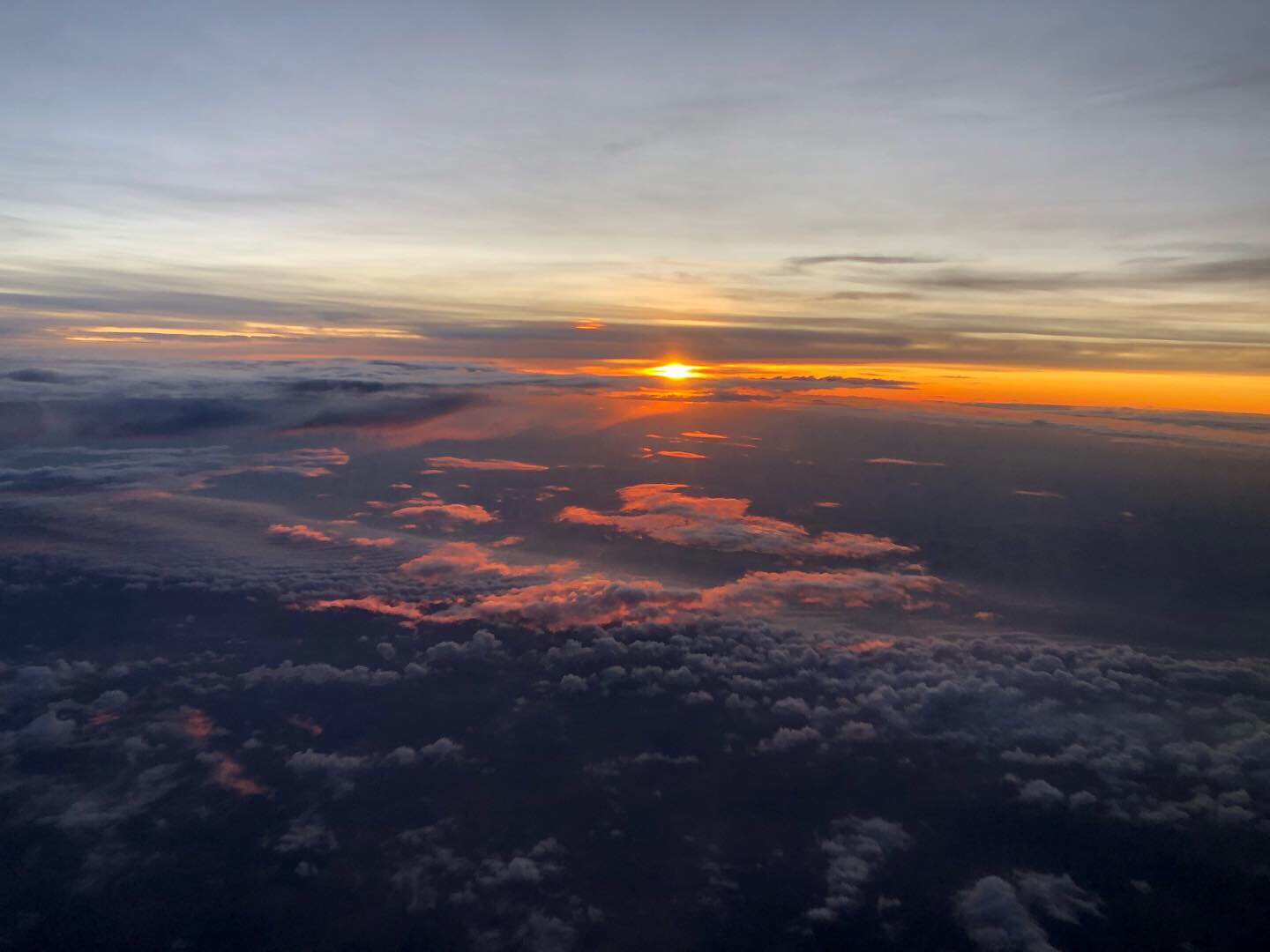
    The time after sunset is when the light show really begins.  If you’re lucky the sky offers you wispy clouds that reflect the fading light in brilliant hues from orange to purple.  When a moment, or a life, has passed, the lingering memory may offer brilliant reflection, staying with us well beyond their time, as the light dances above well after the sunset.  Moments like that moose return to me like the smell of Bodhi on his collar, whispering “I’m still with you”.

    I do think the edges of the day offer focus we may not have during the rest of the day.  Stillness brings awareness that might not be available during the frenzy of activity.  But whether we focus on them or not, each breath is a part of the sum of all of our breaths, and demand consideration. Here again, Annie Dillard reminds us:

    “How we spend our days is, of course, how we spend our lives.” – Annie Dillard

    So our days (and lives) begin with a call to follow our bliss, and end with memories and reflection.  It’s the in between time that is the bulk of our days, and savoring each moment, not just the Instagram moments, is essential. Writing, for me, offers the optics with which to focus on the everyday, and not just that occasional moose moment.

  • Breaking Free of Spreadsheet Travel

    “Buddhists believe that we live our everyday lives as if inside an eggshell.  Just as an unhatched chicken has few clues about what life is truly like, most of us are only vaguely aware of the greater world that surrounds us.” – Rolf Potts, Vagabonding

    I’ve been re-reading Vagabonding again.  It’s been about ten years since I read it the first time, and I’m discovering it anew.  At first glance a travel bible, on further review there’s a good dose of stoicism and hard-won pragmatism in this book that I appreciate more now than when I read it the first time.  As with re-reading Walden, it offers something new with every stage of life.

    When we confirmed an upcoming trip to London and Scotland in late October, I immediately started scanning the lists of things to see in each place, lists of experiences others felt worthwhile enough to put at the top of a list. Then came planning the foundational stuff like hotels, Airbnb and traditional Bed & Breakfast reservations, which put us in specific places at specific times. Then came the logistical stuff like car rentals, trains and ferries, amount of daylight at that time of year, the hours of distilleries and let’s not forget the typical weather. Not so much London, where other than the hotel I’m planning on winging it and relying on my daughter to show us her favorite places, but Scotland… Scotland has been heavily researched. I’ve watched just about every YouTube video you can imagine, plotted travel times and scrutinized street views, until finally I’d had enough. It was sucking all the joy out of the anticipation this trip offered.

    “With escape in mind, vacationers tend to approach their holiday with a grim resolve, determined to make their experience live up to their expectations; on the vagabonding road, you prepare for the long haul knowing that the predictable and the unpredictable, the pleasant and the unpleasant are not separate but part of the same ongoing reality.” – Rolf Potts, Vagabonding

    I’m not this way with other travel. When I went to Newfoundland I didn’t plan my every move on a spreadsheet, I booked a place to stay, went to the meetings I needed to go to and asked the locals where they recommended I visit beyond that. Simply talking to the locals about what their favorite place is has led me to some amazing waterfalls, restaurants and historic sites I might not have seen living off a spreadsheet.  But Scotland…  Scotland holds a dear place in my heart.  And so I over-planned with eager anticipation.  Vagabonding woke me up once again, and having done what I had to do with the rough framework of our trip, I’ll leave the rest to the whims of the road.  I’m eager to give driving a stick with the opposite hand.  Hopefully that doesn’t distract me from actually staying on the road.  There’s so much to see.


  • The Secret Burial of Colonel Westbrook

    In the middle of the night 275 years ago a group of family and friends buried the old Colonel in an undisclosed location to keep his body from being dug up and used as a bargaining chip by creditors.  That this war hero was in this position was regrettable, but 1744 Maine was a hardened world not prone to sentiment.  The final years for Colonel Thomas Westbrook were spent in a battle with his old business partner and fellow soldier.  And it was that battle that brought his family and friends out in the middle of the night to bury him, keeping the location of his grave a closely held family secret until the Bicentennial in 1976, an anniversary that settlers in 1744 couldn’t even conceive of.  They were far more concerned with the very real threat of the French and Abenaki than they were about breaking from Great Britain.

    It’s understandable if you have no idea who Colonel Thomas Westbrook is. Frankly I didn’t know who he was until 10:15 this morning, when I passed a sign for the Colonel Westbrook Executive Park on Thomas Drive (well played).  Being in Westbrook, Maine I was curious about a man who accomplished enough in his time to warrant a town being named after him. Which brought me to discover blueberry cheesecake ice cream. But perhaps I’m getting ahead of myself.

    Colonel Thomas Westbrook famously raided the Abenaki village at Norridgewock in search of Father Sebastien Rales (or Rasles, depending on whether you read the English or French description of the man).  Rales led Indian raids on English settlements in Maine (then part of Massachusetts), and by 1722 the English had had enough of it.  Enter Colonel Westbrook who raided Norridgewock but failed to capture Rales.  He did manage to confiscate Rale’s strong box, which had incriminating evidence of coordinating with the Abenaki to raid the English settlements.  This evidence became gas on the fire, igniting more hostilities between the French, English and Abenaki.  In 1724 another raid on Norridgewock resulted in the massacre of 100 Abenaki and Father Rales.  Westbrook wasn’t involved in that event, though his confiscation of the strong box provided plenty of motivation for those who did.  This was indeed a violent time in Maine, with atrocities committed on both sides.  Norridgewock was yet another example.

    Searching for information on Westbrook while I waited for my lunch appointment led me to an article about the discovery of his gravesite, which led me to Smiling Hill Farm, where I asked for directions to the grave site at the ice cream stand along with what their favorite ice cream was, which led me to that blissful blueberry cheesecake ice cream, which – finally – led me to a brief visit with the Colonel. Once again I found myself off-roading in dress shoes. I should really keep some old running shoes in the car for these unplanned detours… but I digress.

    The gravesite sits between a large grass field and a paved lumberyard. Colonel Westbrook was once the Royal Mast Agent supervising the harvest of white pines for the Royal Navy, so I think he’d get a kick out of the ongoing lumbering activity feet from his final resting place. He may be staring up at the planes taking off from the Portland Jetport wondering what the heck is going on in the world though.  Jet engines roar over the white pines that were once the critical material for the cutting edge transportation technology of the 1700’s.  Times have changed, but on the whole the place he’s buried would be familiar for him.  Smiling Hill Farm remains largely as its been for generations, operated by the Knight family since 1720.  They surely know a thing or two about Colonel Westbrook.

    I walked the dirt and gravel road (mostly a pair of tire tracks) around the front of the lumber yard and there it was, a small white sign in front of a patch of woods marking a quiet, overgrown grave.  This was the site that was revealed to the public in 1976 during the Bicentennial, making Colonel Westbrook famous throughout the area.  There’s a good article that helped me greatly commemorating the 40th anniversary of that Bicentennial celebration posted in the Portland Press-Herald on August 4, 2016.  Two years later it seems the Colonel has been largely forgotten again, at least judging from the overgrown condition of his gravesite.  There’s a replica of Father Rale’s strong box next to the grave site, slowly returning to the earth in this shady nook.

    If you go to Smiling Hill Farm, I recommend trying the blueberry cheesecake ice cream, served with a wooden spoon.  Then walk a bit of it off with a five minute walk to visit the Colonel.  He could use some company.  I may have been the first person to visit in some time based on the path to the grave, but perhaps other history buffs have preceded me.  Those that come after me will see the site in the same condition, as my footprints didn’t make much of a dent in the weeds.  But I paid my respects, dress shoes and all, and got on with my day.  Slightly more informed about events 275 years ago on a quiet hill in the middle of the night.


  • Empty Nest

    Sunday night. Terminal E, shipping off our daughter to London.

    Bags checked.

    Checklists checked.

    Dinner done.

    Last minute advice.

    Hugs and love expressed.

    Pictures.

    It’s time.

    Fly.

  • Expected Storms

    Flights all around me are being cancelled preemptively with severe thunderstorms expected this evening. I’m driving so I’m not worried about flight cancellations this trip, but do the mental math of the impact severe storms might have on my drive time. When you drive you control your destiny more than the flyers can, but also bear more of the mental burden of getting from here to there. Still, it’s a good trade-off.

    Weather forecasting has reached a point of accuracy where anticipated storms dictate flight cancellations more than actual storms seem to. There’s value in this of course, tempered with a dose of frustration when things get cancelled and the predicted apocalypse doesn’t appear. Those are the days meteorologists earn their money as people forget the overall accuracy and dial in on the inconvenience of the moment.

    Looking out the window I see sunny skies, but it can change at any time. If there’s a lesson a road warrior may offer, it’s to prepare as best you can, pivot quickly when possible, and take the rest as it comes. Stoicism in practice, you might say.

  • Rising Above the Sprawl

    I was contemplating the Ramapo Mountains early this morning. I get up early for the magic it brings. This morning didn’t disappoint as the slowly brightening sky highlighted the fog dancing through the hills of Ridgewood State Park. That there’s a highway, gas stations, bus terminal and assorted strip mall horror below this didn’t change my focus on what was beautiful, though I remained aware of the encroachment. There’s really no other way to move through this life – focus on the good, pragmatically manage the not-so-good.

    “God never made an ugly landscape. All that the sun shines on is beautiful, so long as it is wild.” – John Muir

    My drive down here Sunday involved miles of choking, soul-crushing traffic. Playlists and podcasts only go so far in the face of this. Most every car was filled with people coming from or going to something more beautiful, be it family or vacation or a day at the beach. And yet our collective journeys brought us all to the ugliness of gridlocked highways. Surely there’s a better way.

    Society pivots over time. At one point someone pushed for the protection of the forested hills of the Ramapo Mountains, saving them from a carpet of condos or some other indignity. Ridgewood State Park was born the same year I was. Now 53 years later I’m drawn to the very hills that inspired their protection. Good things can happen if we work at it. There’s talk of electric cars and Musk’s transportation tunnel and other such miracles of technological advancement. Perhaps it will transform our highways and cities from gridlocked misery. Society is slowly… slowly, pivoting.

    These hills around me are a good reminder of what preservation can do to protect us from ourselves. Sometimes we don’t see the forest for the trees. We know we shouldn’t eat the French fries but we eat the French fries. We know we should build clean and sustainable infrastructure and we build wider highways. The contrast between the transportation infrastructure below and the cooling green of the Ramapo Mountains above is a striking reminder of what’s possible if we’d only work at it.

  • Rolling Luggage and Dress Shoes

    Read enough business books and you’ll hear the story about the invention of the Rollaboard, the first luggage with wheels and a telescoping handle. It was invented by an airline pilot named Robert Plath in 1987. Prior to that an inventor named Sadler had developed luggage with wheels that you towed through the airport, but it was the Rollaboard that revolutionized the luggage industry.

    The point of the story inevitably comes around to why did it take so long to come up with something so simple? Usually the biggest innovations are right in front of you waiting to be discovered. Luggage was a common problem and adding wheels was inevitable, yet it still took decades for it to happen.

    Savvy travelers would pack lightly for long trips, wear the suit they’d use in the meeting, and take advantage of the curbside luggage for those bulky bags you couldn’t avoid. Now we max out the space available and buy scales to ensure we don’t go over the weight limit. The idea of hauling 50 pound bags around the airport today without wheels is ludicrous. How quickly the norm has changed from “keep it manageable” to “jamb it all in”.

    I’m on a three day business trip. I drove down to New Jersey last night with twelve million other people. Since I was driving I gave myself the luxury of an extra pair of shoes. One pair of dress black and one pair of dress brown shoes. Putting those in my small bag required creative packing but I’m a veteran carry-on traveler so no big deal. But then I remembered I needed to bring running shoes for exercise and a team-building event of some sort to be named later. I could have driven in any of these three pairs of shoes but dress shoes with shorts went out of style in 10,000 BC, and everybody knows you don’t wear your running shoes when you drive, so another pair of shoes was absolutely justified. For those keeping score that’s four pairs of shoes for a three day trip. I blame the luggage wheels for bringing me to this point.

    Luggage wheels solved a first world problem, but created another with the average weight of bags going up. There’s a direct link between luggage wheels and the ubiquitous storage units popping up all over the country. Wheels lead to more stuff, more stuff leads to maxing out the capacity of the attic and garage. Pretty soon people are renting storage space in some row of metal garages that used to be a cornfield. Progress? I think not. So this morning I have to choose between brown and black dress shoes. So much for keeping it simple.