Category: Travel

  • John Smith and New England

    Captain John Smith is usually associated with Jamestown and Pocahontas.  And he’s most famous for his relationship with the Native American tribes in Virginia.  Smith was proactively aggressive with hostile tribes, but proactively friendly with peaceful tribes.  There are plenty of examples in colonial history where hostile and peaceful tribes weren’t distinguished when it came to aggressive treatment of the Native Americans.  Pocahontas was just 11 when she met Smith, and it’s apparent that the stories of a romance between them are BS.  Whether she actually helped save his life is tougher to determine.

    Smith was an opportunist, but so were a lot of men coming to the virgin coast of North America.  What separated him from many others was his gift for self-promotion and his willingness to take risks to advance his standing.  But he backed up this, let’s call it entrepreneurial spirit with tactical and practical knowledge.  Many point out that the inhabitants of Jamestown didn’t fair so well when Smith went back to England.  Instead of growing and storing food for the harsh winter the settlers of Jamestown held out hope for supplies from England.  When the supplies never showed up as much as 90% of the population of Jamestown starved to death.

    Smith returned to North America in 1614 as ambitious as he was on his original trip.  This time he focused on what is now New England, and his crew worked on whaling and fishing to create a return on investment for those who funded the trip, while Smith and some others focused on mapping the coastline from the Bay of Fundy to the Hudson River.  Smith created a pretty accurate map, and betrayed his ambition by bringing the map to a young Prince Charles to have him choose place names for some of the locations.  A few of these, like the Charles River and Cape Ann, survive to this day.  Smith is credited with coming up with the name “New England” for this region, and named several other places on the map which have stuck.  But if he’d hoped to live on in infamy by naming the islands off Portsmouth, New Hampshire after himself, he’d be sorely disappointed to know they became known as Isle of Shoals.  But then again, Smith did enough to be remembered anyway.

  • Choice White Pines and Good Land

    I have a fascination with maps, and especially old maps, that dates back to when I was a kid tracing the route that we would take on family vacations.  When I started driving myself around I bought maps to help me navigate first the town I lived in and later New England and points beyond.  As a hiker I’d plot out where I’d be able to refill water bottles and camp for the night.  Maps were essential for navigating the world.

    Today GPS has stolen the magic of maps for everyday use in getting from point A to point B, but they can’t completely replace them.  I still plot out trips on Google Maps to plan the most efficient route.  I still love a good map; evident in the title of this blog.  So it was a delight to find a gem of an old map from 1761 created by Joseph Blanchard and Samuel Langdon.  This map has wonderfully random reference points like “From Connecticut River to a Great Pine Tree” and “This way captives have been carried by the Indians”.  This is a map you can fall in love with.

    Joseph Blanchard was born in the Nashua area and served as a Colonel during the French and Indian War.  He teamed with Samuel Langdon to create this map, which was published after Blanchard’s death.  It’s an amazing time capsule that highlights some contentious early days in our colonial history.  For me, the part of the map I love the most is in the present-day Plainfield/Montcalm area where the map designers noted “choice white pines and good land”.  A name like Montcalm jumps out if you’re talking about the French & Indian War, but apparently it’s not what the selectmen in that town were striving for when they named it.
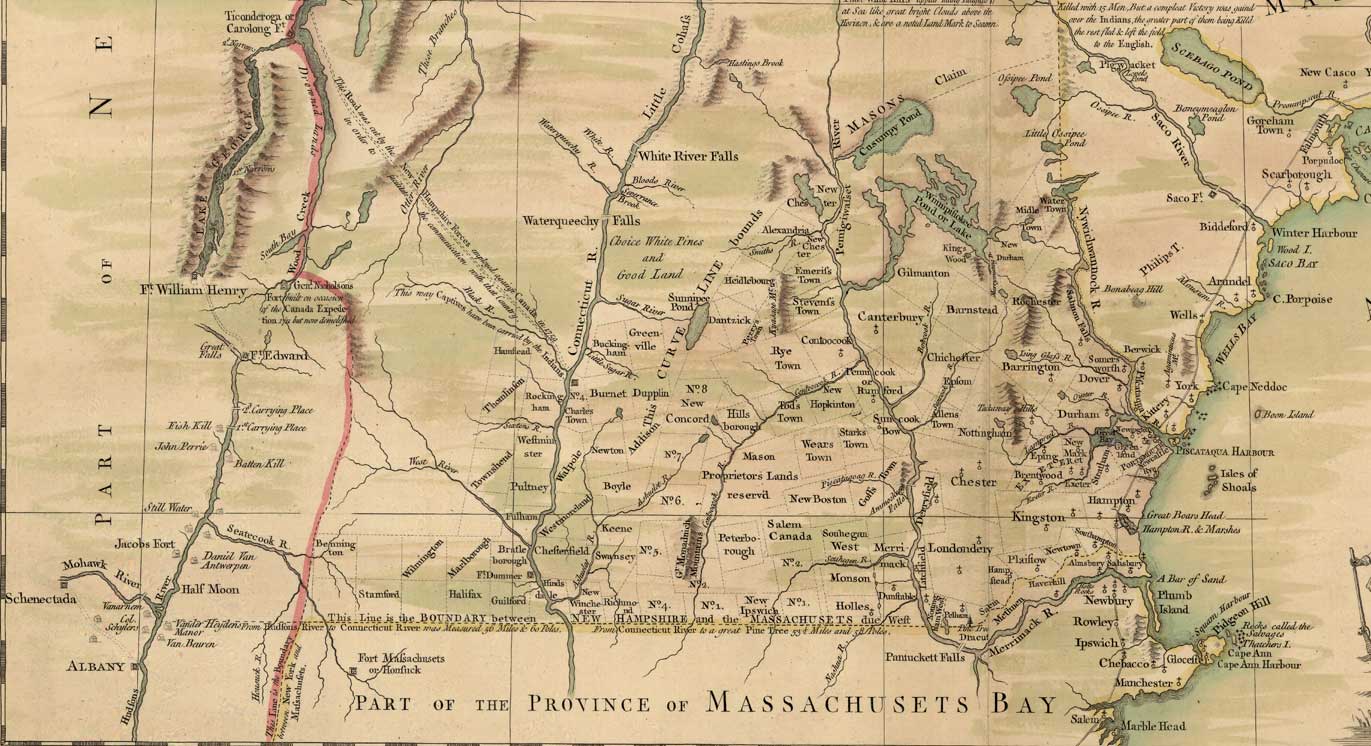
    If you search online you’ll find there are a couple of versions of the map available for  viewing.  The black and white version I have above, and a color version, a portion of which I show below.  The towns have mostly remained the same, with a few splitting into a multiple towns along the way.  The rivers are fairly accurate, which is notable since these were the superhighways of the day.  The map reaches as far west as Schenectady and as for North as Quebec.  This territory was ground zero in the French and Indian War, and the wars with the French that preceded it.  It would be important again during the early years of the Revolutionary War.  I’ve had the opportunity to travel most of this region over the years, and spend a lot of time writing about it in this blog.  So this map put a spell on me that I haven’t shaken loose from just yet.

    “The paradox of mapmaking… is that as soon as you begin shrinking a geography down to usable size, you necessarily are forced to misrepresent it. By making choices about what to include and what to leave out, you change the map from a document faithfully documenting an area to one furthering a particular point of view.” – Michael Blanding, The Map Thief

    Blanchard and Langdon created a map that clearly furthered a point of view, lending credence to Blanding’s observation. The history buff in me delights in reading it. Would it look the same if a Native American warrior had drawn it? Surely not. But the map no longer serves the purpose of furthering a point of view as much as it creates a snapshot of what the map’s creators were thinking at the time. Either way it’s a fascinating dance across time.

  • Downpours and Rainbows

    On Friday I drove through a downpour. A wall of water driving so hard to the ground that it looked like a thick fog as I drove into it. Rain so hard it creates whiteout conditions on your windshield. Cars around me reacted as I did by immediately slowing down, flipping the wipers to their fastest setting and a quick glance in the mirror to see what’s driving up on you. Some folks do better in this than others and like me keep going at a much reduced speed until it passes. Others, perhaps with vision problems or a less forgiving car pull over into the breakdown lane. Drive long enough and you’ll inevitably experience this a few times, and indeed I have.

    Ohio, 2015 driving a rental car from Columbus to Cincinnati I hit sustained rain so hard and steady that highway traffic came to a crawl. Worst I’d ever experienced. Even worse than Stockbridge 2011 on I-84 North approaching the Massachusetts border with intense, heavy sheets of rain pounding the windshield. I got to the rest area in Charlton and they were broadcasting tornado warnings. Sure enough one crossed I-84 shortly after I’d driven through that spot. I think back on my timing that day quite a lot, and look at where it crossed whenever I drive through.

    Back to Friday, and I-88 westbound through Otego. Down below 45 MPH for a stretch with blinding truck spray making it all but impossible to see. Pressing on the rain abated enough to improve visibility and then I was through the other side. Intense sunshine from the late afternoon sun replaced the rain and I quickly put on my sunglasses. Knowing this combination well I glanced in the rear view mirror and sure enough there it was. I smiled at the timing of the Wells Bridge rest stop approaching I pulled in and took a quick photo.

    They say things are darkest before the dawn. Friday offered a new twist on that, with the rain hardest before Mother Nature rewarded us with a rainbow. I’d paid my penance for the view, while those heading eastbound had the reward (the better view) first only to drive into the storm afterwards. There’s probably an analogy to explore there, but it’s best to be on my way.

  • Robert Treman and the Gorges

    I’ve never regretted a morning when I got up early and got outside to exercise. Today I’m moving Emily home from college so that meant an Ithaca waterfall walk. Different hotel than last time I was here, but fortunately there’s a stunning waterfall seemingly on every corner in this town. Five minutes walk from the downtown Hilton Garden Inn is the lovely Cascadilla Gorge Trail. As with most gorges, this one has plenty of water.The lower part of the Cascadilla Gorge Trail begins Treman Triangle, a small triangular shaped park named after Robert H. Treman, a local gentleman and successful Ithaca businessman who, along with fellow trustee Henry Woodward Sackett donated this Gorge to Cornell University.  But Treman didn’t stop with this gorge.  He also donated the land around Buttermilk Falls State Park and the park named after him, the Robert H. Treman State Park.  This is the type of wealthy guy I admire: make a lot of money and then do something good with it.  These were his time capsules, preserving the things he loved about Ithaca so that they might be enjoyed by generations long after he’s gone.  He’s remembered far more for the land he donated than for his success in business.  Isn’t that a greater success story than what he had accumulated in his bank account?
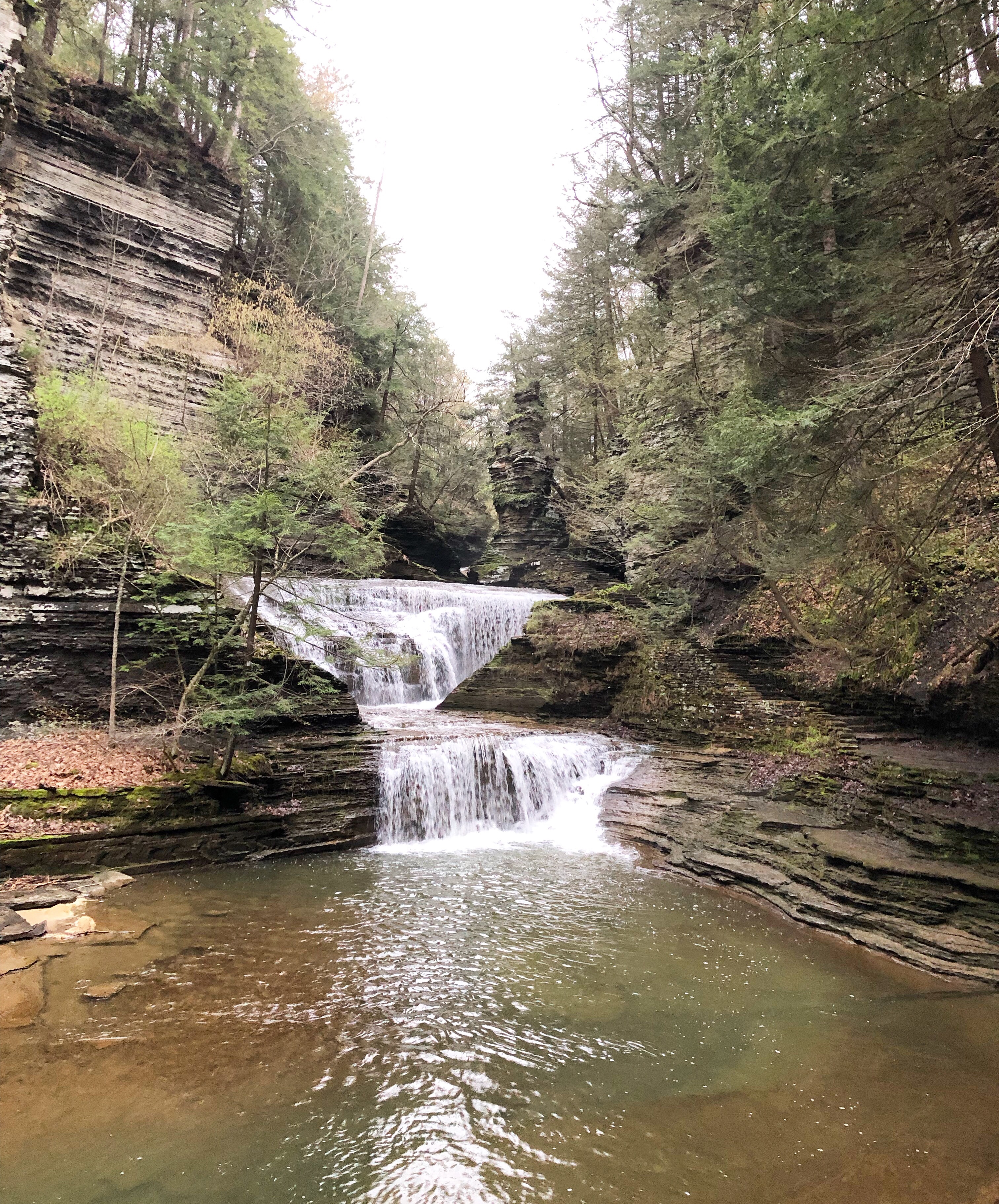
    I started writing today’s post thinking I was writing about Cascadilla Gorge and my observations about it.  It’s truly beautiful, and walking alone through it at 6:15 AM I felt like I was up in the Adirondacks somewhere, not walking up from downtown Ithaca to the Cornell campus.  My step-father went to Cornell and Cascadilla Gorge has a special place in his heart. Walking it while the city slept I could feel it. There’s magic in solitude, especially magnified in a spot like this.  Lingering here felt appropriate, but I was approaching this as exercise and aside from taking some pictures along the way I tried to keep moving.  As with most places I try to know something about where I am, which led me to a greater appreciation for Robert Treman.


  • Time Capsules

    A couple of weeks ago I stopped at Rogers Island Visitor Center in Fort Edward, New York.  I knew the place wasn’t open but I wanted to at least stop for a moment, look around and give a nod to the legacy of Robert Rogers, who used this island as a launching place for much of the fighting his Rangers did during the French and Indian War to the north of this place.  Rogers Island is strategically situated on the Hudson River and well known to the Native American, French, British and Americans who travelled these waters to “The Great Carrying Place” where you’d need to portage your canoe or Bateau boat on your trek to Lake George and points north.

    Rogers Island is considered the birthplace of the US Army Special Forces and holds a special place in the hearts of US Army Rangers to this day.  I wasn’t in the Rangers myself, but recognize the significance of the tactics developed by Rogers.  They essentially mirrored the tactics used by Native American warriors and added a few wrinkles of their own.  That’s a post for another time.

    While walking around I spent a few minutes reading the historical signs placed around the property and considering the commemorative garden that was just starting to bud on the April day I visited.  My eye was naturally drawn to the monument dedicated to those who fought and died in wars engaged in by the United States and I walked up to better view it.  While there I noticed the tablet on the ground marking the time capsule commemorating the 250th anniversary of the French and Indian War.  This capsule is scheduled to be opened in the year 2055.

    Time capsules are a message to future generations.  Schools do these all the time, and add things that are meaningful to the people who are participating in the event.  But the funny thing about time capsules is that in all likelihood you won’t be around when they open it.  Sure, 50 years gives you a fighting chance, but life is full of twists and turns and there’s no guarantee of anything except death.  So burying the artifacts of life is akin to a message in a bottle thrown in the ocean.  You’ll likely never see it again, but you hope that someone will and whatever message you give to them will be meaningful in some way.

    Time capsules are all around us, and you don’t have to bury some safe in the ground to make one.  My time capsules to future generations are the lilacs I planted along the property line, or the trees I planted out front.  They’re the bathroom I renovated in Pocasset and the words I’m writing now.  By this measure I look for similar offerings from those who came before me. Mostly my time capsule is the way I conduct myself and how that influences others for the better or worse as others continue to influence me.  I won’t be here forever but I hope my legacy will be positive beyond the generations who actually know me.  Time will tell, but it won’t tell me.

  • Asking for Directions

    Driving back home after getting my car serviced my trip was detoured for road construction.  Orange signs directed me to a new route, which of course I knew already having lived in the town for 25 years.  During this adventure it occurred to me that I haven’t been asked for directions in years.  The reason is obvious of course; everyone carries directions with them in their pocket.  GPS apps like Waze get you where you need to go, and tell you how much time you have left to your destination.  Where once we asked a person for directions, now this information is readily available.

    I stopped at a rest area a few weeks ago in Vermont.  The rest area attendant and I got to talking a bit about local historical landmarks.  I mentioned I was driving to a meeting near Lake George, had stopped at the Hubbardton Battlefield Memorial and was going to check out the fort when I got to Lake George.  He mentioned the tablet marking the location of the Battler of Fort Anne at Battle Hill, and gave me specific directions on what to look for as I was speeding along at highway speed.  I didn’t ask for directions, but they sure came in handy in spotting the tablet.  There are some things better left to humans to explain.

  • Iceberg Season

    This morning I was thinking about icebergs.  It’s iceberg season in Newfoundland, with more than 1200 released from sea ice and parading past the ruggedly beautiful eastern coast.  Icebergs are big business as tourists flock to see them, much as tourists flock to see Great White sharks now on Cape Cod.  The world has a curiosity about icebergs that goes back to the day the Titanic sank.  There’s something mystical and romantic about these roaming islands of ice marching from their icy prison in the north where they’ve been locked away for millennia to southern waters where they reunite with the blended waters of the world.  Romantic until you run into one anyway.

    Scanning the iceberg sightings this year made me think about my time on Signal Hill in December of 2017.  Signal Hill is impressive without the draw of icebergs floating by you, I can imagine the crowds there on a Saturday with an iceberg floating by.  My time there, documented early in this blog’s history, was memorable but certainly not crowded.  Little did I know at the time that I wouldn’t be back there again any time soon.  It remains on my short list of places I’d love to get back to.

    Environment and Climate Change Canada tracks iceberg activity and states that most of the icebergs that you see in the North Atlantic are calving from glaciers in Western Greenland, with between 10,000 and 40,000 icebergs annually.  I had no idea there were that many in a season.  To be categorized as an iceberg the ice has to be at least 5 meters above the sea level.  That’s the starting point, and icebergs get much bigger from there.  Those that miss the 5 meter cut are still navigation hazards.

    So icebergs triggered my wanderlust affliction, which is always lingering just below the surface.  Surely a trip to Labrador and Newfoundland in April would be a great mix of Aurora Borealis and icebergs.  Frankly I wonder why I haven’t done this trip already.  So much to see and do in this world, and two things I’ve always wanted to see are just out of reach this season.

  • Thoreau Never Worried About Dryer Lint

    Henry David Thoreau describes in wonderful detail his day-to-day life during his time at Walden.  In building his cabin, he obtained used brick to build a fireplace and eventually put in a stove for more efficient cooking.  And he dug a root cellar for storing his food, describing some of the foot lost to moles and other rodents in the matter-of-fact way someone who fully expects some percentage of their food stores to be eaten by rodents.

    Thoreau writes of the ice men who would come to Walden every winter to cut the ice to ship near and far for cooling deep into the summer.  Before refrigerators root cellars and ice houses were the norm, and blocks of ice were the preserving savior of many a family’s harvest.  Root cellars were generally disconnected from the main house, just as outhouses were.  Not having an outhouse in your home makes sense, and really it makes sense for the root cellar as well.  It’s meant to be a cold space, and the food stored there would naturally attract rodents.  Best to have that disconnected from the house.

    Not many people have an ice pick today, but it was so commonplace before refrigeration that it’s immediately thought of as a murder weapon in a mystery.  Casually walking out to the root cellar and grabbing an ice pick to chop off a few chunks of ice for your mixed drink is foreign to us but the concept of using the same tool in a murder mystery makes perfect sense.

    Today as I moved the laundry forward from washer to dryer to laundry basket to closet, I casually pulled the dryer lint from the filter.  For all the modern comforts technology has brought to us, the lint filter is likely low on the list.  But Thoreau would have marveled at it for all that it represented. We are all living a shared experience today with our modern conveniences, just as Thoreau shared similar experiences living in Concord. Most people today would be lost trying to use a wood stove for baking, just as HDT would be lost trying to figure out a microwave. It’s only when you step out into the wilderness that we share the experience of Thoreau in the 1840’s. For it’s there that we become closest to those who lived here before us.

  • Sisyphus the Homeowner

    It’s May 4th and Spring is officially here in New England.  Still a danger of frost, mind you, but the world is blooming.  I’ve been away from home for five full days and as with any extended trip I take a moment to take stock of the house, the pets, the yard and the pool to see what’s changed.  With Bodhi aging I started with him, and sure enough his overall well-being is much worse than it was on Monday.  He’s reaching his time, and we all know it.  For now I wanted to get him outside so he could relieve himself with dignity and I carried him down the deck stairs to the backyard.

    First thing I noticed was the sound of the pool filter making a strange sound and a quick glance at the pool betrayed the reason; the water level was eight inches lower than when I left on Monday morning.  Big problem.  I quickly shut off the filter (thinking the damage is done to the pump) and walked around the pool looking for the source of the leak.  As I write this I still don’t know, but for that much water to be drained from the pool it must be mechanical.  I cursed the timing as this would have been something I would have noticed had I been home.  Kris doesn’t focus on things like this, especially with an aging dog crapping all over the house while she’s at work.

    Beyond the dog and the pool, I noticed the many other changes that occur when you’re away for any time.  The world is constant change, and especially in early spring.  The grass is growing again, which is encouraging given the many bare spots that revealed themselves when the snow melted.  Several shrubs have significant winter kill, which is discouraging given the hope with which I planted many of them just a year ago.  Yet even these show signs of life.  Patient monitoring and maintenance may be enough to bring them back.

    Being a homeowner who travels requires a commitment to maintenance.  You’re signing up for lawn care, housework, mechanical troubleshooting, home decor changes, and ongoing financial outlay to fix or replace things that go astray.  These things ground you when you want to immerse yourself in this world.  Or they handcuff you as you look to the world outside.  It’s a state of mind, really.

    Today I need to roll up my sleeves and get to work maintaining that world we signed up for twenty years ago.  Like Sisyphus pushing the boulder up the hill only to see it roll down to be pushed up again for eternity, being a homeowner means you’re doomed to repeat the same tasks for eternity.  Last year it was the hot tub (still is), this year it’s the pool.  Last year I re-seeded parts of the lawn, this year I’ll be re-seeding parts of the lawn.  Such is the fate of the homeowner.

    There’s a calculation that every homeowner goes through in their heads; is the ROI on this worth the effort?  As an empty nester with a serious wanderlust trait, at what point does it make sense to sell the place and gift these Sisyphean, perpetual tasks to others?  Alas, the answer is… not yet.  For all the maintenance headaches, I love having a pool.  For all the weeding and re-seeding and winterkill, I love having a garden.  For all the sadness of watching your dog age, I love having him around as long as he’s not suffering.  And so it goes, around and around.

  • Buttermilk

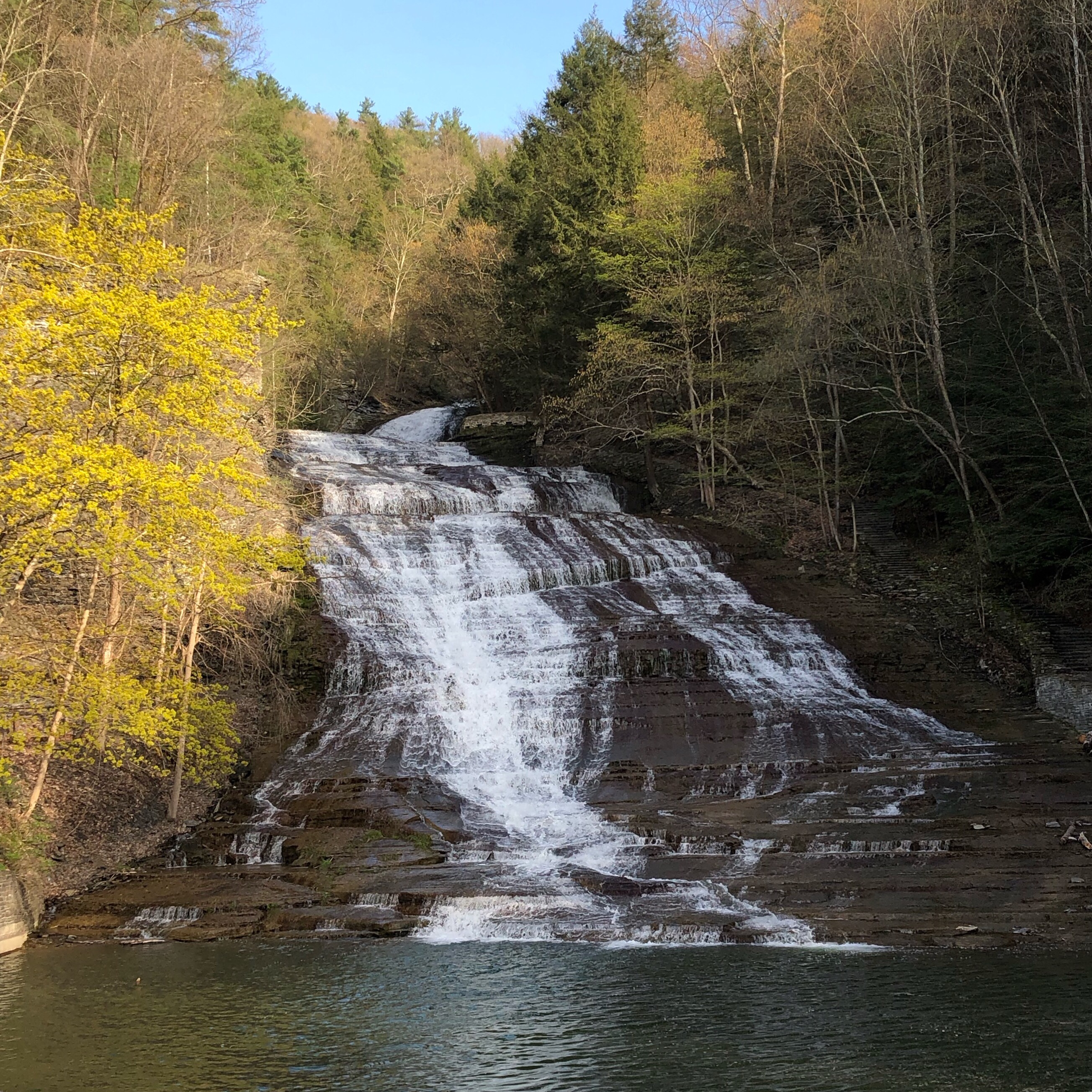
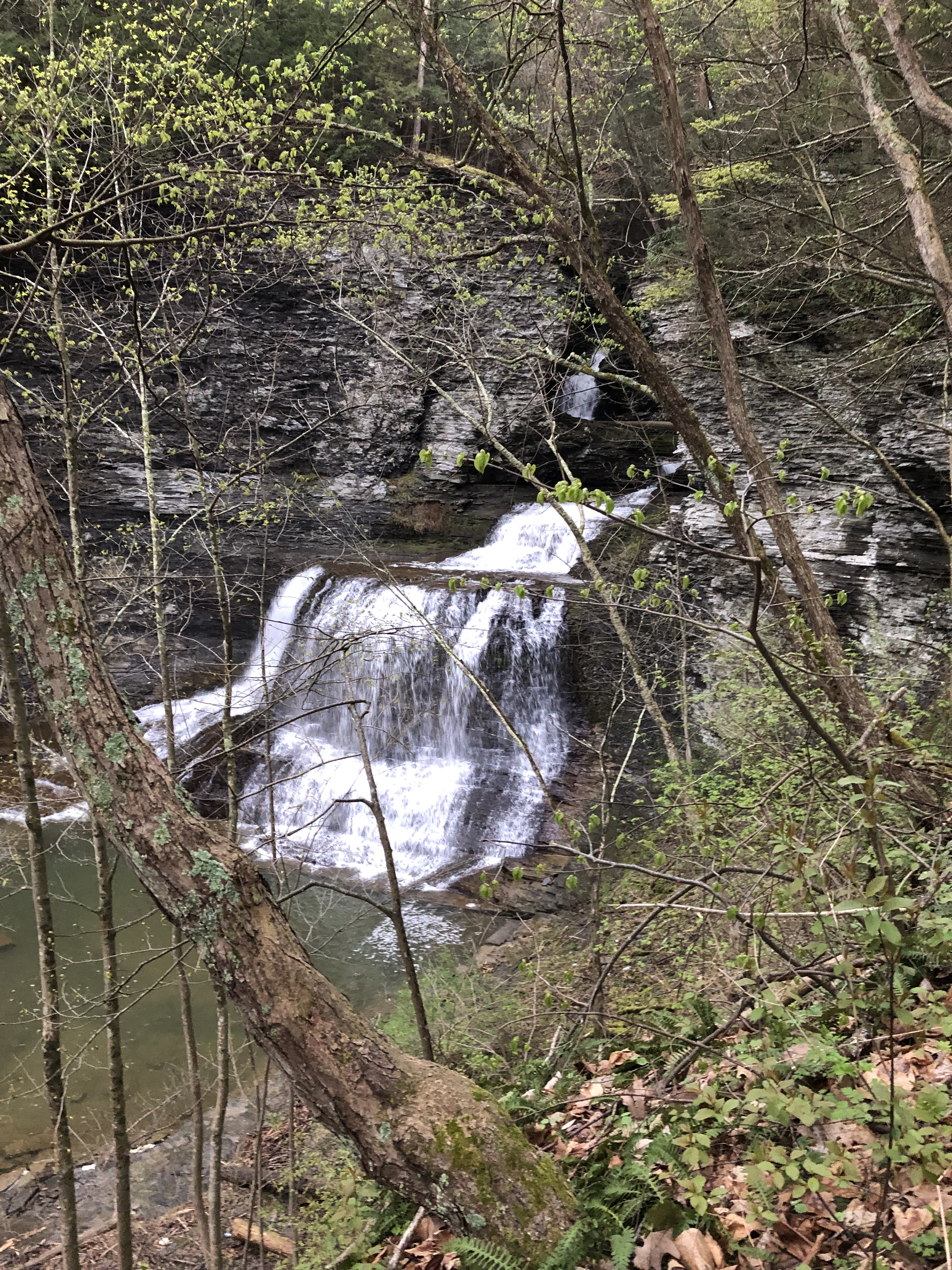
    Buttermilk Falls State Park offers lovely views of the many waterfalls that cascade through the gorges carved by Buttermilk Creek. The biggest cascade is the easiest to see – you can basically drive right up to Buttermilk Falls and take a picture of you wanted. But who the hell wants that? I walked over to the falls from the Hampton Inn I was staying at when I checked in to get the blood flowing and again this morning as part of my earn your breakfast routine. From the Hampton to Pinnacle Rock it’s a little over 3 miles round trip.

    The walk from the hotel to the entrance to Buttermilk Falls State Park is roughly a mile of strips malls, fast food restaurants, and loud traffic rolling by you.  Not the highlight of a trip to Ithaca.  But once you turn into the driveway you see the falls right in front of you and the city sprawl becomes a memory.  As I walked in I noticed that the park was completely empty.  It was 6:15 AM after all, but still, I expected at least one or two people tapping into the energy of Buttermilk Falls.

    Yesterday I stopped at the first observation platform as you walk up the stairs.  Today I wanted more than that and aimed for Pinnacle Rock.  The thing about waterfalls is that if you’re going to hike alongside them you’re going to end up walking uphill for some period of time.  At Buttermilk the steepest part of the Gorge Trail is the very beginning, which probably deters a few people from continuing on.

    The Gorge Trail is about 1/2 mile from Buttermilk Falls to Pinnacle Rock.  This morning in the rain that walk required a dose of awareness of where you were walking.  I don’t hike as often as I’d like, but I can certainly handle this terrain.  Much of the Gorge Trail is stairs and terraced stone built in the 1930’s and 40’s.  I’m sure it’s been re-built a few times over the years but it looked very much like it might have then.

    When I reached the second bridge across Buttermilk Creek I looked up and there was Pinnacle Rock, perfectly situated amongst a double waterfall.  This was what I told myself I came here for, but really it was the experience of hiking up this quiet trail early on a Friday morning while hundreds of people commuted to work just below me.

    For me a hike begins with a Friday night-level anticipatory excitement, and I felt that exhilaration as I rounded every hilltop or bend in the trail to see what came next.  But inevitably the hike must end, and as I descended the Gorge Trail I experienced that Sunday afternoon melancholy of knowing I was going back to the roar of the commuters and back to another workday.  As if to hammer the point home for me, I glanced out across the creek on my descent and saw the orange awnings of a Home Depot across the street from the park entrance.

    All told I did the walk from the hotel to Pinnacle Rock and back in under an hour.  That hour far exceeded any amount of time on a treadmill or an erg in my basement at home. If I lived in Ithaca I’d start every morning with a similar hike.  At least that’s what I tell myself.  If there’s anything positive about business travel, it’s that I’ve grown accustomed to being in different places every night.  If there’s a drawback, it’s the relative ease with which you can slide into bad habits.  Today I cast a vote for a good habit, and I’m the better for the experience.