Tag: New Hampshire

  • The State of Things

    “For to be idle is to become a stranger unto the seasons, and to step out of life’s procession, that marches in majesty and proud submission towards the infinite.” – Khalil Gibran, The Prophet

    I paid a friend to mow my lawn for ten years. I traveled often and didn’t have the time to keep up with it, so I’d simply throw money at the problem and it would be done. Something happens to your yard when you aren’t out in it doing the work. It pulls back from you, feeling shunned perhaps, or maybe reasserting the wild tendencies that were always there, but corralled in suburbia. Walk in the woods and count the cellar holes and stone fences and you’ll know the truth: The land has a longer memory than our lifetime.

    Over the last few years I’d walk about the yard on some gardening task, looking at the state of things. The lawn was cut well, with fine lines at expert angles, but the lawn itself was in a sorry state. So we’re the beds and walkways. In fact the whole yard was feeling a bit worn down and neglected. Sure, I’d rake or spread mulch or pick up the fallen branches after a storm, but the land was slowly returning to a wild state. I’d spent all my time at home on the garden and potted plants, and was getting the cold shoulder from the rest of the yard. No, this won’t do.

    The first step in repairing a damaged relationship is to put in the time building trust back. So I bought a Honda push mower that forces me to walk every step of the land and with the warmer weather I’m out there walking the property. You notice things when you walk every step of the land, things like the quality of the soil in certain places, and weeds you don’t have a name for, and chipmunk holes, and roots and stumps from experiments gone bad. Each step brought me closer to the truth, and forced me to reconcile my decade of indifference to the land. I’d have to do better.

    Eventually travel will return, and weather windows will make mowing an inconvenience. But other excuses like soccer games and basketball tournaments and dance recitals have given back time I’d used to justify the hired help now that the kids are adults. And I’ve found that I enjoy getting to know the land again. It keeps me honest with myself. It’s a form of penance for a decade of neglect, and I don’t seem to mind at all. There’s work to be completed, seasons to mark, tasks at hand, projects to do. A slow march to the infinite, one step at a time. The land might reject me still, but I’m back on it anyway, trying to keep up with the state of things and learning lessons along the way.

  • The Tickle of a Spider on the Tongue

    This is the absolute truth.  This morning I poured myself a glass of water and started writing a post that will have to wait for another day.  I’d set the kettle and heard it starting to boil as I was writing, so I took my glass that had been sitting there and walked into the kitchen.  As I stood in front of the kitchen sink waiting for the kettle to whistle I took a swig of water and felt a clump of something on my tongue.  I spit out the water onto a plate in the sink and there was a spider, equally stunned by how its day had started.  I laughed (what else can you do?) and carried the plate outside and brushed the spider off into the holly bush.  After taking stock of my tongue, I rinsed out the glass and poured myself another one.  I’m fairly sure that the day can only get better from here, and I’m guessing the spider feels the same.  You never know what the new day will bring you.

    Yesterday I tackled yet another project that’s been nagging at me; a river stone bed that had accumulated years of dirt and bird seed and all manner of tree debris.  I spent several hours pulling out every stone, cleaning out the bed and putting the stone back in (If this seems like the perfect way to spend a Saturday, you must be a gardener too).  It’s a meditative process, and I managed to transform the bed from an eyesore to something beautiful that nobody else will ever notice but me.  And it seems that this river stone bed was the perfect place for giving birth to the next generation of spiders, as I disturbed 4 – 5 spider moms with white egg sacks.  In each case I tried to sweep the spider gently into a dust pan and relocate it to another part of the yard.  That was supposed to be my good spider karma for the weekend, and I felt I’d done my part for humanity’s ongoing tenuous relationship with them.  And then I drank their cousin.

    After this enlightening moment I decided to look into what species of spider I almost consumed.  It was your typical wolf spider, which are hunters who don’t spin webs (I feel I might have noticed a web before drinking the spider).  Living next to the woods you see a lot of spiders.  I don’t believe the other family members are as unconcerned about that as I am.  But then again I’m at a point in my life where I don’t worry about such trivial things as spiders on my tongue.  You’ve got to roll with whatever life throws at you.  I don’t ever expect to experience such an epic moment again, but you never know.  I’ll make a point of checking my glass before drinking next time around.  The entire event reminded me of the fable about a ham and egg breakfast.  Sure, the chicken is involved but the pig is invested.  It seems I was the chicken this morning and the spider the pig.  A near-miss breakfast and a moment to remember.  So how’s your day going?


  • A Pair of Opossums Enter the Scene

    I have two neighbors I’ve only seen once, just the other day from an upstairs window overlooking the backyard and the woods beyond. At the edge of the woods there’s a chain link fence that once occasionally held the dog in and now defines the wild from the manicured backyard I wrestle with endlessly. It seems at some point a couple moved into the vacant (of humans anyway) part of my yard that lies beyond the fence. A pair of opossums entered the scene and I can’t stop thinking about the new neighbors.

    I watched them, deep in opossum couple conversation, climb over the old stone wall that marks time in centuries, linger at the gnarled roots of a red maple and slowly make their way into the pile of brush piled just on the other side of the fence. It seems this is the ideal love nest for this pair, and they’re likely doing their business of creating the next generation of opossums as I write. I don’t mind, we can use all the tick and bug eaters we can get around here. I can do without the chipmunks and the groundhog that nibbles on my sweet potato vines and tomatoes, but the opossums are okay in my book. Keep gobbling up those ticks and we’ll be fast friends.

    Funny thing about opossums, the males are called Jacks and the females Jills. Their offspring are called Joeys. They’re nocturnal and generally transient animals, unless they find some cushy love nest anyway. Some people call me Jack, but nobody would call me nocturnal. But we all have our time, and Jack and Jill can have the night. We can say hello during the morning shift change. Hello, Jack! Hello Jack and Jill! And Joey, and Joey, and Joey… but I digress. Opossums have a way of distracting me with their delightfully different vibe.

    Which brings me to the elephant in the room: That silent O in opossum. Who’s idea was it to drop that in there anyway? I complain about learning French, but English is no picnic either. Silent O indeed. It’s my native language and I’m still inclined to start saying “O” when I read the word. Who made these rules anyway? Someone who thought about how delightful it would be to screw with the world for generations. Probably someone named Jack. Or Jill. You know they’re the troublemakers… unlike our friends the opossums.

  • I Wonder About Such Things

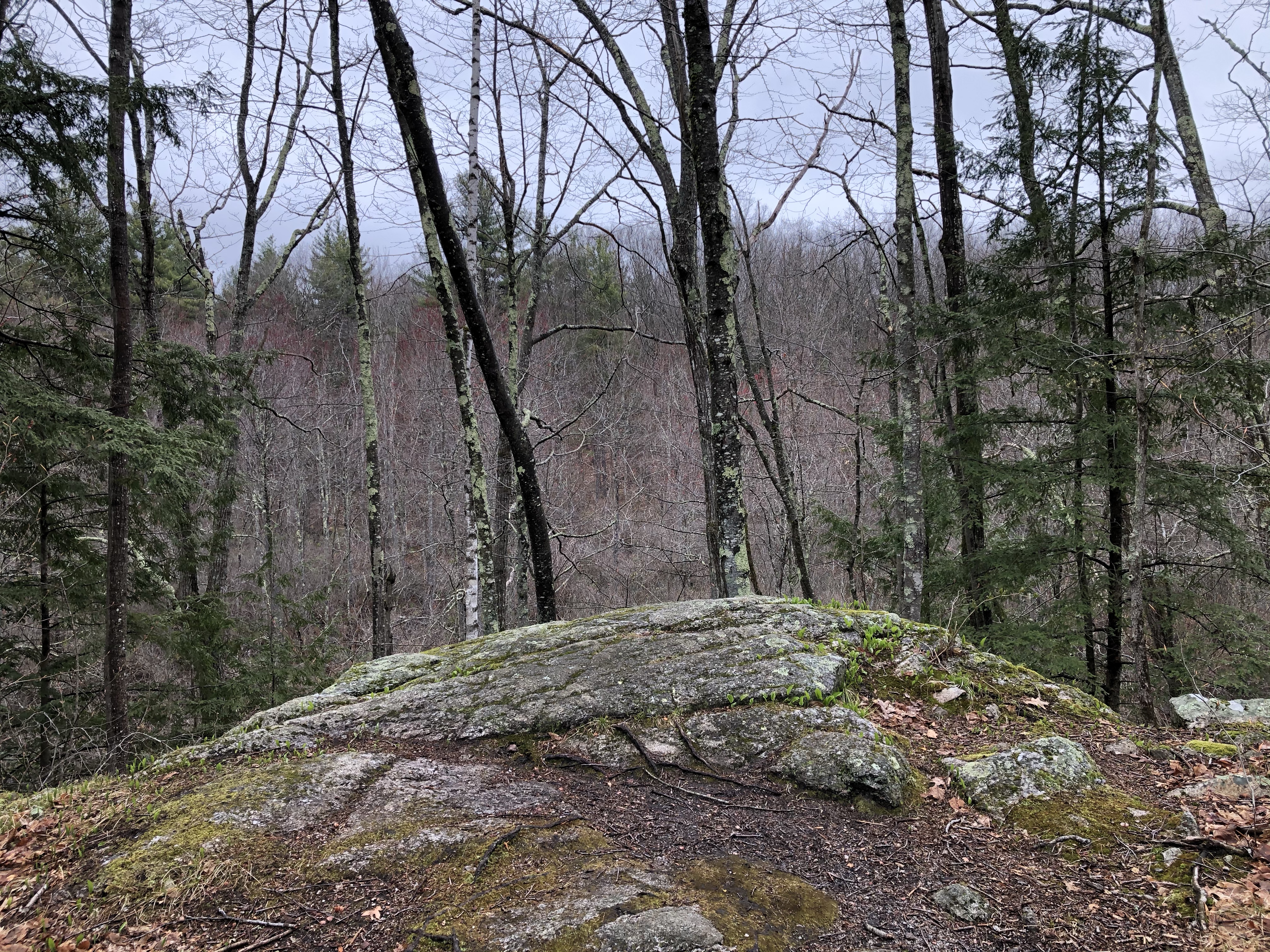
    Who stood here, on this foot-worn knob of ledge looking out on the valley below? Not just today, but one, two or three hundred years ago? I wonder about such things.

    One hundred years ago a young couple, riding up from the mills of Lawrence or Haverhill, getting out of the city for some country air. This spot would surely be an attractive picnicking spot for quietly plotting their future together. A mixture of plowed fields and young forest creeping back in. A fine spot to debate the wisdom of the start of Prohibition or the long-overdue right to vote for women.

    Two hundred years ago, a farmer surveying the land for as far as his eyes could see all plowed fields and grazing land fenced in with large stone pulled all too frequently from the soil. Did he think about his stone walls cross-crossing the land marking his time here long after he left this earth? It was a hard life working the rocky soil. This ledge might have given him a moment’s rest in a lifetime of long, grinding days.

    Three hundred years ago, this ledge might have offered tactical advantage for the Abenaki still fighting for this wilderness of old growth forest. This high ground offered a place to ambush a hunter up from the settlements. But by this time they’d been driven further north and west, and this wilderness would soon be transformed wholly, as the entire continent would be. The Abenaki surely saw the threat of encroaching settlements. Could they imagine all the changes that would come?

    I wonder about such things now, as I stand with ghosts on this ledge, hearing their whispers. It is indeed good land, slowly returning to its original state. This ledge could tell her secrets given the chance. And now I’m just one more story, standing atop an old knob of granite, thinking I might live forever, but the ledge reminds me of the folly in that belief.

  • The Sound of Familiar

    “I hope you’re haunted by the music of my soul
    When I’m gone”
    – Greg Allman, My Only True Friend

    There is what feels like a thousand Black-capped Chickadees living in the holly bush next to my deck. They’re the state bird of both neighboring Massachusetts and Maine. New Hampshire, sitting between these two states, opted for the Purple Finch. Don’t tell that to this cast of characters – they don’t much care for state borders and such human concerns. The party never stops in that holly bush. But now and then a solo singer will fly up on a branch somewhere and sing that familiar “fee-bee” song and it transports me back to earlier days. That song’s been playing my entire life.

    One of the first things I notice when traveling is the ambiance is different. That’s obvious to everyone when you’re seeing the Eiffel Tower or the Grand Canyon, but close your eyes and listen past the sounds of humanity.. There’s a vibration to any place, a soundtrack playing in the background. Wind, water and trees offer their voice, and of course the local bird population sings their own greatest hits like a house band in a local pub. I’m a bit of a migratory bird myself, stuck in a cage at the moment. But I’ve learned to listen in new places and long for the exhilaration of immersion in faraway places.

    With fewer long drives I’m listening to fewer podcasts. I’m reading more, and I’ve grown tired of most of the interviewers I regularly listen to. Instead I favor silence more, or listen to WMVY streaming from Martha’s Vineyard. We all have our greatest hits playing on repeat, but I’ve always sought out new music. WMVY offers music you don’t hear on some corporate iHeart radio station. Respectfully, I prefer to find my own soundtrack. Someday, maybe, I’ll get back to that island. In the meantime I listen to the familiar voices and think about the ferry ride to Vineyard Haven and fried fish and beer at The Newes From America. Island sounds are different from mainland sounds, but for the life of me I’ve lost the sounds beyond the bustle of crowds and the crash of waves. I do need to get re-acquainted, picking up just where we left off like old friends seem to do years between seeing each other.

    The music of a place goes beyond the songs played on the local radio station or in the local pub, it includes the buzz of outboard engines or lawn mowers or street sweepers or chain saws off in the distance, of laughter and chatter coming out of open windows, and the birds occupying the local shrubs catching up on local gossip. The place doesn’t hope you’ll remember it, it just keeps on going as it always has, so long as humanity doesn’t bulldoze it all away anyway. I suppose Greg Allman was thinking about his legacy in the lyrics of this song. We all hope we’ll be remembered in our own way. I write and let it all fall out the way it may. Mostly it’s a familiar record I might return to someday. Like fond memories, revisited.

    I believe I’ve held onto this post long enough. I think it’s time to release this bird from its cage.

  • Dry Towns, Blue Laws and Border Crossings

    There was a time, within my time, when towns were well known for being wet towns or dry towns. I’m not talking about the amount of rainfall, but rather whether a town allowed alcohol sales or not. I went to a dry wedding once and marveled at the resentment in the room as people found out about it. Imagine moving to a dry town and realizing it afterwards? Like that wedding people would simply carry in what they’d like to drink. Rules are meant to be broken, aren’t they?

    New Hampshire only has one “dry” town out of a combined 259 total towns, cities and “unincorporated places”.  That town is Ellsworth, a small town just west of I-93 between the Lakes Region and the White Mountains.  There are only 83 residents in Ellsworth, and every one of them of drinking age have to go to another town to purchase alcohol.  I’m guessing there aren’t a lot of restaurants or stores selling alcohol in Ellsworth anyway, but if they have anything going for them it’s that quirky statistic that makes them unique in the state. Live Free or Die indeed.

    Neighboring Massachusetts by comparison has 8 dry towns. It used to be many more in my lifetime, but the trend is downward. Look, even the Puritans drank alcohol, and for generations it was safer than water in those early colonial years when life was hard and cholera was common. The Pilgrims brought beer across the pond and negotiated with Massasoit with aqua vitae. People went straight from the cold church to the warm tavern. Alcohol consumption was common right up to a century ago, when Prohibition crashed the party for the entire country. From 1920 until 1933 the United States was “dry”. But rules are made to be broken, and organized crime and small time bootleggers, rum-runners and illegal moonshine stills came into prominence immediately afterwards.

    Dry towns are bureaucracy in action, or simply inertia. Most dry towns today are in rural, sparsely populated places that don’t have restaurant and store owners campaigning for change. Dry towns are a curiosity now, 100 years after Prohibition, but also a legacy to the cultural and political winds that blew across the country then. Being a wet town kid, I remember going with my grandfather to the bar where he would proceed to drink many beers in tiny glasses. That bar was on the edge of town, and that edge was wet meeting dry. How many people crossed the border over the years to have a couple of drinks and zig-zagged home? Now that former dry town sells much more alcohol than that old wet town. Money talks, and there’s money in alcohol sales.

    Sunday’s were once a sacred day in Massachusetts, with Blue Laws that prohibited the sale of alcohol. So naturally residents drove across the border to states that didn’t have blue laws. New Hampshire’s southern border is dotted with old convenience stores that sold beer to eager Massachusetts residents on Sundays. New Hampshire built liquor stores on the highways for the quick and convenient sale of alcohol to out-of-staters. The Blue Laws are long gone, but “sin taxes” aren’t. People still stop to fill up their trunks.

    So Ellsworth, New Hampshire remains the lone holdout on the dry side of the law. I hope they always will be, as a reminder of where the country was 100 years ago. If we’ve learned anything over the last few years, it’s that the political winds can blow in strange ways, and a few people can impose their views upon the masses given the opportunity. But if Prohibition teaches us anything, it’s that Americans chafe at arbitrary rules and find ways around them. Our forefathers would recognize the debate either way, and marvel at the choices in the liquor stores.

  • Grateful For The Connection

    They say the Striper return to New Hampshire waters when the lilacs bloom. By “they” I mean a guy standing in front of me talking to another guy six feet in front of him. That the statement was overheard in a COVID-19 mandated line to get into a store is a curiosity of our times, but interesting to me if only because I don’t generally participate in fishing talk. I’m not much of a fisherman, more a fish eater, but I instinctively heard the truth in that statement.

    I’ve been in the woods of New Hampshire for a month now, and other than two trips to visit the in-laws from afar I haven’t strayed out of the 603. I’m plotting covert salt water visits in my mind. I scroll through old photos on my phone and think about excuses to visit Cape Cod once again. Salt water is just out of reach… damn. I’m told that social isolation helps flatten the curve and like most people in the world I hear the truth in that statement. I’ll remain here in the woods for now.

    “Sometimes we are starving to see every bit of what is right in front of us.” – Brian Doyle, The Shrew

    I’ve learned the truth about myself over the years. Especially now I suppose. I’ve learned that it’s easier to listen when you turn off the flow of distraction the world offers. I suppose that’s why people turn on the flow; for distraction. Or to feel connected to the world. We all do, in some measure. The truth about me is I don’t need much distraction. But I do need connection. I learned long ago to have connection you need to reach out for it, because most people are dancing with their own distraction. I turned to the poets and songwriters because they offer connection in spades, even when they’re long gone from this world. If they are so bold as to reach out to me I ought to listen to what they have to say.

    As I stood in that line waiting for enough people to exit that I might enter the store, I found silent connection with a couple of fishermen. It was a bit like stealing because I picked up pieces from them but didn’t give anything back in return. So instead I paid it forward with others I’ve spoken with since, and now with you. Connection is a chain, and we are the links. Distraction weakens the link, attention strengthens it. It doesn’t always seem like it, but I do try to pay attention. And since I have yours, let me say I’m grateful for the connection.

  • Wet Snow Decisions

    The snow came down heavy and wet all afternoon and into the night.  There’s so much water in the snow that you can’t pick up a complete shovel full without risking injury to the shovel or your back.  Only three inches, maybe, blankets the driveway and lawn.  This is snow blower snow, running slowly and deliberately so you don’t clog the chute.  I took the shovel down to the street and cleared some of the plowed snow piled up at the end to give the rolling trash barrel a stable base.  Then I walked back up to the garage, wondering to myself “I suppose this might melt if I just let the sun work at it”.

    Nothing tests your work ethic like late spring snow.  In January there’s no question I’d clear the driveway.  In late March?  Well…  I walked inside and checked the weather report on my phone.  Sure enough, the temperatures are going to warm up enough to make a real dent in this slip with the consistency of wet cement.  I took an inventory of who is going out and who is staying in during this pandemic.  Nobody is going anywhere.  Are we getting any deliveries today that would require me to clear the driveway?  Maybe.  Maybe not.  That’s the wild card, isn’t it?  It’s not about me at that point, it’s about the FedEx guy or the person delivering propane.  Yeah, they’d appreciate a clean driveway.  Might not even deliver if it’s a mess…  damn.

    Well, I could use some fresh air, right?


  • Living Heartily

    “I’m not the river
    that powerful presence.
    And I’m not the black oak tree
    which is patience personified.
    And I’m not redbird
    who is a brief life heartily enjoyed.
    Nor am I mud nor rock nor sand
    which is holding everything together.
    No, I am none of these meaningful things, not yet.

    Mary Oliver, I’m Not The River

    I walked outside barefoot to a chorus of woodland song early this morning. Robins and cardinals and even those clever rascals the crows were all singing to each other at the edge of the woods where humans begin. Birds don’t give a thought to human worries about COVID-19 or mortgage payments or how many steps show up on your watch. No, they go on living heartily, not thinking about the briefness of the duration but working hard to ensure this particular moment isn’t their last.

    It’s Spring in New England. The world wakes up similarly to the way it woke up yesterday, but there’s a slight shift in attitude. The mild winter and a pandemic cancelling everything normal in life and Mookie Betts dumped for money and Tom Brady moving on all make this Spring feel different from any other in my memory, but walking out into the morning chorus you see it’s all the stories we tell ourselves. We’re all just living this brief moment and trying to live another day. Stoicism offers a guide to living more powerfully.  To accept fate (Amor Fati) and our ultimate fate (Memento Mori), and to apply this knowledge, this understanding of the world, to embrace every moment.

    “It’s time you realized that you have something in you more powerful and miraculous than the things that affect you and make you dance like a puppet.” – Marcus Aurelius, Meditations

    I’m working on things just as we all are. Holding things and people together, working to be patient with this world around me, working on small, daily improvement. Living heartily might seem a challenge right now, but it’s more important than ever. I’d think it was a lot more challenging a hundred or a thousand years ago. No, we live in relative comfort compared to those before us. They’d surely laugh at the things we call hardship. We can hold it all together and get beyond this too. Walking barefoot out to greet this first day of Spring and embrace the chorus seems a good first step. But there’s so much more to do with this day, isn’t there?

  • Acorns and All

    The farm through the woods lets the horses loose to run, and I love being outside when it happens; seeing them flash through the trees as they gallop up the hill. This time of year, when the trees between us stand dormant and naked, it’s easy to see them as they run. When the leaves fill in the flash fades from view but I’ll often hear them whinnying to each other and I’m left imagining their joyful charge. When the horses run I’m reminded why I stay in this place.

    The snow is long gone in Southern New Hampshire. All that’s left now is the fallen branches and a million acorns from a bumper crop that fell relentlessly last November. March brings cleanup work and assessment of damage done. Raking those acorns up yesterday I watched the moon rising above the trees. The moon seemed in a hurry to get above it all, and her progress was better than my acorn cleanup. But eventually I got it done, feeling a bit better about the state of things outside. Other neighbors without oak trees don’t have to deal with acorns, but I’ll take the oak trees and live with the trade-off, thank you. It felt good to be outside doing something anyway. I just wish they would be a bit less giving in return.

    Woodpeckers duel for loudest drumbeat on trees out in the woods, and the Mourning Doves sing their sad songs to each other. Their population seems to be increasing at a pace similar to the wild turkeys that roam the woods and spill over into the yard now and then. A mild winter seems to have helped the local wildlife. I know that means the tick population will thrive as well. The human population of Southern New Hampshire grows as developers snap up open space. Maybe the wildlife is just being pushed closer because their natural habitat is shrinking. Hard for me to tell for sure, but it seems related. I know the woods will remain protected but I wonder about the horse farm. I’ll know it’ll be time to move when they develop it. I have no patience for encroachment but I’m a realist. Unchecked development will change this place too. I’m grateful for the good, put up with the bad and wonder about the world as we try to mold it to fit our needs. For my part I’ll keep the oak trees, acorns and all, and hope whoever settles here after me has the same sense of wonder about the world around us.