Tag: New Hampshire

  • Walking to Interesting

    If you watch a commercial on television, or a reporter out on a city street, or even the cast intro on Saturday Night Live in February 2021, everyone is wearing masks. A year ago you’d have wondered at it, even as the pandemic rapidly descended on the world. Today it’s commonplace, and I’m more often surprised at the outliers walking into a store without one. I stood in a line for snowblower parts and a mechanic walked briskly through the store unmasked. In a crowded grocery store I saw an elderly woman(!) without a mask on. In both cases I had the same reaction I might have had two years ago to someone wearing a mask. Isn’t it funny how the world has changed our perceptions in such a brief turn of the calendar?

    I chafe at restrictions, favoring wandering, crossing borders, friendly conversations with strangers and simply getting out there. But we all sense a light at the end of the tunnel, and we’ll reach a tipping point with vaccinations as we did with mask wearing. With more and more people I know joining the ranks of the vaccinated, a sense of optimism grows. Travel will soon be a reality again, even if a bit different from the travel of a few years ago. There’s plenty of travel available today, without worrying about the complexity of borders, just outside.

    “My vicinity affords many good walks; and though for so many years I have walked almost every day, and sometimes for several days together, I have not yet exhausted them. An absolutely new prospect is a great happiness, and I can still get this any afternoon. Two or three hours’ walking will carry me to as strange a country as I expect ever to see. A single farmhouse which I had not seen before is sometimes as good as the dominions of the King of Dahomey. There is in fact a sort of harmony discoverable between the capabilities of the landscape within a circle of ten miles’ radius, or the limits of an afternoon walk, and the threescore years and ten of human life. It will never become quite familiar to you.” – Henry David Thoreau, Walking

    Many times during the past year I’ve thought of Thoreau walking the landscape I know today. There’s plenty that’s changed since his time, but there’s also plenty that remains just as it was then. Much of it remains undisturbed, as if in a time warp, awaiting a visitor. I doubt he ever got up to the corner of New Hampshire where I walk, but I’ve walked in his woods near Walden and note the similarities.

    “Walk until your day becomes interesting — even if this means wandering out of town and strolling the countryside. Eventually you’ll see a scene or meet a person that makes your walk worthwhile.” – Rolf Potts, Vagabonding

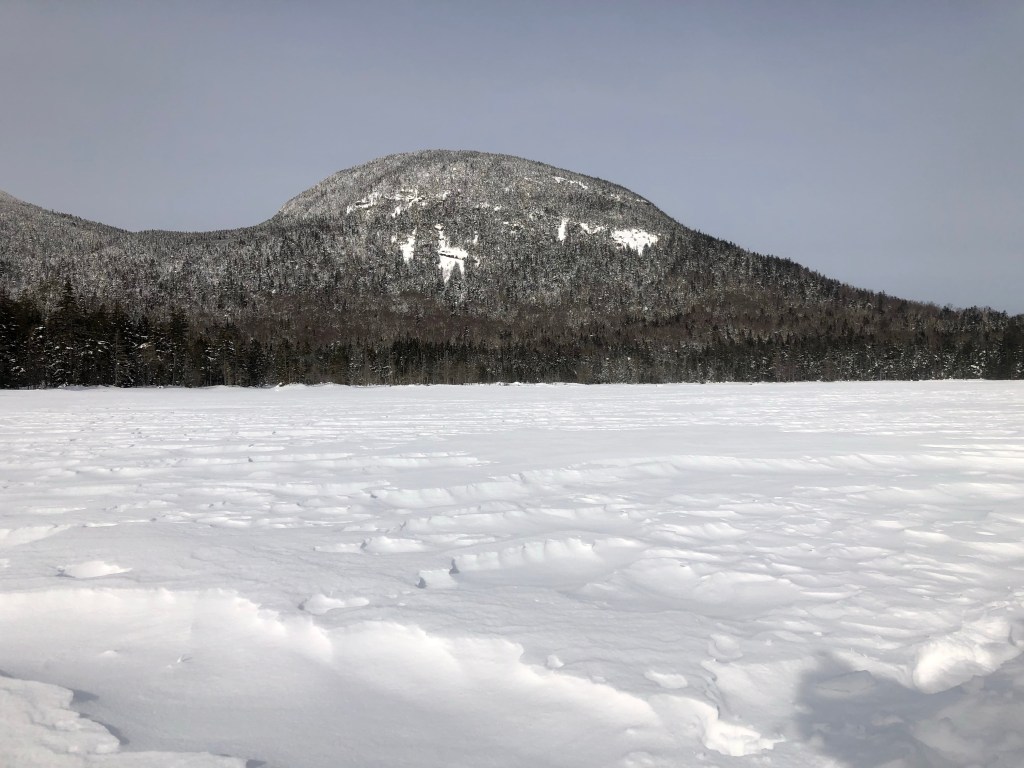
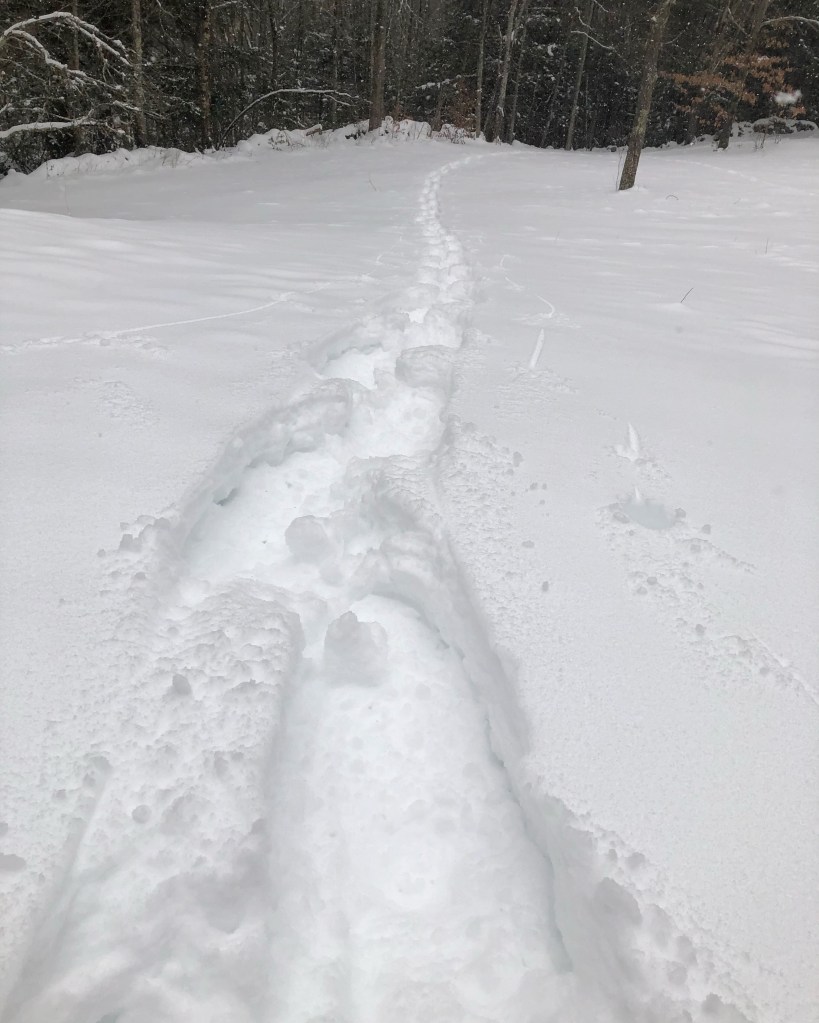
    With a hint of the coming snow in the air, I took my snowshoes out to find new prospects. I quickly moved off the packed trail into virgin snow, crunching along on the snowdrifts through woods and fields. Cold hands soon warmed as I worked up a good pace past old stone walls and silent trees. Snowshoeing offers a slow burn, steady state workout similar to cross-country skiing. There’s a small thrill in hovering over the frozen land while blazing a new trail on snowshoes, and I felt a bit like I was flying as I crunched along.

    Reconnecting with the blazed trail at a frozen stream crossing, I noted the collection of prints of those who had come before me. Snowshoes and fat tire mountain bikes, micro spikes and dog prints spiraling in circles from the trail in patterns of joyful exuberance and the freedom of the winter woods. It occurred to me that my own tracks were more similar to the dog prints than those of the trail walkers. Wandering spirits are rarely contains for very long on defined paths.

    A simple walk in the woods, off trail, can change a person. In winter what was familiar ground becomes a voyage of discovery. Perception is how we frame the world around us, and I find it best to turn my perceptions upside down now and then. Every walk suggests something profoundly new, and winter transforms both the landscape and the visitor alike. Pausing a moment, I listened to the sound of silence. My snowshoes and I had walked our way to interesting, embracing the cold indifference of the woods to pandemics and masks and turns of the calendar.

    Walking along on familiar trails transformed into strange country, I stopped worrying about the neglected collection of stamps in my passport. Feeling a million miles from anywhere I’d every been before, I came across a border marker deep in the woods indicating I’d crossed over from the town forest of my neighboring town into the undeveloped forest of my own town. I smiled and noted that not all borders are closed. And the unfamiliar isn’t very far at all from home.

    Into the snowy woods
    Snow blanket on an old stone fence
  • What Is

    “What is left
    is what is.”
    – Wendell Berry, The Broken Ground

    Lingering soreness from a long winter hike and tackling a foot of snow with a snowblower that quite halfway through the task, leaving only shovels to overcome mechanical obstinance. Fatigue, not all of it in muscles, wished me a good morning with a smirk.

    Looking out the window, I saw the tip of a snow drift dropping down from the roof, as if a wave frozen in the middle of its break. This naturally lured me outside for a look, which led to a walkabout, which led to slipping on snowshoes for a walk in the deep snow out to the bird feeders at the edge of the woods. Silently carving my two foot path across the yard, nothing but the rubbing clumpy sound that cold snow makes when compressed. One foot in front of the other, out and back, feeders filled. Were the yard only longer, for I wasn’t quite ready to finish.

    The feeders were wiped out by Starlings. Greedy, sloppy eaters who cast away seed by the shovelful to get at the dried fruit and other choice treats they favor. What’s left is an empty feeder and a mess on the snowy ground that is gobbled up by squirrels and Mourning Doves and other such ground feeders. The food is there for this purpose, so do I have a right to complain? Only at the waste and frenzied emptying. I can either pause feeding until they find somewhere else to ransack or tolerate the intrusion. But once you commit to feeding the birds you can’t very well stop after a heavy snowstorm.

    For all the dry sameness of the inside of the house, outdoors offers something new at every turn. The second morning after a big snowfall lacks the drama of tackling the job at hand, but it makes up for it with time to have a look around. To see what’s changed. To assess the landscape and yourself. To see what’s left. What is.

  • Traction and Comfort in Winter Hiking

    The last day of January felt like it should throw up challenging hiking in New Hampshire. In fact the temperature read a solid -4 degrees at the start. But the truth is that if you aren’t breaking the trail it’s comparatively easy. The snow pack on popular trails covers up a lot of the erosion and exposed granite ankle biters that are a normal part of hiking in the White Mountains. You simply trade the pounding on your lower extremities for a different pair of challenges: traction and hours of walking with your toes pointing up.

    Think about a groomed ski slope, all corduroy and pristine. Perfect for skiing down, but imagine walking to the summit straight up that slope. How do your feet grip? How does that angle feel on your ankles and calves after about an hour? That’s the dilemma of the hiker on a snow packed trail. Snowshoes and descending butt sliders press the snow down into a version of that groomed slope, albeit it two feet wide. Step six inches off trail and your foot plunges down two feet into the abyss.

    Overcoming such challenges requires mechanical assistance. On the one hand you have micro spikes; one of the best inventions ever for handling winter traction issues. I’ve gushed about micro spikes before and generally they’re perfect for frozen packed snow. They become more challenging when the snow softens and begins to ball up under your feet. Walking on snowballs is just as enjoyable as it sounds. Another consideration is ice. I feel comfortable walking on ice with micro spikes on, but not walking up a slide with them. Trusting rubber bands with your general well being has limits. And this is where an upgrade is in order.

    A step above micro spikes are crampons, which offer more traction with a deeper spike designed to linger in your nightmares. I see crampons and think about those times I accidentally kicked myself in the back of the leg hiking in tight terrain and shudder. But then I recall a story I read about a guy who stepped out of his tent to take a leak hiking Everest or some such place. He made the unfortunate decision to not put on his crampons and promptly slid down the mountain screaming to his death. Crampons are made for comfortable late night relief in such conditions. Truthfully, I tend to avoid most “icy slide nightmare” hiking, but sometimes you run into spots where it would be the better choice. On Mount Liberty a couple of days ago I wished I’d had them a few times as I kicked my micro spikes into frozen snow hoping for footing.

    And then there are snowshoes, used by generations of people trying to get from point A to point B without post-holing every step along the way. Snowshoes have come a long way, and the best of them have crampon-like steel spikes protruding from them and a wonder for the sloped uphill hiking conditions: the heel lift. A heel lift is a metal hinge that flips up to offer welcome support for your heel. It effectively levels your foot on a slope, creating a more comfortable hiking angle. Snowshoes come in different sizes based on your weight and the type of snow you’re hiking it. I have a great set of Tubbs snowshoes that are perfect for fluffy powder walks in open terrain. Being a tall clydesdale my shoes are 36″ long, which makes them a challenge on tight trail hiking. And with the trail compacted it’s simply easier to stick with the micro spikes or crampons. Using shorter snowshoes for compacted snow would offer the best of both worlds.

    There are times when you might put all three on in the same hike. I didn’t bring crampons on my last hike but wore the snowshoes for an hour during a steep ascent in packed powder. My hiking partner that day chose to stick with micro spikes on the ascent and flew up the hill with me gasping to keep up with the extra burn of snowshoes. When I conceded and switched back to micro spikes our hiking speed equalized again. He wore his crampons on the descent while I wore micro spikes. In softening snow broken down by many hikers at that time of the day it was a toss-up. Had it been frozen and compacted as it had been in the morning the crampons would have been better.

    Ultimately accessories are successful when you start with a great pair of boots, pick the right accessory for the terrain, and are willing to switch on the fly when things change. Another truth is that if you don’t get out there in it, none of this matters. Winter is meant to be lived in fully. Being shut up in the warm house might be comforting, but don’t we spend way too much time in our houses now? Step out there. Just wear the appropriate gear.

  • The Art of Packing for a Winter Hike

    Contingencies. I pack for contingencies. Most of it stays in the bag, bulging against the sides, weighing the pack down directly onto the hip belt, as designed, and a bit on the shoulders, as is the way. First aid kit, extra warm clothing, extra food, and, it turns out, just enough water for this eleven mile trip. Snow demands micro spikes, but also snowshoes. Mine spent most of the day strapped to my backpack, but I gave them a try for about an hour of hiking before strapping them back on the pack. The compressed snow and narrow trail made wearing them more hassle than salvation. Sometimes you try out your contingencies and realize that you were better off with the original plan. But I do love those heal lifts on steep inclines.

    It was -4 degrees Fahrenheit at the start of my hike this morning. Most layers packed as contingencies went right on the body for the start of the hike. Snow has a way of being crispy and slippery when you dip below zero. And the trail we started hiking wasn’t the same trail we descended when the sun rose and warmed temperatures into the twenties. Having the right footwear and accessories is essential when you see swings in temperatures like that.

    Still, for all the contingencies planned for, most everything stayed in the pack. Sleeping pad, extra layers, way too much food, all of it mocking me on the steepest parts of the incline and for most of the descent. But as soon as you don’t pack it you know what’s going to happen. Yeah, contingencies, especially in winter, must be a part of your kit. You’ve got to have a winter pack that can handle all the extra stuff, provide tie downs for the snowshoes, and remain an afterthought for the duration of the hike. For day hikes I’ve settled on an ULA Photon pack, which offers everything I need and the space for those extras.

    Winter hiking in New Hampshire offers plenty of beautiful moments. Moments that serve as exclamation points on the trip and in your life. But winter can offer up stunning beauty and calamity quite rapidly in the White Mountains. Mother Nature doesn’t care about your feelings. You must be prepared for whatever she throws at you. And that’s what contingency packing is for. Sure it mocks you when it never gets used, but it also assures you that it will be there for you if you need it.

    The next blog post will cover the actual hike. Memorable, incredibly clear, and two more 4000 footers checked off. Stay tuned, there’s a lot to cover.

  • Doing More

    “The world as we have created it is a process of our thinking. It cannot be changed without changing our thinking.” – Albert Einstein

    Change happens slowly, one habit reinforced at a time. Some reach 10,000 views in one post, but most of us chip away for a few years of daily writing to get that first 10,000. Tolstoy filled War and Peace with 587,287 words. By that standard I’ve got a ways to go. I’ve only published 401K.

    Diet, for all intents and purposes, is one morsel shoved in your mouth to the next. You want to eat better? Don’t make an exception for that tasty treat you’re eying. Want to get fit? Move more, and more consistently. Simple, right?

    We all have reasons for the habits and beliefs we linger in. Life is a grind, after all. Sometimes the best you can do is walk to the refrigerator to see what inspires you that day. The world, as we’ve created it, can eat you up.

    Yesterday was a great day to be outside in New Hampshire, and I took full advantage of that with a hike up Mount Jackson. A hike like that, with friends and on a beautiful winter day, leaves a mark inside. It reinforces who you are in some ways, but alters your thinking as well. Standing on the summit of Jackson and looking up at Mount Washington, I thought it well within reach. I’ve climbed Washington before, but not lately. Looking up at Washington yesterday, cold breeze chilling my sweaty clothes, I thought it possible to do more.

  • Hiking Mount Jackson (New Hampshire)

    Too many weekends since I last hiked to a summit. Basically, I skipped December for the holidays, and was feeling the built-up restlessness that comes with knowing you’ve got things to do. I’d planned for Hale, but latched on to other’s plans for Mount Jackson for the views and banter of friends.

    Mount Jackson is a popular trail. We started early, meeting friends at the trailhead, but not early enough and parked along the side of Route 302. The out and back trail is roughly five miles of moderate hiking, with a short scramble towards the summit. Micro spikes were a requirement with a healthy dose of exposed ice and a couple of (frozen) stream crossings along the way.

    The straight path up Mount Jackson is via the Webster-Jackson Trail. That’s the trail we took, and judging from the compacted snow on the trail, so do most people. The day started overcast at the trailhead, but it was one of those hikes where you walk into sunshine, and like a jet bursting through the clouds, we emerged from the tree line to find bright sunshine and undercast in the valley below. Incredible views of Mount Washington and the Presidential Range greeted us, along with a few hungry Gray Jays looking for handouts.

    Mount Jackson is named for a geologist named Charles Thomas Jackson who completed a geological survey of New Hampshire in 1844. According to Wikipedia, Jackson seems to have been a somewhat controversial figure in his time, with a pattern of taking credit for discoveries others made. His brother-in-law was Ralph Waldo Emerson. For those who can’t get enough information on Charles Thomas Jackson there’s a wealth of information on Jackson in an article published by The State of Maine and while doing a bit of research I saw that the Bangor Daily News just published a small bit about Mount Jackson a few days ago. Apparently I’m not the only one wondering about why they’d name the mountain after this particular character, but based on his controversies he probably just named it after himself and nobody challenged it.

    After a lunch on the summit we started our descent, with plenty of butt sliding mixed into the walk back. A couple of side trails made for interesting views, we spent a few minutes at Bugle Cliff, but opted out of Elephant Head. After the stunning views on the summit maybe we were a bit spoiled.

    On the descent a couple of us hiked down to the Silver Cascade, which is very popular near Route 302 but involves some sweat equity further upstream. The small falls we saw were worth the side trip, with blue ice putting on a dazzling display for the two of us that sought it out. Waterfalls change by the day, and even though most of our party had seen them before I was still surprised more people don’t make the trek down. I’ll never turn down a side trip to a waterfall with kindred spirits.

    I’d circled this weekend in hopes of trying out my new Tubbs snowshoes. They’re a huge upgrade over the snowshoes I used to have, but we just haven’t had the snow accumulation to give them a workout. With the compacted trails today wasn’t the right day for them either. But that didn’t make the day disappointing. It turned out to be a spectacular way to spend a beautiful and cold Sunday; time with the closest of friends, relatively easy hiking and another summit checked off on the 48 New Hampshire 4000 footer list.

    View of Mount Washington
    Gray Jay looking for handouts
    Micro Spikes required
  • The Birds and Stars Remind

    Let’s face it, the days between the US National Election and the events of January 6th were some of the craziest we’ve ever witnessed in our lifetimes. Not since 9/11 have I been so angry and distracted as I was on the afternoon of January 6th, 2021. And it can be easy to wrap yourself around the pole of ongoing coverage and online opinion and speculation. I let myself indulge in some of that too.

    And then last night I took a walk outside on a brilliantly clear night and saw Orion poised above me. Orion has seen it all before and recognizes the smallness in our human lifetimes. This is big by human standards, but we’re like ants to the universe, and not the big ants but the tiny little ones that you have to squint to make out the features on. Orion whispered “This might be a big week for you but this ain’t nothing to the universe, kid.”

    Earlier this morning I waited for the water to boil for my morning jolt of goodness and watched the birds flitter about from the feeder to the ground, ground to the shrub, and back to the feeder. This crowd featured bluebirds and cardinals and mourning doves and sparrows. Mostly taking their turns at the feeder (except for the mourning doves who rely on scraps falling to the ground), but sometimes impatient with each other to get a move on so they can have their turn. This frenzy continued on well past the coffee being ready. Small little things fighting for their share and a little bit more. Perspective is where you find it.

    This week we saw people acting like squabbling birds at the feeder not wanting to take turns, while others pounced on the scraps below. It was maddening, and the days ahead are fraught with peril. But a walk or a glance outside offers lessons in perspective. We have work to do. A lot of work. But the worst of this will pass if we work together to make things better. Generally humanity is moving ever so slowly towards a better place. We might see this if we break our focus on selfishly fighting amongst ourselves. This ain’t nothing to the universe kid. This too shall pass.

  • The Nature of Robust

    I tripped over a delightful word while reading a John McPhee book, turned it around in my head to assess it, and diligently highlighted it for the definition to be sure I had it right. The word? Pallesthesia. I write it and even WordPress underlines it in red dots of confusion. Pallesthesia is a “vibratory sensation”. A more complete definition may be found here if you choose. Anyway, the word seems appropriate for the topic at hand this morning: coffee.

    This week I’ve had the opportunity to assess four distinct coffee blends with my trusty AeroPress coffee maker. Two Peet’s (Berkeley, CA) Major Dickinson blends, one pre-ground and one whole bean. A Stumptown (Portland, OR) Hair Bender pre-ground blend and finally, a Blue Harbor (Hampton, NH) Sumatra whole bean blend. This gave me a unique testing lab to compare the differences, with the AeroPress and the water consistent for each cup.

    It may go without saying that there’s a distinct difference between whole bean and pre-ground coffee, but sometimes you just need the convenience of pre-ground. Given the time it takes to grind a tablespoon of whole coffee beans, it isn’t even convenience, really, but lack of motivation to get the grinder out and do the necessary work. Since I’m waiting for water to boil anyway, why not grind a few beans?

    The difference between pre-ground and freshly ground whole bean was most pronounced between the two bags of Peet’s Major Dickinson beans. The whole beans offer undeniable richness and flavor profiles that you don’t get with the pre-ground. I’m not one to ever turn down a cup of Peet’s, but given the choice the whole bean is the way to go.

    Stumptown is a famous name in coffee, and it’s a good cup, but it suffered in comparison to the whole bean Peet’s. I think it’s partially the Hair Bender roast being blended for mass appeal versus the richer blends I tend to favor. That said, I’m sipping a cup of it now while writing this blog, and it will do the pallesthesia trick when you just want to get moving in the morning.

    And that brings me to Blue Harbor’s whole bean Sumatra. This turned out to be my favorite of the lot. I think it comes down to it being the freshest roast of them all (being a local roaster that doesn’t mass produce bags of coffee at the scale of a Peet’s or Stumptown) and Sumatra is a go-to blend for me anyway. Peet’s guarantees that their coffee is no older than 90 days when you buy it at your local market, but that Blue Harbor is likely no more than 9 days old. Both are great, but you really taste the difference in a freshly roasted, just-ground coffee. So a nod to the local New Hampshire roaster for this round of the coffee wars: best in class this week.

    One thing is clear from all of this sipping and contemplation: great coffee matters. And whole bean great coffee roasted recently is profoundly more interesting than a whole bean brewed a while back. Another example of buying local making a big difference in the quality of your life.

  • Awaiting Discovery

    “It is remarkable that men do not sail the sea with more expectation. Nothing remarkable was ever accomplished in a prosaic mood. The heroes and discoverers have found true more than was previously believed, only when they were expecting and dreaming of something more than their contemporaries dreamed of, or even themselves discovered, that is, when they were in a frame of mind fitted to behold the truth. Referred to the world’s standard, they are always insane.” – Henry David Thoreau, Cape Cod

    This is a year of the commonplace and unromantic if you let it be.  Lockdowns and border closings and mandatory quarantines tend to temper the passions of the high agency traveler.  But then again, if you keep your expectations and dreams focused on regional adventuring until things open up again you might just find the world under your nose.

    Yesterday I watched a bobcat, set against the snow, on the hunt.  It was slinking along the edge of the forest where the fence announces wilderness begins.  I expect it was attracted to the bird feeder activity, for there were squirrels and juicy birds for the taking for the ambitious hunter.  Unlike my snowshoe hare encounter I wasn’t prepared for a picture, and I settled for locking her image in my brain.

    Leaving Cape Cod the other day I stopped to fill up the tank and, glancing up, noticed 9-10 osprey hovering in the wind, all clustered together.  I’ve never seen so many osprey flying together, and there they were right above me gliding gracefully about.  By the time I finished fueling the car the osprey had drifted away to awe others elsewhere, but damn if they didn’t capture my imagination first.

    For all his fame as a transcendentalist and beholder of truths, Thoreau didn’t travel very much in his lifetime.  He spent most of his lifetime in Concord, Massachusetts, with notable trips to Cape Cod, up the Concord and Merrimack Rivers to the White Mountains, to the Maine woods, and one solitary trip across an international border when he visited Quebec.  And yet he saw more than most people who travel far beyond the northeast corner of North America.

    There’s light at the end of the pandemic, though we remain in a dark and treacherous tunnel.  This isn’t the time to cross borders, but the world outside our Twitter feed remains vibrant and alive, awaiting discovery.  The bobcat,  osprey and Thoreau have each inspired me to shake off the creeping prosaic mood that shorter, darker days cloak you in and dive back into adventuring.

    Et toi?  Are you ready to re-join the hunt?  Nothing remarkable was ever accomplished in a prosaic mood.

  • White Cap

    “I am in love with Ocean
    lifting her thousands of white hats
    in the chop of the storm,
    or lying smooth and blue, the
    loveliest bed in the world.”

    – Mary Oliver, Ocean

    I anticipate a white cap day on Buzzards Bay as a Nor’easter rolls through. For now the bay is restless but content to let the rain fall in abundance to its surface instead of rising up to meet it. For the march of thousands of white hats the current and wind must be more contentious than this. It will come in time, as it always does on Buzzards Bay.

    Nor’easter days are meant for hunkering down, catching up on reading and sipping hot beverages. On Cape Cod the storm will bring heavy rain and high winds. The salty water will surely rise to greet her fresh visitors. I’m a visitor myself; like a river forever moving between the mountains and the sea. I want to leave the comfort of the warm house to walk on the beach. You don’t come this far to look at it from afar. For I’m mostly water, shouldn’t I rise up to meet it too?

    Up in New Hampshire all this water will mean white hats of a different kind, with heavy snow in the mountains and clever swirls of white donning posts and mailboxes in the lower elevations. I’ll welcome the grace of snow-packed trails covering the ankle-breakers when I return to the mountains. Whenever that might be – I really don’t know. But they’ve heard my silent promise to return. We have unfinished business, those mountains and me.

    I laugh when I read polls asking where you would want to live forever. How do you choose between the mountains and the sea? Its a Sophie’s Choice question; asking one to pick between a mountain waterfall and the crashing surf. Instead I look to the Abenaki who moved for generations between the White Mountains and ocean fishing villages. They didn’t choose one over the other, they chose a life in between. And that’s where you’ll find me too.

    So today as the white caps rise, I’m reminded of the Mary Oliver poem above. I’m on the very edge of that in between for this Nor’easter, and the chop of the storm has begun. Who’s up for a walk?