Blog

  • Frogs and All

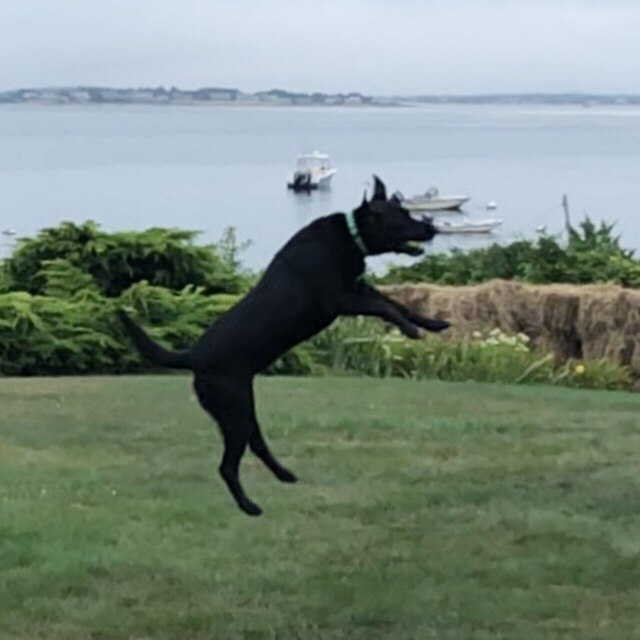
    Yesterday, after thirteen lucky years together, our black lab Bodhi took his last breath.  Forgive me for this brief eulogy.

    There was the time you dug up every tulip bulb I’d just planted because you smelled the bone meal I used to fertilize them.

    There was the winter when we thought you escaped and were lost and drove around the neighborhood and then the town trying to find you late into the night, only to realize that you were lying under the shed all along.

    There were the countless questionable dining choices you made over the years on underwear, the extra ingredients in the cat litter, various leather goods and your favorite, flattened frog roadkill. The ongoing battle with the cats where they’d eat your food so you’d eat theirs. I respected that.

    I’ll miss those 10 PM power walks we’d do, and admit I don’t walk as much as I did when you were healthy. Back when you were a teenager you’d occasionally charge towards the woods, chasing a rabbit or a black bear or maybe a zombie; I was never really sure. I learned to anticipate those abrupt maneuvers and would spool out retractable leash like I was running out line on a marlin.

    Your best move was late night hide and seek. Pretty clever of you, being a black lab on a moonless night standing perfectly still when we let you out, until we gave up and went in for a flashlight. Even then you were usually found in the very last place I’d look for you.

    The pool filter won’t be the same without a full season of black fur clogging it up. You were one hell of a water dog, and swam so much you’d get ear infections. You always had a look of sheer delight when you would push the screen door to the side and sprint straight to Buzzards Bay, kids in chase behind you. You must have seal somewhere in the family tree.

    We’ll miss you Bodhi. 13 lucky years with you was not quite enough.  We loved you, frogs and all.

  • John Smith and New England

    Captain John Smith is usually associated with Jamestown and Pocahontas.  And he’s most famous for his relationship with the Native American tribes in Virginia.  Smith was proactively aggressive with hostile tribes, but proactively friendly with peaceful tribes.  There are plenty of examples in colonial history where hostile and peaceful tribes weren’t distinguished when it came to aggressive treatment of the Native Americans.  Pocahontas was just 11 when she met Smith, and it’s apparent that the stories of a romance between them are BS.  Whether she actually helped save his life is tougher to determine.

    Smith was an opportunist, but so were a lot of men coming to the virgin coast of North America.  What separated him from many others was his gift for self-promotion and his willingness to take risks to advance his standing.  But he backed up this, let’s call it entrepreneurial spirit with tactical and practical knowledge.  Many point out that the inhabitants of Jamestown didn’t fair so well when Smith went back to England.  Instead of growing and storing food for the harsh winter the settlers of Jamestown held out hope for supplies from England.  When the supplies never showed up as much as 90% of the population of Jamestown starved to death.

    Smith returned to North America in 1614 as ambitious as he was on his original trip.  This time he focused on what is now New England, and his crew worked on whaling and fishing to create a return on investment for those who funded the trip, while Smith and some others focused on mapping the coastline from the Bay of Fundy to the Hudson River.  Smith created a pretty accurate map, and betrayed his ambition by bringing the map to a young Prince Charles to have him choose place names for some of the locations.  A few of these, like the Charles River and Cape Ann, survive to this day.  Smith is credited with coming up with the name “New England” for this region, and named several other places on the map which have stuck.  But if he’d hoped to live on in infamy by naming the islands off Portsmouth, New Hampshire after himself, he’d be sorely disappointed to know they became known as Isle of Shoals.  But then again, Smith did enough to be remembered anyway.

  • Choice White Pines and Good Land

    I have a fascination with maps, and especially old maps, that dates back to when I was a kid tracing the route that we would take on family vacations.  When I started driving myself around I bought maps to help me navigate first the town I lived in and later New England and points beyond.  As a hiker I’d plot out where I’d be able to refill water bottles and camp for the night.  Maps were essential for navigating the world.

    Today GPS has stolen the magic of maps for everyday use in getting from point A to point B, but they can’t completely replace them.  I still plot out trips on Google Maps to plan the most efficient route.  I still love a good map; evident in the title of this blog.  So it was a delight to find a gem of an old map from 1761 created by Joseph Blanchard and Samuel Langdon.  This map has wonderfully random reference points like “From Connecticut River to a Great Pine Tree” and “This way captives have been carried by the Indians”.  This is a map you can fall in love with.

    Joseph Blanchard was born in the Nashua area and served as a Colonel during the French and Indian War.  He teamed with Samuel Langdon to create this map, which was published after Blanchard’s death.  It’s an amazing time capsule that highlights some contentious early days in our colonial history.  For me, the part of the map I love the most is in the present-day Plainfield/Montcalm area where the map designers noted “choice white pines and good land”.  A name like Montcalm jumps out if you’re talking about the French & Indian War, but apparently it’s not what the selectmen in that town were striving for when they named it.

    If you search online you’ll find there are a couple of versions of the map available for  viewing.  The black and white version I have above, and a color version, a portion of which I show below.  The towns have mostly remained the same, with a few splitting into a multiple towns along the way.  The rivers are fairly accurate, which is notable since these were the superhighways of the day.  The map reaches as far west as Schenectady and as for North as Quebec.  This territory was ground zero in the French and Indian War, and the wars with the French that preceded it.  It would be important again during the early years of the Revolutionary War.  I’ve had the opportunity to travel most of this region over the years, and spend a lot of time writing about it in this blog.  So this map put a spell on me that I haven’t shaken loose from just yet.

    “The paradox of mapmaking… is that as soon as you begin shrinking a geography down to usable size, you necessarily are forced to misrepresent it. By making choices about what to include and what to leave out, you change the map from a document faithfully documenting an area to one furthering a particular point of view.” – Michael Blanding, The Map Thief

    Blanchard and Langdon created a map that clearly furthered a point of view, lending credence to Blanding’s observation. The history buff in me delights in reading it. Would it look the same if a Native American warrior had drawn it? Surely not. But the map no longer serves the purpose of furthering a point of view as much as it creates a snapshot of what the map’s creators were thinking at the time. Either way it’s a fascinating dance across time.

  • Leafing Out

    Mid-May; the time of year when the bones of the northern New England forests are once again masked in greens and yellows. Tree trunks, stone walls and other hardscape details disappear into clouds of leaves and shadows. The calendar says it’s been spring for awhile but it doesn’t really feel like it until the trees leaf out.

    Southern New Hampshire is officially Zone 5, and you really notice it this time of year when you travel regionally as much as I do. A trip to New York or Cape Cod can feel like a different world in early May. Zones 6 & 7 are that much further ahead of us. A trip further north reveals our own good fortune.

    Flowering trees and shrubs are well underway, while daffodils are just past their peak. Now and then you get a surprise from a bulb that’s way behind popping up to say hello. A single pink Hyacinth poked through a day lily to announce it was time.

    These are the early days of the growing season. Still a danger of frost lingering in the minds of eager gardeners, but safe for some plants. We haven’t seen the heat of summer yet, but we can anticipate it. This is mid-May and mid-spring all at once. Best to enjoy the show because it never lasts long.

  • Walden & High Agency

    The great thing about motivational quotes is they represent wisdom and offer insight for us in our own lives, conveniently boiled down from a pile of words.  The drawback, of course, is that you’re only reading a small part of whatever the quoted person was trying to say, usually twisted into some new meaning in its abbreviated form.  As I’ve re-read and re-discovered Walden, as you may expect many old, familiar quotes pop up.  This particular thread from the Conclusion chapter, takes on a much deeper meaning when you consume everything Thoreau wrote (the oft-quoted  words in bold):

    “I left the woods for as good a reason as I went there.  Perhaps it seemed to me that I had several more lives to live, and could not spare any more time for that one.  It is remarkable how easily and insensibly we fall into a particular route, and make a beaten track for ourselves…  The surface of the earth is soft and impressible by the feet of men; and so with the paths which the mind travels.  How worn and dusty, then, must be the highways of the world, how deep the ruts of tradition and conformity!”

    “I learned this, at least by my experiment; that if one advances confidently in the direction of his dreams, and endeavors to live the life which he has imagined, he will meet with a success unexpected in common hours.  He will put some things behind, will pass an invisible boundary; new, universal, and more liberal laws will begin to establish themselves around and within him; or the old laws be expanded, and interpreted in his favor in a more liberal sense, and he will live with the license of a higher order of things.  In proportion as he simplifies his life, the laws of the universe will appear less complex, and solitude will not be solitude, nor poverty poverty, nor weakness weakness.  If you have built castles in the air, your work need not be lost, that is where they should be.  Now put the foundations under them.” – Henry David Thoreau, Walden

    As romantic a notion as building castles in the air is, these words seem just a little too up with people for general consumption on their own.  Like one of those motivational posters you see in offices around the world.  But taken in the context of the rest of the paragraph, they become more meaningful.  Thoreau is reminding us that we all fall into routines as individuals, and also as societies, but if we only have the courage to break out of those routines in focused pursuit of loftier objectives, the universe aligns to support us in achieving these objectives.

    Reading Walden again, I’ve realized that I glazed over much of it the first time I read it as a teenager.  The words simply didn’t mean as much to me then as they do now.  But isn’t that the case with everything?  We all pick up a little wisdom as we move through life.  But we also pick up bad habits, assumptions and biases, and become the sum of the parts around us.  Choose your path, establish those tiny, sticky habits that move you towards your objective, surround yourself with the right people and you will pass that invisible boundary Thoreau describes.  Routines can build you into something much greater than you imagine, but they can also hold you down.  Get off the worn-down mental path and see the world in a new way.

    “The universe is bigger than our views of it.” – Henry David Thoreau

    Speaking of the universe, it seems to align with the way I’m thinking at a given moment.  I know that’s not entirely accurate, I just notice things more when I happen to be thinking about something related to it, like suddenly seeing white Honda Accords everywhere as soon as you start driving one.  So upon posting this article I scanned Twitter briefly and what do I find but George Mack’s Twitter thread about High Agency, which he heard about from a Tim Ferriss interview with Eric Weinstein:

    “High Agency is a sense that the story given to you by other people about what you can/cannot do is just that – a story.  [A] High Agency person looks to bend reality to their will.  They either find a way or they make a way.  [A] Low Agency person accepts the story that is given to them.  They never question it.  They are passive.  They outsource all their decision-making to other people.

    So a Low Agency person believes the world is as people say it is.  That’s just the way things are.  A High Agency person believes the universe is bigger than our view of it, as Thoreau so eloquently states it.  Be the change you want to see in the world. and what is more High Agency than “If you have built castles in the air, your work need not be lost, that is where they should be.  Now put the foundations under them.”?

  • Downpours and Rainbows

    On Friday I drove through a downpour. A wall of water driving so hard to the ground that it looked like a thick fog as I drove into it. Rain so hard it creates whiteout conditions on your windshield. Cars around me reacted as I did by immediately slowing down, flipping the wipers to their fastest setting and a quick glance in the mirror to see what’s driving up on you. Some folks do better in this than others and like me keep going at a much reduced speed until it passes. Others, perhaps with vision problems or a less forgiving car pull over into the breakdown lane. Drive long enough and you’ll inevitably experience this a few times, and indeed I have.

    Ohio, 2015 driving a rental car from Columbus to Cincinnati I hit sustained rain so hard and steady that highway traffic came to a crawl. Worst I’d ever experienced. Even worse than Stockbridge 2011 on I-84 North approaching the Massachusetts border with intense, heavy sheets of rain pounding the windshield. I got to the rest area in Charlton and they were broadcasting tornado warnings. Sure enough one crossed I-84 shortly after I’d driven through that spot. I think back on my timing that day quite a lot, and look at where it crossed whenever I drive through.

    Back to Friday, and I-88 westbound through Otego. Down below 45 MPH for a stretch with blinding truck spray making it all but impossible to see. Pressing on the rain abated enough to improve visibility and then I was through the other side. Intense sunshine from the late afternoon sun replaced the rain and I quickly put on my sunglasses. Knowing this combination well I glanced in the rear view mirror and sure enough there it was. I smiled at the timing of the Wells Bridge rest stop approaching I pulled in and took a quick photo.

    They say things are darkest before the dawn. Friday offered a new twist on that, with the rain hardest before Mother Nature rewarded us with a rainbow. I’d paid my penance for the view, while those heading eastbound had the reward (the better view) first only to drive into the storm afterwards. There’s probably an analogy to explore there, but it’s best to be on my way.

  • Robert Treman and the Gorges

    I’ve never regretted a morning when I got up early and got outside to exercise. Today I’m moving Emily home from college so that meant an Ithaca waterfall walk. Different hotel than last time I was here, but fortunately there’s a stunning waterfall seemingly on every corner in this town. Five minutes walk from the downtown Hilton Garden Inn is the lovely Cascadilla Gorge Trail. As with most gorges, this one has plenty of water.The lower part of the Cascadilla Gorge Trail begins Treman Triangle, a small triangular shaped park named after Robert H. Treman, a local gentleman and successful Ithaca businessman who, along with fellow trustee Henry Woodward Sackett donated this Gorge to Cornell University.  But Treman didn’t stop with this gorge.  He also donated the land around Buttermilk Falls State Park and the park named after him, the Robert H. Treman State Park.  This is the type of wealthy guy I admire: make a lot of money and then do something good with it.  These were his time capsules, preserving the things he loved about Ithaca so that they might be enjoyed by generations long after he’s gone.  He’s remembered far more for the land he donated than for his success in business.  Isn’t that a greater success story than what he had accumulated in his bank account?

    I started writing today’s post thinking I was writing about Cascadilla Gorge and my observations about it.  It’s truly beautiful, and walking alone through it at 6:15 AM I felt like I was up in the Adirondacks somewhere, not walking up from downtown Ithaca to the Cornell campus.  My step-father went to Cornell and Cascadilla Gorge has a special place in his heart. Walking it while the city slept I could feel it. There’s magic in solitude, especially magnified in a spot like this.  Lingering here felt appropriate, but I was approaching this as exercise and aside from taking some pictures along the way I tried to keep moving.  As with most places I try to know something about where I am, which led me to a greater appreciation for Robert Treman.


  • Time Capsules

    A couple of weeks ago I stopped at Rogers Island Visitor Center in Fort Edward, New York.  I knew the place wasn’t open but I wanted to at least stop for a moment, look around and give a nod to the legacy of Robert Rogers, who used this island as a launching place for much of the fighting his Rangers did during the French and Indian War to the north of this place.  Rogers Island is strategically situated on the Hudson River and well known to the Native American, French, British and Americans who travelled these waters to “The Great Carrying Place” where you’d need to portage your canoe or Bateau boat on your trek to Lake George and points north.

    Rogers Island is considered the birthplace of the US Army Special Forces and holds a special place in the hearts of US Army Rangers to this day.  I wasn’t in the Rangers myself, but recognize the significance of the tactics developed by Rogers.  They essentially mirrored the tactics used by Native American warriors and added a few wrinkles of their own.  That’s a post for another time.

    While walking around I spent a few minutes reading the historical signs placed around the property and considering the commemorative garden that was just starting to bud on the April day I visited.  My eye was naturally drawn to the monument dedicated to those who fought and died in wars engaged in by the United States and I walked up to better view it.  While there I noticed the tablet on the ground marking the time capsule commemorating the 250th anniversary of the French and Indian War.  This capsule is scheduled to be opened in the year 2055.

    Time capsules are a message to future generations.  Schools do these all the time, and add things that are meaningful to the people who are participating in the event.  But the funny thing about time capsules is that in all likelihood you won’t be around when they open it.  Sure, 50 years gives you a fighting chance, but life is full of twists and turns and there’s no guarantee of anything except death.  So burying the artifacts of life is akin to a message in a bottle thrown in the ocean.  You’ll likely never see it again, but you hope that someone will and whatever message you give to them will be meaningful in some way.

    Time capsules are all around us, and you don’t have to bury some safe in the ground to make one.  My time capsules to future generations are the lilacs I planted along the property line, or the trees I planted out front.  They’re the bathroom I renovated in Pocasset and the words I’m writing now.  By this measure I look for similar offerings from those who came before me. Mostly my time capsule is the way I conduct myself and how that influences others for the better or worse as others continue to influence me.  I won’t be here forever but I hope my legacy will be positive beyond the generations who actually know me.  Time will tell, but it won’t tell me.

  • The Endpoints of the Day

    Winning the day starts with the morning. I’m pretty good with the morning now, but there are plenty of mornings where the evening gets in the way. Eat too much, stay up to late, have a few drinks and the morning routine is more challenging. So this ridiculously easy habit stack I have has bailed me out on a few mornings where I wasn’t feeling up to the challenge but did it anyway. If the morning is the angel on one shoulder, the evening can be the devil on the other; full of all kinds of triggers and temptations. Glass of wine? Why not? Bread with dinner? Why not?  I’ve been good today… Slippery slope.

    The morning represents a new hope for the day ahead.  You’ve got your whole day ahead of you!  So very much you can do today!  The evening has its own pleasures of course, but ultimately you’re left with a feeling that I’ve accomplished all I can today or I haven’t done what I needed to do today.  Either way it’s an end point.  Last call.  Give me beginnings.

    “We should be blessed if we lived in the present always, and took advantage of every accident that befell us, like the grass that confesses the influence of the slightest dew that falls on it; and did not spend our time in atoning for the neglect of past opportunities, which we call doing our duty. We loiter in winter while it is already spring. In a pleasant morning all men’s sins are forgiven. Such a day is a truce to vice…. bless the new day, feel the spring influence with the innocence of infancy, and all… faults are forgotten.” – Henry David Thoreau, Walden

    Thoreau pleads with us to live in the moment, but also to bless the new day and forget the past.  Sign me up…

    Also on the morning habit stack is reading, and this morning’s Daily Stoic entry made me chuckle after writing the title of this post: Carpe Diem. It featured this gem of a quote:

    “Let us therefore set out whole-heartedly, leaving aside our many distractions and exert ourselves in this single purpose, before we realize too late the swift and unstoppable flight of time and are left behind. As each day arises, welcome it as the very best day of all, and make it your own possession. We must seize what flees.” – Seneca, Moral Letters

    Seize what flees.  No matter the time.  This day…  this moment.

  • Seeing Green

    “As if the earth sent forth an inward heat to greet the returning sun; not yellow but green is the color of its flame; – the symbol of perpetual youth, the grass-blade, like a long green ribbon, streams from the sod into the summer, checked indeed by the frost, but anon pushing on again, lifting its spear of last year’s hay with the fresh life below…. so our human life but dies down to its root, and still puts forth its green blade to eternity.”                – Henry David Thoreau, Walden

    It happens every spring anew, the world explodes in green and birdsong.  The endless winter is behind us, school is almost out for the colleges and U-Haul trucks and vans are commonplace, the roads and rest areas are getting more crowded with tourists, lawn mowers and leaf blowers roar back to life, and pools filters begin to hum again.  Spring in New England is here again.

    As Thoreau observed 120 years before I was born, the blades of grass begin to rise up once again, bringing welcome life to a lawn that was looking pretty pathetic just two weeks ago.  I’m grateful for its return and look for the bare spots that require re-seeding. When you live on the northern edge of the woods the lawn gets a lot of shade.  When you don’t invest in an irrigation system the lawn fights for a drink with the trees and shrubs that surround it.  When you don’t dump massive amounts of chemicals on your lawn you lose some gain to the insects who nibble on the roots, and the weeds that would gladly supplant the bluegrass and assorted other grasses that make up a lawn.

    Twenty years of maintaining this lawn, and in general it continues on perpetually.  A few troublesome spots where the microclimate doesn’t give the grass much of a chance.  These are the places that the natives take over and moss and dandelions and all the things listed on the bags of chemicals make a home.  These are the places where the tires from the mower wear down bare spots in the yard that harden over time.  Irrigation and chemicals would help in these spots.  Maybe a less aggressive mower too.  But to me these are minor considerations.  When you look at a lawn you know immediately if the homeowner prioritizes it.  My neighbors likely shake their heads at the contrast between my focus on the garden and my apparent disregard for the lawn.  So be it.  At my home low in the valley and snug up against the woods there’s a natural order to things, and moss tends to be more natural than grass.  But it has its own lovely shade of green this time of year.

    I hired someone to mow the lawn several years ago.  That decision has trickled down to my dwindling overall focus on the state of the lawn, which in turn trickles down to my focus on edging and weeding the beds.  The neighbors must look with perplexion towards the flower garden and pots that I meticulously tend every season.  I’m a fickle gardener, and perhaps I need to tend to the rest of the yard once again.  Or perhaps not, and continue my adventures elsewhere.  After all, spring is in the air.