“I’ve got a mule and her name is Sal Fifteen miles on the Erie Canal She’s a good old worker and a good old pal Fifteen miles on the Erie Canal” — Erie Canal
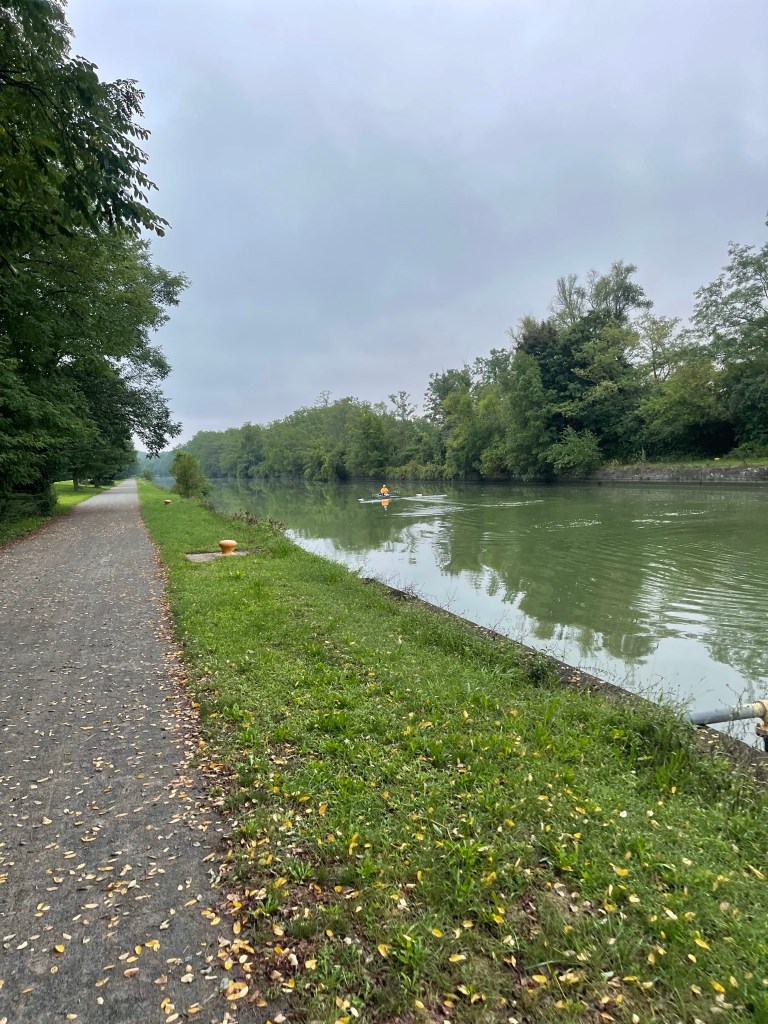
For the last three days I’ve stacked up miles walking along the Erie Canal (Nearly 15 miles, reminding me of the old Erie Canal song). Roughly a mile of that walk traverses the Great Embankment, completed 200 years ago this year. Back in 1822 building an earthen embankment a mile long and 70 feet high was kind of a big deal, and so was the completion of the big ditch known as the Erie Canal. It made the young United States less dependent on the St. Lawrence Seaway and the whims of Canada and the Great Britain to give them access. The success of the canal made fortunes in places from Buffalo to New York City.
Nowadays, it’s more of a tourist attraction than an active commercial highway, but you still see a barge or powerboat making its way from there to here. Seeing them is interesting, and reinforces the belief that the Erie Canal isn’t just a big ditch, but a once powerful statement that we’ll make our own way, thank you. When I walk on the path next to the canal I hear the whispers of history and my very brief moment with place. Think of what that mile of canal has seen in two centuries. And this week it hosted me once again.
On my recent walk the path was filled with bicycles, walkers and runners. I make eye contact with most, give a brief nod of hello and march onward. I’m but a momentary close encounter in their lives, as they are in mine. Someday we’ll all be history ourselves, just a flash of movement in the long life of the long ditch. I wonder if they’ll write about us?
Autumn, delightful as it is in so many ways, is the source of one bit of frustration: the quickly receding number of daylight hours. Traveling west, the morning becomes more and more difficult to work with if you’re trying to be active outdoors. Sure, you can strap on all manner of lighting to make you more visible and to offer a tunnel of light to walk through. But you lose something in all that battery-powered brightness–a feeling of connectedness with the land around you. And isn’t that the point of going outside to walk in the first place?
Just yesterday I was walking on a warm and humid day on Cape Cod. This morning, I found myself next to an old favorite, the Erie Canal at Bushnell’s Basin. The canal trail here is mostly stone dust, with a few paved places along the way. Familiarity is helpful when you’re walking in the dark, and so is choosing to walk in the early morning. Morning offers hope for improving conditions, something an evening walk would be short of. In a safe area like Pittsford there aren’t a lot of concerns about getting mugged, but in a sketchier area most of the thugs eventually go to sleep, leaving the morning generally safer for wannabee fitness models.
Still, there’s something about seeing that offers comfort. Even on a walk I’ve done a dozen times or so, when you run out of ambient light you’ve got to make choices in life. Press ahead into the dark or return to the ambient light? What are the risks? Walking into a branch? A skunk? The Erie Canal? Getting run over by a random cyclist not using a headlamp? None of those sound particularly appealing to start a work day. So I turned back to the light.
Here’s the trick, you don’t walk all the way back to the brightest parts of your walk. You walk just far enough that your eyes can still see in the dim early morning light, then turn around and see how far you can go the next time. Does walking back and forth on a 1000 meter section of cinder path sound fun? You know what? It actually was. Just me and the ducks and some vehicle traffic on the other side of the canal. Back and forth, a bit further each time, until the scales tipped at 6 AM and suddenly you could see everything clear as… well, almost clear as day.
It might seem ridiculous, this walking in the dark business, but I managed four miles before coffee, and sort of saw the Erie Canal from a different perspective than I’m used to. There’s a lot to be said for checking a few boxes before breakfast–exercise, reading, and writing this blog. The only thing that might have made it better would have been an epic sunrise. Perhaps tomorrow, when I plan to be out there again.
Rail trails offer a great opportunity to walk, skate or ride without dealing with the resentful glare of automobile drivers who believe they own the road while controlling your life in their distracted hands. The Shining Sea Bikeway ups the ante with beautiful views and a diverse landscape. The trick on this trail is to avoid being too distracted yourself as the views stack up one upon the other.
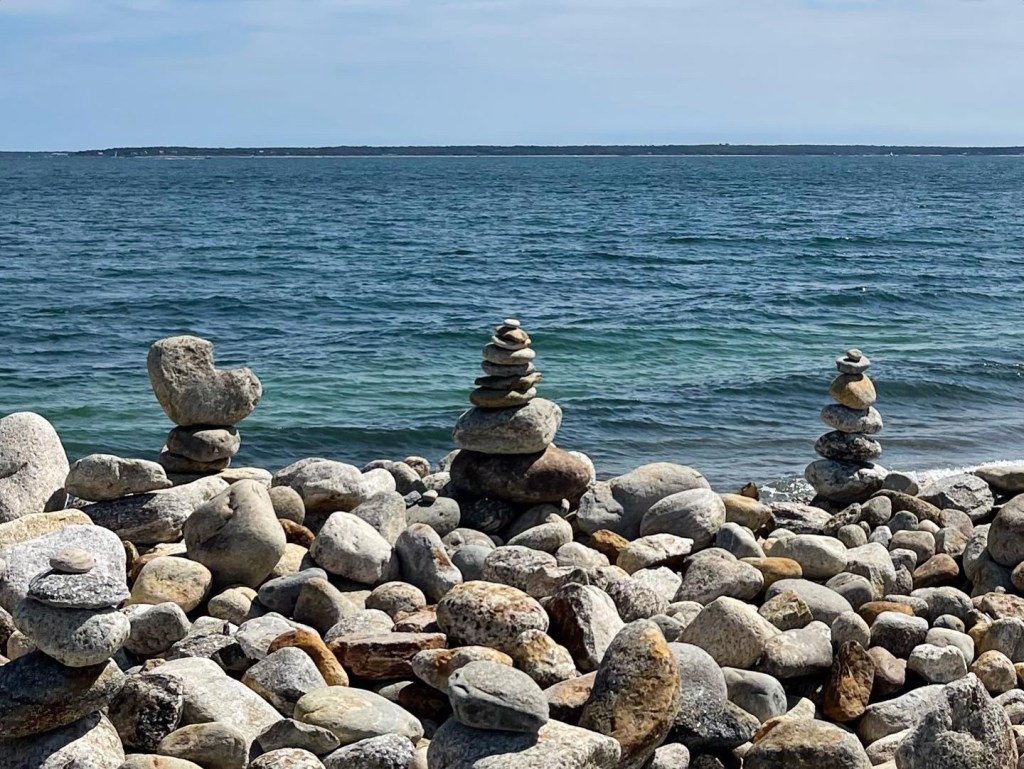
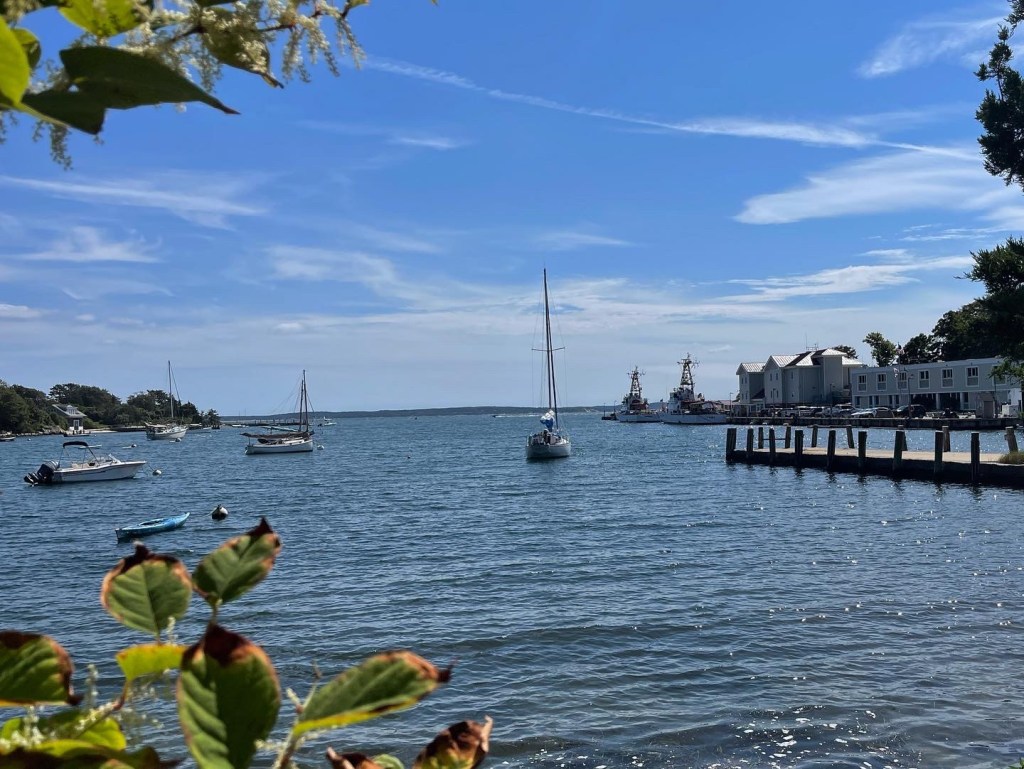
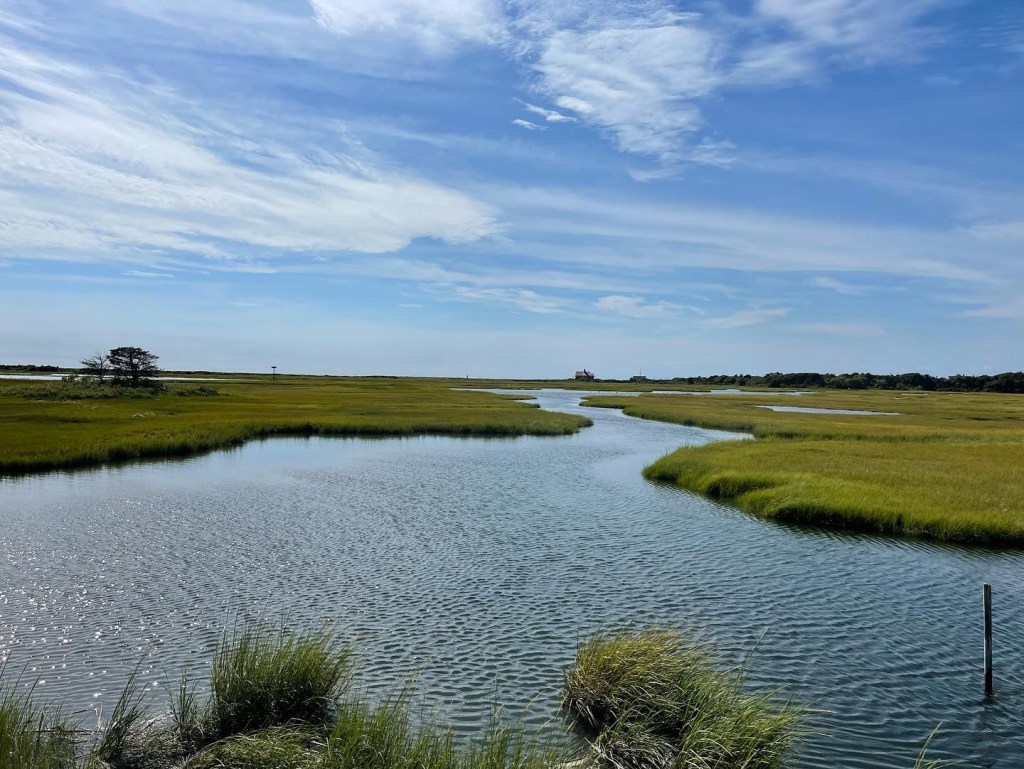
The trail lives up to its name, with views of Buzzard Bay across both of the Sippewissett Marshes (Little and Great—but aren’t they both great?) and of Vineyard Sound and Martha’s Vineyard as it hugs the beach. Shining Sea runs from North Falmouth to Woods Hole, offering plenty of options to linger for time on the beach, stroll through woodland trails, or a visit to the many shops and restaurants of Main Street in Falmouth and Woods Hole.
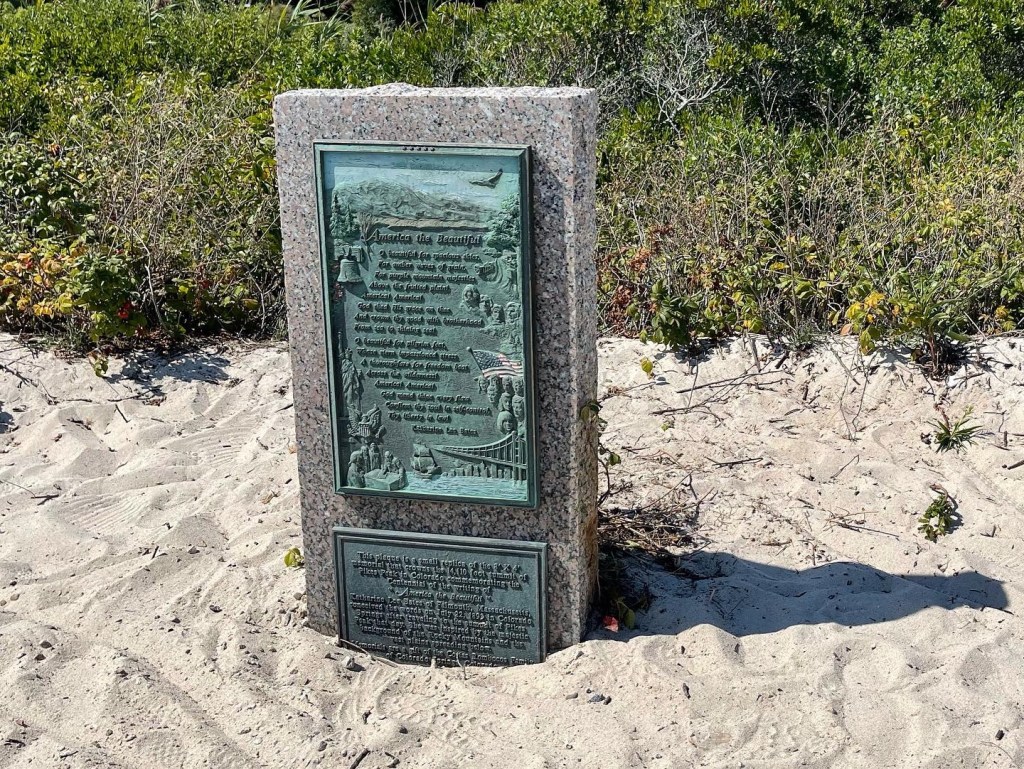
As a sucker for salt water, it was easy to fall in love with the beachside section of the trail. Here you’re treated to those expansive views, the latest trends in beach fashion, and a monument to the trail’s namesake, Katharine Lee Bates, author of “America the Beautiful”, which ends with the famous line, “from sea to shining sea”. Very few Americans can recite every verse of America, the Beautiful, but everyone knows that last line.
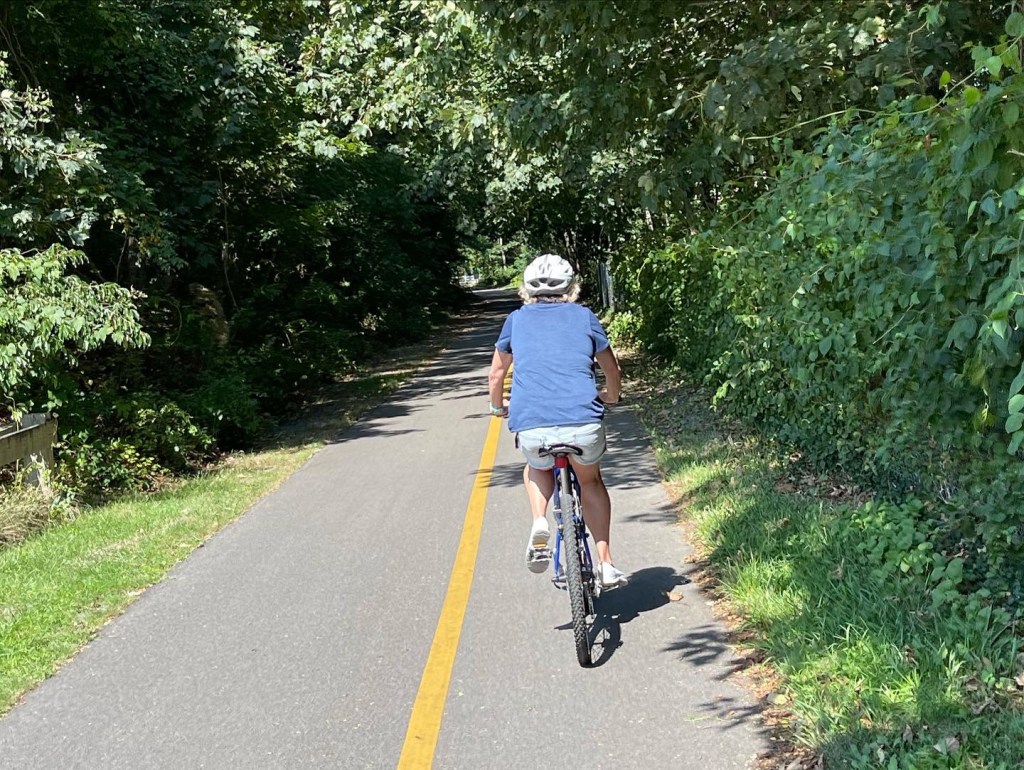
The magic on this trail is in riding through a tunnel of woodland canopy, salt march grass, past that beach sand and finally to the trail’s terminus at the Woods Hole Ferry. For a cyclist with dreams of never getting in a car for a vacation on the Cape and islands, the Shining Sea Rail Trail makes a strong statement of what’s possible. For this cyclist, it was an opportunity to give the feet a break while getting some exercise with a view.
From the North Falmouth terminus, it’s a 21 mile (33 km) round trip. That’s very manageable on a good bicycle. The human body connects with a bicycle in five places, each essential to a great experience. Perhaps none more than the seat. My bicycle seat was apparently designed to maximize suffering, but no matter, a sore saddle wasn’t going to ruin one of the prettiest rail trails in the northeast United States. The seat is replaceable, the memories will last far longer.
There may be no better time to experience the Shining Sea Bikeway than autumn. September is a great time to get the warmth with the crowds, and October should be spectacular for fall colors in that canopy. It’s a trail worth considering if you’re interested in experiencing Cape Cod without the hassle of driving in traffic.
Quietly walking downstairs in the dark, water bottle filled, I opened the front door and slipped outside, hoping the dogs wouldn’t bark. They bark all the time… but thankfully not this time. I get in the truck and begin the drive to the Railroad Bridge (capitalized, thank you). 5:30 AM, it ought to be super quiet there, I think, just me and a couple of fishermen.
Pulling into the parking lot, I see just how wrong I was. The entire parking lot is completely filled with pickup trucks and cars. Every contractor in Eastern Massachusetts must be along the canal, rods protruding from shore in hopes of that big catch. I felt like a single woman walking alone into a bar full of dudes, and like her, promptly turned around and got the hell out of there.
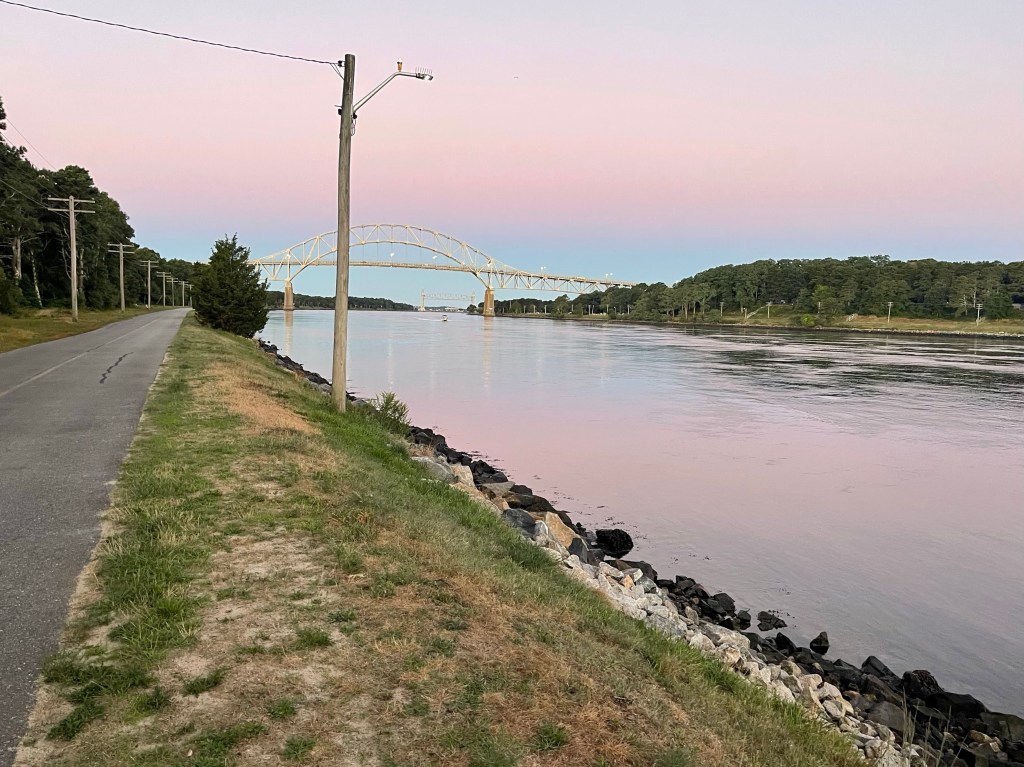
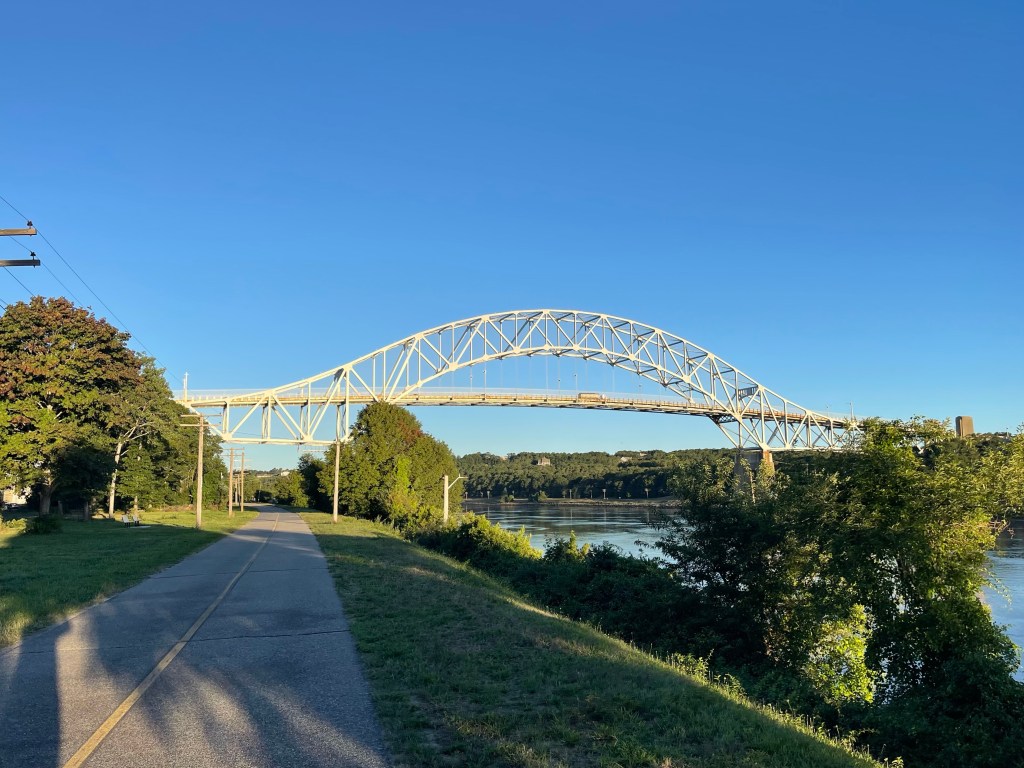
Driving to the Bourne Bridge parking lot, I’m relieved to find it relatively empty, as if the fish don’t like the canal water a mile further. No matter, I’m not here to fish, but to walk. The aim was a bridge-to-bridge walk, but instead of the Railroad Bridge it’s the Bourne to Sagamore Bridge out and back. That net’s me roughly 6.8 miles, and that’s enough for this workout.
Early mornings are a lovely time to walk the canal, and the best time to do it without earbuds in. It’s best to hear what’s happening around you when it’s dark out. Situational awareness is important, no matter who you are. Random cyclists and salty fishermen on old bicycles ride past at various speeds. All I can do is hold my line and keep the pace.
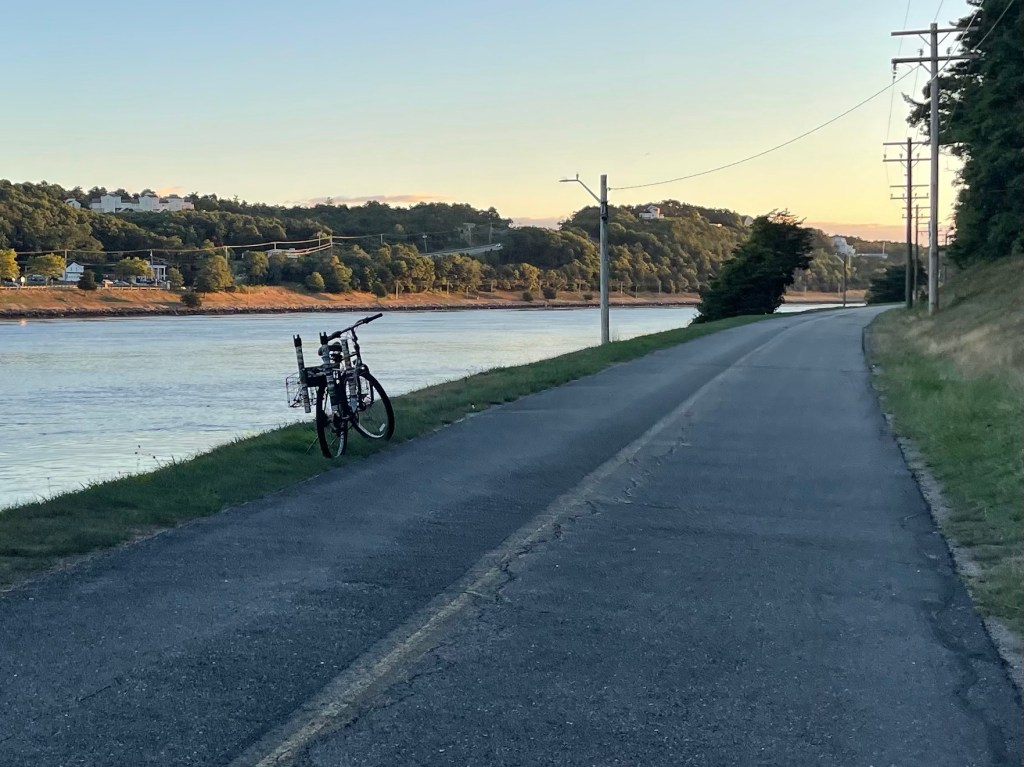
Canal fishermen, and they all seem to be men at 5:30 AM, tend to fall into two categories: those who stay near the parking lots, and those who ride bicycles to their own private fishing spot. The bicycles are an odd mix of cheap mountain bikes and yard sale bikes of all shapes and sizes. Each has a basket for fishing gear and two or three PVC rod holders bolted on. I wondered quietly at the aftermarket potential for a bicycle rod holder business and decided it just wasn’t for me. These aren’t the kinds of customers who are going to go with premium pricing, and I don’t have the heart to sell commodity fishing bicycle accessories.
Mind back to the walk, the bladder begins to call. I promise myself I’m not going to stop until I get to the port-o-potty under the Sagamore Bridge, and, feeling the urgency, push my pace a bit to get there sooner. Just as I arrive another character walking from the other direction sees me and makes a beeline for the plastic throne. I silently grumble, walk beyond the bridge to 3.4 and turn around. On the return the facilities are blessedly empty and soon my bladder is too. Relieved, the walk began again in earnest.
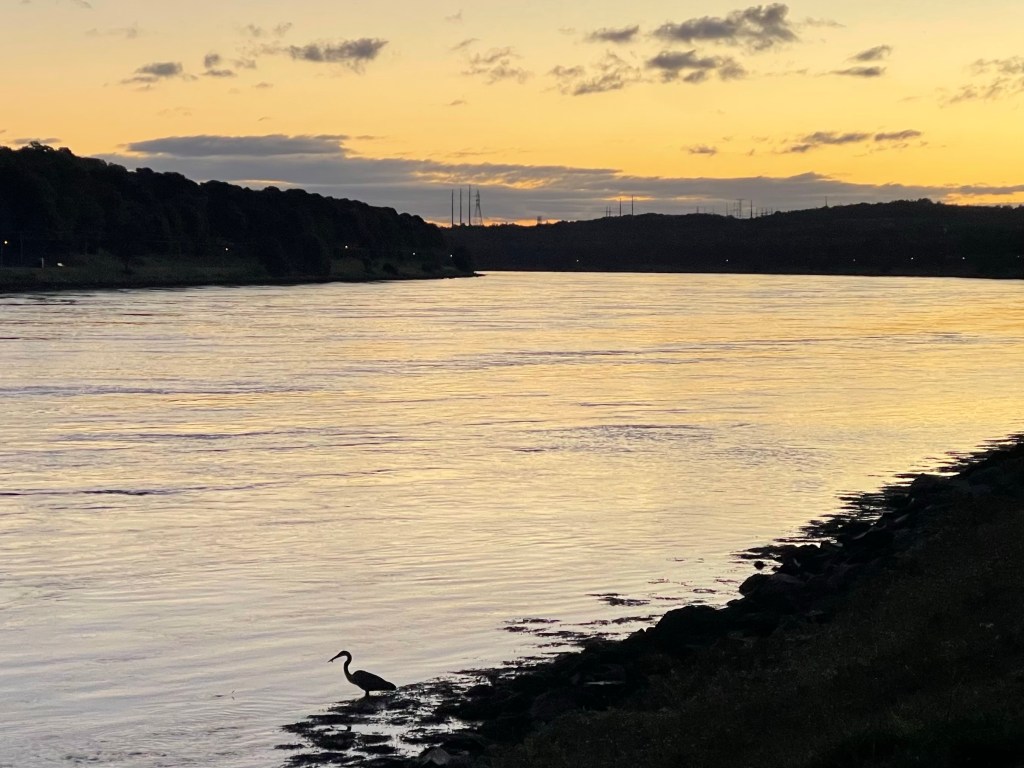
Out and back walks always feel shorter on the return trip, and this walk was no exception. I was a known commodity for the fishermen on my return trip, and ambivalent good morning nods became indifferent been there, done that focus on the task at hand. The fish seemed to win the day, as I only saw two catches on the entire walk, and one of those was a heron catching its breakfast. The only winner, besides the fish, seemed to be Dunkin Donuts, judging from the endless parade of Dunks iced cups passed on the walk. Good coffee stock investment tip for those paying attention.
Finishing a long walk brings with it the satisfaction of clicking that key word “end” on the Apple Watch. Lately I’ve been competing against a couple of women who suffer from the delusion that I’m going to let up and allow them to beat me in a seven day competition. Ha! Competitive banter aside, it’s funny how adding some people to the daily fitness routine can really enhance motivation to do the work. This one in the books, I quietly drove back to the house, waiting for the heckling to begin. And knowing I’m one step ahead, at least for this day.
Not all fishing is done with polesBourne BridgeFisherman’s BikeCanal trafficTurning around to return under the Sagamore Bridge
“The most difficult thing is the decision to act. The rest is merely tenacity. The fears are paper tigers. You can do anything you decide to do. You can act to change and control your life; and the procedure, the process, is its own reward.” — Amelia Earhart
I woke up sore all over, with muscles tight and grumpy, protesting the last week of doing what they’re supposed to do but somehow forgot about in lazy compliance with the mind. The soreness is a lag measure of work applied, simply that, and eventually the lag will be replaced by acceptance of the new reality. It was certainly far easier to get out of shape than to climb back to shape. Such is the way.
Decide what to be and go be it… simple on the face of it because it is in fact that simple. The hard part is hidden under the surface of those words: Go be it. Talk is cheap, and decisions without action are nothing but talk until we drag ourselves along for the transformation.
It’s far easier to have a bit of wine and cheese after a long day than it is to change into workout clothes and earn the right to wear them. It’s far easier to start our work a bit later, and end it a bit earlier. And it’s far easier to doom scroll on our phones than to turn off all distraction and dance with the important but not urgent tasks that move the chains in our lives. But there’s a reason easy has a negative connotation. Deep down, we know it in the moment.
So sure, I’m sore today, just as I’ve been sore for well over a week. It’s just the gap between where I am and where I want to be expressing itself. And what is expression but the manifestation of a feeling? Whatever discomfort we feel in the moment is part of the process of becoming, a manifestation of what we want to be. It’s that voice in our head reminding us that this time, if we stay with it, we might actually be it.
“Every instant of our lives is essentially irreplaceable: you must know this in order to concentrate on life.” — André Gide
Here we go again: another week beginning. Much like last week and the week before, yet we’ve changed. We’ve layered on our moments of insight and irreplaceable instants that root us in identity and purpose, or perhaps left us anchor-less and drifting. Let’s hope for the former.
The thing is, this week is different from those weeks gone by. It’s surely more tangible and immediate, but more, this one is in our hands. We can’t get too caught up in our previous successes and failures, we can only double down on what works for us. And maybe, try something bold and new.
I like the idea of micro-bursts: sprints of intensity where you focus on key activities that move you towards your goals. In rowing it was a Power 10, where everyone put aside personal discomfort and focused on making the next ten strokes their very best. It started with a call from the coxswain when they felt the boat needed a boost in momentum. And it nearly always worked.
Focus on living a bold, meaningful life can start in an instant. Often it begins with a feeling that you need a bit of a boost in productivity or purpose. With the right concentration and effort, like a boat gaining a burst of speed and swing, it nearly always works to reset rhythm and concentration.
“We think of inertia as the state of being inert or motionless—one of our purer displays of passivity and disengagement. It’s not. Inertia is an active event in which we are persisting in the state we’re already in rather than switching to something else… The most reliable predictor of what you’ll be doing five minutes from now is what you’re doing now… The most reliable predictor of who you’ll be five years from now is who you are now.” — Marshall Goldsmith, The Earned Life
Yes, you might detect a pattern in the writing recently. I keep returning to the Tom Peters statement that excellence is the next five minutes. Habits are hard to break, routine is either a prison or a path to a brighter future. And inertia now can predict who we are in five years if we don’t take that next step to change right now.
Does that sound unnecessarily urgent? Perhaps, but aren’t the stakes just that high? We are what we repeatedly do, and more often than not we repeat the same damned thing this five minutes as we did last. So we ought to take this next five minutes and demand something more of ourselves than the previous five. We ought to make it an active event that transcends our previous place.
The easiest way to determine the truth in that is to look at what we did last week and compare it to what we did last year. Sure, there are highlight moments of trips and events that break up the sameness, and a pandemic mixed in to skew the data, but on the whole things are roughly the same. If our habit loop is positive this can be a very good thing, but if we keep repeating bad habits we might be living in a rut that runs straight to the grave.
“Every action you take is a vote for the type of person you wish to become. No single instance will transform your beliefs, but as the votes build up, so does the evidence of your new identity. This is one reason why meaningful change does not require radical change. Small habits can make a meaningful difference by providing evidence of a new identity. And if a change is meaningful, it is actually big. That’s the paradox of making small improvements.” ― James Clear, Atomic Habits
It’s easy to spot inertia when we look at intentions. If we intend to write the book or run the marathon or summit the mountain but find ourselves dancing with the same excuses we had yesterday and five years ago, well, let me introduce you to our friends inertia and low agency. On the flip side, if you’ll allow me to use a few of my own examples, inertia is publishing this blog every day for the last four years, reading early every morning and most nights and maintaining a streak on Duolingo that’s approaching 1000 days. Maybe each is small in the big scheme of things, but each is a +1 on the path to becoming.
@jackbutcher
Moment-to-moment we make decisions that pull us forward or set us back. We default to the familiar, which both reinforces our identity now and reinforces it in our future. That past moment isn’t this moment unless we choose the same thing. Will it be a plus or a minus? Our vote ought to be for an active event, our action should be a plus.
“To me marketing is about values. This is a very complicated world. It’s a very noisy world. And we’re not going to get a chance to get people to remember much about us—no company is. And so we have to be really clear on what we want them to know about us… But even a great brand needs investments and caring if it’s going to retain its relevance and vitality, and the Apple brand has clearly suffered from neglect in this area in the last few years. And we need to bring it back. The way to do that is not to talk about speeds and feeds. It’s not to talk about bits and megahertz. It’s not to talk about how we’re better than Windows… The question we asked was, ‘Our customers want to know, who is Apple and what is it that we stand for? Where do we fit in this world?’ What we’re about isn’t making boxes for people to get their jobs done—although we do that well. We do that better than almost anybody, in some cases. But Apple is about something more than that. Apple, at the core, its core value, is that we believe people with passion can change the world for the better. That’s what we believe. And we have the opportunity to work with people like that. We’ve had the opportunity to work with people like you. With software developers, with customers who have done it in some big and in some small ways. And we believe that, in this world, people can change it for the better. And that those people who are crazy enough to believe that they can change the world for the better are the ones that actually do.” — Steve Jobs, speech at the release of the ‘Think Differently’ advertisement
The speech is in low resolution. The transcript is inaccurate in some places (I’ve tried to correct it here). But Steve Jobs words shine through this grainy time machine like a beacon. When he plays the ad, viewed from the lens of time, you see that he was and would always be one of the crazy ones, one of the misfits, rebels and troublemakers. And we celebrate Jobs today for what he created, even as we recognize he was never perfect. But who is?
Even a great brand need investments and caring if it’s going to retain its relevance and vitality… this is true whether we’re looking at our company, our country, and certainly, ourselves. Jobs points the way with the question, “where do we fit in this world?”. It’s a question we ought to wrestle with in our own lives, in quiet places when the day is ripe with possibility. For in the quiet moments we’re best prepared to answer such questions.
And we ought to answer boldly. Our brand—our identity—isn’t something to trivialize. It ought to give us goosebumps just to think of it. And it must be more than words. For we are what we work consistently towards. We are the sum of our lifetime contribution. But really, we are the next five minutes.
We’re not going to get a chance to get people to remember much about us…. no person is. Our brand ought to be remarkable and memorable for all the right reasons. We can’t control who pays attention, but we can control just how compelling our story is when the world stumbles upon us. Compelling begins with how we view our own contribution. Our identity—our brand—is ours to shape and mold, honed by life but envisioned and realized by the intangible force deep inside of us. We ought to craft something remarkable and memorable.
For this moment is our own time machine, isn’t it? What will we remember of ourselves in this five minutes of boldness or timidity? We aren’t what we think we are, we are what we do! Just what is our brand?
“Every breath I take is a new me.” — Gautama Buddha
“Life happens between an inhale and an exhale.” – from a random Dove chocolate wrapper
Each of us changes. We aren’t who we were yesterday, nor will we be the same person tomorrow that will surely react and adapt to the influences of today. We must own our actions, but we must also recognize that the person who did the things we once did isn’t who we are now. Simple, right?
Not when those around you treat you as the character you once were. How many co-workers put you in a bucket based on the role you had when you walked in the door the first time? How many reunions turn into stories of things you did way back when, with scant focus on who you are now? How many family events center on old nicknames and stories of the past?
Here’s the twist: What if we too are treating people based on the characters they used to be instead of who they are now? Doesn’t it seem more appropriate to learn who they are in this moment? The trick to engagement with any other soul is seeking first to understand, and then to be understood (Covey). Every moment counts, and progress requires our immediate attention!
We aren’t who we once were, but who we once were helped form our current identity. Personally, I’m grateful I’m not who I was at 18 or 30. Sure, there were some redeeming qualities in that character, but I prefer the new me, even if I don’t showcase the abs I had at 22 (too much chocolate?). The moment-to-moment choices we made between then and now brought us here. The moment-to-moment choices we make from now into our unknown future will surely determine who we’ll be then. So make good choices in this breath and the next.
Like the chocolate wrapper reminds, life is happening one way or the other now. Just look at how much we’ve changed already. Imagine where the next breath might take us should we use it wisely.
“Life will throw everything but the kitchen sink in your path, and then it will throw the kitchen sink. It’s your job to avoid the obstacles. If you let them stop you or distract you, you’re not doing your job, and failing to do your job will cause regrets that paralyze you more than a bad back.” — Andre Agassi, Open
When you witness excellence in action, it’s hard to comprehend the work that went into the performance. Seeing Sydney McLaughlin destroy her own 400 meter hurdles record is awe-inspiring because she does the incomprehensible. But the work that brought about the moment isn’t ours to see, or feel. The hurdles aren’t the only obstacle she had to clear on her way to a record-breaking performance—she had to clear every other distraction along the way to get to it. People like McLaughlin or Agassi or Tom Brady are anomalies to the rest of us. They’re obsessively focused and a bit quirky in their habits. Most of us balk at the price of greatness, for them it’s simply the act of doing your job.
Disciplined routine is the answer. Doing your job is the moment-to-moment bias towards productive action and good decisions. Anyone in New England will hear Bill Belichick’s own words ring in that Agassi quote. Do your job… and do it well. It’s a simple thing to grasp, must harder to execute with an undisciplined mind. We must get up daily and do the work that calls to us. No excuses needed, you either do or do not, there is no try (thanks Yoda). This is a tough mindset to acquire, but it’s required for reaching excellence.
“Excellence is the next five minutes”, as Tom Peters put it, “or nothing at all”. We get too caught up in excuses that lie beyond the immediate. Surely we must know where we’re going, but we must then get beyond long term thinking, for it’s a form of procrastination. We often kick things down the curb that we ought to be doing right now. Planning isn’t doing, so we mustn’t tell ourselves what we’re going to do, we mustn’t tell ourselves anything at all, really. We must friggin’ do it.
There are so many obstacles to navigate in life that it can be overwhelming. But most of it is BS playing on a loop between our ears. The only way to break that loop is with a viable habit loop that forces us to execute in the now. Excellence is the next five minutes, or maybe the next 50.68 seconds, or maybe just this very instant. What we do with this moment determines so much of who we’ll be at the finish line. Don’t regret the moment.