Category: Garden and Home

  • Two Sides of the Coin

    The last year highlighted the value of a good home, with a good yard, with good Internet. Having all three was the trifecta. But the last year also reminded us of what we were missing, out there, waiting for quarantines to end.

    For all the bold claims of travel, I keep investing in new projects to fortify the homestead. In a time of amplified real estate frenzy, you either double down or cash out. I keep doubling down with new projects. You invest where you focus most. But always with an eye towards the future. Travel will have its time.

    Many of us are fully vaccinated now and waiting for the world to pivot towards open borders, silently listing the destinations and the vehicles with which to get there. For 2021 I’m contemplating drives across the country instead of flights to the international bucket list. Local mountain peaks and waterfalls remain a priority, with more overnight hiking sprinkled in. Hopefully more time exploring the world from the water. And perhaps, this year, under it.

    In the void, the projects continue. New garage doors sparkle! And point out the requirement for new trim. And of course now something must be done with that front door. The fence project of last year was a beautiful addition! And highlighted where it should have gone to, demanding extension. The garden, the pool, the appliances… everything calls for attention.

    Always time and money. Travel and home each demand the same currencies. And this is the two sides of the coin that I find myself flipping. The coin keeps landing on home at the moment. But things have a way of leveling out… Right?

  • Good Fences

    There where it is we do not need the wall:
    He is all pine and I am apple orchard.
    My apple trees will never get across
    And eat the cones under his pines, I tell him.
    He only says, ‘Good fences make good neighbors.’
    Spring is the mischief in me, and I wonder
    If I could put a notion in his head:
    ‘Why do they make good neighbors? Isn’t it
    Where there are cows? But here there are no cows.
    Before I built a wall I’d ask to know
    What I was walling in or walling out,
    And to whom I was like to give offense.
    – Robert Frost, Mending Wall

    It happened once, and it seemed awkward at the time. The neighbor walked between his fence and my fence to retrieve golf balls he’d been chipping beyond his fence. He quietly picked them up, we waved at each other and the moment ended. Except that it didn’t really end. The neighbor now works from home in a pandemic on conference calls all day, head set on, chipping golf balls back and forth in his yard. And so this scene is repeated several times a day.

    You might be wondering why there are two fences up. Well, that’s a good question with a reasonable answer. The folks that originally put up the neighbor’s fence put it up four feet inside the property line, and had it curved slightly to follow the tree line. A few years later we got a black lab who liked to explore the neighborhood on his terms. We installed a black chain link fence around the perimeter of our yard to discourage this, thinking it blended in with the woods beyond. The dog was mostly contained, the trees between the fences obscured the unusual nature of two fences running parallel to each other. Mission accomplished! Who thinks of Arnold Palmer straying into your personal space at moments like that?

    Fast forward fifteen years and the brush and small trees are cleared out. The neighbors have changed over twice. The dog has since passed. All that remains is the cold reality of a pair of fences quietly marking time. And the frequent moments of the golfer gathering his golf balls while on his conference calls on the edge of our back yard. A back yard that for twenty years offered the illusion of privacy with the woods beyond.

    It’s my own fault, really. I mentioned in passing one day that the land between was his, and Kilroy has since taken great pains to stake his claim to it with errant golf balls and purposeful walks to scoop them up. It seems passive aggressive to me, like running a lawn tractor in your driveway when your neighbor is having a birthday party. Wait, that’s him too…

    If this seems like a justification for building a taller fence, well, it may be. Wouldn’t that be something, two privacy fences running parallel to each other along the yard? Frost’s old neighbor would say good fences make good neighbors. And Frost would rightly question, just what are we walling in and walling out?

  • Charming Gardeners

    “Let us be grateful to people who make us happy; they are the charming gardeners who make our souls blossom.” – Marcel Proust

    Spring in New England is a tricky thing. We pivot from beautiful warm days to snow squalls and bitter wind, often within a few minutes of each other. But the days grow longer and we quietly grow more confident about putting the lawn furniture back out and maybe planting some seeds in starter soil. Basil, cilantro and parsley are each growing in sunny windowsills as I write this, and I’m considering getting the dahlia bulbs going soon. Such is the mind of a gardener.

    Proust writes of a different kind of gardener, of course, but they’re generally one and the same. The people who light us up in social interaction are quiet observers of humanity, readers of eyes and solicitors of smiles. In this particular time when social interaction has been elusive, we haven’t had as much interaction like this, and we’ve never needed it more.

    Spring brings hope to the gardener, and vaccines bring hope for time with those people who make us happy. I’m as ready for a gathering of celebration with friends and family as I am for the smell of fresh cut grass and tomato vines. Confident hugs and hand squeezes and shoulder leans are just around the corner.

    Imagine the days ahead, as a gardener imagines them – life blossoming anew, hope in the air, warm sun on our backs. Breathe in the fresh warm air, turn towards friends old and new, and smile. They could use it – and so could you.

  • Determining the Age of a Tree

    I’ve been wondering about the age of a large white oak tree guarding the edge of the forest for years. Not enough to actually do something about it, mind you, but wondering nonetheless. Then a hike with old growth trees last Sunday triggered a burning curiosity in me about the age of the trees we hiked amongst, and by extension, the age of the trees in my own backyard. I found myself having to know.

    There’s an easy way to gauge the age of a tree: you count the rings. The problem with that method is you’re really measuring the age of death of the tree. I prefer to keep them around, especially when they’re my elders. But rest assured, there’s another method for estimating the age of a tree, and that’s doing some basic math and adding a bit of educated guessing. All of this is searchable online, of course, but I found the instructions from Purdue University to be particularly helpful.

    Step one is to measure the DBH of the tree. What’s this? Another acronym in a world of acronyms? Sorry! But this one is easy to remember. DBH stands for Diameter at Breast Height. Take a flexible tape out to your tree of interest, measure 4 1/2 feet up from the base of the tree and there’s your DBH. Now anchor the end of the tape measure (or have someone hold it) and walk around the tree back to your starting point. This is the circumference of the tree. Convert this to total inches. In the case of my stately white oak, it measures 92 inches in circumference.

    The next step is to determine the diameter of the tree, which simply means dividing the circumference by 3.14. For the white oak, this was 29.29. So far, so good. And now we rely on something called the growth factor to figure out the rest. This is where science meets estimation. For a tree on the edge of the forest in optimal growing conditions, the growth factor is pretty straightforward. For a tree on a sidewalk in downtown Boston or near the summit of Mount Jackson in New Hampshire, well, that tree’s growth factor is going to be pretty compromised by the stress of everyday living. You’ll need to factor that in to the equation at some point.

    Back in my backyard, our white oak is happy as a tree can possibly be in this crazy world. The growth factor for a white oak in this happy situation is 5. You multiply the diameter by the growth factor and my favorite white oak tree turns out to be around 146 years old! And those old growth trees I saw hiking? They’re roughly 300 years old, which is about how long a healthy white oak typically lives. I hope they beat the odds with that good clean living.

    So around 1875 when the fields were no longer being farmed or grazed in this patch of Southern New Hampshire land an acorn sprouted and grew in the sun. It witnessed the forest grow around it, protecting it from the worst of the winds and the whims of humans looking for firewood and lumber. And then I became its neighbor and guardian at age 124. And we became fast friends.

  • Muscle Memory

    I grab the newel post with my left hand in the dark, pivot slightly and feel the stair rail with my right. Twenty-two years of early morning flights and workouts and pouring thoughts into piles of words adds up to the kind of muscle memory that allows you to navigate a house in the dark. So much has changed in that time in the concentric rings of relationships that circle closer and closer to the brain between these ears. But this act, grab left and pivot to right, hasn’t changed at all.

    When you’re in a new relationship everything is discovery and revelation. Hopes and dreams. The small endearing habits, the smell of shampoo, the imperceptible twitch of an eyebrow or shift of a glance that betrays a belief you’ll learn over time.

    Relationships with place are similar, but the friction is different. You get to know the creaks and tendencies in a house, the way it breathes when the furnace turning on, how it reacts to frigid cold and gusty wind, the appliance working to survive another cycle, and the sleep cycles of fellow inhabitants. What sounds right and what seems off.

    A house wears like a pair of jeans, faded and stretched in some places. Lived in. Pets come and go. Children bridge the time between new house and familiar abode. A crayon mark or that chip in the tile from the oldest banging a fireplace poker that you don’t even see anymore. Memories of earlier days flood in; bringing the youngest home for the first time, birthday parties, celebrations and holidays.

    Twenty-two years. For all the talk of travel and downsizing and the encroaching habits of the neighbors, there’s something to be said for the familiar. For muscle memory in dark times.

  • Here, in This Place

    In the place that is my own place, whose earth
    I am shaped in and must bear, there is an old tree growing,
    a great sycamore that is a wondrous healer of itself.
    Fences have been tied to it, nails driven into it,
    hacks and whittles cut in it, the lightning has burned it.
    There is no year it has flourished in
    that has not harmed it. There is a hollow in it
    that is its death, though its living brims whitely
    at the lip of the darkness and flows outward.
    Over all its scars has come the seamless white
    of the bark. It bears the gnarls of its history
    healed over. It has risen to a strange perfection
    in the warp and bending of its long growth.
    It has gathered all accidents into its purpose.
    It has become the intention and radiance of its dark fate.
    It is a fact, sublime, mystical and unassailable.
    In all the country there is no other like it.
    I recognize in it a principle, an indwelling
    the same as itself, and greater, that I would be ruled by.
    I see that it stands in its place, and feeds upon it,
    and is fed upon, and is native, and maker.
    – Wendell Berry, The Sycamore

    I’ve both loved and resented the roots I’ve grown. A wandering spirit, I’ve chafed at being caught in place for too long. Yet I’ve been deeply nourished by the community I’ve planted myself in. I reach towards the sky, trying to fly. While rooting deeper and wider still. Such is the way.

    Roots are built on routines and responsibilities, done with love and established over time. You don’t have to feed the birds where you live, but when you do they reward you with movement and song. They bring life in return for your investment in time, money and persistence. And so it is with a community. When you help nourish the community you’re rewarded in ways you might not have anticipated when you first set roots there.

    Old growth trees come in many shapes and sizes. Some grow impossibly high. With others, thick trunks support wide canopies. And those in the highest mountains remain low to the ground, clustered tightly together and shrinking in on themselves, constantly buffeted by the harshest of winds.

    The pandemic abruptly stepped into our lives about a year ago and still informs. I’ve learned to appreciate the firm ground I’m rooted to all the more when the storms blow. For here in this place I’ve grown more than I might have otherwise. Here in this place the worst of the winds blow over. Here in this place we’ve built lives for ourselves. Bonded to this place and each other, roots interwoven together.

  • Hummingbirds in Winter

    “For unless one is able to live fully in the present, the future is a hoax. There is no point whatever in making plans for a future which you will never be able to enjoy. When your plans mature, you will still be living for some other future beyond. You will never, never be able to sit back with full contentment and say, “Now, I’ve arrived!” Your entire education has deprived you of this capacity because it was preparing you for the future, instead of showing you how to be alive now.” – Alan Watts

    I was thinking about flowers. Specifically, Bee Balm (Monarda). The blooms of next summer are currently scheming in the frozen turf of the garden, awaiting the heat of late June and July to burst onto the scene. In that respect, I share more in common with the flower than the hummingbird, which ignores border restrictions altogether and zips down to Mexico and Central America for the winter. You think that snowbird expression invented itself? The hummingbird is one of many birds that bolts the limited prospects of survival in the north for the tropics.

    Still, I don’t mind winter, when we have it. This year is a confusion of rain and frigid temperatures, but no significant snow to speak of just yet. But that’s the world we live in now, with seasons shifted slightly askew, and some uninformed loud people thinking climate change is a hoax, like COVID and election results and any science that doesn’t jibe with their worldview.

    I imagine the hummingbirds I got to know last summer are doing the Macarina with friends from around North America in some tropical paradise right about now. And why shouldn’t they? They flew 3000 miles and straight across the Gulf of Mexico to arrive in the tropics. So go on: guzzle that nectar and dance to your heart’s content!

    Back here in the frozen north, we wonder when the snow might return again, and then the flowers, and finally the hummingbirds. But, as Watts points out, we can’t live in the future, we can only embrace what we have now. We keep things going here, the dormant flowers and their gardener, making the most of what we’ve got until warmer days and open borders.

    As a gardener, I know there’s merit in planning for the future that Watts doesn’t account for in the quote above. Amending the soil, sowing, weeding and generally seeing your crop through to harvest are inherently forward-looking activities that happen in the present. There’s nothing wrong with knowing where you’re going while living fully in the present. Watts knew this too of course, but you can’t wedge everything into one clever quote.

    Here in New Hampshire, I’m packing as much alive time as possible into each day as it presents itself. In six months time, should we be fortunate to arrive there together, I’ll get reacquainted with the hummingbirds, who like to hover at eye level and check out the character who tends the garden for them. They’ll have squeaky tales of perilous travel over open water and jungle reunions with cousins. What shall my own tales be for them? Don’t we owe it to them to make it interesting?

  • Mid-Autumn Philosophy

    “I like spring, but it is too young. I like summer, but it is too proud. So I like best of all autumn, because its leaves are a little yellow, its tone mellower, its colours richer, and it is tinged a little with sorrow and a premonition of death. Its golden richness speaks not of the innocence of spring, nor of the power of summer, but of the mellowness and kindly wisdom of approaching age. It knows the limitations of life and is content. From a knowledge of those limitations and its richness of experience emerges a symphony of colours, richer than all, its green speaking of life and strength, its orange speaking of golden content and its purple of resignation and death”
    ― Lin Yutang, The Importance of Living

    The leaves on the white oaks stubbornly hold on, even as the rest of the leaves are weeks into their return to earth. Still a lot of green in those leaves, I see. And orange and red and yellow. The oaks don’t get the attention that the maple leaves get – how could they possibly compete? And yet they remain the more resilient reminder of the warmer months. So we begin the waiting game.

    Two weekends ago the yard was cleared of every leaf and acorn. We knew it was only round one. Sure enough we had snow and cold temperatures roll in, and the leaves started raining down off the red oaks. Snow and red oak leaves scattered everywhere as if Mother Nature had vomited over the yard. Not a good look at all, really.

    But soon the snow melted and the winds picked up and the red oak leaves became a gift to others down the street. Or maybe the next town over. The winds were pretty strong and leaves love to fly, so your guess is as good as mine. The wind giveth, the wind taketh away.

    The stack of wood sits waiting for frozen ground and a chain saw to get chopped up into stackable bits. I gave the chain saw away in 2019 to someone who needed it more. I still hear about that, but it’s a phone call away and it was never mine to begin with. I find owning things to be a stack of small burdens that ask for attention, and yet we stack them like firewood anyway. Stuff we must take care of, stuff we give away time to. Stuff that doesn’t matter all that much in the long run.

    And so we slide towards late Autumn, when the trees concede their final leaves, the ground is raked bare once again, and life returns to a naked slumber. The days are short and grow dark too soon. A reminder that life too is short, but didn’t we know that all along? Embrace the cold, short days. For there’s magic in them. And this too shall pass.

  • Blue Wings

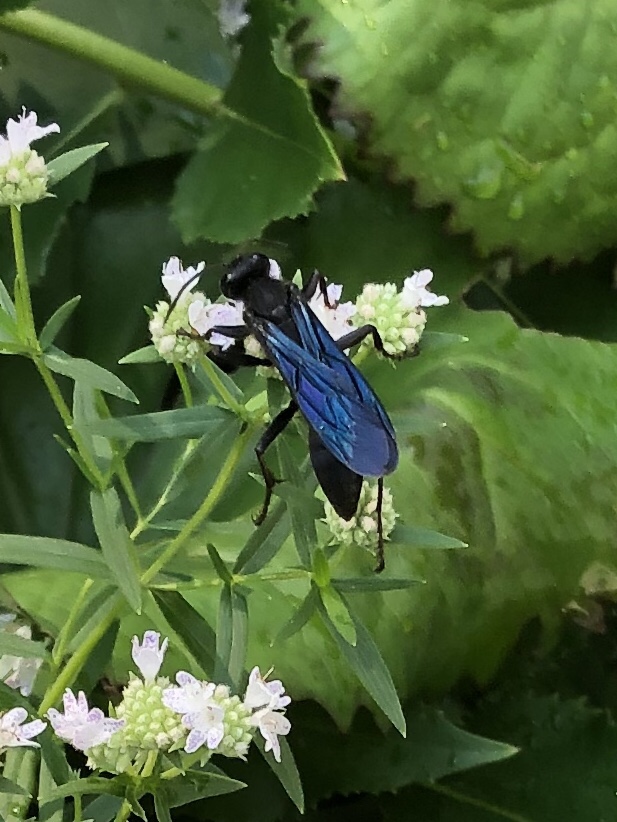
    Wasps are not something I think about very often (until they become a threat anyway), but my attention was drawn to a half dozen fascinating black wasps with blue wings diligently working the flowers like honeybees. I’ve seen them in other years, but sometimes you don’t pay any attention to such things until you’re ready to. It seems I was ready to. And researching this wasp made me gasp.

    I can think of many ways to die that would be better than the way the prey of the Great Black Wasp (Sphex pensylvanicus) die.  In fact, it might just be the most horrific way to die I could think of.  The wasps sting their prey, usually things like grasshoppers and katydids, to paralyze it.  They’ll then bring it back to their underground nest, where they lay eggs on the stomach of the prey that feed on the still-alive and most unfortunate victim.  If you were going to write a script for a horror movie, being eaten alive by the offspring of your hunter while paralyzed in captivity might be your inspiration.

    The Great Black Wasp lives up to its name – black all over with iridescent blue wings.  Its huge by wasp standards. The ones flying around in my garden were more than an inch long, which is daunting when you consider the stinging insects flying around you.  But they were too busy pollinating flowers and looking for food for their offspring to eat alive to worry about me.  I was grateful for their lack of aggression, because I found them to be beautiful insects.  But then, I’m not a grasshopper.

    Viewing the wasps was a nice departure from the devastation caused by the groundhog.  It reminded me that the flower garden is really my preference anyway, precisely because it attracts interesting pollinators like the Great Black Wasp.  At some point maybe the garden will return to normal again, just as I hope the world will. And in those dark moments that 2020 brings think about those beautiful blue wings and remember: things can always be much, much worse.

  • Shift Happens

    The lingering glow of immersion in salt water quickly sweated out of me when I returned home to a yard in need of attention.  Some of the attention simply needed a prompt investment in labor, like mowing the lawn and cleaning the pool.  Co-existing with mature trees means picking up a collection of branches and other debris before you can mow.  Co-existing with wildlife meant scooping six frogs out of the pool once the solar cover was removed, disrupting frog spa day, and more tree debris.  It also meant assessing the damage from the groundhog, who has raised the stakes significantly by wiping out most of the remaining vegetables, but more egregiously climbing up the potted Hibiscus, breaking branches on its quest to mow down tasty bits from the top.  This shall not stand.

    There’s a tangible shift happening with the back yard from June/July satisfaction with the joys of a private oasis in the middle of a pandemic to a feeling that maybe this work is more than I want to deal with.  I recognize this as a post-vacation reality slap and know it will subside in time.  Part of this is a recognition that the pandemic marches on with no clear end in sight, and a burning desire to just get out in the world once again.  To cross borders real and imagined.  Part of it is knowing the routine for what it is and not being quite ready for it just yet.  We’re 1/3 of the way through August and this is naturally the time when I start to look around at where we are and what needs to be done.  The garden had faded even before the large rodent accelerated the process.  Where do we go from here?

    There’s another part of the shift, and its the recognition that time slips quickly away, and our best efforts to maintain a pristine environment can be wiped out faster than you can spell groundhog.  More attention paid to those big things from yesterday’s post, and less on half-assed attempts to grow pumpkins and tomatoes and hibiscus.  Does creating a backyard paradise mean hunting down a mammal that finds a buffet paradise in my efforts?  Or do I just stop planting the things it likes to eat and go to the farm stand for tomatoes and pumpkins?  The garden, however noble a pursuit, was never about produce.

    Yesterday I woke up on the edge of the bay.  This morning I woke up on the edge of the forest.  Each offers a dose of reality that you’ve got to come to terms with.  I’m not a Rhodes Scholar but I’m smart enough to recognize good fortune when I see it.  Appreciate the good and learn from the setbacks.  That’s 2020 in a nutshell.  The world marches on, and shift happens.