Category: History

  • The Lindy Effect

    A few years ago Nassim Nicholas Taleb described a phenomenon known as the Lindy Effect in his book Antifragile. Soon after you started hearing about it in other work, referenced in blog posts, magazine articles and even its own Wikipedia page. I tend to shy away from uber-trendy topics, but I’ve thought a lot about this Lindy Effect since reading about it in Taleb’s book.

    “I follow the Lindy effect as a guide in selecting what to read: books that have been around for ten years will be around for ten more; books that have been around for two millennia should be around for quite a bit of time, and so forth.” – Nassim Nicholas Taleb, Antifragile

    Lindy’s was a famous deli in New York where comedians and actors would gather and discuss such things as the durability of a Broadway show. The observation is that if something survives for a period of time longer than the norm, it implies that it will survive at least that long into the future. The Lindy Effect only applies to non-perishable items, so you and I and that orange on the counter don’t count. But that picture you take or that book you write or the product you release to the market do count. The implication is that you might build something that outlasts you by a long stretch.

    Henry David Thoreau died just eight years after publishing Walden, but the book lives on to this day. When it was originally published it was hardly noticed. Yet today it’s been read by millions. When Ansel Adams took the photograph “Monolith, the Face of Half Dome” in 1927 he was creating something that still captures the imagination of people around the world almost 100 years later. It was the picture that built his legacy and helped preserve Yosemite.

    Ernest Hemingway published his first classic, The Sun Also Rises, in October of 1926, six months before Adams took that photograph. Hemingway had a burning desire to be a great writer, and to publish great and lasting work. Many people point to the last lines of the novel for the way it captures the relationship between the two central characters. You might also see the final line as a hopeful wish from Hemingway that this book might fly:

    “Oh Jake,” Brett said, “We could have had such a damned good time together.”
    Ahead was a mounted policeman in khaki directing traffic. He raised his baton. The car slowed suddenly, pressing Brett against me.
    Yes,” I said. “Isn’t it pretty to think so?”

    – Ernest Hemingway, The Sun Also Rises

    I’ve noticed a small trend in this blog where 6-10 specific blog posts seem to get views all the time, while the other 1000+ have their moment in the spotlight and fade away over time. Millions of books and paintings and pictures similarly fade away over time, but some stand up forever as legendary. Making art may have a formula, but creating its stickiness remains a mystery to most of us.

    Ironically, Lindy’s, the delicatessen that gave birth to the concept of building something that might last forever, closed forever in 2017. For businesses are perishable too. Yet its name lives on. Maybe, like Thoreau or Adams or Hemingway, that is as it should be.

  • A Hole in the Ground

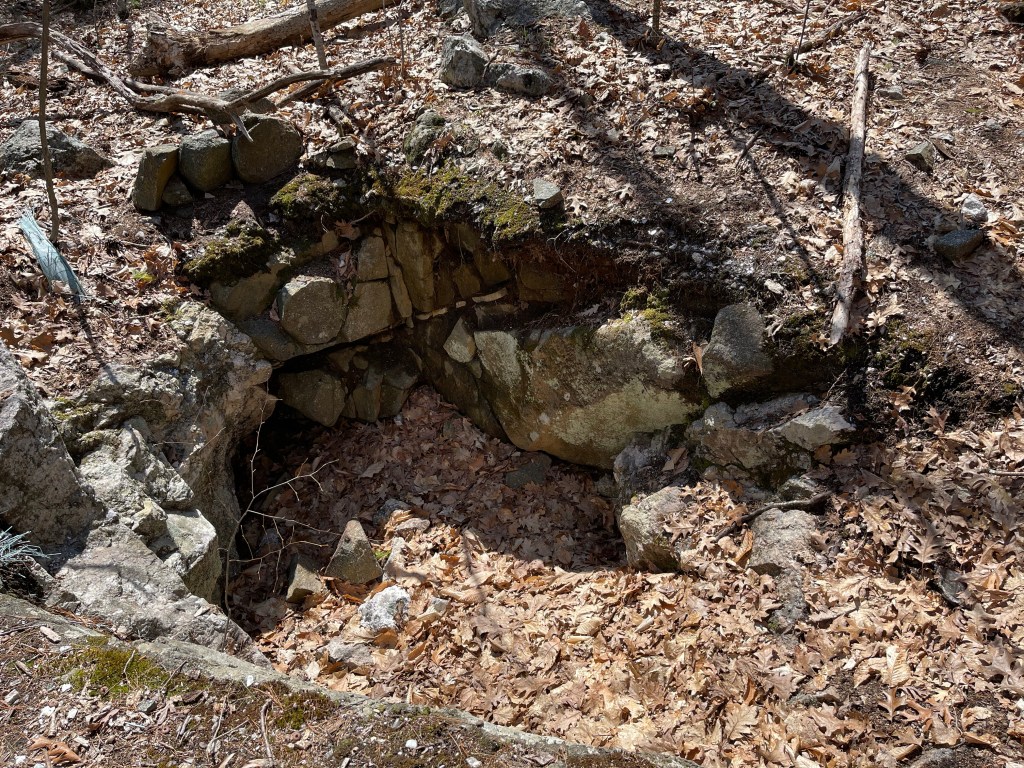
    Walking through the woods of Hampstead, New Hampshire we found an old mine quietly marking time. A modest hole in the ground, really, with scattered bits of Mica all around. To call it a mine seems a bit of a stretch when compared to the big mining operations elsewhere in the world. But it called to me, knowing I’d been looking for it, and seemed to sparkle in the sun for the attention.

    Mica is also known as Isinglass. From a resource perspective, Mica is sheet silicates used in everything from glass making to fashion to a key ingredient in gypsum. It has some heat-resistant qualities and is non-conductive, which makes it useful. But it’s very expensive to mine and labor intensive, so most of the mining now is done in India. For anyone complaining about their work, I’d point to Mica mining as one of many professions that might be a bit tougher.

    In New Hampshire you see flakes of Mica everywhere but the meaningful sheets (or “books”) were harder to find. When they did find it, they’d root it out by blasting and drilling carefully around the sheets. Keeping the sheets intact was the labor-intensive trick.

    There’s a semi-famous mine in Grafton called the Ruggle’s Mine, now closed, that used to be a tourist attraction. Visitors could carry out whatever rock that met their fancy. The mountain where it was mined was called Isinglass Mountain. You can find it on a topographical map but good luck finding that on the list of New Hampshire’s 1,786 mountains. Does a mountain lose prominence when people dig holes in it?

    Back in the woods, I wondered about this old hole in the ground, once a Mica mine, now a landing place for leaves and pine cones. There’s little history around it, probably because it really isn’t any bigger than a cellar hole. But it’s in my nature to wonder about such things. Not so much for the hole but the people who labored in it. I imagine they’re buried somewhere in town, filling their own holes in the ground. What was their story?

    Holes in the ground aren’t nearly as flashy as waterfalls and mountaintops. I can’t blame anyone who skimmed the first paragraph of this post and thought, “not for me”. But there’s a story there in the ground, marking time like the rest of us. And I wonder, what would it take to dig it out? For without a story it’s just another hole in the ground.

    Mica Mine hole in Hampstead, NH
  • A Visit to Fall of Song

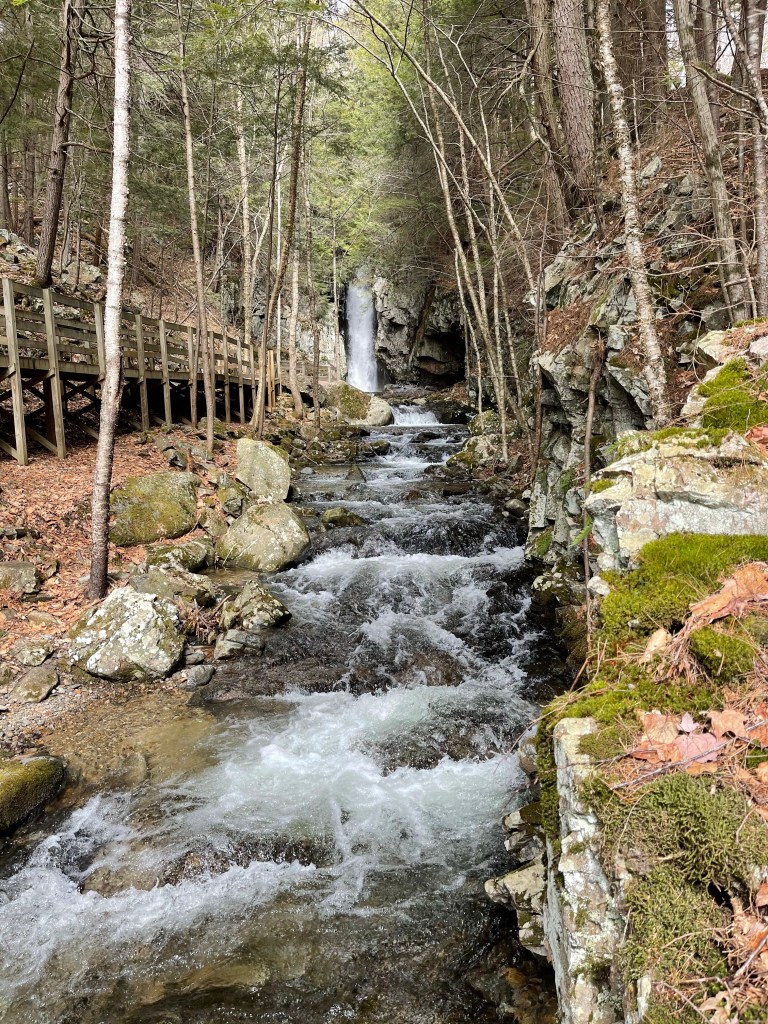
    The Fall of Song is a popular place located on the grounds of Castle in the Clouds in Moultonborough, New Hampshire. The is a waterfall with infrastructure to support the masses, with a large parking lot a short walk from the walls and a boardwalk that runs right up to the waterfalls. These make it far more accessible than most of the waterfalls I visit, and likely ensures a lot of company when you visit at peak times. As is my nature, I visited off-peak and had the place to myself for a short time.

    The Fall of Song was once called Ossipee Falls, so named for the mountain range they’re in. I’m not sure exactly when the name changed to the medieval, lyrical Fall of Song. It may have been in the mid-19th century when the area was known for its mineral springs, or maybe later when BF Shaw came up from Lowell to build Ossipee Park mountain resort here. Or maybe it was when the property was sold to Tom Plant who built his Castle in the Clouds. Any of the characters from that time could have named it Fall of Song. It really doesn’t matter, I suppose. The falls have drawn visitors for generations because they’re simply beautiful.

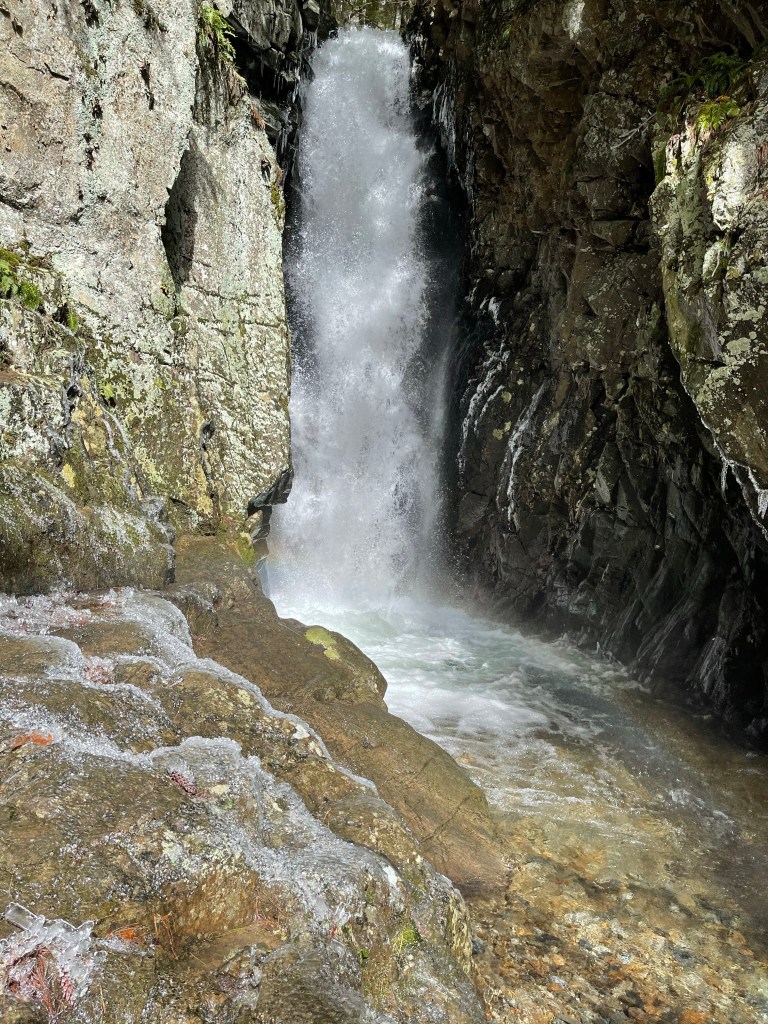
    Fall of Song

    In the winter and early Spring the gates are closed but pedestrians are welcome. A quick half mile walk up the road offers beautiful views of Shannon Brook tumbling down to greet you. You soon reach The Pebble, a giant glacial erratic that stands watch between the brook and the road. I see a lot of glacial erratics in my walks through the woods, and this one is pretty impressive.

    The Fall of Song is an impressive 40 foot plunge through narrow granite walls. With recent rain they were singing with gusto, with an icy mist swirling into a rainbow in the afternoon sun. I appreciated the boardwalk for what it offers in accessibility for people who might not otherwise see Fall of Song, while thinking about how great the photo might have been without the boardwalk in the picture. So it goes.

    Fall of Song and Shannon Brook

    Not being one to settle for the easily accessible, I hiked up the trail above the falls to see them plunge from above, and then made my way up to Bridal Veil Falls just above Fall of Song. This second fall is one you have to earn, but in doing so you feel you’re in on a little secret that those who only visit Fall of Song never know. I tried several approaches to get to the best vantage point without being completely satisfied with any of them and have promised myself another visit to see them again.

    Shannon Brook, above Fall of Song with a glimpse of Bridal Veil Falls above

    There are several other falls above Fall of Song worth a look, with Bridal Veil being the prettiest. And you can spend a lot more time hiking this area beyond the waterfalls. For all my wandering further north in the White Mountains, the old volcano ring of the Ossipee Mountain range offers stunning vistas. This is a place worth returning to.

  • Bridging the Tragic Gap

    I spoke with a friend who is experiencing some PTSD after all the extremist action and rhetoric of the last few years. I don’t have anything to offer but support and faith in progress. Words, really, backed by optimism. But I know I don’t see the world the same way that someone targeted by bigotry and hate does, nor do I feel the gut punch of lost hope and lack of opportunity that the marginalized and enraged feel. I tend to reside in the middle, seeing the possibility of a future where the gaps between us disappear. But the cold reality is that won’t happen in my lifetime. And there lies the tragic gap.

    “By the tragic gap I mean the gap between the hard realities around us and what we know is possible — not because we wish it were so, but because we’ve seen it with our own eyes…
    I call it “tragic” because it’s a gap that will never close, an inevitable flaw in the human condition. No one who has stood for high values — love, truth, justice — has died being able to declare victory, once and for all. If we embrace values like those, we need to find ways to stand in the gap for the long haul, and be prepared to die without having achieved our goals…
    That means we need to change our calculus about what makes an action worth taking and get past our obsession with results. – Parker Palmer, The Sun interview, If Only We Would Listen

    There is a lot to chew on in this 2012 interview, but it’s Parker’s concept of the tragic gap that took hold. For those of us who fancy ourselves bridge-builders, it resonates. For we fill the gap with love and possibility, only to see the divide grow as more people embrace the extremes on either side. Knowing what’s possible and how far we seem to be from it are frustrating at best, tragic at worst.

    So what are we to do? Change our calculus and not obsess with results? Modify expectations and chase the small victories that get us incrementally closer? You see the friction in the world as the two sides of the gap pull away from each other and wonder if bridge-building is even possible. Seen from the lens of history progress is clear, but we never quite get all the way there before the gaps seems to grow again. But is this a trick of the mind at work, just so much amplified noise? The optimism in me believes we’re closer than we sound like we are. With much work still to do.

    “I refuse to accept the view that mankind is so tragically bound to the starless midnight of racism and war that the bright daybreak of peace and brotherhood can never become a reality. I believe that unarmed truth and unconditional love will have the final word.” – Martin Luther King, Jr.

    It’s a tough blow to realize we will never be bridge the tragic gap in our lifetimes, but that doesn’t mean we shouldn’t try. Seeing our own unarmed truth for what it is and doing our small part offers tangible, incremental progress. Each of us, small links in the chain, reaching across the chasm to find a link to a better future. Beyond us, but out there waiting.

  • Freeze and Thaw

    In the dark time of the year.
    Between melting and freezing
    The soul’s sap quivers.
    – T.S. Eliot, Little Gidding

    There are more famous lines from this poem, but this is the time of sap buckets and lines run between maple trees in New England, so forgive me for straying from the popular. For these are the days of freezing and thawing – a confused mix of awakening and nature turning a cold shoulder on us. A reminder that warmer days are coming but we aren’t there just yet.

    And so it is with the vaccine and a pandemic that hasn’t quite finished its business with us, despite casual disregard and letting up of guards. We aren’t quite there, but surely we’re closer. So persevere; for we’ll get through the darkness, together in our isolation.

    Eliot wrote Little Gidding during the darkest days of the Blitz, set it aside in dissatisfaction and returned to it again to publish it during slightly brighter days in 1942. Who would ever think of 1942 as brighter days? Someone who lived through the Blitz of 1940-41 I suppose.

    So who are we to complain about a turn to colder days just as the sun began to warm us once again? Who are we to complain about wearing a mask for just a bit longer? Are we that precious and self-absorbed? Focus on the brighter days ahead, but stay the course in the meantime.

    As the snow and ice retreats for another season, the mud rises to meet our favorite footwear in a cold, gooey grip. The warmest days bring swirls of bugs celebrating their brief dance with life. And we, the comfortable masses, find reasons to complain about the mud and bugs and even the miraculously fast release of vaccines to the world that just seem a bit too slow. For all the joy of thaw, we seem to prefer the angst of freeze.

    Spring is upon us, despite it all. The sap flows with each freeze and thaw, and drips slowly into buckets. Drop by drop, the buckets fill. It’s the only way, really. You can’t very well cut the tree in half to pour out the sap. Not if you hope to have another season anyway. No, progress is slow that way. And offers lessons in patience and perseverance. Of going with the flow and staying the course.

  • The Newfield Covered Bridge

    The 1853 Newfield covered bridge is a survivor. Wooden bridges were usually torn down when they grew old. New York State once boasted of 250 such bridges, now there are only 24. And Newfield’s is the only remaining covered bridge in Tompkins County, New York. As with any survival tale, it comes with a story of perseverance and a battle of beliefs.

    If you aren’t from places where they build such things, you may wonder about the reason for covered bridges. It was simply a matter of economics. Wood was plentiful, but you couldn’t realistically leave a wooden deck exposed to the elements in northern climates without having to close and replace parts of it every few years. So the builders would simply put a roof over it. It was a lot cheaper to replace a roof every twenty years than the bridge itself every few years. And once you had a winner, other communities would copy the design and soon these timber tunnels were commonplace in the northeast United States.

    But soon steel bridges were the rage, quickly replacing older wooden bridges as they aged. It was another case of economics – a steel bridge would last far longer than any wooden bridge, and could be built longer and wider – allowing for more cars and taller trucks. Progress trumped timeless beauty. And so the wooden bridges were taken down one-by-one as they grew weary.

    And then the engineers came to Newfield in 1969 and declared that this bridge too would be replaced with modern steel and concrete. And a woman named Marie Musser said “Over my dead body” and dug in her heels to fight progress. She and her husband Grant fought the county over the fate of the bridge and eventually won the right to preserve it.

    Three years later they oversaw the restoration of the bridge, and again in 1998 when it was reinforced and raised to support modern vehicular traffic. And so it was that the Newfield Covered Bridge survived and today looks as good as she ever did. It’s now the oldest active bridge of its kind in the area. Driving through it feels like time travel. In a way it is.

    Marie Musser died the year after that 1998 restoration, and her husband Grant died the year after that in 2000. Their old bridge survived them both, and was added to the National Register of Historic Places on February 25, 2000. I imagine they both knew in their last days that their bridge would make it. I hope so anyway.

    And this story informs. What are we willing to fight for, as the Muller’s fought for this old neglected bridge, resurrecting it to a sparkling example of the possibility of purpose? What is our own contribution to the future? It only takes one of us to stand up and say “Not on my watch.” If the Newfield Covered Bridge tells us anything, it’s that we are the bridge between the past and future. And where there’s a will there’s a way.

  • A Visit with Benjamin Church

    A seasonably warm Sunday lured me from a visit with friends in Mattapoiset, Massachusetts to Little Compton, Rhode Island to finally meet Benjamin Church. Church was appointed Captain of the first Ranger force in America in 1675 by the Governor Josiah Winslow of Plymouth Colony. He was famous for being the guy leading friendly Native Americans that finally killed Metacomet (King Philip). His greatest innovation was in imitation: adopting the Native American style of fighting to allow his forces to survive and find success in battles with the French and hostile native population.

    What made Church honorable was his respect for the native population and his desire to coexist with them. While many around him were inclined to encroach and eventually push aside native tribes, Church wanted to coexist and work with them. This led to recruiting friendly tribes to assist in King Philip’s War and in later battles with the Abenaki and French in Acadia. War is a dirty business, and there was plenty of atrocity committed on both sides, but Church seemed to live by a code of honor untarnished by historical perspective.

    Today Church lies in rest in a quiet triangle-shaped graveyard in the middle of Little Compton with his wife buried next to him. A monument honoring him stands at his feet, and someone glued an Army Ranger tab just above his engraved name. That engraving is fading away now, barely legible after 300 years of exposure to the elements. If you asked a thousand people in New England who Benjamin Church was, maybe one or two would know. Time fades memory faster than it does engraved stone.

    Here lyeth interred the [body]
    of the Honorable
    Col. Benjamin Church, Esq.,
    who departed this life, January 17, 1717-8 in
    the 78 yeare of his age.’

    On a beautiful Sunday afternoon I was the only visitor, but a group of teenagers were playing basketball nearby. I wondered if they knew the story of the soldier buried nearby? Does their local school teach children about the war that happened right across the river, or about the man quietly marking eternity in a faded grave in the middle of town? I hope so.

    Fading history
  • The Rhode Island Red Monument

    One of the joys of travel is stumbling upon roadside curiosities. On my pilgrimage to visit a favorite hero of King Philip’s War I came across a monument to the Rhode Island Red that drew my attention. The Rhode Island Red is a hen, of course, that famously and productively laid eggs particularly well, which led to breeding of this particular character to make eggs a common and reliable staple of our diet. It seems the Rhode Island Red was first bred on a farm in Little Compton, Rhode Island.

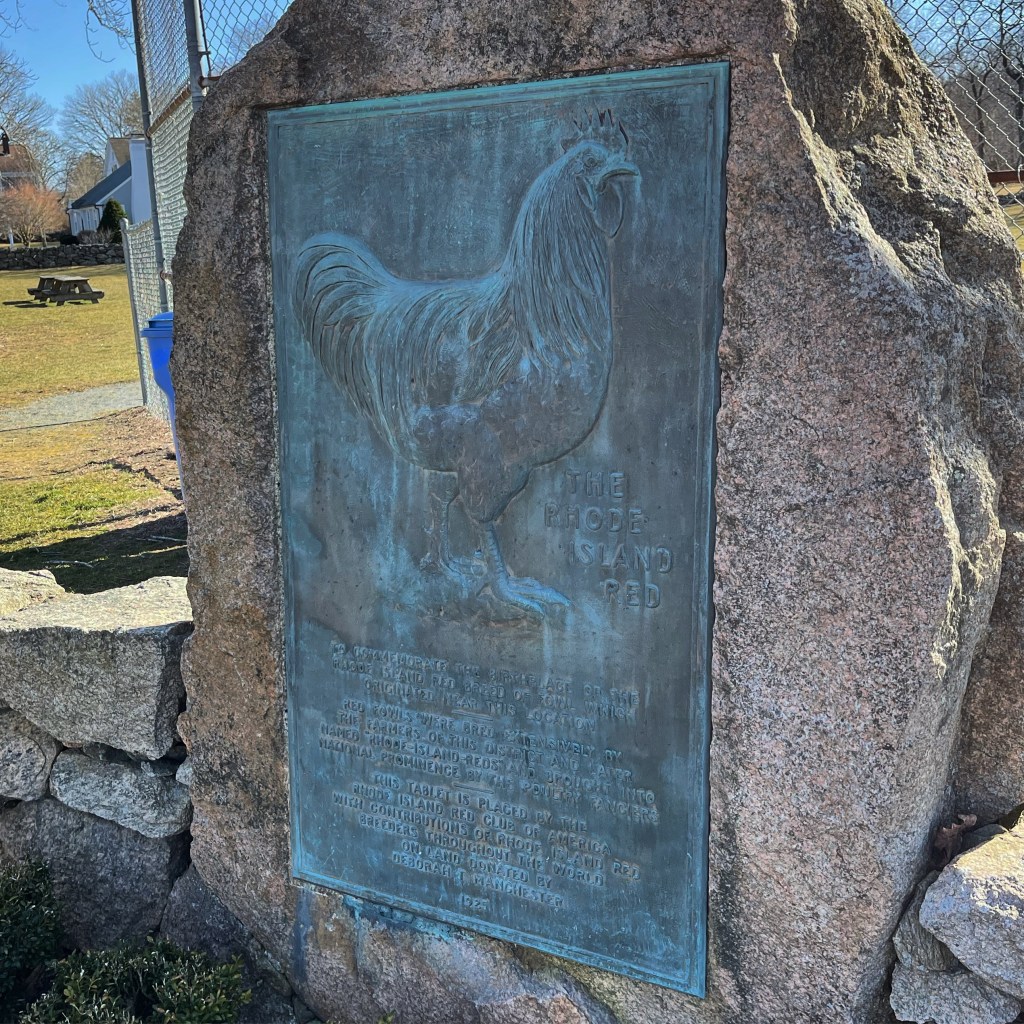
    In 1925 a group of Rhode Island Red enthusiasts erected this monument to the hen, commissioning an artist named Henry Norton to make it. But here’s where the story gets interesting. One group wanted the monument to be erected at the actual farm where the hens were first bred. Another group wanted it in a more prominent location in town (where I came across it, validating their choice I suppose). For a small town, this was pretty heated, with both sides trying to establish a pecking order. At the unveiling of the first monument the opposing group didn’t show up, apparently feeling the location was pretty… fowl. A year later they erected their own monument at their preferred site. The 1925 monument features a rooster, the 1926 monument features a hen. But a well-placed hen. They really showed ’em.

    The 1925 Rhode Island Red Monument

    The inscription on the 1925 monument reads:
    “To commemorate the birthplace of the
    Rhode Island Red breed of fowl which
    originated near this location
    ___
    red fowls bred extensively by
    the farmers of this district and later
    named “Rhode Island Reds” and brought into
    national prominence by the poultry fanciers
    ___
    this tablet placed by the
    Rhode Island Red Club of America
    with contributions of Rhode Island Red
    breeders throughout the world
    on land donated by
    Deborah Manchester
    1925″

    This entire incident is described in the monument’s Wikipedia page in delightful detail. Not having the back story when I came across the monument, I wasn’t aware of the other monument. Now I feel compelled to return to Little Compton again sometime to find it. In the meantime, Norton’s 1925 monument quietly marks time, closing in on its 100th birthday. Placed on the National Register of Historic Places in 2001, this monument to a chicken has secured its own place in history.

  • 7 Observations on Reaching 1000 Blog Posts

    We all write for different reasons, and my observations might not be yours, nor should they be. But reaching a milestone like 1000 blog posts deserves some measure of reflection. As I look forward with anticipation to post number 1001, I pause to give you seven observations about the journey to this point:

    1. The well never runs dry. You just run out of time. Writer’s block is a myth. If you’re earnest and curious you never run out of things to write about. But you will wrestle with perfection and trying to make a post reach its potential. When you post daily you learn to love it as it is and know when it’s time to let it fly. No, it’s never perfect, but you post it anyway.
    2. Everything becomes a potential blog post. I started writing Alexanders Map intending to have a local travel blog with historical sites with visits to amazing places. The name itself infers this. But it quickly expanded to include a diverse (some would say eclectic) mix of topics. You learn to listen to the muse, and embrace the new. And in the unexpected you find your own voice. You are the link between each post, and part of you reflects back on what you’ve visited.
    3. This business of blogging is your own business. You can quickly grow your blog follower list by playing the game of actively following and liking other bloggers. Or you can do the opposite and grow organically. I choose the latter: I’m very selective about who I follow, I “like” what I actually read and appreciated, and I don’t follow to gain followers. You choose what you want to be in the blogging world. I didn’t even mention I had a blog to family and friends until I’d written a hundred or so posts. I do link to Twitter, but rarely on other media. Choose what works for you, because your blog is how you present yourself to the world.
    4. One sentence at a time, you become a better writer. Let’s face it, none of us start a blog thinking we’re bad writers. Bloggers tend to believe they’ve got some skill for writing or they’d start a YouTube channel or build an Instagram or TicTok site. But the craft of writing develops through the daily struggle. I’m nowhere near the writer I thought I was, and I’m nowhere near where I want to be. But I keep chipping away at it, day-by-day. Blogging is an apprenticeship in writing, but you never meet the master.
    5. Some of your favorite posts will be completely ignored. You will work on a blog post that stirs something deep inside you, feel a wave of emotion crash over you as you click publish, and see the world react with complete indifference. Write these posts anyway, and write them often. Because when you tap into this well you aren’t blogging for instant fame, you’re writing to find something inside yourself that you thought, maybe, was there all along.
    6. You develop an eye for the interesting and an ear for the hidden stories. You stop more frequently in fascinating places, detour to find and celebrate the obscure and forgotten, and do things you might not have done otherwise. You become a ghost whisperer, visiting old graveyards and monuments to the past engraved by some soul long forgotten, who was honoring something of note that brought us to where we are today. You learn poetry and philosophy and Latin phrases and stir up the magic in an old pile of words. You hike to places of wonder and seek adventures. In short, you become more alive, and you appreciate this journey more than ever before.
    7. You learn to follow through on the promises you quietly make to yourself. You want to be a writer? Then write, no matter how you feel, and post that work every day, no matter what. Keep that commitment to yourself today. And tomorrow too. As James Clear puts it, every action you take becomes a vote for the type of person you wish to become. Your blog is a stack of votes for your identity. So craft them as best you can and set them free for the world.

    So there we are: 1000 blog posts. As I mulled over this one the last few days, I found myself in a corner of New England I don’t visit enough and chanced upon a couple of roadside wonders I might never have seen had I not set out for an old grave I wanted to visit. And just like that I’ve got three more blog posts in my mind. The world is funny that way – it opens up for the curious observers. I can’t wait to see where the next 1000 take me.

  • A Year Like No Other

    “Man, like a bridge, was designed to carry the load of the moment , not the combined weight of a year all at once.” – William A. Ward

    I’m not going to run a postscript on what happened over the last year – plenty of people have already written about that. A year ago we were quietly celebrating St. Patrick’s Day in an empty bar owned by a friend bearing what we optimistically thought would be a temporary shutdown to flatten that curve. That friend has managed to stay in business despite the severe restrictions on their business, open a second location in the middle of a pandemic, and is in the middle of a second battle front with cancer. Who am I to complain about working from home for a year?

    Some of us have lost much more than others, but we’ve all lost something. Loved ones and graduations, sports seasons and jobs, trips of a lifetime and gathering with friends in busy places. We all have that Rolodex of losses we can pull out to share with the world. The profound losses mix with the simple. But something has to balance the losses out. The world doesn’t just tilt on its side without counterbalancing with something else. If we’re all walking that line between order and chaos, what have we gained?

    We know instinctively what has balanced the losses, if not completely at least enough to stay afloat. More time with immediate family, perhaps a little too much now and then but time we’ll reflect on fondly. More creative use of technology to find a smile in the darkness. More alive time with gardening and cooking and reading the books you were meaning to get to… and more time alone to think. Deep reflection on what is really important.

    There are heroes among us that did so much more than the average. We celebrate the essential workers who kept this thing going, but we should also give ourselves a small pat on the back. We may not be medical staff or law enforcement or supply chain workers, but we’re all collectively doing our part to bridge the madness of the last year, one day at a time.

    Of course, this bridge is still being built, still extending to some place in the future where it might set in the firmness of normal. And some are restless – we watch some tentatively gain footing on what they believe to be firm ground, celebrating together and shouting for the rest of us to join the party. But some of them are dancing in quicksand.

    No, we’re closer now, but like the soldiers in the last months of World War II, we know this isn’t the time to let up our guard. Don’t go frivolously burning that mask just yet folks, we’ve still got today to face, and tomorrow too. We’ve carried on this far, just hold on a bit longer. Almost there.