Category: History

  • The Rhode Island Red Monument

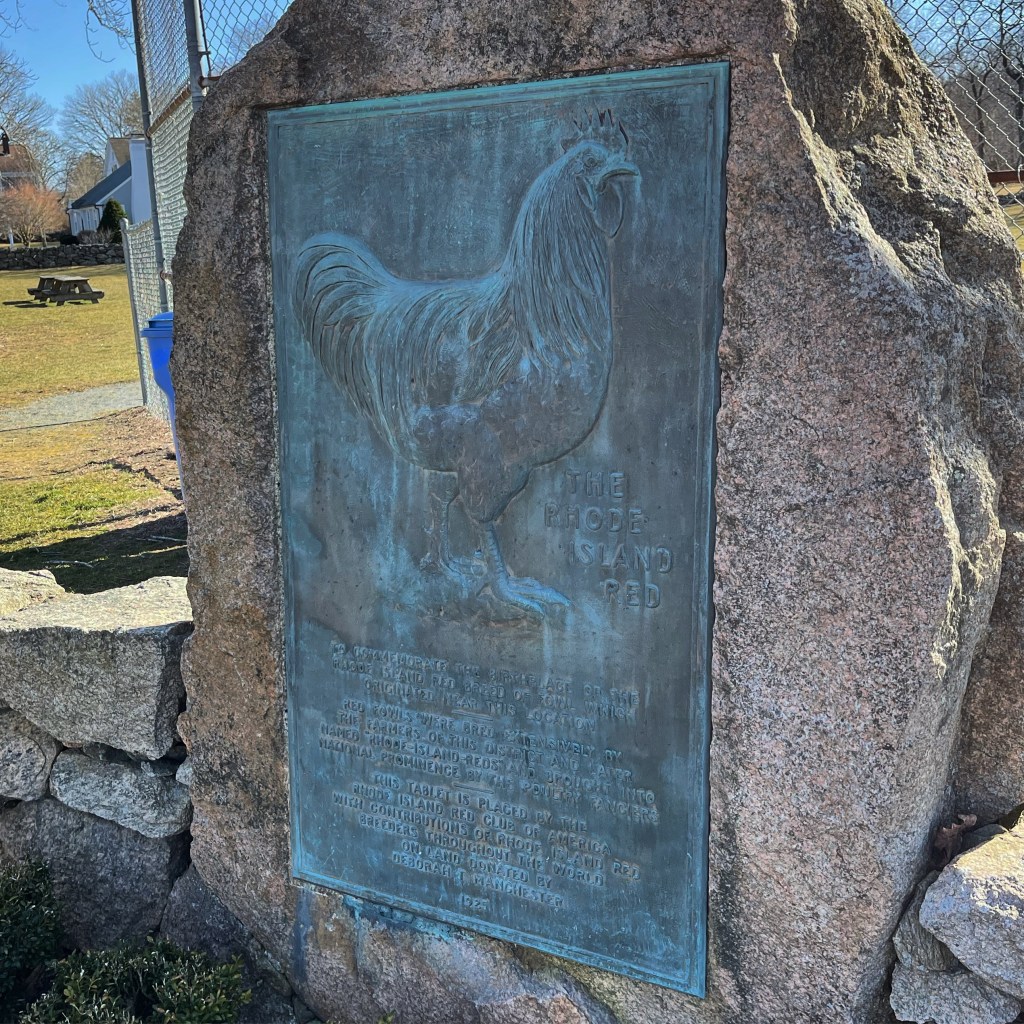
    One of the joys of travel is stumbling upon roadside curiosities. On my pilgrimage to visit a favorite hero of King Philip’s War I came across a monument to the Rhode Island Red that drew my attention. The Rhode Island Red is a hen, of course, that famously and productively laid eggs particularly well, which led to breeding of this particular character to make eggs a common and reliable staple of our diet. It seems the Rhode Island Red was first bred on a farm in Little Compton, Rhode Island.

    In 1925 a group of Rhode Island Red enthusiasts erected this monument to the hen, commissioning an artist named Henry Norton to make it. But here’s where the story gets interesting. One group wanted the monument to be erected at the actual farm where the hens were first bred. Another group wanted it in a more prominent location in town (where I came across it, validating their choice I suppose). For a small town, this was pretty heated, with both sides trying to establish a pecking order. At the unveiling of the first monument the opposing group didn’t show up, apparently feeling the location was pretty… fowl. A year later they erected their own monument at their preferred site. The 1925 monument features a rooster, the 1926 monument features a hen. But a well-placed hen. They really showed ’em.

    The 1925 Rhode Island Red Monument

    The inscription on the 1925 monument reads:
    “To commemorate the birthplace of the
    Rhode Island Red breed of fowl which
    originated near this location
    ___
    red fowls bred extensively by
    the farmers of this district and later
    named “Rhode Island Reds” and brought into
    national prominence by the poultry fanciers
    ___
    this tablet placed by the
    Rhode Island Red Club of America
    with contributions of Rhode Island Red
    breeders throughout the world
    on land donated by
    Deborah Manchester
    1925″

    This entire incident is described in the monument’s Wikipedia page in delightful detail. Not having the back story when I came across the monument, I wasn’t aware of the other monument. Now I feel compelled to return to Little Compton again sometime to find it. In the meantime, Norton’s 1925 monument quietly marks time, closing in on its 100th birthday. Placed on the National Register of Historic Places in 2001, this monument to a chicken has secured its own place in history.

  • 7 Observations on Reaching 1000 Blog Posts

    We all write for different reasons, and my observations might not be yours, nor should they be. But reaching a milestone like 1000 blog posts deserves some measure of reflection. As I look forward with anticipation to post number 1001, I pause to give you seven observations about the journey to this point:

    1. The well never runs dry. You just run out of time. Writer’s block is a myth. If you’re earnest and curious you never run out of things to write about. But you will wrestle with perfection and trying to make a post reach its potential. When you post daily you learn to love it as it is and know when it’s time to let it fly. No, it’s never perfect, but you post it anyway.
    2. Everything becomes a potential blog post. I started writing Alexanders Map intending to have a local travel blog with historical sites with visits to amazing places. The name itself infers this. But it quickly expanded to include a diverse (some would say eclectic) mix of topics. You learn to listen to the muse, and embrace the new. And in the unexpected you find your own voice. You are the link between each post, and part of you reflects back on what you’ve visited.
    3. This business of blogging is your own business. You can quickly grow your blog follower list by playing the game of actively following and liking other bloggers. Or you can do the opposite and grow organically. I choose the latter: I’m very selective about who I follow, I “like” what I actually read and appreciated, and I don’t follow to gain followers. You choose what you want to be in the blogging world. I didn’t even mention I had a blog to family and friends until I’d written a hundred or so posts. I do link to Twitter, but rarely on other media. Choose what works for you, because your blog is how you present yourself to the world.
    4. One sentence at a time, you become a better writer. Let’s face it, none of us start a blog thinking we’re bad writers. Bloggers tend to believe they’ve got some skill for writing or they’d start a YouTube channel or build an Instagram or TicTok site. But the craft of writing develops through the daily struggle. I’m nowhere near the writer I thought I was, and I’m nowhere near where I want to be. But I keep chipping away at it, day-by-day. Blogging is an apprenticeship in writing, but you never meet the master.
    5. Some of your favorite posts will be completely ignored. You will work on a blog post that stirs something deep inside you, feel a wave of emotion crash over you as you click publish, and see the world react with complete indifference. Write these posts anyway, and write them often. Because when you tap into this well you aren’t blogging for instant fame, you’re writing to find something inside yourself that you thought, maybe, was there all along.
    6. You develop an eye for the interesting and an ear for the hidden stories. You stop more frequently in fascinating places, detour to find and celebrate the obscure and forgotten, and do things you might not have done otherwise. You become a ghost whisperer, visiting old graveyards and monuments to the past engraved by some soul long forgotten, who was honoring something of note that brought us to where we are today. You learn poetry and philosophy and Latin phrases and stir up the magic in an old pile of words. You hike to places of wonder and seek adventures. In short, you become more alive, and you appreciate this journey more than ever before.
    7. You learn to follow through on the promises you quietly make to yourself. You want to be a writer? Then write, no matter how you feel, and post that work every day, no matter what. Keep that commitment to yourself today. And tomorrow too. As James Clear puts it, every action you take becomes a vote for the type of person you wish to become. Your blog is a stack of votes for your identity. So craft them as best you can and set them free for the world.

    So there we are: 1000 blog posts. As I mulled over this one the last few days, I found myself in a corner of New England I don’t visit enough and chanced upon a couple of roadside wonders I might never have seen had I not set out for an old grave I wanted to visit. And just like that I’ve got three more blog posts in my mind. The world is funny that way – it opens up for the curious observers. I can’t wait to see where the next 1000 take me.

  • A Year Like No Other

    “Man, like a bridge, was designed to carry the load of the moment , not the combined weight of a year all at once.” – William A. Ward

    I’m not going to run a postscript on what happened over the last year – plenty of people have already written about that. A year ago we were quietly celebrating St. Patrick’s Day in an empty bar owned by a friend bearing what we optimistically thought would be a temporary shutdown to flatten that curve. That friend has managed to stay in business despite the severe restrictions on their business, open a second location in the middle of a pandemic, and is in the middle of a second battle front with cancer. Who am I to complain about working from home for a year?

    Some of us have lost much more than others, but we’ve all lost something. Loved ones and graduations, sports seasons and jobs, trips of a lifetime and gathering with friends in busy places. We all have that Rolodex of losses we can pull out to share with the world. The profound losses mix with the simple. But something has to balance the losses out. The world doesn’t just tilt on its side without counterbalancing with something else. If we’re all walking that line between order and chaos, what have we gained?

    We know instinctively what has balanced the losses, if not completely at least enough to stay afloat. More time with immediate family, perhaps a little too much now and then but time we’ll reflect on fondly. More creative use of technology to find a smile in the darkness. More alive time with gardening and cooking and reading the books you were meaning to get to… and more time alone to think. Deep reflection on what is really important.

    There are heroes among us that did so much more than the average. We celebrate the essential workers who kept this thing going, but we should also give ourselves a small pat on the back. We may not be medical staff or law enforcement or supply chain workers, but we’re all collectively doing our part to bridge the madness of the last year, one day at a time.

    Of course, this bridge is still being built, still extending to some place in the future where it might set in the firmness of normal. And some are restless – we watch some tentatively gain footing on what they believe to be firm ground, celebrating together and shouting for the rest of us to join the party. But some of them are dancing in quicksand.

    No, we’re closer now, but like the soldiers in the last months of World War II, we know this isn’t the time to let up our guard. Don’t go frivolously burning that mask just yet folks, we’ve still got today to face, and tomorrow too. We’ve carried on this far, just hold on a bit longer. Almost there.

  • Determining the Age of a Tree

    I’ve been wondering about the age of a large white oak tree guarding the edge of the forest for years. Not enough to actually do something about it, mind you, but wondering nonetheless. Then a hike with old growth trees last Sunday triggered a burning curiosity in me about the age of the trees we hiked amongst, and by extension, the age of the trees in my own backyard. I found myself having to know.

    There’s an easy way to gauge the age of a tree: you count the rings. The problem with that method is you’re really measuring the age of death of the tree. I prefer to keep them around, especially when they’re my elders. But rest assured, there’s another method for estimating the age of a tree, and that’s doing some basic math and adding a bit of educated guessing. All of this is searchable online, of course, but I found the instructions from Purdue University to be particularly helpful.

    Step one is to measure the DBH of the tree. What’s this? Another acronym in a world of acronyms? Sorry! But this one is easy to remember. DBH stands for Diameter at Breast Height. Take a flexible tape out to your tree of interest, measure 4 1/2 feet up from the base of the tree and there’s your DBH. Now anchor the end of the tape measure (or have someone hold it) and walk around the tree back to your starting point. This is the circumference of the tree. Convert this to total inches. In the case of my stately white oak, it measures 92 inches in circumference.

    The next step is to determine the diameter of the tree, which simply means dividing the circumference by 3.14. For the white oak, this was 29.29. So far, so good. And now we rely on something called the growth factor to figure out the rest. This is where science meets estimation. For a tree on the edge of the forest in optimal growing conditions, the growth factor is pretty straightforward. For a tree on a sidewalk in downtown Boston or near the summit of Mount Jackson in New Hampshire, well, that tree’s growth factor is going to be pretty compromised by the stress of everyday living. You’ll need to factor that in to the equation at some point.

    Back in my backyard, our white oak is happy as a tree can possibly be in this crazy world. The growth factor for a white oak in this happy situation is 5. You multiply the diameter by the growth factor and my favorite white oak tree turns out to be around 146 years old! And those old growth trees I saw hiking? They’re roughly 300 years old, which is about how long a healthy white oak typically lives. I hope they beat the odds with that good clean living.

    So around 1875 when the fields were no longer being farmed or grazed in this patch of Southern New Hampshire land an acorn sprouted and grew in the sun. It witnessed the forest grow around it, protecting it from the worst of the winds and the whims of humans looking for firewood and lumber. And then I became its neighbor and guardian at age 124. And we became fast friends.

  • Finding the Magic Behind the Ice

    There’s something uniquely foreign about the experience, akin to visiting an ice palace in a fantasy movie. Humans aren’t supposed to be in such places. At least that’s what we tell ourselves when we look at a waterfall from the front. And when it’s frozen in winter? Well, there’s something chillingly locked away in… there.

    Now, in case you’re wondering, this isn’t the first time I’ve been behind a waterfall. Like countless thousands, I’ve walked behind Niagara Falls and for the price of admission seen the roaring waters dropping away from the safety of a dim, well-engineered if soulless tunnel. Interesting, to be sure. But not magical.

    It’s clearly the ice. It forms a wall over the falls that announces, “sorry, closed for the season”. There’s beauty in the frozen stillness of a waterfall in winter, of course, but there’s a small part of you that feels betrayed by the ice. You hear the muted sound of water falling deep inside, and want for more.

    Enter Beede Falls in Sandwich, New Hampshire. In warmer months it’s a 35 foot horsetail of falling water with a popular swimming hole. In winter it’s an ice bulge, beautiful but seemingly as inaccessible as other frozen waterfalls. But this one offers a secret for those who dare. You can duck and crawl in behind the falls on the left or right side, and even crawl all the way through if you wanted to. For some less tall than me standing up is even possible.

    I wondered at the characters over the years who have crawled behind the falls in all seasons. I wasn’t the first on this day, and other hikers waited patiently for me to finish to have their own turn in the tight tunnel between granite, water and ice. How many humans have made this crawl over the thousands of years that this cave and waterfall have danced together? A lot, I suppose. But for a few minutes, there was only me and the ice and water.

    That’s where I finally saw the magic locked away behind that frozen blue skin. Deep behind the water is indeed falling, forming icicles and frozen bubbles successively grown upon each other to form otherworldly sculptures. And through it all that shower of water penetrates the center, surrounded by its icy shield and backlit by the daylight beyond. An incredible wonderland so foreign to me, so delightful, that I felt I’d gone to another world. And indeed I had.

    Beede Falls, behind her icy shield
  • Twice the Fun: Mount Israel & Beede Falls

    Not every amazing hike is over 4000 feet. In New Hampshire there are other lists besides the 4K list, lists like 52 with a view, which offers some beautiful views with a bit less effort than the 4000 footers. For a warm Sunday with snow melting into snowball-making consistency, a couple of friends invited me to join them on a hike of Mount Israel and for a bonus, a visit to Beede Falls, one of the waterfalls on my personal checklist to see in 2021.

    A bit of history is in order. Mount Israel is named for a settler named Israel Gilman, who lived near the trailhead for this mountain. There’s still an active farm near that trailhead, and it’s easy to imagine the land in the 1760’s when Gilman was walking around this place. Mount Israel is located in Sandwich, New Hampshire, which also has a bit of history in its name. The town of Sandwich is named for the 4th Earl of Sandwich, John Montagu, supposedly the inventor of the sandwich. Given that, I made a point of packing a sandwich for the hike, in honor of the Earl (or whomever it was, lost to history, who made sandwiches for him).

    The hike began at Mead Base in Sandwich, with a straightforward two mile hike up the Wentworth Trail. For those wondering about the name of the trail, a bit more history for you: Sandwich was founded in 1767 from a grant by Governor Benning Wentworth. Another name you’ll come to know is Daniel Beede, who was chosen to lead the settlement of Sandwich and granted 100 acres. Place names usually betray the history of that place, and if you look hard enough you’ll find Easter eggs like these on maps and street signs.

    I quickly fell in love with the Wentworth Trail. It winds through old growth oak and pine trees, with some tree trunks four feet in diameter – exceedingly rare around here. The snow cover acted as a spotlight on the biggest trees in the forest. I was smitten with one oak tree that had to be a witness to the transition from Native American land to English settlement. Further up, the trail wound around granite ledge and hemlocks, offering glimpses out to Squam Lake and the surrounding ridge line.

    The summit of Mount Israel is 2620 feet with 1900 feet of elevation. Despite its modest height relative to some of the other mountains in New Hampshire, it didn’t disappoint in views or the stunning beauty of the trail itself. Steep enough for a workout, short enough to give you time for other adventures. We made short work of the trail and before we knew it we were back at the trailhead at Mead Base and Act II.

    A half mile from the trailhead is another wonder worth visiting, Beede Falls, which is named after our friend Daniel Beede. The walk itself is wonderful, with granite ledge and scattered glacial erratics lining the edge of the trail. A large cave named Cow Cave offered a quick distraction. It was so named by some cows that decided to shelter inside the cave one day deep in the past. The cave was interesting, to be sure, but the real show was Beede Falls.

    In late February the falls were largely frozen, and we walked out on the ice that must be a lovely swimming hole on a hot summer day. The amazing part of Beede Falls in looking at them from behind. The falls froze solid in front, but you can access the back from the left and right side, and crawling behind them offered a magical trip into an icy palace. Water cascaded from the granite ledge, plunging between the icy wall you see on the outside and the cave formed behind. There’s just enough room to go all the way through it if you’re adventurous and don’t mind getting a little wet.

    In all our days on this earth, how often can you say that you got to see the world from the summit of a small mountain and from the crawlspace behind a waterfall in the space of a couple of hours? If you’re blessed with good health and mobility, then surely life is to be lived fully. Adventures like this one are within reach of most of us. All you’ve got to do is get out there.

    Frozen Beede Falls
    Ice wall in cave behind the falls
    Summit of Mount Israel
  • And Yet it Moves

    The secret of the illusoriness is in the necessity of a succession of moods or objects. Gladly we would anchor, but the anchorage is quicksand. This onward trick of nature is too strong for us: Pero si muove. When at night I look at the moon and stars, I seem stationary, and they to hurry. Our love of the real draws us to permanence, but health of body consists in circulation, and sanity of mind in variety or facility of association. We need change of objects. – Ralph Waldo Emerson, Nature

    This phrase, Pero si muove, mentioned in passing by Emerson, is famously Galileo Galilei’s. Forced by the Catholic Church to recant the truth of the matter that the earth revolves around the sun, Galileo dropped this little truth bomb after recanting. “Pero si muoveor, “And yet it moves”.

    I think about Galileo’s mic-dropping truth in a particularly dark time for truth in history as reality-based people of the Earth coexist with the buzz of maddening conspiracy theories, flat-Earthers and rigged election believers. The simplicity of truth seems lost in the escalating rhetoric of these online screamers. Imagine for a moment Galileo and Emerson returning to the world of today and listening to this din of despairing dolts. They’d lose all hope in humanity and throw up their hands in despair. There are days when I want to myself. Aren’t we past all this nonsense?

    It’s ironic that all this craziness is happening at a time of brilliant scientific advancement. We see images and hear sounds broadcast from the surface of Mars. We embrace the heroic efforts of the scientific community to develop viable vaccines to fight off COVID, and to stand up a delivery system to get it into the arms of the billions of people on the planet that desperately need it and a return to “normal”. We see the smartest among us looking at the problems humanity has created on this fragile blue ball rotating around the sun and tackling climate change and plastics and clean water and the related list of short-sighted gains that created long-term problems for future generations.

    There’s hope in the world, but there’s also a healthy dose of self-inflicted despair and rage. And we won’t get past it without facing the truth. Pero si muove. Or consider again Emerson’s words: “Our love of the real draws us to permanence, but health of body consists in circulation, and sanity of mind in variety or facility of association. We need change of objects.” I think all of this social isolation has stirred the pot of madness a bit too much. Sanity of mind seems to be a real issue for way too many people looking for something to cling to in the swirling uncertainty of the age.

    I find hope in Galileo’s phrase. For all the forced dogma of his time, the truth prevailed. And it lives on in the majority of people in the world today. There have always been laggards on the bell curve of reality, they just happen to have a louder voice at the moment. Pero si muove. Truth finds a way to shine through in the end. So long as people have the courage to stand for it as Galileo did.

  • To Live is to Function

    In this symposium my part is only to sit in silence. To express one’s feelings as the end draws near is too intimate a task. But one thought that comes to me as a listener-in. The riders in the race do not stop short when they reach the goal. There is a little finishing canter before coming to a standstill. There is time to hear the kind voice of friends and to say to oneself that the work is done.

    But just as one says that, the answer comes: The race is over, but the work never is done while the power to work remains. The canter that brings you to a standstill need not be only coming to rest. It cannot be while you still live, but to live is to function. That is all there is. And so I end with a line from a Latin poet, who uttered the message more than fifteen-hundred years ago, Death, death, plucks my ear, and says, ‘Live. I am coming.’”
    – Oliver Wendell Holmes (from a radio broadcast when he turned 90)

    This image Holmes painted of cantering after the race is over, living but not quite in the race anymore, lingers. I’ve seen a few people who’s cantering ended sooner than we all wanted, but bless them, they were cantering to the end. Their work was done, and they functioned as best they could until they left us. And whispered a reminder that soon our own race will end, so best run it well.

    The canter that brings you to a standstill need not be only coming to rest.

    My own race took me around a snowy loop in the woods again yesterday, snowshoeing in deep snow, following cross-country ski tracks in a quiet patch of woods that doesn’t see a lot of action from the conservation land walking crowd. Just me and a trusty map, making my way alone in the woods, working up a sweat with a brisk pace as I broke trail next to the ski tracks. This, the morning after, I stepped out of bed gingerly to test the legs and found myself doing okay. Looking back on February so far, I’ve gotten out to snowshoe or hike most days. For I’m still very much in the race, after all, and far be it from me to start cantering now.

    To live is to function – to be out there in the world doing. A challenge to us all from Holmes, all those years ago. To be engaged with those around you, to be charging around the track of life all frothy and full of joyous exuberance at full gallop. Holmes was a Civil War veteran, wounded in battle, a Harvard-educated lawyer who rose up to the Supreme Court and the oldest serving member of that court. A living link between Lincoln and Franklin Delano Roosevelt. He lived in Mattapoisett and Beverly, Massachusetts and by all accounts lived a rich, full life during his own time in the race.

    Death, death, plucks my ear, and says, ‘Live. I am coming.’

    How do you read these words spoken by Oliver Wendell Holmes nearly a hundred years ago? As a reminder to get out and live while you’re still in the race? Or as a dark reminder that death is coming for us all? To me the only choice is the former. To have Holmes quote the stoics near the end of his own life, well into his cantering years, is a wake-up call for the generations lining up for the races after his own. Fast forward to today and now it’s our race. So how shall we run it?

  • Considering the Music of 1973

    Oh, give me the beat, boys, and free my soul
    I want to get lost in your rock ‘n’ roll
    And drift away

    Dobie Gray didn’t write Drift Away, Mentor Williams wrote it. But Dobie made it an international hit. The right mix of sing along, stirring lyrics and his silky soulful voice made it magical. I go about with life, forgetting about a song like this for a time, and then hear it on the radio or shuffled on a playlist of songs and it washes over me all over again, bringing me back to the first memories of hearing it. Dobie’s version was released in 1973, by all measures a very good year for music, with some of the greatest songs ever written released that year.

    Consider these ten 1973 classics:
    Give Me Love (Give Me Peace On Earth)
    Ramblin Man
    Let’s Get It On
    Just You ‘N’ Me
    Angie
    Money
    Bad, Bad Leroy Brown
    Over the Hills and Far Away
    Jet
    Love, Reign o’er Me

    And that’s just scratching the surface. Big albums were released in 1973, including Dark Side of the Moon, Band on the Run, Goodbye Yellow Brick Road, Houses of the Holy and Quadrophenia. Individual songs were brilliant, but this was the peak era of albums, when the entire record was a work of art gift-wrapped in an album cover to cherish. Radio latched on to songs and made them hits, but the fans were eagerly listening to deep cuts on the best albums and finding gold.

    The world itself was upside down in 1973, with Watergate beginning to boil up, the Paris Peace Agreement to get the United States out of Vietnam, inflation running amuck, and our parents dressing us in some crazy multicolor outfits. But hey, at least we had the music. And if you were a kid growing up in the early 70’s you were immersed in some of the greatest music ever created.

    1973 was a stacked year in a string of stacked years for rock and roll. Scan the music released in any year from 1965 to 1975 and you can create a heck of a playlist. These were the golden years for rock ‘n’ roll, when each release, and each year, tried to raise the bar. Popular music tried to stay hip and part of the action, and sometimes a song would rise up and become that classic for the ages. If we’ve learned anything over the years, it’s that popular doesn’t always equal good, and there were some really bad songs hitting the charts in each of those years too, but those tend to drift away, don’t they? As with life, we tend to remember the best things. Like great songs. You know a melody can move me

  • A Rock in the Woods

    History whispered from the woods, calling me to find it. A mere rock this time, set in place to forever mark the border between two agreed-upon places, as settlers tended to do. This one, they say, was set here in 1741, a year after being settled and eight years before Hampstead would be incorporated. The other town, Atkinson, would be incorporated twenty-six years later. That there is a carved A and H on the stone that is a handy indicator that you found it, but neither settlement was known by these names in 1741. Hampstead was known as Timberlane Parish then, and Atkinson at the time was a part of Plaistow, New Hampshire. No, the carving came sometime later. And so did the red paint used to highlight the letters.

    Living on a border town between New Hampshire and Massachusetts, I’m fascinated with these border markers. Some are easier to find than others, conveniently standing aside the road they’ve watched grow over their lifetime. But others are more evasive. And town border markers tend to be less fussy still. When the plowed fields return to the woods they always wanted to be the stones become hidden. And that’s where the fun begins for adventurous history geeks like me. This one wasn’t so hidden; it appears on trail maps for the conservation land it resides in. But ask the 15,000 residents of the two towns where it is and maybe 400 might not give you an odd stare back. The rock isn’t exactly a national landmark like the fictional Plymouth Rock.

    And yet, this tiny rock in the woods marking the border between two towns was set in the heart of the lands the Abenaki once used to stage raids on Haverhill, Massachusetts only four decades before. It would stand witness to the French and Indian War, the Revolutionary War, The Civil War and two World Wars, drawing the settlers from the land that surrounds it to fight for survival nearby and across the globe. And of course it would witness the birth of a nation.

    So sure, it’s just a rock in the woods, but it’s a rock that has seen a few things in its job marking a random border set in 1741 between two settlements in New Hampshire. And I wondered, brushing the snow off it for a better look, how many of those people have wondered at it in that time as I do now? And for how long will it guard this border before such things don’t matter again? I wonder.

    1741 A/H Marker