Category: History

  • Leaving Long Shadows

    “Time flies over us, but leaves its shadow behind.” – Nathaniel Hawthorne

    The march through time continues. What will the shadow that we cast behind our lives look like? I’m reading through a couple of weighty tomes that run through evolution. Don’t know why the stars aligned in such a way that I’m diving deep into evolution at this particular moment, but here we are.

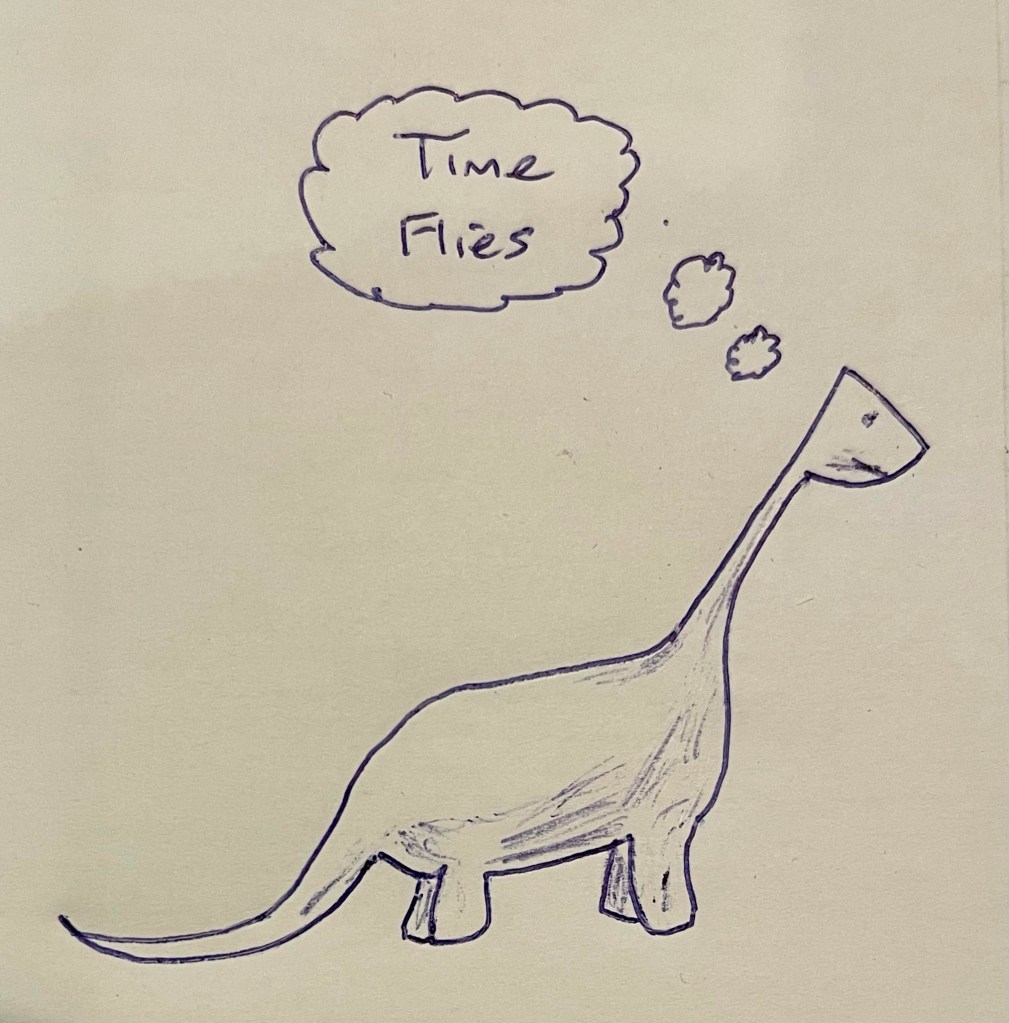
    Maybe it was the subject matter but I absently sketched a dinosaur on a notepad and thought about these giants who came and went millions of years ago. Millions. So what is a hundred years or so for us? Not a whole lot.

    Or maybe it’s enough, if you use it well.

    The point is, we’re all leaving shadows behind us. What will our shadows be? Long and notable or brief and forgettable? In some ways it doesn’t matter when you look at life through the lens of millions of years. But then again, doesn’t it all matter in the end?

    This planet has been spinning around in the universe for billions of years. Dinosaurs roamed millions of years ago. These are big numbers. But this? This is our time. Shouldn’t we make the most of it, and leave the longest shadow we can? I should think so.

    Time Flies
  • The Muse

    There’s a ghost in my head. A story that won’t go away. Compelling and screaming to be written. The boy in the story died over 300 years ago, and he didn’t live much of a life at all. A life of lost freedom and sadness. But his story is screaming out for someone to tell the world about him.

    So the muse taps my shoulder, asking when I’m going to get around to it. Threatening to leave me and take the boy elsewhere. And I feel the guilt of ignoring the call of the dead boy for the obligations of the living. Your story must be told… but not just yet. And the muse grows restless.

    I suppose I could just write about him in the blog. It would serve to tell his story. But I’ve held on to his life as the kernel of a novel that could grow around him. It seems selfish when I write that, holding a ghost boy hostage while I procrastinate on writing his story. Yet here we are.

    The confession serves as a concession to the muse. I’ll get to the boy, one of these days. I’ll write his story as best I can. This year? Yes, absolutely. This year. Just after I finish these other things…

    And the muse grows more restless.

  • The Naming of Cape Cod

    “On the 26th of March, 1602, old style. Captain Bartholomew Gosnold set sail from Falmouth, England, for the North part of Virginia, in a small bark called the Concord… ‘The 15th day,’ writes Gabriel Archer, ‘we had again sight of the land, which made ahead, being as we thought an island, by reason of a large sound that appeared westward between it and the main, for coming to the west end thereof, we did perceive a large opening, we called it Shoal Hope. Near this cape we came to anchor in fifteen fathoms, where we took great store of cod-fish, for which we altered the name and called it Cape Cod.’” – Henry David Thoreau, Cape Cod

    A bit of trivia lost in history is where Cape Cod originally got its name. A lot of people, including Thoreau, point to Gabriel Archer. Archer wrote the entry Thoreau quotes above in 1602. He’d then go on to supposedly name Martha’s Vineyard after his daughter when an abundance of grapes were found there.

    Of course, without the Cod, it might have been named something else. Four hundred years of fishing decimated the Cod population, leading to sharp restrictions on fishing. Pressure from commercial fishing lobbies to raise limits on Cod run counter to the goal of full restoration of the biomass. And then you’ve got those seal population increases. The slow restoration of the Cod population is ongoing, but like so many endangered species it hangs by a thread.

    Archer traded with the local Wampanoag Tribe at what is now Cuttyhunk. He returned to England that same year but would return again in 1607. Archer would butt heads with John Smith in Jamestown and would ultimately die there within a few years. His journal was published after his death and the names Cape Cod and Martha’s Vineyard were sticky enough to live on well after him. More than his own name, it seems. Life is funny that way.

  • Whispers from a Dead Poet

    There is no dusk to be,
    There is no dawn that was,
    Only there’s now, and now,
    And the wind in the grass.

    Days I remember of
    Now in my heart, are now;
    Days that I dream will bloom
    White the peach bough.

    Dying shall never be
    Now in the windy grass;
    Now under shooken leaves
    Death never was.

    – Archibald MacLeish, An Eternity

    I confess to not really knowing much about Archibald MacLeish, who died in Boston exactly 39 years ago yesterday, the day I started thinking about Archibald MacLeish at all. It started the night before, watching Ken Burns’ Hemingway and latching on to his name as someone Hemingway hung out with in Spain, as someone I ought to look into. Much of his poetry is available online, and I waded through a strong dose of it. And then I read his biography:

    “His mother was a Hillard, a family that, as Dialogues of Archibald MacLeish and Mark Van Doren reveals, MacLeish was fond of tracing back through its New England generations to Elder Brewster, the minister aboard the Mayflower.” – Poetry Foundation Biography of Archibald MacLeish

    It seems I’m a distant relative of Mr. MacLeish, both of us pointing to Elder Brewster as a connection to the Mayflower. I don’t dwell on the Mayflower connection – who cares if you were the first European to settle here or the millionth? What matters is how you behaved when you got here. I think on the whole Brewster settled his accounts well. And MacLeish lived a life of consequence himself. So how does one keep up with the relatives?

    What do you make of meeting a long dead relative through his work on the very day he passed 39 years before? Serendipity? Whispers? Or just history and happenstance capturing my imagination and carrying it away once again, as it’s done so many times before?

    It doesn’t matter so much, does it? We have the advantage of now, and now. Until we lose it. Until we are whispers ourselves, hardly heard in the swirling wind in the grass. Days we remember and dreams of the future matter little compared to the urgent matter of now. And what we might do with it.

  • A Visit to First Encounter Beach

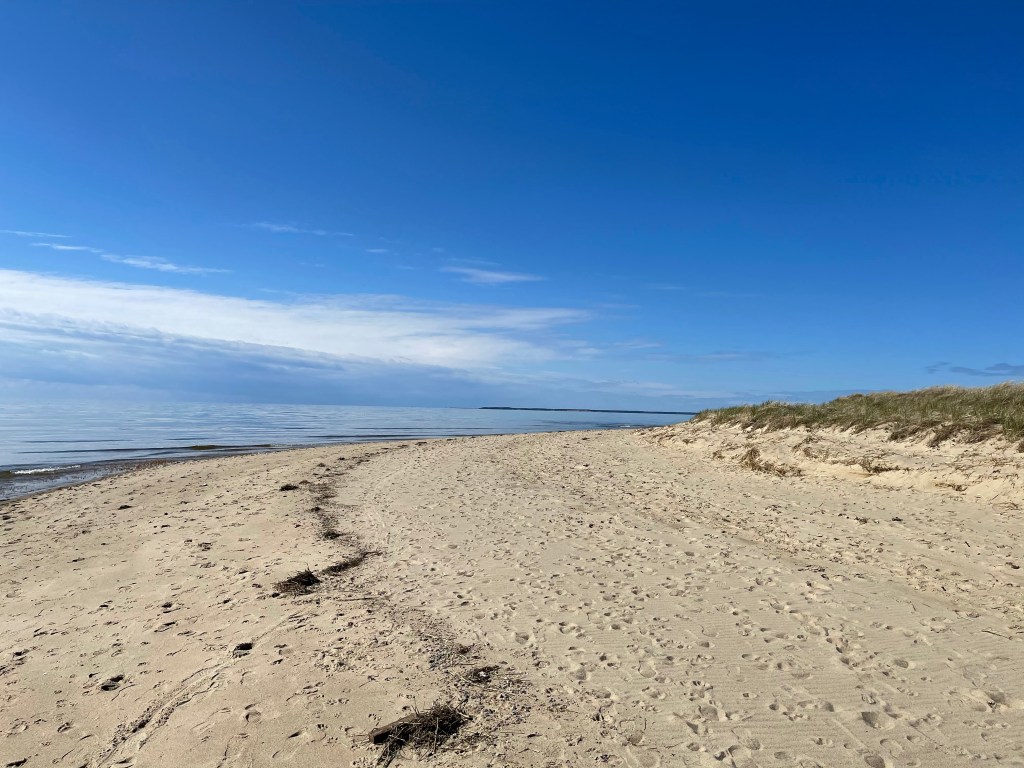
    If Provincetown claims the first landing of the Pilgrims in North America, and Plymouth claims the place they settled, Eastham is the place where they first encountered the Native American population. And like the thousands of encounters between settlers and natives to follow, it wasn’t hugs and kisses.

    Today there’s a popular beach with a paved parking lot on the calm waters of Massachusetts Bay. The real estate runs in the millions now, with great sunsets and a chance to swim while the sharks stake a claim on their ancestral hunting grounds on the opposite coast of Cape Cod. Really, it’s all funny money out here, but especially when you can claim a water view.

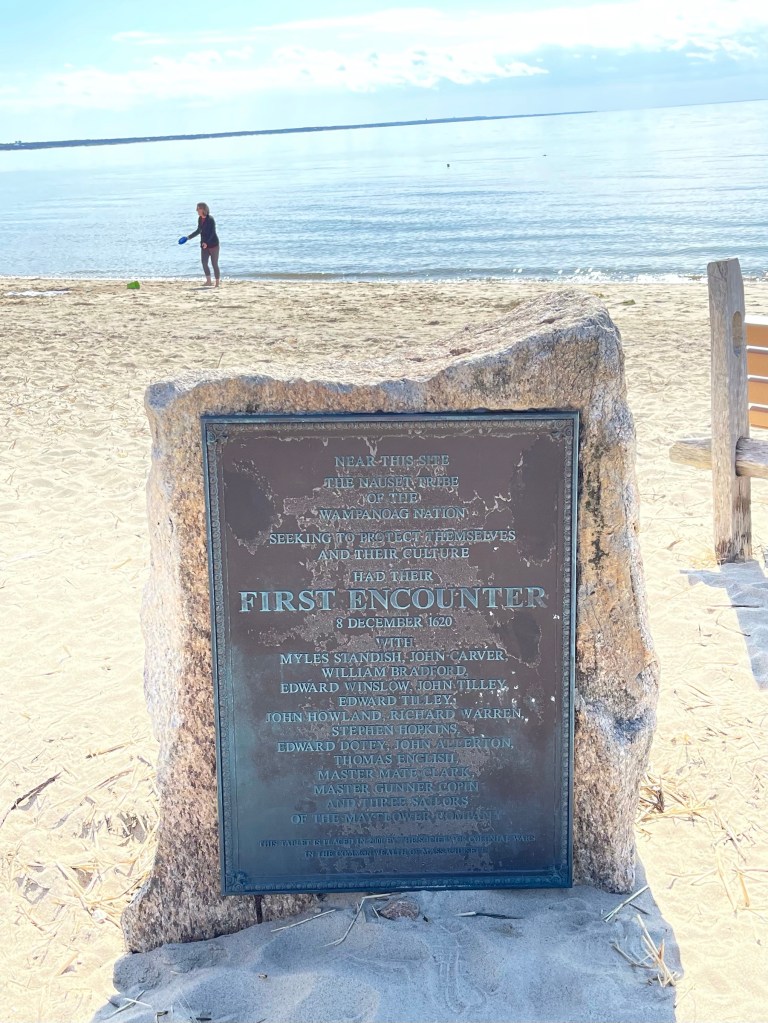
    There are two memorial plaques at the beach. One is hidden from view up the hill a bit from the beach, placed there to commemorate the tercentenary anniversary of that first encounter. The second, and more obvious one, is right as you walk from the parking lot onto the beach. Each offer a history lesson in worldview of the time.

    1920: “On this spot hostile indians had their first encounter December 8, 1620”

    2001: “Near this site the Nauset Tribe of the Wampanoag Nation seeking to protect themselves and their culture had their first encounter 8 December 1620”

    Both are true, aren’t they? But the devil is in the details, and none of us really know how that first encounter went down. We have historical record from one side but not the other. And that’s history for you; recorded by those who ultimately survive to write about it. Ultimately both inform, and the site itself pulls at history buffs like me. How do you visit Cape Cod for decades without a pilgrimage to the site of the first encounter between those who had it all and those who would ultimately take it from them?

    Now all you need is a parking spot at $15 per day for non-residents. For all the historical import of the site, today it’s mostly just a pretty, family-friendly beach. And a nice place for a quiet Spring walk with your significant other. And maybe a few hugs and kisses.

  • A Walk on Cahoon Hollow Beach

    “The sea-shore is a sort of neutral ground, a most advantageous point from which to contemplate this world. It is even a trivial place. The waves forever rolling to the land are too far-travelled and untamable to be familiar. Creeping along the endless beach amid the sun-squall and the foam, it occurs to us that we, too, are the product of sea-slime.” – Henry David Thoreau, Cape Cod

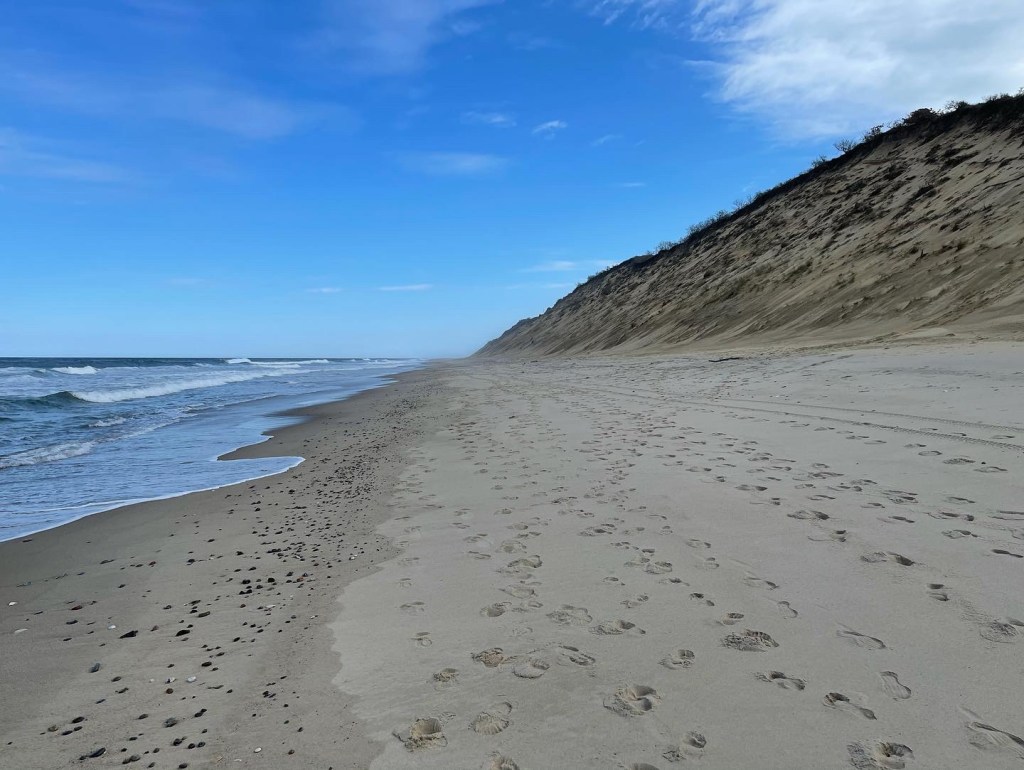
    Between the massive dunes and the crashing Atlantic Ocean in Wellfleet is a strip of sandy beach bearing the brunt of the relentless assault from wind and sea. The surf in warmer months is a feeding ground for Great White Sharks, who have modified their hunting style to chase grey seals right into the churning shallows that swimming humans like to frolic in during the warmer months. Great Whites don’t hunt humans, but sometimes they mistake humans for seals.

    In April you don’t see many seals bobbing in the surf on Cape Cod. So the sharks move on to other hunting grounds and leave this stretch of wild ocean to the occasional surfer and the beach walkers. A walk on the Cape Cod National Seashore can happen just about anywhere with an access path down the 100-foot dunes. Sand is dangerous stuff that can bury a reckless trespasser in no time at all. Sticking to the access paths preserves the dunes and just might preserve you too. The access paths themselves inform in their soft give. This is not a place for the meek. If you can’t handle the access path don’t walk this beach.

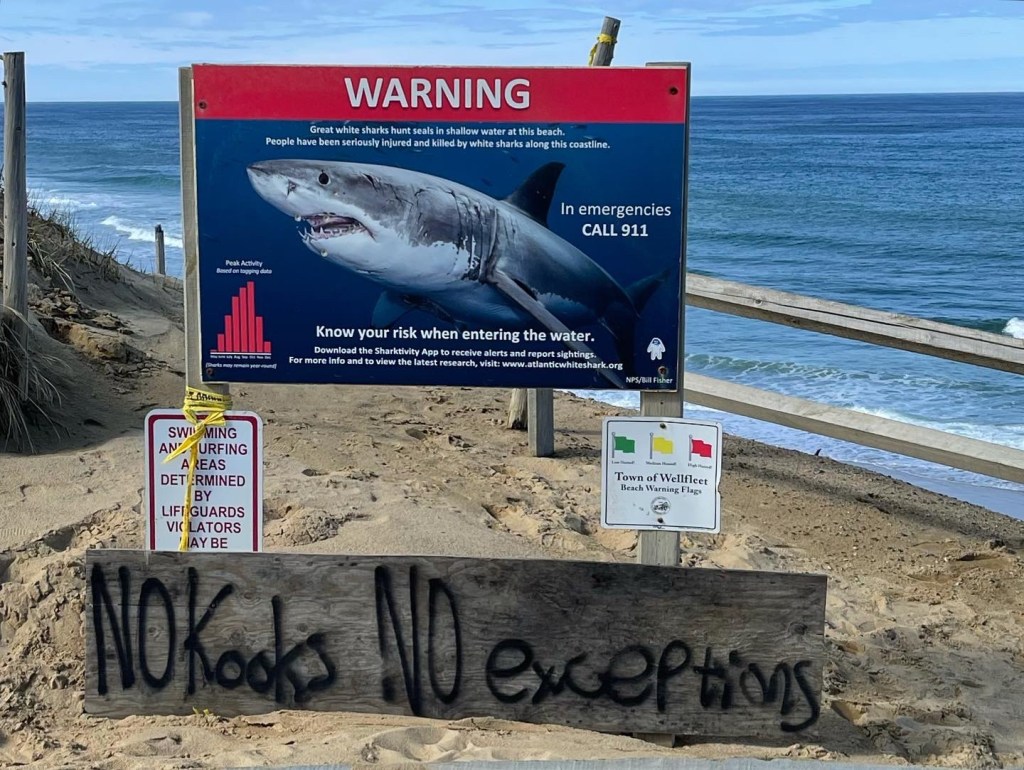
    For an off-season walk, we chose to park at the Beachcomber in Wellfleet and walk a stretch of soft sand known as Cahoon Hollow Beach. The Beachcomber is a trendy cool place at the height of summer. In mid-April it’s a convenient parking spot for easy access to the beach. A sign of the times is a shark warning with a handmade sign added to the bottom sharply suggesting “No kooks, no exceptions”. Wellfleet has had just about enough of the worst representatives of shark tourism.

    The National Seashore has a 40 mile stretch of beach that would test the strongest of walkers. When you say you’ll walk just to the bend you soon realize that bend keeps disappearing ahead of you. We walked about a mile, following the curve of the dunes around the forearm of Cape Cod. Walkers tend to gravitate towards the surf line where shells and smooth rocks offer themselves up for consideration. Soon your pockets are full and you recognize the folly of treasure hunting when every receding wave reveals another treasure.

    Thoreau walked the entire length from Chatham to Provincetown in the mid-1850’s and wrote about it for lectures that would end too soon in his abbreviated life. It would be published after his death in 1865 – the same year the Civil War ended. I think often about Thoreau, dying at 45 with so much left to do and see and write about. And here I was following him again, walking the beach between dune and sea, thinking it might just go on forever. Knowing it won’t.

  • The Lindy Effect

    A few years ago Nassim Nicholas Taleb described a phenomenon known as the Lindy Effect in his book Antifragile. Soon after you started hearing about it in other work, referenced in blog posts, magazine articles and even its own Wikipedia page. I tend to shy away from uber-trendy topics, but I’ve thought a lot about this Lindy Effect since reading about it in Taleb’s book.

    “I follow the Lindy effect as a guide in selecting what to read: books that have been around for ten years will be around for ten more; books that have been around for two millennia should be around for quite a bit of time, and so forth.” – Nassim Nicholas Taleb, Antifragile

    Lindy’s was a famous deli in New York where comedians and actors would gather and discuss such things as the durability of a Broadway show. The observation is that if something survives for a period of time longer than the norm, it implies that it will survive at least that long into the future. The Lindy Effect only applies to non-perishable items, so you and I and that orange on the counter don’t count. But that picture you take or that book you write or the product you release to the market do count. The implication is that you might build something that outlasts you by a long stretch.

    Henry David Thoreau died just eight years after publishing Walden, but the book lives on to this day. When it was originally published it was hardly noticed. Yet today it’s been read by millions. When Ansel Adams took the photograph “Monolith, the Face of Half Dome” in 1927 he was creating something that still captures the imagination of people around the world almost 100 years later. It was the picture that built his legacy and helped preserve Yosemite.

    Ernest Hemingway published his first classic, The Sun Also Rises, in October of 1926, six months before Adams took that photograph. Hemingway had a burning desire to be a great writer, and to publish great and lasting work. Many people point to the last lines of the novel for the way it captures the relationship between the two central characters. You might also see the final line as a hopeful wish from Hemingway that this book might fly:

    “Oh Jake,” Brett said, “We could have had such a damned good time together.”
    Ahead was a mounted policeman in khaki directing traffic. He raised his baton. The car slowed suddenly, pressing Brett against me.
    Yes,” I said. “Isn’t it pretty to think so?”

    – Ernest Hemingway, The Sun Also Rises

    I’ve noticed a small trend in this blog where 6-10 specific blog posts seem to get views all the time, while the other 1000+ have their moment in the spotlight and fade away over time. Millions of books and paintings and pictures similarly fade away over time, but some stand up forever as legendary. Making art may have a formula, but creating its stickiness remains a mystery to most of us.

    Ironically, Lindy’s, the delicatessen that gave birth to the concept of building something that might last forever, closed forever in 2017. For businesses are perishable too. Yet its name lives on. Maybe, like Thoreau or Adams or Hemingway, that is as it should be.
  • A Hole in the Ground

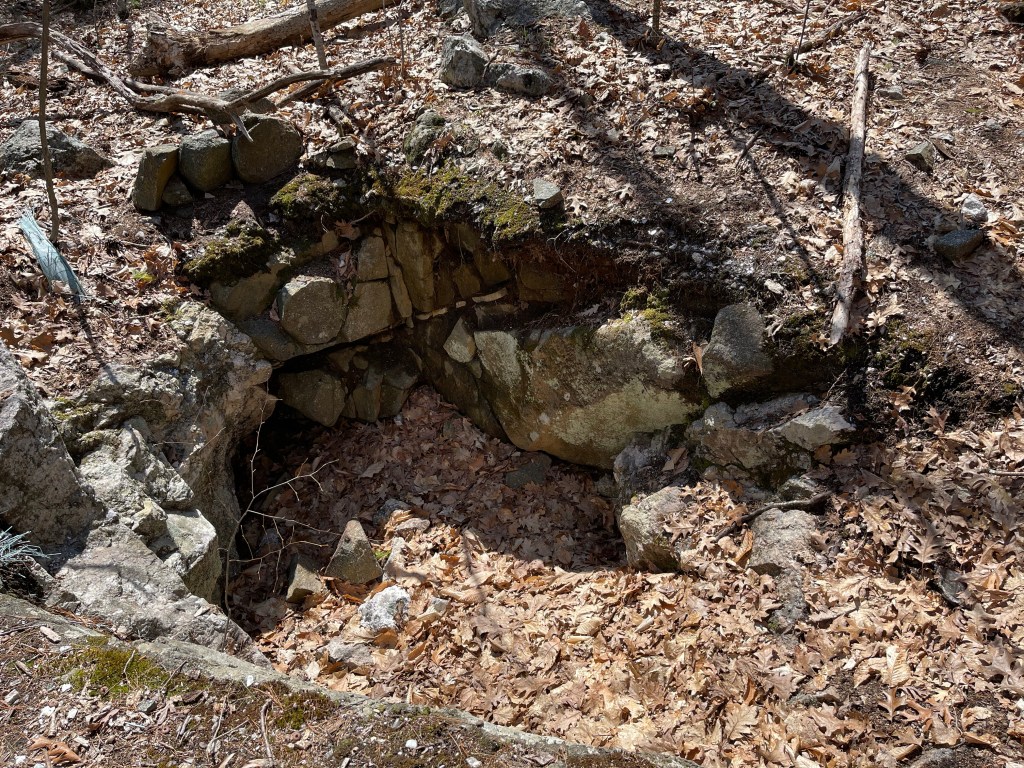
    Walking through the woods of Hampstead, New Hampshire we found an old mine quietly marking time. A modest hole in the ground, really, with scattered bits of Mica all around. To call it a mine seems a bit of a stretch when compared to the big mining operations elsewhere in the world. But it called to me, knowing I’d been looking for it, and seemed to sparkle in the sun for the attention.

    Mica is also known as Isinglass. From a resource perspective, Mica is sheet silicates used in everything from glass making to fashion to a key ingredient in gypsum. It has some heat-resistant qualities and is non-conductive, which makes it useful. But it’s very expensive to mine and labor intensive, so most of the mining now is done in India. For anyone complaining about their work, I’d point to Mica mining as one of many professions that might be a bit tougher.

    In New Hampshire you see flakes of Mica everywhere but the meaningful sheets (or “books”) were harder to find. When they did find it, they’d root it out by blasting and drilling carefully around the sheets. Keeping the sheets intact was the labor-intensive trick.

    There’s a semi-famous mine in Grafton called the Ruggle’s Mine, now closed, that used to be a tourist attraction. Visitors could carry out whatever rock that met their fancy. The mountain where it was mined was called Isinglass Mountain. You can find it on a topographical map but good luck finding that on the list of New Hampshire’s 1,786 mountains. Does a mountain lose prominence when people dig holes in it?

    Back in the woods, I wondered about this old hole in the ground, once a Mica mine, now a landing place for leaves and pine cones. There’s little history around it, probably because it really isn’t any bigger than a cellar hole. But it’s in my nature to wonder about such things. Not so much for the hole but the people who labored in it. I imagine they’re buried somewhere in town, filling their own holes in the ground. What was their story?

    Holes in the ground aren’t nearly as flashy as waterfalls and mountaintops. I can’t blame anyone who skimmed the first paragraph of this post and thought, “not for me”. But there’s a story there in the ground, marking time like the rest of us. And I wonder, what would it take to dig it out? For without a story it’s just another hole in the ground.

    Mica Mine hole in Hampstead, NH
  • A Visit to Fall of Song

    The Fall of Song is a popular place located on the grounds of Castle in the Clouds in Moultonborough, New Hampshire. The is a waterfall with infrastructure to support the masses, with a large parking lot a short walk from the walls and a boardwalk that runs right up to the waterfalls. These make it far more accessible than most of the waterfalls I visit, and likely ensures a lot of company when you visit at peak times. As is my nature, I visited off-peak and had the place to myself for a short time.

    The Fall of Song was once called Ossipee Falls, so named for the mountain range they’re in. I’m not sure exactly when the name changed to the medieval, lyrical Fall of Song. It may have been in the mid-19th century when the area was known for its mineral springs, or maybe later when BF Shaw came up from Lowell to build Ossipee Park mountain resort here. Or maybe it was when the property was sold to Tom Plant who built his Castle in the Clouds. Any of the characters from that time could have named it Fall of Song. It really doesn’t matter, I suppose. The falls have drawn visitors for generations because they’re simply beautiful.

    Fall of Song

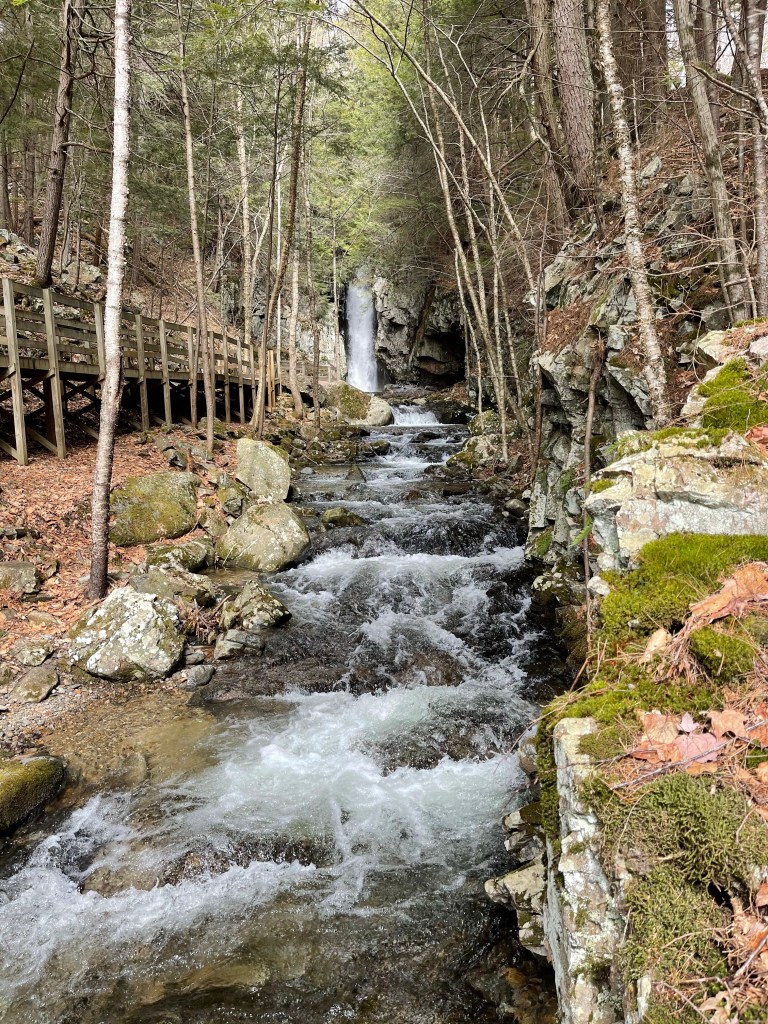
    In the winter and early Spring the gates are closed but pedestrians are welcome. A quick half mile walk up the road offers beautiful views of Shannon Brook tumbling down to greet you. You soon reach The Pebble, a giant glacial erratic that stands watch between the brook and the road. I see a lot of glacial erratics in my walks through the woods, and this one is pretty impressive.

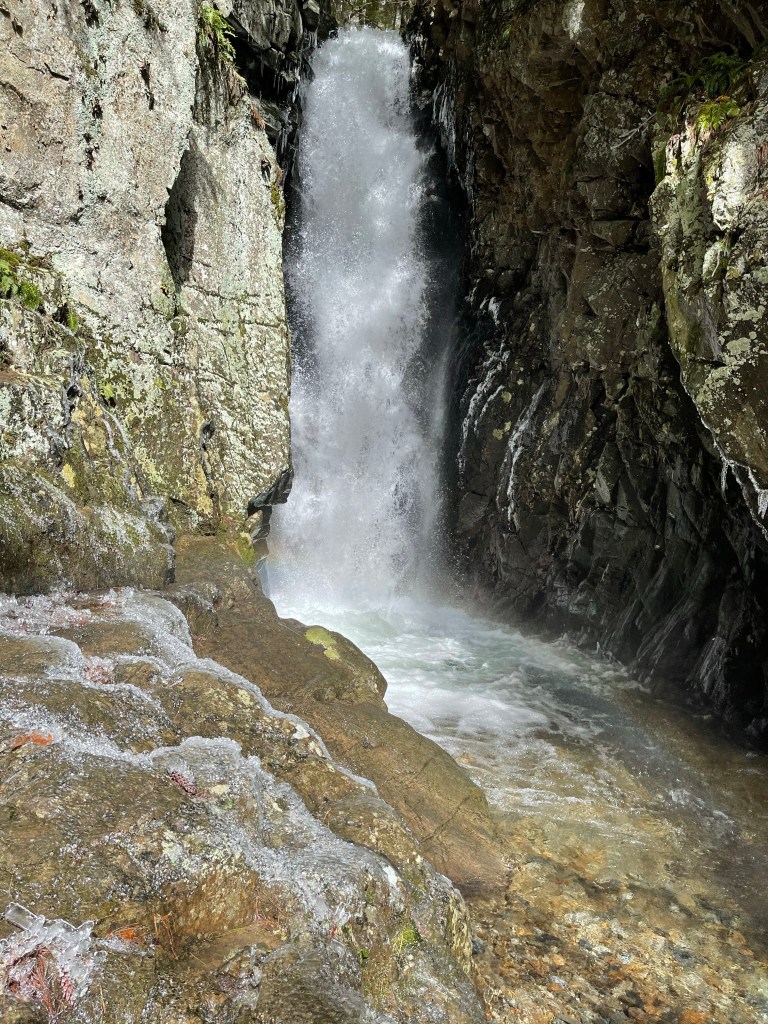
    The Fall of Song is an impressive 40 foot plunge through narrow granite walls. With recent rain they were singing with gusto, with an icy mist swirling into a rainbow in the afternoon sun. I appreciated the boardwalk for what it offers in accessibility for people who might not otherwise see Fall of Song, while thinking about how great the photo might have been without the boardwalk in the picture. So it goes.

    Fall of Song and Shannon Brook

    Not being one to settle for the easily accessible, I hiked up the trail above the falls to see them plunge from above, and then made my way up to Bridal Veil Falls just above Fall of Song. This second fall is one you have to earn, but in doing so you feel you’re in on a little secret that those who only visit Fall of Song never know. I tried several approaches to get to the best vantage point without being completely satisfied with any of them and have promised myself another visit to see them again.

    Shannon Brook, above Fall of Song with a glimpse of Bridal Veil Falls above

    There are several other falls above Fall of Song worth a look, with Bridal Veil being the prettiest. And you can spend a lot more time hiking this area beyond the waterfalls. For all my wandering further north in the White Mountains, the old volcano ring of the Ossipee Mountain range offers stunning vistas. This is a place worth returning to.

  • Bridging the Tragic Gap

    I spoke with a friend who is experiencing some PTSD after all the extremist action and rhetoric of the last few years. I don’t have anything to offer but support and faith in progress. Words, really, backed by optimism. But I know I don’t see the world the same way that someone targeted by bigotry and hate does, nor do I feel the gut punch of lost hope and lack of opportunity that the marginalized and enraged feel. I tend to reside in the middle, seeing the possibility of a future where the gaps between us disappear. But the cold reality is that won’t happen in my lifetime. And there lies the tragic gap.

    “By the tragic gap I mean the gap between the hard realities around us and what we know is possible — not because we wish it were so, but because we’ve seen it with our own eyes…
    I call it “tragic” because it’s a gap that will never close, an inevitable flaw in the human condition. No one who has stood for high values — love, truth, justice — has died being able to declare victory, once and for all. If we embrace values like those, we need to find ways to stand in the gap for the long haul, and be prepared to die without having achieved our goals…
    That means we need to change our calculus about what makes an action worth taking and get past our obsession with results. – Parker Palmer, The Sun interview, If Only We Would Listen

    There is a lot to chew on in this 2012 interview, but it’s Parker’s concept of the tragic gap that took hold. For those of us who fancy ourselves bridge-builders, it resonates. For we fill the gap with love and possibility, only to see the divide grow as more people embrace the extremes on either side. Knowing what’s possible and how far we seem to be from it are frustrating at best, tragic at worst.

    So what are we to do? Change our calculus and not obsess with results? Modify expectations and chase the small victories that get us incrementally closer? You see the friction in the world as the two sides of the gap pull away from each other and wonder if bridge-building is even possible. Seen from the lens of history progress is clear, but we never quite get all the way there before the gaps seems to grow again. But is this a trick of the mind at work, just so much amplified noise? The optimism in me believes we’re closer than we sound like we are. With much work still to do.

    “I refuse to accept the view that mankind is so tragically bound to the starless midnight of racism and war that the bright daybreak of peace and brotherhood can never become a reality. I believe that unarmed truth and unconditional love will have the final word.” – Martin Luther King, Jr.

    It’s a tough blow to realize we will never be bridge the tragic gap in our lifetimes, but that doesn’t mean we shouldn’t try. Seeing our own unarmed truth for what it is and doing our small part offers tangible, incremental progress. Each of us, small links in the chain, reaching across the chasm to find a link to a better future. Beyond us, but out there waiting.