Category: History

  • No Time for Tired

    Mais où sont les neiges d’antan! (Oh, where are the snows of yesteryear!)
    – François Villon, Ballade des dames du temps jadis

    We’re all a bit tired, aren’t we? Tired of the pandemic, tired of political deviants and extremists, tired of people not caring about the environment or really anything but themselves. Tired of things the way they are now. Tired that New Year’s Eve plans were scrapped because Christmas turned into a super spreader event, with half the vaccinated family getting COVID. You think maybe that booster will put you over the top and find your trail leg caught the hurdle.

    Villon was a rogue. He spent time in prison, and spent time writing poetry. He’s a complicated footnote in history. This poem, reflecting on the great women of the past during his time, lives on centuries after he too passed like the snows of yesteryear. And the analogy reminds us we too must pass from this moment. Our time here is short and not meant to be devoid of suffering and the occasional inconvenience.

    All we once knew has changed, all we know now will change again. Tomorrow, should we indulge in the folly of being there for it, will bring more change still. This is the way. Tired doesn’t matter. Billions of people had it worse than we do, right now, right here. Did you do a face plant on this hurdle? No? Then get over the next one. For the universe moves on with or without you. There’s no time for tired. We aren’t done with this race just yet.

  • My 12 Favorite Books of 2021

    I’ll finish the year having read somewhere between 34-36 books. That includes some heavy lifting non-fiction, some escapist pager turner fiction and a couple of books of poetry. All but one are older classics that I finally tackled in 2021. We ought to live a bit outside ourselves more often, and reading is an easy way to travel back in time, far into the future, or to places we thought we knew better. Here, in no particular order, are some favorites:

    The Intellectual Life: Its Spirit, Conditions, Methods – A. G. Sertillanges
    “If you produce nothing you get a habit of passivity; timidity grows continually and the fear caused by pride; you hesitate, waste your powers in wasting, become as unproductive as a knotted tree-bud.”

    Referenced in Newport’s book (next), I immediately purchased a copy and placed it on the top of the pile. The book is a bit dated, certainly written through the lens of a French Catholic philosopher in the first half of the 20th century, but bits of brilliance shine through. I’ll return to this one now and then in the future.

    Deep Work: Rules For Focused Success in a Distracted World – Cal Newport
    “To learn hard things quickly, you must focus intensely without distraction. To learn, in other words, is an act of deep work. If you’re comfortable going deep, you’ll be comfortable mastering the increasingly complex systems and skills needed to thrive in our economy.”

    Reading this book finally pushed me to delete Facebook from my phone, and to put the phone itself in another room when I want to get deep work done. The world is increasingly distracted, but we don’t have to be. The people capable of focusing and rising to the next level will fare well in a world where artificial intelligence and globalization threaten more and more jobs. Go deeper and differentiate from the shallow, distracted masses.

    The 4 Disciplines of Execution: Achieving Your Wildly Important Goals – Chris McChesney, Jim Huling, and Sean Covey
    “When a team defines its lead measures they are making a strategic bet. In a sense, they are saying, “We’re betting that by driving these lead measures we are going to achieve our wildly important goal.” They believe that the lever is going to move the rock, and because of that belief, they engage.”

    A classic in business writing, this book outlines the steps needed to identify and execute on the most important goals for an organization. The secret is deep focus on no more than one or two wildly important goals. The magic is in drawing the entire organization in to help make the dream a reality. Most people want meaning in their careers. When they identify the actionable tasks that contribute to the overall win and execute on them, everybody wins.

    Dead Wake: The Last Crossing of the Lusitania – Erik Larson
    “In his final log entry on the attack, at 2:25 P.M., [Kptlt. Walther] Schwieger wrote: It would have been impossible for me, anyhow, to fire another torpedo into this crushing crowd of humanity trying to save their lives.”
    Schwieger directed his U-boat out to sea. His crew was jubilant: they had destroyed the Lusitania, the ship that symbolized British maritime prowess.”

    Larson is one of the great historians of our time, and he unpacks moments like the Blitz and the sinking of the Lusitania with a style that few can match. We all sort of know the story of the Lusitania, but Larson unpacks the tragedy of it in a page-turner style. This book will fascinate you, and even as you know the inevitable ending you’ll be surprised by many of the details.

    Mastery – Robert Greene
    “Your true self does not speak in words or banal phrases. Its voice comes from deep within you, from the substrata of your psyche, from something embedded physically within you. It emanates from your uniqueness, and it communicates through sensations and powerful desires that seem to transcend you. You cannot ultimately understand why you are drawn to certain activities or forms of knowledge. This cannot really be verbalized or explained. It is simply a fact of nature. In following this voice you realize your own potential, and satisfy your deepest longings to create and express your uniqueness. It exists for a purpose, and it is your Life’s Task to bring it to fruition.”

    How do we reach mastery? Most don’t. Most settle for a life of unfocused and relative comfort, unwilling to spend the hours of apprenticeship to master their craft. For those who want to rise above the average, this is an excellent playbook. Greene walks the talk–few take the time to research and perfect a topic as he does.

    Sapiens: A Brief History of Humankind – Yuval Noah Harari
    “We believe in a particular order not because it is objectively true, but because believing in it enables us to cooperate effectively and forge a better society. Imagined orders are not evil conspiracies or useless mirages. Rather, they are the only way large numbers of humans can cooperate effectively.”

    Enlightening book that reveals how humans got to be who we are. Harari makes a strong case for the rise of humanity being great for us but catastrophic for every other species. This is a foundational book that I’d delayed reading until 2021 despite consistent prompts from friends.

    Keep Sharp: Building a Better Brain at Any Age – Sanjay Gupta M.D.
    “We don’t usually think about dementia when we’re entering our prime, but we should, because it provides a remarkable opportunity. Data from longitudinal observational studies accumulated over the past few decades have shown that aside from age, most other risk factors for brain disease can be controlled. That means you indeed have a powerful voice in controlling your risk for decline. As you might guess, some of the most influential and modifiable factors related to that decline are linked to lifestyle: physical inactivity, unhealthy diet, smoking, social isolation, poor sleep, lack of mentally stimulating activities, and misuse of alcohol.”

    Brain health is top of mind for me, and this book proved a reassuring playbook for controlling some of what happens with my own brain health over the second half of my life. Not surprisingly, what’s good for the body is usually good for the brain. Good nutrition, restorative sleep, proper hydration and exercise all help the brain as much as the body. Knowing this, you can fold the right kind of lifestyle choices into your daily routine and put yourself in a better position to have a vibrant, healthy brain to our final days.

    The Great Mental Models: General Thinking Concepts – Shane Parrish
    “If we never learn to take something apart, test our assumptions about it, and reconstruct it, we end up bound by what other people tell us—trapped in the way things have always been done.”

    A playbook for conceptual thinking, this is one of three books Parrish published on mental modelling. It’s a helpful guide for framing a problem or decision using proven methodology. Parrish has an excellent podcast called The Knowledge Project that builds on this framework by exploring just how the world’s great thinkers frame their own decisions and build great organizations.

    West With The Night – Beryl Markham
    “The air takes me into its realm. Night envelops me entirely, leaving me out of touch with the earth, leaving me within this small moving world of my own, living in space with the stars.”

    This is a breathtaking book that sparkles with magic. Markham writes with an elegance that Hemingway would strive to match, raising the bar for writing in the 20th century. If you want to travel back in time to the barnstorming days of early flight, elephant hunting when the elephants had the upper hand and a glimpse of the changing landscape of Africa between the two World Wars this book is for you.

    Start with Why: How Great Leaders Inspire Everyone to Take Action – Simon Sinek
    “Before it can gain any power or achieve any impact, an arrow must be pulled backward, 180 degrees away from the target. And that’s also where a WHY derives its power. The WHY does not come from looking ahead at what you want to achieve and figuring out an appropriate strategy to get there. It is not born out of any market research. It does not come from extensive interviews with customers or even employees. It comes from looking in the completely opposite direction from where you are now. Finding WHY is a process of discovery, not invention.”

    Why do we align ourselves with brands, political parties or people? Because they speak to us on some level. We desire to belong to something. How we arrive at that feeling of belonging is the “why” that drives the “what” something is and “how” it’s done. Organizations that do this well, think Apple, create a compelling case to identify with the brand. The very best leaders create a compelling why.

    On the Road – Jack Kerouac
    “Dean took out other pictures. I realized these were all the snapshots which our children would look at someday with wonder, thinking their parents had lived smooth, well-ordered, stabilized-within-the-photo lives and got up in the morning to walk proudly on the sidewalks of life, never dreaming the raggedy madness and riot of our actual lives, or actual night, the hell of it, the senseless nightmare road. All of it inside endless and beginningless emptiness. Pitiful forms of ignorance.”

    On the Road nagged me for years. For a few years in my early 20’s I chased the legend of Kerouac through the streets of Lowell, Massachusetts. I drank in some of the same bars that Kerouac drank in. Walked the same streets he grew up on. But I stubbornly kept his most famous book at arm’s length. I made a point of reading it in 2021 and saw the brilliance in his prose even as it betrayed the lifestyle that would eventually kill him.

    Falling Upward: A Spirituality for the Two Halves of Life – Richard Rohr
    “By the second half of life, you have been in regular unwelcome contact with your shadow self, which gradually detaches you from your not-so-bright persona (meaning “stage mask” in Greek) that you so diligently constructed in the first half of life. Your stage mask is not bad, evil, or necessarily egocentric; it is just not “true.” It is manufactured and sustained unconsciously by your mind; but it can and will die, as all fictions must die.”

    If we’re lucky, we all live two lives. We eventually transcend the character we are in the first part of our lives and “fall upward” into a higher self. I wouldn’t say I’ve arrived at that higher self, but I’m aware that it’s there should I stay on the path. Reading is a big part of that journey, and this and the other books finished in 2021 are stepping stones across the shallow stream to the other side.

  • Plymouth’s National Monument to the Forefathers

    Plymouth, Massachusetts might not be the oldest European settlement in the United States, but you can safely say it’s where England got its foothold in America. They might have landed in Provincetown first, hit a few places along the Cape Cod coast as they looked for a better place to settle, and maybe they would have been better off if they’d landed in what would become Boston or Providence, but they landed here. And the great floodgates of immigration began, changing this continent forever.

    That narrative of settlement and conquest is… complicated. But you can make a good case that the Mayflower Pilgrims’ pilgrimage was driven by religious freedom and a desire for peaceful coexistence with the Native American population. They happened to settle in a place where the native population had recently been decimated by disease, making for a bit more elbow room to root themselves in the place, but let’s stay on point. That first generation tried to fulfill the mission as best they could.

    To honor those noble intentions, and to put a spotlight on the best virtues that we humans aspire to, the Pilgrim Society of Plymouth conceived of a huge statue that would dominate Plymouth Harbor. The original monument was supposed to be 150 feet tall and right on the water. Reason eventually took over and they moved the monument to the top of a small hill with a commanding view of the harbor, then shortened it to 81 feet.

    The National Monument to the Forefathers is believed to be the tallest granite statue in the world. There is impressive detail in the carvings and a sense of Victorian optimism about what we aspire to be throughout. The cornerstone was laid in 1850 and the monument completed in 1889. That’s a lifetime for someone in the middle of the 19th century. Throw in the Civil War and violent conflict with Native Americans as the country was settled ever westward and those ideals were challenged even as the monument was being built.

    Today the National Monument to the Forefathers stands in dignified silence, 132 years after the dedication ceremony and a year after the 400th anniversary of the settlement of Plymouth by those Mayflower Pilgrims. That big party got cancelled last year with the pandemic, the narrative of living up to the best of virtues is more challenging than ever as we Americans sort out just who we want to be, but the monument stands. Still waiting for us to measure up.

  • Life is the Train

    “Our life is a constant journey, from birth to death. The landscape changes, the people change, our needs change, but the train keeps moving. Life is the train, not the station.” – Paulo Coelho

    Traveling by regional train is such a treat when you’ve been subjected to the indignities of air travel and commuting in the relentless grind of traffic. Taking an Amtrak from Boston to New York is not the fastest way from point A to point B, but my gosh it’s surely the best way. Give me the rolling scenery without the stress of distracted drivers and unpredictable traffic, thank you. Give me actual leg room in coach over whatever they think proper leg room is on a regional jet between any two cities in the United States. The train is the best way from here to there if the option presents itself.

    There are two options when taking the train from Boston to New York (or Washington beyond). The first is the Acela, the “high speed” option. The second is the regional train. The difference is in top speed the trains can travel at, and the number of stops the train makes along the way. For all the potential of the Acela, it only gets you there about 30 minutes faster. I’m quite content taking the regional most days. Sit on the port side going south for the coastal views and the sunrise, or the starboard side for the great view of the city as you make your final approach to Manhattan.

    Days blend into weeks, which blend into months. Years fly by and suddenly you can’t recall how many times you’ve done this particular trip. Last week I was flying up and down the East Coast, this week I’m doing a portion of that trip ten feet above sea level. In the last month I’ve been in nine states and when I land in my hotel room tonight I’ll have slept in 12 different beds. Clearly I’m inching back to my old nomadic lifestyle. With travel as with life, I’ve found that it’s usually far better when you’re taking the journey with someone than running solo. But most trips that’s not the way it works with business travel.

    The world changes, that’s not a negative statement, but a simple fact of life. And we must keep adapting to change, and keep authoring our own life story. To stay in one place seems a waste to me, when there’s so very much to see out there. Why not explore the world while you have health and mental faculty on your side? We’ve seen how it goes when you wait too long. Life isn’t fair, it will brush you back with a fastball and strike you out with a nasty curve before you know what happened to you. Get to it while you can, and don’t ever strike out looking.

    Travel by train gives you the time and mental space to think. To appreciate how far you’ve come, and not stress out about where you’re going. You’ll get there, just stay on the train. Life is like that, isn’t it? Stick with things, keep moving forward and things tend to work out for you. Trains and baseball analogies, all in one post. Isn’t it funny how far a rolling coastal view will take the mind?

  • Through Fields of Cotton

    Driving through the Carolinas on back country roads in harvest season, you’re struck by the endless miles of ripe cotton greeting you. With many crops, you look at it and wonder what it might be when you’re flying by at 50 MPH. Not so cotton. You know immediately what this crop is. You’ve been wearing it all your life. Ripe cotton waves back at you like a stadium full of home run hankies or laundry lines strung with tighty whities.

    Cotton fields echo. Deep down you know the labor history of this crop, know the historical advancement in picking the stuff from slavery to machinery and all it meant in between. Cotton and tobacco share similar echoes, but cotton reverberates a bit louder. As I understand it the crop was more labor intensive to pick, but also grew exponentially in demand. Cotton was one of the first commercial crops grown by European settlers in America. They grew it in both Florida and at Jamestown, Virginia in the first wave of settlements. The value of cotton in human lives demanded attention, and fueled generations of economic prosperity and more than a little oppression too.

    Driving through field-after-field of cotton you begin to feel the weight of it all, this essential crop for so much of what we wear and use in our daily lives. I wanted to shout to stop the car so I could walk through the fields, feeling the cotton plants (Gossypium) in my own hands. But we kept rolling through, and those endless fields soon felt like clouds rolling by your plane window. And I began to feel like we were flying through history.

    Cotton Firld
  • Pier, 2 Piers

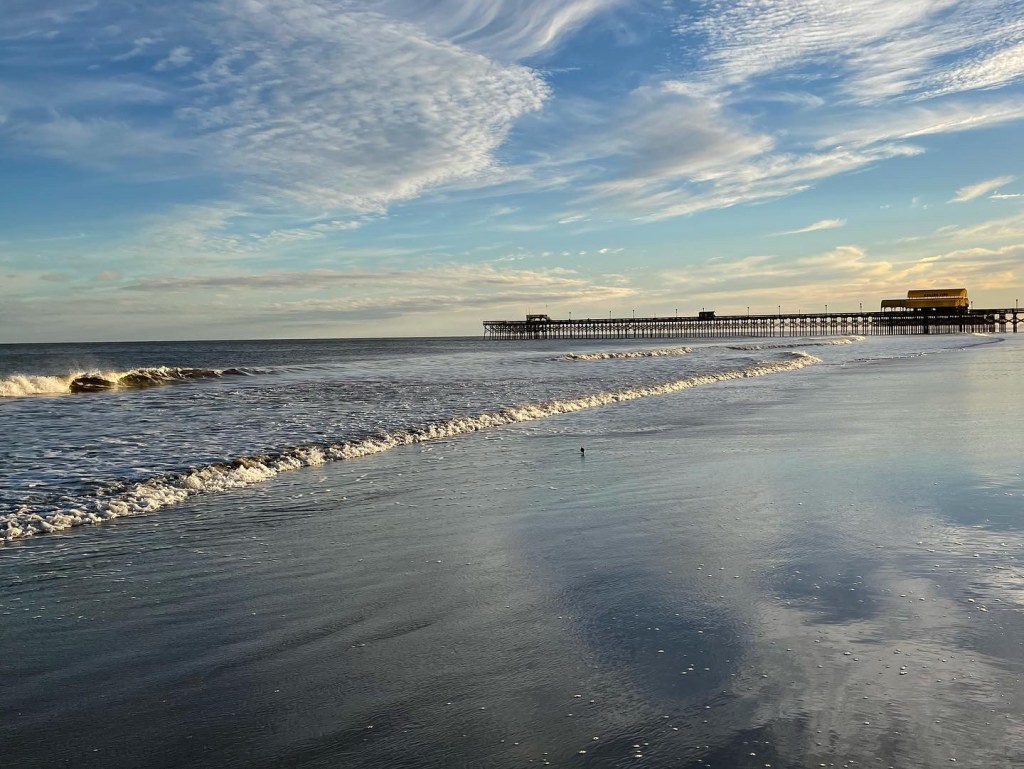
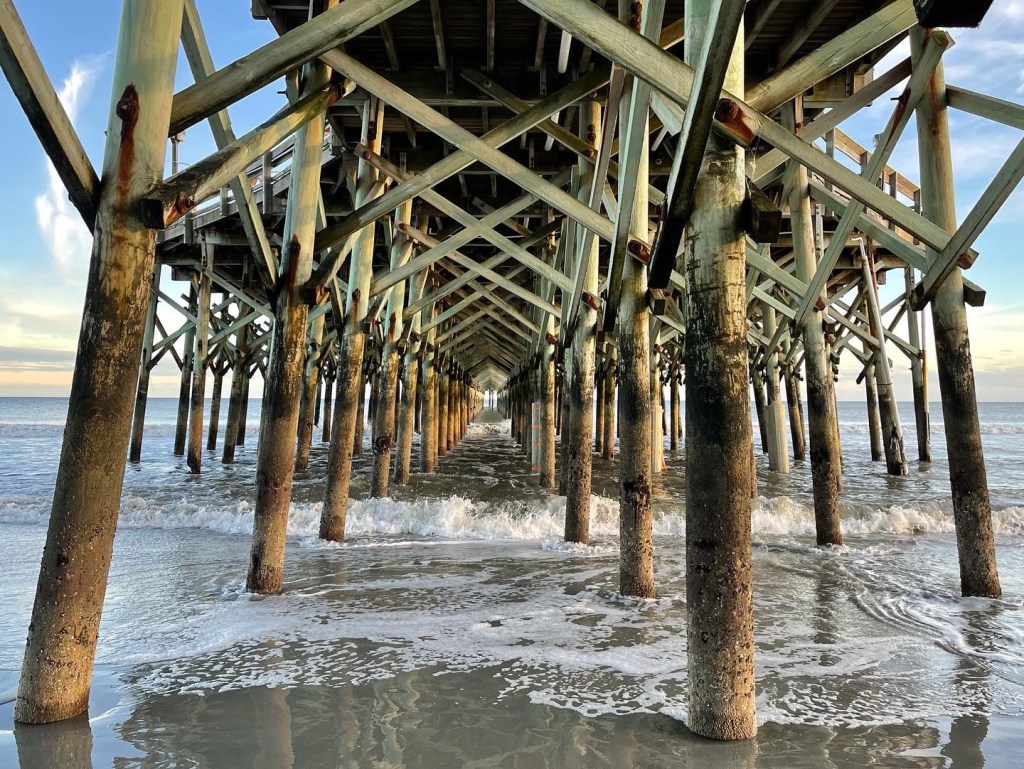
    The Apache Pier in Myrtle Beach, South Carolina and the Oceanside Pier in Oceanside, California share two things in common. They’re the longest piers on the eastern and western coasts of the United States, respectively. And secondly, this writer managed to unwittingly stumble upon both of them with no prior knowledge of their standing in the world of wooden fishing piers.

    The Apache Pier in Myrtle Beach was build in 1994, making it a relative toddler in the world of wooden piers. By comparison, the Oceanside pier was first built in 1888 and subsequently rebuilt several times. Apache reaches out 1,206 feet into the Atlantic Ocean, while Oceanside juts 1,954 into the Pacific Ocean. If you’re wondering, Apache Pier is named for the beachside campground that owns it.

    I’ve written a bit about Oceanside recently. Myrtle Beach is new for me, and it seems like paradise for year-round golfers, with over 100 courses nearby. I’m not much of a golfer, but I appreciate a long, walkable beach in the offseason, and they surely have that in Myrtle Beach. The piers connect two places for me, if only as common ground. Latitude isn’t that far off, Myrtle Beach is at 33.6891° N, while Oceanside is at 33.1959° N. The gulf currents are of course opposite between the coasts, with warmer water reaching up to greet Apache Pier, while Oceanside Pier has cooler waters coming down from Alaska.

    I confess I rarely think about fishing piers. I live in New Hampshire, and we have piers too, but not piers that stick a thousand feet out into the open ocean. So it’s interesting to spend a bit of time with a couple of the big boys in lumber allocation. I may never write about fishing piers again, but I never thoughts I’d have two posts about them already. You just never know where travel and blogging will take you, do you?

    Myrtle Beach and Apache Pier
    Apache Pier
    Apache Pier
    Oceanside Pier
  • The Hollywood Sign

    The Hollywood sign that clings to the southern side of Mount Lee in Los Angeles was first built in 1923, reconstructed in 1949 and again in 1978. It was repainted in 2005. The letters are 45 feet tall and the total length of the sign is 350 feet. Over the years it’s become the iconic symbol of Hollywood, and you can’t really visit the place without seeing the sign from some vantage point. On clear days there are plenty of those, but Griffin Park and the nearby Hollywood Sign Scenic Vista Point seem to be where most people go for close-up photos.

    I confess, I’m not a fan of the celebrity fanaticism undercurrent of this place, but I appreciate the more creative output coming out of Hollywood and the people behind the scenes who do the work. I’d much rather take a studio tour to see how they create a movie than stand near a red carpet trying to catch a glimpse of some famous person. And sure, maybe it’s odd for me to be celebrating a plywood sign at all, but ultimately I seek out the landmarks that make a place unique, and there’s no other place with a hilltop sign as iconic as Hollywood.

    The sign used to say “Hollywoodland”, built to advertise a development going in the early 1920’s. It became iconic with the growth of Hollywood and they dropped the “land” with the 1949 restoration. The first time I saw it, appropriately I suppose, was from the top floor of the Academy Museum of Motion Pictures (itself a place that makes you fall in love with the craft of moviemaking when you visit it). But you need to get closer for that true touristy picture, and the park and vista point are great spots for that purpose. As a side benefit you get to meet some great dogs.

    Had time allowed I’d have hiked to the summit of 1,708 foot Mount Lee to see the sign from behind. That will have to wait for another trip and a clearer city below, for as clear as the sky was above us, smog enveloped the city below. That, sadly, is another thing Los Angeles is known for. And as a visitor from a place with crisp air and clear skies, the other thing you notice. But looking up, at least we had that blue sky.

  • A Visit to Oceanside

    There might not be a more aptly-named city than Oceanside, California. Tightly hugging the Pacific Ocean on it’s western edge, pristine waves roll to shore and create the perfect conditions for surfers. When you walk out onto the 1,942 foot long city pier you feel like you’re out there with the surfers bobbing in the waves. In fact, when you reach the surfers you’re only halfway out to the end.

    Camp Pendleton is right next to Oceanside, and the two are forever associated with each other. The US Marines train at Camp Pendleton and I know several people who came here to train before being deployed elsewhere. As neighbors, Oceanside is a military town and you see it in the stores that cater to the Marines, and especially in the barber shops with their rows of chairs ready for customers on leave. The city is changing as more and more people are attracted to this place, but this will be a military town as long as the Marines stay next door.

    While the military vibe is tangible, Oceanside’s other neighbor is the Pacific, and it dominates the conversation of identity. Health, fitness and outdoor living are also a vibe here. There’s a surfing museum of note here, and surfers dot the water on either side of the pier. Oceanside hosts an Ironman Triathlon and they were set up for it during my visit. Walking around you find a cool vibe, exceptional dining options and friendly, fit people.

    I have a friend who moved to Oceanside, prompting a visit to see him and linger in town for a couple of hours. I can see that the place has transformed him into a happier, healthier person. Walking around in this pristine city I can see exactly how he got there. And sure, it’s easy to imagine living here too. This place where every day is paradise seems pretty tempting indeed.

  • Morro Rock

    When you’ve driven down the coast of California you’ve seen plenty of rocks in the water, and Morro Rock might be considered one more in a string of them. And yet it’s different from the rest. There’s a presence emanating from this big boulder that attracts you to it. Two Native American tribes, the Chumash and the Salinan, thought of the tock as sacred. Explorers mentioned it as a landmark, and it does jump out at you from miles away.

    Like most of nature, white settlers thought of it differently. When you call something a “natural resource” it somehow gives you license to put it through indignities or use it up entirely. It was quarried for a time, until the community saw it’s value more clearly and protected it. But rather than make it a centerpiece of a larger park someone else had the idea to stick a huge three stack power plant in front of it. I’m sure my timelines are off, but each of these things clearly happened.

    Despite all that, there’s a nice beach and access to the base of Morro Rock. It still has something to say. I think maybe it’s “leave me alone, I’ve had enough of you’.

  • Pacific Coast Highway

    “We do not associate the idea of antiquity with the ocean, nor wonder how it looked a thousand years ago, as we do of the land, for it was equally wild and unfathomable always.” – Henry David Thoreau

    I’m an East Coast guy. California is another world when you live with ice and snow and sunrises as your standards. You imagine what a place might be like when you’ve never been to it but hear of it often. It becomes the stuff of legend. Driving the Pacific Coast Highway and visiting Monterey and Big Sur became such a legend for me. And the experience lived up to its billing.

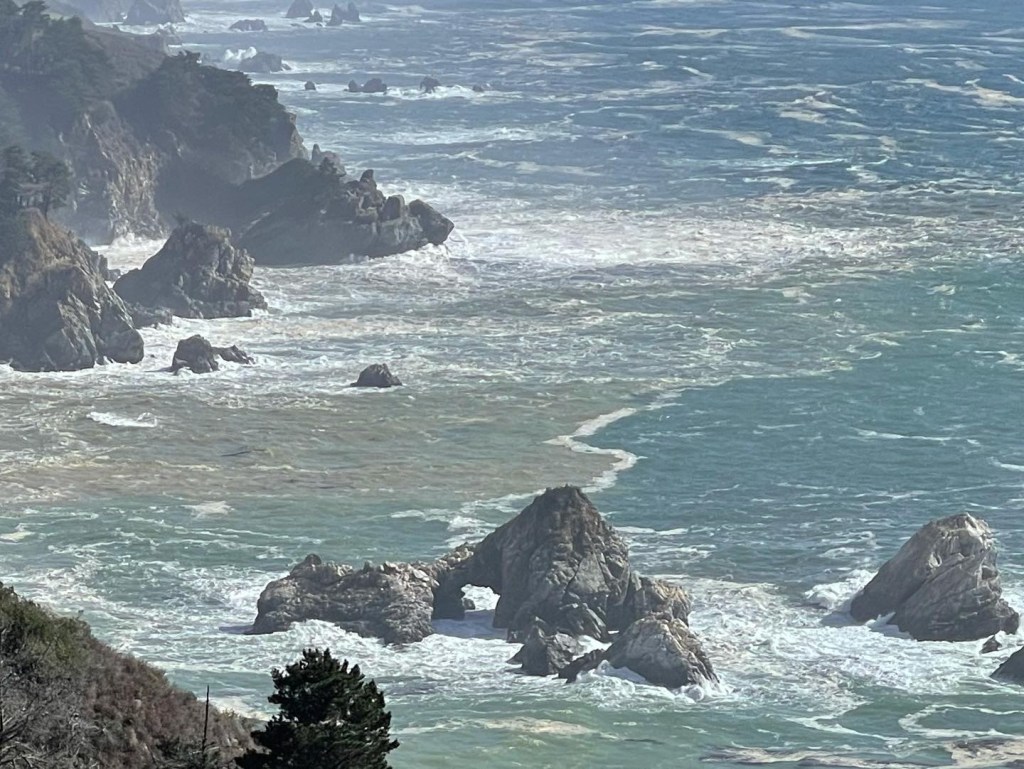
    When you look out at the Pacific Ocean for a few hours, and the rugged, mountainous terrain this highway snakes through, you feel the truth in Thoreau’s words. But for the highway itself and a few scattered houses and ranches this view hasn’t changed much in millennia. And unless it all tumbles into the sea it ought to look the same for another millennium. We’re just rolling footnotes passing through the eternal. The Pacific Coast Highway sets you straight about such things.

    Starting our drive from the dunes of Marin, we drove Ocean View Boulevard to Sunset Drive, making our way to pay the $10.75 entry fee for access to 17 Mile Drive. It was worth the price of admission, particularly with the big waves rolling in as remnants of a stormy ocean. Officially, 17 Mile Drive has 17 landmarks to view (all mapped for you when you pay to enter). Unofficially, the glimpses of the homes of the ultra-wealthy and a drive by Pebble Beach Golf Links are a big part of the draw.

    A quick visit (checking of the box) in Carmel and we were off to Big Sur. This is where cellular coverage all but disappeared and you put your trust in fate. There are hundreds of turn-offs you can pull over into and several larger scenic vista parking areas. The toughest places to find elbow room were Bixby Bridge and McWay Falls. Each offer that postcard or Instagram worthy image. The trick is to find an image that’s unique without putting yourself in peril. Sometimes the perfect picture is the one everyone else took too.

    The rest was simply breathtaking views and an appropriate focus on keeping the car on the road. Every turn brought another stunning view, and at some point you stop taking pictures of waves crashing onto massive boulders and cliffs and simply enjoy the drive. The Pacific Coast Highway is an embarrassment of riches in its beauty and a national treasure. Make sure you have a full tank and the time to enjoy this experience.