There’s a lot of history lurking in plain sight. Take Calf Pasture Beach in Norwalk, Connecticut. on the surface it’s a pretty municipal beach on Long Island Sound. I suppose that might be enough. But there’s a significant link to the Revolutionary War on this beach. As an eager participant in maximizing the potential of any trip, I’d read about the beach while looking for a good place to watch a sunrise. As a history geek I leapt out of my chair when I learned more about the beach. A sunrise visit became a no-brainer.
So why the strange name? Calf Pasture Beach was exactly what the name infers. When the first European settlers arrived in 1651, their cattle grazed on the grass just off the beach. Names have a way of sticking, don’t they? But there’s even more history whispering on this beach. On July 10, 1779, British Lieutenant General William Tryon led 2,600 troops on the Revolutionary War raid of Norwalk. They camped right on the peninsula where the beach is located, and the next morning burned most of the town to the ground.
There’s no sign of British encampments or cows now, just a municipal beach with a fishing pier and bathhouse, a few baseball fields and a large parking lot. The property might have developed into any number of things, from industrial facilities to a housing development. Thankfully it was donated to the city exactly 100 years ago by the Marvin-Taylor family, who had owned the land for generations. That’s a gift that keeps on giving, and I hope Norwalk has something planned for 2022 to commemorate the family.
All this history lured me to that particular beach for a wonderful sunrise over Long Island Sound. Arriving during magic hour, the sky was lit up in pink, and Sprite Island offered a beautiful contrast with its bare trees. A short walk down the beach brings you to a fishing pier, which offers a different perspective on the sunrise, and a different perspective on the beach itself. This small peninsula feels like it would be a million miles away from the congested I-95 corridor, yet here it is just a few minutes away. It’s funny what you find when you pause to look around a bit. Not every early morning micro-adventure pays off, but this one surely did.
Sprite Island during the magic hour before sunriseCalf Pasture Beach, Norwalk, CTSunrise over Long Island Sound from the Captain William Clark Fishing Pier
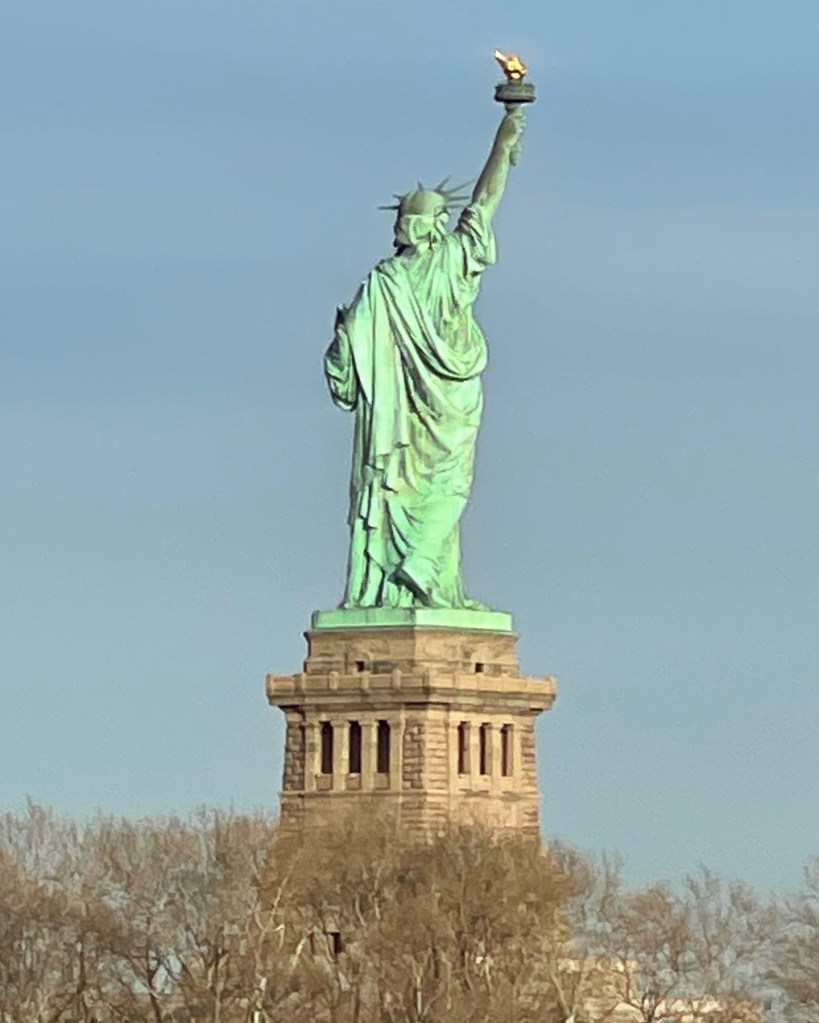
When you see the Statue of Liberty from the New Jersey side, it feels a bit surreal. We’re all used to that image in our head of the face of Lady Liberty, but how often do we ever think of the back? Yet that’s what New Jersey sees. I recall a joke about Lady Liberty forever turning her back on New Jersey, but let’s flip that script around for what’s really been happening since 1886: New Jersey’s always had her back.
Liberty Park offers a striking view of Manhattan and Frédéric Auguste Bartholdi’s bold vision of American liberty. He called his work “Liberty Enlightening the World”. Liberty represents the hopes and dreams of millions, standing exposed to the elements for 13+ decades. 1886 was within the lifetimes of Civil War veterans, think about what that statue meant to them. What it still means, when we look at the world with new perspective.
Liberty connects generations, and she stoically stands, not just American’s, but for the world. The work was literally a gift from the Old World to the New. We ought to remember the message in the gift. Forget the people trying to co-opt her message for political gain, Liberty represents all of us. When you look at America’s Liberty from New Jersey, you aren’t just looking at it, you’re a part of it. And from that perspective, shouldn’t we all have her back?
Let’s get the elephant in the room addressed right off the bat: Anthony’s Nose has an odd name. Here’s one story I came across in Kiddle that describes how it got it:
“Pierre Van Cortlandt, who owned this mountain, said it was named for a pre-Revolutionary War sea captain, Anthony Hogan. This captain was reputed to have a Cyrano de Bergerac type nose. One of his mates, looking at this mount, as they sailed by it, compared it to that of the captain’s nose. He said that they looked similar in size. This good-natured joke soon spread, and the name Anthony’s Nose stuck to this peak. Washington Irving’s History of New York, a satire, attributes the name to one Antony Van Corlear, who was the trumpeter on Henry Hudson’s ship.”
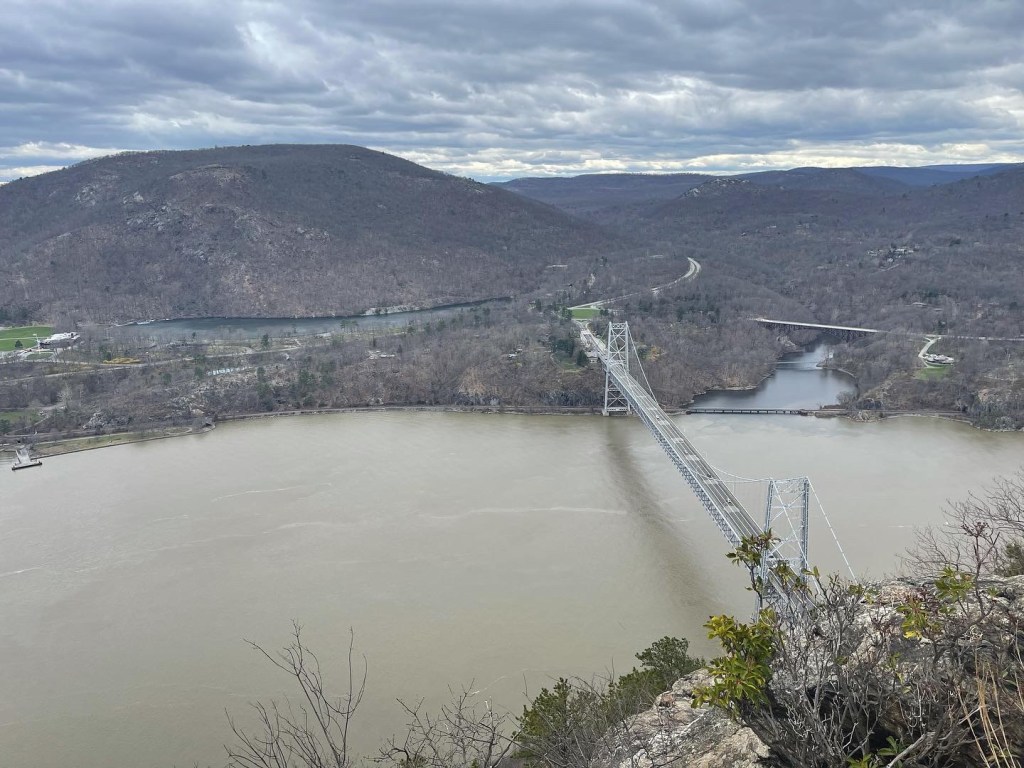
Whatever the source, it requires that each hiker now forever able to say they went up Anthony’s Nose. How you feel about that is entirely up to you. For me, the motivation was to see a bridge I hadn’t seen in almost 30 years, get a quick hike in to break up a long drive and get a feel for a stretch of the Hudson River from a hill top.
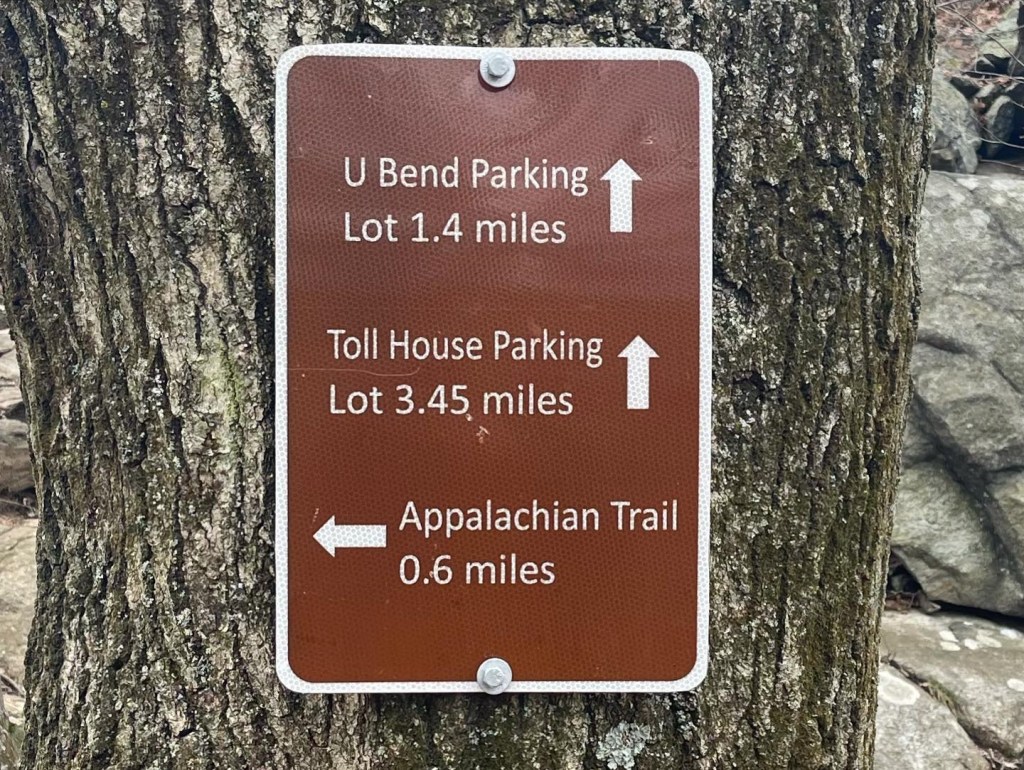
There are a few routes up Anthony’s Nose (sorry). The most direct route is a steep granite “staircase” that brings you to your destination relatively quickly. This requires street parking on a busy stretch of road. Alternatively, there are a couple of longer routes to the lookout spot, the one I favored followed the white blazes of the Appalachian Trail. The AT crosses the Bear Mountain Bridge over the Hudson River and meanders up through a final stretch of New York before reaching Connecticut. You might expect a stretch of the AT to be lovely hiking. You’d be correct for this stretch.
There seems to be a lot of confusion about where the trailhead is for Anthony’s Nose. If you’re going to hike straight up the staircase, you begin at a small deck on the side of the road not far from the bridge. If you’re more interested in a 90 minute round trip hike, take the AT route. The trailhead begins on South Mountain Pass Road, which is a rutted stone dust road for a long stretch. If you’ve got a small sedan you might consider driving in from the Blue Mountain Beacon Highway side, which offers a bit more pavement to work with. Driving a truck, I enjoyed the off-road feel of reaching the trailhead after a few hours of highway driving to get there.
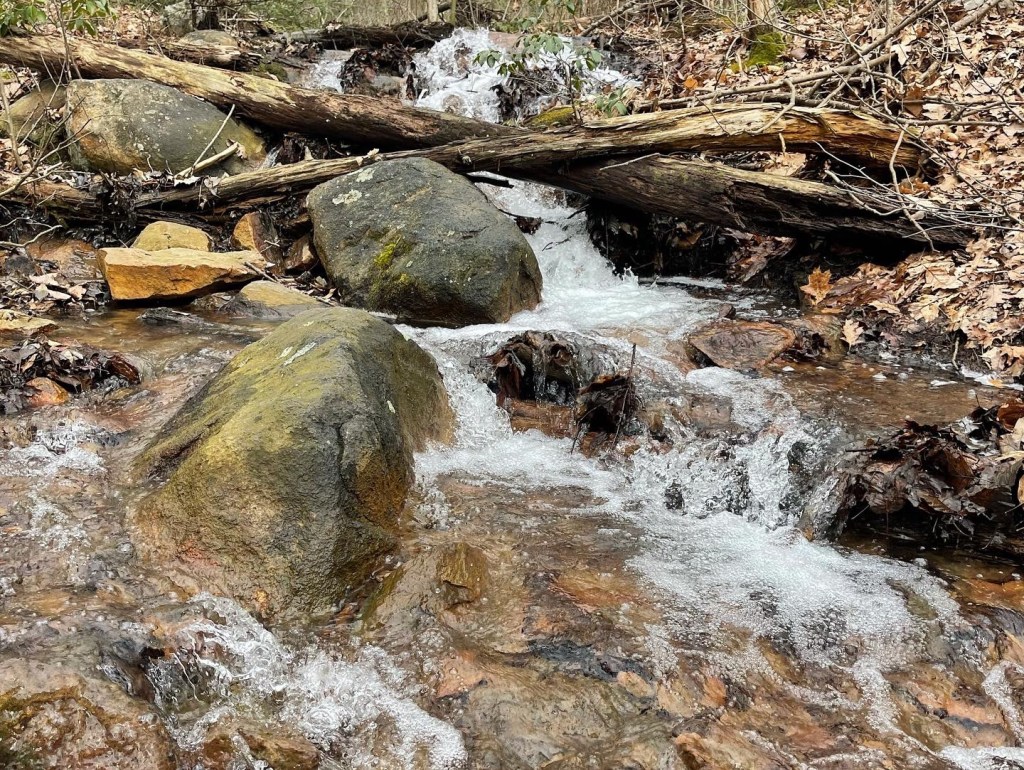
The key for the trail is to follow the white blazes, which leave an old roadbed a few hundred yards up and begin descending towards a small stream before climbing back along the ridge line. The trail head would benefit from a bit of signage and a map, as one hiker after another asked each other if they were in the right spot. Perhaps a Boy Scout Troop could take it on as a project.
The hike took 90 minutes round trip. Parts of the trail felt like you were in the middle of the White Mountains, but with glimpses of the Hudson River along the way. There was a bit of traffic buzz in the background, but overall it was a perfect hike to break up a drive from New Hampshire to New Jersey for me, or a short destination hike away from New York City. I’d recommend bringing lunch and soaking up the view.
Bear Mountain Bridge with it’s namesake rising up behind it
“We have to remind ourselves that, at that moment, Blitzkrieg was nothing. It was just a bunch of stalled Panzers. Just a monstrous traffic jam on the Austrian highways, some furious men, a word that was coined later, like a gamble. What’s astounding about this war is the remarkable triumph of bravado, from which we can infer one lesson: everyone is susceptible to a bluff. Even the strictest, most serious, most old-world souls: they might not give in to the demands of justice, they might not yield to an insurgent populace, but they’ll always fold before a bluff.” — Eric Vuillard, The Order of the Day
It’s hard not to read this quote about the earliest days of World War II and not see current events in the world. We’re seeing bravado and bluster all around us, and the voices of those who stand up against it shouted down in social media and in mob rallies. This isn’t far off from what was happening in 1930’s Europe. We’ve always seen it, really, for humans live to react and take time to think about the consequences when it’s too late.
History is full of thugs and gangsters rising to power on a bluff and a healthy dose of intimidation. To think it’s not happening now is to live with blinders on. But we wonder, who are we to raise a voice in protest? Why rock the boat when you see what happens to others who do? We all have our filters on, biting our tongue when the oddball rambles about something a bit too extreme for our tastes. Why give them any momentum at all?
I was at a trade show in Las Vegas, listening to some people I know parroting some mob rally talking points. I wasn’t surprised at their point of view, but taken aback that they’d voice it in the midst of industry peers. And what are you to do in that moment? Argue the contrary? Who wants to argue with someone you’re trying to do business with? And that’s exactly how a fringe idea vocalized becomes accepted by some who lean in that particular direction.
I write this with a sense of optimism. It feels like the world has recoiled, finally, in the face of Putin’s aggression. In the face of Trump’s sedition. Yet the mob rallies continue. The lights are on and the cockroaches scatter, but they’re still there, waiting for their opportunity to come back out. Don’t give it to them.
Bravado and bluster attracts some even as it repulses others. We either rise up and face it or we enable it. Strong leadership requires a play for the middle. The middle must recoil and throw them out before they gain momentum. Call their bluff—before it’s too late. As we’ve seen, it can happen here too.
If you’ve been seeking balance in your life, today’s your day. March 20 brings balance to the earth once again. The sun is positioned directly over the equator, making the day and night exactly the same. If you love the idea of yin and yang and skating the line between order and chaos, then March 20, 2022 is your happy place.
For those in the Northern Hemisphere who prefer day to night, this is good news. You’ll have more and more of the former. For friends in the Southern Hemisphere, well, you’ll have more time for stargazing and romantic evenings. The Northern Hemisphere began this slow tilt back towards the sun on December 21st on the winter solstice, and will finish its tilt and start heading back away from it on June 21st, the summer solstice. For those keeping score the next vernal equinox will occur on September 22nd.
These are the four quadrants of the year, making one wonder why the calendar year wasn’t set to these four reference points. The answer is that the calendar year was originally set to the beginning of farming season, which in Rome meant March 1. March, being the “first” month, was named for Mars (there’s an interesting article about how the months got their names here). So much of who we are today was derived from those Romans.
So, lovers of balance, celebrate today like it’s the last day on earth, because it is but a one day celebration. Tomorrow day and night are once again out of balance. The earth is permanently off-kilter, and this odd fact both explains and sustains those of us who inhabit this crazy planet. Perfect only happens 2 out of 365 days per year. For those of us who are far from perfect, the other 99.5 % of the year is our time for celebration. Cheers!
The Omni Mount Washington Hotel was built in 1902, making it 120 years old this year. When you walk into this place, you feel the history and grandeur. It’s a time machine of sorts, bringing you back to another era. And yet it’s timeless (if a bit creaky here and there). I’d stayed here before, maybe 15 years ago. When the world seemed different. The hotel has grown since then with more than $90 million in modernizations and additions. The old heated pool is gone, replaced by a 25,000 square foot modern spa, now with a newer heated pool a longer walk away down the hill (dress accordingly).
The hotel was built by Joseph Stickney between 1900 and 1902. He died a year after it opened, but his name is still associated with the place. The hotel stayed in the family until 1944, when the hotel, closed for the war, was sold off. Having stayed here twice now, I can say the place seems to be thriving. For Omni, it’s more than just an old hotel, there’s the Bretton Woods Ski Resort, a couple of golf courses, a large nordic center and a number of other properties to manage. Unlike some owners, they’re actually improving the investment instead of milking it for all it’s worth. It’s noticeably improved in the 7 years they’ve owned it.
Any resort begins with the people who support it, and you notice a fair measure of joy in the staff working the restaurants, bars, nordic center and hotel that you don’t always see in the hospitality industry. This mix of international and local staff genuinely seem happy to be there, happy to talk to you, happy to represent the Omni Mount Washington Hotel. This set the tone for the stay, as everything seemed so… pleasant. Hard to pull that off with 800 guests staying there on the first weekend of March, when everyone was busy and the guests can be demanding.
The dining options at the hotel are more than acceptable. There are three distinct restaurants with different menus: the main dining room (which used to have a large dance floor in the middle that’s become a popular bar), Stickney’s Restaurant, and for the busy weekends, a third themed dining option in the Grand Ballroom (on our stay a Chinese food buffet with Disney movies playing for families). The food was excellent for each of the meals we had, but with a notable luxury price tag. You don’t stay and eat at an Omni without throwing down some serious cash. So staying here is either a splurge or a lifestyle choice. Reservations are required for dinner at the Main Dining Room and Stickney’s, and I’m told you ought to make those reservations well in advance. We managed a late table at Stickney’s our first night and settled for the Ballroom buffet the second night.
The bar scene is active, with all the skiers and hikers returning to celebrate the calories burned with a nightcap or three. The Cave is an old speakeasy deep in the basement that reminded us of the Cavern in Liverpool where The Beatles once played. The walls are granite and brick, and you enter through a granite tunnel. There are plenty of other places to get a drink beyond this, and we spent a couple of hours talking about life in this mad world nursing glasses of wine in the Observatory.
Naturally, there’s plenty to do besides eating and drinking. We opted to skip the skiing on our weekend and instead went snowshoeing on the groomed trails that originate at the nordic center. The trails are extensive and relatively quiet. There was just enough snow left for snowshoeing or XC-skiing, but the horse drawn sleigh rides seemed to be suspended as the snow cover in this mild winter didn’t allow it in early March.
What do you do after snowshoeing for miles? You go for a swim in the outdoor pool, of course. With the water heated to—I’m guessing—85 degrees it provided the perfect way to soak in the mild winter air with spectacular views of the White Mountains and the Presidential Range. For all the changes Omni has made, I’m glad they still offer the heated outdoor pool. It was memorable fifteen years ago in the old pool, and it surely was this time in the new one.
There’s one more thing to know about the Mount Washington Hotel, and it’s the connection to history. For the hotel was the site of the Bretton Woods Conference in 1944, when 44 Allied nations gathered at the hotel to establish the Articles of Agreement for the International Bank for Reconstruction and Development (IBRD) and the International Monetary Fund (IMF). The hotel justifiably makes a point of highlighting this history, and you can walk around the table where some key discussions happened that impact us to this day.
So there you have it. The Omni Mount Washington Hotel is a glorious destination year-round. Our winter weekend reminded us just how wonderful this place is. You’ll pay for it, but it surely is an experience worth having now and then. I hope it won’t be another fifteen years for me.
The Omni Mount Washington HotelHeated pool with Mount Washington in the backgroundSite of the Bretton Woods Conference
“There are decades where nothing happens; and there are weeks where decades happen.” ― Vladimir Lenin
I’m hesitant to quote Lenin for all the reasons you might imagine, but the quote resonates this particular week, when the world and my own world turned in on itself and landed with a thud. Plans and lives can change in an instant. Our bravado betrays us as our fragility surprises us. It might all seem too much.
And yet the rivers still flow to the sea. The sun continues to greet us every morning, indifferent to humanity’s struggles. The most distant stars reach across 100,000+ years to express their indifference, and their light keeps on reaching beyond us to infinity. Who are we to fixate on a single week?
And yet, in the microscope of a human lifetime, Lenin’s quote rings true. Some weeks are far more eventful than others. Some moments stay with us forever. But what is forever for you and me? We weren’t built to dance with infinity, but we can dance with today.
Like that starlight flying past us, this moment will pass. We will pass. But we each play our small part in what happens before it all flies away. We ought to make the most of it.
“On every side, the eye ranged over successive circles of towns, rising one above another, like the terraces of a vineyard, till they were lost in the horizon. Wachusett is, in fact, the observatory of the State. There lay Massachusetts, spread out before us in its length and breadth, like a map. There was the level horizon, which told of the sea on the east and south, the well-known hills of New Hampshire on the north, and the misty summits of the Hoosac and Green Mountains, first made visible to us the evening before, blue and unsubstantial, like some bank of clouds which the morning wind would dissipate, on the northwest and west. These last distant ranges, on which the eye rests unwearied, commence with an abrupt boulder in the north, beyond the Connecticut, and travel southward, with three or four peaks dimly seen. But Monadnock, rearing its masculine front in the northwest, is the grandest feature.
As we beheld it, we knew that it was the height of land between the two rivers, on this side the valley of the Merrimack, or that of the Connecticut, fluctuating with their blue seas of air,—these rival vales, already teeming with Yankee men along their respective streams, born to what destiny who shall tell? Watatic, and the neighboring hills in this State and in New Hampshire, are a continuation of the same elevated range on which we were standing. But that New Hampshire bluff,–that promontory of a State,—lowering day and night on this our State of Massachusetts, will longest haunt our dreams.” — Henry David Thoreau, A Walk to Wachusett
Mount Wachusett is a glaciated monadnock, standing 2006 feet tall. Like her neighbor to the northwest, Mount Monadnock in New Hampshire, Mount Wachusett stands watch over the landscape that bows before her. You can’t talk about one mountain without mentioning the other, for they are forever kindred spirits in the landscape. Both mountains are uniquely positioned so that their waters flow to the Merrimack River from one side and to the Connecticut River from the other. The waters from each river run in my blood, which made a hike to the summit a sort of homecoming for me. And yet, for all the hikes I’ve done on Monadnock, I’d never hiked Wachusett.
This was a month where the weather continued to disappoint those who dream of deep snow drifts, while thrilling those who pine for a mild winter. Count me in the camp of the former: I wanted nothing more than to fly across snow plains this winter. A heavy snowfall the day before offered one last chance for the month. But it was quickly apparent that this was a micro spike hike, and the snow shoes were left behind yet again.
From the Visitor’s Center, you can easily summit Mount Wachusett in under 30 minutes. But that wasn’t our goal. Instead we took the Bicentennial Trail around the eastern slope to High Meadow Trail, up through a stand of Hemlocks to the Pine Hill Trail. Fluffy snow over ice creates uncertain footing, and we slowed our pace to mitigate the risk of injury. For a time, the only break in the trail ahead was from a porcupine, who’s distinct tail marked the trail in footprints and swirly plows. It seems most people cut to the chase and scramble up the mountain. We were more inclined to linger with it, to get to know it better. To feel what Thoreau felt when he and Richard Fuller hiked here from Concord, set up their tent atop the lonely summit, and had the place to themselves for a night.
Wachusett’s summit has changed since Thoreau’s time. There’s a ski slope on one side, there’s a mountain road you can drive up in the warmer months to see the view without earning it, and there’s ample parking for those cars. A few towers, including an observation tower, complete the scene. I wonder, reading Thoreau’s account, where did they pitch their tent and read Virgil by the light of a summer full moon?
Winter snow obscures much of the impact of man, but you’re still clearly in a manmade world when you’re on the summit of Mount Wachusett. To return to nature you must seek the trails that criss-cross around the reservation. But the views are largely the same as they were for Thoreau’s 180 years ago. Just as it was for him, Monadnock stands prominently as the grandest feature of the 360 degree view.
Inevitably we left with more to see, trails and old growth forest to explore another day. For this day I found what I was looking for. Time with an old friend hiking trails I’d always meant to get to one day. And a glimpse into a world Thoreau would find both foreign yet comfortably familiar. Wachusett is timelessly accessible, but somehow always felt apart from the mountains I sought out. We finally got acquainted with one another.
Summit tower, Mount Wachusett Distinctive porcupine tracks mark the trailPlenty of exposed granite despite the snowWhich way do we go? Plenty of choices.
“It was Sam’s first view of a battle of Men against Men, and he did not like it much. He was glad that he could not see the dead face. He wondered what the man’s name was and where he came from; and if he was really evil of heart, or what lies or threats had led him on the long march from his home; and if he would rather have stayed there in peace.” ― J.R.R. Tolkien, The Lord of the Rings
What do we make of war? What do we make of people who don’t interpret it as the horrible failure of diplomacy that it is? As you get a bit older you recognize that most people are winging it, no matter what their title. A few people push harder to get their way than the rest of us. And a rare few rise to the top through burning singular focus and a bag of tricks. We see people we’d never want to associate with in real life rising to powerful positions in business and politics, and we’re left to deal with the consequences. History taught us this in the two World Wars, didn’t it? How quickly we forget when those who fought those wars pass on.
J.R.R. Tolkien fought in World War One and lived through World War Two. The Lord of the Rings is derived from his experience in war. It’s a book worth investing the time in, for it brings us into a world we can’t imagine living in for the weakness of character and selfish power grabs of those in leadership positions and the unrelenting misery for those who do the dirty work. The books should be required reading. Add it to your list of banned books to get through before the hordes of fascists begin burning the next pile.
The tragic events unfolding in Ukraine were highly predictable and likely avoidable. But it all started much sooner than 2022. In a way, there was a ticking time bomb released since Boris Yeltsin expanded the powers of the Russian Presidency, and handed over the reigns to Vladimir Putin in 1999. It surely accelerated the moment Donald Trump became the Republican nominee for the American Presidency, shifting the party of Ronald Reagan to whatever it’s become since then. If you want a close look at long view power grabbing, look no farther than Putin. Over 23 years he’s worked to eliminate or mitigate the checks and balances meant to curb the power of an autocrat, both domestically and abroad, and here we are.
I joked when Trump was elected that I hoped the world wouldn’t crumble in on itself with him at the helm. It wasn’t worse than I expected, but it’s on pace to be. The only way to fight an autocrat with a long view is to swing the view of the people against them. There’s darkness in the world that can only be eliminated by putting a spotlight on it. And just as we saw in every other tragic example in history, we are the ones who have to clean up the mess.
“You once told me that the human eye is god’s loneliest creation. How so much of the world passes through the pupil and still it holds nothing. The eye, alone in its socket, doesn’t even know there’s another one, just like it, an inch away, just as hungry, as empty. Opening the front door to the first snowfall of my life, you whispered, ‘Look.’” — Ocean Vuong, On Earth We’re Briefly Gorgeous
We write to express ourselves, don’t we? But also to see. For the writer observes the world. Otherwise what do we hold on to, in the end? Memories and the occasional catchy phrases. For a moment to last we must create. I think all artists work to share a vision with the world. Their work naturally exists after the vision the artist is sharing, and thus becomes a way to retain that which would have otherwise disappeared.
A photographer snaps a picture that represents an instant in time. Immediately it becomes a historical document of what once was. It becomes a way of holding on to the past. We can all play this game of looking at pictures and remembering moments that had otherwise slipped to the recesses of our minds. People and objects that once were but are now just memories and memorabilia. All art drives a similar stake in the ground, capturing that moment in the artist’s life expressed in their creation. Art captures us as we once were.
What do we hold on to? What do we let go of? Some moments are forever locked in amber, some drift away immediately. What we experience and what we hold on to are never the same thing. Think about the things we’ve all experienced over the last few years. We can’t agree on what we all saw, how could we possibly agree on how to capture this moment?
Art is always subject to interpretation. It captures a moment through the perspective of the artist, and is received by the audience with their perspective in their moment. Life, and art, are indeed fleeting. The world passes through us, and we all disappear into the past together. All we can hold on to is the moment. But the artist tries to share it.