Category: History

  • Visiting a Legend in Sleepy Hollow

    “To look upon its grass grown yard, where the sunbeams seem to sleep so quietly, one would think that there at least the dead might rest in peace.” – Washington Irving, The Legend of Sleepy Hollow

    There are two Sleepy Hollow Cemeteries of note. There’s the one up in Concord, Massachusetts with it’s Author’s Ridge populated with the bones of Thoreau, Emerson, Alcott and others. And then there’s the one here on the shores of the Hudson River, where the wealthy vacated the city for one last time and tried to one-up each other in death with grand mausoleums as their final statement about how rich and powerful they were.

    Those rich folks can wait in their eternity. For there’s really only one name that matters when you talk about Sleepy Hollow, the guy who put it on the map: Washington Irving. Irving wrote two of the most familiar short stories in our cultural memory: The Legend of Sleepy Hollow and Rip Van Winkle.

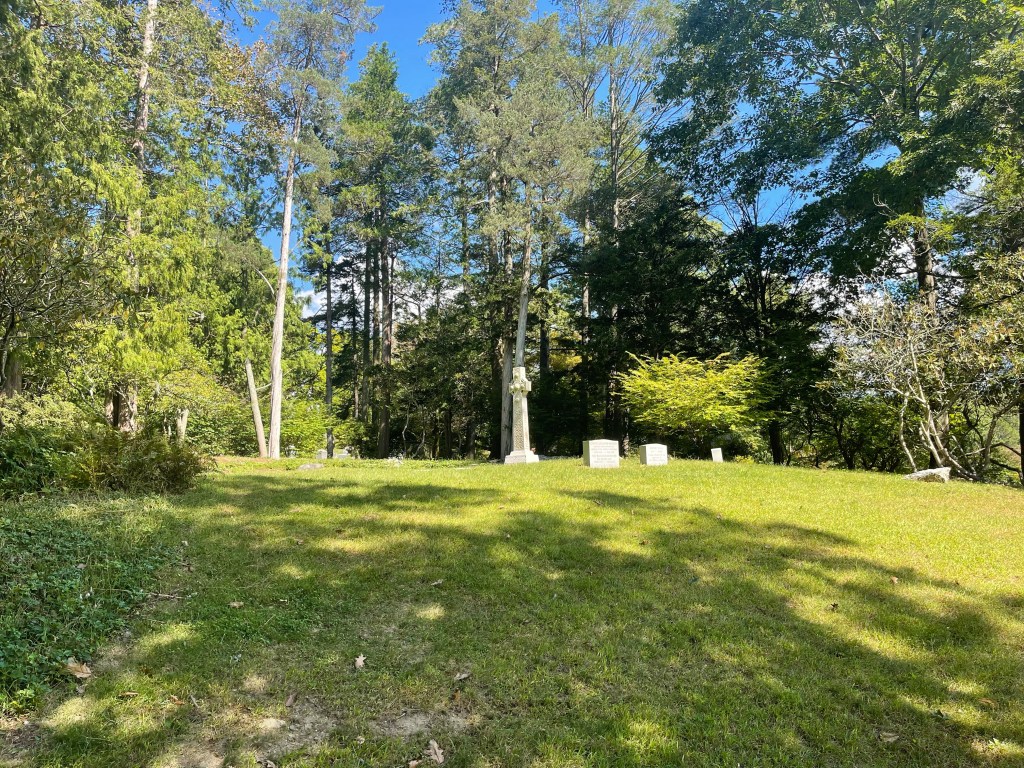
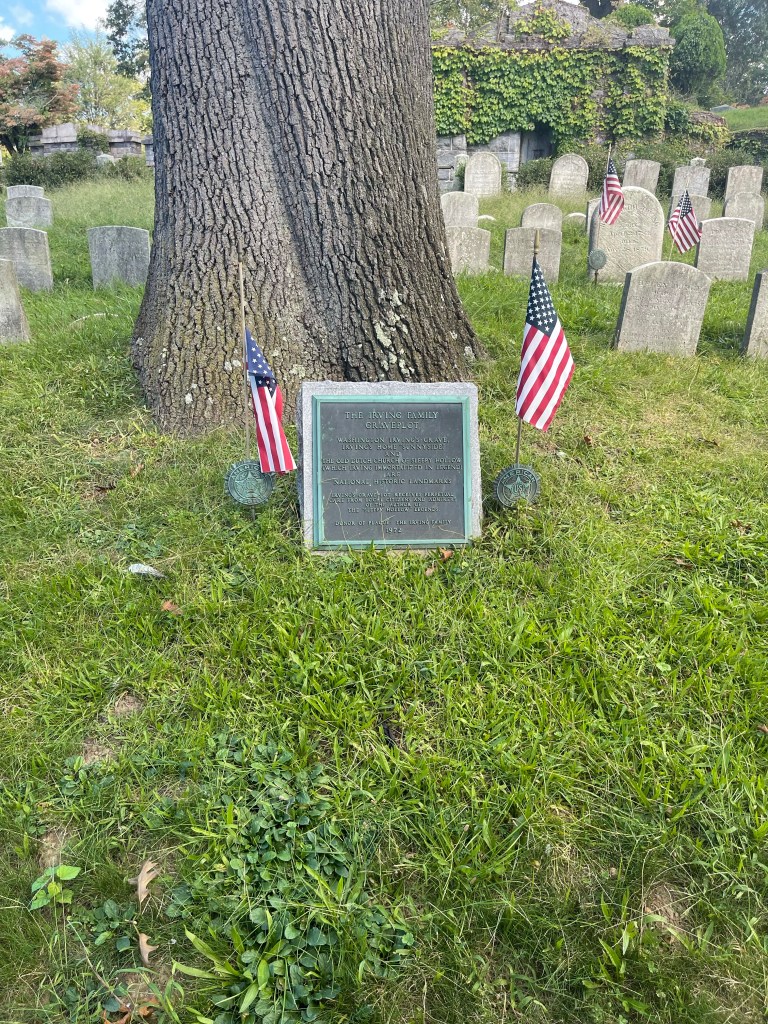
    It’s that tale of the headless horseman that inspires people to visit his grave at the Sleepy Hollow Cemetery. Irving is buried in the oldest section of the graveyard, with unpaved roads crisscrossing un-mowed plots with headstones protruding up in neat columns. That walk up the hill to visit his grave seemed perfect. Like walking back in time to visit those who came before us.

    I didn’t visit out of some ghoulish fascination with his short story, but for the whispers you hear at their resting place. Cemeteries generally hold the lay of the land as it was on the day they buried someone, and Irving’s resting place nestled amongst his family on a hill overlooking the Hudson River Valley seems a lovely place to spend eternity.

    Of course, Irving doesn’t need to whisper, for he wrote plenty for us to draw on. His stories will likely outlast every gravestone in Sleepy Hollow. Does that make him a legend?

  • More Than Just Names

    Sleeping beauty awakes from her dream
    With her lover’s kiss on her lips
    Your kiss was taken from me
    Now all I have is this
    – Bruce Springsteen, Countin’ On A Miracle

    Twenty years. I’m still here, just as I was that day, but everything has changed. What seemed important on the morning of September 11, 2001 disappeared from my mind when I heard Howard Stern, of all people, explaining what was happening at that moment in New York as I drove to a job that would be impossible to focus on for a long time afterwards.

    The world has changed since 9/11. We’ve all grown hardened by violence and war and angry rhetoric. It was our generation’s Pearl Harbor, and we were ready to lash out at all who would assault us so boldly. In so many ways we’re still lashing out, but much of it has turned inward. That unified country in the days after 9/11 is far from it now.

    We all felt the impact of that day, but nobody felt it more than the families and friends of those who died that day. Bruce Springsteen wrote the album The Rising shortly after 9/11. The lyrics quoted above resonate more for me than any other, representing all that was taken from so many that day. And it plays in my head now, twenty years after that day. As the bells ring in remembrance. And the names, so many names, are spoken one after another.

    During the Super Bowl in 2002, just months after 9/11, U2 performed as the halftime show. They sang MLK and Where The Streets Have No Name with a white banner scrolling the names of those lost on 9/11. I still can’t watch it without getting choked up, and I dismiss anyone who might venture to declare any other performance at a Super Bowl as more powerful or significant.

    These songs will always be my 9/11 soundtrack. They remind us that these were more than just names. They are lives interrupted.

  • The Force of Bitter Need

    First he chipped fire
    Out of the veins of flint where it was hidden;
    Then rivers felt his skiffs of the light alder;
    Then sailors counted up the stars and named them:
    Pleiades, Hyades, and the Pole Star;
    Then were discovered ways to take wild things.
    In snares, or hunt them with the circling pack;
    And how to whip a stream with casting nets,
    Or draw the deep-sea fisherman’s cordage up;
    And then the use of steel and the shrieking saw;
    Then various crafts. All things were overcome
    By labor and by force of bitter need.
    – Passages from Virgil’s First Georgic, translation by Robert Fitzgerald

    When you read something like this, what does it do to you? Most of us won’t ever experience the life or death struggles that our ancestors faced. Yet the force of bitter need echoes in how we live our lives today. As a student of history, it’s easy to treat the migration of humans across the globe as an academic exercise. To treat wars and conflict and the enslavement and genocide of large swaths of people as horrible footnotes in history. But the stories we tell ourselves that keep the world in order is all so very fragile.

    This translation of Virgil is breathtaking to me, because it reveals our shared history, our overcoming of things, to survive another day and maybe build off that to create a generation after us to keep things going. Our human story is one of deep struggle, pain and labor. Of surviving despite the deck stacked against us. May we never forget how all that we’ve overcome as humans has shaped us. And shapes us still.


  • The Voice of Justice and Consanguinity

    We, therefore, the Representatives of the united States of America, in General Congress, Assembled, appealing to the Supreme Judge of the world for the rectitude of our intentions, do, in the Name, and by Authority of the good People of these Colonies, solemnly publish and declare, That these United Colonies are, and of Right ought to be Free and Independent States; that they are Absolved from all Allegiance to the British Crown, and that all political connection between them and the State of Great Britain, is and ought to be totally dissolved; and that as Free and Independent States, they have full Power to levy War, conclude Peace, contract Alliances, establish Commerce, and to do all other Acts and Things which Independent States may of right do. And for the support of this Declaration, with a firm reliance on the protection of divine Providence, we mutually pledge to each other our Lives, our Fortunes and our sacred Honor. – Declaration of Independence, July 4, 1776

    There’s a sentence in the Declaration of Independence that grabs me, written before the lines above brings this document to its bold conclusion. It’s the accusation that the British have been deaf to the voice of justice and consanguinity, which is both accurate and ironic. For we are an imperfect country, and if the last five years taught us anything it’s this: justice and consanguinity (the belief that we’re all kin derived from the same blood) are stories that we tell ourselves when it works in our favor.

    I’m not here to beat up this country I love on her birthday. That would be unfair. We are an imperfect country, but we latched on to a bold idea that generally has steered us towards progress for the citizens of the United States, and maybe, in some ways, for the world. This idea, that all men are created equal, is still a work in progress. But it is progressing.

    That bold ask, freedom and independence, continues to this day. For the Declaration of Independence and the Constitution to follow were each intended to be a call for a higher standard. We are a country of laws and young traditions, based on a belief in justice and consanguinity. We’re a bit rough around the edges, we don’t always get it right, but we’re slowly progressing towards a more inclusive interpretation of that original vision.

  • Remembering New Hampshire’s Soldiers Lost at Bunker Hill

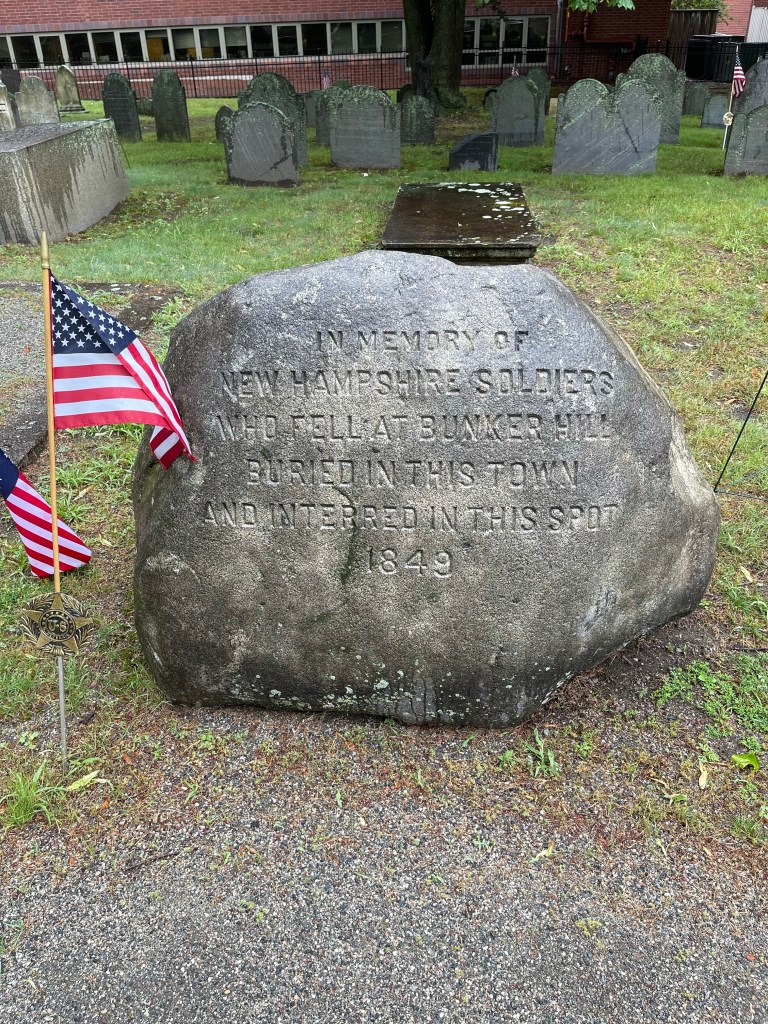
    The boulder quietly marks time amidst the everyday buzz of Medford Square, with cars circling the Burying Ground like planes preparing for a landing at nearby Logan Airport. It’s a nice touch, really, a nod to tough New Hampshire granite, honoring the men who left New Hampshire to fight in the Battle of Bunker Hill who never returned. They’re buried in Medford, and the engraved boulder placed here in 1849 honors their sacrifice.

    The Salem Street Burying Ground is a time capsule back to the earliest days of American history, surrounded on all sides by a perimeter of brick walls, roads and buildings. Medford is not what it was in 1775, but then, everything changed after Bunker Hill. Everything but the quietly stoic gravestones standing in rows around the boulder, like the soldiers themselves once lined up to battle men not much different from themselves. Enemies by fate and events bigger than themselves.

    New Hampshire sent its share of men to fight at Bunker Hill, most famously John Stark. If you look at the roster of soldiers from New Hampshire you see an extensive list from all parts of the state. By my count, 32 were killed on June 17, 1775 and two died from their wounds within a few days. No New Hampshire town paid a bigger price than Hollis, with 25% of the killed in action originating from this small community.

    Many of the British soldiers killed that day are entombed in the crypt at Old North Church in Boston. For the Americans killed that day, many are buried in small burial grounds throughout the area. This one in the heart of Medford, a little more than 4 miles from Breed’s and Bunker Hill, offers a small tribute to New Hampshire’s lost soldiers.

    I wonder about that final journey for these men. Did all of them make it to marked graves like the ones here, or were some buried in places now covered over by the relentless march of progress? For many, their final resting place, like many of their names, is lost to history.

    Honoring New Hampshire’s soldiers killed at the Battle of Bunker Hill
  • To Be Touched by Everything I’ve Found

    One obvious problem with long drives is that it eats into reading time. You can solve this with audio books, of course, but then what of podcasts? As a heavy consumer of both, what do you choose? And this is where time becomes our enemy.

    Long drives require epic podcast episodes, and there’s nothing more epic than Hardcore History with Dan Carlin. For the last year I’ve been saving long stretches of travel to complete Supernova of the East, which is like all of Carlin’s podcasts: devastating edge of your seat listening. You want a little perspective as you crawl along in traffic over the Tappan Zee Bridge? Listen to the details of the Battle of Okinawa as Carlin spins his magic.

    What do you do when you’ve finished a series like Supernova of the East and you need to step back into the better side of humanity? Music helps. Lately I’ve been mixing classic rock and what today is known as “Americana” music (personally, I just call it music). Specifically, diving into old Crosby, Stills, Nash & Young tunes and new Jason Isbell and the 400 Unit compilations. Looking for poetry set to music? You can’t go wrong with either. As a lover of words piled together just so, Isbell does to your brain cells what a complex Cabernet does to your taste buds.

    The best I can do
    Is to let myself trust that you know
    Who’ll be strong enough to carry your heart

    – Jason Isbell and the 400 Unit, Letting You Go

    When you get to a hotel room in some remote place and you’ve caught up on all those emails and administrative work, what next? Drink? Watch television? Or dive back into the books that have tapping you on the shoulder for attention? There’s a place for every form of entertainment, but in most of my travels the hotel television never gets turned on. But the Kindle app does.

    After some consistent prodding by a friend of mine, I’m finally finishing Sapiens by Yusef Noah Harari. I know, what took me so long? Honestly it just kept slipping down the pile as other books jumped ahead. Regrettable, but life is about tradeoffs. What we choose to dance with in our brief time makes all the difference in how we see the world. Now that I’ve almost wrapped it up, I see what all the fuss is about.

    “Even today, with all our advanced technologies, more than 90 per cent of the calories that feed humanity come from the handful of plants that our ancestors domesticated between 9500 and 3500 BC – wheat, rice, maize (called ‘corn’ in the US), potatoes, millet and barley. No noteworthy plant or animal has been domesticated in the last 2,000 years. If our minds are those of hunter-gatherers, our cuisine is that of ancient farmers.” – Yusef Noah Harari, Sapiens

    Speaking of that stack of books, I put aside a couple of other books to focus on completing Sapiens. One in particular, The Blind Watchmaker, is a heavier lift than Sapiens, but compliments it well. I’ve referenced it before in the blog, and look forward to moving it to the virtual “done” pile. Combined, these two books have shaken my perspective of the world and how we got here.

    “If you have a mental picture of X and you find it implausible that the human eye could have arisen directly from it, this simply means that you have chosen the wrong X.” – Richard Dawkins, The Blind Watchmaker

    Inevitably I need to sprinkle in page-turner fiction, poetry and sharp left turn material to shake off reality until I can catch my breath again. Journey to Ixtlan by Carlos Castaneda was a definite left turn for me, an interesting read that got me thinking about mysticism and craving more time in the desert Southwest.

    “You can do better. There is one simple thing wrong with you—you think you have plenty of time.” – Carlos Castaneda, Journey to Ixtlan

    The Sea in You: Twenty Poems of Requited and Unrequited Love by David Whyte is a lovely collection of poems by one of our living masters. Whyte stirs words together with the best of them and catches my imagination with his alchemy. I’ll surely spend more time with Whyte in this blog in the near future.

    “be weathered by what comes to you, like the way you
    too
    have travelled from so far away to be here, once
    reluctant
    and now as solid and as here and as willing
    to be touched as everything you have found.”
    – David Whyte, The Sea in You: Twenty Poems of Requited and Unrequited Love

    We collect bits of wisdom and memorable nuggets in our consumption. Does this make us better conversationalists or a faster draw on Jeopardy? Most likely, but there’s something more to it than that. To revisit the old cliche, we are the average of the five people we spend the most time with. What we consume either amplifies our biases or challenges them. I choose to be challenged, and find myself slowly stretching and building a better mind, with greater perspective, through what I listen to, watch and read.

    In short, to be touched by everything I’ve found.
  • Myths and Pretty Stories

    “Like the elite of ancient Egypt, most people in most cultures dedicate their lives to building pyramids. Only the names, shapes and sizes of these pyramids change from one culture to the other. They may take the form, for example, of a suburban cottage with a swimming pool and an evergreen lawn, or a gleaming penthouse with an enviable view. Few question the myths that cause us to desire the pyramid in the first place.” – Yuval Noah Harari, Sapiens: A Brief History of Humankind

    We all build pretty stories, latch on to myths that align us with a currency, political party, and what we chase in our short time on earth. Since I reached “responsible” adulthood I’ve been servant to my pyramid in New Hampshire, my second pyramid, thank you. I’ve done my part to keep both the economy and humankind going by getting married and having two children, a boy and a girl, to keep the party going after I someday check out.

    Sapiens challenges long-standing assumptions we have about our place in the world: how we got here, what we believe, what we’ve destroyed in the process of getting here and what is being destroyed now as a result of the myths and pretty stories we collectively tell ourselves. And that’s the part that I’ve been thinking about lately. We’ve all seen what collective belief in a myth can do on September 11, 2001 and on January 6, 2021. There’s a very dark side of humanity that emerges when subscribing to certain myths. And there’s a swell of resistance that rises up when confronted with myths that don’t fit our own view of the world.

    It may come as no surprise to any reader of this blog that I’m a romanticist, chasing experiences in this short life. And yet like many of my fellow romanticists I’ve also built a pyramid. And keep adding smaller pyramids around it to make this life more… comfortable? Luxurious? Sure. But every myth has a price, and to function in this society your story needs to align with the larger story of paying mortgages and car payments and working to fund it all.

    We humans are complicated, aren’t we? Life is about the pretty stories we tell ourselves. About where we are and where we’re going. We all tell ourselves and others these stories. I tell myself that I’m chasing washboard abs, but still managed to have a third taco last night. Now I’m planning a long walk and yard work to make up for the three tacos. Washboard abs are just another pretty story I tell myself if I don’t align my habits with the larger goal.

    As an American I grew up believing certain things about our Rights as citizens. We buy into the belief that all men and women are created equal. Over time you learn this is a myth, we aren’t at all equal. Some are dealt tougher hands than others. Some drink the Kool-Aid of scarcity and fear and react to that with aggression and hate. In sharp contrast, may of us subscribe to something bigger. A belief in each other and a better future.

    “Well, big wheels roll through fields where sunlight streams
    Oh, meet me in a land of hope and dreams”
    – Bruce Springsteen, Land of Hope and Dreams

    Inevitably there’s friction and chafing when one person’s myths run into another’s opposing myths. We live in a dangerous time, and a lot depends on how the pendulum swings during our watch. Like Springsteen I’m an eternal optimist, but recognize that’s just the way we frame our pretty stories. Like washboard abs and too many tacos, sometimes pretty stories and reality don’t align and you’ve got to recognize that and commit to changing the story.

    We all have to work for the pyramids we are building towards the sky. It’s fair to question whether we’re building the right pyramid in the first place. Isn’t it?

  • Leaving Long Shadows

    “Time flies over us, but leaves its shadow behind.” – Nathaniel Hawthorne

    The march through time continues. What will the shadow that we cast behind our lives look like? I’m reading through a couple of weighty tomes that run through evolution. Don’t know why the stars aligned in such a way that I’m diving deep into evolution at this particular moment, but here we are.

    Maybe it was the subject matter but I absently sketched a dinosaur on a notepad and thought about these giants who came and went millions of years ago. Millions. So what is a hundred years or so for us? Not a whole lot.

    Or maybe it’s enough, if you use it well.

    The point is, we’re all leaving shadows behind us. What will our shadows be? Long and notable or brief and forgettable? In some ways it doesn’t matter when you look at life through the lens of millions of years. But then again, doesn’t it all matter in the end?

    This planet has been spinning around in the universe for billions of years. Dinosaurs roamed millions of years ago. These are big numbers. But this? This is our time. Shouldn’t we make the most of it, and leave the longest shadow we can? I should think so.

    Time Flies
  • The Muse

    There’s a ghost in my head. A story that won’t go away. Compelling and screaming to be written. The boy in the story died over 300 years ago, and he didn’t live much of a life at all. A life of lost freedom and sadness. But his story is screaming out for someone to tell the world about him.

    So the muse taps my shoulder, asking when I’m going to get around to it. Threatening to leave me and take the boy elsewhere. And I feel the guilt of ignoring the call of the dead boy for the obligations of the living. Your story must be told… but not just yet. And the muse grows restless.

    I suppose I could just write about him in the blog. It would serve to tell his story. But I’ve held on to his life as the kernel of a novel that could grow around him. It seems selfish when I write that, holding a ghost boy hostage while I procrastinate on writing his story. Yet here we are.

    The confession serves as a concession to the muse. I’ll get to the boy, one of these days. I’ll write his story as best I can. This year? Yes, absolutely. This year. Just after I finish these other things…

    And the muse grows more restless.

  • The Naming of Cape Cod

    “On the 26th of March, 1602, old style. Captain Bartholomew Gosnold set sail from Falmouth, England, for the North part of Virginia, in a small bark called the Concord… The 15th day,’ writes Gabriel Archer, ‘we had again sight of the land, which made ahead, being as we thought an island, by reason of a large sound that appeared westward between it and the main, for coming to the west end thereof, we did perceive a large opening, we called it Shoal Hope. Near this cape we came to anchor in fifteen fathoms, where we took great store of cod-fish, for which we altered the name and called it Cape Cod.’” – Henry David Thoreau, Cape Cod

    A bit of trivia lost in history is where Cape Cod originally got its name. A lot of people, including Thoreau, point to Gabriel Archer. Archer wrote the entry Thoreau quotes above in 1602. He’d then go on to supposedly name Martha’s Vineyard after his daughter when an abundance of grapes were found there.

    Of course, without the Cod, it might have been named something else. Four hundred years of fishing decimated the Cod population, leading to sharp restrictions on fishing. Pressure from commercial fishing lobbies to raise limits on Cod run counter to the goal of full restoration of the biomass. And then you’ve got those seal population increases. The slow restoration of the Cod population is ongoing, but like so many endangered species it hangs by a thread.

    Archer traded with the local Wampanoag Tribe at what is now Cuttyhunk. He returned to England that same year but would return again in 1607. Archer would butt heads with John Smith in Jamestown and would ultimately die there within a few years. His journal was published after his death and the names Cape Cod and Martha’s Vineyard were sticky enough to live on well after him. More than his own name, it seems. Life is funny that way.