Category: History

  • From Asquamchumauke to Baker: What’s in a Name?

    The Baker River flows from Mount Moosilauke to the Pemigewasset River in present day Plymouth, New Hampshire. On the map the name is cut and dried: Baker. But when you cross the river at the Gorge Brook Trailhead another name emerges from the past: Asquamchumauke. History once again whispering for all who might hear.
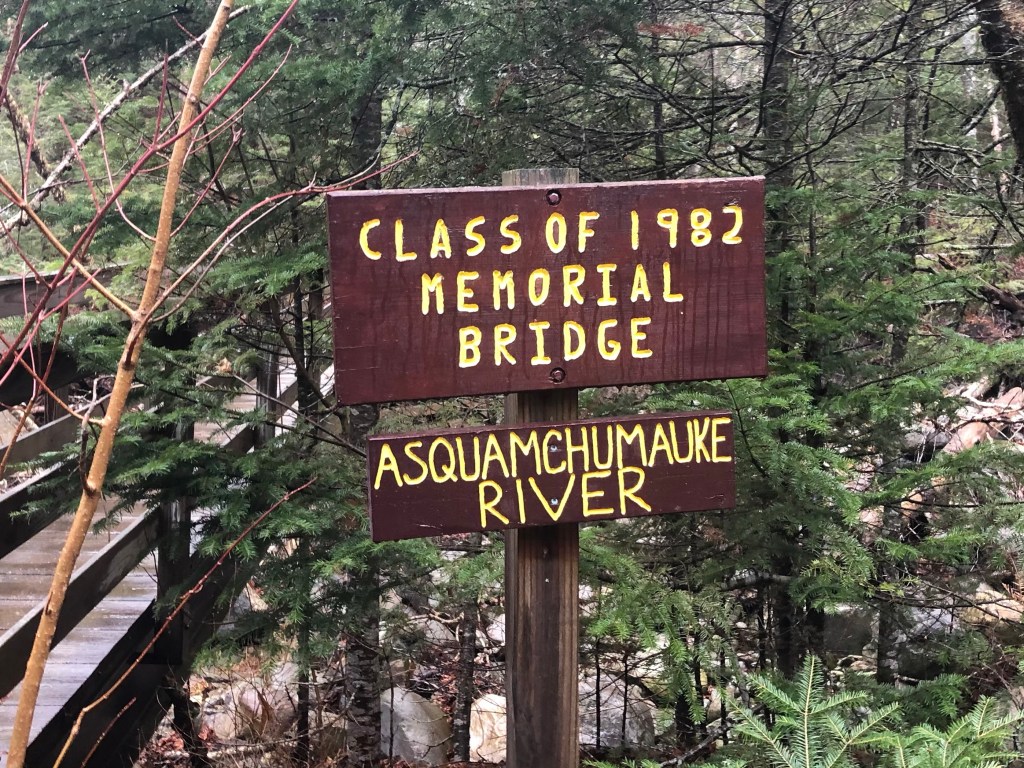
    Dartmouth College honoring the original name

    Asquamchumauke means “crooked water from high places” in the language of the Abenaki tribes that once thrived here. It’s a lovely, descriptive name that brings romantic notions of Native Americans living in this place for generations. Yet we’ve called it Baker since well before the American Revolution. The story behind the name change is another fascinating chapter in the violent history of New Hampshire.

    Thomas Baker was a soldier in Deerfield, Massachusetts on February 29, 1704 when the Deerfield Raid occurred. Deerfield was a seminal event in Queen Anne’s War and New England history. French and Native American warriors overran the fortified settlement, 47 settlers were killed and 112 captives, including Baker, were marched up to Montreal. The Native American warriors came from around the northeast, including several tribes of the Wabenaki Confederacy. One of them was a Pennacook sachem named Wattanumman.

    Whether Baker and Wattanumman met during the fighting or forced march to Montreal is unclear, but events would bring them together again eight years later. Thomas Baker led an expedition north with around 30 men and ambushed Wattanumman, a dozen of his men and their families at the site in present-day Plymouth where the Asquamchumauke River meets the Pemigewasset River. Wattanumman and several others were killed and scalped. The men collected furs and anything of value and brought it all down to Massachusetts where Baker was rewarded for his efforts with £40.

    And this is where present-day morality meets the violent frontier morality of New England in the earliest days of our history. Both men participated in violent raids against the other in a time of war. But for fate Baker might have been killed in Deerfield, which may have extended Wattanumman’s life a few more years. Who knows? All of us are subject to the whims of fate.

    There was one other reward for Thomas. To honor what Baker and his men did in this place the name of the river was changed from Asquamchumauke to Baker, a name it still has today. With one event the life of Wattanumman was erased, and the legacy of Baker was sealed. We Americans tend to honor people with place names, while the Native Americans honored the spirit of the place itself. Asquamchumauke: crooked water from high places.

    Has a nice ring to it.
  • Norumbega

    “Not on Penobscot’s wooded bank the spires
    Of the sought City rose, nor yet beside
    The winding Charles, nor where the daily tide
    Of Naumkeag’s haven rises and retires,
    The vision tarried; but somewhere we knew 5
    The beautiful gates must open to our quest,
    Somewhere that marvellous City of the West
    Would lift its towers and palace domes in view,
    And, lo! at last its mystery is made known—
    Its only dwellers maidens fair and young, 10
    Its Princess such as England’s Laureate sung;
    And safe from capture, save by love alone,
    It lends its beauty to the lake’s green shore,
    And Norumbega is a myth no more.”
    – John Greenleaf Whittier, Norumbega Hall

    Norumbega; the mythical city of gold in the northeast corner of North America. The name most people today have never heard of. But you see hints of it to this day if you look around enough. around the Wellesley and Newton, Massachusetts area. This poem above was from the dedication of the huge building that was College Hall at Wellesley College, which say on Norumbega Hill until it burned down in 1914. There never was a city of gold in the northeast, but the legend lives on anyway.

    The name became associated with this place we now call New England, but this place could easily still be Norumbega if the French had been more successful in their first interactions with the Native American population living in New England at the time. But the French Commander Jean de Poutrincourt was afraid of the Native Americans, and they in turn deeply distrusted him. Conflict and a hasty retreat north of the Penobscot River, and an opportunity lost. Instead they left an opening for the English. In 1620 Pilgrims arrived, found the local population decimated by disease likely from interactions with other Europeans, and settled into our familiar narrative about New England.

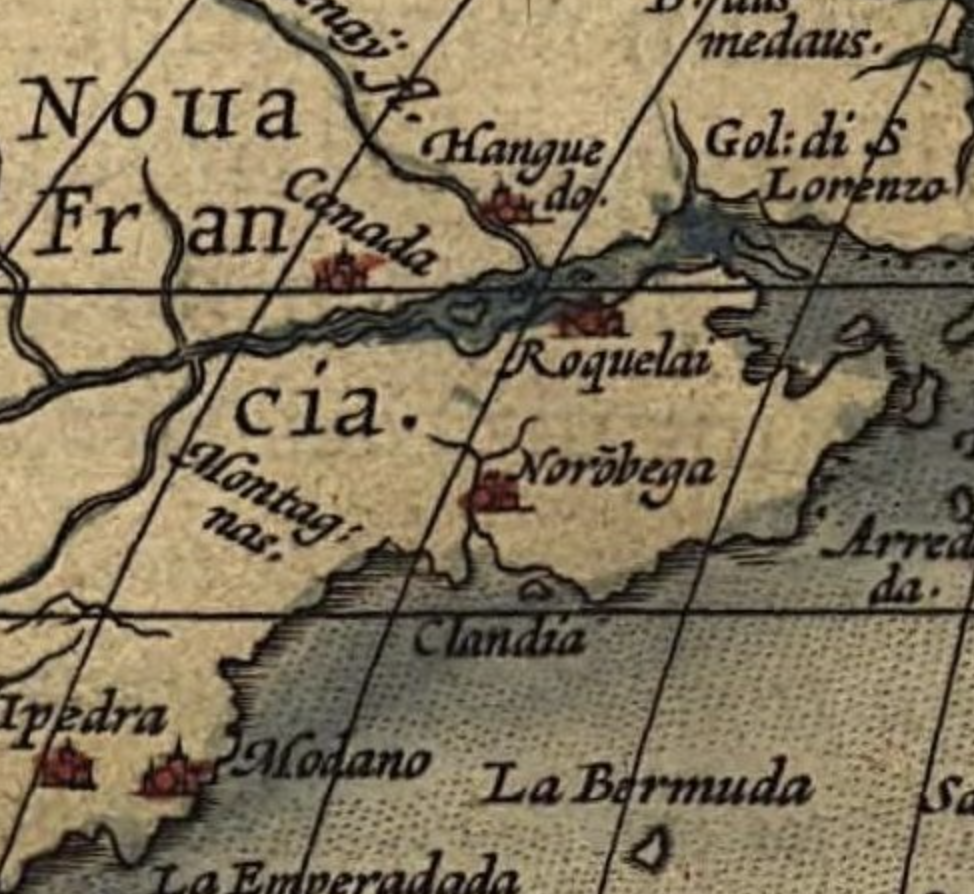
    The name preceded the French. Norumbega appeared on maps by a couple of Dutch cartographers, who situated this lost city of gold south of New France but north of Florida. Maps weren’t especially detailed back in the 1500’s. Abraham Ortelius published his famous Typus Orbis Terrarum in 1570, which shows far greater detail in the areas Spain had conquered than in the northern half of the Americas. But there’s Norumbega, tantalizingly real on a map, ready for the taking by some enterprising conquering nation (the Native American population apparently not a strong consideration).

    Norumbega, depicted in the 1570 Ortelius Map

    Cornelielius van Wetfliet seemingly had Norumbega situated where present-day Washington, DC in his 1597 atlas that, at the time, was the most detailed map of the northeastern coast of North America. But Norumbega was generally accepted to be far north of the Potomac, perhaps the Hudson River but most say it was either the Charles River or the Penobscot River. When you don’t really know the lay of the land you mush it all together into a general blob. Such were the early maps of North America.

    So, since the mythical city of gold in the northeast never really existed, Norumbega became the general place name for New England for a time. That time ended when the English put a stake in the ground at Plymouth Colony in Massachusetts and the eventual settlement of what would be called New England. By the time my old friend Alexander’s map was published in 1624 the place was firmly established as New England, and Norumbega faded into history like the people who lived and explored this place long before the Mayflower set sail. But pull back the covers of history and there it is: mythical, elusive, fascinating. Norumbega is a myth no more

  • November and the Ninth Wave

    “November retained its name (from the Latin novem meaning “nine”) when January and February were added to the Roman calendar.” – Wikipedia

    And there it is: November. I’ve wondered about October before. I mean, “octo” is eight yet October was the tenth month. I hadn’t thought much about the origin of November until I stared at the November 1 on my calendar a beat longer than normal. And so here we are, with “novem” forever associated with nine for me. (novem ≠ 11, novem = 9, but November is the 11th month so deal with it. Don’t even get me started on December). We learn through association. Those Romans forever shaped the minutia of our world…

    November has always had a special place in my heart, for in the Northern Hemisphere its the month of quiet walks on crunchy fallen leaves, when the world opens up to reveal all that was hidden previously by foliage. In the United States November is associated with Thanksgiving, the very best of holidays (at least in my family) because it’s only about giving thanks together with family and friends. There are November birthdays of note in the family, and personally, one very notable anniversary coming up in a few days to punctuate the importance of the month in this household.

    And then there’s the election. Every four years in the United States we have the national election to choose our President. The “first Tuesday after the first Monday” of November was chosen and made into law in 1845 “to establish a uniform time for holding elections for electors of President and Vice President in all the States of the Union.” So Election Day can never be held on November 1, since it must follow the first Monday (unless the law is changed of course).

    This year has been relentlessly charging along, both rapid in the spinning of days and painfully slow in getting it all over with. Nobody who loves life wishes away time, but we all wish away the current situation we find ourselves in. November marks the moment when we vote and either validate the current administration or reject it wholeheartedly and install new leadership. I know where my vote goes. Choose wisely with your own vote, fellow citizens.

    In sailing the ninth wave in succession is the largest. It’s the one that might sink the ship and drown the crew. I reflect back on the stunning masterpiece Ninth Wave by Ivan Aivazovsky that I was blessed to see once in my lifetime. The Ninth Wave offers a glimmer of hope for those clinging to the mast in a raging sea. The sun is rising through the storm, marking a turning point of sorts. Danger remains all around and there’s no guarantee of survival, but again, there’s hope. And that’s what I think about on this first day of November. November (novem), marks the turning of the seasons towards winter. Change is coming. We all know it, and now we all face it. With hope.

  • Calm

    “Real power is not in momentary desires, but in complete calmness.” – Leo Tolstoy

    I have a bit of nervous energy as I write this. I’m traveling tomorrow for the first time in seven months and there’s a vibrating exhilaration deep inside knowing that I’m getting on a plane again, going to another state and driving around to places new to me. Mind you, its not like I’m flying to Antarctica for an extended climate change study, I’m going to Cleveland. I’ve been to Cleveland at least a half dozen times that I can recall and maybe a time or two beyond that. But it’s travel in a time of no travel, and this year that alone creates a buzz.

    I got the same vibration hiking solo up Mount Tecumseh earlier this summer. Not because it was a particularly challenging hike, but because I was hiking it alone late in the day. Just enough risk to raise the level of uncertainty, but calculated risk. Hiking alone at night inherently offers risk to the hiker. You just don’t have people walking by you to offer assistance. So you take extra care or alternatively, you charge ahead brazenly challenging fate.

    Calmness in the face of potential stressors is a superpower. In an age of talking heads stirring the pot of anxiety for advantage, of a pandemic ramping up for killing season, of a time when we teeter on the brink of a deeper recession or a depression and irreversible climate change should we get this wrong, in this time the calm prevail. We can take the bait and react, or swim calmly in the present storm.

    “Do not be concerned too much with what will happen. Everything that happens will be good and useful for you.” – Epictetus

    The posters used early on during the Blitz, “Keep Calm and Carry On” naturally come to mind. Those posters weren’t successful at the time as people viewed them as patronizing, but the expression has exploded in popularity in the last twenty years. Whether you view it as patronizing or nostalgic now, the expression does carry weight as a stoic reminder to keep your head about you. For in calmness we find clarity.

    During that time when the British were facing down Nazi aggression, Viktor Frankl was living a nightmare in a succession of Nazi prison camps, ending at Auschwitz before finally being freed at the end of the war. He observed that state of mind had a lot to do with who survived and who didn’t as much as the whim of fate. Some people were in the wrong place at the wrong time, but others just gave up in the face of hopelessness and horror. Some people survived simply because they had a purpose for living. Based on this experience, he wrote the extraordinary book Man’s Search for Meaning after the war.

    “Everything can be taken from a man but one thing: the last of the human freedoms – to choose one’s attitude in any given set of circumstances, to choose one’s own way.”
    – Viktor Frankl, Man’s Search for Meaning

    Today we live in a time when everything is hyper-scrutinized, everything is a perceived affront, everything is designed to invoke a spark of fear or outrage. But when we swim in our sea of calmness, we overcome the efforts of those who would inspire a follow or a like or another cycle of commercials before they tell you the rest of the story. A calm mind sees the truth in the world and in ourselves. It remains the best foundation for a life of purpose and happiness. Want to improve the state of world? Be calm. And yes; carry on.

  • The Work of Exploration

    “Filling the mind with illusions is not the way to carry out with honor the work of exploration.”
    – Samuel Champlain

    Champlain was a stickler for careful preparation and research. He wasn’t one to half-ass anything he did, especially when it came to sailing across an ocean to uncharted places. He learned from the failures of others, noting failures in leadership, failures in preparation, failures in aligning political alliances to have your back when you were away, and failures in the treatment of the Native American population. And he was disciplined in his resolve to be successful in his own exploration.

    When I think about Samuel Champlain, I think about the guy who famously explored the North American coast and more than anyone helped stake a flag of settlement for France. In New England we live in a culture that rightfully celebrates the arrival of the Pilgrims in America 400 years ago, surely a major turning point for the English settlement of North America, but let’s not forget those who came well before the Pilgrims. If the settlement of Plymouth was a comedy of errors and bad preparation, Champlain’s plan for exploration and settlement was meticulous.

    Champlain found a way to be an invited guest of the Spanish on a trip to their own empire, surveying and documenting the atrocities of the Spanish conquerers with the native population and with African slaves for gold, silver and pearls. He resolved to never duplicate the things he saw, and treated men with respect and honor in his own exploration. And he learned from the brutal religious wars of France between Catholics and Protestants as well, resolving to bring religious tolerance to his own settlement. Champlain wasn’t just ahead of his time, he was helping to pave the way to our time.

    I’ll return to Champlain again in future blogs, but for now I’m lingering on the quote that opens this post. A warning to not half-ass our own exploration. To be prepared and do the work necessary to put yourself in a position to not just survive, but thrive. This is true whether you’re starting a business, changing your career, working to finish a project before a deadline or planning that long hike. Filling the mind with illusions is not the way to carry out with honor the work of exploration. Be prepared, as the Marines would tell you. But don’t just prepare and dream of exploration either. Do the work of exploration too.

  • This is Not Us

    Watching the United States Presidential debate last night, I was struck by just how far over the edge we’ve fallen from “Presidential”. I’ve known this, as you have, but it was hammered home like an iron spike to the skull last night. And so I woke seeking inspiration from better men (so far) who have held the Presidency. And their words remind me we’re bigger than one man, but that we must rise up to remind ourselves and the current resident of the White House of that fact. This thing we saw last night? It’s a part of us, but on the whole the people of this country are good people who want to rise above the worst traits of humanity. Perhaps former Presidents might remind the current one that this is not who we are. This is not us. But then again, I suppose he won’t listen.

    “The basis of our political system is the right of the people to make and to alter their constitutions of government.” – George Washington

    “This country, with its institutions, belongs to the people who inhabit it. Whenever they shall grow weary of the existing government, they can exercise their constitutional right of amending it, or exercise their revolutionary right to overthrow it.” – Abraham Lincoln

    “The things that will destroy America are prosperity-at-any-price, peace-at-any-price, safety-first instead of duty-first, the love of soft living, and the get-rich-quick theory of life.” – Theodore Roosevelt

    “Many people are always saying the Presidency is too big a job for any one man. When I hear this assertion, I always try to point out that a single man must make the final decisions that affect the whole, but that proper organization brings to him only the questions and problems on which his decisions are needed. His own job is to be mentally prepared to make those decisions and then to be supported by an organization that will make sure they are carried out.” – Dwight D Eisenhower

    “No government ought to be without censors; and where the press is free no one ever will.” – Thomas Jefferson

    “Let us not seek the Republican answer or the Democratic answer, but the right answer. Let us not seek to fix the blame for the past. Let us accept our own responsibility for the future.” – John F Kennedy

    “John F. Kennedy was the victim of the hate that was a part of our country. It is a disease that occupies the minds of the few but brings danger to the many.” – Lyndon B Johnson

    “Government is instituted for the common good; for the protection, safety, prosperity, and happiness of the people; and not for profit, honor, or private interest of any one man, family, or class of men; therefore, the people alone have an incontestable, unalienable, and indefeasible right to institute government; and to reform, alter, or totally change the same, when their protection, safety, prosperity, and happiness require it.” – John Adams

  • Mount Desert Island

    “Le sommet de la plus part d’icelles est desgarny d’arbres parceque ce ne sont que roches. Je l’ay nommee l’isle des Monts-deserts.” – Samuel de Champlain
    (Translated into English: “The top of most of them is bare with trees because they are only rocks. I named it the island of Monts-deserts.”)

    French Explorer Samuel de Champlain sailed up the Gulf of Maine in 1604 and observed the granite mountain summits on the island before him. He named it “Ile de Monts Deserts,” or “island of the bare mountains”. Through all the turf wars between the French and the English the place names haven’t always been consistent, but this one has. The map below was from the British atlas The Atlantic Neptune in 1800 that shows the name clearly, along with other place names commonly accepted. And thus the island became known by a name we’ve called it forever since; Mount Desert Island. The pronunciation of “desert” itself leans towards the French… as it should.

    While exploring this island topped with pink granite peaks, Champlain hit a ledge off of Otter Cliff and had to take the time necessary to repair the hull. With the aid of a couple of Abenaki guides he explored some of the island, most likely around the Otter Creek area, but I wonder how far he explored while he was there. He and his guides would surely recognize large parts of the island today, but would be stunned by the crowds. A large part of the island and surrounding islands and land became part of Acadia National Park (from 1919 to 1929 it was known as Lafayette National Park, but changed to reflect the original French colony) and forever preserved for generations to see what Champlain saw in 1604. It would be the only time he set foot on Mount Desert Island, but his mark on history remains to this day.

  • Free From All Licentious Reflections, Insolence, and Abuse

    “As our present political state affords Matter for a variety of Thoughts, of peculiar importance to the good people of New England we purpose to insert every thing of that Nature that may be pertinently and decently wrote. For ourselves, we declare that we are of no Party, neither shall we promote the narrow and Private designs of any such. We are ourselves free, and our Paper shall be free—free as the Constitution we enjoy—free to Truth, good Manners, and good Sense, and at the same time free from all licentious Reflections, Insolence, and Abuse … to state and defend the Rights and Liberties of Mankind.” – From the Independent Advertiser, on January 4, 1748.

    Samuel Adams was 26 years old in 1748; a Harvard College graduate working in his father’s malthouse (or brewery if you believe the marketing) and trying to figure out his place in the world. That year he would take a big step towards that goal with the publication of his newspaper, the Independent Advertiser. Heavily influenced by the writings and philosophy of John Locke, he would in turn influence countless people himself. He would write most of the content in the Independent Advisor for the next 27 years until the British would shut it down in 1775. Too late for the Mother Country, for the damage was already done.

    Samuel Adams was 41 when the French and Indian War ended, leaving Great Britain in debt and looking for a way to relieve that debt. They chose taxation of the colonists who had already suffered the weight of the war with the French and Native American population. This would prove too much, and the Independent Advertiser became decidedly less neutral. Adams, as the primary writer of the newspaper, became a thought leader and the Father of American Independence. The period between the end of the French and Indian War and the beginning of the Revolutionary War cemented Adam’s place in history.

    Nowadays its trendy in some orange circles to bash the media as fake. There’s no doubt that there’s plenty of fake media out there, but there’s also plenty of real news that politicians and profiteers would sweep under the “fake news” rug. The problem is knowing what, and who, to trust. And now there have never been more misinformed content writers, promoters of conspiracy theories, and the mad ramblings of direct sources on Twitter to fuel the chaos. These are strange, dark times.

    Adams was considered a radical until enough people saw things the same way. It makes you wonder, what is considered radical today that will gain enough momentum to be commonly-accepted truth down the road? There’s plenty to choose from in the last few years leading up to this penultimate 2020. Who is rising up to state and defend the Rights and Liberties of Mankind? Plenty of people are. The question is, who will shake themselves free of the noise to listen? And if 2020 is indeed penultimate, what is the next chapter?

    The concept of civilized discourse in politics has eroded over the last few years. That mirrors society as a whole, at least on social media and on the front lines of ideological debate. As a reader of history I know it wasn’t all that much different in Sam Adam’s time. We just have more advanced technology to amplify the licentious reflections, insolence and abuse. At what point does that technology start amplifying the truth, good manners and good sense instead? As it was when Samuel Adams was building his future, it will be when enough people start seeing things the same way. And demanding a higher standard.

  • In Search of a Border Marker

    In 1622 Captain John Mason was granted the land between the Kennebec River and the Merrimack River and the territory was named New Hampshire. The border with Massachusetts wasn’t the middle of the river, but a distance three miles north of the river’s shore. This made for an interesting, zig-zagging border that meanders along as the Merrimack River has from long before settlement by the English. That’s 398 years of continuous service as the official border between two similar yet completely different states. Barring wholesale changes in the borders that virtual sharp point should remain forever.

    Today, instead of eating lunch like a normal person I drove over to find the sharpest point on the border between Massachusetts and New Hampshire at a spot that on a map looked to be accessible in two directions. Using Google I zoomed in on the satellite image and decided the easiest possible way to get to this point was to walk the maintenance “road” that ran under the power lines adjacent to Route 213 in Methuen, Massachusetts. This worked out well until I reached the place where I needed to head north to the border point and scanned a swampy mess overgrown with cattails and impenetrable brush. This hike turned into a dead end but a good education on the lay of the land.

    Next option was to drive to the town transfer station, which was the next closest public land, to see if I could get to the woods that the border ran through that way. I had a great conversation with the woman weighing trucks in at the entrance, and she was politely curious about the quest that I was on, but received a no-go from the decision-makers on the other end of the radio. Not to be on this day. And that leaves me two options. Find another way in, potentially across private land, or to simply wait for the heart of winter when the ground is frozen solid to attempt the power line route again. I suppose there’s a third option of just dropping this pursuit of a border marker that may not even be there, but tell me, what’s the fun in that?

  • Over and Over

    “To do the same thing over and over again is not only boredom: it is to be controlled by rather than to control what you do.” – Heraclitus

    Heraclitus seems to be trending on the blog, coming up a couple of times in the last 24 hours of writing. Purely coincidence, but then again maybe there’s something in the September air. The days grow shorter, the air cooler, and the last of the harvest has begun. And yet we’re still in a pandemic, just as we were in the heat of summer and the early spring days when it all seemed uncertain. And many of us are still working from home day-by-day, chipping away at our jobs in the new normal, never quite feeling that way. My daughter began her senior year of college in the basement where she used to play with legos and costumes. I know she’d rather be amongst her peers on campus, and want it for her.

    Reading about the Battle of Britain in Erik Larson’s book helps me appreciate the relative ease with which we live through a global crisis compared to our grandparents and great-grandparents. We’re asked to work from home and wear a mask to avoid getting sick? Perhaps a moment of inconvenience in “living your best life”? Think about the souls being bombed from above night-after-night, wondering if this was the bombing that launched the expected German invasion. Looking at the full moon not in wonder but with dread for the illumination it offered to the enemy. No, wearing a mask doesn’t seem all that controversial in the big scheme of things.

    “History never repeats itself, but it rhymes.” – Mark Twain

    The funny thing about reading about fascists is seeing traits inherent in some world leaders of today. Critical errors made because of a character flaw changed the course of history then, and do so today as well. We just haven’t lived that history yet. But you can see the ripples that are building into waves in extremism and with climate change. Will we check the progress of the ripples or let them build into waves that wash over all of us? Appeasement didn’t work out well for Europe in the 1930’s. What are we tolerating now that will come back to bite us if unchecked?

    I suppose I should stick with the original themes of this blog, but seeing the same things over and over again gets frustrating. Sometimes you need to raise your voice and lend a hand to advance what is right. There will be moments of enlightened observation to come, but it ought to be balanced with a willingness to stand up and be counted. We can’t let the chorus of the ignorant drown out the voices of the informed. If that sounds like arrogance and elitism, well, let’s talk through our differences. There isn’t as large a gap as some might lead you to believe.