Category: History

  • Determining the Age of a Tree

    I’ve been wondering about the age of a large white oak tree guarding the edge of the forest for years. Not enough to actually do something about it, mind you, but wondering nonetheless. Then a hike with old growth trees last Sunday triggered a burning curiosity in me about the age of the trees we hiked amongst, and by extension, the age of the trees in my own backyard. I found myself having to know.

    There’s an easy way to gauge the age of a tree: you count the rings. The problem with that method is you’re really measuring the age of death of the tree. I prefer to keep them around, especially when they’re my elders. But rest assured, there’s another method for estimating the age of a tree, and that’s doing some basic math and adding a bit of educated guessing. All of this is searchable online, of course, but I found the instructions from Purdue University to be particularly helpful.

    Step one is to measure the DBH of the tree. What’s this? Another acronym in a world of acronyms? Sorry! But this one is easy to remember. DBH stands for Diameter at Breast Height. Take a flexible tape out to your tree of interest, measure 4 1/2 feet up from the base of the tree and there’s your DBH. Now anchor the end of the tape measure (or have someone hold it) and walk around the tree back to your starting point. This is the circumference of the tree. Convert this to total inches. In the case of my stately white oak, it measures 92 inches in circumference.

    The next step is to determine the diameter of the tree, which simply means dividing the circumference by 3.14. For the white oak, this was 29.29. So far, so good. And now we rely on something called the growth factor to figure out the rest. This is where science meets estimation. For a tree on the edge of the forest in optimal growing conditions, the growth factor is pretty straightforward. For a tree on a sidewalk in downtown Boston or near the summit of Mount Jackson in New Hampshire, well, that tree’s growth factor is going to be pretty compromised by the stress of everyday living. You’ll need to factor that in to the equation at some point.

    Back in my backyard, our white oak is happy as a tree can possibly be in this crazy world. The growth factor for a white oak in this happy situation is 5. You multiply the diameter by the growth factor and my favorite white oak tree turns out to be around 146 years old! And those old growth trees I saw hiking? They’re roughly 300 years old, which is about how long a healthy white oak typically lives. I hope they beat the odds with that good clean living.

    So around 1875 when the fields were no longer being farmed or grazed in this patch of Southern New Hampshire land an acorn sprouted and grew in the sun. It witnessed the forest grow around it, protecting it from the worst of the winds and the whims of humans looking for firewood and lumber. And then I became its neighbor and guardian at age 124. And we became fast friends.

  • Finding the Magic Behind the Ice

    There’s something uniquely foreign about the experience, akin to visiting an ice palace in a fantasy movie. Humans aren’t supposed to be in such places. At least that’s what we tell ourselves when we look at a waterfall from the front. And when it’s frozen in winter? Well, there’s something chillingly locked away in… there.

    Now, in case you’re wondering, this isn’t the first time I’ve been behind a waterfall. Like countless thousands, I’ve walked behind Niagara Falls and for the price of admission seen the roaring waters dropping away from the safety of a dim, well-engineered if soulless tunnel. Interesting, to be sure. But not magical.

    It’s clearly the ice. It forms a wall over the falls that announces, “sorry, closed for the season”. There’s beauty in the frozen stillness of a waterfall in winter, of course, but there’s a small part of you that feels betrayed by the ice. You hear the muted sound of water falling deep inside, and want for more.

    Enter Beede Falls in Sandwich, New Hampshire. In warmer months it’s a 35 foot horsetail of falling water with a popular swimming hole. In winter it’s an ice bulge, beautiful but seemingly as inaccessible as other frozen waterfalls. But this one offers a secret for those who dare. You can duck and crawl in behind the falls on the left or right side, and even crawl all the way through if you wanted to. For some less tall than me standing up is even possible.

    I wondered at the characters over the years who have crawled behind the falls in all seasons. I wasn’t the first on this day, and other hikers waited patiently for me to finish to have their own turn in the tight tunnel between granite, water and ice. How many humans have made this crawl over the thousands of years that this cave and waterfall have danced together? A lot, I suppose. But for a few minutes, there was only me and the ice and water.

    That’s where I finally saw the magic locked away behind that frozen blue skin. Deep behind the water is indeed falling, forming icicles and frozen bubbles successively grown upon each other to form otherworldly sculptures. And through it all that shower of water penetrates the center, surrounded by its icy shield and backlit by the daylight beyond. An incredible wonderland so foreign to me, so delightful, that I felt I’d gone to another world. And indeed I had.

    Beede Falls, behind her icy shield
  • Twice the Fun: Mount Israel & Beede Falls

    Not every amazing hike is over 4000 feet. In New Hampshire there are other lists besides the 4K list, lists like 52 with a view, which offers some beautiful views with a bit less effort than the 4000 footers. For a warm Sunday with snow melting into snowball-making consistency, a couple of friends invited me to join them on a hike of Mount Israel and for a bonus, a visit to Beede Falls, one of the waterfalls on my personal checklist to see in 2021.

    A bit of history is in order. Mount Israel is named for a settler named Israel Gilman, who lived near the trailhead for this mountain. There’s still an active farm near that trailhead, and it’s easy to imagine the land in the 1760’s when Gilman was walking around this place. Mount Israel is located in Sandwich, New Hampshire, which also has a bit of history in its name. The town of Sandwich is named for the 4th Earl of Sandwich, John Montagu, supposedly the inventor of the sandwich. Given that, I made a point of packing a sandwich for the hike, in honor of the Earl (or whomever it was, lost to history, who made sandwiches for him).

    The hike began at Mead Base in Sandwich, with a straightforward two mile hike up the Wentworth Trail. For those wondering about the name of the trail, a bit more history for you: Sandwich was founded in 1767 from a grant by Governor Benning Wentworth. Another name you’ll come to know is Daniel Beede, who was chosen to lead the settlement of Sandwich and granted 100 acres. Place names usually betray the history of that place, and if you look hard enough you’ll find Easter eggs like these on maps and street signs.

    I quickly fell in love with the Wentworth Trail. It winds through old growth oak and pine trees, with some tree trunks four feet in diameter – exceedingly rare around here. The snow cover acted as a spotlight on the biggest trees in the forest. I was smitten with one oak tree that had to be a witness to the transition from Native American land to English settlement. Further up, the trail wound around granite ledge and hemlocks, offering glimpses out to Squam Lake and the surrounding ridge line.

    The summit of Mount Israel is 2620 feet with 1900 feet of elevation. Despite its modest height relative to some of the other mountains in New Hampshire, it didn’t disappoint in views or the stunning beauty of the trail itself. Steep enough for a workout, short enough to give you time for other adventures. We made short work of the trail and before we knew it we were back at the trailhead at Mead Base and Act II.

    A half mile from the trailhead is another wonder worth visiting, Beede Falls, which is named after our friend Daniel Beede. The walk itself is wonderful, with granite ledge and scattered glacial erratics lining the edge of the trail. A large cave named Cow Cave offered a quick distraction. It was so named by some cows that decided to shelter inside the cave one day deep in the past. The cave was interesting, to be sure, but the real show was Beede Falls.

    In late February the falls were largely frozen, and we walked out on the ice that must be a lovely swimming hole on a hot summer day. The amazing part of Beede Falls in looking at them from behind. The falls froze solid in front, but you can access the back from the left and right side, and crawling behind them offered a magical trip into an icy palace. Water cascaded from the granite ledge, plunging between the icy wall you see on the outside and the cave formed behind. There’s just enough room to go all the way through it if you’re adventurous and don’t mind getting a little wet.

    In all our days on this earth, how often can you say that you got to see the world from the summit of a small mountain and from the crawlspace behind a waterfall in the space of a couple of hours? If you’re blessed with good health and mobility, then surely life is to be lived fully. Adventures like this one are within reach of most of us. All you’ve got to do is get out there.

    Frozen Beede Falls
    Ice wall in cave behind the falls
    Summit of Mount Israel
  • And Yet it Moves

    The secret of the illusoriness is in the necessity of a succession of moods or objects. Gladly we would anchor, but the anchorage is quicksand. This onward trick of nature is too strong for us: Pero si muove. When at night I look at the moon and stars, I seem stationary, and they to hurry. Our love of the real draws us to permanence, but health of body consists in circulation, and sanity of mind in variety or facility of association. We need change of objects. – Ralph Waldo Emerson, Nature

    This phrase, Pero si muove, mentioned in passing by Emerson, is famously Galileo Galilei’s. Forced by the Catholic Church to recant the truth of the matter that the earth revolves around the sun, Galileo dropped this little truth bomb after recanting. “Pero si muoveor, “And yet it moves”.

    I think about Galileo’s mic-dropping truth in a particularly dark time for truth in history as reality-based people of the Earth coexist with the buzz of maddening conspiracy theories, flat-Earthers and rigged election believers. The simplicity of truth seems lost in the escalating rhetoric of these online screamers. Imagine for a moment Galileo and Emerson returning to the world of today and listening to this din of despairing dolts. They’d lose all hope in humanity and throw up their hands in despair. There are days when I want to myself. Aren’t we past all this nonsense?

    It’s ironic that all this craziness is happening at a time of brilliant scientific advancement. We see images and hear sounds broadcast from the surface of Mars. We embrace the heroic efforts of the scientific community to develop viable vaccines to fight off COVID, and to stand up a delivery system to get it into the arms of the billions of people on the planet that desperately need it and a return to “normal”. We see the smartest among us looking at the problems humanity has created on this fragile blue ball rotating around the sun and tackling climate change and plastics and clean water and the related list of short-sighted gains that created long-term problems for future generations.

    There’s hope in the world, but there’s also a healthy dose of self-inflicted despair and rage. And we won’t get past it without facing the truth. Pero si muove. Or consider again Emerson’s words: “Our love of the real draws us to permanence, but health of body consists in circulation, and sanity of mind in variety or facility of association. We need change of objects.” I think all of this social isolation has stirred the pot of madness a bit too much. Sanity of mind seems to be a real issue for way too many people looking for something to cling to in the swirling uncertainty of the age.

    I find hope in Galileo’s phrase. For all the forced dogma of his time, the truth prevailed. And it lives on in the majority of people in the world today. There have always been laggards on the bell curve of reality, they just happen to have a louder voice at the moment. Pero si muove. Truth finds a way to shine through in the end. So long as people have the courage to stand for it as Galileo did.

  • To Live is to Function

    In this symposium my part is only to sit in silence. To express one’s feelings as the end draws near is too intimate a task. But one thought that comes to me as a listener-in. The riders in the race do not stop short when they reach the goal. There is a little finishing canter before coming to a standstill. There is time to hear the kind voice of friends and to say to oneself that the work is done.

    But just as one says that, the answer comes: The race is over, but the work never is done while the power to work remains. The canter that brings you to a standstill need not be only coming to rest. It cannot be while you still live, but to live is to function. That is all there is. And so I end with a line from a Latin poet, who uttered the message more than fifteen-hundred years ago, Death, death, plucks my ear, and says, ‘Live. I am coming.’”
    – Oliver Wendell Holmes (from a radio broadcast when he turned 90)

    This image Holmes painted of cantering after the race is over, living but not quite in the race anymore, lingers. I’ve seen a few people who’s cantering ended sooner than we all wanted, but bless them, they were cantering to the end. Their work was done, and they functioned as best they could until they left us. And whispered a reminder that soon our own race will end, so best run it well.

    The canter that brings you to a standstill need not be only coming to rest.

    My own race took me around a snowy loop in the woods again yesterday, snowshoeing in deep snow, following cross-country ski tracks in a quiet patch of woods that doesn’t see a lot of action from the conservation land walking crowd. Just me and a trusty map, making my way alone in the woods, working up a sweat with a brisk pace as I broke trail next to the ski tracks. This, the morning after, I stepped out of bed gingerly to test the legs and found myself doing okay. Looking back on February so far, I’ve gotten out to snowshoe or hike most days. For I’m still very much in the race, after all, and far be it from me to start cantering now.

    To live is to function – to be out there in the world doing. A challenge to us all from Holmes, all those years ago. To be engaged with those around you, to be charging around the track of life all frothy and full of joyous exuberance at full gallop. Holmes was a Civil War veteran, wounded in battle, a Harvard-educated lawyer who rose up to the Supreme Court and the oldest serving member of that court. A living link between Lincoln and Franklin Delano Roosevelt. He lived in Mattapoisett and Beverly, Massachusetts and by all accounts lived a rich, full life during his own time in the race.

    Death, death, plucks my ear, and says, ‘Live. I am coming.’

    How do you read these words spoken by Oliver Wendell Holmes nearly a hundred years ago? As a reminder to get out and live while you’re still in the race? Or as a dark reminder that death is coming for us all? To me the only choice is the former. To have Holmes quote the stoics near the end of his own life, well into his cantering years, is a wake-up call for the generations lining up for the races after his own. Fast forward to today and now it’s our race. So how shall we run it?

  • Considering the Music of 1973

    Oh, give me the beat, boys, and free my soul
    I want to get lost in your rock ‘n’ roll
    And drift away

    Dobie Gray didn’t write Drift Away, Mentor Williams wrote it. But Dobie made it an international hit. The right mix of sing along, stirring lyrics and his silky soulful voice made it magical. I go about with life, forgetting about a song like this for a time, and then hear it on the radio or shuffled on a playlist of songs and it washes over me all over again, bringing me back to the first memories of hearing it. Dobie’s version was released in 1973, by all measures a very good year for music, with some of the greatest songs ever written released that year.

    Consider these ten 1973 classics:
    Give Me Love (Give Me Peace On Earth)
    Ramblin Man
    Let’s Get It On
    Just You ‘N’ Me
    Angie
    Money
    Bad, Bad Leroy Brown
    Over the Hills and Far Away
    Jet
    Love, Reign o’er Me

    And that’s just scratching the surface. Big albums were released in 1973, including Dark Side of the Moon, Band on the Run, Goodbye Yellow Brick Road, Houses of the Holy and Quadrophenia. Individual songs were brilliant, but this was the peak era of albums, when the entire record was a work of art gift-wrapped in an album cover to cherish. Radio latched on to songs and made them hits, but the fans were eagerly listening to deep cuts on the best albums and finding gold.

    The world itself was upside down in 1973, with Watergate beginning to boil up, the Paris Peace Agreement to get the United States out of Vietnam, inflation running amuck, and our parents dressing us in some crazy multicolor outfits. But hey, at least we had the music. And if you were a kid growing up in the early 70’s you were immersed in some of the greatest music ever created.

    1973 was a stacked year in a string of stacked years for rock and roll. Scan the music released in any year from 1965 to 1975 and you can create a heck of a playlist. These were the golden years for rock ‘n’ roll, when each release, and each year, tried to raise the bar. Popular music tried to stay hip and part of the action, and sometimes a song would rise up and become that classic for the ages. If we’ve learned anything over the years, it’s that popular doesn’t always equal good, and there were some really bad songs hitting the charts in each of those years too, but those tend to drift away, don’t they? As with life, we tend to remember the best things. Like great songs. You know a melody can move me

  • A Rock in the Woods

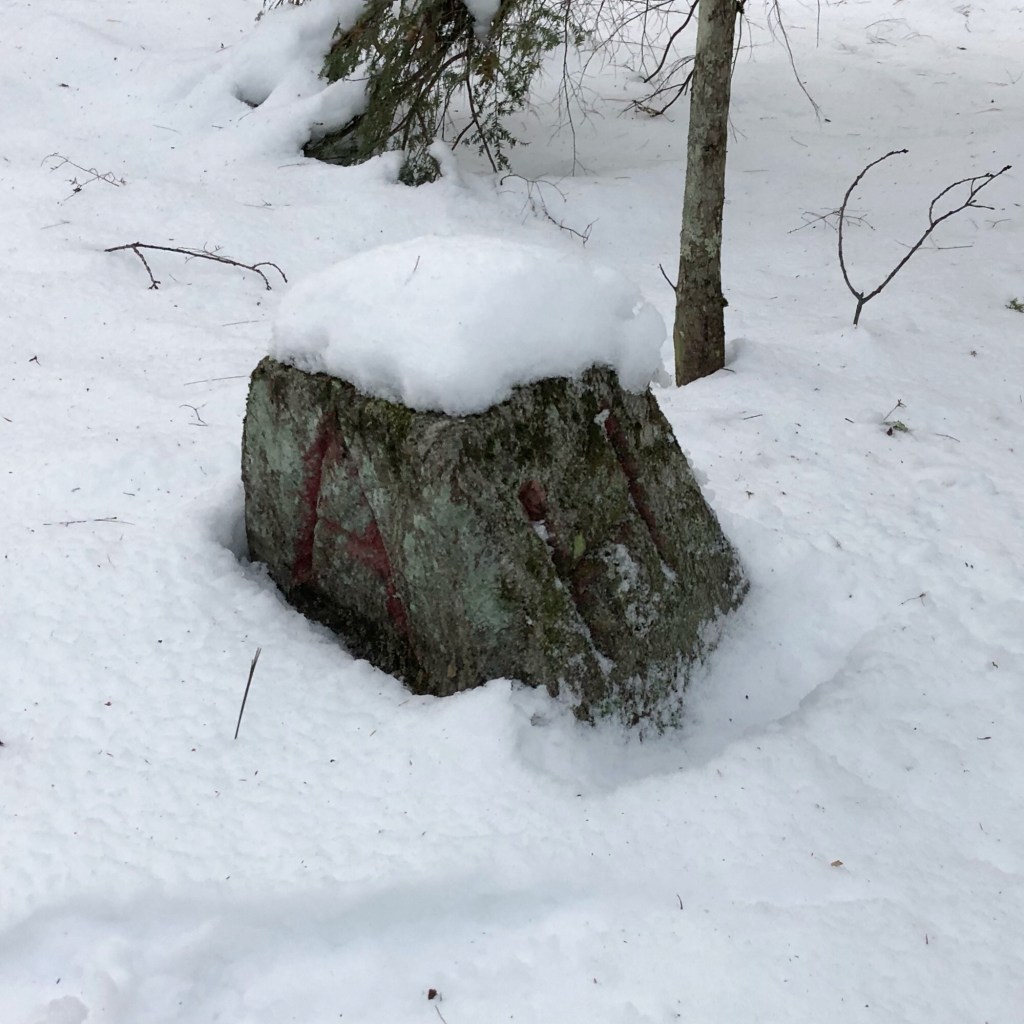
    History whispered from the woods, calling me to find it. A mere rock this time, set in place to forever mark the border between two agreed-upon places, as settlers tended to do. This one, they say, was set here in 1741, a year after being settled and eight years before Hampstead would be incorporated. The other town, Atkinson, would be incorporated twenty-six years later. That there is a carved A and H on the stone that is a handy indicator that you found it, but neither settlement was known by these names in 1741. Hampstead was known as Timberlane Parish then, and Atkinson at the time was a part of Plaistow, New Hampshire. No, the carving came sometime later. And so did the red paint used to highlight the letters.

    Living on a border town between New Hampshire and Massachusetts, I’m fascinated with these border markers. Some are easier to find than others, conveniently standing aside the road they’ve watched grow over their lifetime. But others are more evasive. And town border markers tend to be less fussy still. When the plowed fields return to the woods they always wanted to be the stones become hidden. And that’s where the fun begins for adventurous history geeks like me. This one wasn’t so hidden; it appears on trail maps for the conservation land it resides in. But ask the 15,000 residents of the two towns where it is and maybe 400 might not give you an odd stare back. The rock isn’t exactly a national landmark like the fictional Plymouth Rock.

    And yet, this tiny rock in the woods marking the border between two towns was set in the heart of the lands the Abenaki once used to stage raids on Haverhill, Massachusetts only four decades before. It would stand witness to the French and Indian War, the Revolutionary War, The Civil War and two World Wars, drawing the settlers from the land that surrounds it to fight for survival nearby and across the globe. And of course it would witness the birth of a nation.

    So sure, it’s just a rock in the woods, but it’s a rock that has seen a few things in its job marking a random border set in 1741 between two settlements in New Hampshire. And I wondered, brushing the snow off it for a better look, how many of those people have wondered at it in that time as I do now? And for how long will it guard this border before such things don’t matter again? I wonder.

    1741 A/H Marker
  • Hiking Mount Jackson (New Hampshire)

    Too many weekends since I last hiked to a summit. Basically, I skipped December for the holidays, and was feeling the built-up restlessness that comes with knowing you’ve got things to do. I’d planned for Hale, but latched on to other’s plans for Mount Jackson for the views and banter of friends.

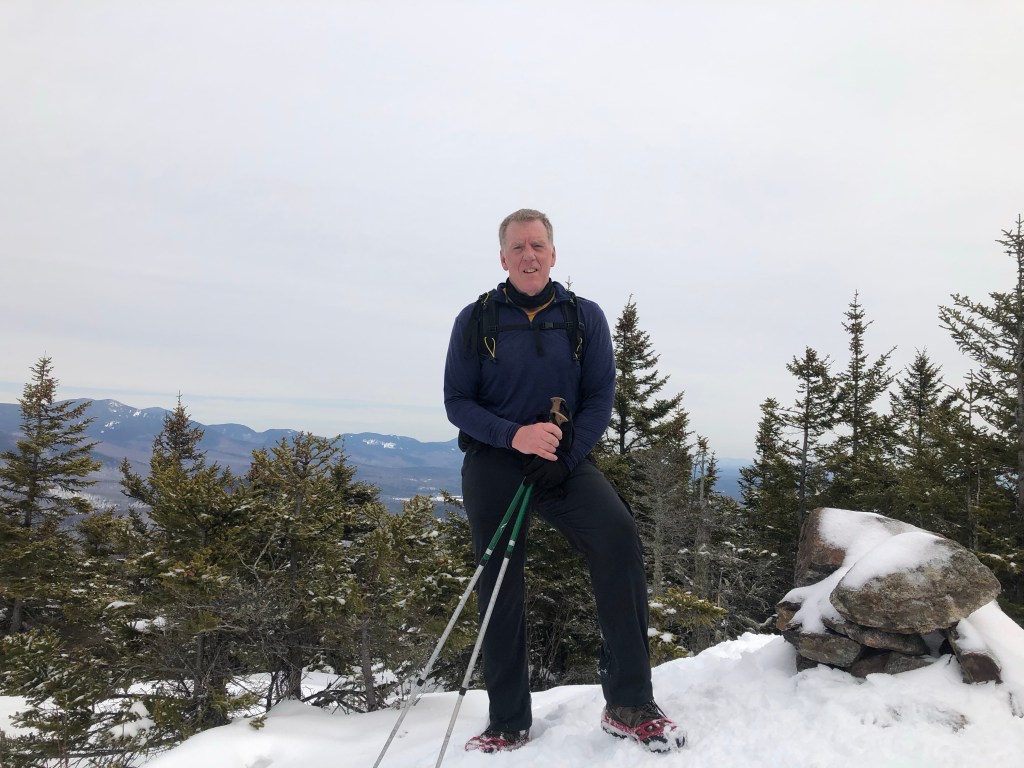
    Mount Jackson is a popular trail. We started early, meeting friends at the trailhead, but not early enough and parked along the side of Route 302. The out and back trail is roughly five miles of moderate hiking, with a short scramble towards the summit. Micro spikes were a requirement with a healthy dose of exposed ice and a couple of (frozen) stream crossings along the way.

    The straight path up Mount Jackson is via the Webster-Jackson Trail. That’s the trail we took, and judging from the compacted snow on the trail, so do most people. The day started overcast at the trailhead, but it was one of those hikes where you walk into sunshine, and like a jet bursting through the clouds, we emerged from the tree line to find bright sunshine and undercast in the valley below. Incredible views of Mount Washington and the Presidential Range greeted us, along with a few hungry Gray Jays looking for handouts.

    Mount Jackson is named for a geologist named Charles Thomas Jackson who completed a geological survey of New Hampshire in 1844. According to Wikipedia, Jackson seems to have been a somewhat controversial figure in his time, with a pattern of taking credit for discoveries others made. His brother-in-law was Ralph Waldo Emerson. For those who can’t get enough information on Charles Thomas Jackson there’s a wealth of information on Jackson in an article published by The State of Maine and while doing a bit of research I saw that the Bangor Daily News just published a small bit about Mount Jackson a few days ago. Apparently I’m not the only one wondering about why they’d name the mountain after this particular character, but based on his controversies he probably just named it after himself and nobody challenged it.

    After a lunch on the summit we started our descent, with plenty of butt sliding mixed into the walk back. A couple of side trails made for interesting views, we spent a few minutes at Bugle Cliff, but opted out of Elephant Head. After the stunning views on the summit maybe we were a bit spoiled.

    On the descent a couple of us hiked down to the Silver Cascade, which is very popular near Route 302 but involves some sweat equity further upstream. The small falls we saw were worth the side trip, with blue ice putting on a dazzling display for the two of us that sought it out. Waterfalls change by the day, and even though most of our party had seen them before I was still surprised more people don’t make the trek down. I’ll never turn down a side trip to a waterfall with kindred spirits.

    I’d circled this weekend in hopes of trying out my new Tubbs snowshoes. They’re a huge upgrade over the snowshoes I used to have, but we just haven’t had the snow accumulation to give them a workout. With the compacted trails today wasn’t the right day for them either. But that didn’t make the day disappointing. It turned out to be a spectacular way to spend a beautiful and cold Sunday; time with the closest of friends, relatively easy hiking and another summit checked off on the 48 New Hampshire 4000 footer list.

    View of Mount Washington
    Gray Jay looking for handouts
    Micro Spikes required
  • America Will Fix Itself

    Yesterday was ugly in America, and there will be more ugly days ahead. Angry, misguided people tend to lash out, especially when emboldened in a mob and spurred on by an orange tyrant. America was slapped across the face and abused, but she’s rising up and fixing the demons that haunt her. We have a long way to go, but yesterday will be a catalyst for those who stood by silently to rise up and join those who were fighting all along.

    Change is hard. The violence and brutality and outrage we’ve seen in America are symptoms of underlying problems that needed to be addressed. And in addressing them we’ll create even more friction from those who perceive that something is being taken away from them. Outrage is big business, and there are plenty of platforms to feed and escalate it. Those platforms need a hard look too.

    Free speech is a blessing and a curse. We all have the right to say what we want to say. But we don’t have the right to an audience. Tempering the outrage industry will be a tough but necessary step. I won’t pretend to know how to cool things down, but I believe it starts with helping people focus on using that energy for productive, positive things. Building instead of destroying.

    Ultimately we’re all tiny humans living on a fragile planet that’s given her all for us, largely against her will. America is one very loud and self-absorbed part of a global community. We have our issues right now. But we’re figuring it out. And we’ll get it right. Because we have no other choice but to figure it out.

  • 11 of My Favorite Books Read in 2020

    Looking back on this maddening year, I found I read a lot of poetry that inspired and a lot of page-turner novels that distracted. It would be easy to make half this list collections of Mary Oliver poems, but I subtracted poetry from the list altogether to focus on the craft of the written novel or book. Still, I like to bend the rules, so in making my list of top ten favorite books for the year, I chose eleven. This was a nod to Charlie Mackesy, who spun a bit of magic in a year where it was essential. Illustrating the timeless nature of books (or perhaps how far behind I am in catching up), only four of the eleven were released in 2020. These eleven books are listed in no particular order, largely because there’s a bit of wonder in each of them. Each informed and delighted me.

    Breath: The New Science of a Lost Art by James Nestor
    “The more oxygen life can consume, the more electron excitability it gains, the more animated it becomes. When living matter is bristling and able to absorb and transfer electrons in a controlled way, it remains healthy. When cells lose the ability to offload and absorb electrons, they begin to break down.”

    I find myself thinking often about breathing after reading this book. Waking up with a dry mouth reminds me I need to be better at nasal breathing, when hiking I try to control my breath and focus on how I’m taking in oxygen, and when I chew almonds I crunch with satisfaction, knowing it helps release stem cells and increase bone density. This book is highly informative and strongly recommended for anyone, well, breathing.

    The 80/20 Principle: The Secret to Achieving More With Less by Richard Koch
    “Equality ends in dominance: that is one of the messages of chaos theory. The 80/20 Principle’s message is different yet complementary. It tells us that, at any one point, a majority of any phenomenon will be explained or caused by a minority of the actors participating in the phenomenon. Eighty percent of the results come from 20 percent of the causes. A few things are important; most are not.”

    This was the most highlighted book of the bunch. Honestly, there were chapters I skimmed over because they didn’t sing a tune I wanted to hear, but the theories here are sound. I wish I’d read this book at the beginning of my career, but it’s not too late to implement the core principles in many aspects of my life.

    The Splendid and the Vile: A Saga of Churchill, Family, and Defiance During the Blitz by Erik Larson
    Hitler wanted still more force applied against Britain. America seemed increasingly likely to enter the war but would do so only, he reasoned, if Britain continued to exist. On March 5 he issued another directive, No. 24, this signed by Field Marshal Wilhelm Keitel, chief of the High Command of the Armed Forces (OKW), aimed mainly at how Germany and Japan might coordinate strategy under the Tripartite Pact, which both had signed with Italy the preceding fall. The goal, the directive said, “must be to induce Japan to take action in the Far East as soon as possible. This will tie down strong English forces and will divert the main effort of the United States of America to the Pacific.” Beyond this Germany had no particular interest in the Far East. “The common aim of strategy,” the directive stated, “must be represented as the swift conquest of England in order to keep America out of the war.”

    We all grew up sort of knowing about The Blitz. This book neatly sums up just how tenuous the situation was. I fancy myself well-informed about World War II, but I learned far more from the The Splendid and the Vile than I expected to. For all our complaints about the pandemic, most of us have no idea what real sacrifice is. Larson brings us closer to understanding with this book.

    The Boy, the Mole, the Fox and the Horse by Charlie Mackesy
    “What do you want to be when you grow up?” asked the mole.
    “Kind,” said the boy.


    A beautiful, simple book. I picked this up for my daughter as a gift and read it quickly before wrapping it up. If 2020 kicked you in the ass, read this. Then read it again. The Boy, the Mole, the Fox and the Horse is art, meditation and a warm hug disguised as a book.

    Longitude: The True Story of a Lone Genius Who Solved The Greatest Scientific Problem of His Time by David Sobel
    The zero-degree parallel of latitude is fixed by the laws of nature, while the zero-degree meridian of longitude shifts like the sands of time. This difference makes finding latitude child’s play, and turns the determination of longitude, especially at sea, into an adult dilemma—one that stumped the wisest minds of the world for the better part of human history.

    I’ve danced around this book for years, never getting around to reading it. And then I went to Greenwich and saw the chronometers ticking away in their plexiglass cases and resolved to get right to it when I returned home. This is a story of perseverance solving what was believed to be the impossible. A delightful book.

    Mayflower: A Story of Courage, Community, and War by Nathaniel Philbrick
    No longer mindful of the debt they owed the Pokanokets, without whom their parents would never have endured their first year in America, some of the Pilgrims’ children were less willing to treat Native leaders with the tolerance and respect their parents had once afforded Massasoit.

    Living in New England, you can’t really get away from the story of the Pilgrims. But the part we seem to forget with the Pilgrims is how much they relied on luck and the strategic kindness of Massasoit to survive at all. It seems I’m a descendent of a Pilgrim (or two), so I’m told, and that lineage makes me all the more indebted to the Pokanokets who assured that those first few years here weren’t the last for the passengers on the Mayflower. As the quote above suggests, that indebtedness seemed to skip the next generation, paving the way for the tragedy of King Phillip’s War.

    Draft No. 4: On the Writing Process by John McPhee
    That four-to-one ratio in writing time—first draft versus the other drafts combined—has for me been consistent in projects of any length, even if the first draft takes only a few days or weeks. There are psychological differences from phase to phase, and the first is the phase of the pit and the pendulum. After that, it seems as if a different person is taking over. Dread largely disappears. Problems become less threatening, more interesting. Experience is more helpful, as if an amateur is being replaced by a professional. Days go by quickly and not a few could be called pleasant, I’ll admit.

    Reading McPhee, like reading Hemingway, it’s easy to get just a bit intimidated. The beauty of this book is that he pulls back the curtains to show you the way. Great research, editors and fact checkers smooth out the rough edges and polish the story, but the work you put into it makes the finished product shine.

    Cape Cod by Henry David Thoreau
    The ocean there is commonly but a tantalizing prospect in hot weather, for with all that water before you, there is, as we were afterward told, no bathing on the Atlantic side, on account of the undertow and the rumor of sharks. At the lighthouse both in Eastham and Truro, the only houses quite on the shore, they declared, the next year, that they would not bathe there “for any sum,” for they sometimes saw the sharks tossed up and quiver for a moment on the sand. Others laughed at these stories, but perhaps they could afford to because they never bathed anywhere. One old wrecker told us that he killed a regular man-eating shark fourteen feet long, and hauled him out with his oxen, where we had bathed; and another, that his father caught a smaller one of the same kind that was stranded there, by standing him up on his snout so that the waves could not take him. They will tell you tough stories of sharks all over the Cape, which I do not presume to doubt utterly,—how they will sometimes upset a boat, or tear it in pieces, to get at the man in it. I can easily believe in the undertow, but I have no doubt that one shark in a dozen years is enough to keep up the reputation of a beach a hundred miles long.

    This book, like Philbrick’s Mayflower, informs the native New Englander about the places that once were the places that now are. I have a stack of quotes from this book that I’m saving for other blog posts, but the one above reminds us that the question of sharks has been around a lot longer than we might believe. Like Thoreau I’m much more concerned about undertow when swimming in the surf, but hey, you never know…

    Siddhartha: A Novel by Hermann Hesse
    “Were not all sufferings then time, and were not all self-torments and personal fears time? Weren’t all the difficult and hostile things in the world gone and overcome as soon as one had overcome time, and as soon as time could be thrust out of the mind?

    I’ve heard enough people recommend this book that eventually I had to read it, and I finished it in 2020. Amazingly, it feels like I read this a decade ago, for all that’s happened this year. Like The Alchemist, it’s a story that teaches you a bit about yourself as you wade through it.

    Thinking in Bets: Making Smarter Decisions When You Don’t Have All The Facts by Annie Duke
    What makes a decision great is not that it has a great outcome. A great decision is the result of a good process, and that process must include an attempt to accurately represent our own state of knowledge. That state of knowledge, in turn, is some variation of “I’m not sure.”

    How do you make decisions? How can you make better, more informed decisions when you don’t have all the facts? And what is a game of strategy versus a game of chance? This book uncovers some of these answers. As with anything, there’s book smart and there’s street smart, and reading about it and understanding it in real life are different things. Duke sprinkles in some street smarts hard won on the poker tables.

    Sailing True North: Ten Admirals and the Voyage of Character by James G. Stavridis
    “The contemporary malaise is the unwillingness to take chances. Everyone is playing it safe. We’ve lost our guts. It’s much more fun to stick your neck out and take chances. The whole attitude is to protect yourself against everything, don’t take chances. But we’ve built this country on taking chances” (Quoting Rear Admiral Grace Hopper)

    A quick, enjoyable read that offers lessons learned from some of the great “Admirals” in history. This is examination of character in ten short biographies, but also an unflinching look at racism and sexism in the Navy and how that battle continues to be fought to this day. And there’s no mistaking the Admiral’s feelings about character in certain political leaders we currently suffer through. A timely message for all of us.