I learned a few things yesterday that change my worldview. Most notably, I’m not the Skee Ball player I once was. Someone’s got to finish last. I provided enough evidence to convince myself, grudgingly, that I’m not as good as my wife and daughter. So be it. More importantly, I suppose, was spending the time with each of them.
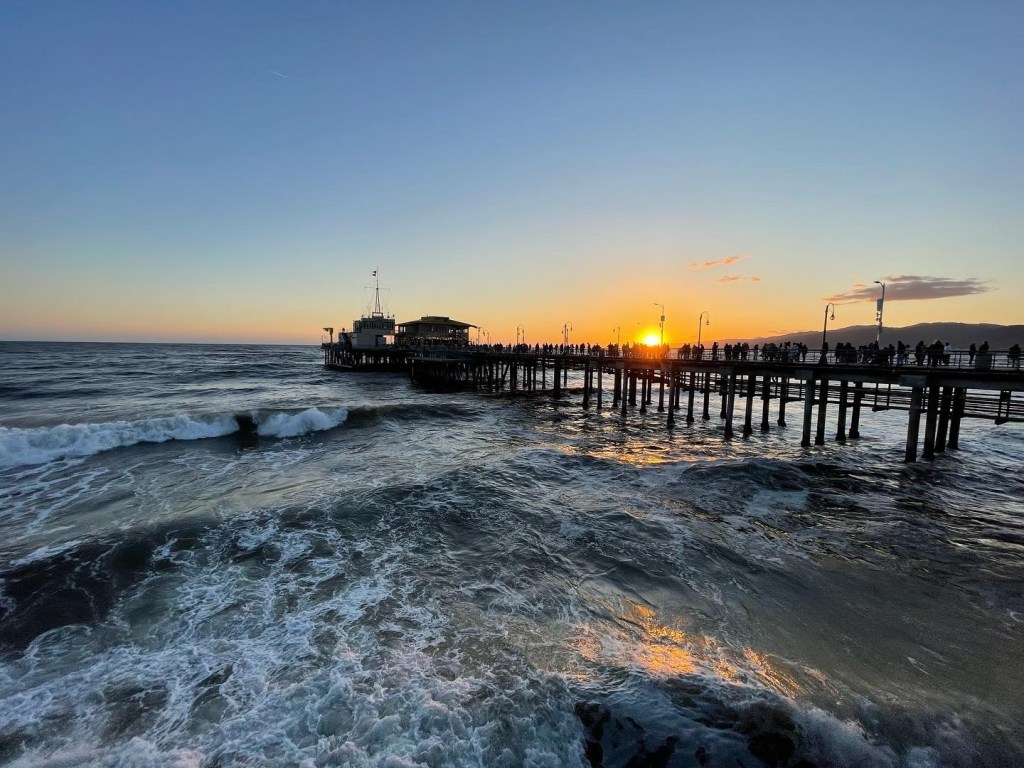
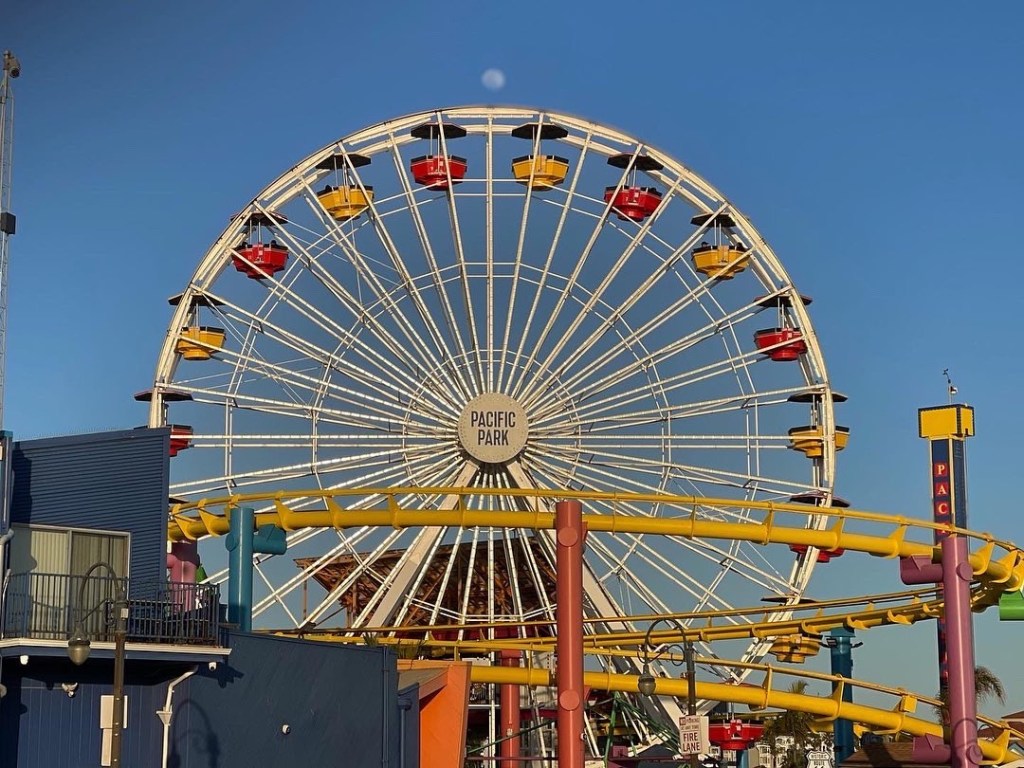
The Santa Monica Pier is a classic California beach pier, jammed with people watching the waves roll underneath while the sun drops towards the horizon. The arcade and amusement park rides were active, despite a chilly breeze off the Pacific Ocean. Dining choices were strictly fattening and a bit greasy, and nobody seemed particularly concerned about the lack of kale and spinach smoothies on the menu. There’s plenty of that elsewhere in California, this place is for fun.
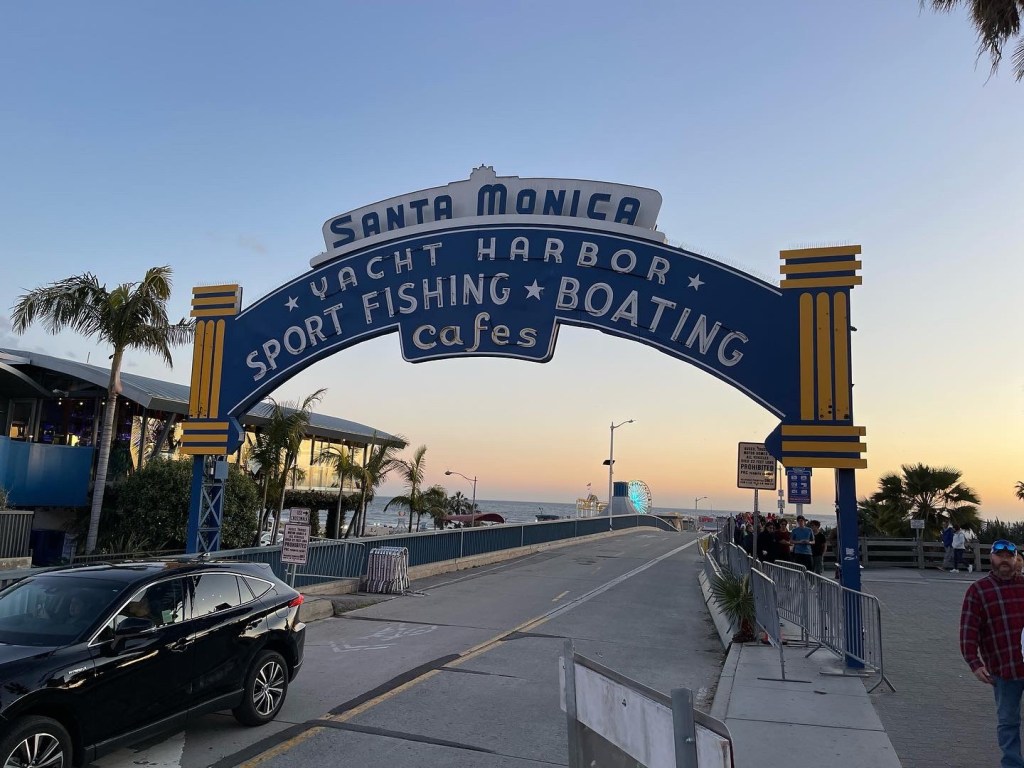
Route 66 terminates at Santa Monica Pier. You could drive your car from Chicago to Santa Monica, park on the pier and watch the sunset with some fried dough if you want to. I settled for the sunset, which seemed a great way to wrap up a brief few days out west.
There’s no doubt this place is touristy, but the beach and rolling waves back it up with substance. Sometimes we just need to forget the world’s problems and have some fun. This place has offered up fun for generations.
“To be ignorant is to be afraid, and in the dark mystery of the unknown a man cannot find his way alone. He must have guides to speak to him with authority.” — Edith Hamilton, The Greek Way
And, truly, what of good ever have prophets brought to men? Craft of many words, only through evil your message speaks. Seers bring aye terror, so to keep men afraid. — Æschylus, Agamemnon
Both of these quotes were drawn from Hamilton’s extraordinary book. The Gutenberg Project offers the entire English translation of Agamemnon, which the link above will take you to. Hamilton’s life story is itself fascinating and worth a deeper dive another time. For today, let’s focus on the urgency of climbing the steep hill of the informed. History ebbs and flows and, as Mark Twain said, rhymes.
Much of the world runs on fear and ignorance. Those in the know shake their heads in disbelief at the things the ignorant regurgitate from the talking heads trying to hold power at any costs. That they’re largely successful speaks to the effectiveness of the platforms designed to stoke the fire. We must put out the fires being stoked or eventually be consumed by them.
We dare not be ignorant. Look around at the world and feel the obligation of the informed, carrying the weight of the ignorant. We must look squarely into the eyes of those who would destroy democracy and rise up to meet them. Many will walk through life with blinders on, lest they witness anything contrary to what they’re told. There’s no nuance in the fears they express, no dance with life, merely a cycle of fear of what others are coming to take from them. They don’t see that they’ve already had everything taken from them by their messenger of choice.
The thing is, we can’t change the extremists on either end of the spectrum, we can only shine a light on, and be open to, the truth. Life is a dance with either ignorance or knowledge. We must choose our dance partner with the utmost care, and in turn teach others to dance. Feel the rhythm in the rhyming of history and step towards truth. The alternative is wretchedness and fear. What kind of life is that?
I wonder, now and then, who has tread on the ground I walk on. Surely this thought comes to mind often in famous places where people whom we remember did things that stir the imagination and puts us in their shoes, if only for a little while. The history buff in me lingers in places where famous moments happened. It’s my way of understanding their moment a little better, even as my moment in that place is so very different. I’m a visitor in that place in that moment, they defined the place in theirs. Walden, Culloden, Kehlsteinhaus, Liverpool’s Cavern, Saratoga… each stirred up ghosts as I walked in footsteps. Some we honor, some we simply try to understand.
There’s that word again: understand. We can never put ourselves in the place of the characters who brought us here, but we can learn from them. History rhymes, after all. When we learn from those who came before us we might change the script, or gain insight into our next move. We’re all just re-writing history, we’re all playing the same chords. We make of it what we will.
Last week I visited Gljúfrabúi, partly inspired by watching a YouTube video of someone walking into the gorge to experience the hidden waterfall. I re-watched that video, just to see it again from the perspective of someone who has now been there. For all the thousands of people who have likely walked there, the experience of that particular person walking in my footsteps when I’d actually walked in theirs felt circularly surreal for me. It reminded me that each of us is walking in the footsteps of others while also creating footsteps for those who will follow us. Doesn’t it make you wonder, how will we define our place?
Reykjavik is the capital city of Iceland and the northernmost capital city in the world. As with any great city it has a strong foundation of history, culture and character. For the most part it’s highly walkable with a vibrant and diverse food and bar scene, friendly and interesting people. The trick is navigating the ice and wind in winter. They deal with ice by heating some of the main sidewalks, utilizing their abundance of geothermal heat. The wind you just learn to deal with. This blog post is a postcard from a city I’ve quickly grown to love.
Hallgrímskirkja Lutheran Church Leif Erikson Statue, given to Iceland by the United States in 1930 to commemorate the 1000th anniversary of his discovery of AmericaParliament Building Harpa Music Hall
“The important thing is never to let oneself be guided by the opinion of one’s contemporaries; to continue steadfastly on one’s way without letting oneself be either defeated by failure or diverted by applause.” — Gustav Mahler
Gustav Mahler was an Austrian composer who’s work is familiar to us whether we know it or not. His Symphony No. 1 in D is the basic tune of “Frère Jacques”, the nursery rhyme embedded in our brains as children. He built his legacy as a conductor and composer in Vienna, a place chock full of legendary conductors and composers, and navigated his career through both anti-semitism and general criticism of his work, which pushed boundaries many weren’t ready for. So in this context, his quote becomes illuminating.
There’s a moment after we’ve tied a shoe or set a sail just so when we look up and begin going where we determined we’d go in our minds just a beat before. It’s that moment of beginning on one’s way, wherever it may bring us, that is transformative. Everything that comes after is a matter of resolve: Do we finish what we started or to let it fall by the wayside and try something else?
Most likely, the worst criticism we face comes from within. Self-doubt, imposter syndrome and fear of failure have destroyed more art than all the critics and book-burning zealots combined. In such moments, we must keep going, one way or another. Easier said than done, of course, but pushing through has a way of building confidence and resilience. We simply learn to ignore the voice inside.
“Most of us have two lives. The life we live, and the unlived life within us. Between the two stands Resistance.” — Steven Pressfield
That moment of beginning, of breaking through that Resistance, is a big step in reaching our unlived life. But every step thereafter has its own subsequent Resistance. Put one foot in front of the other, and soon you’ll be walking across the floor, as the song goes. To reach our potential we must overcome all the external and internal noise that is distracting us from that voice in our head that is telling us quietly, persistently, what we ought to do.
Today we’re beginning something, and continuing other things. Who we once were passed away in that beat. This blog post, like the 1,663 before this one, is another step for me across that proverbial floor, with the character who wrote each long gone. What remains is the sum of each, on the way to becoming something entirely new. Who we become is in so many ways up to us, determined by the choices one makes on one’s way and our steadfast resolve to arrive at what’s next.
A visit to Walden Pond can be immersive, if you go at the right time. Many people go in summer to swim and enjoy the pristine water. Many fish for large mouth bass and other prizes. But the pilgrims go to visit Henry David Thoreau’s famous pond and the woods surrounding it. I’ve watched the place change over the years, but the pond and woods remain largely as Thoreau would recognize.
You must treat a brief visit to Walden as you would a visit to a nightclub with a cover charge. There’s a flat fee of $30 USD to park. That applies for an hour or the entire day. There’s a lower fee, apparently, for Massachusetts residents. I suppose you can also opt for other ways to get to Walden Pond, but this was the simplest way to spend time at a place. The area surrounding Walden Pond is a mix of highway, commuter railroad (as it was in Thoreau’s time), capped landfill and houses increasingly further out of reach for someone choosing the lifestyle of the person who made this place famous.
Early December is considered late autumn, but my visit felt more mid-autumn, with temperatures warmer than they should be this time of year. Henry David Thoreau would have shaken his head, I think, at some of the same behavior he observed in his day leading to the climate change we’re experiencing today but generally sitting on our hands about. But it made for a lovely day to walk around the pond.
There is a well-defined path around the pond. It’s maintained and easy for most walkers to navigate. They make you feel like you’re in a cattle chute for much of it, with wire strung on each side of the path to keep wanderers from straying off the path. Signage explains this as erosion control measures. As a hiker of the White Mountains in New Hampshire, I’m all too familiar with the impact of popularity on trails and the surrounding landscape. I stay to the path, liberated from the freedom to wander, I instead focused on the environment around me.
You can hear the world encroach on you at Walden. Distant highway sounds, construction, sirens, airplanes flying overhead and the commuter train all remind you that you’re in a suburb of Boston. It’s best to acknowledge this, but let it go as Thoreau let the train go as it went past in his time. The landscape is largely preserved, the water clear, awaiting those who would linger.
When I was younger, there was no visitor center, but there was a bath house. At some point well before I came into this world some well-meaning people decided that the best way to save Walden Pond was to make it a recreation center. So a bath house was built, beach sand extended and you had a destination for family recreation. Thoreau’s cabin is on the opposite shore from the bath house, but it’s the first thing you see when you walk down the visitor parking lot. You’re either at peace with it or not, but it’s relatively benign in the off-season.
Walden Woods extend well beyond the perimeter of the pond, and we can thank people like Don Henley for their commitment to preservation. Generations of developers find a way to squeeze as much money as they can from resources, and there are plenty of people who would turn the place inside out and up. There’s a place for development in this world, but there ought to be a place for preservation too.
I’d brought a water bottle with me on the walk, warm day that it was, and decided in a moment of inspiration to fill it with water from Walden Pond. Thoreau drank straight from the pond in his day, I’m not inclined to do that without a filter. Instead, I brought the water with me for another pilgrimage. Just across that highway is the center of Concord, where Thoreau and Ralph Waldo Emerson lived. Just beyond the center is the Sleepy Hollow Cemetery, site of Author’s Ridge, where Thoreau, Emerson, Alcott and others are buried. I stopped for a brief visit on Author’s Ridge, told of my visit to his old cabin site, and poured Henry a sip of Walden Pond. Cheers Henry.
Walden PondA view of the pond just down the hill from Thoreau’s cabin site. This is similar to the view he would have had.Pile of stones next to the cabin site. I’m not loving it, but cairns are how people seem to express themselves. The site to me feels like a construction site, cleared and ready to build.The cabin site is surrounded by granite pillars to denote the position and size of the cabin.Creative cairn art rising out of Walden Pond.
“Two students had studied for many years with a wise old master. One day the master said to them, “Students, the time has come for you to go out into the world. Your life there will be felicitous if you find in it all things shining.” The students left the master with a mixture of sadness and excitement, and each of them went a separate way. Many years later they met up by chance. They were happy to see one another again, and each was excited to learn how the other’s life had gone. Said the first to the second, glumly, “I have learned to see many shining things in the world, but alas I remain unhappy. For I also find many sad and disappointing things, and I feel I have failed to heed the master’s advice. Perhaps I will never be filled with happiness and joy, because I am simply unable to find all things shining.” Said the second to the first, radiant with happiness, “All things are not shining, but all the shining things are.”— Hubert Dreyfus, All Things Shining: Reading the Western Classics to Find Meaning in a Secular Age
All Things Shining, linked above, is a heavy lift in places. When you wade deeply into western literature with a heavy emphasis on Homer, Dante, Jesus and Melville’s Moby Dick, you’re going for a deep dive. Nobody said delving into nihilism, polytheism, and monotheism would be a page turner. I’m the better for having read it, but earned the finish that I’ve just given you freely. For it ended with this delightful epilogue, casting a glow that lingers.
We may live a life full of routine and tedium, nastiness and fear of the unknown. We may also live a full life overflowing with ritual and wonder, generosity and openness. The lens we view the world through matters greatly in determining how full this brief dance really is. Some of my closest acquaintances choose to complain about everything in their life. They aren’t leaving a trail of joy behind them. Other acquaintances are relentlessly optimistic about the world and their place in it. They lift the room with their presence. Surely, not everything is wonderful, but many things are. What do we focus on?
These are the days you might fill with laughter until you break These days you might feel a shaft of light Make its way across your face And when you do you’ll know how it was meant to be See the signs and know their meaning It’s true You’ll know how it was meant to be Hear the signs and know they’re speaking to you, to you — 10,000 Maniacs, These Are Days
These are days we’ll remember. Focusing on the joyful bits isn’t an escape from the harshness of the world, it’s an acknowledgement that there’s two sides to the coin in life. This isn’t putting our head in the sand, for joy coexists with sad and disappointing in this world. We can fixate on unrelenting misery and darkness, or flip the coin and give our attention to all the shining things in this lifetime. The choice has always been ours.
“I am the harvest of man’s stupidity. I am the fruit of the holocaust. I prayed like you to survive, but look at me now. It is over for us who are dead, but you must struggle, and will carry the memories all your life. People back home will wonder why you can’t forget.” — E.B. Sledge, With the Old Breed
“So it came to pass that as he trudged from the place of blood and wrath his soul changed.” — Stephen Crane, The Red Badge of Courage
I’m not a veteran of war. I chose a path that took me far from the battlefields of modern armies. I wonder at the courage of those who charged towards an almost certain death, thinking that perhaps they had something in them that is beyond my capacity to endure and fight another day. I suppose all of us blessed to have never fought in war are also given the curse of wondering just what we might have done under the same circumstances. May we and those we love never find out. May the world rise above the conflicts of mankind and bow to love instead. We have a long way to go.
We learned to honor our veterans growing up. They fought in the big wars we learned about in history class. They were my uncles coming home again, not really speaking much about what they experienced. We read about war in books like All Quiet on the Western Front and think we understand what a veteran will never say. There’s a chasm there that humanity should never cross, and those who have been there and survived bring it back with them. Who are we to ask what it was like for them?
If Memorial Day honors those who paid the ultimate price, Veterans Day honors those who came home again. On Veterans Day I think of the people in my life who served. Some were wounded, and some lived a lifetime shortened by Agent Orange or other demons hard to define. All carry something of themselves from that time in their lives that we can’t really understand not having been there with them.
We are the sum of our experiences. Veterans have experienced a sum of things most of us will never understand. To wear a remembrance poppy or to thank someone for their service seems a small gesture, but when done with sincerity and grace, it’s noticed by those who sacrificed so much in their time. No, I’m not a veteran, but I will remember, honor and support those who were. Thank you.
“Secrecy is the keystone to all tyranny. Not force, but secrecy and censorship. When any government or church for that matter, undertakes to say to its subjects, “This you may not read, this you must not know,” the end result is tyranny and oppression, no matter how holy the motives. Mighty little force is needed to control a man who has been hoodwinked in this fashion; contrariwise, no amount of force can control a free man, whose mind is free. No, not the rack nor the atomic bomb, not anything. You can’t conquer a free man; the most you can do is kill him.” ― Robert A Heinlein
“Almost any sect, cult, or religion will legislate its creed into law if it acquires the political power to do so.” ― Robert A. Heinlein
If you’d asked me ten years ago if I could imagine the end of democracy in the United States, I would have laughed at the very idea. We weren’t a perfect union, something the Founding Fathers envisioned when drafting the U.S. Constitution, but we were at the very least unified in our belief that we were making progress towards a better democracy. Or so I thought.
A decade of sipping increasingly toxic poison on extreme media sites has created an undercurrent of madness in the United States and other countries. The vast majority of people want the crazies to shut up and crawl back in their hole of misery, but they have a platform and momentum that is hard to deny. The only way to shut up a crazy person in power is to vote. The appropriate way to shut up a crazy person spewing divisive rhetoric or conspiracy theories is to leverage the legal system. There have been encouraging examples of each this year, but discouraging examples of crazies getting away with things too. Who’s to say what will happen next?
Well, we can. In the United States of America we have a mid-term election to choose who represents we the people in Congress and in the individual states. This is an opportunity to do the right thing and slam the door on the worst tendencies of humanity, or surrender to the whims of madmen and conspiracists. What a choice.
When you see a country like Ukraine, with everything they hold dear at stake, fighting for their freedom against an oppressive autocratic state, shouldn’t that serve as a reminder of what we ourselves fight for in our own country? It ought to be. And when we see a rise in violent acts applied against the political or cultural opposition, we ought to view that with horror and decisive corrective action too. We become what we amplify, and we become what we allow on our watch. We forget sometimes that we are the adults in the room.
This week we get to live history in the United States of America. We either repudiate the rising antithesis of democratic union, or we surrender to the turbulent winds of outrage and conspiracy. It doesn’t seem like a tough choice, really. But here we are. Could the adults in the room kindly control the children?
“Dale Hollow Dam and Lake was authorized by the Flood Control Act of 1938 and the River and Harbor Act of 1946. The project was completed for flood control in 1943. Power generating units were added in 1948, 1949 and 1953. The project was designed by the U.S. Army Corps of Engineers and built by private contractors under the supervision of the Corps…. The dam impounds a length of 61 miles of the Obey River creating Dale Hollow Lake with 620 miles of shoreline, 27,700 acres of water, and 24,842 acres of land for recreational opportunities. ” — US Army Corps of Engineers, Nashville District
Dale Hollow Lake is named after William Dale, a government surveyor who came to the region to survey the border between Tennessee and Kentucky. He settled in the region and later drowned in a boating accident while taking part in the War of 1812. That drowning would prove prescient. The land was originally the region of the Cherokee tribe, and retains its natural beauty, though the Cherokee and William Dale would hardly recognize the place now, hundreds of feet underwater in places they once walked.
The shoreline is controlled by the Army Corps of Engineers and protected from development, largely preserving the area as a pristine natural environment. Beyond the shoreline, development is grabbing hold of the region, but the lake remains a beautiful statement for preservation, even as it conceals what it stole away. There’s a town named Willow Creek under this lake, built before the Revolutionary War, a ghost lingering below the water hinting at times past. We forget sometimes, living in our moment of now, that there was so much we don’t know about what was here before us. The region whispers its Cherokee and early settler history when you stop and listen.
Being out on a boat on a raw Late October day, it was easy to listen. The hundreds of houseboats, pontoon boats and fishing boats were largely dormant at marinas. I imagine in summer the area is a bit “Ozark” crazy, but we couldn’t have seen more than a half dozen other boats out on the water with us, all of them fishermen. Off-season has it’s perks.
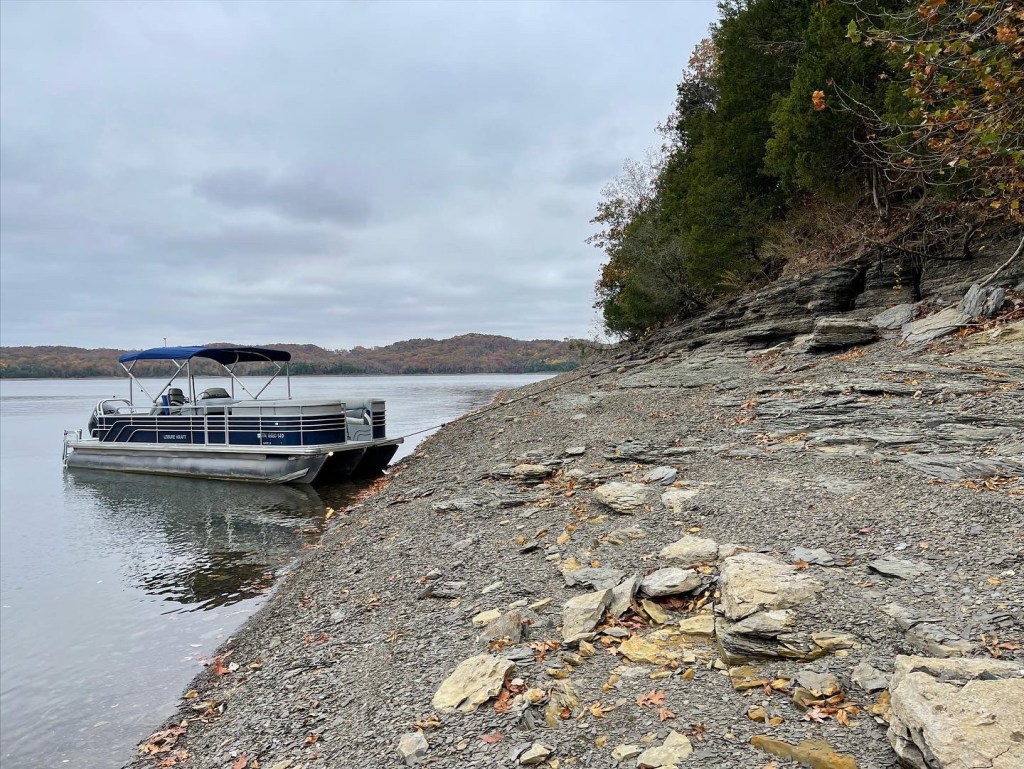
Turning off the engine, you quickly drift past slate and limestone beaches created when they lower the lake for the winter. The shoreline is composed of countless bits of broken slate, brittle and pliable underfoot. This doesn’t seem a great place for walking barefoot, but as with anywhere, when you dress for the environment it makes all the difference. Walking on those broken sleet beaches was fascinating and wonderful.
And I do wonder at this place. The region is going through an identity crisis of sorts. On the one hand, you have the people who have always been here: farmers and hunters and people scraping together a living in an area desolately beautiful. On the other hand you have land speculators scooping up property at ridiculously low prices (for a New Englander) and building vacation and retirement communities. Just as the lake swallowed up Willow Creek, there’s an entire community here that is slowly drowning in change, and reacting to it as you might expect. Trump and “Let’s Go Brandon” signs are everywhere, crime is rising as some misfit locals break into vacant houses packed with luxury goods. There’s friction in change, and the changes here are accelerating. Like the lake, some will drown in it, and others will find opportunity to flourish.
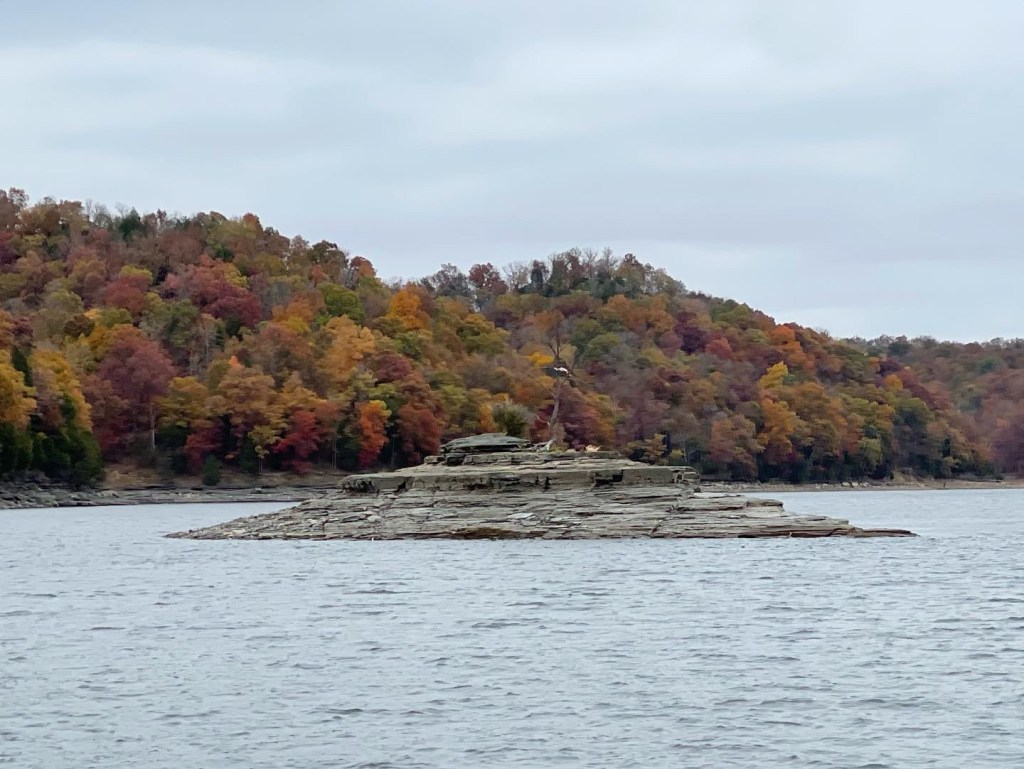
Hilltop turned islandPillars of slate exposed when lake is lowered in winterDale Hollow Lake is split between Kentucky and TennesseeWhen the lake is lowered it exposes a slate and limestone “beach” worth exploring