Category: Lifestyle

  • Four Waterfalls in One Afternoon

    I found myself with an afternoon to myself today while in Ithaca, New York.  Ithaca is a great college town with plenty of restaurants to choose from and enough shopping to occupy those who are inclined to spend their lives in retail environments.  I’m not one of those people.

    I decided to make the waterfall circuit.  Now, Ithaca has a lot of waterfalls and I only had half a day of daylight to work with, so I tried to choose wisely.  You can’t go to Ithaca and not view Ithaca Falls, so that was on the list.  But so was Buttermilk Falls, Taughanock Falls and Lucifer Falls.

    I started with Taughanock Falls.  This was the furthest away but one I really wanted to hike to.  I drove out to Ulysses and changed into my winter boots for the hike.  I’d contemplated this hike before I drove out here so I also put on micro spikes, as I expected the conditions to be icy.  My expectations were met.  The path to the falls was about a mile long with a mix of ice, snow and mud.  I passed 50 or 60 people on this walk and I was the only one wearing micro spikes.  A few people pointed to them and said they wished they’d thought to bring them too.  Taughanock Falls on a mild February day were spectacular.

    Next on the list was Buttermilk Falls.  This one was right down the street from my hotel and easy to get to.  No hiking boots required, just park and walk over to take a picture.  Buttermilk Falls are beautiful, but there’s no real effort required to see them.  I like to earn my scenic vistas.

    Third waterfall was Ithaca Falls.  This is another easy one right off the road.  In fact, you can technically see the falls from the road, which is how we first discovered them.  But I put on my boots again and walked out to the falls for another picture.  Quick walk but well worth the effort to get closer.

    Finally, I drove out to the Robert H. Treman State Park to see Lucifer Falls.  Waze sent me past the state park parking lot to the service road on the other side of the Enfield Creek.  This ended up working out really well as there was a nice path down to the creek on that side.  This was another hike where micro spikes were invaluable.  I’m not sure I would have chanced the hike without them.  This hike reminded me of New Hampshire.  There were hemlock trees shading the path, and with the icy conditions I was one of the only people out on the trail. 

    There’s a bumper sticker available in many of the stores in Ithaca that says “Ithaca is Gorges”.  It’s a nice play on words of course, but right on point; Ithaca’s Gorges are indeed gorgeous.  When you get off the city streets Ithaca offers plenty of views that are well worth the effort to find.  I’m glad to have had the opportunity to see these four waterfalls today.  I’ll definitely go back to each one again, and especially Lucifer Falls.

  • Wind Turbines

    Wind turbines keep popping up.  30 years ago you’d be hard pressed to find one in New England.  Today they’re seemingly everywhere.  And yet the New England states lag far behind other states like Texas, Oklahoma, Iowa, Illinois, New York, California and Oregon.  That middle swath of the country is all prairie, the land is cheap and the wind plentiful.  That’s a great recipe for wind turbines.

    New England is working to catch up.  There are plenty of wind turbines popping up.  But solar seems to be the green energy of choice.  Which is funny when you think about the number of sunny days versus the number of windy days.  Wind just seems like a logical choice.

    The biggest wind farm project in New England was Cape Wind, an offshore wind farm situated south of Cape Cod that would have produced 468MW from 130 turbines.  But it was in the wrong place.  The rich people in Nantucket and Hyannis objected to the prospect of looking out from their beachside mansions and seeing wind turbines.  So after 16 years the Cape Wind project was cancelled.  And billionaires celebrated.

    When I look out at Buzzards Bay in Pocasset, I can see eight wind turbines that were built in Wareham and Bourne.  Have they changed the view?  Absolutely.  But I don’t mind seeing them.  To me wind turbines represent a sustainable future state.  I hope my grandchildren and great-grandchildren have a world worth living in.  And I wonder about people who think only of themselves and the view they have.  Selfish narcissist bastards I believe.  There are way too many of those inhabiting the world nowadays.

  • February Sunset

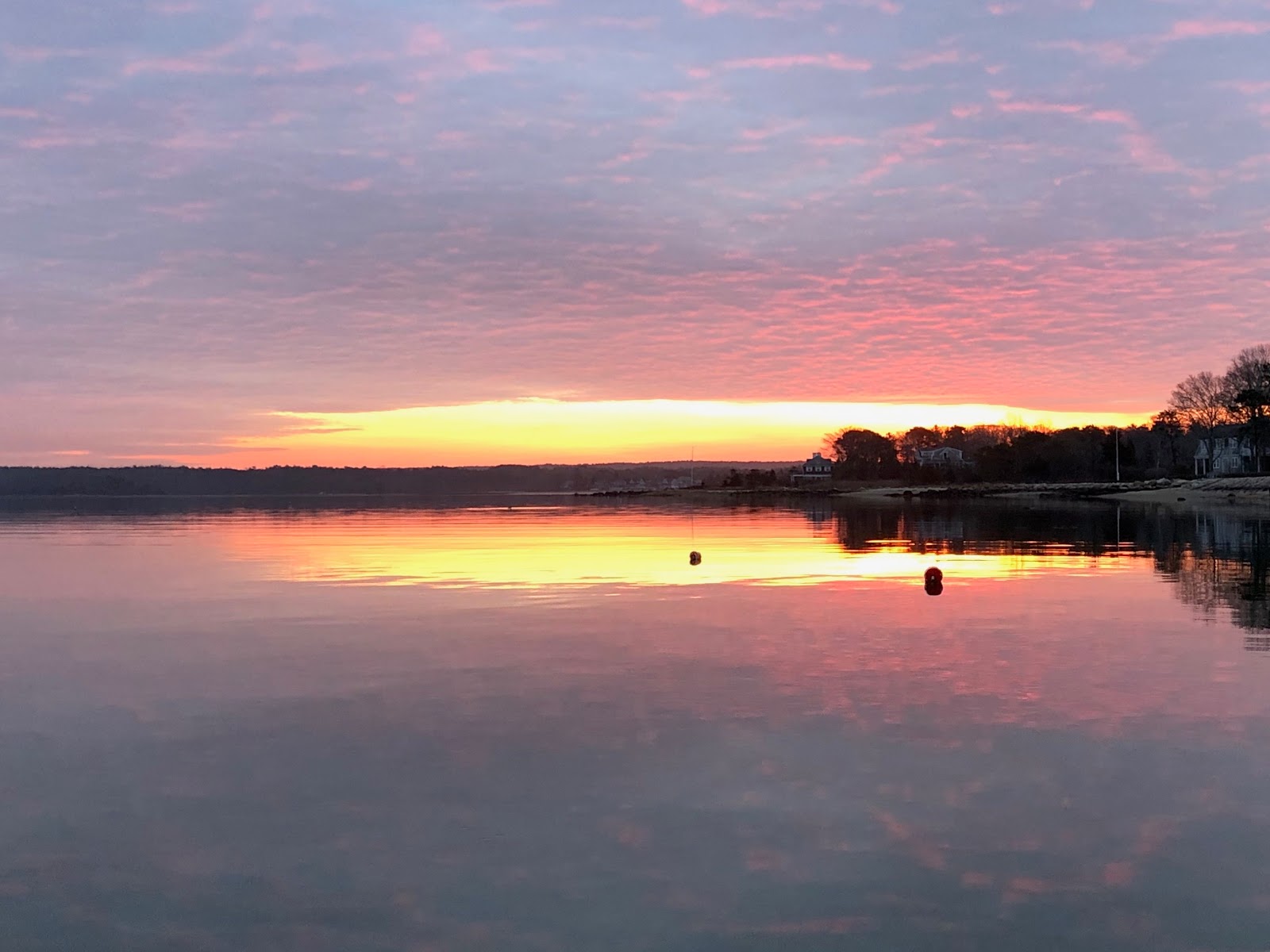
    Waiting on February sunsets and dreaming of the road.  I’m… tired.  Good time to look at some sun dappled water.

    You’ve got your passion, you’ve got your pride
    But don’t you know that only fools are satisfied?
    Dream on, but don’t imagine they’ll all come true
    When will you realize, Vienna waits for you? – Billy Joel, Vienna

    A bathroom shower project I’m working on isn’t going especially well.  Funny how that can set you back so much.  Dreaming of travel when so much is right in front of me.


  • Seeing Legends

    I was driving back from a basketball game when I heard Steely Dan’s My Old School played.  It occurred to me, not for the first time, that I never did take the opportunity to see them play live before  Walter Becker died.  I didn’t go see Tom Petty either.  Or a hundred other legends that have since passed on.

    On the other hand I’ve seen The Eagles before Glenn Frey died.  I’ve seen Paul McCartney and Van Morrison and Jimmy Buffett and Bob Seger and James Taylor and BB King….  and I’m glad I did.  I’ve seen Tom Brady throw a touchdown pass and Roger Clemens and Pedro Martinez throw a baseball.  I’ve seen Larry Bird play on the original parquet.

    Momento Mori.  There’s a lot to see and do in this world.  And someday it won’t be the other guy that’s dying.

  • Flip

    One of the most popular drinks available in colonial times was a concoction called flip.  I first learned about flip from a great book called And a Bottle of Rum, written by Wayne Curtis.  This is by far the most interesting book I’ve ever read on the subject, and it’s proven to be a source of endless inspiration in book historical and libation exploration.

    “… a tavern keeper started with a large earthenware pitcher or an oversized pewter mug.  This would be filled about two-thirds with strong beer, to which was added some sort of sweetener – molasses, loaf sugar, dried pumpkin, or whatever else was at hand.  Then came five ounces of rum, neither stirred nor shaken but mixed with a device called a loggerhead – a narrow piece of iron about three feet long with a slightly bulbous head the size of a small onion… plunged red-hot into a beer-rum-and-molasses concoction.  The whole mess would foam and hiss and send up a mighty head.  This alcoholic porridge was then decanted into smaller flip tumblers…” – Wayne Curtis, And a Bottle of Rum
    Life was hard in colonial times.  Taverns provided a respite from the hardness of the world.  I suspect I might have spent a fair amount of time in taverns in those times.  But I’d like to think I’d have been out exploring the virgin North American forests, rivers and mountains too.  Leisure time was hard to come by in those days, but it seems a lot of that time was spent in taverns.

    The days are short, the weather’s cold
    By tavern fires tales are told
    Some ask for dram when first come in
    Others with flip and bounce begin – Unknown, borrowed from Wayne Curtis, And a Bottle of Rum

    I read this book maybe ten years ago, and it stays with me.  And of all the drinks Curtis describes, Flip is the one that I’m most fascinated with.  I think it’s high time to take the recipe above and make some.  That’s a February “project”.
  • Rum

    Life for the settlers of North America was hard.  Scraping together enough food to eat from the cold land was certainly challenging.  Having enough food to eat was a daily challenge for settlers.  Compounding this was a general distrust of water was prevalent throughout the colonies as water harbored cholera and other diseases.  Tea was one answer for replacing water.  Rum was a better answer.  Rum not only solved the problem of water-born disease, it also offered critical calories.

    “Rum was not just a diversion; it was nutritionally to colonists who labored to coax a meager sustenance out of a rocky, stump-filled landscape and cold seas.  Alcohol has fewer calories per ounce than straight far but about the same as butter.  It’s five times more caloric than lean meat, and has ten times the calories of whole milk.  A bottle of rum squirreled away in a Grand Banks fishing dory provided the energy to haul nets and aided in choking down hardtack and salt cod.” – Wayne Curtis, And a Bottle of Rum

    Rum, ale and cider were the three primary alcoholic drinks in the 1700’s, and rum was far and away the most popular.  Molasses was shipped up to Boston from the Caribbean, it was made into rum and shipped around the world.  Some of this rum was traded in Africa for slaves, which were shipped to the Caribbean to complete the cycle.  Rum had as large a part to play in the earliest days of the thirteen colonies as any drink.

  • Celestial Dance

    This morning Venus was dancing with the crescent moon, while Juniper looked on with envy.  The air is brutally cold this morning, but getting outside before the sunrise has its benefits.  Watching this tango was one of them.  Sadly I couldn’t get a decent picture of conjunction of these three, but I’m glad to have shared the moment with them.

    My reason for being outside in the first place on this cold morning was to let Bodhi get outside for a little relief.  The days of long power walks are over for him, and it seems I’m not inclined to do many myself without his company.  So seeing celestial dances like this aren’t as common as they once were for me.  I clearly need to change my routine and get back outside.

  • Wooden Pipes

    Before lead and copper and cast iron pipes, there were clay and wood pipes.  Woods pipes sound crazy, but in a time when trees were abundant but copper, iron and lead were harder to come by it made sense to use materials that were readily available.

    Wooden pipes were basically logs that were drilled out.  Nothing especially exotic about this, and it turned out that they could be effective transportation vessels for water when buried underground.  And they would do their job until they rotted away, split or were replaced with more modern options.

    I came across a wooden pipe from the 1870’s or 1880’s at the Department of Public Works in Burlington, Vermont a couple of years ago, and I’ve seen it every time I visit there.  It’s a great reminder of the older infrastructure that our ancestors had to create to support the growing cities of the time.  Yankee ingenuity?  I think so.  And also a time capsule that reminds us of our not-so-distant past.

  • Reading Water

    Back in college when I rowed, we would row in all kinds of conditions.  In general we would row in just about anything.  But two things you never wanted to see when you were rowing were lightning and whitecaps.  Lightning was a problem on summer afternoons.  Whitecaps were a problem on bigger bodies of water.  It’s been years since I rowed.  I have strong memories of rowing in both thunderstorms with lightning crashing around us and in races where the whitecaps were cresting over the gunwales.

    I don’t row on water anymore, but I still look to the water whenever I’m around it, and read the surface as I once did as a rower.  Rowers read the water a little bit differently than sailors do.  Where sailors read the water looking for puffs to propel the boat forward, rowers look to those same puffs with a mental calculation of what that means to the set of the boat.  Wind and water conditions determine rigging, strategy in a race, and whether you’re going out on the water or hitting the ergs.

    Sunday I was looking out at Buzzards Bay and watching the gusts of wind ripple across the glassy water.  It reminded me of those days reading the rivers and lakes that we rowed on.  And I remembered that I miss rowing.

  • Prevailing Winds

    The prevailing winds are different as you move from the North Pole to the South Pole.  Up in the north where I am we have the westerlies.  Which means that the prevailing winds blow from the west eastward.  Further south, roughly around the lattitude of the Gulf of Mexico, the winds blow in the opposite direction, from the east downward towards the equator in a southwest direction.  Below the equator the winds blow from the west in a northeast direction towards the equator.  Further south, the winds blow from east to west.

    Prevailing winds are a strong consideration when you’re planning east-west travel as it will slow down the trip and burn more fuel as you fight the winds.  Going west to east will shorten the trip and save on fuel.  These are factors in flying, but also in sailing.  Adding to the economy in my lattitude on an east-west trip is the Gulf Stream ocean current.

    Prevailing winds also factor into other things.  You don’t want to be downwind of a sewage treatment plant.  Or in my case a next-door neighbor who chain smokes.  Important considerations like these require a sense of place, an understanding of the prevailing winds, and foresight into who is moving next to you.