A short walk from its more famous waterfall cousin Seljalandsfoss is a hidden waterfall that I found overwhelmingly beautiful. Gljúfrafoss is hidden in a gorge, which you can reach by wading into ankle-deep water. This leads you into a cathedral of falling water and mossy boulders. Gljúfrafoss also goes by another Icelandic name, Gljúfrabúi, which I’m told means “Dweller in the Gorge”, which describes it perfectly.
Iceland is bearing a massive surge in popularity, and you really see that at the popular tourist spots like Seljalandsfoss, which are overwhelmed with buses and small group vans. I’m one of those visitors too, so who am I to judge? But hidden waterfalls, even the most magical ones, become overrun by the masses. I have mixed feelings about it, while being drawn to these places myself.
I wanted to shout for the rest of my friends to join me in this misty cathedral, but there were no takers. The thing is, when you meet a place as magical as this head-on, you want the world to experience it as you have. Yet you want to be protective of it too. For a few minutes of relative quiet, as one of the few to wade into the cold waters flowing out of the gorge, I paused in reverence in the cold mist before heading back to join the masses.
GljúfrabúiA friend captured this image of me inside the gorgeIce formations made it even more magical
Iceland is known as the land of fire and ice, for all the volcanic activity you can find nudged up against the Arctic Circle. Visiting in February, there’s ample opportunity to experience ice, but less so fire. You just don’t get eruptions that frequently, even here. But you do get plenty of geothermal activity. They might be experienced as hot springs, as with the Blue Lagoon, or they can be experienced as geysers dancing with in sky. Both are amazing to be a part of,
Geysers are what you might expect: groundwater boiling underground looking for a release. Once it finds a weak spot it erupts with whatever force it’s accumulated. The result, especially on a cold winter day, is a spectacular column of boiling water and steam. Not something to linger too close to, but fun to watch from just far enough away.
The word geyser originated in Iceland, with a geyser called—surprise—Geysir. Geysir is largely dormant now, but the boiling water has a release point nearby in a geyser called Strokkur, which spouts every 7-10 minutes. It’s predictability and frequency make it a great place to experience a geyser with efficient use of your limited winter daylight.
“The Aurora Borealis is a fickle phenomenon. A week can pass without a flicker … then bang! The Northern Lights come on like a celestial lava lamp.” — Nigel Tisdall
I went to Iceland expecting to be disappointed by the weather. I’m not a pessimist by nature, but the forecast simply didn’t look good. There are a lot of reasons to go to Iceland in winter, but the primary reason is to see the Aurora Borealis. Yes, there are waterfalls and volcanoes, geysers and glaciers. These are spectacular, but also things that you can see any old month. But the Northern Lights are more evasive than that. Dark, clear skies are merely a starting point. You must also have some luck. Winter brings ample darkness but also some challenging weather conditions. We put ourselves in the way of beauty, but a bit of luck goes a long way too.
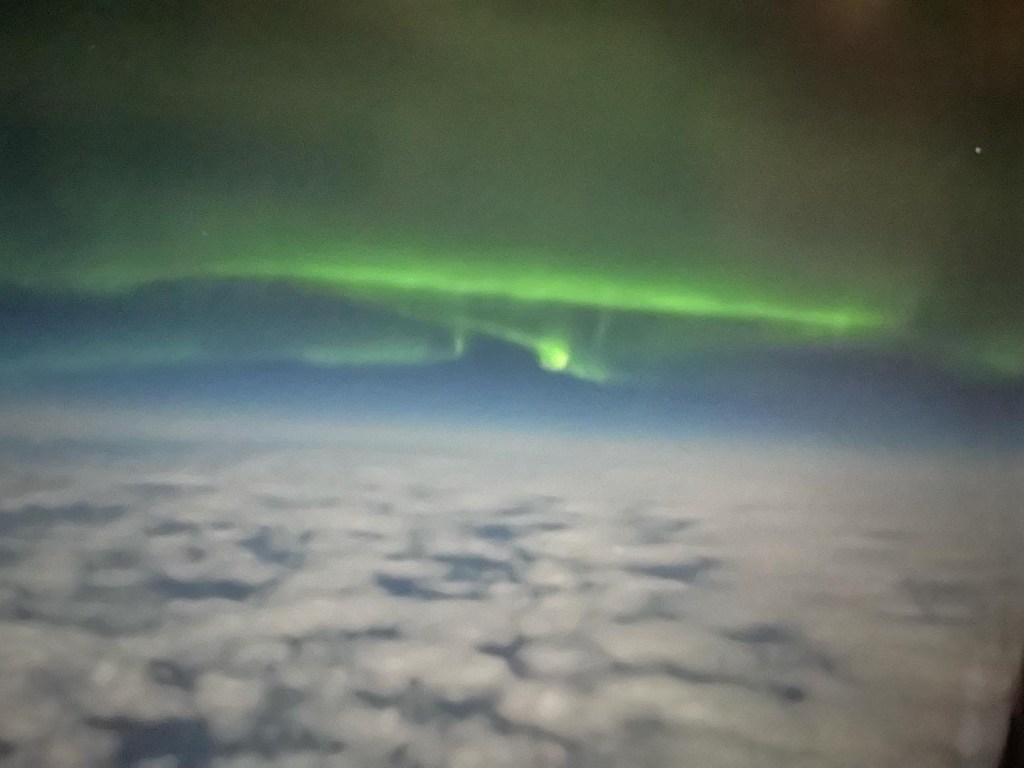
Sure enough, we arrived to heavy snow. That might have frustrated me, but I’d already seen the Northern Lights on this trip. We’d had an ace up our sleeve, a window seat facing north for the flight, which carried us over the snow-laden clouds, up where auroras dance. It’s there that I finally glimpsed it, checking a box I wondered when I’d ever get to. There’s still hope for more dances with Aurora, should the weather cooperate, beginning tonight. Bucket lists deserve more than a brief encounter to savor, don’t you think?
On a recent walk I noticed the recently painted median strip dividing the road featured artwork now and then. It seems they painted the road in autumn, as the oak leaves returned to the earth to close their cycle and begin again. A few rebels, wishing for immortality perhaps, found the opportunity to capture the moment. It struck me this was what all artists do; reach out from the anonymous mass of their moment and leave something of ourselves for others to find.
There’s something lovely in the temporary nature of this street art, akin to chalk drawings on sidewalks or sandcastles at low tide. Some art is meant to someday be a memory, recalled in quiet moments when you again walk down that street or on that particular stretch of beach. Do you remember the leaves of autumn, swirling in the wind? How quickly they fade from memory. We surf on a wisp of a moment, sometimes captured, mostly lost forever. We ought to embrace the freedom in that, elusive as it feels, for this is our fragile dance.
“If you would create something, you must be something.” ― Johann Wolfgang von Goethe
At times we hear the call from the naked page of a notebook, and at times from the middle of the road. Leaves locked in the amber of their moment are a whisper from seasons past to do something with this one. To feel the urgency of the season and make the most of it before the moment fades. This is the unique call of our work, leaping to our attention in the strangest of places. In each case, the question lingers in the moment: Where will you take us now?
Winter is different this year. The ground, frozen for weeks leading up to the New Year, thawed in a warming trend that hit New England in the first few weeks of the year. We sometimes say we’re grateful when it rains instead of snows here, knowing the general equation of one inch of rain equalling one foot of snow, but some of us actually prefer the snow. And when it finally came after the thaw and heavy rains, it made for muddy cleanup when you dared stray off the pavement. Yes, winter is finally here, sort of, and fashionably late, so enjoy it while you can. Just don’t go straying out on pond ice or try to steer a snowblower across the lawn to the shed. Each of these reckless acts will end in regret.
Plenty of friends and acquaintances celebrate a mild winter. Perennially overextended, they’d rather deal with snow on their terms, with a quick ride up I-93 to the ski resorts. “Let them have the snow;” they say, “we’d rather not deal with it here”. As if we aren’t meant to have it here. Here isn’t all that far from there, I think, and winter has retreated enough already.
I’m more sympathetic with the aged and the frail amongst us. Shoveling and navigating the world is a lot more complicated for them when you add heavy snow. This is where a sense of community is essential, to help those who might not be physically able to help themselves. Like snow, we accumulate awareness and empathy over time, and learn to check in on people more than we might have when we were younger and more carefree.
We witness the changes in those we know moving from vibrant wrestlers of winter conditions to a more fragile condition. On days of particularly heavy and wet snow, we learn to face our own move to a more fragile condition. They call it “heart attack snow” for a reason, and something as mundane as shoveling snow can be a reckless act if our heart isn’t up for the task. We ought to celebrate the things we can do now, like walking in snow through the woods to visit a pond or simply shoveling the deck, for one day it will be beyond our reach.
After cleaning up the remnants of the latest storm, I took a walk through the woods to see how winter was treating a local pond. During the drought of summer it had dropped to sad levels. With the rains of autumn and winter the water levels were back to normal and now coated with a slushy ice coating that wasn’t to be trusted. Still, it made for a pretty winter scene on a quiet winter morning. Moments like this are what we remember about winter, even as we forget that winter isn’t what it once was.
Facing the changes this winter, it’s easy to see that everything is connected. Everything has its time, maybe even normal winters. With things like climate and physical fitness, we ought to do what we can while we can. Regret is no way to cap a window of time when it closes.
The Welch-Dickey Loop Trail is one of the most popular trails in New Hampshire. There are many reasons for this, including its relative closeness compared to trails further north and its proximity to popular recreation destination Waterville Valley. But really, people hike this trail because the views are spectacular and you can do the hike in a few hours if you want to push, or linger with those views if you wish to take your time. In summer the blueberry bushes are generous and those ledges are great places to sit awhile. In winter, those ledges look like toboggan runs to a hard landing. Best to stick to the trail, wear spikes and respect the unforgiving nature of the White Mountains when people get careless.
As the name infers, there are two mountains on this 4.4 mile loop: Mount Welch and Mount Dickey. Both have a ton of exposed granite ledge that let the world open up for you, making the payoff in views exceptional for the effort expended. In summer, it’s a fun scramble up the granite, in winter, it’s strongly advisable to have micro spikes or crampons. Even with spikes on, I was very deliberate with every step hiking up Mount Welch. It’s not a trail to be doing in casual footwear in winter.
At some point along the way, I recognized that the prominence of the summit wasn’t ever my goal, it was simply getting out in nature at elevation, to a place where I earn the view with every step. I’ve been too distracted by numbers (48, 200 & 4000: there are 48 4000 foot mountains with a prominence of 200 feet or more) lately, forgetting that lists are not the point. While it’s in my nature to finish what I started and complete the 48, it took this winter hike on the Welch-Dickey Loop Trail to remind me that deep down I’m seeking experience, not validation. The numbers can take a hike. I’ll finish when I finish.
If you’re looking for incredible views with a relatively easy hike, the Welch-Dickey Loop Trail brings you to two summits of the five I’d recommend in New Hampshire, along with Mounts Monadnock, Major and Willard. In summer or during foliage season these hikes are maddeningly crowded on the weekends, but winter brings relative quiet and pristine beauty. Just remember those micro spikes.
The steep ledge scramble up Mount WelchWould you hike this without spikes?
Let us live in the land of the whispering trees, Alder and aspen and poplar and birch, Singing our prayers in a pale, sea-green breeze, With star-flower rosaries and moss banks for church. All of our dreams will be clearer than glass, Clad in the water or sun, as you wish, We will watch the white feet of the young morning pass And dine upon honey and small shiny fish. — Elizabeth Bishop, Let Us Live (With nod to The Book Binder’s Daughter)
I was describing the trails through nearby conservation land to a neighbor who sticks to running on pavement. She is reluctant to stray into the woods, blaming everything from the possibility of getting lost to hunting season. There are surely risks in the woods, but aren’t there also risks in never venturing into them? How do you find magic on pavement? Its only purpose is speed. Isn’t life fast enough already?
Humans have chosen to be bound to the clock and calendar where speed is valued more than meandering. More than lingering. More than reverence. We ought to put aside our schedules and listen more. The trees in the forest live in a timeless world, rooted to their ancestral home and holding things together for future generations.
We humans are rapidly closing out another year on the calendar. Did we meet our goals and realize our dreams? Are we making progress or slowly sliding backwards? Human lives are filled with such questions. We fill our lives with so much noise that it becomes hard to hear the answers.
A forest is a choir, singing to the universe. We’d be wise to listen. They suggest that we might choose a different life, free from such human constraints as clocks and calendars, yet sustained and rooted just the same. The forest, timeless as it is, whispers only one question: Just what do we dream of anyway?
Sunsets must be earned in winter. There are no casual seaside deck conversations with a few pictures between sips of rum. No, you must seek out December sunsets by going to where it falls into the bay while bracing against biting cold winds galloping towards you in a stampede of frothy fury. Still, it makes a pretty picture and another memory.
Micro-adventures and stolen moments of dancing with life count just the same as big trips and scheduled events. Life is our collection of all such experiences. We ought to sprinkle a bit more salt on our days to make them savory. For our best days are savored, aren’t they?
A visit to Walden Pond can be immersive, if you go at the right time. Many people go in summer to swim and enjoy the pristine water. Many fish for large mouth bass and other prizes. But the pilgrims go to visit Henry David Thoreau’s famous pond and the woods surrounding it. I’ve watched the place change over the years, but the pond and woods remain largely as Thoreau would recognize.
You must treat a brief visit to Walden as you would a visit to a nightclub with a cover charge. There’s a flat fee of $30 USD to park. That applies for an hour or the entire day. There’s a lower fee, apparently, for Massachusetts residents. I suppose you can also opt for other ways to get to Walden Pond, but this was the simplest way to spend time at a place. The area surrounding Walden Pond is a mix of highway, commuter railroad (as it was in Thoreau’s time), capped landfill and houses increasingly further out of reach for someone choosing the lifestyle of the person who made this place famous.
Early December is considered late autumn, but my visit felt more mid-autumn, with temperatures warmer than they should be this time of year. Henry David Thoreau would have shaken his head, I think, at some of the same behavior he observed in his day leading to the climate change we’re experiencing today but generally sitting on our hands about. But it made for a lovely day to walk around the pond.
There is a well-defined path around the pond. It’s maintained and easy for most walkers to navigate. They make you feel like you’re in a cattle chute for much of it, with wire strung on each side of the path to keep wanderers from straying off the path. Signage explains this as erosion control measures. As a hiker of the White Mountains in New Hampshire, I’m all too familiar with the impact of popularity on trails and the surrounding landscape. I stay to the path, liberated from the freedom to wander, I instead focused on the environment around me.
You can hear the world encroach on you at Walden. Distant highway sounds, construction, sirens, airplanes flying overhead and the commuter train all remind you that you’re in a suburb of Boston. It’s best to acknowledge this, but let it go as Thoreau let the train go as it went past in his time. The landscape is largely preserved, the water clear, awaiting those who would linger.
When I was younger, there was no visitor center, but there was a bath house. At some point well before I came into this world some well-meaning people decided that the best way to save Walden Pond was to make it a recreation center. So a bath house was built, beach sand extended and you had a destination for family recreation. Thoreau’s cabin is on the opposite shore from the bath house, but it’s the first thing you see when you walk down the visitor parking lot. You’re either at peace with it or not, but it’s relatively benign in the off-season.
Walden Woods extend well beyond the perimeter of the pond, and we can thank people like Don Henley for their commitment to preservation. Generations of developers find a way to squeeze as much money as they can from resources, and there are plenty of people who would turn the place inside out and up. There’s a place for development in this world, but there ought to be a place for preservation too.
I’d brought a water bottle with me on the walk, warm day that it was, and decided in a moment of inspiration to fill it with water from Walden Pond. Thoreau drank straight from the pond in his day, I’m not inclined to do that without a filter. Instead, I brought the water with me for another pilgrimage. Just across that highway is the center of Concord, where Thoreau and Ralph Waldo Emerson lived. Just beyond the center is the Sleepy Hollow Cemetery, site of Author’s Ridge, where Thoreau, Emerson, Alcott and others are buried. I stopped for a brief visit on Author’s Ridge, told of my visit to his old cabin site, and poured Henry a sip of Walden Pond. Cheers Henry.
Walden PondA view of the pond just down the hill from Thoreau’s cabin site. This is similar to the view he would have had.Pile of stones next to the cabin site. I’m not loving it, but cairns are how people seem to express themselves. The site to me feels like a construction site, cleared and ready to build.The cabin site is surrounded by granite pillars to denote the position and size of the cabin.Creative cairn art rising out of Walden Pond.
“The millions are awake enough for physical labor; but only one in a million is awake enough for effective intellectual exertion, only one in a hundred millions to a poetic or divine life. To be awake is to be alive. I have never yet met a man who was quite awake. How could I have looked him in the face? We must learn to reawaken and keep ourselves awake, not by mechanical aids, but by an infinite expectation of the dawn, which does not forsake us in our soundest sleep. I know of no more encouraging fact than the unquestionable ability of man to elevate his life by a conscious endeavor.” — Henry David Thoreau, Walden
How rare is the poetic or divine life today? It’s hard to say. In talking to people, there is a distinct lack of engagement in the workforce. A lack of inspiration for putting yourself into things, no passion for the work, a going through of the motions that must be reconciled. If one in a hundred million souls were sparked by the poetic or divine in Thoreau’s time, I wonder what the ratio is now?
Do we linger in a post-pandemic stupor? Is it a generational change as the kids raised with iPhones and social media and gaming become the primary fuel that powers economic and cultural life? Is it older generations, churned and manipulated, poked and prodded, finally having enough? Is it the relentlessly obvious climate change impacting everything while seemingly nothing is done about it? It makes you want to sail away sometimes, especially when you see how much fun those who did are having. But there’s inspired work to be done still, and clearly a need for more of us to lift others.
We must learn to reawaken and keep ourselves awake. We each have purpose in this lifetime that must be fulfilled. To do otherwise is to live in quiet desperation, as Henry would point out. But how do we keep ourselves awake in such a noisy, conflicted and demanding world? He showed the way, didn’t he? Walk away from the noise, find a quiet place to contemplate your place in the world and pay attention to what happens to you. He didn’t travel very far himself (his friends would take the short walk to visit him, and he them). Mostly, solitude is turning off the electronic babysitter and the insistent chatter of the uninspired and listening to yourself. Writing it all down surely helps.
Thoreau has always been my grounding rod. When I become disenchanted or feel that quiet desperation stirring inside or have simply had enough of the loud talkers in my world I return to Thoreau’s work, or visit his grave, or take a pilgrimage to Walden. He remains a voice of reason in an unreasonable world, speaking universal truths like so many time travelers. Their spark forever awake, forever informing, forever a beacon to light the way even as their physical selves forever rest.
From where do we derive hope and an infinite expectation of the dawn? Answers are inclined to find us. Don’t let its whisper be drowned out in the noise.