Category: Nature

  • Here It Comes! A Visit to Krimml Waterfall

    Live water heals memories. I look up the creek and here it comes, the future, being borne aloft as on a winding succession of laden trays. You may wake and look from the window and breathe the real air, and say, with satisfaction or with longing, “This is it.” But if you look up the creek, if you look up the creek in any weather, your spirit fills, and you are saying, with an exulting rise of the lungs, “Here it comes!” —Annie Dillard, Pilgrim at Tinker Creek

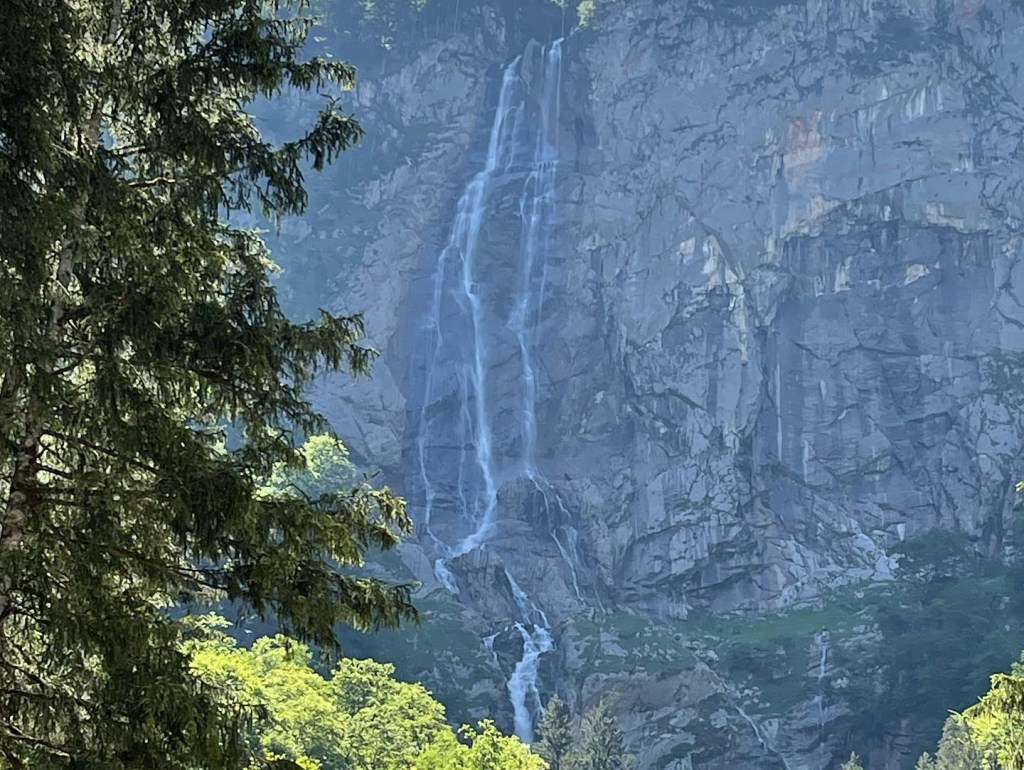
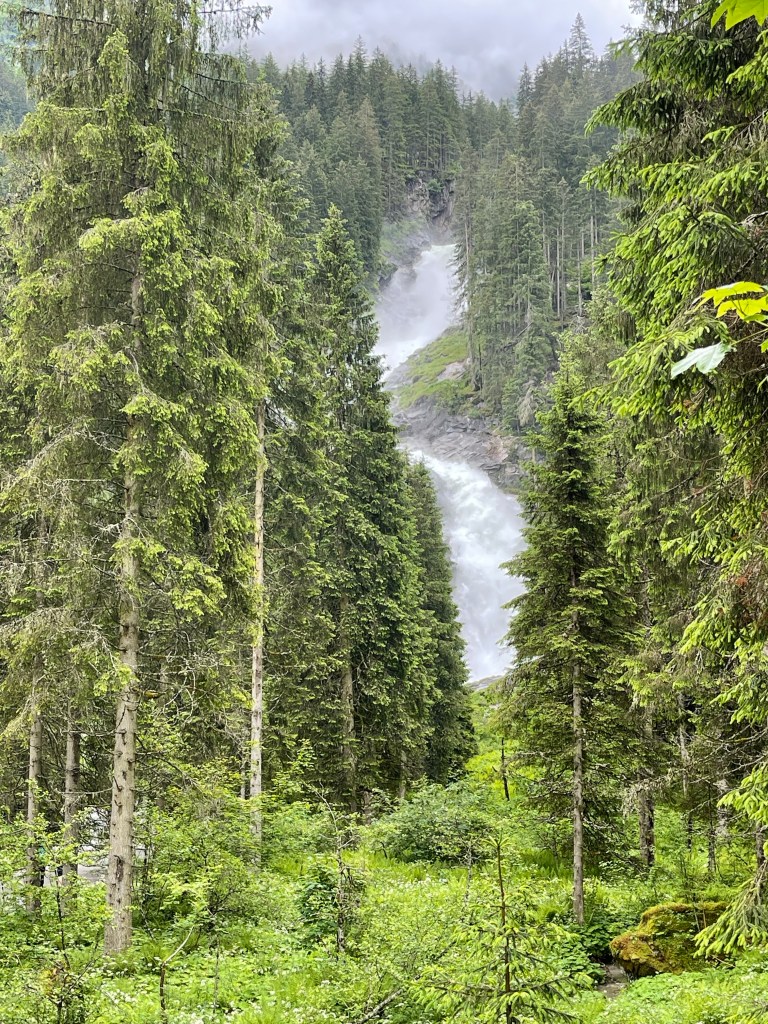
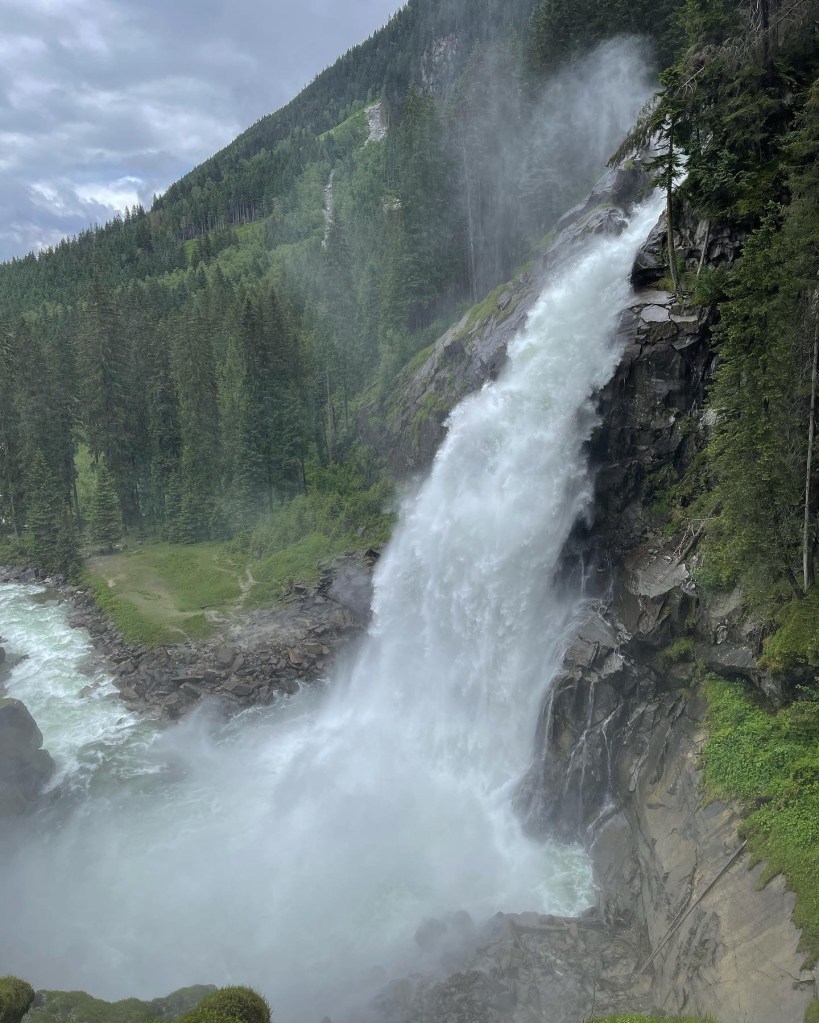
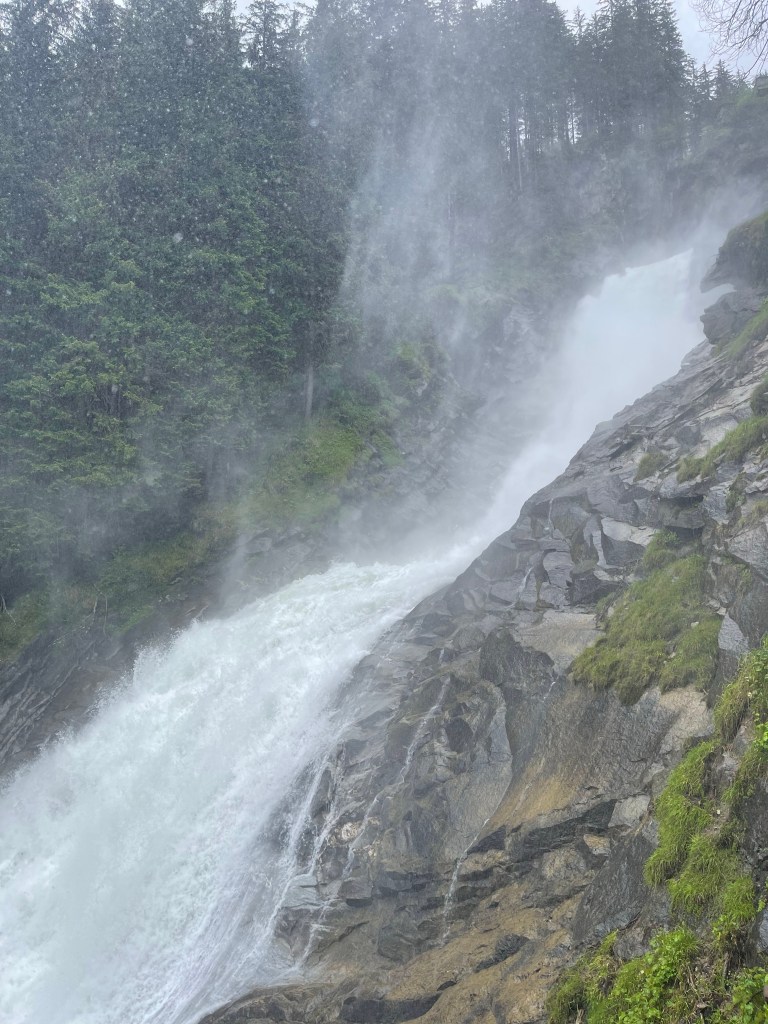
    I’m told that Krimml Wasserfall, or Krimmler Waterfall if you prefer, is the tallest waterfall in Europe. The cascades are broken up into distinct falls and the landscape makes it impossible to see the entire waterfall when you’re standing near it. Instead you hike up and discover the falls a bit at a time. With an hour to see them, this presented a slight problem—we simply couldn’t see the entire waterfall on this trip. But seeing half was quite impressive.

    It’s quite easy for your spirit to fill when you feel the spray swirl around you and hear the roar of frigid whitewater meeting stubborn rock. Maybe this is why we seek out big waterfalls, but small plunges offer their own lift. A giant like Krimml amplifies that spirit lift with awe. A visit locks in new memories.

  • Coming to Our Senses

    “Slow down and taste and smell and hear, and let your senses come alive. If you want a royal road to mysticism, sit down quietly and listen to all the sounds around you. You do not focus on any one sound; you try to hear them all. Oh, you’ll see the miracles that happen to you when your senses come unclogged.” — Anthony de Mello, Awareness

    The world wants us to focus on it. It calls to us constantly. Sure, those notifications on our phones and smart watches and other electronics are designed to capture our attention. Our to-do lists grow relentlessly longer. The demand for our attention has never been greater.

    There’s nothing wrong with letting it all drift away.

    Unclogging our senses brings us to them. Focus intently on a task at hand, or nothing at all. Recognize what matters when we get out and listen to nature, or our own voice. Walking is the great sifter of souls, shaking the nagging little things away. Why don’t we walk more?

    We think we’re too busy.

    We have so much noise in our lives that we don’t hear our own voice. We must sift it all away and find what really speaks to us. What is a better use of our time than listening to our own calling and taking meaningful action towards change? We can’t set our compass if we don’t step out into the world and find out where we are right now.

  • I Saw Tranquility

    “Deep in the forest there is something sacred that exists without a perceptible function. This is the central core, the navel of the world, and I want to return to that place.” — Hayao Miyazaki

    Last month I walked through a forest with several coworkers on a group hike. One of them commented that the naked trees were spooky and reminded him of The Blair Witch Project. I looked around and saw something completely different. And two days later I doubled down on that place and hiked alone in the dark before dawn with a failing headlamp. The things we do for love.

    So much of the world is what we perceive it to be. I may find tranquility in a stand of trees, someone else sees a buildable lot and the trees themselves as a commodity to haul off to the mill. America was built on such vision. Thankfully there are people who saw the land as something timeless and preserved it. Were we to level every forest where would we ever find ourselves?

    The trees are beginning to leaf out in the Northern Hemisphere, transforming the naked landscape. Soon the forest will hide things that are apparent in colder months. Leaves bring deep shade and mystery to the forest. Often what we see appears distinctly different from one person to another. What the forest is really showing us is not itself, but our own nature. My hiking friend that day saw horror in the naked forest. I saw tranquility.

  • Chickadee Advice

    In the golden hour before the dawn the black-capped chickadees talked amongst themselves, adding more and more high-pitched “dee-dee-dee’s” to their song the closer I walk to them. I’m the intruding loner early in the morning and this is their warning to each other. I may live here, but this isn’t my backyard—it’s always belonged to the birds since the time of dinosaurs. I’m just the latest affront to their ritual. Knowing my place, I behave and sit still to take stock of the waking world around me, assessing the frenzied week and contemplating the week ahead. A bit of stillness listening to chickadees is welcome.

    We choose what to pay attention to. Away from the din of urgency and outrage we might hear our own voice. We choose how we’ll react to whatever happens in our days. Each quiet morning offers a sabbatical of sorts. We need a bit of stillness now and then. A measure of calm between our storms to set the sails for what comes next. In stillness we decide what to do and be next.

    In the hushed quiet hour before the sunrise, those dee-dee-dee’s say something entirely different to us humans, if we’ll listen carefully to the call we’ll hear our own voice: Decide what you’ll be, be, be! Go on and see, see, see!

  • Ambient Noise

    After a few nights in New York and New Jersey, I returned to New Hampshire to reflect on the differences. I’d hiked in pristine woodland next to gorgeous streams, the kind of stuff you see regularly in the White Mountains of New Hampshire. I’d stayed in a beautiful resort surrounded by hills. I’d eaten at a vineyard next to a lovely river. I’d visited New York City itself, deep in the heart of it. And capped my visit to the city with a trip to Liberty Park in New Jersey with its striking Upper Bay view of Manhattan and the Statue of Liberty.

    It was all beautiful. The days and nights were lovely. The people were generous and friendly. You learn to love the spirit and energy and vibrancy of the place and miss it when you’re away from it. And yet I’ve never gotten used to the ambient noise.

    The Metropolitan New York region has a relentless buzz that stays around you all the time. If you live there you likely don’t even know it exists, but when you’re a country mouse coming to the big city regularly you pick right up on it. The automobile traffic, the air brakes on trucks, the train whistles, the sharp roar of planes and helicopters flying overhead, the steady rumble of ships on the Hudson River and the constant beeps and thumps and shouts of close proximity that collectively create a soundtrack of urban living. This soundtrack bleeds for miles up the Hudson River, far out into the Atlantic on Long Island and deep into the hills of New Jersey and Connecticut. It begins with the roar of the city and fades to the sound of sprawl.

    Hiking the amazing Harriman State Park next to a pristine river, you’d think the white noise would drown it all away. But reach a bit of elevation and you hear the traffic informing you that you must go even deeper into the green splashes that surround the map of New York City. Even Harriman, as big a green space as it is, has roads full of commuters cutting through it, like Central Park in the hills of the Hudson River Valley. Those roads surely serve, but they also detract if you let them. Don’t let them.

    For it’s all so very beautiful. Even the ambient noise, that guarantees no escape from the world, fades just enough when you focus on what they’ve protected from the sprawl. This is a place that offers the advantages and disadvantages of one of the greatest cities in the world, the constant beat of progress and growth and rising to the occasion that New York is famous for. But within an hour are these places like Harriman where you might immerse yourself in nature, so long as you accept the soundtrack playing way in the background and focus on the wind in the trees and the water finding its way through ancient boulder fields.

    The farther away you get from the ambient noise of New York the more faint it is. Somewhere along that spectrum of noise we reach a place where we feel the ambiance most vividly. Life isn’t about escaping from the world, but finding our place in it.
  • The Wind Always Speaks

    “If there seems to be no communication between you and the people around you, try to draw close to those things that will not ever leave you. The nights are still there and the winds that roam through the trees and over many lands.”Rainer Maria Rilke, Letters to a Young Poet

    We’re often alone in this world, but alone doesn’t require loneliness. These days gifted to us are full of routine and ritual, from how we wake up in the morning to where we sit and what we eat. Who we interact with is often our choice, but alas, not always. How we react to everything and everyone we interact with—or don’t interact with—is always our choice.

    Stepping outside on a spring day in New Hampshire, the world is alive in chatter. Birds and squirrels debate nest design or which yard has the best feeders today. A light wind might stir the tree tops like a hand brushing over tall grass, while a heavier wind might offer a gusty, heartfelt shake. No, there is no loneliness outside—the world is always present.

    The garden begins to awaken. Rabbits have nibbled the tops off of some early bulbs, inspiring a silent curse and a fence resurrected to stake a claim for beauty. Days are longer now and there’s more to see, but for the stars as they concede more and more to the sun. Every day brings a new voice to the yard as the migration continues northward. Flashes of blue are a regular part of the days now as the Bluebirds, present all winter at the feeder, decided to make the birdhouse their own once again.

    Every day is a poem. Every day offers an embrace when you step out to greet it. Even on the quietest of days, the wind always speaks.

  • What Do We Make Of This Texture?

    “What do I make of all this texture? What does it mean about the kind of world in which I have been set down? The texture of the world, its filigree and scrollwork, means that there is the possibility for beauty here, a beauty inexhaustible in its complexity, which opens to my knock, which answers in me a call I do not remember calling, and which trains me to the wild and extravagant nature of the spirit I seek… The texture of space is a condition of time. Time is the warp and matter the weft of the woven texture of beauty in space, and death is the hurtling shuttle.”
    Annie Dillard, Pilgrim at Tinker Creek

    “Every religion that does not affirm that God is hidden,” said Pascal flatly, “is not true.” What is man, that thou art mindful of him? This is where the great modern religions are so unthinkably radical: the love of God! For we can see that we are as many as the leaves of trees. But it could be that our faithlessness is a cowering cowardice born of our very smallness, a massive failure of imagination. Certainly nature seems to exult in abounding radicality, extremism, anarchy. If we were to judge nature by its common sense or likelihood, we wouldn’t believe the world existed. In nature, improbabilites are the one stock in trade. The whole creation is one lunatic fringe. If creation had been left up to me, I’m sure I wouldn’t have had the imagination or courage to do more than shape a single, reasonably sized atom, smooth as a snowball, and let it go at that. No claims of any and all revelations could be so far-fetched as a single giraffe. The question from agnosticism is, Who turned on the lights? The question from faith is, Whatever for?”Annie Dillard, Pilgrim at Tinker Creek

    At some point a month or two ago I gently put aside Pilgrim at Tinker Creek. It was right around when things got very busy, when bad news began to stack up around me like junk mail, when processing the deeper concepts behind Annie Dillard’s words became a bit more than I wanted to tackle at the moment. Everything has its time.

    Yet the questions remained.

    What do we make of all this texture? Every ridge line traversed, every waterfall’s mist tickling our skin, every deep conversation with another, every swim in a salty bay, and every sunrise glimpsed are but texture to our lives. But then again, so is every mosquito bite. It’s all so damned far-fetched, and yet here we are.

    I have a sister who is firmly in the God camp. I’m more skeptical of the Hallmark version of a loving God moving the world around like so many chess pieces. We both know life isn’t fair and throws you a curveball now and then to keep you on your toes. We just happen to disagree about “who” is winding up to throw it. And yet we peacefully coexist in both the universe and family dinners—we just don’t question each other’s beliefs.

    It’s easy to be outraged by the other side of the coin. They’re tossing around beliefs that just don’t jibe with our world views. Yet we’re the same coin. It’s fair to ask both “Who turned on the lights?” and “Whatever for?” We’re all asking our version of What’s It All About Alfie? Who said that we are ever meant to know the answers?

    Thankfully, we aren’t alone in pondering the imponderables; as with Dillard and Bacharach framing the questions in this post, we may draw on the wisdom of the ages at any time. Philosophy doesn’t answer the questions for you, but it does help you structure those questions better. We only have our short time to dance with the mysteries of the universe, and will never have all the answers.

    And yet… we get so caught up in the “who, what and why” questions that we forget to ask: How do we make the most of our present condition? For the universe only asks us to live in our time. You come to appreciate the tapestry of life a lot more when you learn to weave yourself into it and let the questions fall away.

  • The Late Night Star Run

    “The sky is the daily bread of the eyes.” — Ralph Waldo Emerson

    Last night offered a small chance to see the northern lights as the skies cleared just enough to open up the universe. What are you to do with an opportunity like that but chase after it? With son and daughter as my two co-conspirators we jumped in the truck and drove northward over twisting country roads. Higher elevations, darker skies, reason for hope to witness that elusive sky dance.

    We never did find the northern lights. Instead we found the starry dome, the wind whispering a chilly welcome, and time to catch up with each other in a random field far from home. The sky above didn’t disappoint, even as we recognized that it wasn’t going to show all its cards to our power trio. As the clouds rolled back in, we jumped back in the truck for the drive home. We agreed the chase was worthwhile, if only for the billion stars dancing infinitely above and for locking us in the amber of the moment in revelatory quiet below.

    We don’t just stumble upon revelation, we must seek it out. Having a spirit of adventure mixed with a sense of place may seem contradictory, as if chasing dreams means leaving home. But the spirit that calls is the universe, and it in turn is our place. You see it more clearly when you get away from the ambient light.

  • April Showers

    We are the first double-leaf sprout, two inches out of the ground.
    We need rain, or we may not grow more than this.
    — Rumi

    The rain rolled in right on schedule, really, timed to mask the Aurora Borealis thoroughly and keep my mind from wandering north. Quietly scheming to drop everything and drive as far north as necessary to be under the northern lights, it became a blessing when I saw there was no point in trying this time. Even as the geomagnetic activity caused a stir of excitement in the aurora community, Mother Nature mocked the audacity of those of us waiting for our turn in New Hampshire.

    April is the second month of the Roman calendar. Depending on the sources you believe, the name is derived from the Roman word Aprillis, for second, or aperio, which means to open up as a flower does. I’ll stick with the former, even as I recognize the world opening up around me. April showers help this process, even as it masks the magic in the universe.

    So be it. We need the rain. More importantly, I need to be present here and now, focused on things beyond my control. Let it rain. April showers wash away the last of winter and coax the earth to awaken in the gun-shy way annuals always approach April in New England. Stick your head up too quickly and you’ll end up freezing it off. Yet one day at a time the world begins to green once again.

    We asked the universe for clear skies, we received days of steady rain. These are the gifts we don’t always welcome in the moment, but come to appreciate some time down the path. For now we must be rooted, and using the stormy days for growth.

  • The Rhizome Remains

    “We do not know how life is going to turn out. Therefore the story has no beginning, and the end can only be vaguely hinted at. The life of man is a dubious experiment. It is a tremendous phenomenon only in numerical terms. Individually, it is so fleeting, so insufficient, that it is literally a miracle that anything can exist and develop at all. I was impressed by that fact long ago, as a young medical student, and it seemed to me miraculous that I should not have been prematurely annihilated. Life has always seemed to me like a plant that lives on its rhizome. Its true life is invisible, hidden in the rhizome. The part that appears above ground lasts only a single summer. Then it withers away — an ephemeral apparition.
    When we think of the unending growth and decay of life and civilizations, we cannot escape the impression of absolute nullity. Yet I have never lost a sense of something that lives and endures beneath the eternal flux. What we see is blossom, which passes. The rhizome remains. In the end the only events in my life worth telling are those when the imperishable world erupted into this transitory one. That is why I speak chiefly of inner experiences, amongst which I include my dreams and visions. These form the prima materia of my scientific work.”

    Carl Jung, Memories, Dreams, Reflections

    Our lifespan is but the bloom that eventually withers away, yet the rhizome remains in our spirit and the work we leave behind for others. Think of the traits we see carry from generation to generation. Think of the art and music that resonates long after the composer has withered away. We have people that stay with us for the rest of our days; we can see the twinkle in their eye, we can hear their laughter. Life is Jung’s ephemeral apparition, but as we feel of those who have transcended this world, the physical manifestation of our being isn’t all there is of us.

    Our season is very short, but rooted below the surface we’re anchored to eternity. And this, when you think about it, offers a bit of hope in this ridiculous game of living. For we come and go in our season, but our rhizome remains. There’s a sense of permanence in that, as we make the most of our impermanent time in bloom. We shine in our time and offer what we might to those who carry on.

    The present season, anchored to eternity