“Suppose we suddenly wake up and see that what we thought to be this and that, ain’t this and that at all?” — Jack Kerouac, The Dharma Bums
The world is full of revelations, for the way we see the world is never really how the world is. Collect enough revelations and you learn to take what people tell you at face value. People have funny beliefs about everything from political or religious affiliation to the subjectivity of the officiating at sporting events. Waking up to the truth in the world requires humility. We all think we’ve got it all figured out. Often what we figure out is that we didn’t really have anything figured out.
There’s been a plethora of articles in business publications recently about The Great Resignation. Millions of people decided to leave their jobs and to leap into another or just get out of the rat race entirely. I know a few of these people, and easily understand their desire to change things up. Millions of people looked around and said, “This can’t be my purpose here, can it?” They finally saw that it wasn’t all this and that.
Every day offers an opportunity to review all those things we think we have figured out. All those beliefs we cling to. Every day offers an opportunity to change it all. But it also presents an opportunity to celebrate what we have. Isn’t that something?
I live in the open mindedness of not knowing enough about anything. — Mary Oliver, Luna
There’s a liberation in knowing your limitations in this world. Understanding what you don’t know offers a fork in the road to either learn more or move on and embrace your ignorance. Which we choose is determined by who we want to be, or who we must be.
I was presented a wine list by a waiter during a team dinner at a high end restaurant. Scanning the list, I quickly found the familiar wines. And hundreds of wines I’d never heard of before, each categorized in general groupings based on the region of the world they came from. Determined to try something new, I welcomed the sommelier who quickly rattled off a few questions that brought us to a bottle. The sommelier and I each met that fork in the road at different points in time. Sometime in his past he embraced learning about each of those hundreds of bottles. When I reached that same fork he was right there to guide me. And every other name and region on that extensive list faded away from my mind.
Not knowing enough about anything and knowing just enough about something aren’t so different. Being open-minded about experiencing what the world brings you offers opportunity. Experience develops the confidence to accept what you’ll never know.
Lately I’ve doubled down on getting lost. Now, I understand that deliberately putting yourself into a place where you’re lost might seem counterintuitive and odd. But the thing about being lost is it forces you to find your way out, and this is where learning takes place.
Case in point: I dove into the deep end with learning languages, doubling down on French and German (!) and forcing myself further beyond my comfort zone with each. I’d been doing the bare minimum with French for a couple of years, never really proceeding beyond “Je m’appelle John. Je suis un homme.Où est le toilette?” Barely functional and not exactly conversational.
Something triggered me to dive deeper into lost. With French it was a lingering dissatisfaction with scratching the surface of feminine and masculine terminology, never diving into the nitty gritty because I stuck with the bare minimum to check the box for the day. With German, well, I booked a trip to Austria and Germany and forced my hand to figure it out.
The only way to truly learn a language is to immerse yourself in it. That’s true for a foreign language or the language of your craft. Want to understand the world of finance or a testing laboratory? Immerse yourself in that world and learn the world of pie charts or pipettes. Want to know how to build a house? Join a crew and start hauling lumber. Every apprentice begins completely lost in the world they’ve immersed themselves in. But then something funny happens—your hand is forced and you slowly, awkwardly begin to learn. We’ve all experienced this in school and in our earliest days after graduating and beginning careers. But then we get comfortable and stop challenging ourselves. We stop getting lost. And in our comfort we stop growing.
Taking the easy path slowly kills our learning and kills us in the process. Comfort kills our brains. Kills our dreams. Kills any momentum for big leaps and dramatic turns. In nature we grow or we die, there is no stasis. Yet so many seek stasis.
Maybe diving deeper into a couple of languages doesn’t quite equate to growing or dying. But then again, maybe it does. Challenging our own status quo begins with making ourselves uncomfortable now and then. It begins with stumbling through challenges and finding our way out of it. As with physical fitness, growth comes from stress. There are benefits to being lost. For in being lost we may find our way.
Build a new house down by the sea Get to the place we were meant to be You’ll know it when you smile —World Party, When the Rainbow Comes
Do you ever wonder why people are drawn to the seashore? Is it the taste of salt, or the sound of waves crashing on the beach? These are lovely things indeed. But I think it’s also the place where our world opens up to the universe, where the view is the same for us today as it was for some soul living 10,000 years ago. And so long as we don’t screw it up it will be the same 10,000 years hence. All rivers flow to the ocean, and so must we.
Ah, but what of the source? The rivers all flow from the highest points downward. And we often look up and wonder what we might find when we get there. For the mountains whisper differently than the sea, but no less persistently. When you walk amongst the peaks you feel like you might touch the sky, and the song in the wind feels as timeless as the crash of the ocean. Do we become breathless in the mountains from exertion or from awe? I should think both.
The thing is, we tend to be drawn to the edges; both source and sea. Yet most people settle in between. Is this a compromise between the places we love, or simply a pragmatic nod to efficiency? When you live at one end or the other you necessarily have a longer journey to the middle, let alone to what lies beyond. Crops don’t grow in beach sand or on granite summits. Somebody has to keep things going in the middle. Call it a happy medium if you will. But does settling in the middle like everyone else bring you happiness, or is it just settling?
Life pulls us in different directions, and most of us settle somewhere in the middle. But the magic resides at the edges of our comfort zone. And deep down you know you’ve reached the place you were meant to be when you smile.
“On every side, the eye ranged over successive circles of towns, rising one above another, like the terraces of a vineyard, till they were lost in the horizon. Wachusett is, in fact, the observatory of the State. There lay Massachusetts, spread out before us in its length and breadth, like a map. There was the level horizon, which told of the sea on the east and south, the well-known hills of New Hampshire on the north, and the misty summits of the Hoosac and Green Mountains, first made visible to us the evening before, blue and unsubstantial, like some bank of clouds which the morning wind would dissipate, on the northwest and west. These last distant ranges, on which the eye rests unwearied, commence with an abrupt boulder in the north, beyond the Connecticut, and travel southward, with three or four peaks dimly seen. But Monadnock, rearing its masculine front in the northwest, is the grandest feature.
As we beheld it, we knew that it was the height of land between the two rivers, on this side the valley of the Merrimack, or that of the Connecticut, fluctuating with their blue seas of air,—these rival vales, already teeming with Yankee men along their respective streams, born to what destiny who shall tell? Watatic, and the neighboring hills in this State and in New Hampshire, are a continuation of the same elevated range on which we were standing. But that New Hampshire bluff,–that promontory of a State,—lowering day and night on this our State of Massachusetts, will longest haunt our dreams.” — Henry David Thoreau, A Walk to Wachusett
Mount Wachusett is a glaciated monadnock, standing 2006 feet tall. Like her neighbor to the northwest, Mount Monadnock in New Hampshire, Mount Wachusett stands watch over the landscape that bows before her. You can’t talk about one mountain without mentioning the other, for they are forever kindred spirits in the landscape. Both mountains are uniquely positioned so that their waters flow to the Merrimack River from one side and to the Connecticut River from the other. The waters from each river run in my blood, which made a hike to the summit a sort of homecoming for me. And yet, for all the hikes I’ve done on Monadnock, I’d never hiked Wachusett.
This was a month where the weather continued to disappoint those who dream of deep snow drifts, while thrilling those who pine for a mild winter. Count me in the camp of the former: I wanted nothing more than to fly across snow plains this winter. A heavy snowfall the day before offered one last chance for the month. But it was quickly apparent that this was a micro spike hike, and the snow shoes were left behind yet again.
From the Visitor’s Center, you can easily summit Mount Wachusett in under 30 minutes. But that wasn’t our goal. Instead we took the Bicentennial Trail around the eastern slope to High Meadow Trail, up through a stand of Hemlocks to the Pine Hill Trail. Fluffy snow over ice creates uncertain footing, and we slowed our pace to mitigate the risk of injury. For a time, the only break in the trail ahead was from a porcupine, who’s distinct tail marked the trail in footprints and swirly plows. It seems most people cut to the chase and scramble up the mountain. We were more inclined to linger with it, to get to know it better. To feel what Thoreau felt when he and Richard Fuller hiked here from Concord, set up their tent atop the lonely summit, and had the place to themselves for a night.
Wachusett’s summit has changed since Thoreau’s time. There’s a ski slope on one side, there’s a mountain road you can drive up in the warmer months to see the view without earning it, and there’s ample parking for those cars. A few towers, including an observation tower, complete the scene. I wonder, reading Thoreau’s account, where did they pitch their tent and read Virgil by the light of a summer full moon?
Winter snow obscures much of the impact of man, but you’re still clearly in a manmade world when you’re on the summit of Mount Wachusett. To return to nature you must seek the trails that criss-cross around the reservation. But the views are largely the same as they were for Thoreau’s 180 years ago. Just as it was for him, Monadnock stands prominently as the grandest feature of the 360 degree view.
Inevitably we left with more to see, trails and old growth forest to explore another day. For this day I found what I was looking for. Time with an old friend hiking trails I’d always meant to get to one day. And a glimpse into a world Thoreau would find both foreign yet comfortably familiar. Wachusett is timelessly accessible, but somehow always felt apart from the mountains I sought out. We finally got acquainted with one another.
Summit tower, Mount Wachusett Distinctive porcupine tracks mark the trailPlenty of exposed granite despite the snowWhich way do we go? Plenty of choices.
There’s a tricky thing in writing—deep introspection is conveyed through outward expression. When you read a lot you stumble on some deeply damaged characters who had the courage to put it all out there on paper for others to see. I’ve mined myself similarly, but I don’t have the deep scars that others seem to have. Blame it on a good family growing up, but the fuel for the writing isn’t to draw out the pain of the past but rather to tap into the experience and intense gratitude of being alive at this time. That doesn’t mean there aren’t scars, how does anyone live an unsheltered life without scars? That which you once were is a memory that haunts you or spurs you towards becoming a better person. I’ve long ago buried the character I hated in myself, though he keeps trying to crawl out of his grave.
Decide what to be and go be it.
There’s a feeling that comes over you when you decide what to be. It’s like a magnet that pulls you in the direction you want to go in. My sailor and hiker friends know this, for it relentlessly pulls them towards their True North. I smile when someone questions why someone would put all their eggs in one basket. If you haven’t found your basket you can’t possibly know why others do what they do.
“I don’t want to swim in a roped off sea.” — Jimmy Buffett, Cowboy in the Jungle
We all have our calling. Do we listen to it or to the helpful guidance of others? When you find that direction, killing time on other things feels like you’re strangling yourself. Urgency and purpose demand your attention. The only way forward is deliberate action. Growing outward requires we stretch ourselves beyond what we once were, and then to keep doing it over and over again. To reach out towards where we want to be often means pulling away from what we once were.
“I tell you that as long as I can conceive something better than myself I cannot be easy unless I am striving to bring it into existence or clearing the way for it. That is the law of my life. That is the working within me of Life’s incessant aspiration to higher organization, wider, deeper, intenser self-consciousness, and clearer self-understanding.” — George Bernard Shaw, Man and Superman
I understand old George, for I’m right with him on this point. When we hear the siren, when we strive for something better than ourselves, we begin a lifetime process of chipping away at the stubborn facade that hides that potential deep inside. What we don’t quite realize when we begin is just how tough a journey this can be. For it takes a lifetime, and even then some, for we never quite reach what we aspire to, do we?
“I saw the angel in the marble and carved until I set him free.” – Michelangelo
Is it any wonder most people just skate in their lane? Who needs to lump more pressure on themselves when we can just enjoy where we are? Well-meaning friends and family remind you to keep your blinders on and stick with what brought you here. We experience this most deeply in work, where we’re often thought of as who we were when we walked in the door, not who we become as we grow and learn. Isn’t that why so many change jobs?
We aren’t salmon in a fish farm, we have streams and oceans to explore! We have an opportunity—an obligation—to reinvent ourselves daily. To reach for something better than ourselves in all that we do. Life is a short game, unfair and fickle. We’ll all leave something on the table in the end. Don’t let it be that which means the most. Aspire for that which you might be, and do the work to set it free.
“I don’t know what that means. To truly live.’… ‘To find work that you love and work harder than other men. To learn languages of the earth, and love the sounds of the words and the things they describe. To love food and music and drink. Fully love them. To love weather, and storms, and the smell of rain. To love heat. To love cold. To love sleep and dreams. To love the newness of each day.’ He stared at his hands. ‘To love women. To pleasure them. To make them laugh. To be foolish for them. To respect them. To listen to them’ He paused. ‘They are the lifegivers. To live is to love them’ ‘You will see,’ he said. ‘The proof will be in your living” ― Pete Hamill, Forever
Forever is one of those books that I’ve come back to a few times, and I celebrate the magic Pete Hamill weaves into the novel. We must weave magic into our own lives, mustn’t we? Books do that for us, even when the world itself doesn’t always measure up.
I’ve returned to reading the stack of fiction that’s been mocking my time with business and history books. I give a nod here to Forever, but my attention is on novels new to me that spin their own magic. Perhaps I’ll quote them in the blog, but certainly I’ll learn something from each writer’s style. What is your writing style? And is there enough magic weaved in to transform the reader?
The central character in Forever is a man named Cormac O’Connor who comes to New York City and lives forever as long as he doesn’t leave the island of Manhattan. When you live forever you get a chance to accumulate experiences and languages, master a musical instrument or two, navigate a few relationships from beginning to end, and reinvent yourself every new day. There’s joy and pain inherent in watching people come and go in your life, there’s accumulated wisdom of bringing each day’s lesson home with you.
You and I won’t live forever. But we too can accumulate our share of experiences and celebrate the newness of each day. We too can weave magic into our lives. Ultimately, the proof will be in our living.
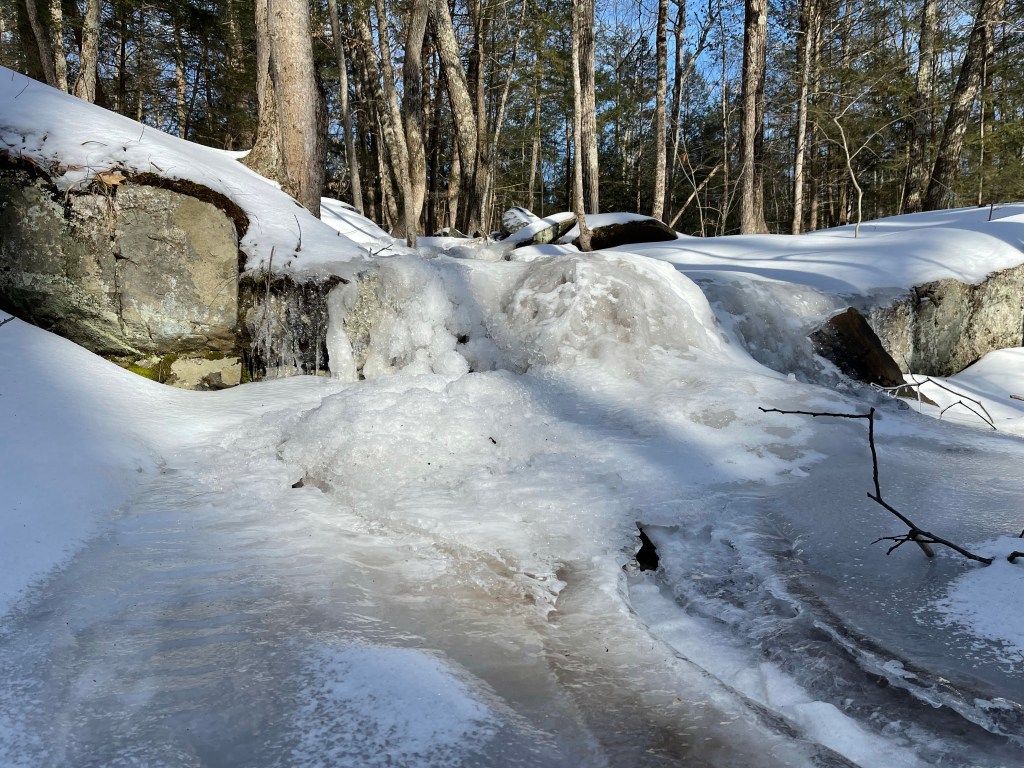
Friday offered heavy rain that turned to sleet and finally snow. With temperatures plummeting, this quickly turned into a frozen mess on the roads. And temperatures stayed well below freezing, guaranteeing that anything frozen was likely to stay that way for a few days. The snow was transformed to rock-hard ice, with a light frosting of granular snow atop it. It was perfect for slipping on boots and micro spikes and heading for the trails.
The same conditions that make roads miserable transform trails into magic carpet rides. Most of the sins of the trail are locked below the frozen hard pack, and with the right gear the trail is a joyful peregrinate through the wonders of the forest. Streams and waterfalls become sculpture. Granite recedes from primary feature to delightful accent locked in the ice blanket. The trail itself offers an entirely different experience than it did just days before when snowshoes were the kit of choice. In winter every day brings something new, should you go out to find it.
Much like the landscape around you, walking alone through the woods on a frozen but brilliant sunny day you become intensely embedded in the moment. You don’t walk with purpose to a destination, the walk is your destination. Every step becomes the point of your being here. With micro spikes announcing their grip on the ice, every step becomes a cry of Now! Here! Now!
I visit a frozen waterfall. I only seem to visit it in winter, when it’s locked away in ice, and each visit I tell myself I ought to stop by in spring when the water is running angry. We all feel locked away ourselves in winter, I suppose the waterfall and I are kindred spirits in this way. My visit becomes a vote of solidarity with the falls behind the ice. I promise once again that I’ll be back, and believe I mean it this time. The frozen waterfall is indifferent to my promises. All that matters is the present for a waterfall. The future lies upstream, waiting for its moment. Whether I’m here for it doesn’t matter to the waterfall.
I come across a few people along the way, couples and dog walkers and snowshoers gamely giving it a go on the ice. Read the room, folks. The trail betrays all who have come before me: fat tire tracks, boots, paw prints and snowshoe tracks. We believe we’re the only people on earth when we’re alone in the frozen woods, yet here was proof of all who came before, with all that you chance upon. You aren’t really alone in the woods, you’re alone in the moment. And there’s a measure of delight that washes over you as you make your way towards your own future.
Mellow is the man who knows what he’s been missing Many, many men can’t see the open road — Led Zeppelin, Over the Hills and Far Away
Huddled in a group at an Irish pub, four men scheming for the future: one free of obligations and ready to roam, one surfing the peak of his career and working to cash in before it crashes, one just riding the swell and hoping this time—this time— he’d caught the right wave, and me, a would-be writer and wanderer observing the human condition. I’m surfing my own wave, of course, but don’t we all dream of coming about, hoisting the main and sailing away instead?
“We labour at our daily work more ardently and thoughtlessly than is necessary to sustain our life because it is even more necessary not to have leisure to stop and think. Haste is universal because everyone is in flight from himself.” ― Friedrich Nietzsche, Untimely Meditations
Nowadays we can all see what we’ve been missing in YouTube videos, Instagram and Facebook posts, or wherever you choose to live vicariously through the lens of others. My own favorite footage often involves drones flying above stunning landscapes, as if I were flying myself. And don’t we all wish to fly?
But the question is, do we wish to fly away from something or towards something? For life is short and we can’t waste our precious time running away from ourselves. Yet so many do, in distraction and debauchery and debate. It’s easy to run away, but impossible to really get away from that nagging discontent.
Old friend Henry David Thoreau pointed out that “the mass of men lead lives of quiet desperation.” He would also say that, “So thoroughly and sincerely are we compelled to live, reverencing our life, and denying the possibility of change. This is the only way, we say; but there are as many ways as there can be drawn radii from one centre. All change is a miracle to contemplate; but it is a miracle which is taking place every instant.”
In other words, life is change, everything is changing around us even as we debate what we ought to do with ourselves. Which brings me back to a constant refrain: We must decide what to be and go be it. And be content with that which we leave behind.