Category: Travel

  • There Once Was a Sink From Nantucket

    The last few days have been a whirlwind.  Running all over creation in search of a viable solution to a vexing problem: an undersized vanity and a hard deadline from the countertop people.

    It started off innocently enough.  We had the sink we needed, we had the countertop ordered and the vanity was installed by yours truly over the weekend.  Everything was in screaming successful installation….  which made me nervous.  Nothing is easy and this couldn’t be THAT easy, right?  Right.  Dry fitting the sink I discovered that it was too deep, and I had a guy coming to measure the template and pick up the sink for installation in two days(!!).

    I returned the sink for a smaller one and drove it down on Tuesday to meet the counter guy.  Dry fit revealed it too was too big.  Cursing myself for not bringing the measurements with me, I quickly drove to Wareham to see what the plumbing supply place had.  No go.  Home Depot? No go.  Lowe’s?  No… go.  So I hustled back with the smallest sink they stocked and realized it too was too big.  Meeting the counter guy, I told him I’d be by their shop tomorrow (today) with a smaller one.

    Quick online searches and some phone calls brought relief – one left in stock in Boston!  Buy it now to hold it and pick it up in the morning!  Whew!

    This morning I got up at 4 AM, drove to Boston to pick up the sink, drove it to Bourne and proudly handed it to the salesperson.  Her response?  We have this same sink in the next room.  See?   Life is either a grand adventure or nothing at all.  But it’s best to check local stock before you drive all over creation trying to find something that was right under your nose the whole time.

  • Candlemas Massacre: The Raid on York

    Wandering around New England today, it’s difficult to imagine this place as the frontier and a war zone.  But you don’t have to look far to see evidence of ancient atrocities.  In 1692 one of those atrocities took place in York, Maine.  200-300 Penobscot Indians led by sachem Madockawando and Father Louis-Pierre Thury, a French missionary but no man of God.

    There were clearly a lot of horrific things done to the Native Americans over the years, but its simplistic to say that they were always the victims.  Madockawando’s Penobscot warriors, like the Abenaki, were vicious warriors who would kill innocent women and children as quickly as they’d kill an armed soldier.  There are stories of torturing and murdering prisoners that are as bad as any other atrocity I’ve heard about in history.

    Candlemas is the feast of the Presentation of the Lord, which takes place 40 days after the birth of Jesus.  It’s a holy day for Christians, and the faithful of York no doubt looked at it as a day of spiritual celebration.  Unfortunately, York was the edge of the wilderness in 1692, and right in the middle of King William’s War between the English and the French.  Raiding English settlers was considered fair game by the French and their Native American allies.  Scalps were considered proof that they had killed someone, and they were rewarded for every scalp, whether it was a man, woman or child’s.

    On January 24th, 1692, the morning after Candlemas Day celebrations, the Penobscot warriors left their snowshoes on a large, flat rock and raided the settlement of York.  They burned 17-18 houses, killed 75 people and marched between 100-200 more to New France as prisoners.  Several of these prisoners died during the march north, others were eventually set free when the English paid a ransom.

    The rock that the raiding warriors used to lay their snowshoes on was preserved and used as a memorial for the victims of the raid.  You could easily drive past it on Chases Pond Road without realizing what it is, a simple memorial set into the rock, on a small plot of land lined with stones and woodland behind it.  It wouldn’t be hard to envision the Penobscot warriors walking through the woods and setting those snowshoes down.  Walking around and placing a hand on the rock is a handshake with history, and a reminder of the harsh environment our ancestors lived in 327 years ago.  In another nod to history, someone named one of the nearby side roads Snowshoe Spring.  Otherwise this could be any other stretch of country road in New England.


  • Boulder Hopping

    When I was a kid I’d spend hours climbing on boulders, hopping from one to the next like a goat.  As I got older this tendency didn’t fade.  Instead, the boulders got bigger.  Hiking a boulder cove on a White Mountain trail is still a delight and I hope it always will be.  Perhaps the ultimate boulder hopping adventure is Muhoosuc Notch in Maine.  Once you’ve done this “toughest mile of the Appalachian Trail”, you’ll know what boulder hopping is all about.

    A similar, less strenuous experience is walking along a long jetty that hasn’t been civilized for the general population.  A jetty that’s basically a pile of rocks extended out into the water is much more interesting than, say, the Rockland Breakwater.  Both serve the same utilitarian purpose, but the secondary benefit of each is very different.  The relatively flat Rockland Breakwater allows you to look around a bit instead of constantly checking where you’re going to land your foot next.  Hopping from rock to rock can be compared to working on a jigsaw puzzle in that it requires a high level of concentration, which becomes meditative.  Another analogy might be playing chess, where you’re thinking a few moves ahead to ensure success.

    Stepping stones in a stream are another form of boulder hopping, and offers it’s own reward as well as risk.  Gauging distance between stones, the level of traction you’ll experience when you land on it and the relative stability of the stone are critical components to your overall success in staying dry and getting where you need to go.

    Ultimately the analogy of stepping stones and one’s career is overused, so I’m not going to dwell on that here.  To me the exhilaration of jumping from one boulder to the next is enough.  I’ve never come across a pile of rocks that I haven’t wanted to crawl over or hop from one to the next.  Or a scattering of boulders on a body of water that I haven’t mentally played connect the dots with to determine the best way to land on each without stepping on the same stone twice.  That’s not unlike points on a map, is it?


  • Day One

    One day or day one.  You decide. – Paolo Coelho

    Knocking off a few projects this weekend.  Have some big projects still in front of me.  This quote hits the mark on a few levels.  At the root it’s message of beginning instead of waiting for the right time is dead on.

    Onward.

  • Bay View

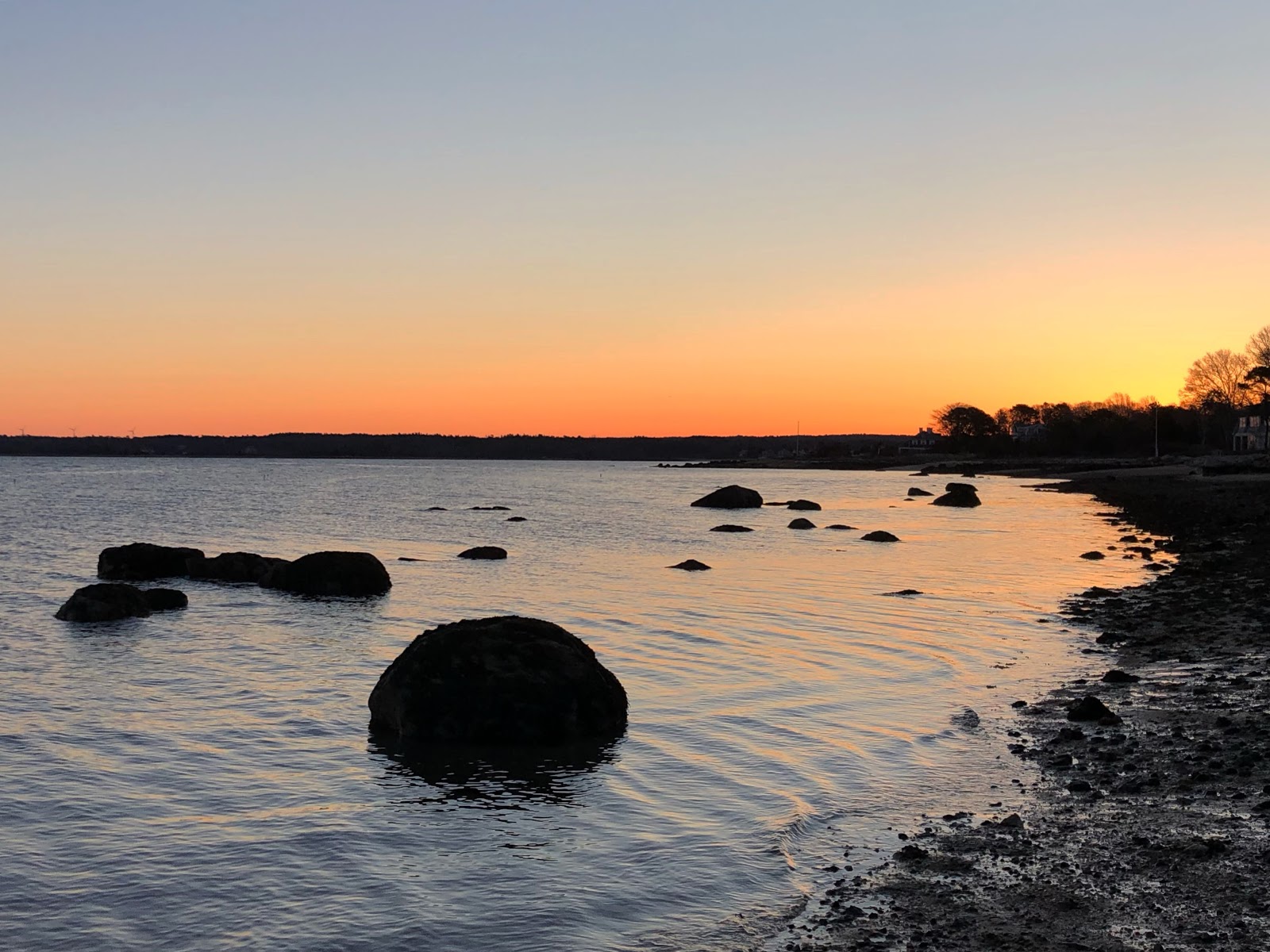
    Looking out at Buzzards Bay again tonight, and it occurred to me that I’m likely going to spend more time here in the winter and spring than I will this summer.  Strange to think that, but the reality is I only have so much vacation time and the family’s demand for the house is very high in summer.  Nothing shocking in that I suppose.

    Winter brings its own benefits.  No traffic, no lines at the Lobster Trap, no mosquitoes…   but no swims in the bay, no reading a book on the beach while the sun dries you off, no casual deck time.  But I’m on the cape, and it’s hard to find anything wrong with that.

  • Working Around the Edges

    It occurred to me that many of my bucket list places to visit skirt the outer edges of populated areas.  I’ve written about a few places that are literally the edges – like the precipitous cliffs of Portugal and the easternmost point of the North American Continent in Cape St. Vincent, Newfoundland.  I love being in places like that, and I’ll continue to seek them out as long as I’m able to.

    I’m as eager to see Torngat Mountains National Park deep in Labrador as I am to see Paris.  I’m looking forward to visiting London later this year, but anticipate the Northern Highlands of Scotland just as much.  I want to see New Zealand as much or more than I want to see Hawaii.  And while I love the energy in New York City, I adore the stillness of a forest or the beach in winter.

    Perhaps I’m a loner at heart.  That doesn’t mean I don’t thrive around people, but I don’t need people to be content.  I appreciate solitude.  Which is a good thing since the bulk of my job puts me alone in a car or a hotel room.  I’ve become self-sufficient in travel, and in many parts of daily life.  Stick me by myself in a garden weeding and I’m just as happy as I am when I’m at a family party.  I think that level of contentment within your own mind is a good thing.  I don’t need noise to drown out my own thoughts.

    Maybe I should have been a lighthouse keeper.  Or a meteorologist on the summit of Mount Washington.  Or a solo through hiker on the Appalachian Trail.  But then again, I’m a traveling salesperson, a gardener, a solo walker, a rower.  Isolation isn’t the aim – I greatly enjoy those I’ve built my life around and banter with those I’ve just met – but when I need it it’s a welcome partner in my journey deep into the soul.

  • Scol!

    There’s a several scenes from my favorite movie Local Hero that I replay in my head.  This scene is on the beach, while Mac and the locals wait for Ben and Happer to finish their long meeting in the beach hut.  They all pour brandy into styrofoam cups and Mac offers a toast:

    Mac: “Well, sláinte, everybody.”
    Locals: “Eh? What?”  
    Mac: “Sláinte?”
    Russian: “skål!”
    Local Scot:  “Skol!”
    All:  “Cheers!”

    I’m familiar with sláinte.  And in fact I just wrote about it on St. Patrick’s Day.  But Scol was something I wondered about…  So I had to look it up of course.  According to the online Dictionary of Scots Language:

    Scol(l, Skoll, n. Also: scole, skole, scoall, scoill, skoill.
    [Only Sc. till the 19th c. Norw., Dan. skall, ON skál, whence also Scale n.1
    Perhaps, OED conjectures, ‘introduced through the visit of James VI to Denmark in 1589’.]

    A drink taken as evidence of the drinker’s good wishes for the welfare of another person or other persons; (a person’s) ‘health’; a toast; also, the cup or glass from which the health is drunk. Also, scoll of drink.

    As an American saying sláinte! in St. Patrick’s Day toasts it’s easy to feel a bit like you’re hijacking a phrase that doesn’t belong to you.  And maybe that’s why Mac’s toast and the local’s confused reaction resonates for me.  We’re all just posers borrowing clever phrases.  But since we’re all just raising a glass to the good health of those we’re with, I don’t think they’d mind all that much.

    A darker origin of the toast may come from the Vikings, who would drink from the skull of the tribal leader they just killed after battle.  This was a tribute to those who fought well but lost, and helped ensure that they would enter Valhalla.  They apparently would chant skol!  Skol!  Skol! as they went into battle, and then enjoy a toast to the fruits of their labor in the skull of the vanquished leader.  I think I’d prefer the styrofoam cup, thank you.

  • Spring Equinox

    Last day of winter.  As winters go this one was pretty mild.  I’m okay with that.  I haven’t embraced winter this season like I have in some other seasons.  No skiing, no sledding, no ice skating, no winter hiking….  and no complaints.  I like all those things and hope to do them all next winter.  But this winter, or at least the last 24 hours of it, is just about over.

    I hope spring is kind to us.

  • Evacuation Day

    March 17th is of course St. Patrick’s Day, and Boston celebrates this day as well as anyone with the parade in South Boston and taverns overflowing with Irish and Irish-for-the-day revelers.  But Boston has another reason to celebrate the day that is unique to the city.  On March 17, 1776 Boston’s long siege ended as the British evacuated the city and sailed to Halifax.  Boston has marked this date forever since as Evacuation Day, and it remains a city holiday to this day.

    The siege may have continued on indefinitely had Colonel Henry Knox not pulled off the Herculean task of hauling cannon from Fort Ticonderoga and Crown Point to Dorchester Heights.  The British had the naval strength to continue controlling the harbor, meaning the siege was an inconvenience but the loyalists and British in Boston wouldn’t starve.  It was only when they saw the cannon on Dorchester Heights that they realized the dangerous position that put them in and chose to pull out.

    There are many people who roll their eyes at Evacuation Day as a city holiday.  They surmise, perhaps correctly, that it’s an excuse to have a day off for the drinking, parade and extracurricular activity of St. Patrick’s Day.  But if you’re a history buff it’s a great day to celebrate.

    Today is Evacuation Day at home as well, as both kids head back to college.  This is bittersweet of course, but ultimately a necessary rite of passage as they both move deeper into adulthood.  My hope is that they get safely back to school before the drunks hit the road after a long day of celebratory drinking.

  • Sláinte

    Cheers.  Or to your good health.  Whatever.  “Sláinte” is your typical Gaelic toast when you clink glasses and have a drink with your best friends or your best friends for the moment.  So on this St. Patrick’s Day, let me take this moment to say sláinte to you!