Category: Garden and Home

  • Catkins and Helicopters and Life at the Edge of the Woods

    When you live on the edge of the woods you become part of the woods. The plants of the woods want to be a part of your garden. The creatures of the woods want to roam free in the clearing that you’ve made for them, and swim (sometimes unsuccessfully) in the pool you’ve placed as an offering. And the pollen, seeds and nuts make an airborne assault on… everything.

    Living here on the edge of the woods for twenty years now, I’ve learned the habits of the woods; just as I know which neighbors mow on Sunday, I know roughly when the acorns and hickory nuts start raining down in the fall, and roughly when the oak catkins and the maple helicopters will fly in spring. Yesterday was day one of the helicopter assault. Tens of thousands of them whirled down into everything – the pool, the deck, the flower beds, into the potted plants, the gutter… everywhere. And I know they’re not done. Looking up into the maples you see clumps of willing volunteers poised to make their own flight. No, it’s not over yet.

    Meanwhile the catkins quietly prepare for their own assault. Oaks do everything later than the maples. They leaf out later, turn color later, and drop their leaves much later in the fall. Everything has its time, and the oaks don’t rush anything. They’ve made probing missions already, but I know they’re holding out until I’ve cleaned up the yard.

    So the pool skimmers pile up clumps of soggy muck that need to be scooped out every morning, and sometimes during heavy assaults a couple of times a day. The patio has its own artwork going, with seed pods and clumps of catkins glued together with pollen, and moss and weeds popping up as the temperatures pull the trigger on the starting gun. Picasso has nothing on Mother Nature. <sigh> Add weeding to the to-do list. And the cleanup begins again, and then again still, until the woods concede another season to me. But we both know they’ve got time in their side.

  • Lilacs in Bloom

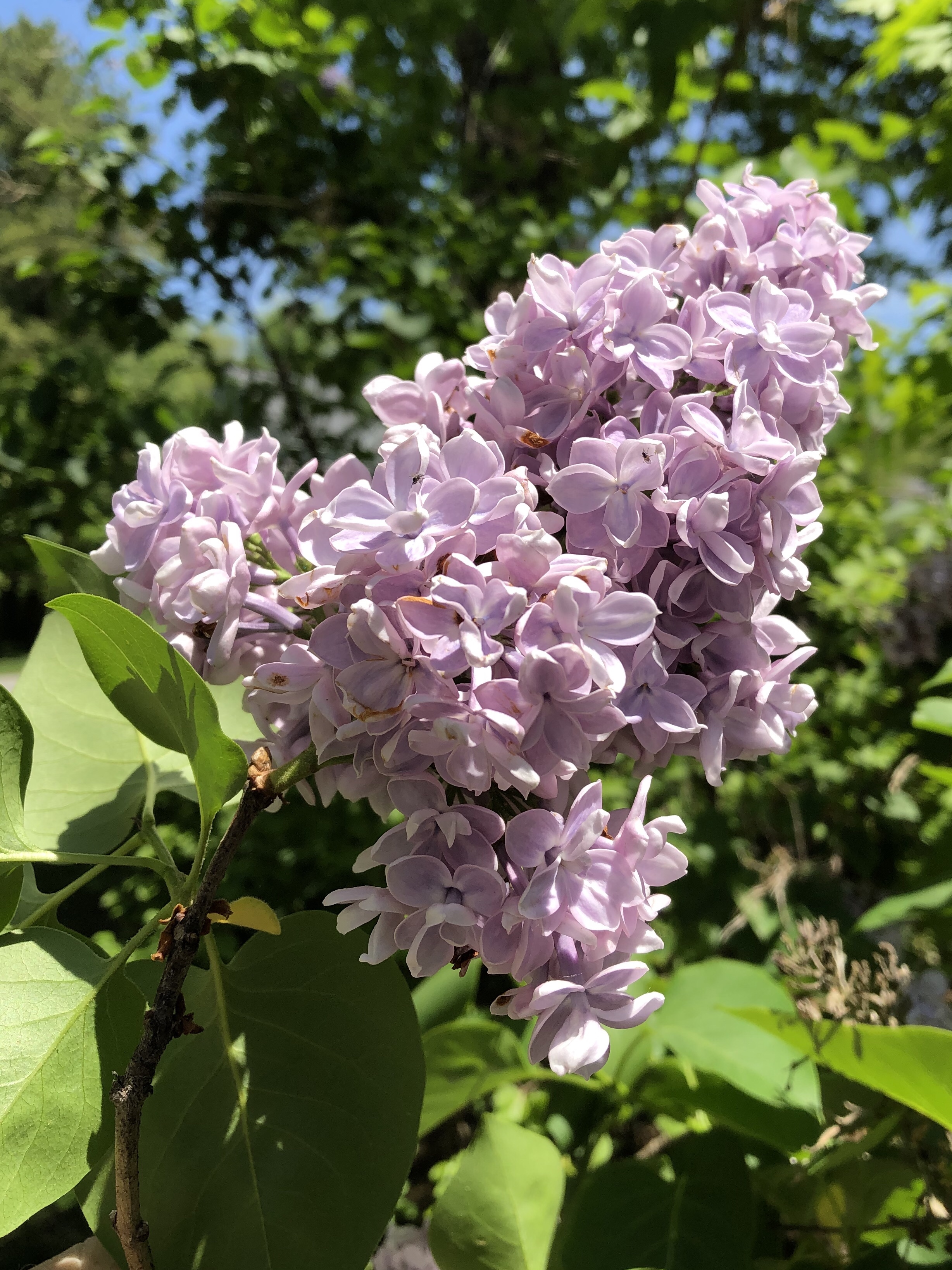
    A garden is a complete sensory experience, and any gardener will tell you that the smells of the garden are as memorable as the sights.  Monarda smells like tea leaves (because they are), tomatoes and marigolds announce the return of summer with a sniff of their leaves and stems.  Basil, mint, rosemary and other herbs have their own delightful fragrance. And of course the flowers offer their own too.  We’re witnessing the long parade of flowers each in turn announcing their time to shine.  For the last couple of weeks that time has belonged to the lilacs.  Their dance isn’t nearly long enough before they recede into the background of the garden like most flowering shrubs.  The magic in lilacs is the fragrance. And they sway in the breeze releasing it to all who come nearby. I make a point of visiting every chance I get, but notice others who love lilacs as much as I do never make the effort to pay them a visit. So I quietly bring them inside to perfume the kitchen. And celebrate spring in New Hampshire.


  • Catalpa

    Sitting at Boston Medical Center for an appointment earlier today I looked up to see a pair of Catalpa trees in full bloom. There’s nothing like a Catalpa tree, whether in bloom or later in the year when giant string bean-like fruits dangle off the branches. It’s a tree that I once promised myself I’d plant, but alas the yard isn’t right for a tree of this size.

    When I was in 8th grade my family moved to Chelmsford, Massachusetts to a beautiful old Victorian house with four acres of land. The house had four apple trees and a giant Catalpa tree right in the center of the yard. In front of the Catalpa was a large lawn that we’d play games on. We watched our dog get run over by a neighbor one day while playing kickball. Behind the Catalpa we rigged up a tire swing on a maple tree and would see how high we could go. One of the neighborhood girls whom I had a crush on passed away this year from cancer. We haven’t lived in that house in 34 years and I haven’t seen her since at least then.  Funny the things that spark your memories.
    Since then those who came after us tore down the old barn and the tack room that were attached to the house. I used to envision converting that barn into a living space. Such are the dreams of a teenager. I had a real connection to that house until I went off to college and our parents divorced. Those who came after us also ripped out the old lilacs that grew along the border with the neighbors. They changed the color of the house back to white.  I’m sure they did a lot more than I can see from a drive-by or a virtual Google street view flyby.  Whatever, it’s their house now – I just lived there once upon a time.  But that time was memorable for a lot of reasons; good and bad.  I miss the house but I don’t spend a lot of time pining for the days in Chelmsford.  I moved in as a 13 year old, moved out as a 19 year old.  So almost my entire teenage years were spent in that house.  A lot has happened in 34 years.  I’m happy to know that that Catalpa tree is still there, blooming year after year. It’s outlasted a lot of things in its time.

  • Apple Blossoms in the Woods

    Sitting in traffic a couple of weeks ago on Route 110 in Chelmsford, Massachusetts I glanced over at an old apple tree blossoming in the woods. The woods have grown up around it, shading the tree, but it was still throwing out blossoms to be pollinated for fruit. The average apple tree lives about as long as a lucky human – about 100 years.  If your typical farmer in 1920 is 30 years old when they plant the tree it’s likely to outlive them, and maybe their children too.  Like people, an apple tree reaches towards immortality by reproducing, and this tree was working hard to ensure that.

    New England is not an easy place to be a farmer, or to maintain orchards. Short, fickle growing seasons, harsh winters and encroaching development makes farming a challenging livelihood. Farms run out of steam as children choose a different career path, farmers near retirement and the lure of the real estate payday becomes increasingly attractive.  How many farms and apple orchards have been swallowed up by urban sprawl?  More than I’d care to think about.

    The tree I saw was swallowed up by woodland instead.  Farms that aren’t worked return to the woods eventually.  Native trees compete for light and strive to outgrow each other.  An old apple tree doesn’t stand much of a chance over time when the trees come back.  The woods of New England have many such apple trees, which like stone walls and old cellar holes live well past the farmers who introduced them to this place. But unlike stones an apple tree is a living, breathing witness to the history of this plot of land. Eventually the woods will shade the tree so much that it dies and returns to the earth. But not yet. Perhaps the apples will reach the ground, and the seeds will root another tree to replace its parent. The odds are stacked against it though. And yet, this spring the white blossoms signal hope for future generations.

  • New England Hops

    New England was once the hop growing capital of North America.  Like the population, it migrated to New York and eventually to the west coast.  But it all started here, introduced by the Massachusetts Bay Company in 1629, making it one of the original crops brought to North America.  Potatoes wouldn’t be introduced for almost another century.  So beer played an important role in the life of the earliest settlers.  The Puritans were pretty good at growing hops and eventually began exporting the harvest to other colonies.

    If there is a problem with growing hops in New England, it’s the humidity.  Hops are susceptible to downey mildew, which can devastate an entire crop.  Downy mildew and other factors like Prohibition eventually led to the entire hop growing industry shifting to the west.  In my younger beer drinking years I thought of hops as a west coast crop, and my experience growing a single hop bine proved futile enough to make me believe it wasn’t meant for New Hampshire’s climate.  And yet it was indeed a viable and profitable crop for almost 300 years.

    Today’s explosive growth in micro-brewing has fueled a resurgence in local hop growing.  Driving around Vermont and New York you can easily spot the hops growing in farms and even in urban breweries.  Growers will built tall support structures of wooden poles and string strong cables across the tops.  From these vertical cables run from the ground to the horizontal cables, forming 20 foot long channels for the hop bines to grow.  The hops are usually harvested in August and September and give unique bitter characteristics to the beer.  So we’ve come full circle, and hops are once again a viable local crop.


  • Leafing Out

    Mid-May; the time of year when the bones of the northern New England forests are once again masked in greens and yellows. Tree trunks, stone walls and other hardscape details disappear into clouds of leaves and shadows. The calendar says it’s been spring for awhile but it doesn’t really feel like it until the trees leaf out.

    Southern New Hampshire is officially Zone 5, and you really notice it this time of year when you travel regionally as much as I do. A trip to New York or Cape Cod can feel like a different world in early May. Zones 6 & 7 are that much further ahead of us. A trip further north reveals our own good fortune.

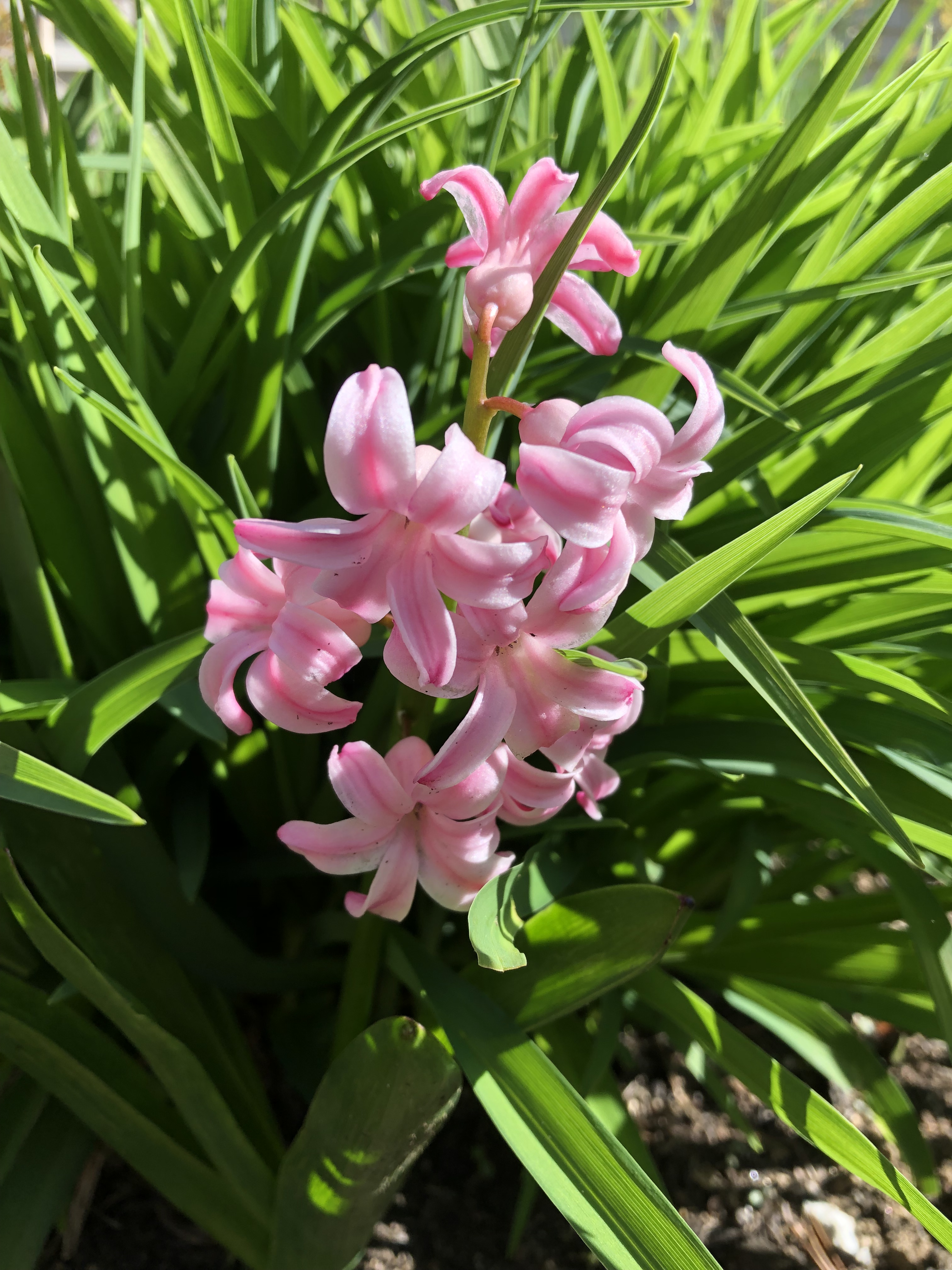
    Flowering trees and shrubs are well underway, while daffodils are just past their peak. Now and then you get a surprise from a bulb that’s way behind popping up to say hello. A single pink Hyacinth poked through a day lily to announce it was time.

    These are the early days of the growing season. Still a danger of frost lingering in the minds of eager gardeners, but safe for some plants. We haven’t seen the heat of summer yet, but we can anticipate it. This is mid-May and mid-spring all at once. Best to enjoy the show because it never lasts long.

  • Seeing Green

    “As if the earth sent forth an inward heat to greet the returning sun; not yellow but green is the color of its flame; – the symbol of perpetual youth, the grass-blade, like a long green ribbon, streams from the sod into the summer, checked indeed by the frost, but anon pushing on again, lifting its spear of last year’s hay with the fresh life below…. so our human life but dies down to its root, and still puts forth its green blade to eternity.”                – Henry David Thoreau, Walden

    It happens every spring anew, the world explodes in green and birdsong.  The endless winter is behind us, school is almost out for the colleges and U-Haul trucks and vans are commonplace, the roads and rest areas are getting more crowded with tourists, lawn mowers and leaf blowers roar back to life, and pools filters begin to hum again.  Spring in New England is here again.

    As Thoreau observed 120 years before I was born, the blades of grass begin to rise up once again, bringing welcome life to a lawn that was looking pretty pathetic just two weeks ago.  I’m grateful for its return and look for the bare spots that require re-seeding. When you live on the northern edge of the woods the lawn gets a lot of shade.  When you don’t invest in an irrigation system the lawn fights for a drink with the trees and shrubs that surround it.  When you don’t dump massive amounts of chemicals on your lawn you lose some gain to the insects who nibble on the roots, and the weeds that would gladly supplant the bluegrass and assorted other grasses that make up a lawn.

    Twenty years of maintaining this lawn, and in general it continues on perpetually.  A few troublesome spots where the microclimate doesn’t give the grass much of a chance.  These are the places that the natives take over and moss and dandelions and all the things listed on the bags of chemicals make a home.  These are the places where the tires from the mower wear down bare spots in the yard that harden over time.  Irrigation and chemicals would help in these spots.  Maybe a less aggressive mower too.  But to me these are minor considerations.  When you look at a lawn you know immediately if the homeowner prioritizes it.  My neighbors likely shake their heads at the contrast between my focus on the garden and my apparent disregard for the lawn.  So be it.  At my home low in the valley and snug up against the woods there’s a natural order to things, and moss tends to be more natural than grass.  But it has its own lovely shade of green this time of year.

    I hired someone to mow the lawn several years ago.  That decision has trickled down to my dwindling overall focus on the state of the lawn, which in turn trickles down to my focus on edging and weeding the beds.  The neighbors must look with perplexion towards the flower garden and pots that I meticulously tend every season.  I’m a fickle gardener, and perhaps I need to tend to the rest of the yard once again.  Or perhaps not, and continue my adventures elsewhere.  After all, spring is in the air.

  • The Evasive Groundnut

    “I discovered the ground-nut (Apios tuberosa) on its string, the potato of the aborigines, a sort of fabulous fruit, which I had begun to doubt if I had ever dug and eaten in childhood, as I had told, and had not dreamed it.  I had often since seen its crumpled red velvety blossom supported by the stems of other plants without knowing it to be the same.  Cultivation has well-nigh exterminated it.” – Henry David Thoreau, Walden

    “Hannah Bradley later told her family that “she subsisted on bits of skin, ground-nuts, the bark of trees, wild onions and lily roots” on the trek to Canada.” – Jay Atkinson, Massacre on the Merrimack (endnotes)

    Apios americana, also known as the American groundnut, potato bean and several other names, is an indigenous plant that grows in the forests from Canada to Florida.  I’ve had a strangely compelling fascination with groundnuts since I read a description of Hannah Dustin, Hannah Bradley and other prisoners of the Abenaki who kidnapped them digging around in the woods of New Hampshire wherever they were encamped to find groundnuts to eat.  I live in New Hampshire, I wander about in the woods (though not often enough) and I found the fact that these groundnuts were so readily available to be fascinating.

    Reading about Benedict Arnold’s men starving on their march through the woods of Maine when they invaded Quebec, or Roger’s Rangers starving to death as they evaded the French and Native Americans during campaigns in the Lake George/Lake Champlain region have made me wonder about this evasive groundnut even more.  If this was a staple of the Native American population’s diet, and were known to men like Robert Rogers, why were so many of them starving?

    Henry David Thoreau alludes to one reason in Walden when he writes about discovering a “now almost exterminated ground-nut” someday resuming “its ancient importance and dignity as the diet of the hunter tribe.”  These New Hampshire woods that I like to wander in were once fields as settlers plowed fields and brought in livestock.  The stone fences that criss-cross the forest betrays the history of this land.  So for a farmer from Massachusetts living off the land may have been tougher than it is today.  As ancient forests were cut down and plowed fields took their place the groundnuts became harder to find, just as wild animals who were hunted for food became harder to find.  For the native population who lived off the land as hunter-gatherers, this must have been particularly devastating.

    Over the last few years of gardening I’ve noticed some invasive vines growing into the yard.  I sprayed some of them along with the poison ivy to knock them back, and pulled them off the fence and a spruce tree in the yard.  Imagine my surprise when I realized that the plant I was aggressively expelling from the edges of my yard was the very plant that I’ve been wondering about.

  • Backyard Observations on this Easter Sunday

    The deer are 50 yards away moving silently in the woods.  Their movement betrays them as much as their flicking white tails.  Another few weeks of spring buds leafing out and I won’t see them at all.  We glance at each other occasionally just to keep tabs, but otherwise go about our business in our own ways.

    The red wing blackbirds call out in the forest, no doubt telling each other how close I am to the feeders they hungrily raid.  They travel in packs, those blackbirds, and they make quick work of the seed.  There’s a chorus of other songbirds surrounding the yard.  I can pick out a few, others blend together.  A lot of conversations this morning.

    Writing this I’m buzzed by a fat bumblebee flying over to the flowering Mountain Laurel.  A squirrel circumvents the yard eying me warily as it makes its way to the base of the feeder, looking for the seed the blackbirds toss aside as they pick through for the juiciest meal.  A chipmunk scurrying along the fence joins the squirrel for an easy meal.

    Human neighbors are using this time for chores.  I can hear the hum of a pressure washer a few doors down, and hammering of something or other nearby.  My chain smoking neighbor’s phlegmy cough invaded my space and I brace for the smell of her cigarette wafting over the fence.  Some things aren’t welcome.

    The air cools quickly as the warm sunshine gives way to overcast skies.  The day changes quickly, and I’ll take it as it comes.  We have places to go, family to see.  I’m reluctantly getting up and heading inside.  So much to do on this Easter Sunday.

  • Pruning

    “Relentlessly prune bullshit, don’t wait to do things that matter, and savor the time you have.” – Paul Graham

    Spring is a good time to assess the yard, clean up the debris that accumulates over winter that was covered over in snow, fix things that need fixing, and prune the trees and shrubs to clean up any winter kill and promote growth of healthy new shoots.  I’ve gotten better at pruning over the years.

    I watch less television than ever.  I moved all my social media apps into a file called Time Suckers.  I deleted Words With Friends and other such games.  I steer clear of negative people who infect the air with poisonous rhetoric.  I eliminate a meal more often.  I’m not a monk mind you, but I’ve gotten better at pruning over the years.

    Instead, I write more than I’ve written since college.  I exercise every morning even if just a little bit.  I read immediately after exercise, even if just a little bit.  I research the places I go and look for interesting things to see and do there and try to get to those places and then write about them to help me remember what I saw and learned during my visit.

    I’m more present in the moment.  Not just the easy stuff like smelling the roses when they’re in bloom, but the harder stuff that’s easy to ignore.  I wash the dishes, sweep the floor and do the laundry.  I call old friends and family more often, and try to see them when I can.  And in work break out of the familiar routines and make new contacts, learn new skills and push myself out of the comfort zone.  I’ve gotten better promoting growth over the years.  And savoring the time that I have.

    I was going to end this blog post right there, and in fact did publish it.  Then I read Brain Pickings today and apparently I’m not the only one thinking this way today.  Maria Popova tackled time management in her own way, with quotes from Walt Whitman, Seneca and others.  So instead of ending this post on my own observations, I’ll lean in on Seneca to wrap up this post:

    “Set yourself free for your own sake; gather and save your time, which til lately has been forced from you, or filched away, or has merely slipped from your hands…  Certain moments are torn from us… some are gently removed…. others glide beyond our reach.  The most disgraceful kind of loss, however, is that due to carelessness.” – Seneca