Category: History

  • The Hollywood Sign

    The Hollywood sign that clings to the southern side of Mount Lee in Los Angeles was first built in 1923, reconstructed in 1949 and again in 1978. It was repainted in 2005. The letters are 45 feet tall and the total length of the sign is 350 feet. Over the years it’s become the iconic symbol of Hollywood, and you can’t really visit the place without seeing the sign from some vantage point. On clear days there are plenty of those, but Griffin Park and the nearby Hollywood Sign Scenic Vista Point seem to be where most people go for close-up photos.

    I confess, I’m not a fan of the celebrity fanaticism undercurrent of this place, but I appreciate the more creative output coming out of Hollywood and the people behind the scenes who do the work. I’d much rather take a studio tour to see how they create a movie than stand near a red carpet trying to catch a glimpse of some famous person. And sure, maybe it’s odd for me to be celebrating a plywood sign at all, but ultimately I seek out the landmarks that make a place unique, and there’s no other place with a hilltop sign as iconic as Hollywood.

    The sign used to say “Hollywoodland”, built to advertise a development going in the early 1920’s. It became iconic with the growth of Hollywood and they dropped the “land” with the 1949 restoration. The first time I saw it, appropriately I suppose, was from the top floor of the Academy Museum of Motion Pictures (itself a place that makes you fall in love with the craft of moviemaking when you visit it). But you need to get closer for that true touristy picture, and the park and vista point are great spots for that purpose. As a side benefit you get to meet some great dogs.

    Had time allowed I’d have hiked to the summit of 1,708 foot Mount Lee to see the sign from behind. That will have to wait for another trip and a clearer city below, for as clear as the sky was above us, smog enveloped the city below. That, sadly, is another thing Los Angeles is known for. And as a visitor from a place with crisp air and clear skies, the other thing you notice. But looking up, at least we had that blue sky.

  • A Visit to Oceanside

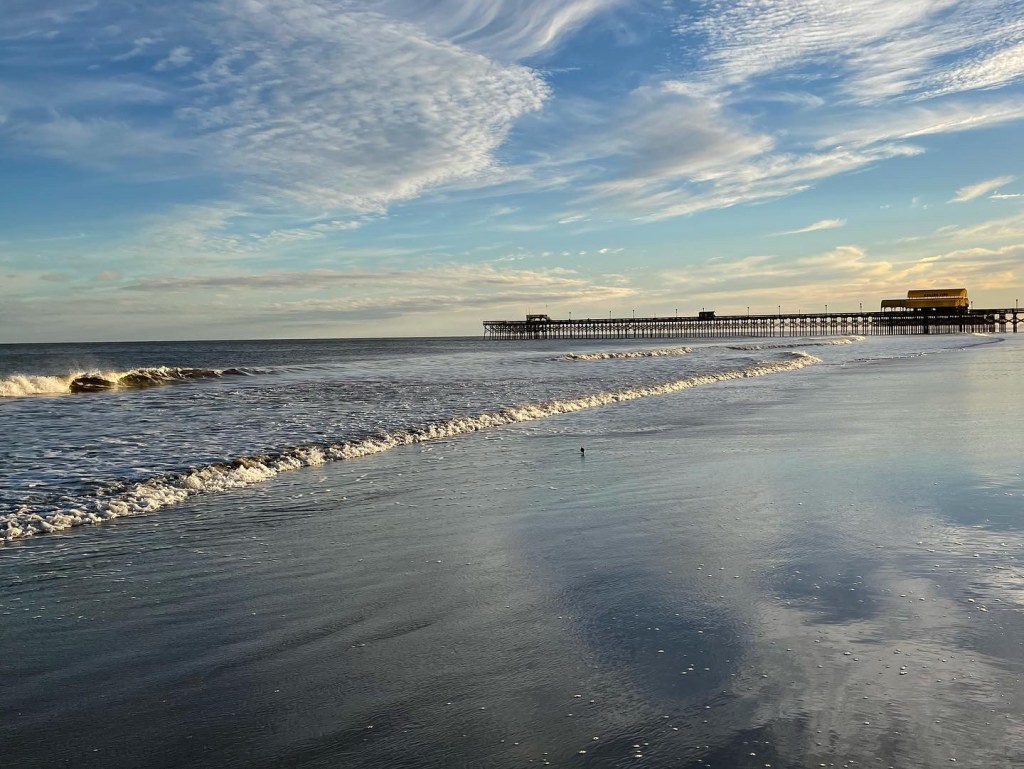
    There might not be a more aptly-named city than Oceanside, California. Tightly hugging the Pacific Ocean on it’s western edge, pristine waves roll to shore and create the perfect conditions for surfers. When you walk out onto the 1,942 foot long city pier you feel like you’re out there with the surfers bobbing in the waves. In fact, when you reach the surfers you’re only halfway out to the end.

    Camp Pendleton is right next to Oceanside, and the two are forever associated with each other. The US Marines train at Camp Pendleton and I know several people who came here to train before being deployed elsewhere. As neighbors, Oceanside is a military town and you see it in the stores that cater to the Marines, and especially in the barber shops with their rows of chairs ready for customers on leave. The city is changing as more and more people are attracted to this place, but this will be a military town as long as the Marines stay next door.

    While the military vibe is tangible, Oceanside’s other neighbor is the Pacific, and it dominates the conversation of identity. Health, fitness and outdoor living are also a vibe here. There’s a surfing museum of note here, and surfers dot the water on either side of the pier. Oceanside hosts an Ironman Triathlon and they were set up for it during my visit. Walking around you find a cool vibe, exceptional dining options and friendly, fit people.

    I have a friend who moved to Oceanside, prompting a visit to see him and linger in town for a couple of hours. I can see that the place has transformed him into a happier, healthier person. Walking around in this pristine city I can see exactly how he got there. And sure, it’s easy to imagine living here too. This place where every day is paradise seems pretty tempting indeed.

  • Morro Rock

    When you’ve driven down the coast of California you’ve seen plenty of rocks in the water, and Morro Rock might be considered one more in a string of them. And yet it’s different from the rest. There’s a presence emanating from this big boulder that attracts you to it. Two Native American tribes, the Chumash and the Salinan, thought of the tock as sacred. Explorers mentioned it as a landmark, and it does jump out at you from miles away.

    Like most of nature, white settlers thought of it differently. When you call something a “natural resource” it somehow gives you license to put it through indignities or use it up entirely. It was quarried for a time, until the community saw it’s value more clearly and protected it. But rather than make it a centerpiece of a larger park someone else had the idea to stick a huge three stack power plant in front of it. I’m sure my timelines are off, but each of these things clearly happened.

    Despite all that, there’s a nice beach and access to the base of Morro Rock. It still has something to say. I think maybe it’s “leave me alone, I’ve had enough of you’.

  • Pacific Coast Highway

    “We do not associate the idea of antiquity with the ocean, nor wonder how it looked a thousand years ago, as we do of the land, for it was equally wild and unfathomable always.” – Henry David Thoreau

    I’m an East Coast guy. California is another world when you live with ice and snow and sunrises as your standards. You imagine what a place might be like when you’ve never been to it but hear of it often. It becomes the stuff of legend. Driving the Pacific Coast Highway and visiting Monterey and Big Sur became such a legend for me. And the experience lived up to its billing.

    When you look out at the Pacific Ocean for a few hours, and the rugged, mountainous terrain this highway snakes through, you feel the truth in Thoreau’s words. But for the highway itself and a few scattered houses and ranches this view hasn’t changed much in millennia. And unless it all tumbles into the sea it ought to look the same for another millennium. We’re just rolling footnotes passing through the eternal. The Pacific Coast Highway sets you straight about such things.

    Starting our drive from the dunes of Marin, we drove Ocean View Boulevard to Sunset Drive, making our way to pay the $10.75 entry fee for access to 17 Mile Drive. It was worth the price of admission, particularly with the big waves rolling in as remnants of a stormy ocean. Officially, 17 Mile Drive has 17 landmarks to view (all mapped for you when you pay to enter). Unofficially, the glimpses of the homes of the ultra-wealthy and a drive by Pebble Beach Golf Links are a big part of the draw.

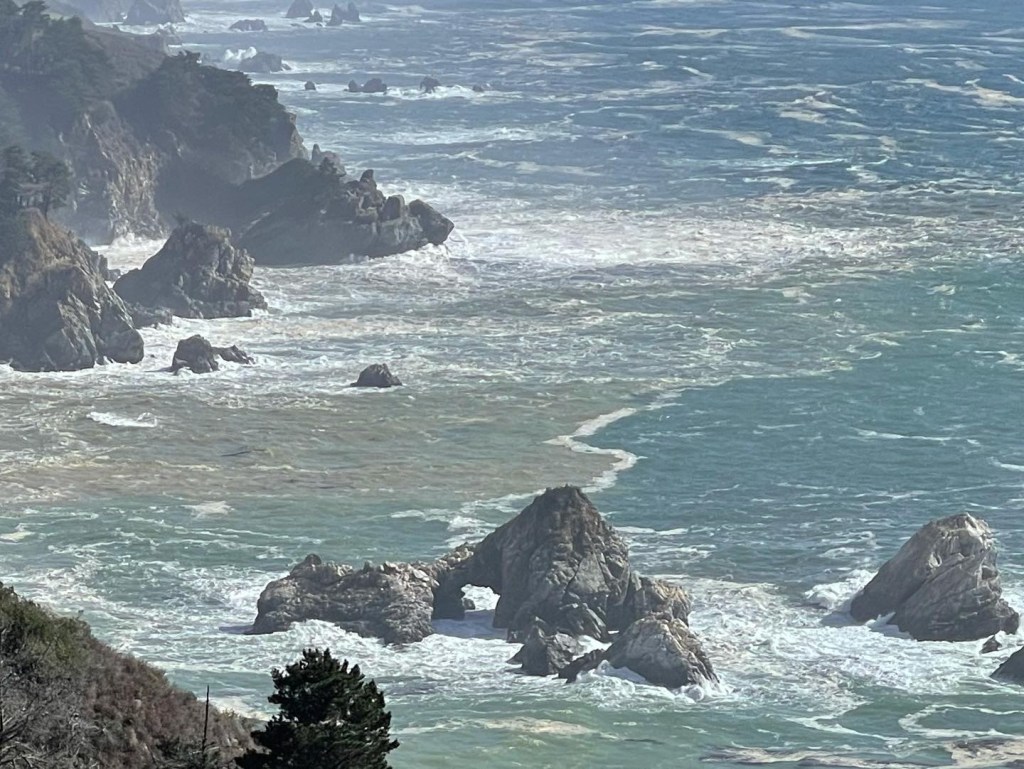
    A quick visit (checking of the box) in Carmel and we were off to Big Sur. This is where cellular coverage all but disappeared and you put your trust in fate. There are hundreds of turn-offs you can pull over into and several larger scenic vista parking areas. The toughest places to find elbow room were Bixby Bridge and McWay Falls. Each offer that postcard or Instagram worthy image. The trick is to find an image that’s unique without putting yourself in peril. Sometimes the perfect picture is the one everyone else took too.

    The rest was simply breathtaking views and an appropriate focus on keeping the car on the road. Every turn brought another stunning view, and at some point you stop taking pictures of waves crashing onto massive boulders and cliffs and simply enjoy the drive. The Pacific Coast Highway is an embarrassment of riches in its beauty and a national treasure. Make sure you have a full tank and the time to enjoy this experience.

  • Finding Relative Quiet at Muir Woods

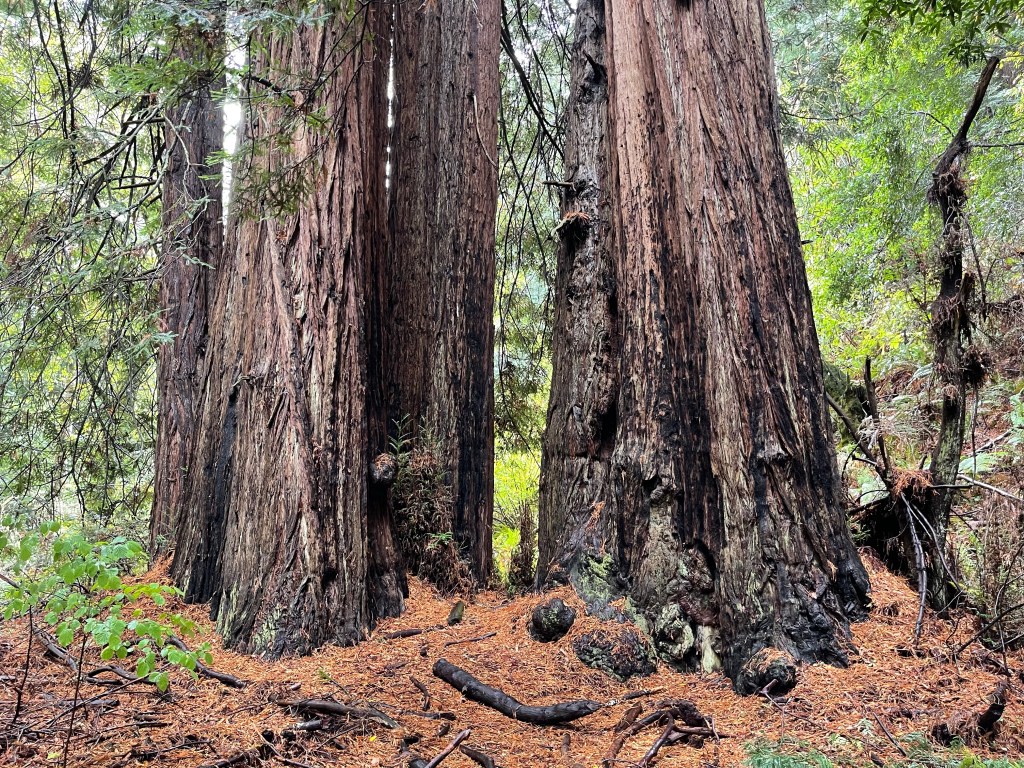
    Taking a long, slow walk amongst the Redwoods in Muir Woods, I deliberately slowed down, lingered, and sometimes stood still to feel the forest. Looking straight up I watched water drops formed in the tree tops from the light mist fall a few hundred feet. There are trees here that have stood here for more than a thousand years, my visit was just one blip in their lifespan. And here I found what I’d been looking for, what I’d hoped I’d find on this twisting drive through the hills. Here were the ancient forests of my imagination.

    Seeking quiet, reverent space amongst the giants is tricky business if you only stay on the main path. No matter how much signage they put up, tourists chat like they’re at the mall, oblivious to the glorious silence. You must go there expecting this careless chatter, but you don’t have to participate in it. The best option for silence is to take the paths less taken, and Muir Woods offers these opportunities. Take any trail that scares the masses – be it mud or the promise of exertion or even a dead end sign and you quickly find yourself in relative quiet.

    There are other old growth redwood forests, not enough of them we might agree, but they’re out there as state and national parks throughout the region. These offer more opportunities for isolation. Muir Woods is both the most famous and the most crowded. The trees won’t ever disappoint you, but your fellow man might.

    If we lost all the money we have and saved these trees, it would be worthwhile, wouldn’t it?” – William Kent

    William Kent purchased this land and fended off those who planned to log the redwoods to rebuild San Francisco after the 1906 earthquake and then flood the valley as a reservoir. He might have named it after himself but chose to honor John Muir. Modest? No doubt, but there’s an element of brand recognition at work here too. Since 1908, the Muir Woods National Monument has stood as protected land, surely thrilling Kent and those who worked so hard to save the trees, and capturing the imagination of reverent pilgrims ever since.

    If you visit, make a parking reservation well in advance. Go as early as possible to avoid the worst of the crowds. Wear appropriate footwear for hiking the side trails. And save the casual conversation for later. For you’ll have plenty to talk about.

  • A Visit to Alcatraz

    The first thing you notice about Alcatraz is how small it is compared to that image in your mind. If you’re ever met a celebrity you find most of them are smaller in real life. It’s the same with this place. The Rock became famous, and like any other celebrity you come to terms with the stories in your head when you meet one.

    I don’t celebrate the lives of murderers and con men. They were put here for a reason, and it’s not for things that should be celebrated. For me, Alcatraz was a curiosity, an island front and center in the middle of San Francisco Bay that offers stunning views back towards the city, the bridges and the beautiful natural world that surrounds you when you’re standing on it.

    Jail cells and all that aside, the island was once a fort that utilized that commanding position in the harbor as a key defensive position. Eventually military prisoners were incarcerated on the island and it grew from there into a federal prison. It reminded me of Edinburgh Castle, both with reputations for strength, both at turns a fort and prison, both requiring steep ascents to get to the top. They put these places where they were for a reason.

    The Alcatraz tour itself is a downloadable app that you listen to on your phone. You can still borrow the headphones but most people seem to prefer the app. It detects when you remove the phone from your ear so you aren’t missing the story while taking pictures with your phone. The drawback to this is dozens if people walking in every direction with their phones pressed to their ears like Christmas Eve shoppers in a crowded mall. So I was happy to complete the official tour and wander around the island. And that’s where the real magic was.

    The gardens of Alcatraz are beautiful, diverse landscapes in a unique microclimate. Old foundations form neat garden walls, and the wall tops themselves became long rows of planters. Plants ranged from agave to fuchsia to a showstopper, Pride of Madeira, each set against a beautiful water view. The gardens made the trip for me, making Alcatraz more than a rock in the bay with a few stories.

    I confess I wasn’t excited about going to Alcatraz, but I’m glad I did. It rounds out the history of this place when you’re standing on it. That story is a little dark, but also more beautiful than I gave it credit for. But isn’t that what travel does for you? It changes perceptions, one visit at a time.

    Defensive map of San Francisco Bay
    Pride of Madeira
    Fuchsia
  • A Visit with Andrew Carnegie

    “The man who dies rich dies in disgrace.” – Andrew Carnegie

    Andrew Carnegie was born into poverty, turned steel into gold and then gave away 90% of his fortune in the last 18 years of his life. Of all the places in the world he could spend eternity, he chose the Sleepy Hollow Cemetery. I wonder at such things – why here? Why not his beloved Scotland? Why not Lenox, Massachusetts, where he spent his last couple of years? The only way to know is to visit the place.

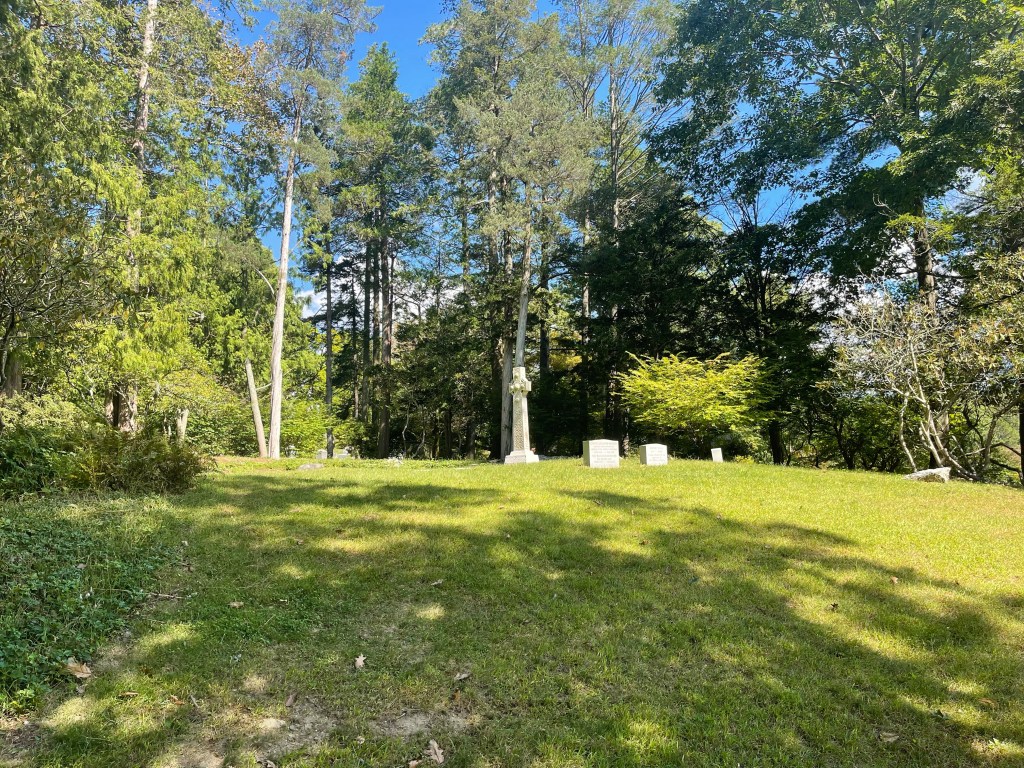
    Walking around you realize that Sleepy Hollow is a beautiful spot, and likely was peaceful once, before cars and sirens and encroaching development squeezed the solitude right out of the place. But deep in the heart of the cemetery, way up on the hill, you find it grows relatively still, even now. And this is where you’ll find Carnegie.

    Looking around at the grand celebrations of wealth displayed in death at Sleepy Hollow (You see? I mattered!) I was struck by the simple and beautiful Celtic Cross gravestone rising amongst the trees at Andrew Carnegie’s burial plot. Granite ledge behind him and a gentle sloping hill in front. Peace.

    Wealth bought him elbow room in death, and wisdom guided him to use it in the most simple, dignified way. I should think he made a point of being placed at arms length from the wealthy posers of the day. He was especially good at calling them out for what they were:

    “There is no class as pitiably wretched as that which possesses money and nothing else.”

    I’m not particularly interested in being buried in one spot. I think I’d rather have my ashes scattered to the winds and sea – to be an eternal traveller in this world. But I see the value of having a place where people can visit you, as I visited Carnegie this week.

    Carnegie became larger than life when he gave away his fortune before death. That Celtic Cross serves as a compass in his absence, pointing the way for the generations who followed him. Quietly reminding us to do enough in our life that others might want to invest a bit of their own brief lives to visit you long after your gone.

    Simplicity and elbow room at Andrew Carnegie’s final resting place.
  • Visiting a Legend in Sleepy Hollow

    “To look upon its grass grown yard, where the sunbeams seem to sleep so quietly, one would think that there at least the dead might rest in peace.” – Washington Irving, The Legend of Sleepy Hollow

    There are two Sleepy Hollow Cemeteries of note. There’s the one up in Concord, Massachusetts with it’s Author’s Ridge populated with the bones of Thoreau, Emerson, Alcott and others. And then there’s the one here on the shores of the Hudson River, where the wealthy vacated the city for one last time and tried to one-up each other in death with grand mausoleums as their final statement about how rich and powerful they were.

    Those rich folks can wait in their eternity. For there’s really only one name that matters when you talk about Sleepy Hollow, the guy who put it on the map: Washington Irving. Irving wrote two of the most familiar short stories in our cultural memory: The Legend of Sleepy Hollow and Rip Van Winkle.

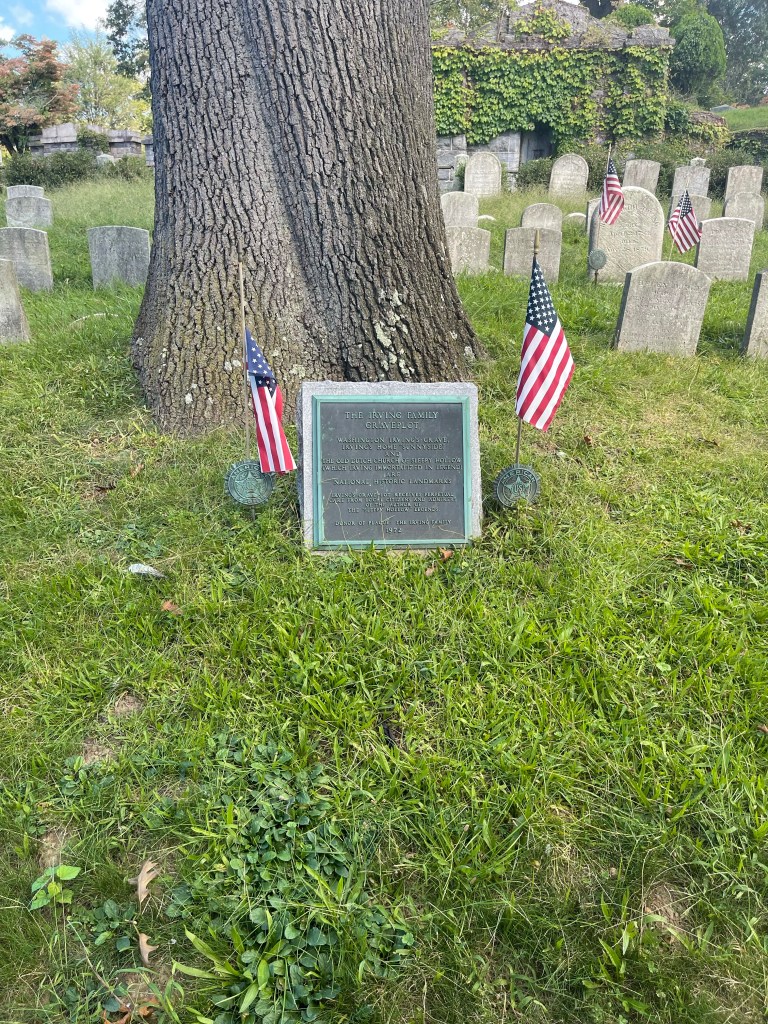
    It’s that tale of the headless horseman that inspires people to visit his grave at the Sleepy Hollow Cemetery. Irving is buried in the oldest section of the graveyard, with unpaved roads crisscrossing un-mowed plots with headstones protruding up in neat columns. That walk up the hill to visit his grave seemed perfect. Like walking back in time to visit those who came before us.

    I didn’t visit out of some ghoulish fascination with his short story, but for the whispers you hear at their resting place. Cemeteries generally hold the lay of the land as it was on the day they buried someone, and Irving’s resting place nestled amongst his family on a hill overlooking the Hudson River Valley seems a lovely place to spend eternity.

    Of course, Irving doesn’t need to whisper, for he wrote plenty for us to draw on. His stories will likely outlast every gravestone in Sleepy Hollow. Does that make him a legend?

  • More Than Just Names

    Sleeping beauty awakes from her dream
    With her lover’s kiss on her lips
    Your kiss was taken from me
    Now all I have is this
    – Bruce Springsteen, Countin’ On A Miracle

    Twenty years. I’m still here, just as I was that day, but everything has changed. What seemed important on the morning of September 11, 2001 disappeared from my mind when I heard Howard Stern, of all people, explaining what was happening at that moment in New York as I drove to a job that would be impossible to focus on for a long time afterwards.

    The world has changed since 9/11. We’ve all grown hardened by violence and war and angry rhetoric. It was our generation’s Pearl Harbor, and we were ready to lash out at all who would assault us so boldly. In so many ways we’re still lashing out, but much of it has turned inward. That unified country in the days after 9/11 is far from it now.

    We all felt the impact of that day, but nobody felt it more than the families and friends of those who died that day. Bruce Springsteen wrote the album The Rising shortly after 9/11. The lyrics quoted above resonate more for me than any other, representing all that was taken from so many that day. And it plays in my head now, twenty years after that day. As the bells ring in remembrance. And the names, so many names, are spoken one after another.

    During the Super Bowl in 2002, just months after 9/11, U2 performed as the halftime show. They sang MLK and Where The Streets Have No Name with a white banner scrolling the names of those lost on 9/11. I still can’t watch it without getting choked up, and I dismiss anyone who might venture to declare any other performance at a Super Bowl as more powerful or significant.

    These songs will always be my 9/11 soundtrack. They remind us that these were more than just names. They are lives interrupted.

  • The Force of Bitter Need

    First he chipped fire
    Out of the veins of flint where it was hidden;
    Then rivers felt his skiffs of the light alder;
    Then sailors counted up the stars and named them:
    Pleiades, Hyades, and the Pole Star;
    Then were discovered ways to take wild things.
    In snares, or hunt them with the circling pack;
    And how to whip a stream with casting nets,
    Or draw the deep-sea fisherman’s cordage up;
    And then the use of steel and the shrieking saw;
    Then various crafts. All things were overcome
    By labor and by force of bitter need.
    – Passages from Virgil’s First Georgic, translation by Robert Fitzgerald

    When you read something like this, what does it do to you? Most of us won’t ever experience the life or death struggles that our ancestors faced. Yet the force of bitter need echoes in how we live our lives today. As a student of history, it’s easy to treat the migration of humans across the globe as an academic exercise. To treat wars and conflict and the enslavement and genocide of large swaths of people as horrible footnotes in history. But the stories we tell ourselves that keep the world in order is all so very fragile.

    This translation of Virgil is breathtaking to me, because it reveals our shared history, our overcoming of things, to survive another day and maybe build off that to create a generation after us to keep things going. Our human story is one of deep struggle, pain and labor. Of surviving despite the deck stacked against us. May we never forget how all that we’ve overcome as humans has shaped us. And shapes us still.