Category: History

  • The Cold Water Initiation

    “Though it be the hottest day in July on land, and the voyage is to last but four hours, take your thickest clothes with you, for you are about to float over melted icebergs.” – Henry David Thoreau, Cape Cod

    The stretch of water between Cape Sable Island in Nova Scotia and Cape Cod in Massachusetts is known as the Gulf of Maine. A lot of history has floated between these two points, from Native Americans and later the Basque fishing and whaling these rich and vibrant waters to explorers like Giovanni da Verrazzano and Samuel de Champlain mapping the coast and looking for places for settlements. The Gulf of Maine remains the one constant that each would recognize, though they might wonder where all the fish went until they glance back at the developed shoreline.

    In 1604 Champlain ventured south from Port Royal to explore the coast of Maine. It was on this trip that he discovered Acadia, and further south, the “baye longue” between two capes and a long stretch of sand beaches on the present coast of New Hampshire.” (David Hackett Fischer, Champlain’s Dream. It’s on these beaches that generations of New Englanders and vacationing Canadians have discovered the truth in Thoreau’s words: this water is as cold as melted icebergs!

    Cold water gets in your blood, and you don’t celebrate it so much as accept it for what it is: a shocking reminder of how insignificant we really are. The Atlantic Ocean is divided into the Northern Atlantic and the Southern Atlantic, but really, there are divisions within divisions. A swim in Miami is not the same as a swim in Virginia, and a swim in the Hamptons on Long Island is definitely not the same as a swim at Hampton Beach in New Hampshire.

    You aren’t really a New Englander until you’ve taken the plunge into the Gulf of Maine on a hot day. It’s an initiation of sorts into the extremes. There isn’t a person who swam in early July at Hampton Beach who couldn’t relate to the bobbing passengers at the end of Titanic. The cold water hardens you, tests your mettle, and reminds you of your mortality. And that’s why I’ve grown to love a bracingly cold swim now and then. That stinging skin is a shocking reminder that you’re still very much alive… if a bit numb.

  • En Passant, Knowing Your Place and Breaking Rules

    I once got in a debate with my grandfather about the rules of chess. Specifically, he would execute En Passant when I would attempt to move past his advancing pawn. At the time I thought I knew the rules of chess, but it seems I’d never fully grasped the rules the pawn plays by. It wasn’t until I took the time to learn chess at a deeper level that I realized he was right all along. And I can see him winking at me in my mind.

    For those who don’t play the game, a pawn may advance one square forward, can’t move past a piece that blocks its forward advance until that piece moves and may capture another piece diagonally forward only. Simple. And then they added another rule to help speed up the game a bit, allowing you to move every pawn two squares forward on its initial move only. Well, this created a problem as well, for if an opponent’s pawn had advanced to a point where your move two squares forward eliminated their ability to capture your pawn in it’s forward diagonal move, you were essentially stealing the already limited power from the opponent’s pawn.

    En Passant, French for “in passing“, is a rule that allows the opponent to say “not so fast!” (Well, really they would say “en passant“) and execute the move of putting their pawn onto your square where your recently deceased pawn had once been. It’s a way of telling you not to get too far ahead of yourself or you’ll pay the consequences.

    And there lies the dark side to En Passant: It’s reminding the pawns of the world to know their place, to not get ahead of themselves or they’ll suffer the consequences. En Passant was invented long before democracy, and pawns generally knew their place and skated their lanes. The bold were snuffed out if they went a step too far.

    In democratic societies we chafe at being pawns, and the bold among us do leap forward. The rules of law can still remind you you’re a pawn if you grow reckless, but mostly it’s other pawns telling you not to stick your neck out. And worse, En Passant largely resides in our own minds: Imposter syndrome, timidity, and fear of the unknown keep us skating in our own lane, one square at a time, while the big players in the world spin around us.

    A pawn that plays by the rules may advance forward diligently and become a queen or any player it wants should it reach the end. There’s a subtle message there too, and you look around and most people play that game. Skate your lane, reach the end and retire… Fine, I suppose, but a little less sparkle for your time on the board, don’t you think?

    No, there’s a place for boldness in this world. We are each in passing here for a very brief time. En Passant only applies to pawns, after all. And who said you had to be a pawn anyway?

  • Awaiting Discovery

    “It is remarkable that men do not sail the sea with more expectation. Nothing remarkable was ever accomplished in a prosaic mood. The heroes and discoverers have found true more than was previously believed, only when they were expecting and dreaming of something more than their contemporaries dreamed of, or even themselves discovered, that is, when they were in a frame of mind fitted to behold the truth. Referred to the world’s standard, they are always insane.” – Henry David Thoreau, Cape Cod

    This is a year of the commonplace and unromantic if you let it be.  Lockdowns and border closings and mandatory quarantines tend to temper the passions of the high agency traveler.  But then again, if you keep your expectations and dreams focused on regional adventuring until things open up again you might just find the world under your nose.

    Yesterday I watched a bobcat, set against the snow, on the hunt.  It was slinking along the edge of the forest where the fence announces wilderness begins.  I expect it was attracted to the bird feeder activity, for there were squirrels and juicy birds for the taking for the ambitious hunter.  Unlike my snowshoe hare encounter I wasn’t prepared for a picture, and I settled for locking her image in my brain.

    Leaving Cape Cod the other day I stopped to fill up the tank and, glancing up, noticed 9-10 osprey hovering in the wind, all clustered together.  I’ve never seen so many osprey flying together, and there they were right above me gliding gracefully about.  By the time I finished fueling the car the osprey had drifted away to awe others elsewhere, but damn if they didn’t capture my imagination first.

    For all his fame as a transcendentalist and beholder of truths, Thoreau didn’t travel very much in his lifetime.  He spent most of his lifetime in Concord, Massachusetts, with notable trips to Cape Cod, up the Concord and Merrimack Rivers to the White Mountains, to the Maine woods, and one solitary trip across an international border when he visited Quebec.  And yet he saw more than most people who travel far beyond the northeast corner of North America.

    There’s light at the end of the pandemic, though we remain in a dark and treacherous tunnel.  This isn’t the time to cross borders, but the world outside our Twitter feed remains vibrant and alive, awaiting discovery.  The bobcat,  osprey and Thoreau have each inspired me to shake off the creeping prosaic mood that shorter, darker days cloak you in and dive back into adventuring.

    Et toi?  Are you ready to re-join the hunt?  Nothing remarkable was ever accomplished in a prosaic mood.

  • Halifax Christmas Tree

    If you live in Boston or Halifax you likely know Boston’s Christmas tree is an annual gift from Halifax. Since 1971 Halifax has sent a tree to Boston. Fifty years of tree giving. This isn’t inconsequential. The cost of transporting a tree 700 miles to Boston surely add up. So why make the commitment at all? The story behind that tradition is lesser known.

    In 1917, at the height of World War One, a French ship named the SS Mont Blanc was loaded with munitions and set out from Halifax Harbor for Europe. The ship would never leave Halifax. She collided with another ship in the narrows and caught on fire. When the fire reached the munitions there was a massive explosion that wiped out part of Halifax, killing over 2000 people and injuring another 9000. At the time it was the largest manmade explosion in history. And it occurred in a heavily populated area.

    When Boston’s Mayor Curley heard about the tragedy, he immediately sent a group of doctors and nurses to aid Halifax with medical supplies. Boston’s response was actually significantly faster that Ottawa’s. The team of doctors and nurses spent Christmas 1917 in Halifax, decorating Christmas trees in the hospitals. The bond between Halifax and Boston was forever fused.

    The connection between the two cities goes beyond Christmas trees: Halifax broadcasts Boston’s WCVB and also has a large following of Red Sox and Patriots fans as the games are broadcast there. And then there’s family connections. Since the Port of Halifax was the Ellis Island of Canada, many New Englanders are descendants of immigrants who came through Nova Scotia. The bond is indeed deep.

    In 1971, within the lifetimes of many of the people who lived through that tragedy, Halifax began donating a tree every year. I bet there were several survivors of the explosion who shed a few tears the day that first tree was shipped to Boston. Boston remembered as well, and the tree serves as a reminder of the common bond between the two cities. Today is the lighting of the Christmas tree in Boston, and we turn our eyes north to our friends in Halifax.

    The pandemic has closed borders, blocking access to people and places we took for granted. With the border closed even the Christmas tree took a unique route to Boston in 2020: It was shipped from Halifax to Portland, Maine and then driven down the rest of the way. Many of us look forward to having the borders open again so that we may once again see our friends and kin up north.

  • From Asquamchumauke to Baker: What’s in a Name?

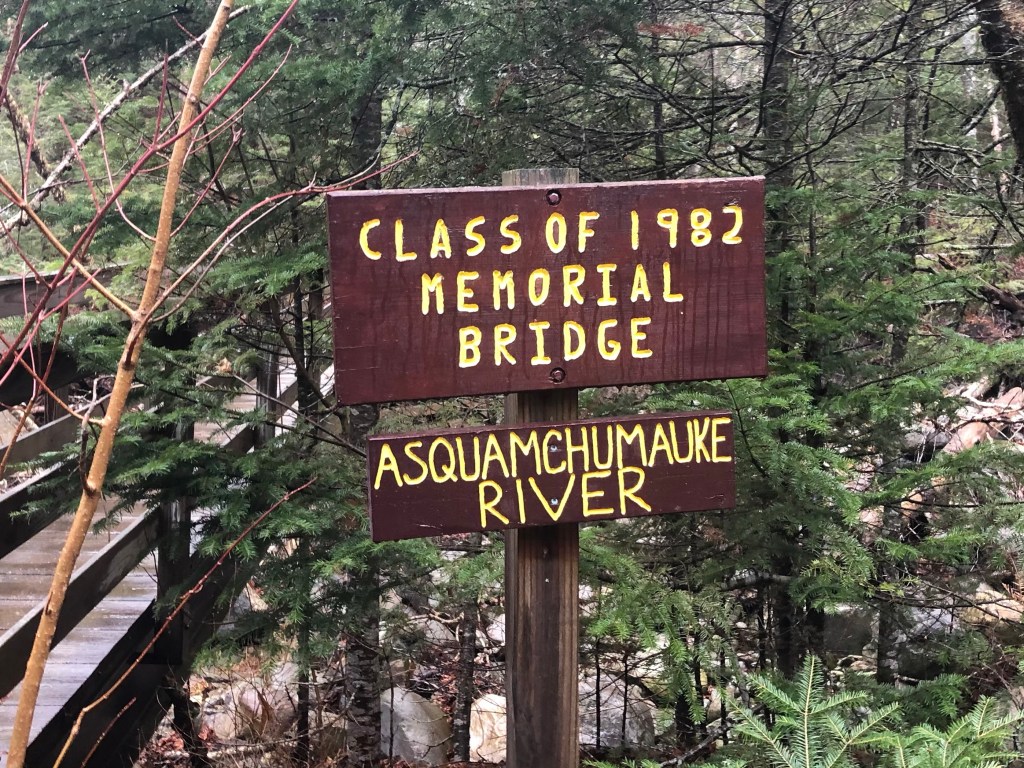
    The Baker River flows from Mount Moosilauke to the Pemigewasset River in present day Plymouth, New Hampshire. On the map the name is cut and dried: Baker. But when you cross the river at the Gorge Brook Trailhead another name emerges from the past: Asquamchumauke. History once again whispering for all who might hear.

    Dartmouth College honoring the original name

    Asquamchumauke means “crooked water from high places” in the language of the Abenaki tribes that once thrived here. It’s a lovely, descriptive name that brings romantic notions of Native Americans living in this place for generations. Yet we’ve called it Baker since well before the American Revolution. The story behind the name change is another fascinating chapter in the violent history of New Hampshire.

    Thomas Baker was a soldier in Deerfield, Massachusetts on February 29, 1704 when the Deerfield Raid occurred. Deerfield was a seminal event in Queen Anne’s War and New England history. French and Native American warriors overran the fortified settlement, 47 settlers were killed and 112 captives, including Baker, were marched up to Montreal. The Native American warriors came from around the northeast, including several tribes of the Wabenaki Confederacy. One of them was a Pennacook sachem named Wattanumman.

    Whether Baker and Wattanumman met during the fighting or forced march to Montreal is unclear, but events would bring them together again eight years later. Thomas Baker led an expedition north with around 30 men and ambushed Wattanumman, a dozen of his men and their families at the site in present-day Plymouth where the Asquamchumauke River meets the Pemigewasset River. Wattanumman and several others were killed and scalped. The men collected furs and anything of value and brought it all down to Massachusetts where Baker was rewarded for his efforts with £40.

    And this is where present-day morality meets the violent frontier morality of New England in the earliest days of our history. Both men participated in violent raids against the other in a time of war. But for fate Baker might have been killed in Deerfield, which may have extended Wattanumman’s life a few more years. Who knows? All of us are subject to the whims of fate.

    There was one other reward for Thomas. To honor what Baker and his men did in this place the name of the river was changed from Asquamchumauke to Baker, a name it still has today. With one event the life of Wattanumman was erased, and the legacy of Baker was sealed. We Americans tend to honor people with place names, while the Native Americans honored the spirit of the place itself. Asquamchumauke: crooked water from high places.

    Has a nice ring to it.

  • Norumbega

    “Not on Penobscot’s wooded bank the spires
    Of the sought City rose, nor yet beside
    The winding Charles, nor where the daily tide
    Of Naumkeag’s haven rises and retires,
    The vision tarried; but somewhere we knew 5
    The beautiful gates must open to our quest,
    Somewhere that marvellous City of the West
    Would lift its towers and palace domes in view,
    And, lo! at last its mystery is made known—
    Its only dwellers maidens fair and young, 10
    Its Princess such as England’s Laureate sung;
    And safe from capture, save by love alone,
    It lends its beauty to the lake’s green shore,
    And Norumbega is a myth no more.”
    – John Greenleaf Whittier, Norumbega Hall

    Norumbega; the mythical city of gold in the northeast corner of North America. The name most people today have never heard of. But you see hints of it to this day if you look around enough. around the Wellesley and Newton, Massachusetts area. This poem above was from the dedication of the huge building that was College Hall at Wellesley College, which say on Norumbega Hill until it burned down in 1914. There never was a city of gold in the northeast, but the legend lives on anyway.

    The name became associated with this place we now call New England, but this place could easily still be Norumbega if the French had been more successful in their first interactions with the Native American population living in New England at the time. But the French Commander Jean de Poutrincourt was afraid of the Native Americans, and they in turn deeply distrusted him. Conflict and a hasty retreat north of the Penobscot River, and an opportunity lost. Instead they left an opening for the English. In 1620 Pilgrims arrived, found the local population decimated by disease likely from interactions with other Europeans, and settled into our familiar narrative about New England.

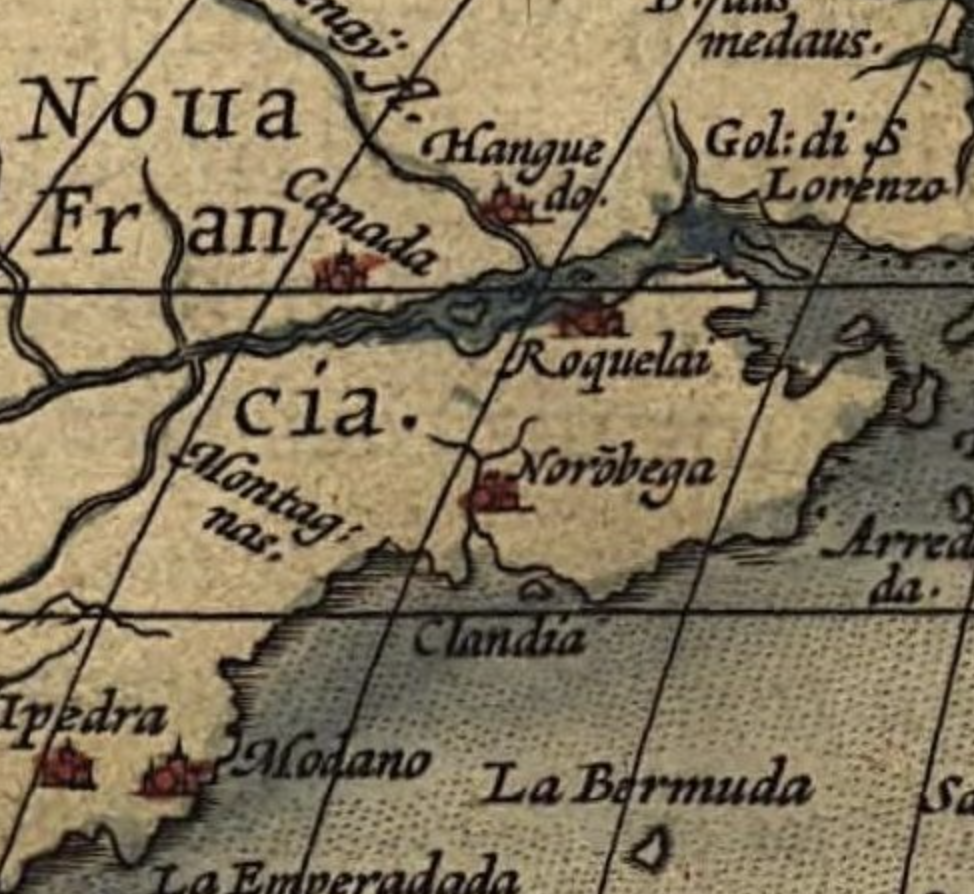
    The name preceded the French. Norumbega appeared on maps by a couple of Dutch cartographers, who situated this lost city of gold south of New France but north of Florida. Maps weren’t especially detailed back in the 1500’s. Abraham Ortelius published his famous Typus Orbis Terrarum in 1570, which shows far greater detail in the areas Spain had conquered than in the northern half of the Americas. But there’s Norumbega, tantalizingly real on a map, ready for the taking by some enterprising conquering nation (the Native American population apparently not a strong consideration).

    Norumbega, depicted in the 1570 Ortelius Map

    Cornelielius van Wetfliet seemingly had Norumbega situated where present-day Washington, DC in his 1597 atlas that, at the time, was the most detailed map of the northeastern coast of North America. But Norumbega was generally accepted to be far north of the Potomac, perhaps the Hudson River but most say it was either the Charles River or the Penobscot River. When you don’t really know the lay of the land you mush it all together into a general blob. Such were the early maps of North America.

    So, since the mythical city of gold in the northeast never really existed, Norumbega became the general place name for New England for a time. That time ended when the English put a stake in the ground at Plymouth Colony in Massachusetts and the eventual settlement of what would be called New England. By the time my old friend Alexander’s map was published in 1624 the place was firmly established as New England, and Norumbega faded into history like the people who lived and explored this place long before the Mayflower set sail. But pull back the covers of history and there it is: mythical, elusive, fascinating. Norumbega is a myth no more

  • November and the Ninth Wave

    “November retained its name (from the Latin novem meaning “nine”) when January and February were added to the Roman calendar.” – Wikipedia

    And there it is: November. I’ve wondered about October before. I mean, “octo” is eight yet October was the tenth month. I hadn’t thought much about the origin of November until I stared at the November 1 on my calendar a beat longer than normal. And so here we are, with “novem” forever associated with nine for me. (novem ≠ 11, novem = 9, but November is the 11th month so deal with it. Don’t even get me started on December). We learn through association. Those Romans forever shaped the minutia of our world…

    November has always had a special place in my heart, for in the Northern Hemisphere its the month of quiet walks on crunchy fallen leaves, when the world opens up to reveal all that was hidden previously by foliage. In the United States November is associated with Thanksgiving, the very best of holidays (at least in my family) because it’s only about giving thanks together with family and friends. There are November birthdays of note in the family, and personally, one very notable anniversary coming up in a few days to punctuate the importance of the month in this household.

    And then there’s the election. Every four years in the United States we have the national election to choose our President. The “first Tuesday after the first Monday” of November was chosen and made into law in 1845 “to establish a uniform time for holding elections for electors of President and Vice President in all the States of the Union.” So Election Day can never be held on November 1, since it must follow the first Monday (unless the law is changed of course).

    This year has been relentlessly charging along, both rapid in the spinning of days and painfully slow in getting it all over with. Nobody who loves life wishes away time, but we all wish away the current situation we find ourselves in. November marks the moment when we vote and either validate the current administration or reject it wholeheartedly and install new leadership. I know where my vote goes. Choose wisely with your own vote, fellow citizens.

    In sailing the ninth wave in succession is the largest. It’s the one that might sink the ship and drown the crew. I reflect back on the stunning masterpiece Ninth Wave by Ivan Aivazovsky that I was blessed to see once in my lifetime. The Ninth Wave offers a glimmer of hope for those clinging to the mast in a raging sea. The sun is rising through the storm, marking a turning point of sorts. Danger remains all around and there’s no guarantee of survival, but again, there’s hope. And that’s what I think about on this first day of November. November (novem), marks the turning of the seasons towards winter. Change is coming. We all know it, and now we all face it. With hope.

  • Calm

    “Real power is not in momentary desires, but in complete calmness.” – Leo Tolstoy

    I have a bit of nervous energy as I write this. I’m traveling tomorrow for the first time in seven months and there’s a vibrating exhilaration deep inside knowing that I’m getting on a plane again, going to another state and driving around to places new to me. Mind you, its not like I’m flying to Antarctica for an extended climate change study, I’m going to Cleveland. I’ve been to Cleveland at least a half dozen times that I can recall and maybe a time or two beyond that. But it’s travel in a time of no travel, and this year that alone creates a buzz.

    I got the same vibration hiking solo up Mount Tecumseh earlier this summer. Not because it was a particularly challenging hike, but because I was hiking it alone late in the day. Just enough risk to raise the level of uncertainty, but calculated risk. Hiking alone at night inherently offers risk to the hiker. You just don’t have people walking by you to offer assistance. So you take extra care or alternatively, you charge ahead brazenly challenging fate.

    Calmness in the face of potential stressors is a superpower. In an age of talking heads stirring the pot of anxiety for advantage, of a pandemic ramping up for killing season, of a time when we teeter on the brink of a deeper recession or a depression and irreversible climate change should we get this wrong, in this time the calm prevail. We can take the bait and react, or swim calmly in the present storm.

    “Do not be concerned too much with what will happen. Everything that happens will be good and useful for you.” – Epictetus

    The posters used early on during the Blitz, “Keep Calm and Carry On” naturally come to mind. Those posters weren’t successful at the time as people viewed them as patronizing, but the expression has exploded in popularity in the last twenty years. Whether you view it as patronizing or nostalgic now, the expression does carry weight as a stoic reminder to keep your head about you. For in calmness we find clarity.

    During that time when the British were facing down Nazi aggression, Viktor Frankl was living a nightmare in a succession of Nazi prison camps, ending at Auschwitz before finally being freed at the end of the war. He observed that state of mind had a lot to do with who survived and who didn’t as much as the whim of fate. Some people were in the wrong place at the wrong time, but others just gave up in the face of hopelessness and horror. Some people survived simply because they had a purpose for living. Based on this experience, he wrote the extraordinary book Man’s Search for Meaning after the war.

    “Everything can be taken from a man but one thing: the last of the human freedoms – to choose one’s attitude in any given set of circumstances, to choose one’s own way.”
    – Viktor Frankl, Man’s Search for Meaning

    Today we live in a time when everything is hyper-scrutinized, everything is a perceived affront, everything is designed to invoke a spark of fear or outrage. But when we swim in our sea of calmness, we overcome the efforts of those who would inspire a follow or a like or another cycle of commercials before they tell you the rest of the story. A calm mind sees the truth in the world and in ourselves. It remains the best foundation for a life of purpose and happiness. Want to improve the state of world? Be calm. And yes; carry on.

  • The Work of Exploration

    “Filling the mind with illusions is not the way to carry out with honor the work of exploration.”
    – Samuel Champlain

    Champlain was a stickler for careful preparation and research. He wasn’t one to half-ass anything he did, especially when it came to sailing across an ocean to uncharted places. He learned from the failures of others, noting failures in leadership, failures in preparation, failures in aligning political alliances to have your back when you were away, and failures in the treatment of the Native American population. And he was disciplined in his resolve to be successful in his own exploration.

    When I think about Samuel Champlain, I think about the guy who famously explored the North American coast and more than anyone helped stake a flag of settlement for France. In New England we live in a culture that rightfully celebrates the arrival of the Pilgrims in America 400 years ago, surely a major turning point for the English settlement of North America, but let’s not forget those who came well before the Pilgrims. If the settlement of Plymouth was a comedy of errors and bad preparation, Champlain’s plan for exploration and settlement was meticulous.

    Champlain found a way to be an invited guest of the Spanish on a trip to their own empire, surveying and documenting the atrocities of the Spanish conquerers with the native population and with African slaves for gold, silver and pearls. He resolved to never duplicate the things he saw, and treated men with respect and honor in his own exploration. And he learned from the brutal religious wars of France between Catholics and Protestants as well, resolving to bring religious tolerance to his own settlement. Champlain wasn’t just ahead of his time, he was helping to pave the way to our time.

    I’ll return to Champlain again in future blogs, but for now I’m lingering on the quote that opens this post. A warning to not half-ass our own exploration. To be prepared and do the work necessary to put yourself in a position to not just survive, but thrive. This is true whether you’re starting a business, changing your career, working to finish a project before a deadline or planning that long hike. Filling the mind with illusions is not the way to carry out with honor the work of exploration. Be prepared, as the Marines would tell you. But don’t just prepare and dream of exploration either. Do the work of exploration too.

  • This is Not Us

    Watching the United States Presidential debate last night, I was struck by just how far over the edge we’ve fallen from “Presidential”. I’ve known this, as you have, but it was hammered home like an iron spike to the skull last night. And so I woke seeking inspiration from better men (so far) who have held the Presidency. And their words remind me we’re bigger than one man, but that we must rise up to remind ourselves and the current resident of the White House of that fact. This thing we saw last night? It’s a part of us, but on the whole the people of this country are good people who want to rise above the worst traits of humanity. Perhaps former Presidents might remind the current one that this is not who we are. This is not us. But then again, I suppose he won’t listen.

    “The basis of our political system is the right of the people to make and to alter their constitutions of government.” – George Washington

    “This country, with its institutions, belongs to the people who inhabit it. Whenever they shall grow weary of the existing government, they can exercise their constitutional right of amending it, or exercise their revolutionary right to overthrow it.” – Abraham Lincoln

    “The things that will destroy America are prosperity-at-any-price, peace-at-any-price, safety-first instead of duty-first, the love of soft living, and the get-rich-quick theory of life.” – Theodore Roosevelt

    “Many people are always saying the Presidency is too big a job for any one man. When I hear this assertion, I always try to point out that a single man must make the final decisions that affect the whole, but that proper organization brings to him only the questions and problems on which his decisions are needed. His own job is to be mentally prepared to make those decisions and then to be supported by an organization that will make sure they are carried out.” – Dwight D Eisenhower

    “No government ought to be without censors; and where the press is free no one ever will.” – Thomas Jefferson

    “Let us not seek the Republican answer or the Democratic answer, but the right answer. Let us not seek to fix the blame for the past. Let us accept our own responsibility for the future.” – John F Kennedy

    “John F. Kennedy was the victim of the hate that was a part of our country. It is a disease that occupies the minds of the few but brings danger to the many.” – Lyndon B Johnson

    “Government is instituted for the common good; for the protection, safety, prosperity, and happiness of the people; and not for profit, honor, or private interest of any one man, family, or class of men; therefore, the people alone have an incontestable, unalienable, and indefeasible right to institute government; and to reform, alter, or totally change the same, when their protection, safety, prosperity, and happiness require it.” – John Adams